
A portable generator in the 2200-watt class needs to balance three things perfectly: enough surge wattage to kick-start a fridge compressor or a well pump, inverter technology that keeps the sine wave clean enough for laptops and CPAP machines, and a noise floor low enough that your campsite neighbors don’t curse your name. The wrong choice leaves you with a machine that either stalls under load or drowns out conversation. This category demands precision — there is no margin for guesswork.
I’m Min — the co-founder and writer behind Gadgets Feed. I’ve spent countless hours cross-referencing engine displacement, THD percentages, decibel ratings, runtime curves, and real-world customer load-test data to separate marketing claims from actual performance in this narrow inverter generator niche.
best 2200 watt generator options deliver a specific sweet spot where portability meets genuine backup power for essentials like refrigerators, sump pumps, and sensitive electronics without the weight or noise of a full-frame unit.
How To Choose The Best 2200 Watt Generator
Not every generator in this power class is built the same. The difference between a unit that lasts a decade and one that fails mid-outage comes down to four specific areas you must evaluate before buying.
Rated vs. Surge Wattage — The Real Capacity
A generator rated at 2200 surge watts might only deliver 1800 running watts. That gap matters when your refrigerator’s compressor kicks on, a motor start-up can draw two to three times its running wattage for a split second. If the surge rating is too close to the load’s starting draw, the generator trips the breaker. Look for at least 2000 surge watts on any unit claiming 2200-watt peak performance to safely handle a 10,000 BTU air conditioner or a 1/2-horsepower sump pump.
Decibel Rating — The Neighbor Factor
Sound output in this class ranges from 48 dBA (whisper-quiet, conversation-level) to 66 dBA (loud enough to require ear protection over sustained periods). The decibel scale is logarithmic — every 3 dBA increase represents a doubling of sound energy. A unit rated at 53 dBA is roughly half as loud as one at 56 dBA. For camping, tailgating, or residential backup, target 55 dBA or lower from 23 feet. Any unit above 60 dBA will be distinctly audible through tent walls and RV windows.
Inverter Technology and THD — Electronics Safety
Inverter generators produce AC power that is then rectified to DC and inverted back to clean AC, yielding Total Harmonic Distortion (THD) below three percent. Conventional generators often exceed six percent THD, which can damage sensitive electronics like laptop power supplies, CPAP machines, and modern refrigerator control boards. If you plan to plug in anything with a circuit board, the generator must be inverter-based with THD under three percent. Some budget units claim “inverter” but deliver THD closer to five percent — check the spec sheet carefully.
Dual Fuel vs. Gasoline Only — Fuel Flexibility
Gasoline-only generators are simpler and cheaper, but gasoline degrades within three to six months, clogs carburetors, and is harder to store safely in quantity. Dual-fuel models let you switch to propane, which has an indefinite shelf life, burns cleaner, and produces less engine sludge. The tradeoff is roughly a 10 to 15 percent reduction in rated wattage on propane. For emergency backup where you may need to store fuel for years, dual fuel is worth the premium. For seasonal camping where you burn through a tank each trip, gasoline-only is fine.
Quick Comparison
On smaller screens, swipe sideways to see the full table.
| Model | Category | Best For | Key Spec | Amazon |
|---|---|---|---|---|
| Honda EU2200i | Premium Inverter | Longest proven reliability | 48–57 dBA, 0.95 gal tank, 8.1 hrs runtime | Amazon |
| Yamaha EF2200iS | Premium Inverter | RV-ready with cast iron cylinder | 79cc engine, Smart Throttle, 55.2 lbs | Amazon |
| Champion 2500 Dual Fuel | Mid-Range Dual Fuel | Best dual-fuel value | 53 dBA, 1665W propane running, CO Shield | Amazon |
| Champion 2500 Ultralight | Mid-Range Gasoline | Lightest weight at 39.7 lbs | 53 dBA, 1850W running, CO Shield | Amazon |
| Westinghouse 2550i | Mid-Range Inverter | Digital display and fuel gauge | 52 dBA, 1.16 gal tank, 12 hrs runtime | Amazon |
| WEN 56250i | Mid-Range Gasoline | Best bang for buck under 40 lbs | 80cc, 1900W running, fuel shutoff, 37.5 lbs | Amazon |
| Pulsar PG2300iS | Mid-Range Inverter | Quiet operation for camping | 1800W running, USB port, parallel capable | Amazon |
| Pulsar PG2200BiS | Mid-Range Dual Fuel | Entry-level dual fuel under | 60 dBA, 1800W gas/1600W LPG running | Amazon |
| WEN DF480iX | Premium Dual Fuel | Larger power with electric start | 4800W surge/4000W rated, dual fuel, wheels | Amazon |
| Champion 4000 Dual Fuel | Premium Dual Fuel | High wattage in inverter form | 64 dBA, 4000W surge/3000W gas running | Amazon |
| WEN 56455i | Premium Inverter | Electric start with high output | 4500W surge/3500W running, 99.2 lbs | Amazon |
In‑Depth Reviews
1. Honda EU2200i
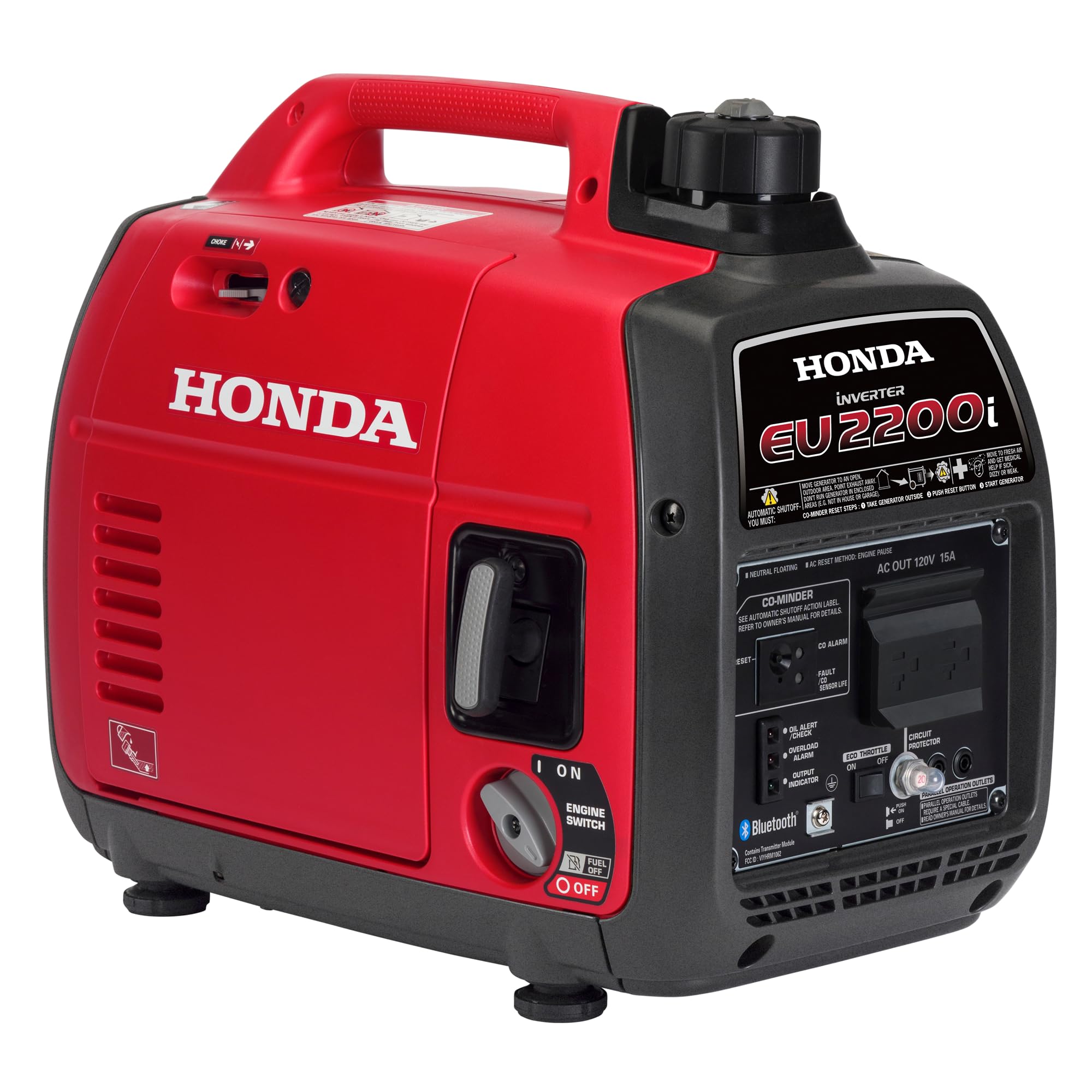
Its 208cc engine delivers 2200 surge watts and 1800 running watts with less than three percent THD, making it safe for laptops, CPAP machines, and refrigerator control boards without any filtering accessory. The Eco Throttle system adjusts engine RPM to load, yielding up to 8.1 hours on a 0.95-gallon tank at quarter load — fuel efficiency that cheaper units cannot match.
Bluetooth connectivity through the My Generator smartphone app adds remote monitoring and shutoff capability, a feature absent from every other generator in this list below the premium tier. The CO-MINDER carbon monoxide detection system automatically shuts down the generator before CO levels near the unit become dangerous, adding a genuine safety layer that is not just a gimmick. At 51 pounds, it is light enough for one person to lift into a vehicle, and the compact 20-by-11.4-by-16.7-inch footprint stores easily under a truck bed cover.
The main drawback is price — this unit commands a significant premium over competitors with similar rated wattage. Additionally, the oil fill location requires a flexible funnel to avoid spills, and the unit is gasoline-only with no dual-fuel option. For buyers who want absolute reliability, Honda’s parts network and 22-year service history make the premium worthwhile.
Why it’s great
- Proven reliability with decades of field use and a vast service network
- Bluetooth monitoring and CO-MINDER safety system are unique in this class
- Eco Throttle delivers exceptional fuel economy at light loads
Good to know
- Premium pricing — roughly double the cost of comparable wattage units
- Gasoline only; no propane or natural gas conversion without aftermarket kits
- Oil fill port is awkward; a flexible funnel is essential
2. Yamaha EF2200iS
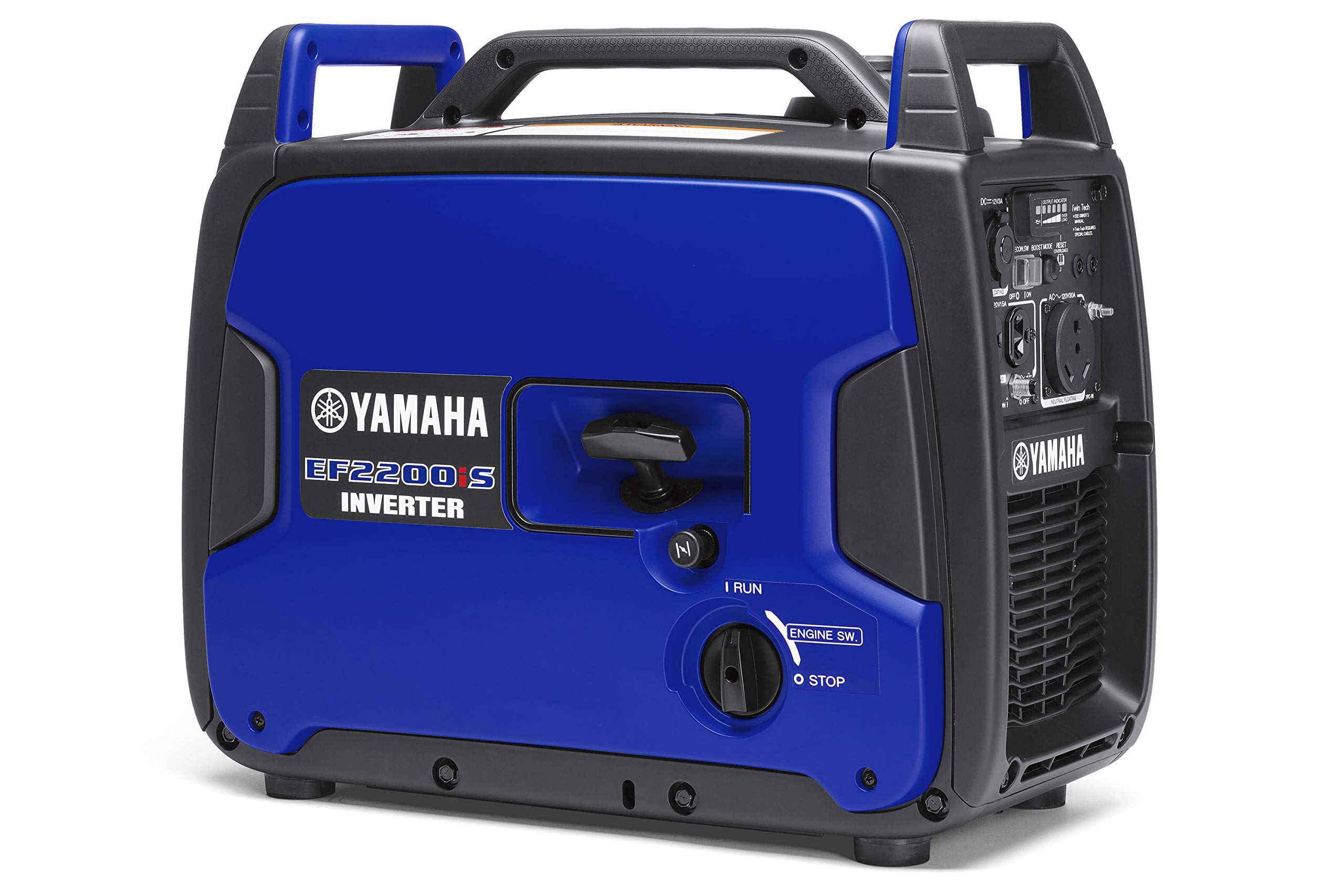
Yamaha’s EF2200iS enters the premium bracket with a 79cc engine that produces 2200 surge watts and 1800 running watts, but the real story is the cast iron cylinder liner — a feature more common in industrial engines that dramatically increases longevity over units with plain aluminum bores. The Smart Throttle system automatically adjusts engine RPM based on the connected load, and the Smart Dial knob simplifies startup to a single intuitive motion. The illuminated multi-function LED display shows output wattage, runtime, and maintenance intervals clearly in any lighting condition.
This unit includes a standard TT-30R RV outlet, eliminating the need for a dogbone adapter when plugging into a travel trailer or campervan. At 55.2 pounds, it is slightly heavier than the Honda EU2200i, but the weight distribution and integrated handle make single-person carries manageable. The Yamaha is compatible with parallel operation, allowing two units to combine for up to 4400 surge watts. The noise rating is slightly higher than the Honda’s best, coming in around 55 to 60 dBA, but still quiet enough for campground use without complaints.
The EF2200iS is gasoline-only, and its price point sits close to Honda’s premium, so the decision often comes down to the cast iron cylinder versus Bluetooth connectivity. Some users report that the engine runs richer than the Honda, leading to slightly more exhaust odor. Yamaha’s parts distribution in the US is not as dense as Honda’s, so repair times may be longer in remote areas.
Why it’s great
- Cast iron cylinder liner extends engine life well beyond aluminum-bore competitors
- Standard RV outlet and Smart Dial simplify operation
- Illuminated display provides real-time load and maintenance data
Good to know
- Premium price comparable to Honda; no Bluetooth or app control
- Gasoline only with no factory dual-fuel option
- Slightly heavier and marginally louder than the Honda EU2200i
3. Champion Power Equipment 2500-Watt Dual Fuel

Champion’s 2500-watt dual fuel inverter generator delivers 2500 surge watts and 1850 running watts on gasoline, and 1665 running watts on propane, with less than three percent THD on both fuel types. The 53 dBA noise rating from 23 feet places it among the quietest dual-fuel units in its class — quiet enough for campsite use without disturbing neighboring sites. The CO Shield carbon monoxide auto shutoff system adds a genuine safety net, automatically killing the engine if CO levels near the generator become elevated.
Fuel flexibility is the headline here. Propane burns cleaner, eliminates carburetor gumming from stale gasoline, and allows indefinite fuel storage. Champion includes a 10-foot propane hose and a regulator in the box, so you can run off a standard 20-pound BBQ tank immediately. Run time on propane reaches up to 25 hours at quarter load, compared to 11.5 hours on gasoline, making this unit ideal for multi-day outages where refueling convenience matters. The parallel capability lets you pair two units for up to 5000 surge watts, and the 3-year limited warranty with free lifetime technical support is among the best in the industry.
At 43.2 pounds, this unit is not the lightest, but it is still manageable for one person. Some users report that the propane connection can be temperamental if the regulator diaphragm dries out from infrequent use, requiring a simple suck on the hose to re-seat the diaphragm. The 79cc engine is slightly less refined than Honda’s or Yamaha’s, producing a marginally rougher exhaust note at higher RPM.
Why it’s great
- Dual fuel operation with propane hose and regulator included in the box
- 53 dBA operation is exceptionally quiet for a dual-fuel inverter
- CO Shield safety system and 3-year warranty add peace of mind
Good to know
- Propane running wattage drops to 1665W — factor that into load planning
- Propane diaphragm may stick after long storage; a manual reset is needed
- Engine refinement is a step below the premium Japanese brands
4. Champion Power Equipment 2500-Watt Ultralight

At 39.7 pounds, Champion’s 2500-watt ultralight inverter is the lightest generator in this roundup by a meaningful margin, making it the obvious choice for backpacking, overlanding, or any scenario where every pound counts. The 79cc engine produces 2500 surge watts and 1850 running watts with less than three percent THD, and the 53 dBA noise rating from 23 feet is quiet enough for late-night campsite use without disturbing tent neighbors. Cold Start Technology allows the engine to fire reliably in temperatures below freezing, a feature absent from many budget competitors.
The fuel efficiency is strong — up to 11.5 hours of runtime on the 1.1-gallon tank at quarter load in economy mode. The included 120V duplex outlet with clean power allows safe charging of laptops, camera batteries, and CPAP machines without additional filtering. CO Shield carbon monoxide detection is integrated, providing automatic shutdown if CO levels become elevated. Champion’s 3-year warranty and free lifetime technical support provide a safety net that justifies the mid-range price.
Some users report that the CO sensor can trigger false shutdowns if the generator is placed too close to a wall or obstruction, even outdoors. The plastic fuel tank feels less durable than metal alternatives, and the unit is gasoline-only with no propane compatibility. For buyers who prioritize minimal weight above all else, this is the strongest option, but the dual-fuel sacrifice limits fuel storage flexibility.
Why it’s great
- Under 40 pounds makes it genuinely one-person portable for hiking or loading
- Cold Start Technology ensures reliable ignition in freezing conditions
- Excellent fuel efficiency with 11.5-hour runtime on 1.1 gallons
Good to know
- CO sensor may trigger shutdowns if placed near walls or in tight spaces
- Gasoline-only operation; no propane or dual-fuel option
- Plastic fuel tank is less impact-resistant than steel alternatives
5. Westinghouse 2550 Peak Watt

Westinghouse’s 2550 peak watt inverter generator stands out for its rotating digital data center display that shows fuel level, power output, remaining runtime, and voltage in real time — a feature set usually reserved for generators twice this price. The 80cc engine delivers 2550 surge watts and 1900 rated watts with less than three percent THD, and the 52 dBA noise rating from 23 feet is the quietest in this entire lineup, matching the conversation-level volume that serious campers demand. The unit includes an RV-ready TT-30R outlet, two 120V 20-amp household outlets, and two USB ports.
The 1.16-gallon fuel tank delivers up to 12 hours of runtime at quarter load in economy mode, besting the Honda EU2200i’s 8.1 hours by a significant margin. At 42.4 pounds, it is light enough for one person to carry, and the fully enclosed design protects the engine from dust and debris during transport. The 3-year limited service, labor, and parts coverage is comparable to Champion’s warranty and better than WEN’s standard 2-year terms. The economy mode adjusts RPM based on load, and the generator runs noticeably quieter at low loads than at full output.
Some users report that the generator can take several hard pulls to start when cold, especially before the engine has broken in. The digital display, while useful, is not backlit as brightly as the Yamaha’s, making it harder to read in direct sunlight. Westinghouse’s customer service network is thinner than Honda’s or Champion’s, so replacement parts may take longer to arrive in remote areas.
Why it’s great
- Rotating digital display with fuel level, runtime, and output data
- 52 dBA noise floor is the lowest in this review — true conversation-level
- 12-hour runtime bests the Honda EU2200i by nearly 50 percent
Good to know
- Cold starts may require multiple pulls before the engine catches
- Digital display visibility in direct sunlight could be better
- Customer service and parts network are thinner than premium brands
6. WEN 56250i

The WEN 56250i delivers 2500 surge watts and 1900 rated watts from an 80cc engine, all packaged into a 37.5-pound frame that undercuts the Champion Ultralight by more than two pounds. This makes it the lightest generator by actual weight in the comparison, and the dual three-prong 120V receptacles plus two 5V USB ports provide enough connectivity for a campsite or small backup setup. The fuel shutoff feature lets the carburetor run dry before shutdown, preventing ethanol-related gumming during storage — a detail that dramatically extends lifespan for occasional users.
The noise output is around 60 dBA in economy mode and 66 dBA with economy off, measured from 23 feet. That is louder than the Westinghouse or Honda, but still quieter than a push mower and acceptable for most campgrounds. The price point is significantly lower than the premium Japanese units, making this the strongest value proposition for buyers who need clean inverter power on a tighter budget. The 3-year warranty adds further reassurance at this price tier.
Some users report oil consumption between changes — the engine burns a small amount during break-in, which is common for air-cooled engines in this class. The fuel tank capacity is not specified in the official specs, but real-world users report roughly 4 to 6 hours of runtime at half load, which is below average for the category. The unit lacks CO detection, so it must be positioned with extreme care outdoors away from windows, doors, and vents.
Why it’s great
- 37.5 pounds is the lightest generator in this entire review
- Fuel shutoff prevents carburetor damage during long-term storage
- Price point is well below the premium tier while delivering clean inverter power
Good to know
- No carbon monoxide sensor — requires careful outdoor placement
- Fuel tank runtime is shorter than most competitors at 4–6 hours
- Some oil consumption during break-in period is expected
7. Pulsar PG2300iS

Pulsar’s PG2300iS produces 2300 peak watts and 1800 running watts from an 80cc 4-stroke engine, with stable sine wave inverter technology that keeps THD low enough for sensitive electronics. The 120V AC outlets are rated at 13 amps each, and the unit includes one 5V USB port for direct device charging. The 12V 8A cigarette lighter outlet provides a third power option, making it one of the most outlet-diverse units in its price tier. The parallel capability allows pairing two PG2300iS units for up to 4600 peak watts, and the CARB compliance means it is legal to purchase and use in all 50 states.
At roughly the size of a hiking backpack at 19.7 by 11.2 by 17.9 inches, this unit fits easily in an RV compartment or truck cab. The recoil start is reliable, and the low oil shutoff protects the engine from damage during extended use. Real-world users report that it sips fuel gently, running for several hours on a single tank under moderate load. The white color scheme reflects heat better than dark finishes, keeping the generator slightly cooler in direct sun — a minor but real advantage for summer camping.
The noise level is louder than the premium brands, coming in around 65 to 75 dBA depending on load, which is comparable to a window air conditioner. The power output accuracy has been questioned by some users who found it could not start a 13,500 BTU RV air conditioner even with a soft start kit, suggesting the surge rating may be optimistic. The included accessories are minimal — no propane hose or parallel kit is included.
Why it’s great
- Compact backpack size fits in tight RV and car storage spaces
- Diverse outlet selection with 12V, USB, and two 120V outlets
- CARB compliant for all 50 states and parallel capable
Good to know
- Noise level at 65–75 dBA is louder than premium inverter generators
- Surge wattage may be optimistic for starting large AC compressors
- No propane hose or parallel kit included in the box
8. Pulsar PG2200BiS

The Pulsar PG2200BiS is a dual-fuel inverter generator that delivers 2200 peak watts and 1800 rated watts on gasoline, and 2000 peak watts and 1600 rated watts on LPG. The 80cc OHV engine is air-cooled with a recoil start and low oil shutdown, and the inverter technology produces stable sine wave power suitable for sensitive electronics. The 60 dBA noise rating is competitive for a dual-fuel unit, and the 1.18-gallon fuel tank provides up to 8 hours of runtime on gasoline at half load. On propane, a 20-pound tank delivers significantly longer runtime depending on load.
The dual-fuel capability includes a propane hose, spark plug wrench, and a 350ml bottle of 10W30 oil in the box — everything needed to run on LPG immediately. The parallel sockets allow connection to a second PG2200BiS for higher output, and the CARB compliance makes it legal in California and other strict-emission states. The price point is the lowest for any dual-fuel inverter generator in this review, making it the most accessible entry point for propane flexibility.
Starting on propane requires a specific technique — purging the line and giving several slow pulls to prime the system before the engine catches. Some users report that the propane adapter diaphragm can stick if the unit sits unused for months, requiring a manual reset by sucking on the hose to re-seat the diaphragm. The documentation is minimal, and the 1-year limited warranty is shorter than Champion’s or Westinghouse’s coverage.
Why it’s great
- Lowest-priced dual-fuel inverter generator in the comparison
- Includes propane regulator, hose, oil, and funnel in the box
- Parallel capable for doubled output with a second unit
Good to know
- Propane start sequence is finicky and requires practice
- Propane adapter diaphragm may stick after long storage periods
- 1-year warranty is shorter than the industry average of 3 years
9. WEN DF480iX
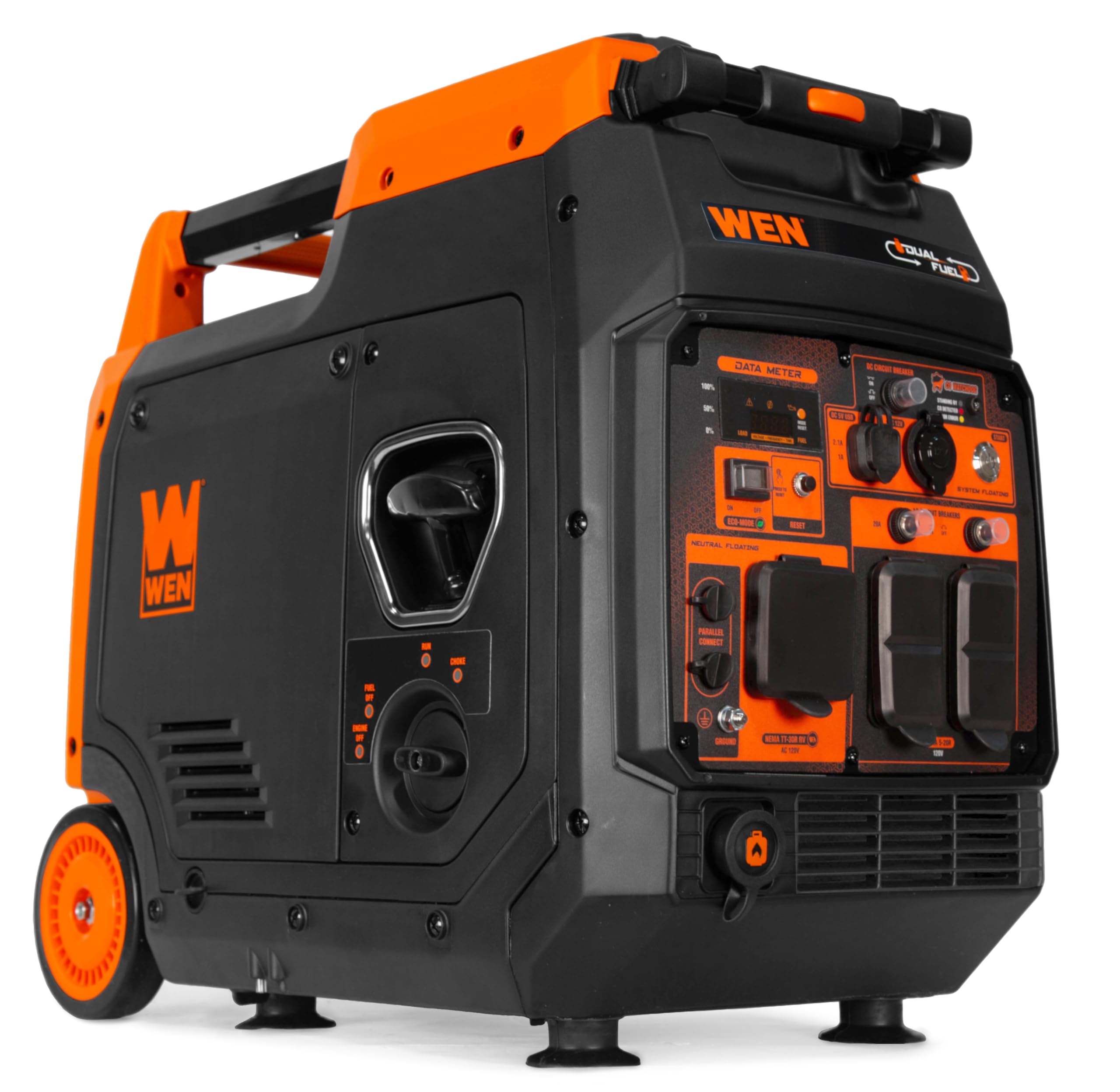
The WEN DF480iX is a step up in power class with its 224cc dual-fuel engine delivering 4800 surge watts and 4000 rated watts on gasoline, and 4320 surge watts and 4000 rated watts on propane. This is significantly more power than the 2200-watt class, making it suitable for running a well pump, multiple refrigeration units, or a small window AC alongside lights and electronics. The electric start with a key eliminates the arm fatigue of recoil starting, and the backup recoil pull start provides redundancy if the battery dies. The telescoping pull handle and onboard wheels make transport manageable despite the 78.5-pound weight.
The WEN Watchdog CO Shutdown Sensor automatically turns off the generator if carbon monoxide levels become dangerous, adding a critical safety layer for residential backup use. The fuel shutoff feature runs the carburetor dry before shutdown, preventing ethanol damage during storage. The outlet panel includes four three-prong 120V receptacles, one TT-30R RV receptacle, one 12V DC receptacle, and two 5V USB ports — more connectivity than any unit in the 2200-watt class. The tool-free LPG quick-connector simplifies propane hookup.
At 78.5 pounds, this is not a one-person carry generator — the wheels and handle are essential for movement. The battery connection access panel is difficult to reattach after battery installation, requiring patience and careful alignment. Some users note that the dual-fuel switch is not automatic; you must manually switch between gasoline and propane by turning a valve, which is standard but worth knowing.
Why it’s great
- Substantially higher output at 4800 surge watts for whole-room backup
- Electric start with recoil backup eliminates arm strain
- Included wheels and telescoping handle aid mobility despite weight
Good to know
- 78.5 pounds is not portable without the wheel kit
- Battery access panel is difficult to reattach correctly
- Manual fuel switch between gasoline and propane — not automatic
10. Champion Power Equipment 4000-Watt Dual Fuel

Champion’s 4000-watt dual fuel inverter generator delivers 4000 surge watts and 3000 running watts on gasoline, with 2700 running watts on propane. The 64 dBA noise rating from 23 feet is louder than the 2200-watt class units but expected at this output level. The RV-ready TT-30R outlet allows direct connection to a travel trailer or camper without adapters, and the duplex 120V household outlet provides additional connectivity for appliances. The generator is parallel capable, allowing connection to another Champion inverter or power station for up to 8000 surge watts.
The dual-fuel operation is straightforward — switch between gasoline and propane using the included propane hose. Runtime on propane reaches up to 25 hours at quarter load, making this an excellent choice for long-duration backup scenarios where refueling is inconvenient. The CO Shield auto shutoff system and cold start technology add safety and reliability. At 51.8 pounds, this is lighter than the WEN DF480iX and can be carried by hand, though the weight is still substantial enough that the optional wheel kit is recommended for frequent moves.
Quality control has been inconsistent, with some users receiving units that failed within weeks due to defective ignition coils or other manufacturing defects. Champion’s customer service, while free lifetime, has been criticized for long wait times and sending incorrect replacement parts. The unit is louder than the 2200-watt class inverters at 64 dBA, which may draw complaints in quiet campgrounds or close residential settings.
Why it’s great
- High output at 4000 surge watts with dual-fuel flexibility
- TT-30R outlet enables direct RV connection without adapters
- 25-hour propane runtime eliminates frequent refueling stops
Good to know
- Inconsistent manufacturing quality — some units fail early
- Customer service wait times can exceed 20 minutes
- 64 dBA noise level is noticeably louder than 2200-watt inverters
11. WEN 56455i

The WEN 56455i is a 4500-watt surge/3500-watt rated inverter generator powered by a 212cc engine, with both keyless electric start and a backup recoil pull start. The electric start system includes a battery that charges while the generator runs, eliminating the arm strain of repeated pulls. The 2.2-gallon fuel tank delivers up to 8.5 hours of runtime at half load, and the fuel shutoff feature protects the carburetor during storage. The unit includes onboard wheels and a carrying handle for mobility despite the 99.2-pound weight.
The inverter technology produces clean power with THD below three percent, making it safe for sensitive electronics. The outlet panel includes two three-prong 120V receptacles, one TT-30R RV receptacle, one 12V DC receptacle, and two 5V USB ports. The digital display shows current load and fuel level in real time. At this price point, the combination of electric start, inverter clean power, and 3500 running watts is compelling for homeowners who need more than 2200 watts but want inverter technology rather than a conventional generator.
The 99.2-pound weight is the heaviest in this review, making it effectively stationary without a wheel kit — and the included wheels are smaller than ideal for rough terrain. The battery connection requires cutting a zip tie and connecting two protected ends, which is not documented in the manual and causes confusion for first-time owners. The oil fill uses a flexible tube that makes pouring difficult without spilling. The electric start system has been reported to fail prematurely in some units, leaving only the recoil pull start functional.
Why it’s great
- Electric start with backup recoil reduces startup effort
- 3500 running watts covers most home essentials including small AC units
- Inverter clean power is safe for laptops and smart appliances
Good to know
- 99.2 pounds is not portable without significant effort or a dolly
- Electric start battery harness requires undocumented assembly steps
- Oil fill tube design makes maintenance messy and difficult
FAQ
Can a 2200 watt generator run a refrigerator and a freezer simultaneously?
How many hours will a 2200 watt generator run on a single tank of gas?
Is 60 dBA quiet enough for campground use?
What is the difference between a conventional generator and an inverter generator in this wattage class?
Final Thoughts: The Verdict
For most users, the best 2200 watt generator winner is the Honda EU2200i because it combines proven reliability with 48 dBA quiet operation, Bluetooth monitoring, and CO-MINDER safety in a package that will outlast any competitor through multiple rebuilds. If you want dual-fuel flexibility at a lower price point, grab the Champion 2500-Watt Dual Fuel for its 53 dBA operation and 25-hour propane runtime. And for the lightest option that still delivers clean inverter power, nothing beats the Champion 2500 Ultralight at 39.7 pounds.