
The air you breathe indoors can be two to five times more polluted than outdoor air, yet most people have no idea what’s floating around their living room, nursery, or home office. An AQI monitor changes that by putting real-time particulate, carbon dioxide, and VOC data on your desk—so you stop guessing and start ventilating.
I’m Min — the co-founder and writer behind Gadgets Feed. I’ve spent countless hours combing through sensor specifications, reading verified buyer reports, and comparing the actual detection accuracy of the most popular indoor air quality monitors on the market today.
After analyzing over a dozen models across different price tiers, I’ve built the definitive list of the best aqi monitor options to help you find the right sensor array for your home.
How To Choose The Best AQI Monitor
A good AQI monitor is more than a pretty display — it’s a sensor-driven tool that helps you make smarter decisions about ventilation, air purifier placement, and overall indoor health. Here’s what to look for when narrowing down your options.
Sensor Types and What They Actually Detect
Not all AQI monitors measure the same pollutants. The most common sensors include a laser particle counter for PM2.5 and PM10, an NDIR (non-dispersive infrared) sensor for carbon dioxide, and a metal-oxide semiconductor sensor for volatile organic compounds (VOCs). Some premium units also add formaldehyde (HCHO) detection. If you suffer from allergies or asthma, prioritize PM2.5 accuracy. If you work from home and deal with brain fog, a calibrated CO₂ sensor is non-negotiable.
Display Readability and Alert Systems
You’ll look at this screen daily, so display quality matters. Large, color-coded screens that show multiple parameters at once are far more useful than tiny LCDs that require button-mashing. Alerts can be visual (color changes) or audible (buzzer alarms). Look for adjustable brightness and a mute option — your bedroom monitor shouldn’t glow like a lighthouse at 3 AM.
Connectivity and Smart Home Integration
Basic monitors show data on the device itself. Smart monitors pair with Alexa, Google Assistant, or a dedicated app to display historical trends, send push notifications, and even trigger routines (like turning on a fan when CO₂ spikes). If you value data analysis or voice control, choose a model with Wi-Fi and app support. If you prioritize simplicity and privacy, a plug-and-play unit with no app is the better call.
Quick Comparison
On smaller screens, swipe sideways to see the full table.
| Model | Category | Best For | Key Spec | Amazon |
|---|---|---|---|---|
| UNNI 7.5″ Display Monitor | Mid‑Range | Home office & nursery | Swiss Sensirion CO₂ sensor | Amazon |
| GoveeLife H5140 | Premium | Smart home automation | Photoacoustic NDIR CO₂ sensor | Amazon |
| Amazon Smart Air Quality Monitor | Premium | Alexa ecosystem users | 5‑factor detection + routines | Amazon |
| YNAK 16‑in‑1 | Mid‑Range | Comprehensive home monitoring | 7″ display, external high-precision sensors | Amazon |
| INKBIRD IAM‑O2 | Budget‑Friendly | CO₂ grow tents & RVs | Swedish CO₂ sensor, 3‑6 month battery | Amazon |
| LifeBasis 11‑in‑1 | Budget‑Friendly | Portable multi‑room use | 2500mAh battery, 11 indexes | Amazon |
| KDWKD AK23CA | Mid‑Range | New construction & remodels | 9 hours battery, formaldehyde detection | Amazon |
In‑Depth Reviews
1. UNNI 7.5″ Display AQI Monitor
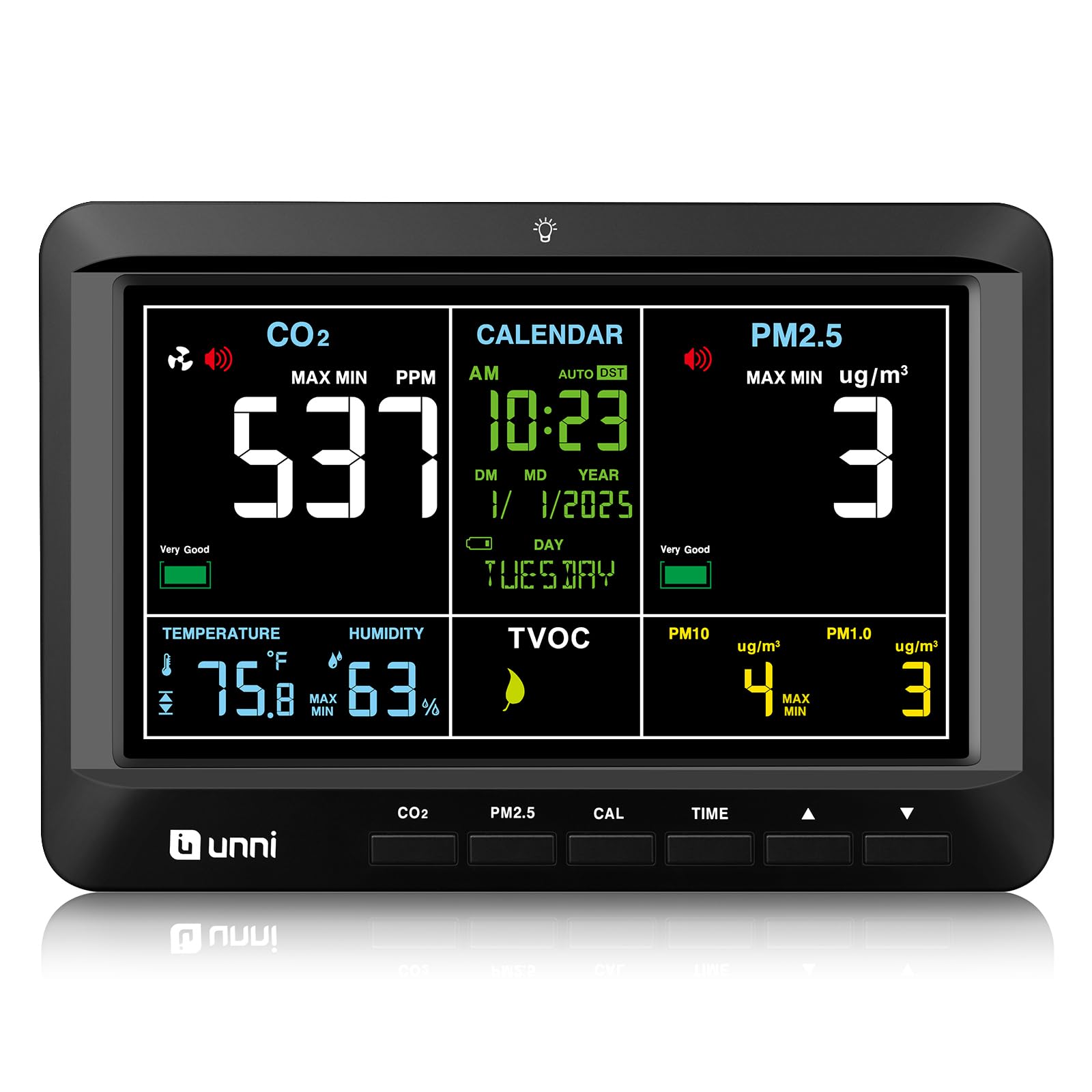
The UNNI monitor earns the top spot by offering a large, color-coded 7.5-inch display that shows CO₂, PM2.5, PM1.0, PM10, TVOC, temperature, humidity, and date simultaneously — no menu scrolling required. It uses a Swiss-made Sensirion sensor for CO₂ detection with an accuracy of ±5% plus 50 ppm, which gives you lab-grade confidence in a consumer package.
Setup takes 180 seconds out of the box: plug in the USB cable, let it warm up, and live readings update every five seconds. The smart CO₂ and PM2.5 alerts are adjustable and include a mute option, so you won’t be startled awake. Three brightness levels allow you to keep the screen readable during the day but dim enough at night not to disrupt sleep.
Buyers consistently report that the unit responds instantly to cooking smoke, candle burning, and closed-window CO₂ buildup. The lack of an app means zero privacy concerns and no Wi-Fi setup headaches, making this the ideal choice for anyone who wants accurate, hassle-free air quality monitoring without smart-home complexity.
Why it’s great
- Large 7.5″ display shows all parameters at once
- Accurate Swiss Sensirion CO₂ sensor
- No app or Wi-Fi required — true plug‑and‑play
Good to know
- Bottom protrudes when wall‑mounted, not flush
- Does not detect carbon monoxide
2. GoveeLife H5140 CO₂ Monitor
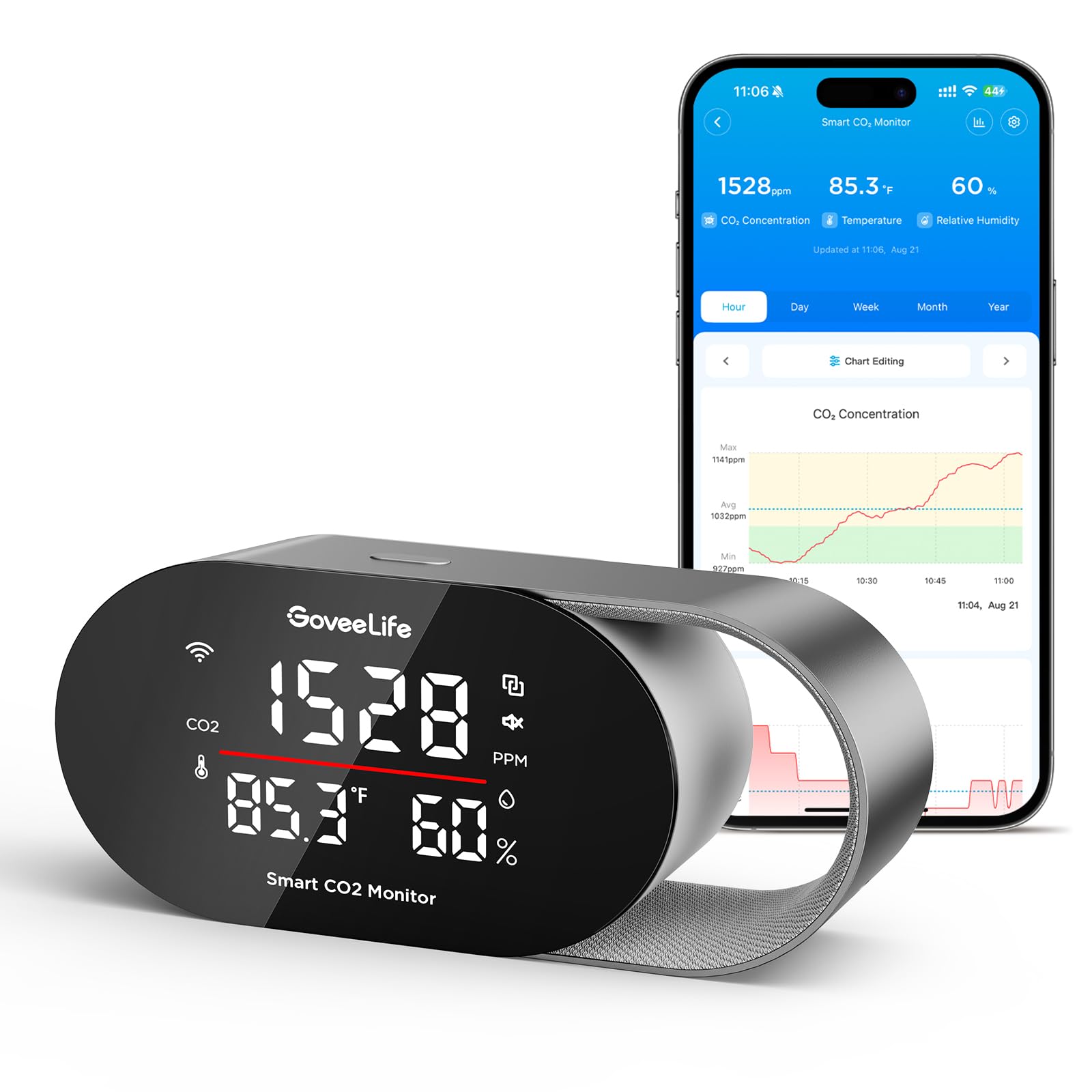
GoveeLife brings its signature smart-home polish to the H5140, a CO₂-first monitor that also tracks temperature and humidity with a photoacoustic NDIR sensor accurate to ±40 ppm plus 5%. The five-second refresh rate and built-in pressure compensation ensure reliable readings regardless of altitude, making this unit a standout for anyone who experiences afternoon brain fog or morning headaches from poor ventilation.
The triple-alert system — on-device buzzer, app push notification, and email report — makes sure you never miss a spike. You can customize thresholds for CO₂, temperature, and humidity, and the programmable LED screen automatically dims on a day/night schedule so it won’t disturb light sleepers. The 4.82-inch color display shows CO₂, °F/°C, %RH, and a clock, all updated in real time.
With Alexa and Google Assistant voice queries plus the ability to trigger smart plugs, humidifiers, and tower fans, this monitor transforms passive awareness into active environmental control. Buyer feedback highlights its fast CO₂ response during parties and closed-door meetings, and owners of mushroom grow tents praise the VPD data it provides. The only limitation is the lack of a particulate sensor — it is purely a CO₂/humidity/temp device.
Why it’s great
- Photoacoustic NDIR sensor with altitude compensation
- Triple alerts: buzzer, app, and email
- Smart home routines with Alexa/Google Assistant
Good to know
- Does not measure PM2.5, PM10, or VOCs
- AC powered — must stay plugged in 24/7
3. Amazon Smart Air Quality Monitor (Pack of 2)

This two-pack from Amazon monitors five key factors — PM2.5, VOCs, carbon monoxide, humidity, and temperature — and plugs directly into the Alexa ecosystem. The color-coded LED gives a quick visual snapshot, while the Alexa app provides a detailed air quality score and historical data. The real power lies in Routines: you can program Alexa to turn on an air purifier when PM2.5 spikes, or activate a dehumidifier when humidity exceeds a threshold.
Setup is effortless if you already own an Echo device — just plug it in, open the Alexa app, and follow the prompts. Real-time alerts can appear on your phone or as voice announcements from Echo speakers. Buyers report that the sensor catches cooking fumes, cleaning chemical VOCs, and even candle smoke within minutes, offering peace of mind for homes with kids, pets, or allergy sufferers.
The main drawback is the sensor’s high sensitivity to aerosols — a spritz of hairspray can tank the IAQ score for a while, which some users view as oversensitivity rather than false data. The red alert LED cannot be turned off when thresholds are exceeded, which may be annoying in a bedroom. For users fully invested in Amazon’s smart home platform, this is the most seamless and actionable AQI monitor available.
Why it’s great
- Triggers Alexa Routines for smart devices
- Measures CO, PM2.5, VOCs, humidity, temp
- Voice announcements and phone alerts
Good to know
- Requires Alexa app for setup and data
- Red alert LED cannot be manually turned off
4. YNAK 16‑in‑1 AQI Monitor
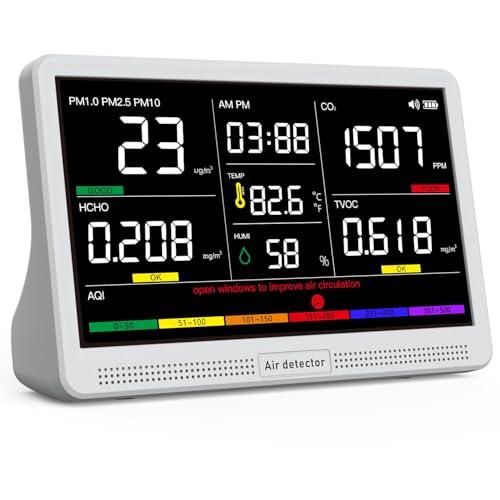
The YNAK monitor packs the most extensive sensor array in this roundup, covering CO₂, PM2.5, PM1.0, PM10, formaldehyde, TVOC, temperature, humidity, and AQI — all displayed simultaneously on a crisp 7-inch LED screen. The external high-precision sensors claim 0.001-unit accuracy for real-time detection of the smallest environmental changes, which buyers confirm by reporting instant PM spikes when cooking or burning candles.
Unlike many competitors, this unit includes a built-in 2500mAh battery that provides up to eight hours of cordless operation, letting you carry it between rooms, offices, or even into an RV without hunting for an outlet. The seven distinct AQI alert buzzers cover different pollutant thresholds, and a mute button silences the noise while visual warnings remain active. The display also includes a clock with 12/24-hour toggle and °F/°C switching via a double-press of the power button.
Reviewers consistently note the instant detection of vape smoke and UV printer fumes, making it a favorite for workshops and shared living spaces. The only caution is that the device ships with a protective film on the sensor vents — removing it before use is essential for accurate readings. For those who want the broadest pollutant coverage in a portable package, this is the monitor to beat.
Why it’s great
- Detects 9 parameters including formaldehyde
- Portable with 2500mAh battery (8 hours)
- Large 7″ screen with three brightness levels
Good to know
- External sensors require care — avoid perfume exposure
- Some buyers question TVOC accuracy in initial burn-in
5. INKBIRD IAM‑O2 CO₂ Monitor
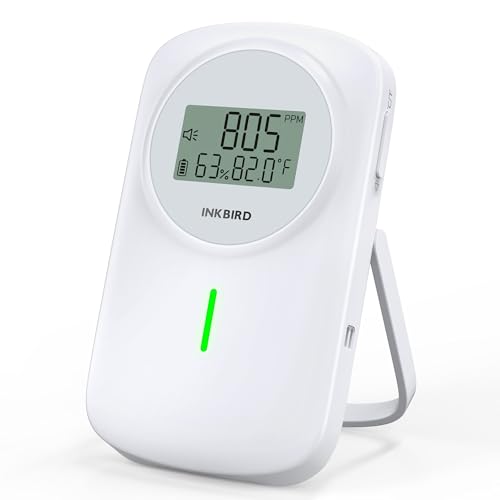
The INKBIRD IAM‑O2 strips the feature set down to the essentials — CO₂, temperature, and humidity — and executes each one with impressive efficiency. It is powered by a Swedish CO₂ sensor accurate from 0 to 9999 ppm, and its extreme low-power design enables three to six months of continuous use on a single charge. The backlit LCD screen and three-color LED system (green/yellow/red) give you instant air quality feedback without an app.
Mushroom growers and greenhouse operators are particularly fond of this unit because it responds quickly to CO₂ changes from fresh air intake and can be hung on a wall or placed on a shelf. Buyers confirm that its readings match detectors costing several times more, and the USB-C charging means a 30-minute top-up restores weeks of runtime. The permanent setting memory locks in personalized alarm thresholds even after a power loss.
The lack of Wi-Fi, Bluetooth, or historical data logging limits its utility for data-driven users. Reviewers also note that the display shows 0 ppm in pure CO₂ environments, indicating the sensor tops out at 9999 ppm. For targeted CO₂ monitoring — whether in a grow tent, a classroom, or an RV — this unit delivers exceptional battery life and reliable accuracy at an accessible price point.
Why it’s great
- 3‑6 month battery life on a single charge
- Swedish CO₂ sensor with fast response
- Permanent memory lock for alarm settings
Good to know
- No particulate, VOC, or formaldehyde detection
- No app, no data logging, no smart home integration
6. LifeBasis 11‑in‑1 AQI Monitor

The LifeBasis monitor packs 11 indexes — AQI, CO₂, PM1.0, PM2.5, PM10, particles, formaldehyde, TVOC, temperature, and humidity — into a slim, pocket-portable chassis that weighs just 6.1 ounces. The LCD screen uses color-coding (green/yellow/orange/red) for each gas and includes both visual and audible alerts when levels exceed safe thresholds. A built-in 2500mAh battery delivers 11 to 12 hours of continuous monitoring on a full charge.
Buyers highlight the NDIR infrared CO₂ sensor and laser particle sensor as the standout components, noting that PM2.5 readings closely match those from more expensive PurpleAir monitors. The manual CO₂ calibration feature — rare at this tier — allows you to zero the sensor outdoors for improved long-term accuracy. Users have creatively deployed the device at work, on road trips, and even as a “flatulence alerter” thanks to its sensitivity to VOC spikes.
The main trade-off is the lack of Wi-Fi or Bluetooth connectivity — there is no app, no data export, and no historical logging. The screen is functional but not as bright or large as the premium models. For buyers on a budget who still want real CO₂ sensor accuracy and portable multi-room coverage, the LifeBasis offers outstanding value.
Why it’s great
- 11 monitoring indexes in a portable design
- Battery lasts 11‑12 hours on full charge
- Manual CO₂ calibration for improved accuracy
Good to know
- No Wi‑Fi, Bluetooth, or app support
- Audible fan hum reported by some users
7. KDWKD AK23CA AQI Monitor
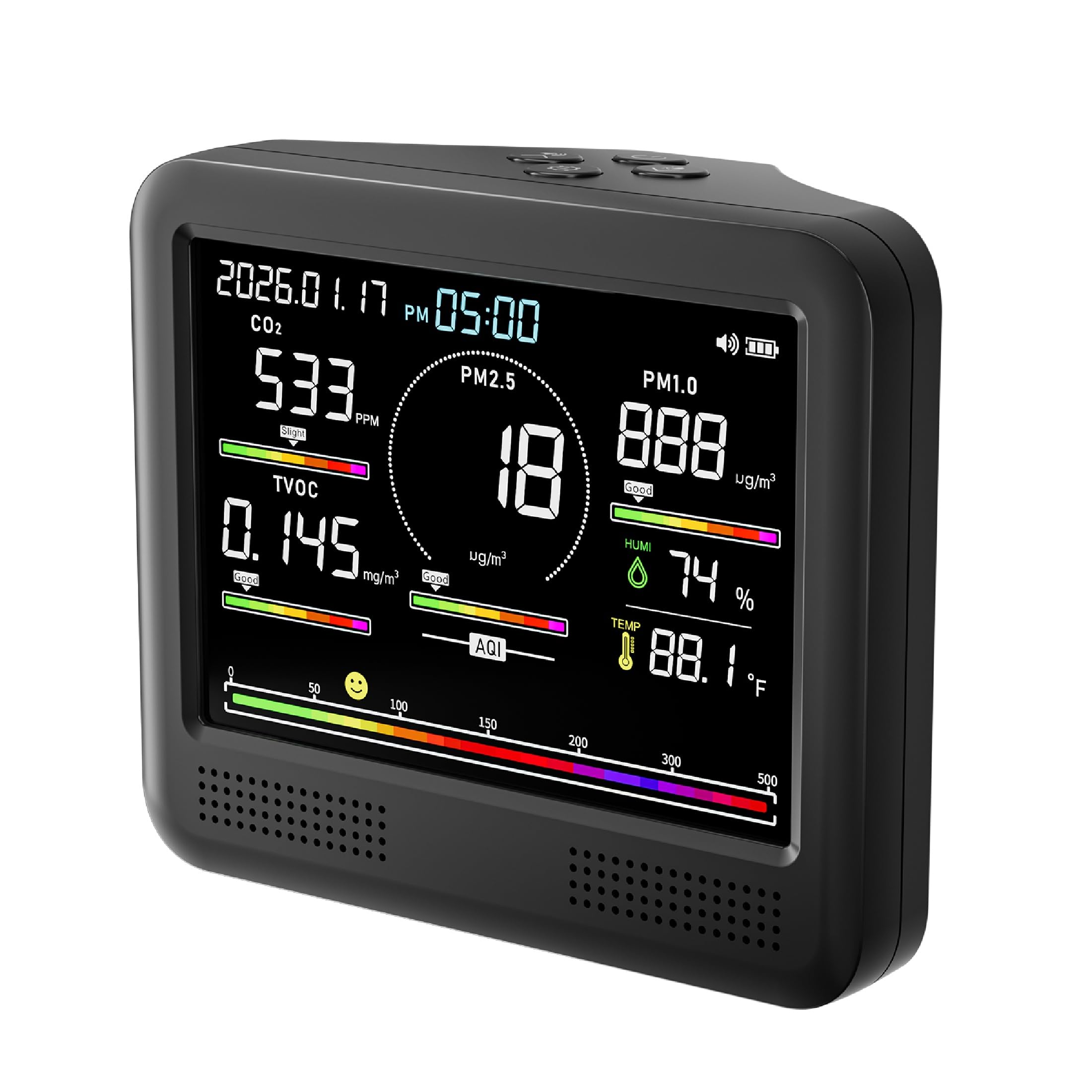
The KDWKD AK23CA focuses heavily on the pollutants that plague new construction and recent renovations — formaldehyde, TVOCs, and fine particulate matter down to PM0.3. It tracks CO₂, PM0.3, PM0.5, PM1.0, PM5.0, PM10, HCHO, TVOC, benzene, temperature, and humidity, making it one of the most detailed sensor suites available at this level. The large color screen shows a 7-level AQI display with optional audible alerts.
The built-in rechargeable battery provides up to nine hours of operation, giving you the freedom to test air quality in every room of a new home or apartment without being tethered to an outlet. Reviewers who recently remodeled report that the monitor reliably detects high VOC off-gassing from paint, furniture, and adhesives — information that helps them decide when to ventilate or run an air purifier. The compact ABS housing fits easily on a nightstand or desk.
Some early buyer reviews are mixed, with a few units arriving from third-party sellers with questionable packaging. The sensor also requires a brief burn-in period before it settles to accurate TVOC readings. For anyone moving into a freshly built or renovated space and wanting to track formaldehyde and fine particle levels, this is the most targeted tool in the list.
Why it’s great
- Detects formaldehyde, benzene, and PM0.3
- Portable with 9‑hour battery life
- 7‑level color AQI display for quick reading
Good to know
- TVOC accuracy may drift during initial burn-in
- Packaging quality inconsistent from some sellers
FAQ
What is the difference between an AQI monitor and a CO₂ detector?
Do I need to calibrate my AQI monitor regularly?
Can an AQI monitor detect mold or radon?
Final Thoughts: The Verdict
For most users, the best aqi monitor winner is the UNNI 7.5″ Display Monitor because it combines a large, easy-to-read screen with an accurate Swiss Sensirion sensor and the simplest plug-and-play setup available. If you want to automate your smart home based on air quality, grab the GoveeLife H5140. And for the broadest pollutant coverage in a portable package, nothing beats the YNAK 16‑in‑1.