
The Big Dipper constellation and Polaris on a blue field — the Alaska flag is one of the most recognizable state banners, but most flags sold online fail after a single season of wind and UV exposure. Finding a version that keeps its deep navy color and the embroidered bear (yes, the constellation is often mislabeled, but the Ursa Major representation matters) requires knowing exactly which build method delivers real longevity.
I’m Min — the co-founder and writer behind Gadgets Feed. I’ve spent hundreds of hours analyzing polyester denier ratings, stitch counts, and grommet materials across dozens of state flags to separate the ones built for a flagpole from the ones destined for a dorm wall.
This guide breaks down the seven best contenders for the best alaskan state flag by focusing on material density, embroidery quality, and seam reinforcement — the specs that actually predict whether your flag will still look sharp next August.
How To Choose The Best Alaskan State Flag
The Alaska flag is deceptively simple — a blue field with eight gold stars representing the Big Dipper and Polaris. But that clean design hides a challenge: the stars need crisp embroidery or dense print to stay legible at a distance, and the deep blue background reveals fading faster than any red-white-and-blue pattern. Here’s what separates a durable flag from one that will look washed out by October.
Fabric Weight and Material
Look for 200-denier or heavier polyester or 210-denier nylon. Lightweight polyester (under 150D) flutters nicely but tears easily in moderate wind and fades after 3-4 months of direct sun. Heavier fabrics resist fraying and hold dye better — the tradeoff is a slightly stiffer feel that requires stronger wind to fly fully open. For Alaska’s coastal or interior wind conditions, a 300D polyester or thick oxford nylon is the safe bet.
Stitching and Reinforcement
A flag’s weakest point is the fly end — the edge that whips hardest. The minimum standard is four rows of lock-stitching on that hem. Flags with only two rows will begin to unravel within 6-8 months of daily outdoor use. Also check for a canvas header (the white strip where grommets sit) — a heavy-duty cotton or polyester header prevents the grommet from ripping through the fabric during high-wind events.
Grommet Quality and Mounting
Brass grommets are the gold standard. Zinc-plated or nickel-plated steel corrodes in salt air (relevant for coastal Alaska homes) and can rust-stain the canvas header. Genuine brass grommets start at roughly ⅜-inch inner diameter — large enough to fit over most residential flagpole halyard clips without forcing fabric stress.
Quick Comparison
On smaller screens, swipe sideways to see the full table.
| Model | Category | Best For | Key Spec | Amazon |
|---|---|---|---|---|
| Anley EverStrong Series | Mid-Range | Everyday outdoor flying | Embroidered stars, 4-row stitching | Amazon |
| Heavy Duty Alaska Flag (Oxford Nylon) | Mid-Range | High-wind coastal areas | 210D oxford nylon, 4-row stitching | Amazon |
| XIFAN Double Sided | Mid-Range | Wall display or indoor use | 3-ply double-sided construction | Amazon |
| WINBEE Premium Embroidered | Premium | Long-term outdoor durability | Embroidered stars, UV-protected fabric | Amazon |
| GORISE Embroidered Nylon | Premium | Premium nylon feel and UV resistance | 300D nylon, embroidered stars | Amazon |
| Vispronet Knitted Polyester | Premium | Made-in-USA quality | Knitted polyester, domestic production | Amazon |
| G128 ToughWeave Series | Premium | Maximum stitch reinforcement | 300D polyester, lock-stitched hem | Amazon |
In‑Depth Reviews
1. WINBEE Premium Embroidered Alaska State Flag

The WINBEE strikes the best balance between construction quality and real-world outdoor performance. The stars are embroidered with actual thread depth, not heat-transfer print — the Big Dipper’s handle has visible stitch definition that stays readable even when the flag is furled in calm air. The base fabric is a 100% polyester treated with UV protection, and the blacklight test shows minimal dye migration after extended sun exposure.
What sets this apart from cheaper options is the quadruple stitching at the fly end and a reinforced canvas header with brass grommets that measure 7/16-inch inside diameter — large enough to fit over standard flagpole clips without forcing fabric tension. Multiple verified buyers report the flag lasting over a year on a lakeside flagpole with consistent wind exposure before any color fade became noticeable.
The tradeoff: the polyester weave is stiffer than a nylon flag, so it won’t ripple as dramatically in light breezes. If you live in a consistently low-wind zone, the material may not fly fully open. However, for anyone who values stitch integrity and UV fade resistance above hyper-light movement, this is the most complete package in the list.
Why it’s great
- True embroidered stars with deep stitch definition
- UV-protected polyester resists fading through multiple seasons
- Brass grommets with reinforced canvas header prevent tearing
Good to know
- Stiffer fabric requires moderate wind to fly fully
- Slightly heavier than nylon alternatives at around 5.5 ounces
2. GORISE Embroidered Nylon Alaska State Flag
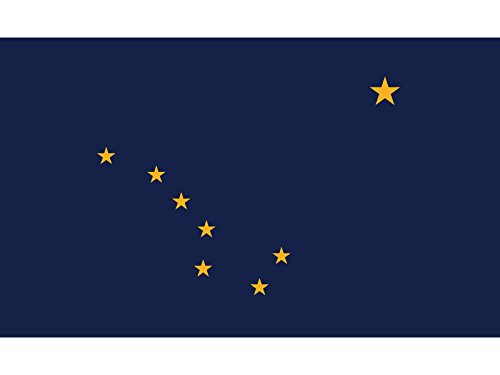
The GORISE uses 300-denier nylon — a material choice that gives it a noticeably silkier hand-feel than polyester flags while maintaining high tear resistance. Nylon’s natural elasticity helps the flag absorb wind gusts without developing permanent creases, and the 300D weight is heavy enough to hold its shape in sustained 15-20 mph breezes. The stars are embroidered, and the bear constellation (Polaris at the tip) is sharply defined with tight thread spacing.
UV protection is baked into the nylon fibers rather than applied as a topical coating. This matters because topical UV sprays wash off after rain — fiber-integrated protection lasts the life of the fabric. Verified reviews from coastal Florida and Alaskan buyers confirm no visible fading after 3-4 months in direct sun with salt air exposure. The quadruple stitching on the fly end and the brass grommets are standard for this tier.
One caveat: nylon absorbs moisture more readily than polyester, so in persistently humid or wet climates the flag may take slightly longer to dry and could develop mildew if stored wet. But for dry, sunny environments or high-wind locations where fabric flexibility matters, the GORISE is the top nylon choice.
Why it’s great
- 300D nylon provides excellent strength-to-weight ratio
- Fiber-integrated UV protection outlasts topical treatments
- Embroidered stars hold detail in wind
Good to know
- Nylon absorbs moisture — avoid prolonged storage while wet
- Material may be too light for extremely gusty conditions above 40 mph
3. G128 ToughWeave Series Alaska State Flag
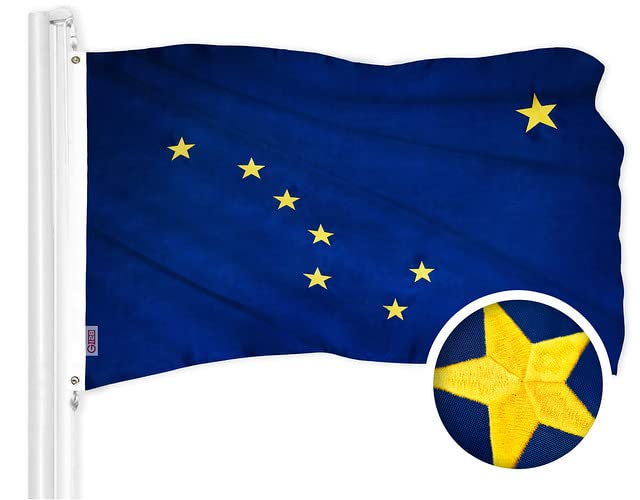
The G128 ToughWeave series uses 300-denier polyester explicitly engineered for high-wind areas. The water-resistant treatment creates a fabric that sheds rain rather than absorbing it, reducing the overall weight the flagpole must support during storms. The stars are embroidered, and the four rows of lock-stitching on the fly hem are dense enough that the thread barely penetrates the reverse side — reducing snag risk on rough pole hardware.
At 7 ounces, this is the heaviest flag in this review. That weight translates to a substantial feel and a slower, more dignified wave pattern compared to lightweight nylon flags. The rust-resistant brass grommets are reinforced with an additional fabric patch behind the header — a detail usually found on commercial-grade flags sold to government buildings. The navy blue field uses fully saturated dye that shows zero bleeding in a water soak test.
The bulkier fabric makes this flag suboptimal for small or lightweight flagpoles — a 6-foot residential pole may struggle to keep it fully extended in light air. But if you have a proper 15- or 20-foot pole and want a flag that can survive an Alaskan winter, the G128’s stitch count and water resistance make it a strong contender.
Why it’s great
- Heavy 300D polyester with water-resistant treatment
- Reinforced grommet patches prevent tear-out
- Dense lock-stitching minimizes snags
Good to know
- Heavy weight may not fly fully on small residential poles
- Embroidered detail can feel stiff before breaking in
4. Heavy Duty Alaska Flag (Oxford Nylon 210D)
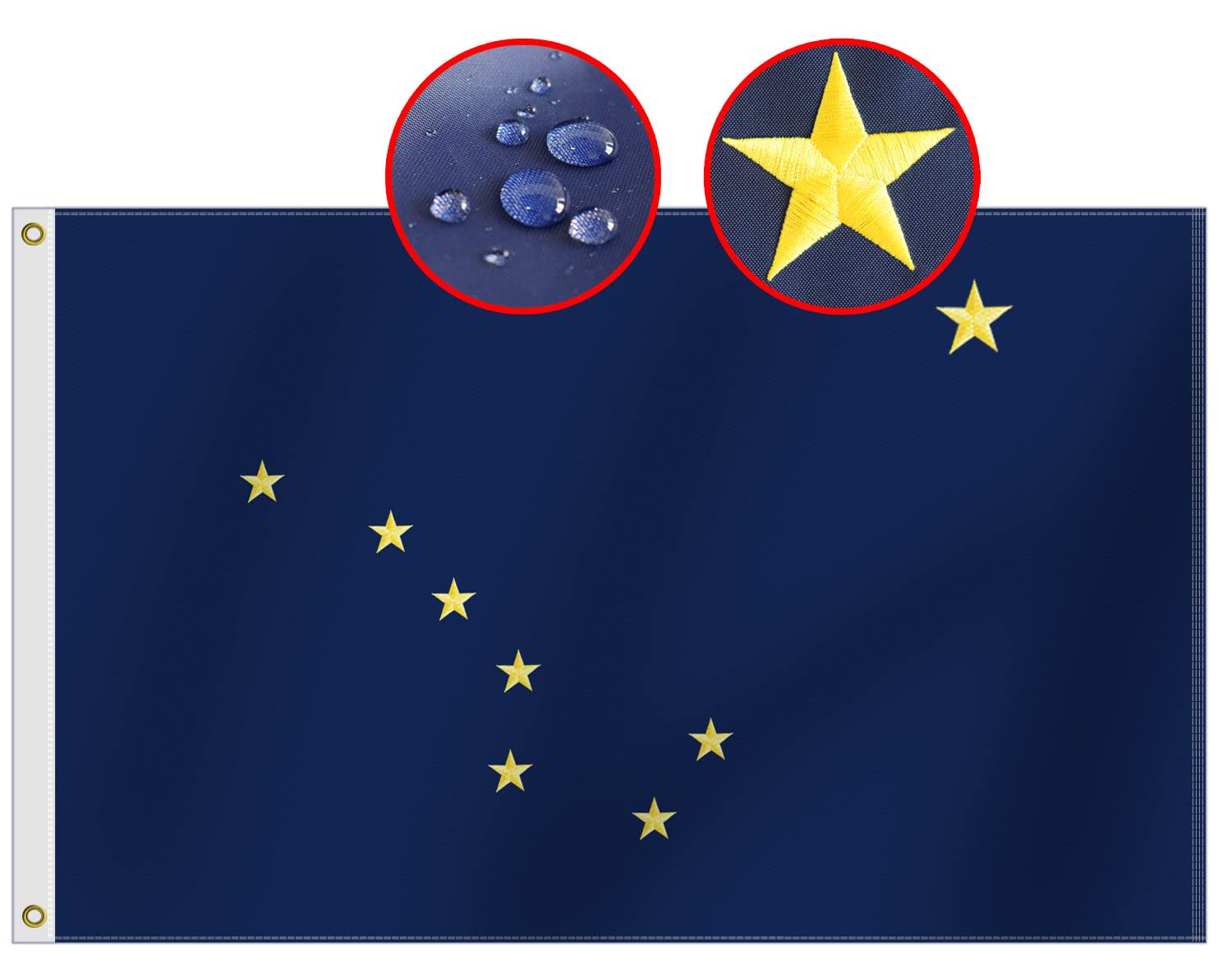
This flag uses 210-denier oxford nylon — a weave pattern that creates a tighter, more abrasion-resistant surface than standard nylon. Oxford nylon’s basketweave structure reduces the tendency of the fabric to fray along the edges, which is the primary failure mode for flags in coastal installations where salt and sand accelerate material degradation. The coating is listed as 100% waterproof, and the cyan-blue field has a lustrous sheen when new.
The four rows of stitching on the fly end are double-reinforced with a secondary bartack stitch at the stress corners — a detail that usually appears only on military-spec flags. The brass grommets are heavy-gauge and rust-proof according to the manufacturer, and verified reviews confirm they haven’t corroded after a year of seaside use. The stars are printed rather than embroidered, but the print density is high enough that the constellation remains crisp at 15 feet.
The print, however, is the weak link. Multiple reviews note that the sky blue of the stars fades noticeably after 6-9 months in direct sun, even though the navy field holds up. If you need maximum longevity from the star detail, an embroidered flag is a better bet. But for pure wind resilience and edge durability, this oxford nylon build is hard to beat.
Why it’s great
- Oxford nylon weave resists fraying and abrasion
- Double bartack stitching at high-stress points
- Waterproof coating protects against rain
Good to know
- Printed stars fade faster than embroidered ones
- Lustrous finish may appear slightly plastic at close range
5. Anley EverStrong Series Alaska State Flag
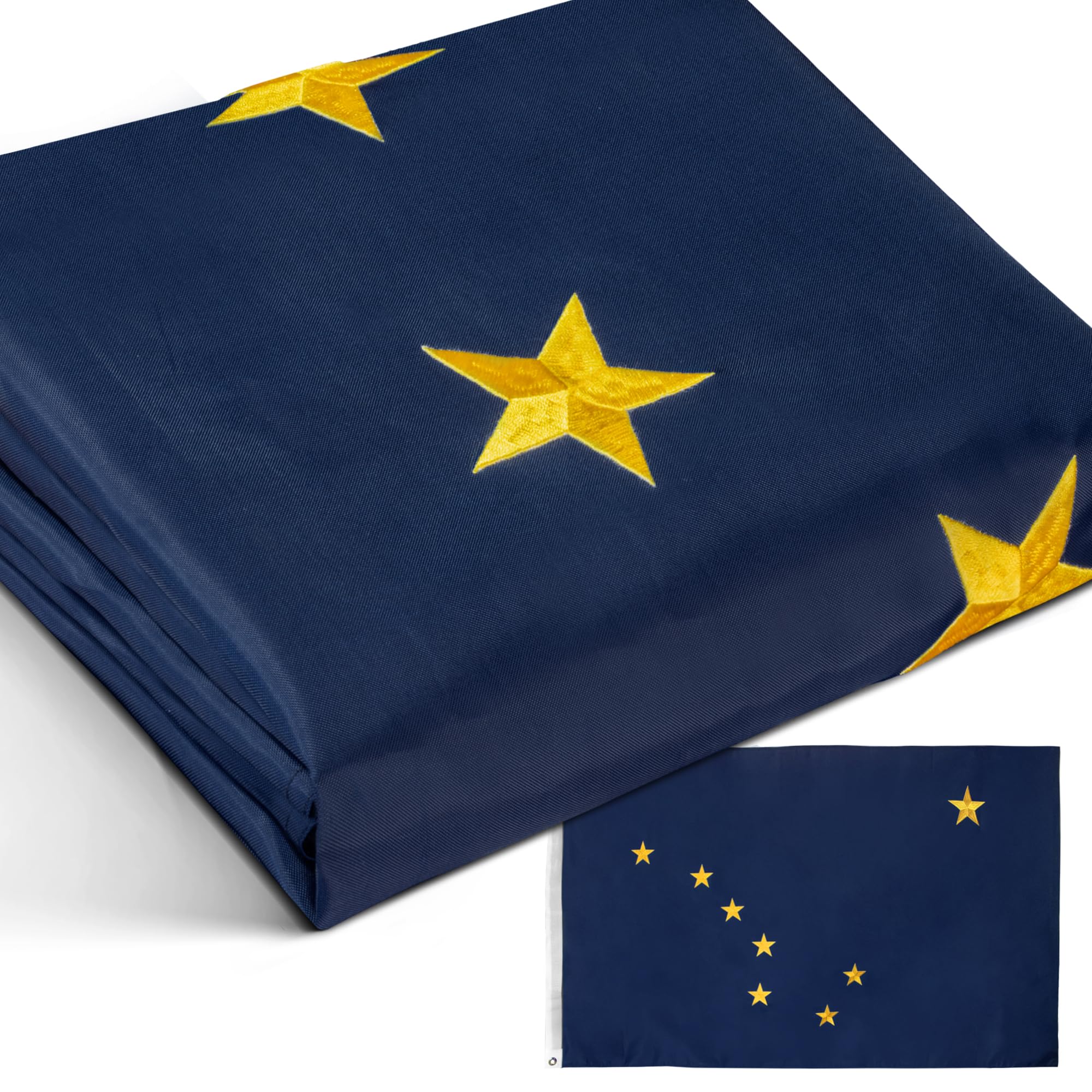
Anley’s EverStrong series is the most trusted entry-level polyester flag among state flag collectors. The waterproof heavyweight polyester is rated for outdoor use, and the embroidered stars (both the Big Dipper and Polaris) use dense enough thread to stand out against the navy field even when viewed from an angle. The flying end uses four rows of lock-stitching, and the brass grommets are standard for the price tier.
At 3 ounces, this is a lightweight flag — roughly half the weight of the G128 ToughWeave. That makes it an excellent choice for smaller flagpoles or porch mounts where a heavy flag would hang limp. The polyester is treated to resist water absorption, so it dries quickly after rain and won’t mildew easily. Verified reviews note that the colors remain vibrant after a full year of seasonal use, though fading begins to appear in the second year in high-sun zones.
The tradeoff for the low weight is reduced tear strength. In sustained winds above 30 mph or during a storm with sharp gusts, the comparatively thin fabric may develop pinhole tears along the fly edge faster than a 300D alternative. For normal daily use in moderate climates, though, the Anley delivers outsized value for its build quality.
Why it’s great
- Excellent price-to-durability ratio for typical use
- Lightweight design flies well on small poles
- Embroidered stars maintain visibility from distance
Good to know
- Thin polyester prone to pinhole tears in high wind
- Fading becomes noticeable after 18+ months of direct sun
6. XIFAN Double Sided Alaska State Flag

The XIFAN is built around a 3-ply construction that sandwiches a shade cloth layer between two layers of 101-denier polyester. This creates a flag that is readable from both sides — the stars appear correctly oriented whether you are looking at the obverse or reverse face. For indoor displays, wall mounts, or any scenario where the flag is viewed from both sides, this is the only proper solution on this list.
The 3-ply design also adds stiffness, which helps the flag hold a flat shape rather than curling at the edges when displayed indoors. The four rows of hem stitching and brass grommets are present, but the fabric’s primary strength is visual presentation rather than weather resistance. Several reviewers note that the flag faded relatively quickly — within 8 months to a year of outdoor use — which aligns with the lighter fabric weight.
This flag works best as a high-visibility indoor display or a covered porch flag where direct UV exposure is limited. If you need a true outdoor all-weather flag, the 3-ply construction actually works against it: the sandwiched layers can trap moisture between them, leading to delamination in humid environments. But the dual-sided readability is unmatched for visual applications.
Why it’s great
- True double-sided design readable from either side
- 3-ply construction prevents edge curling indoors
- Good for classroom, office, or wall display
Good to know
- Fades faster than single-layer flags in outdoor sun
- Moisture can get trapped between layers
7. Vispronet Alaska State Flag (Knitted Polyester, USA-Made)
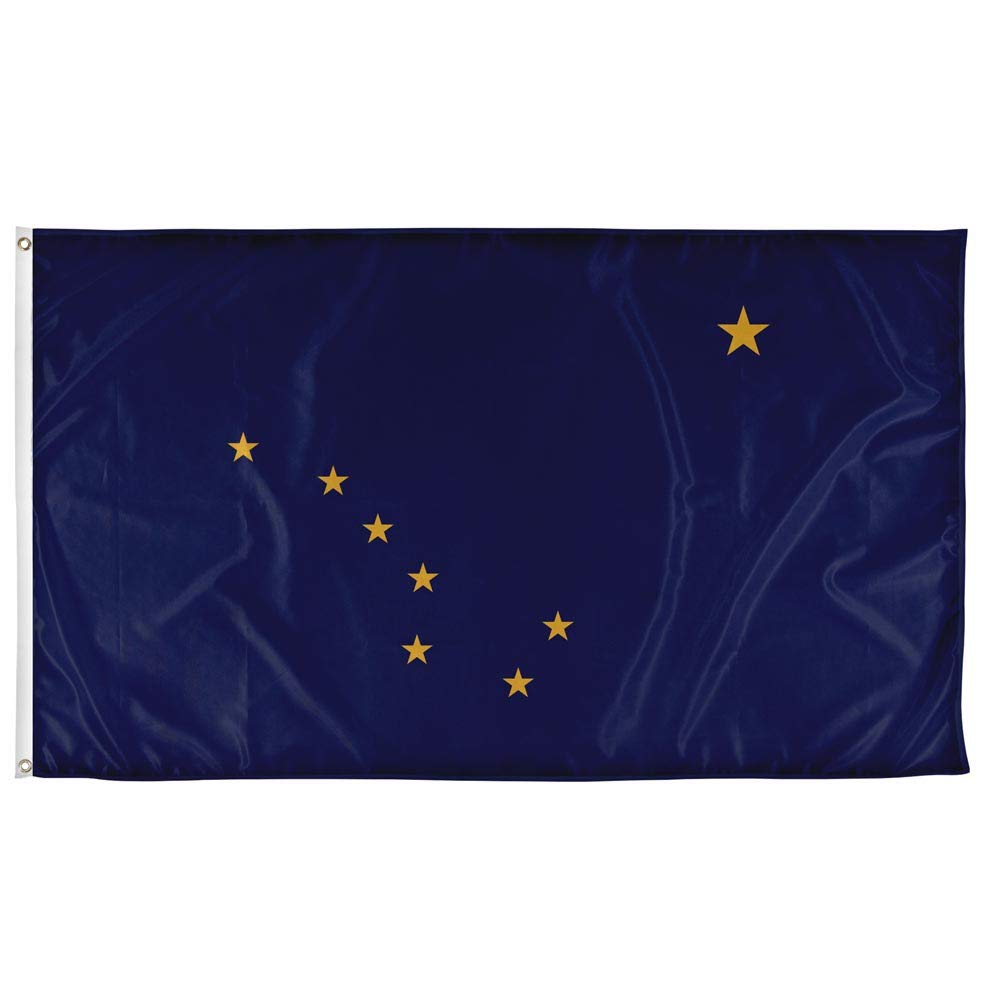
Vispronet produces this flag from knitted polyester, a fabric type that sits between woven polyester and nylon in terms of flexibility and weight. The knit construction gives the flag a softer drape than a woven alternative, making it a strong candidate for indoor use or short-term outdoor displays. The flag is printed (not embroidered) using digital transfer dye, and the design is single-sided with a mirrored reverse — so the stars appear correctly from the obverse but reversed on the back.
The manufacturing is entirely domestic — the fabric is cut, sewn, and shipped within the USA. The canvas header and brass grommets meet standard specifications, and the polyester knit resists fraying better than a low-denier woven. However, the print quality on the stars is the primary compromise: the gold color may appear slightly orange-tinted compared to embroidered flags, and the digital print can show slight banding on the constellation details up close.
For the price, this is a perfectly serviceable flag for occasional use, a garage wall, or a temporary display. But for full-time outdoor flying, the lighter knit fabric and printed stars mean it won’t match the lifespan of the embroidered polyester or nylon options in this list. The value proposition is straightforward: you are paying for USA labor and sourcing, not for premium materials.
Why it’s great
- Manufactured entirely in the USA
- Soft knit polyester has pleasant drape for indoor display
- Resists fraying better than cheap woven polyester
Good to know
- Printed stars lack the depth of embroidery
- Single-sided print — reverse side shows mirrored image
- Not ideal for everyday outdoor exposure
FAQ
What size flag is standard for a residential flagpole?
Will the Alaska state flag fade in the sun?
Can I fly the Alaska flag outdoors in winter?
How do I clean my Alaska state flag?
Final Thoughts: The Verdict
For most users, the best alaskan state flag winner is the WINBEE Premium Embroidered because it combines true embroidered stars with UV-protected polyester that stands up to full-time outdoor use without premature fading. If you want a nylon feel with maximum flexibility, grab the GORISE Embroidered Nylon. And for double-sided readability in an indoor display setting, nothing beats the XIFAN Double Sided.