
An AI accelerator card is no longer a niche workstation component — it is the engine that determines whether your local LLM runs at conversational speed or stalls on token generation. The difference between a card with 16GB of VRAM and one with 96GB is the difference between running a 7B parameter model comfortably and wrestling with memory offloading that kills inference latency. Every spec tier in this guide targets a specific workload: gaming-adjacent inference, professional content creation with AI upscaling, or full-stack model fine-tuning and deployment.
I’m Min — the co-founder and writer behind Gadgets Feed. I’ve spent hundreds of hours cross-referencing memory bandwidth, CUDA core counts, AI TOPS ratings, and thermal design profiles across the current accelerator card landscape to build a comparison that matches real workloads, not marketing tiers.
Whether you are fine-tuning a 70B parameter model locally, running stable diffusion pipelines, or deploying a multi-user inference server, this breakdown of the best ai accelerator cards will point you to the correct memory class and compute architecture for your actual budget and task list.
How To Choose The Best AI Accelerator Cards
Selecting an AI accelerator card requires evaluating three non-negotiable dimensions: VRAM capacity for model fitting, architecture generation for tensor core compatibility, and thermal solution for sustained load. Consumer gaming cards can run inference, but professional cards offer ECC memory and certified driver stacks that prevent silent data corruption during multi-day training runs.
VRAM Capacity And Model Sizing
The single most constraining resource for local AI workloads is video memory. A 7B parameter model in FP16 requires roughly 14GB of VRAM, while a 70B model demands close to 140GB. Cards with 16GB or 24GB are viable for smaller models and quantized formats (FP4, INT8), but 48GB and 96GB variants allow full unquantized model loading, eliminating the CPU offload bottleneck that kills token generation speed by orders of magnitude.
Architecture Generation And Precision Support
Tensor core generation determines which precision formats are hardware-accelerated. NVIDIA’s 5th Gen Tensor Cores on Blackwell add native FP4 support, doubling effective throughput for models that support quantization. AMD’s RDNA 4 with 2nd Gen AI Accelerators competes on the ROCm software stack, but ecosystem maturity still favors CUDA for production ML frameworks like PyTorch and TensorFlow.
Thermal Design And Multi-Card Scalability
Sustained AI workloads push GPU thermals harder than gaming. Blower-style coolers exhaust heat directly out of the chassis, making them essential for 2U server racks or multi-card workstation builds. Open-air axial fans run quieter and cooler in single-card scenarios but recirculate hot air inside the case, degrading adjacent card performance in dense configurations.
Quick Comparison
On smaller screens, swipe sideways to see the full table.
| Model | Category | Best For | Key Spec | Amazon |
|---|---|---|---|---|
| NVIDIA DGX Spark | Desktop Supercomputer | Local 200B model prototyping | 128GB unified memory + 1 PFLOPS FP4 | Amazon |
| NVD RTX PRO 6000 Blackwell | Workstation Flagship | 70B+ model fine-tuning | 96GB GDDR7 ECC | Amazon |
| PNY NVIDIA RTX A6000 | Professional Visual Computing | LLM inferencing, CAD workloads | 48GB GDDR6 | Amazon |
| ASUS ROG Astral RTX 5090 | Flagship Gaming | DLSS 4 + local inference hybrid | 3593 AI TOPS | Amazon |
| ASRock Radeon AI PRO R9700 | Pro Creators | AI dev, 8K video, multi-GPU racks | 32GB GDDR6 + blower cooler | Amazon |
| ASUS Dual RX 9060 XT | Mid-Range Value | 1440p gaming + entry AI tasks | 16GB GDDR6 + dual BIOS | Amazon |
| GIGABYTE RX 9060 XT | Budget Workhorse | 1080p/1440p gaming, light inference | 16GB GDDR6, PCIe 5.0 | Amazon |
In‑Depth Reviews
1. NVIDIA DGX Spark
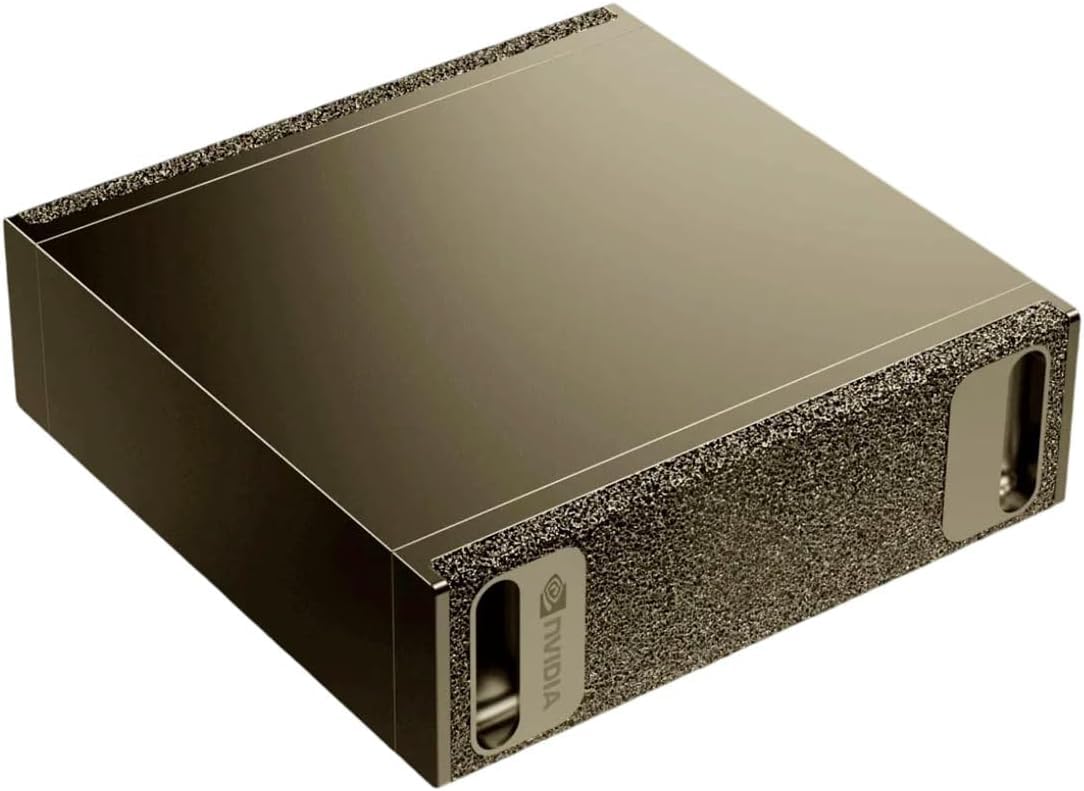
The DGX Spark is a dedicated personal AI supercomputer, not a drop-in GPU card. It integrates the NVIDIA GB10 Grace Blackwell superchip with 128GB of coherent unified system memory and delivers up to 1 petaFLOP of FP4 AI performance. This unified architecture eliminates the PCIe bandwidth bottleneck that plagues discrete GPU inference, allowing local loading of models up to 200 billion parameters without memory offloading.
The unit ships with 4TB of self-encrypted NVMe storage, ConnectX-7 Smart NIC, and the full NVIDIA AI Enterprise software stack pre-integrated. Users running Ollama, OpenCode, or ComfyUI report being able to run 27B and 70B parameter models locally at acceptable speeds for code review and image generation, all without cloud API costs or data exposure.
Its primary trade-off is the proprietary DGX OS and the lack of a visible power indicator during boot. The system runs silently and draws far less power than a multi-GPU workstation, but the closed software environment and long-term OS support concerns have led some power users to return the unit in favor of a discrete RTX 5090 for raw throughput. For secure, fully local AI development at scale, the DGX Spark is unmatched.
Why it’s great
- 128GB unified memory fits large unquantized models
- 1 PFLOPS FP4 for fast local inference and fine-tuning
- Silent, compact, low power draw vs multi-GPU rigs
Good to know
- Proprietary DGX OS may have limited long-term driver support
- Slower per-token throughput than an RTX 5090 on smaller models
2. NVD RTX PRO 6000 Blackwell

The RTX PRO 6000 Blackwell is NVIDIA’s current flagship workstation card, packing 96GB of GDDR7 ECC memory, 5th Gen Tensor Cores with native FP4 support, and a double-flow-through thermal design rated for a 600W power envelope. The 1.8 TB/s memory bandwidth allows local fine-tuning of 70B parameter models without sharding, and the MIG (Multi-Instance GPU) feature can partition the card into isolated instances for multi-user inference servers.
PCIe Gen 5 interface doubles the bandwidth available for data-intensive tasks like 3D modeling and AI dataset processing. The DisplayPort 2.1 outputs can drive 8K at 240 Hz or 16K at 60 Hz, which matters for VR environment exploration and high-refresh-rate simulation work. Users report successful deployment with ComfyUI, Ollama, and TTS pipelines on Linux using driver version 575 or newer.
The double-flow-through cooler expels hot air into the case interior rather than the rear I/O bracket, which can raise chassis ambient temperatures significantly. Users running open-air test benches note the air discharge is extremely hot and recommend additional case fans. The seller landscape includes price-gouging resellers and one verified report of malware distribution during the RMA process, so verify the seller is authorized before purchasing.
Why it’s great
- 96GB GDDR7 ECC fits very large models without offloading
- MIG partitioning enables multi-tenant inference servers
- FP4 support doubles effective throughput on quantized models
Good to know
- Hot air exhaust goes inside the case, increasing system temps
- Reseller quality varies; buy from authorized distributors
3. PNY NVIDIA RTX A6000

The RTX A6000 is built on the Ampere architecture, which is one generation behind Blackwell but still highly capable for AI inference. Its 48GB of GDDR6 memory is sufficient for running 30B parameter models in FP16 or larger models with quantization, and the single-slot blower design makes it ideal for multi-card workstation builds where board density matters. Users running LLM inference pipelines report stable performance with significantly lower power draw than a comparable 3090Ti — roughly 150W less peak.
Port selection includes four DisplayPort 1.4 outputs, and the package includes DP-to-HDMI and DVI adapters for legacy display connections. The card is explicitly not designed for gaming: it lacks the HDMI 2.1 bandwidth and the shader clock optimizations that gamers need. Instead, it targets CAD, deep learning training, and professional rendering environments where ECC memory and certified ISV drivers matter more than raw frame rate.
Its primary limitation is the older memory technology: GDDR6 instead of GDDR7, and the PCIe 4.0 interface caps bandwidth compared to newer Gen 5 cards. The compute performance is slower than a 3090Ti for rendering tasks, but the 48GB VRAM buffer, quieter blower fan, and lower energy consumption make it a compelling choice for researchers building a multi-GPU inference cluster on a budget.
Why it’s great
- 48GB GDDR6 fits large models at a lower entry point
- Blower cooler exhausts heat out the back for dense builds
- ~150W less peak power than equivalent 3090Ti setups
Good to know
- Ampere architecture lacks FP4 native support
- Not suited for gaming due to lower clock speeds
4. ASUS ROG Astral RTX 5090

The ROG Astral RTX 5090 uses NVIDIA’s Blackwell architecture in a consumer gaming form factor, delivering 3593 AI TOPS for tensor-heavy workloads. With 32GB of GDDR7 memory on a 512-bit bus, it can comfortably handle 30B parameter models and some quantized 70B configurations. The OC mode pushes the boost clock to 2610 MHz, and the BTF (Back to Future) adapter supports up to 1000 watts of power delivery through a single connector when paired with a compatible BTF motherboard.
DLSS 4 with Multi Frame Generation provides exceptional frame pacing for simulation and real-time rendering work. Users report Cyberpunk 2077 at 400+ FPS with ray tracing enabled and 360 FPS with path tracing, compared to roughly 95 FPS on an RTX 4090. The 3.8-slot cooler maintains GPU temperatures in the high 60s to low 70s Celsius under sustained gaming loads, running whisper quiet.
The card is physically enormous at 14.1 inches long and 3.8 slots wide, blocking three PCIe slots and making dual-card builds effectively impossible without a specialized chassis. The BTF design requires a compatible BTF motherboard, and there are documented quality control issues, including one unit shipped with a loose capacitor. The power draw of 780-920 watts under full load demands a 1200W minimum PSU, and the entire system acts as an effective space heater.
Why it’s great
- 3593 AI TOPS for fast tensor and DLSS workloads
- 32GB GDDR7 handles large model sizes in quantized formats
- BTF adapter simplifies cable management with compatible boards
Good to know
- 3.8-slot width prevents multi-card configurations
- Requires 1200W+ PSU; generates extreme heat under full load
5. ASRock Radeon AI PRO R9700
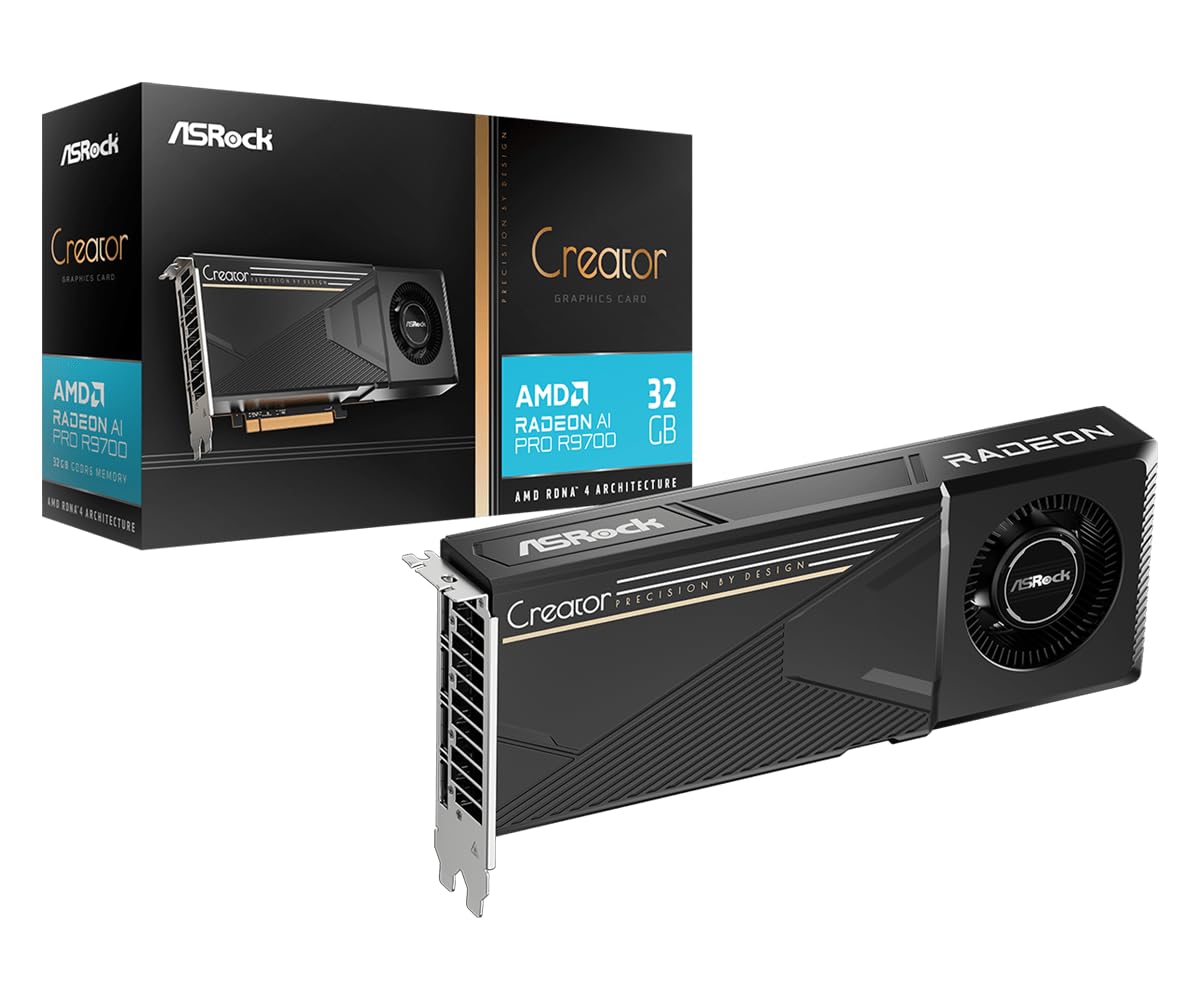
ASRock’s AI PRO R9700 is the first card on this list to use AMD’s RDNA 4 architecture with dedicated 2nd Gen AI Accelerators. Its 32GB of GDDR6 memory on a 256-bit bus delivers 20 Gbps memory speed, making it suitable for running 7B and 13B parameter models in FP16, or up to 30B models with quantization. The blower-style cooler uses a vapor chamber and Honeywell PTM7950 thermal interface material to exhaust heat directly out of the chassis, a critical feature for multi-GPU workstation racks.
PCIe 5.0 support and four DisplayPort 2.1a outputs enable high-bandwidth data transfer and multi-monitor 8K professional displays. Users running ComfyUI, Ollama, and Hermes Agent on Ubuntu report good performance at 64 degrees Celsius VRAM temperature, significantly cooler than a comparable RTX 3090 which runs at 80-82 degrees. The compact 2-slot form factor maximizes density in server racks.
The primary drawback is the immature ROCm software ecosystem for the R9700, which requires some tinkering with driver versions and may not support all PyTorch features out of the box. The blower fan is audibly louder than open-air designs, described as similar to an air purifier in noise level. Additionally, some units have exhibited coil whine and one verified report of missing fan assembly screws, indicating QA inconsistency.
Why it’s great
- 32GB GDDR6 with blower cooling ideal for multi-GPU setups
- Lower VRAM temps than NVIDIA Ampere equivalents
- PCIe 5.0 and DP 2.1a for professional display needs
Good to know
- ROCm support is still maturing; expect driver troubleshooting
- Blower fan is audibly louder than axial fan designs
6. ASUS Dual Radeon RX 9060 XT
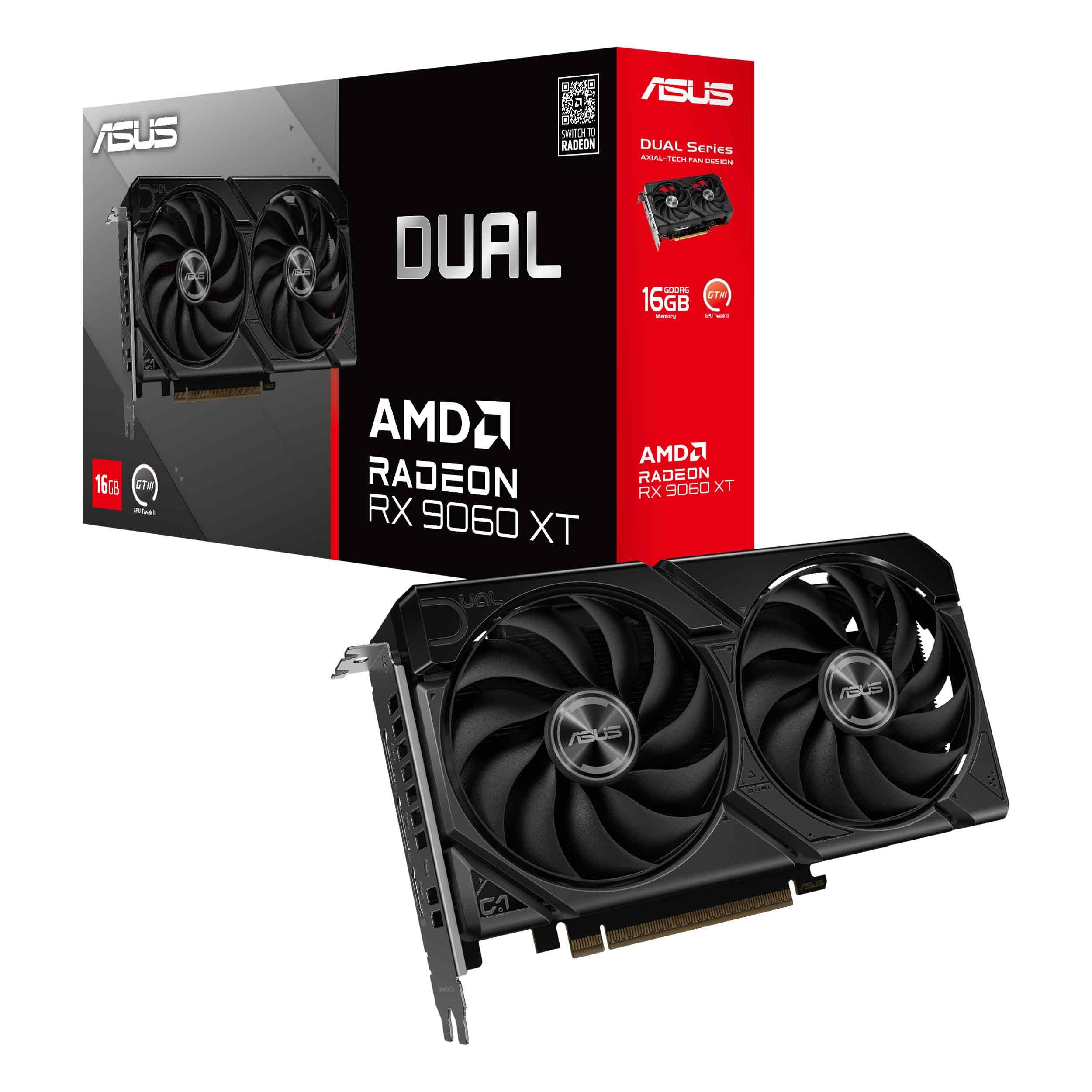
The ASUS Dual RX 9060 XT offers a strong balance of AI inference capability and gaming performance. With 16GB of GDDR6 memory and a boost clock of 3250 MHz, it can run 7B parameter LLMs in FP16 and smaller diffusion models locally, while delivering excellent 1440p gaming performance in titles like Destiny 2 at 180 FPS. The dual BIOS switch lets users toggle between Quiet and Performance profiles, and the 0dB technology stops the fans entirely under light loads for silent operation.
The 2.5-slot design keeps the card compact enough for ITX cases, with dimensions of just 8 inches in length and 4.7 inches in width. Users report GPU temperatures in the 60-75 degrees Celsius range even in small form factor builds. The axial-tech fans with a smaller hub and barrier ring increase downward air pressure, and the dual ball bearings are rated for up to twice the lifespan of sleeve bearing designs.
The card’s 16GB VRAM limits it to smaller models and quantized formats, and it lacks the dedicated AI accelerators found on AMD’s PRO series or NVIDIA’s Tensor Core lines. The plastic backplate feels less premium than metal alternatives, and the current pricing landscape makes it a tighter value proposition. It is best suited for users who need a daily driver for 1440p gaming with occasional local AI experimentation on the side.
Why it’s great
- Compact 2.5-slot design fits ITX and small cases
- Dual BIOS and 0dB fan stop for quiet operation
- Excellent 1440p gaming performance with 16GB VRAM
Good to know
- 16GB VRAM limits model size to 7B-13B quantized ranges
- Plastic backplate feels less durable than metal alternatives
7. GIGABYTE Radeon RX 9060 XT

The GIGABYTE RX 9060 XT is the value-oriented entry point into PCIe 5.0 graphics for AI-adjacent workloads. It shares the same 16GB GDDR6 memory configuration as the ASUS Dual variant but trades some compactness and BIOS flexibility for the WINDFORCE triple-fan cooling system, which uses Hawk fans and server-grade thermal conductive gel to maintain low temperatures under load. Users report zero-RPM mode for silent operation during light tasks and excellent thermals during sustained 1440p ultra sessions in titles like Cyberpunk 2077 and Hogwarts Legacy.
PCIe 5.0 support ensures the card will not be a bottleneck for future CPU generations, and the 8-pin power connector avoids the adapter headaches associated with higher-end cards. The 16GB VRAM buffer is sufficient for 1080p and 1440p gaming at max settings, and users consistently highlight the dollar-for-dollar value as the card’s strongest selling point. FSR 4 upscaling and AV1 encoding provide additional utility for content creation and streaming.
The 11.06-inch length and 4.65-inch width make this a large card that may not fit compact cases, and the ray tracing performance on AMD’s Radeon architecture still trails NVIDIA’s RTX equivalent. The 16GB VRAM is the same limitation as the ASUS variant — fine for quantized 7B models but insufficient for larger unquantized LLMs. It is the strongest pick for budget-conscious users who want a primarily gaming-focused card that can also serve as a capable entry-level AI accelerator.
Why it’s great
- Excellent dollar-for-dollar value in 1440p gaming
- WINDFORCE triple-fan cooling runs quiet and cool
- PCIe 5.0 and AV1 encoding for future-proofing
Good to know
- Large footprint may not fit small form factor cases
- Ray tracing performance lags behind NVIDIA alternatives
FAQ
Can a gaming GPU like the RTX 5090 replace a professional workstation card for local AI?
How much VRAM do I need to run a 70B parameter model locally?
Why does AMD ROCm have less software support than NVIDIA CUDA for AI?
Final Thoughts: The Verdict
For most users, the best ai accelerator cards winner is the NVIDIA DGX Spark because its 128GB unified memory and 1 PFLOPS FP4 performance allow local operation of large models without the complexity of multi-GPU setups. If you want the highest raw TOPS in a discrete GPU format, grab the ASUS ROG Astral RTX 5090. And for multi-GPU inference servers where heat exhaust and ECC reliability are critical, nothing beats the NVD RTX PRO 6000 Blackwell.