
Stacks of old photographs, boxes of receipts, and folders of tax documents sit untouched because the thought of scanning each piece individually on a flatbed feels like a part-time job. Automatic photo scanners solve this by feeding pages, receipts, or photos through an ADF or straight path, digitizing both sides in seconds with no manual flipping.
I’m Min — the co-founder and writer behind Gadgets Feed. I’ve spent countless hours dissecting the scan engines, feeder mechanisms, and bundled software ecosystems of the current auto-feed scanner market to isolate what actually separates a fast, reliable digitizer from a frustrating paper jam machine.
Whether you are archiving family photo albums or clearing a decade of business receipts, the right tool transforms a grudge task into a batch workflow. This guide breaks down the top contenders to help you find the best automatic photo scanner for your specific stack size and image quality needs.
How To Choose The Best Automatic Photo Scanner
Automatic photo scanners are not created equal. Some prioritize blistering document speed, while others are tuned for delicate photo paper, precise color depth, and minimal streaks. Before you buy, match the scanner’s strengths to your actual job: high-volume document archiving, fragile photo digitization, or receipt management with financial software integration.
Scan Speed and Feeder Design
The advertised pages-per-minute (ppm) figure often refers to one-sided 300 dpi black-and-white documents. For photos, you typically run at 600 dpi or higher in color, which halves the rated speed. A 25 ppm duplex scanner will process roughly 12–15 color photos per minute. Equally important is the feeder path: a U-turn path can bend stiff photo paper, while a straight-through path handles card stock and Polaroids without jamming.
Image Quality and Sensor Type
CIS sensors are compact and energy-efficient, powering most modern portable scanners. They produce excellent 600 dpi scans for receipts and documents, but may struggle with depth-of-field on wrinkled or curved photos. CCD sensors, found in bulkier office models, deliver superior color accuracy and shadow detail on glossy prints. For true photo archiving where color fidelity matters, prioritize a CCD sensor or a CIS unit with active background removal and dust detection.
Bundled Software Ecosystem
Hardware is only half the equation. The best automatic photo scanners include software that auto-crops, deskews, rotates, removes blank pages, and exports to searchable PDFs or JPGs without manual intervention. Look for features like automatic file naming based on content type (receipt vs. photo), direct cloud upload (Dropbox, Google Drive, OneDrive), and integration with financial tools like QuickBooks or TurboTax. Software that requires manual saving of every scan will kill your batch workflow.
Quick Comparison
On smaller screens, swipe sideways to see the full table.
| Model | Category | Best For | Key Spec | Amazon |
|---|---|---|---|---|
| Canon imageFORMULA RS40 | Premium | High-volume photo batches up to 40 items/min | 600 dpi optical, 40 ppm duplex | Amazon |
| Epson WorkForce ES-580W | Premium | Wireless networked offices | CCD sensor, 35 ppm duplex | Amazon |
| ScanSnap iX2400 | Premium | Speed at 45 ppm with 100-sheet ADF | 600 dpi, 45 ppm duplex | Amazon |
| Brother ADS-3100 | Premium | Mixed document types with security features | 600 dpi, 40 ppm duplex | Amazon |
| ScanSnap iX1300 | Premium | Compact wireless scanning to cloud | 600 dpi, 30 ppm duplex | Amazon |
| Canon imageFORMULA R30 | Premium | Plug-and-scan USB with no software install | 600 dpi, 25 ppm duplex | Amazon |
| Doxie Pro | Premium | Duplex document scanning with direct feed slot | 600 dpi optical, duplex auto-feed | Amazon |
| Epson RapidReceipt RR-60 | Premium | Receipt and invoice digitization with QuickBooks | 600 dpi, 10 ppm simplex | Amazon |
| HP Small USB Scanner PS100 | Premium | Ultra-portable simplex scanning for travel | 300 dpi, 15 ppm simplex | Amazon |
In‑Depth Reviews
1. Canon imageFORMULA RS40

The Canon imageFORMULA RS40 is purpose-built for photo digitization, offering a 40-page-per-minute duplex feed that handles Polaroids, 4×6 prints, business cards, and receipts in mixed batches. Its RGB LED light source and interpolated 1200 dpi capability mean glossy photo paper gets even illumination without hot spots. Users report stacking 20–30 photos in the ADF with minimal jams across thousands of scans, a reliability figure that justifies its position as a serious archiving tool.
The bundled CaptureOnTouch and photo enhancement software includes red-eye correction, face smoothing, and auto-cropping — features absent from most document-focused scanners. The RS40 saves to JPG, TIF, PNG, PDF, and even PPTX, giving flexibility for scrapbooking or cloud sharing. A known quirk is that the default profile can crush shadow detail on underexposed photos, so adjusting brightness/contrast in the software profile is recommended before batch runs.
While the RS40 excels at photos, its software interface has a learning curve and the unit is not wireless — it uses a USB connection. For users whose primary goal is digitizing shoeboxes of family photos without spending hours per image, the RS40’s speed, dual-sided scanning, and dedicated photo tools make it the top pick in the category.
Why it’s great
- Dedicated photo software with red-eye correction and face smoothing
- 40 ppm duplex handles up to 30 photos with few jams
Good to know
- No Wi-Fi connectivity; USB tethered only
- CaptureOnTouch software can be clunky and may need temp file cleanup on long batches
2. Epson WorkForce ES-580W
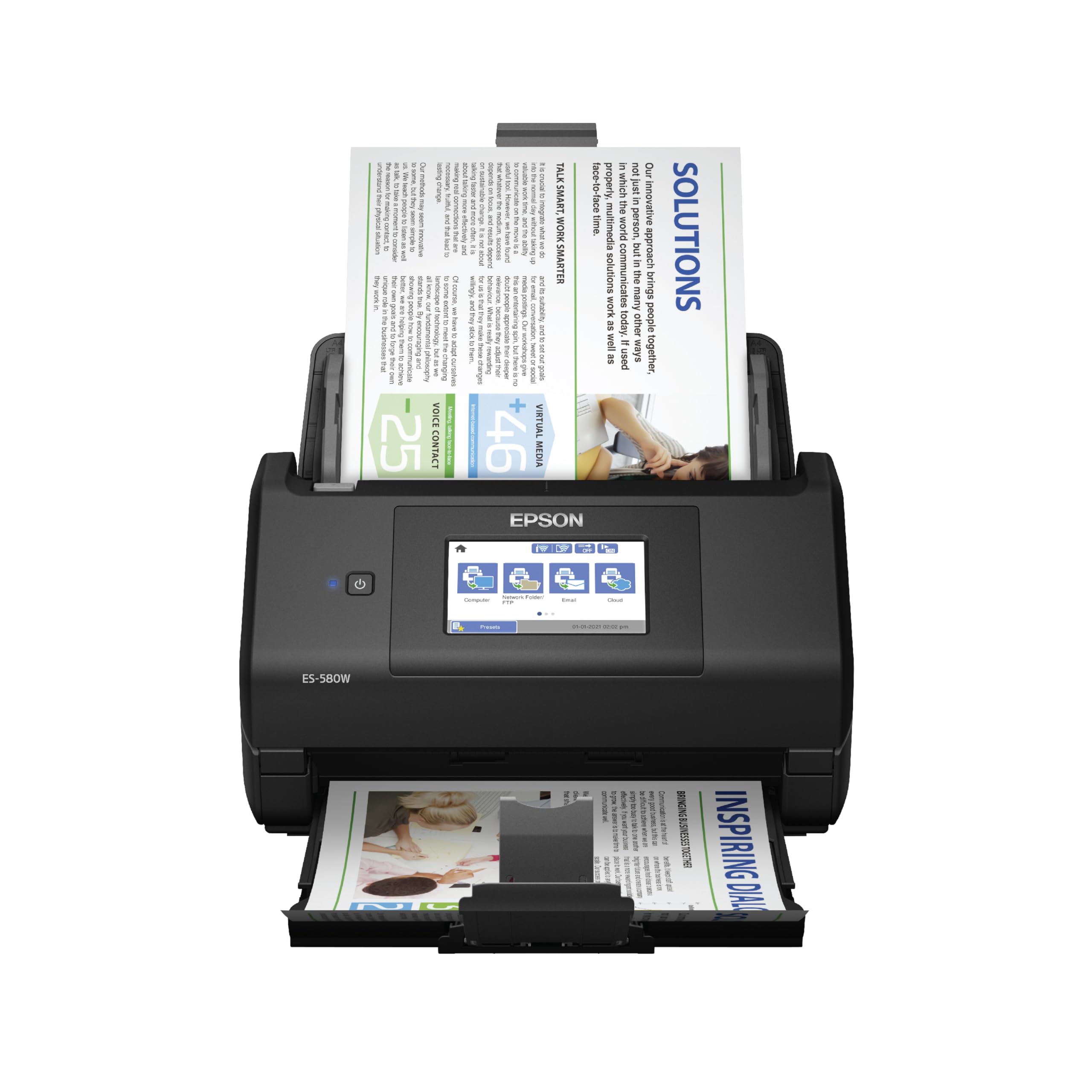
The Epson WorkForce ES-580W distinguishes itself with a CCD optical sensor — a rarity in the auto-feed scanner market. CCD provides superior color depth and shadow detail on glossy photos compared to the CIS sensors found on nearly every other model here. Combined with a 100-sheet ADF and 35 ppm duplex speed, it is built for uninterrupted batch scanning of both documents and photos.
Its 4.3-inch color touchscreen allows stand-alone operation: you can scan directly to USB, email, or cloud services like Dropbox, Google Drive, and OneDrive without turning on a computer. The ES-580W also includes TWAIN drivers for integration with business software like QuickBooks. Active dirt detection and paper skew correction further reduce manual cleanup time on older or dusty photo prints.
The catch is size and weight — at nearly 8 pounds, it is not a portable unit. Some users note the lack of Ethernet as a minor drawback, and the bundled software suite is not as photo-centric as the Canon RS40’s. For a networked office or home where both photos and documents need to be batch-fed wirelessly to the cloud, the ES-580W’s CCD sensor makes it the best choice for image quality.
Why it’s great
- CCD sensor delivers superior color depth on glossy photos
- Stand-alone scanning via 4.3″ touchscreen, no PC required
Good to know
- Heavier and bulkier than CIS-based competitors
- No Ethernet port; Wi-Fi and USB only
3. ScanSnap iX2400
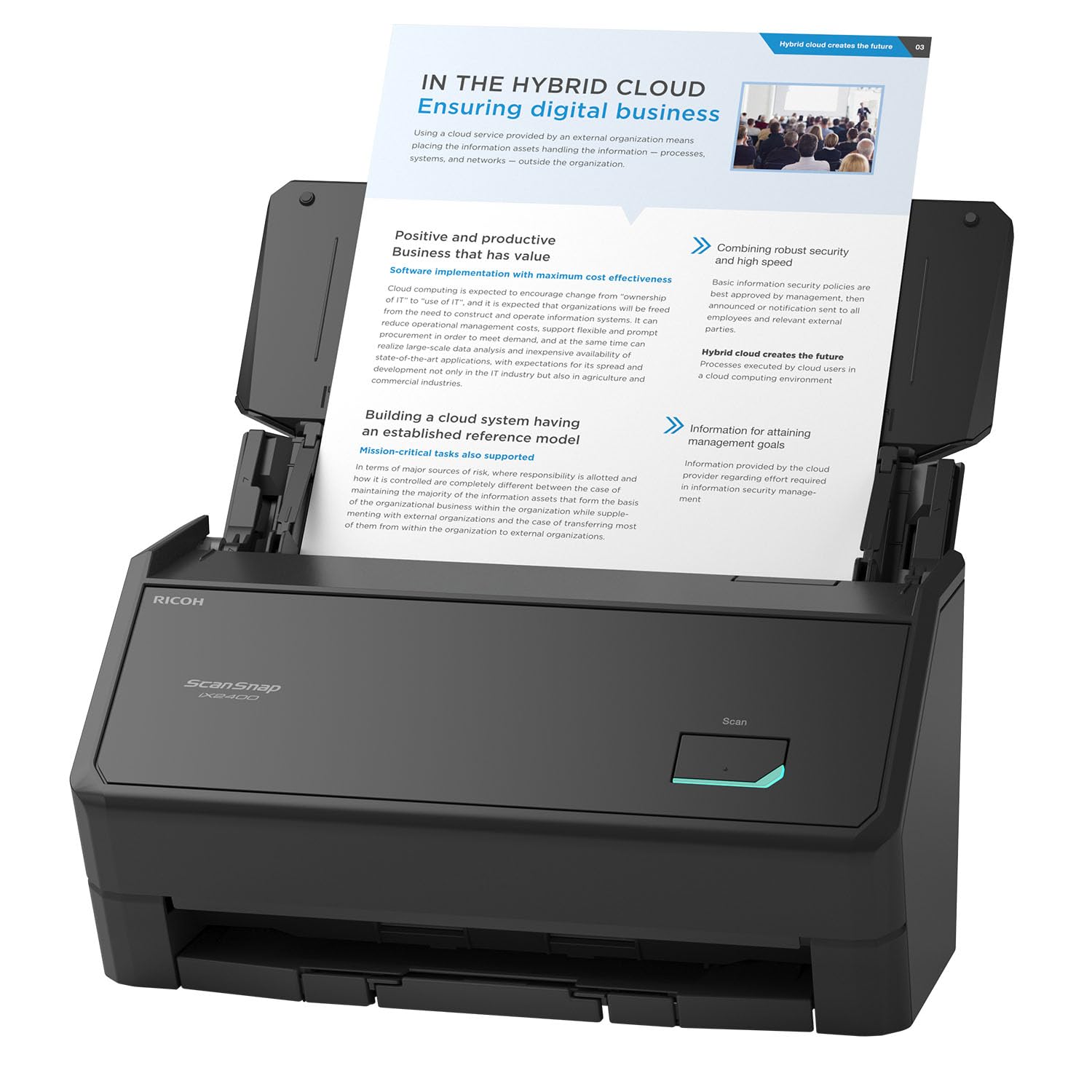
The ScanSnap iX2400 is the fastest scanner on this list, pushing 45 pages per minute duplex through a 100-sheet automatic document feeder. That translates to roughly 90 images per minute when scanning double-sided photos. The one-touch button workflow means you load, press, and walk away — ScanSnap Home software auto-detects document size, removes blank pages, deskews, and rotates images without any driver configuration.
Build quality is high, with a reported lifespan spanning years even at heavy use. The iX2400 handles mixed batches of business cards, receipts, photos, and envelopes without issue. Its USB-only connection ensures consistent performance without Wi-Fi dropouts, a deliberate design choice for reliability over convenience.
The main tradeoff is price and the lack of TWAIN or WIA support, which limits compatibility with some third-party document management systems. The ScanSnap Home software, while powerful, requires a few extra clicks for folder naming. For pure throughput volume — scanning thousands of pages a month with minimal intervention — the iX2400 is unmatched in speed.
Why it’s great
- Fastest duplex speed at 45 ppm in its class
- Reliable 100-sheet ADF with auto image cleanup
Good to know
- No Wi-Fi or Bluetooth; USB tethered
- Does not support TWAIN/WIA drivers
4. Brother ADS-3100

The Brother ADS-3100 targets small offices and work-from-home setups that need reliable duplex scanning at 40 ppm with triple-layer security for sensitive documents. Its 60-sheet ADF handles mixed media types — from business cards to 8.5×14 inch documents — and the USB 3.0 connection ensures fast data transfer for large file batches. The scanner includes TWAIN and WIA drivers, making it compatible with virtually any document management software.
What sets the ADS-3100 apart is its bundle of seven software applications, including OCR, PDF editing, and file optimization tools. It also supports scanning directly to USB, allowing you to capture documents without a connected computer. Users report it handles double-sided cards and photo paper reliably with minimal skew.
Some owners have experienced feeding issues where multiple pages are pulled at once, a problem that Brother support has not always resolved quickly. The ADS-3100 also lacks Wi-Fi, so it is a wired-only solution. For a secure, fast, and software-rich unit that integrates with existing business workflows, the ADS-3100 is a strong mid-range option despite the occasional feeding concern.
Why it’s great
- Triple-layer security features for sensitive scanning
- Bundled with seven applications including premium OCR
Good to know
- No Wi-Fi; USB 3.0 only
- Occasional multi-page feeding on mixed media
5. ScanSnap iX1300

The ScanSnap iX1300 is a compact marvel that folds away into a desk drawer yet delivers 30 ppm duplex scanning with both USB and Wi-Fi connectivity. Its space-saving design includes an innovative fold-out ADF that stays low-profile even when in use. The scanner handles documents, photos, cards, and even plastic IDs through a manual feeder in addition to the ADF, giving you flexibility for non-standard items.
ScanSnap Home software provides a drag-and-drop Quick Menu that sends scans directly to your preferred apps — email, Dropbox, Evernote, or local folders — with automatic de-skew, color optimization, and blank page removal. Users report scanning over 9,000 photos reliably on this unit, with the auto-scan feature correcting slightly skewed feeds without intervention.
The iX1300 is not the fastest in its family (the iX2400 is significantly quicker) and the ADF capacity is smaller than the 100-sheet flagships. Some users report jams every 4–5 scans when feeding non-standard paper. For a home office seeking a compact, wireless auto-feed scanner that handles photos and documents without taking over the desk, the iX1300 offers an excellent balance of size and capability.
Why it’s great
- Folding design fits in a desk drawer while maintaining 30 ppm speed
- Dual connectivity via USB and Wi-Fi for flexible placement
Good to know
- Not as fast as the higher-tier ScanSnap models
- Occasional jams with glossy or non-standard paper types
6. Canon imageFORMULA R30

The Canon imageFORMULA R30 is designed for users who want to scan immediately without wrestling with driver installations. It stores its scanning software on the device itself — plug it into a computer via the supplied USB cable and it auto-launches, eliminating compatibility headaches. The 60-sheet ADF feeds documents at 25 ppm duplex, making it a solid choice for medium-volume digitization.
The R30 handles mixed media types including invoices, contracts, and business cards with reliable blank page skip and auto-crop. Users have reported scanning over 1,000 pages in a single session without jams or overheating. The built-in software updates automatically, ensuring you always have the latest features without manual downloads.
The R30 does not include photo-specific software like red-eye correction or face smoothing, so it is better suited for document archiving than photo archiving. Some users report driver instability on certain operating systems, requiring occasional reinstallation. For a no-fuss, reliable batch document scanner that bypasses software setup entirely, the R30 delivers excellent value.
Why it’s great
- Built-in software runs from the scanner itself — no driver installation
- 60-sheet ADF with reliable auto-crop and blank page skip
Good to know
- No dedicated photo enhancement tools
- Driver instability reported on some system configurations
7. Doxie Pro

The Doxie Pro stands out with a unique collapsible document feeder and a separate direct feed slot for thick or delicate items like folded paper, receipts, and photos that might jam in a standard ADF. It scans both sides automatically at up to 600 dpi, with real-time text recognition and image enhancement — auto-crop, auto-rotate, and contrast boost are applied on the fly without needing to rescan.
The bundled Doxie software is intentionally simple: it imports scans and lets you organize them into batches, then send them to Dropbox, Evernote, OneNote, or iCloud with a single click. There are no complicated drivers to install, and the company offers responsive US-based support. Its compact footprint measures roughly 12 by 4 by 3 inches, fitting easily on a crowded desk.
One limitation is the 20-page ADF capacity, which is lower than many competitors. Some users find the full retail price higher than comparable specs, though it is often found at a discount for a used unit. For users who need duplex scanning with a dedicated path for fragile paper, the Doxie Pro’s direct feed slot makes it a uniquely capable tool in this space.
Why it’s great
- Direct feed slot handles thick, delicate, or folded paper without jams
- Simple, clutter-free software with one-click cloud export
Good to know
- Small 20-page ADF capacity limits batch size
- No wireless connectivity; USB only
8. Epson RapidReceipt RR-60

The Epson RapidReceipt RR-60 is purpose-built for one job: digitizing receipts and invoices for financial management. It uses ScanSmart AI PRO technology to automatically categorize scanned receipts, extract key data, and export to QuickBooks, TurboTax, or other financial software. At just 10 oz and USB-powered, it is the lightest and most portable scanner in this list — ideal for small business owners who scan on the go.
The RR-60 scans at 10 ppm simplex and 600 dpi, auto-crops and removes background, and creates searchable PDFs. It recognizes whether you are scanning a receipt, an invoice, or a business card and applies appropriate file naming conventions automatically. Users consistently praise how it feeds receipts smoothly and straight, producing high-quality PDFs suitable for archiving or accounting.
The biggest drawback is speed: 10 ppm simplex means photos take 6 seconds each, and there is no duplex scanning. For high-volume photo batches this is too slow. Some users also report reliability issues after a few months, with connection errors rendering the scanner unusable. For small businesses processing 10–30 receipts per day with tight software integration, the RR-60 excels — but it is not a general-purpose photo scanner.
Why it’s great
- AI-driven receipt categorization with QuickBooks and TurboTax export
- Ultra-portable at 10 oz, USB powered, fits in a laptop case
Good to know
- Slow 10 ppm simplex — not suitable for high-volume photo scanning
- Some units report connection errors after a few months of use
9. HP Small USB Scanner PS100

The HP PS100 is the smallest and lightest scanner in this guide at just 3 ounces, designed for travelers, students, and professionals who need occasional simplex scanning on the road. It slides into a bag or briefcase and powers via USB 2.0, eliminating the need for a separate power adapter. Despite its size, it offers 300 dpi scanning at up to 15 ppm for documents, receipts, business cards, and photos up to 8.5 x 14 inches.
The bundled HP WorkScan software provides auto-scan and size detection, along with basic image optimization like background cleanup and edge smoothing. Users report it as an excellent upgrade from using a multi-function printer for photos, with significantly faster per-image throughput for small batches. The simplex design means you must flip ID cards or two-sided photos manually, which is expected at this form factor.
Resolution is locked at 300 dpi in some software configurations, which is fine for documents but less ideal for detailed photo archiving where 600 dpi is standard. The PS100 is a dedicated on-the-go tool — it lacks ADF capacity beyond a single sheet and cannot compete with desktop models. For the user whose primary need is fast, portable digitization of a few photos or documents at a time, the PS100 is an unbeatable lightweight companion.
Why it’s great
- Weighs 3 oz and slips into any bag — true pocket portability
- USB powered with no external adapter needed
Good to know
- Simplex only — requires manual flipping for two-sided items
- Software may restrict resolution to 300 dpi; third-party software recommended for 600 dpi
FAQ
Can an automatic photo scanner handle glossy photo paper without scratching it?
Is 300 dpi sufficient for scanning family photos, or do I need 600 dpi?
Why does my automatic photo scanner produce streaks on every photo?
Final Thoughts: The Verdict
For most users looking for the best automatic photo scanner, the winner is the Canon imageFORMULA RS40 because it combines 40 ppm duplex speed with dedicated photo software features like red-eye correction and face smoothing that no other model in this list matches. If you need wireless stand-alone scanning with superior CCD image quality, grab the Epson WorkForce ES-580W. And for the fastest batch throughput — digitizing thousands of pages per month — nothing beats the ScanSnap iX2400 at 45 ppm with a 100-sheet ADF.