
Moving a heavy, fume-spewing gas generator out of the garage, filling it with stabilizer-treated fuel, and listening to it drone for hours during a blackout is a ritual most homeowners are ready to retire. The modern alternative is a battery-powered 1000Wh power station that slips into a corner, charges from a wall outlet or solar panel, and delivers silent, emission-free electricity the moment the grid goes down. These units have matured past niche camping gear into serious home backup appliances, with LiFePO₄ battery chemistry now standard for thousands of charge cycles and inverter technology clean enough for sensitive electronics.
I’m Min — the co-founder and writer behind Gadgets Feed.
I paired each unit against practical load scenarios — running a refrigerator overnight, powering a CPAP machine, or keeping a home office online during an outage — to give you a dense, actionable evaluation of the very best 1000wh power station options available right now.
How To Choose The Best 1000Wh Power Station
A 1000Wh power station sits at the sweet spot between portability and real backup capability. Before you buy, focus on the battery chemistry, the inverter’s continuous and surge wattage, the speed of recharging, and the port selection. Each spec directly determines whether the station will keep your refrigerator cold, your CPAP running through the night, or your tools buzzing at a job site.
Battery Chemistry and Cycle Life
All of the top-tier units now use LiFePO₄ (LFP) cells, which deliver 3,000 to 6,000 charge cycles before dropping to 80% capacity. That translates to 8 to 15 years of daily use, far outlasting the older NMC batteries that degrade after 500 to 1,000 cycles. For a dedicated home backup unit, the longer cycle life justifies a higher upfront cost.
AC Inverter Output and Surge Capacity
The continuous AC wattage rating tells you what appliances the station can run indefinitely. A 1,800W inverter powers most refrigerators, sump pumps, and power tools, while a 2,400W unit can handle a small window AC or a microwave. The surge rating — typically 2x to 3x continuous — matters for starting motors in fridges and pumps. Check both numbers against your critical loads.
Charging Speed and Solar Input
Fast AC recharging — under 2 hours for a full 1kWh — means you can top up between outages. Solar input voltage and wattage limits determine how quickly you can recharge off-grid. Most 1000Wh stations accept 200W to 500W of solar, and the higher the MPPT voltage range, the more panel configurations are possible.
Port Selection and UPS Behavior
Count the AC outlets, USB-C PD ports, and 12V DC outputs you actually need. A station with a sub-20ms UPS transfer time will keep a desktop computer or network gear running through a flicker. Confirm that the UPS mode works with the specific appliances you plan to protect, as some units have quirks with sensitive loads.
Quick Comparison
On smaller screens, swipe sideways to see the full table.
| Model | Category | Best For | Key Spec | Amazon |
|---|---|---|---|---|
| DJI Power 2000 | Premium | Whole-home essentials & drone fleet | 2048Wh, 3000W inverter, 55-min 80% charge | Amazon |
| Jackery Explorer 2000 v2 | Premium | Lightweight 2kWh RV & home backup | 2042Wh, 2200W inverter, 39.5 lbs, CTB | Amazon |
| Anker SOLIX C1000 | Mid-Range | Portable camping & fridge backup | 1056Wh, 1800W inverter, 80% in 43 min | Amazon |
| EF ECOFLOW Delta 2 | Mid-Range | Expandable home backup & RV | 1024Wh, 1800W inverter, 3000+ cycles | Amazon |
| AFERIY 3840Wh Station | Mid-Range | Large-capacity home backup on a budget | 3840Wh, 3600W inverter, UPS <10ms | Amazon |
| BLUETTI Elite 300 | Premium | Compact 3kWh RV & home backup | 3014Wh, 2400W inverter, 78-min full charge | Amazon |
| Enphase IQ PowerPack 1500 | Premium | Enphase solar ecosystem integration | 1500Wh, 1500W inverter, built-in IQ8 microinverters | Amazon |
| EGO POWER+ PST3042 | Mid-Range | EGO tool owners & tailgating | 2000W continuous, 3000W peak, 2x 56V 7.5Ah | Amazon |
| Jackery HomePower 3000 | Premium | Whole-home essentials & RV 30A | 3072Wh, 3600W inverter, 1.7-hr hybrid charge | Amazon |
| GROWATT HELIOS 3600 | Premium | Whole-house 240V backup & off-grid | 3600Wh, 3600W inverter, expandable to 36kWh | Amazon |
| Anker SOLIX F3000 | Premium | Generator passthrough & high solar input | 3072Wh, 3600W inverter, 2400W solar input | Amazon |
| VTOMAN FlashSpeed Pro 3600 | Premium | Fast-charging RV & home backup | 3096Wh, 3600W inverter, 2-hr full AC charge | Amazon |
| BLUETTI Apex 300 | Premium | 120V/240V split-phase home backup | 2765Wh, 3840W inverter, 0ms UPS | Amazon |
In‑Depth Reviews
1. DJI Power 2000
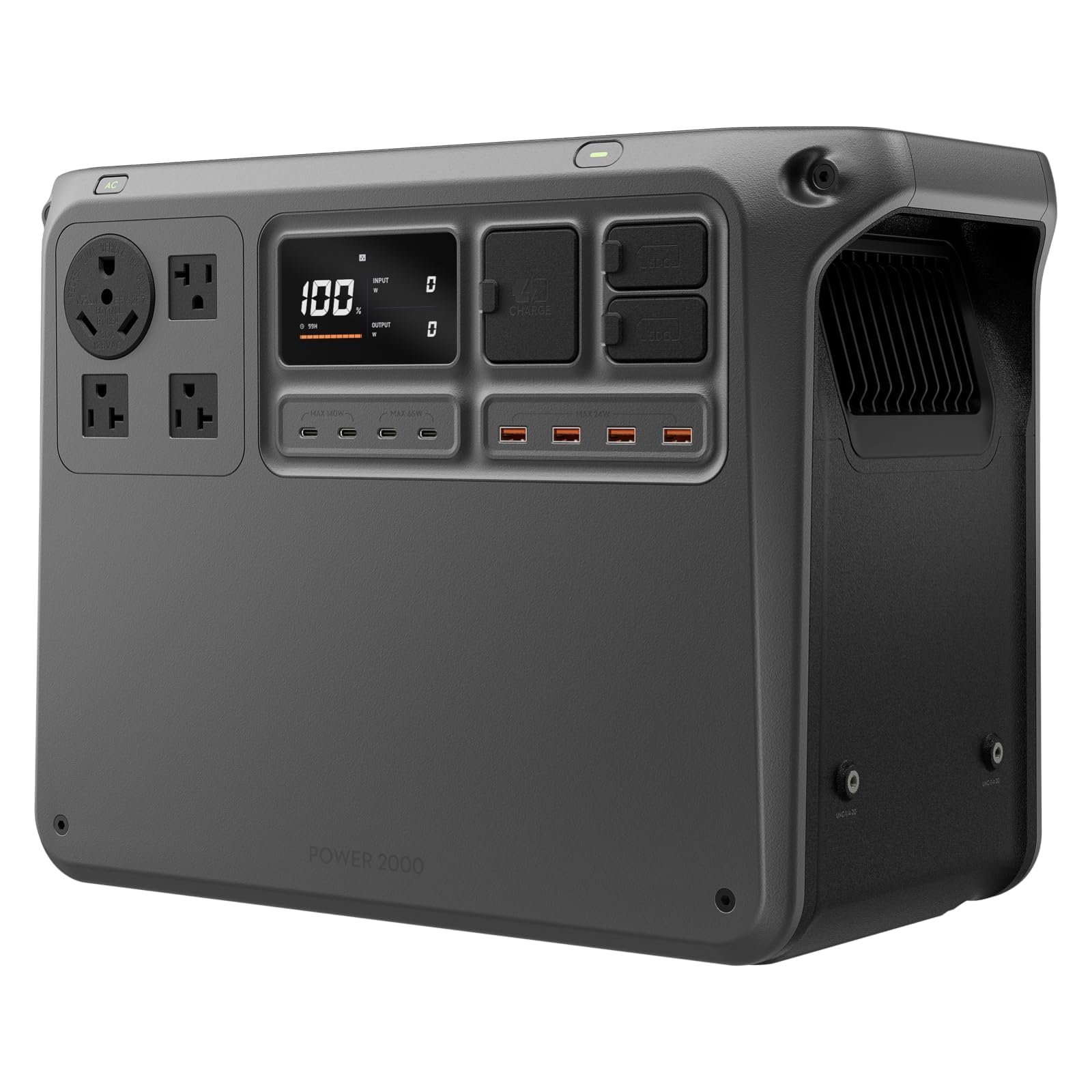
DJI enters the power station market with a compelling entry that undercuts many established competitors on price while exceeding them on raw specs. The 2048Wh LiFePO₄ battery feeds a 3000W continuous inverter (4000W peak), enough to start a refrigerator compressor, run a microwave, or power a drone charging station without breaking a sweat. What truly sets it apart is the 0–80% recharge in just 55 minutes via AC — a pace that makes it feasible to top up during a short utility service window.
The unit operates at under 30 dB in its quietest modes, making it one of the most sleep-friendly backup options for an RV bedroom or a home office. The 15-port array includes dual USB-C outputs at 140W each, which will fast-charge a MacBook Pro at full speed. Build quality is robust, with flame-retardant housing and a sub-nano coating for moisture resistance, though the lack of built-in wheels on a 48-lb unit is a minor ergonomic miss.
Some buyers have reported initial 50 Hz settings on gray-market units, so confirm the vendor’s US inventory before ordering. The DJI Home app adds remote monitoring and scheduling, but advanced features like solar MPPT require a separate adapter. For the price-to-performance ratio, this is the best value play at this capacity tier.
Why it’s great
- Industry-leading 55-minute 0–80% AC recharge speed
- 3000W continuous inverter handles heavy appliances
- Near-silent 30 dB operation ideal for sleep spaces
- 5-year warranty for long-term peace of mind
Good to know
- No built-in wheels on a 48-lb chassis
- Solar MPPT and car charging require separate adapters
- Gray-market units may ship with 50 Hz default settings
2. Jackery Explorer 2000 v2

The Explorer 2000 v2 is Jackery’s answer to the weight problem that plagues large power stations. Using Cell-to-Body technology borrowed from EV battery packs, they’ve packed 2042Wh into a 39.5-lb chassis that is 41% lighter and 34% smaller than typical 2kWh LFP units. That weight saving makes it genuinely portable for loading into an SUV or carrying into a cabin, without sacrificing the 2200W continuous output needed for a fridge and lights.
AC fast charging hits 80% in 66 minutes, and an “Emergency Super Charging” mode in the app gets you to full in 102 minutes. The silent charging mode keeps fan noise under 30 dB, and the 20ms UPS switchover is UL-certified for desktop gear. The 3 AC outlets, dual USB-C (100W PD), and a USB-A port cover most home backup needs, though the lack of a second 100W USB-C port is a small miss for dual-laptop households.
The solar barrel connectors feel slightly fragile — the frame around the ports flexes when plugging in — and the Bluetooth connection can be inconsistent. Still, real-world reports show it running a refrigerator for over 21 hours and surviving power outages with seamless pass-through. For RV and camping users who prioritize weight over raw capacity, this is the tightest package.
Why it’s great
- 39.5 lbs — the lightest 2kWh portable power station available
- CTB technology improves space and structural efficiency
- Silent charging mode at <30 dB for overnight use
- UL-certified 20ms UPS for sensitive electronics
Good to know
- Solar input ports feel flimsy during plug insertion
- Bluetooth connection for the app is not persistent
- Only one 100W USB-C PD port
3. Anker SOLIX C1000

Anker’s SOLIX C1000 is the most aggressive price-to-capacity play in the true 1kWh class. The 1056Wh LiFePO₄ battery supports 3,000 cycles and comes with Anker’s signature UltraFast recharge: 80% in 43 minutes, 100% in 58 minutes, via AC. That is nearly half the recharge time of many competitors. The 1800W continuous inverter with SurgePad 2400W peak handles 99% of household appliances, including refrigerator compressors and sump pumps.
The 11-port layout covers most scenarios, with 6 AC outlets, USB-C PD (60W), and DC inputs. Bundle it with the 200W solar panel and you get IP67 waterproofing on the panel side, plus adjustable angle stands for optimal sun tracking.
The biggest compromise is the non-expandable battery — you cannot add an extra battery to double runtime. The 200W solar bundle panel may also arrive separately from the power station, so plan for split shipments. For a dedicated backup unit that stays at home and recharges faster than any rival, the C1000 is a fantastic mid-range anchor.
Why it’s great
- Fastest AC recharge in class: 80% in 43 minutes
- SurgePad 2400W peak handles refrigerator and pump starts
- 6 AC outlets offer above-average outlet count
- 10-year / 3,000-cycle battery lifespan
Good to know
- Battery is non-expandable; no extra pack option
- 200W solar panel ships separately, not trackable together
- 60W USB-C PD is slower than 100W+ competitors
4. EF ECOFLOW Delta 2

The Delta 2 is EcoFlow’s mid-range workhorse, built on a 1024Wh LFP base that can scale from 1kWh to 3kWh with optional expansion batteries. The 1800W AC output covers 90% of home appliances — refrigerators, microwave ovens, power tools — and the X-Boost feature lets it drive loads up to 2400W by adjusting voltage. The LFP chemistry delivers 3,000 cycles to 80% capacity, translating to nearly a decade of daily use.
AC charging is rated at 7x faster than standard models, reaching full charge in roughly 1.6 hours. The 220W bifacial solar panel included in the bundle captures up to 25% more energy from reflected light, and the MPPT controller accepts up to 500W of solar input. Users report the panel achieving 80% efficiency even in winter sun, and the unit runs a 1200W fryer, a fridge, and lights simultaneously without issue.
The EcoFlow app has connectivity quirks — some users report it ignoring charge/discharge range settings — and the solar charging cable instructions lack depth. The fan can run audibly under heavy load, though it is still far quieter than any gas generator. For a modular system where you can start with 1kWh and expand later, the Delta 2 offers the best upgradability in its price tier.
Why it’s great
- Scalable from 1kWh to 3kWh with add-on batteries
- X-Boost handles loads up to 2400W
- Bifacial 220W solar panel captures reflected light
- 3,000-cycle LFP battery for long service life
Good to know
- App has occasional Bluetooth and scheduling bugs
- Solar panel elastic retention bands can be temperamental
- Fan noise noticeable at high sustained loads
5. AFERIY 3840Wh Station

AFERIY delivers a massive 3840Wh capacity at a price point that undercuts most premium 2kWh stations, making it the best raw-capacity bargain in the market. The 3600W continuous inverter (7200W surge) can start and run heavy loads like a well pump or a small air conditioner, and the system is expandable up to 11.5kWh with extra battery packs. The UPS switchover at under 10ms is fast enough for computers and network gear.
The 15-port configuration includes 5 AC outlets, dual USB-C (PD 3.0), and a 12V car socket. The app provides real-time monitoring, schedule charging, and remote on/off control. With a combined AC + solar input, you can fully recharge in 1.5 hours — impressive for a 3.8kWh unit. The pull handle and wheels make the 80-lb chassis manageable, though it is still a heavy lift for stairs.
Some early units had display issues (dark segments) that resolved with handling, suggesting loose internal connectors. The app lacks separate AC and solar input wattage displays, which complicates solar optimization. For the price, however, you get nearly 4x the capacity of a base 1kWh station, making it a compelling choice for extended backup scenarios where budget is the primary constraint.
Why it’s great
- 3840Wh base capacity at a budget-friendly price
- 7200W surge handles heavy motor loads
- Expandable to 11.5kWh for multi-day outages
- 1.5-hour full recharge via AC + solar hybrid
Good to know
- Display quality control issues reported on early units
- 80-lb weight makes stair transport difficult
- App does not show separate AC and solar input wattage
6. BLUETTI Elite 300
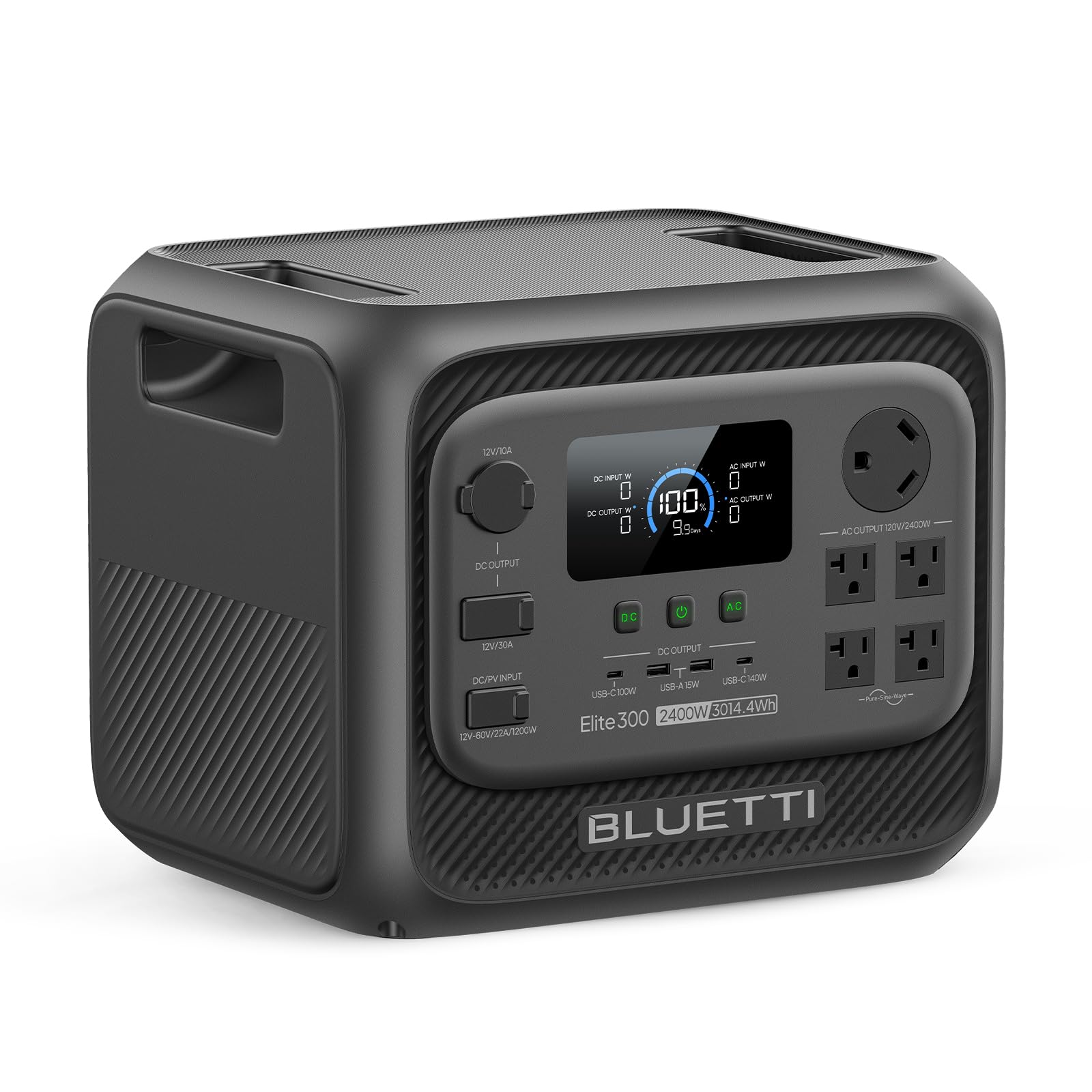
BLUETTI’s Elite 300 is a certified Frost & Sullivan “world’s smallest 3kWh portable power station,” packing 3014Wh into a footprint that is 59% smaller than typical 3kWh units. The 2400W continuous inverter (4800W surge) runs RV air conditioners, refrigerators, and CPAP machines, and the TT-30 RV port plus 12V/30A DC output make it a natural fit for camper vans and travel trailers. The UPS transfer time is a quick 10ms.
AC charging reaches 80% in 70 minutes and 100% in 78 minutes — class-leading speed for a 3kWh unit. The BLUETTI app offers full monitoring and control, and the display is crisp and clear. Users praise the build quality and the fact that the unit loses virtually no charge when powered off. The 140W USB-C PD ports charge laptops at full speed, and the unit handles a sustained 2400W load for 30 minutes without thermal throttling.
The Elite 300 is non-expandable — what you buy is what you get — and the maximum solar input is limited to 1200W, which is lower than some competitors. At 58 lbs, it is heavy for its small size, but the compact form factor makes it easier to store than bulkier models. For RVers who value a small footprint and fast AC recharge, this is the premier compact choice.
Why it’s great
- Smallest 3kWh footprint on the market (59% size reduction)
- TT-30 RV port for direct camper connection
- 78-minute full AC recharge from empty
- 140W USB-C PD for fast laptop charging
Good to know
- Non-expandable battery (no extra packs)
- 1200W max solar input is below class average
- 58-lb weight still requires two hands to move
7. Enphase IQ PowerPack 1500
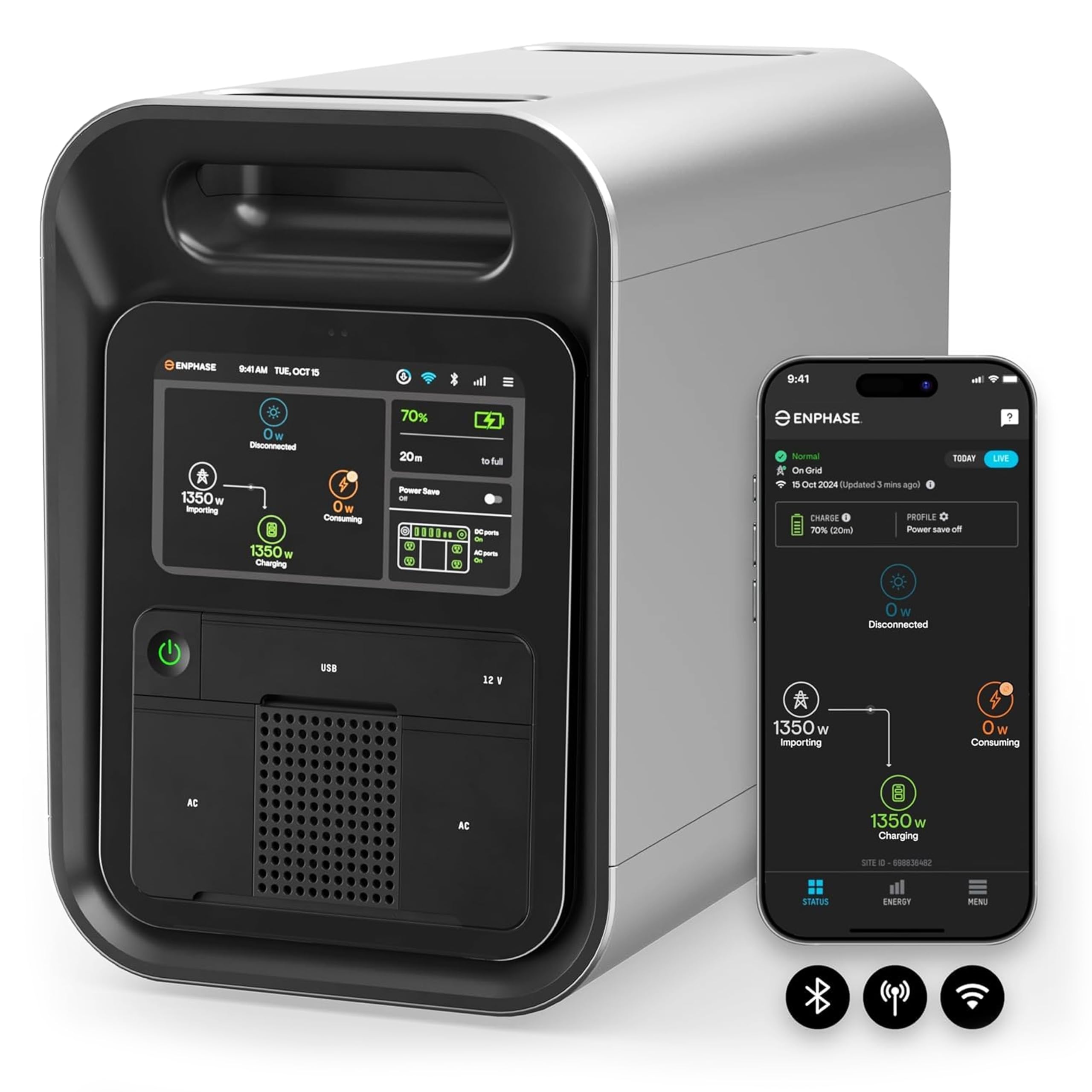
The IQ PowerPack 1500 is built around three Enphase IQ8 microinverters, the same technology trusted in over 5 million home solar installations. This architecture delivers exceptionally clean sine wave power with built-in redundancy — if one microinverter fails, the other two keep running. The 1500Wh battery is UL 9540A certified for thermal runaway safety and UL 2743 certified for outdoor use, operating from -4°F to 122°F.
The unit provides 11 output ports including 4 AC outlets, 2 USB-C (60W), and 4 USB-A. The 7-inch color LCD touchscreen is one of the best interfaces in the category, showing charge status, power flow, and system diagnostics at a glance. Built-in 4G cellular, Wi-Fi, and Bluetooth provide constant connectivity to the Enphase app, which integrates natively with existing Enphase home solar systems for whole-home energy management.
A notable quirk: the unit may trip its internal breaker if you try to charge it via AC at under 700W input, falsely reporting an overload error. At 45.9 lbs, it is portable but not ultralight. The price per kWh is high compared to generic LFP stations, but for Enphase ecosystem owners who want seamless integration and UL-certified safety, the IQ PowerPack offers unique value.
Why it’s great
- Triple IQ8 microinverters for clean, redundant output
- UL 9540A and UL 2743 certified for safety and outdoor use
- Built-in 4G, Wi-Fi, and Bluetooth with robust app
- Excellent cable management and weather-resistant shell
Good to know
- AC charging trips breaker below 700W input
- High cost per kWh relative to non-Enphase stations
- Limited 60W USB-C PD
8. EGO POWER+ PST3042
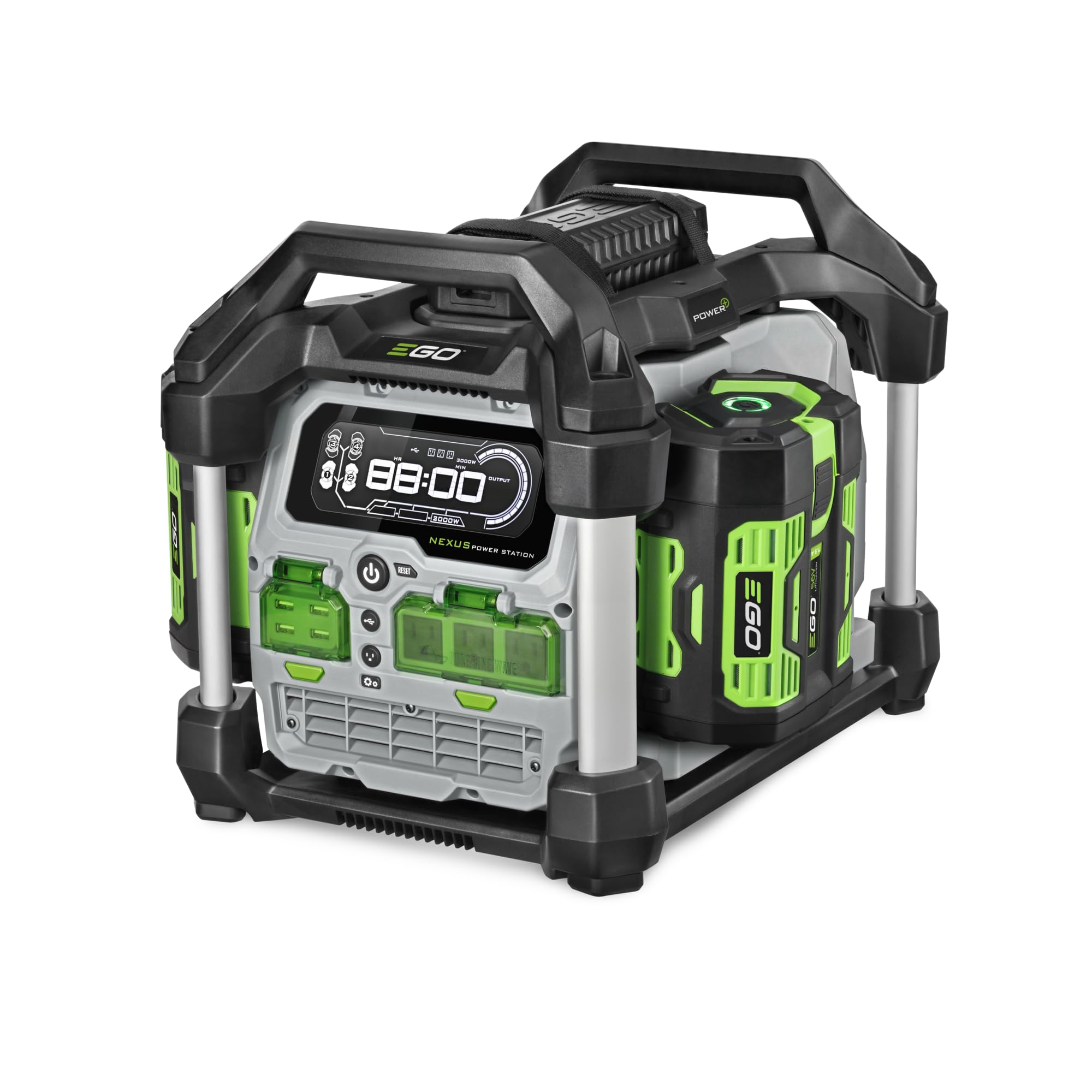
The EGO POWER+ PST3042 is not a traditional power station — it is a 3000W peak (2000W continuous) inverter that draws from EGO’s 56V battery ecosystem. For existing EGO lawn tool owners (trimmers, blowers, chainsaws), this means your existing 7.5Ah, 5.0Ah, or 2.5Ah batteries double as backup power sources. The unit appears with two 7.5Ah batteries in the box, and you can add any other EGO ARC lithium batteries to increase runtime.
The three 120V AC outlets deliver pure sine wave power, making it safe for sensitive electronics like CPAP machines and laptops. The 4 USB-A ports handle device charging, and the bright LED display shows remaining runtime in hours based on current load. The integrated battery charger can charge up to 4 EGO batteries simultaneously when plugged into an AC outlet, rotating through them to maintain power output.
The biggest limitation is that the unit cannot supply AC power while simultaneously charging batteries — a dealbreaker for UPS use. Charging four depleted 7.5Ah batteries takes around 12 hours. Runtime is limited by the batteries you own: two 7.5Ah batteries provide roughly 540Wh at 56V. For tailgating, job sites that ban gas generators, or short-duration backup, the PST3042 is brilliant. For extended outages, you will need a stack of spare batteries.
Why it’s great
- Uses existing EGO 56V tool batteries; no new ecosystem
- Pure sine wave output for sensitive electronics
- 3000W peak starts motor loads reliably
- Compact and weather-resistant for outdoor job sites
Good to know
- Cannot discharge AC power while charging batteries
- Battery charging is slow (12h for 4x 7.5Ah)
- Total energy capacity limited by battery count owned
9. Jackery HomePower 3000
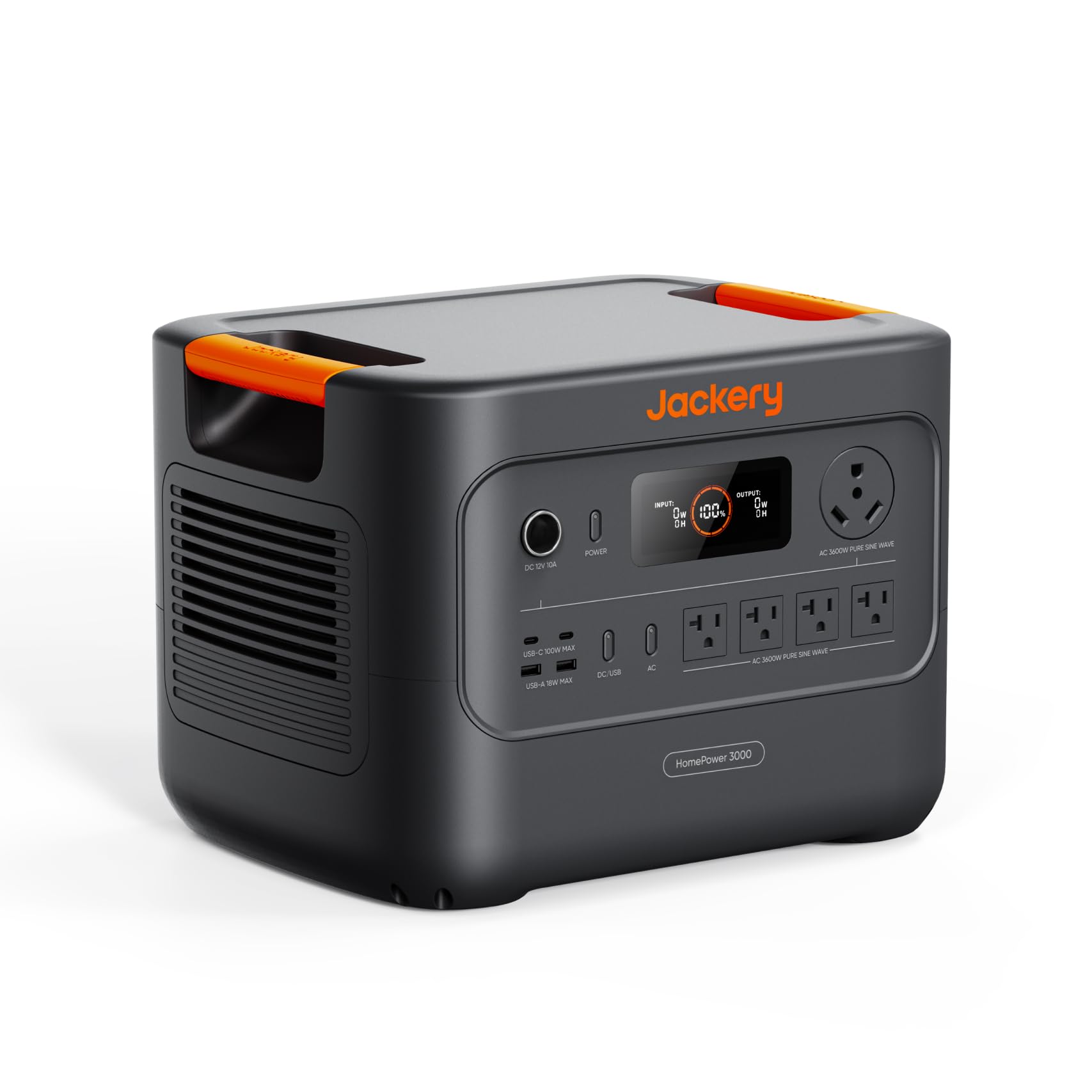
Jackery’s HomePower 3000 is designed as a serious whole-home backup, delivering 3600W continuous output (7200W surge) from a 3072Wh LFP battery. The 30A TT-30 RV port lets you plug directly into a travel trailer’s power inlet, and the dual 100W USB-C PD ports handle laptops and tablets at full speed. With ChargeShield 2.0 AI algorithms, the unit optimizes charging speed while extending battery lifespan past 4,000 cycles.
Hybrid AC + DC charging reaches full charge in 1.7 hours, and solar charging hits 80% in 9 hours with two 200W panels. The CTB construction makes it 47% smaller and 43% lighter than comparable 3kWh models — at 59.5 lbs, it is still heavy but more manageable than the competition. The honeycomb bottom shell adds structural rigidity and helps with heat dissipation during high-load operation.
The fan noise is the biggest practical tradeoff: it runs at about 60 dB under any significant load, making it too loud for a bedroom UPS. The warranty policy is a red flag — Jackery only honors warranties for units purchased directly from their website, not from Amazon or third-party retailers. For RV users who need full-day power with propane backup, this is a strong choice if you buy direct.
Why it’s great
- 3600W continuous / 7200W surge for heavy appliances
- TT-30 RV port for direct camper hookup
- 47% smaller and 43% lighter than typical 3kWh units
- 4,000-cycle LFP battery with ChargeShield 2.0
Good to know
- Fan runs at ~60 dB under load — not silent
- Warranty voided if purchased from third-party retailers
- Sleep disturbance risk for bedroom backup use
10. GROWATT HELIOS 3600
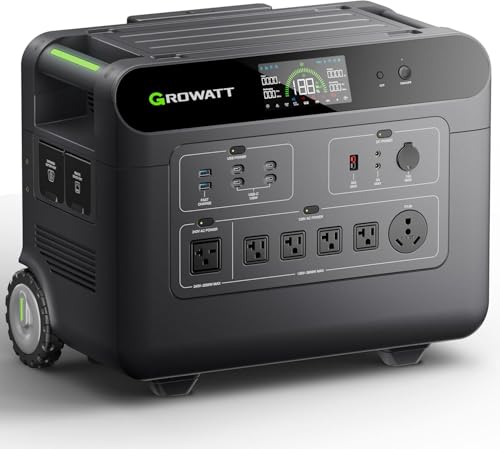
The GROWATT HELIOS 3600 distinguishes itself with true 240V split-phase capability — connect two units in parallel and you get 240V/7200W power, enough to run a central air conditioner, electric dryer, or well pump. The base unit offers 3600Wh and 3600W output with a 15ms EPS switchover and cold-start technology that operates down to -22°F, making it viable in extreme winter storms. Capacity is expandable up to 36kWh for multi-day whole-home backup.
Solar charging is impressive: 2000W input via MC4 connectors allows a full recharge in 2.8 hours from panels alone. AC charging at 120V takes 3 hours for a full charge, or 1.5 hours at 240V. The 16 ports include NEMA TT-30, Anderson input/output, and standard AC outlets. The app supports TOU (time-of-use) scheduling to store cheap off-peak electricity and automatically prioritize solar input.
Setup is not fully plug-and-play — the 240V combiner disables EPS, so you must choose between whole-home backup and portable use. The app’s Bluetooth and WiFi have connectivity issues on some units, and the handle/wheel placement could be better for stair navigation. For homeowners willing to invest in a two-unit parallel setup for 240V appliances, the HELIOS 3600 offers premium solar integration at a competitive price.
Why it’s great
- True 240V/7200W split-phase with dual units
- Cold-start operation down to -22°F
- 2000W solar input for fast off-grid recharge
- TOU scheduling and app-based energy management
Good to know
- 240V combiner disables EPS pass-through
- App Bluetooth/WiFi connectivity can be unreliable
- Handle and wheel placement not optimized for stairs
11. Anker SOLIX F3000
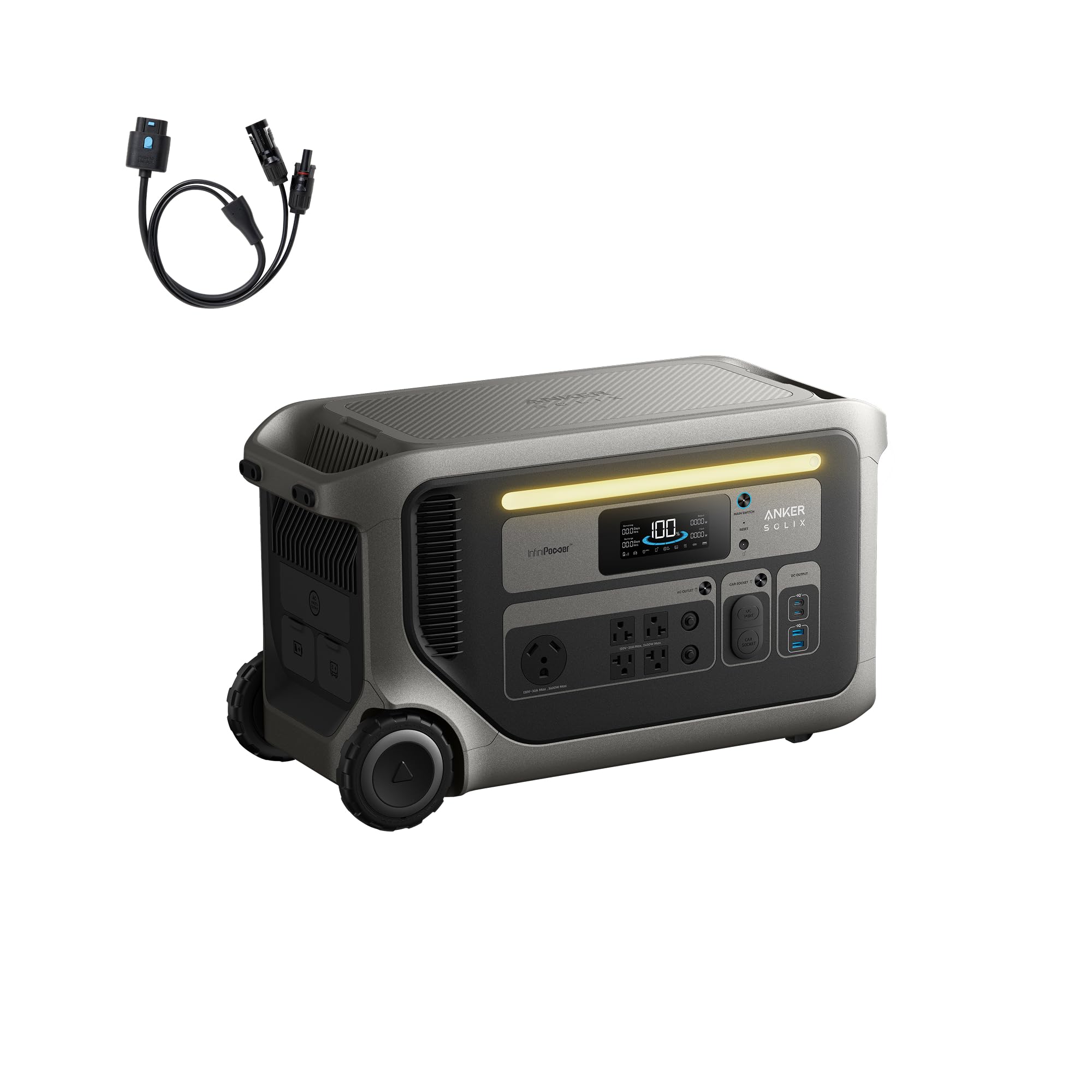
The Anker SOLIX F3000 is built for users who want to combine a battery station with a traditional fuel generator. Its headline feature is 3600W pass-through charging — you can recharge the battery from a 120V generator while simultaneously powering appliances at full load, eliminating the “charge then run” cycle that plagues most stations. The 3072Wh LFP battery expands up to 24kWh with add-on batteries, covering 80+ hours of essential loads.
Ultra-low idle power consumption gives 125 hours of AC standby time, or 42 hours running a 190W refrigerator. Solar input hits 2400W via dual ports (165V and 60V), allowing fast off-grid top-ups. When paired with Anker’s Bi-Directional Inlet Box and Smart Meter, the F3000 can automatically store free solar or low-cost off-peak grid electricity without manual intervention. The integrated wheels and handle make the 91.5-lb unit easier to move than the weight suggests.
The F3000 lacks 240V split-phase output — you cannot run a 240V appliance directly. The USB ports have a minimum 1W draw that cannot be fully disabled, which slightly reduces standby efficiency. At this price point, it competes directly with the BLUETTI Apex 300 and GROWATT HELIOS 3600. For those with an existing gas generator who want to minimize runtime and noise, the F3000’s generator passthrough is uniquely compelling.
Why it’s great
- 3600W generator passthrough — recharge and run simultaneously
- 125-hour AC standby with ultra-low idle draw
- Moveable on integrated wheels despite 91.5-lb weight
- Expandable to 24kWh for multi-day outages
Good to know
- No 240V split-phase output
- USB ports have 1W minimum draw that cannot be disabled
- Heavy chassis, not for frequent stair movement
12. VTOMAN FlashSpeed Pro 3600
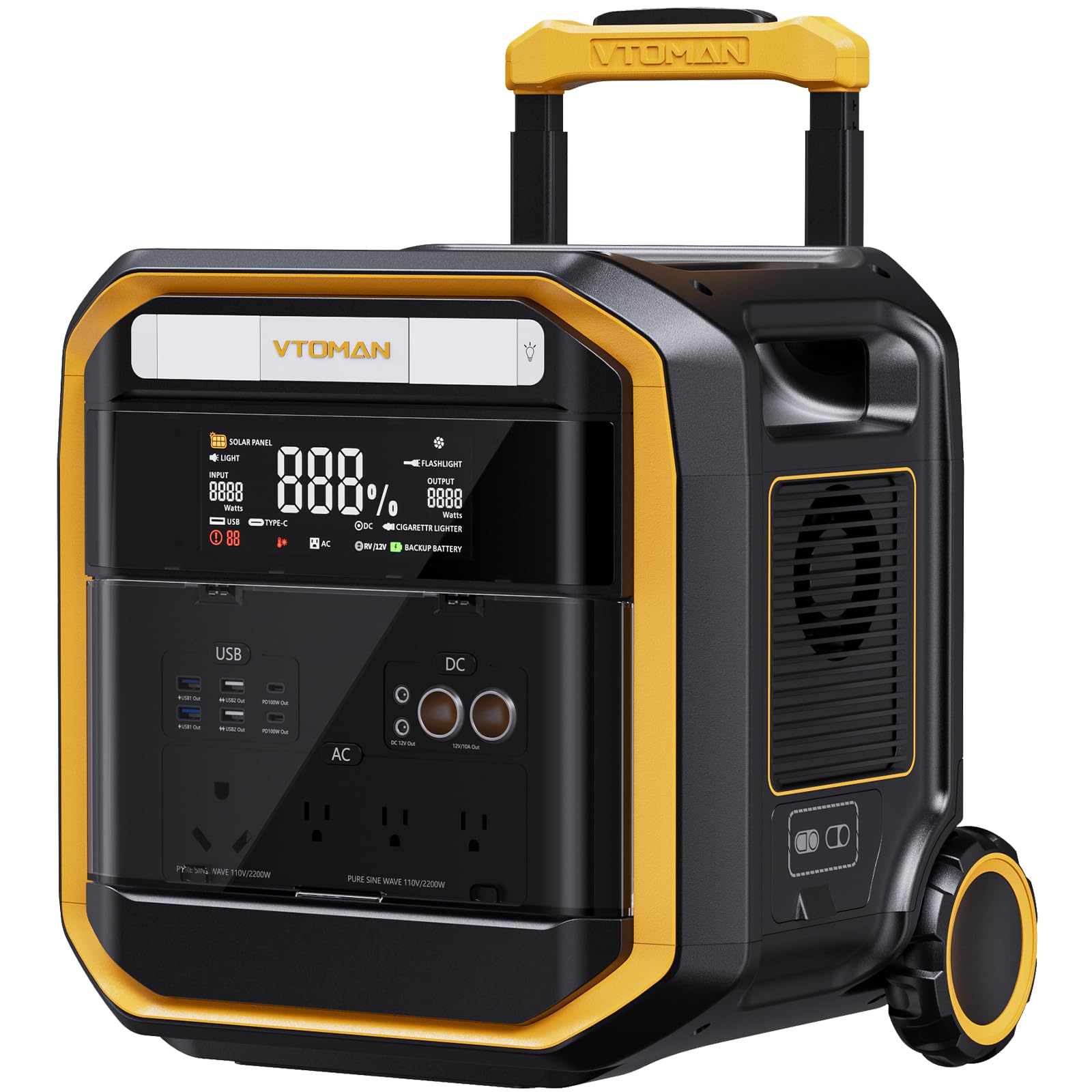
The FlashSpeed Pro 3600 lives up to its name with a 2-hour full recharge from AC wall power — one of the fastest times for a 3kWh-class station. The 3096Wh LFP battery (6000+ cycles at 50% capacity) feeds a 3600W inverter that can surge to 6000W for starting motor loads. The 14-output port array includes 4 AC outlets, 2 USB-C PD100W, and a 12V car socket, covering most home and RV scenarios.
The wheeled design with an integrated pull handle is a major mobility upgrade over handle-only competitors — rolling an 83.8-lb unit is far easier than carrying it. The 800W solar input is lower than some alternatives, but the included 400W solar panel (sold separately in some bundles) achieves 25% efficiency, reducing panel count for a given charging rate. The 20ms UPS switchover is adequate for most electronics, though not as fast as sub-10ms rivals.
Long-term users report an issue where the 12V DC auto-shutdown can be triggered by fridge compressors, which may require a workaround. The barrel connectors for solar are standard but not lockable. For the price, the FlashSpeed Pro 3600 offers a fantastic balance of capacity, recharge speed, and portability, especially for RV users who need to recharge quickly between stops.
Why it’s great
- 2-hour full AC recharge — fastest in 3kWh class
- Integrated wheels and handle for easy rolling
- 6000+ cycles at 50% depth of discharge
- 6000W surge handles heavy motor loads
Good to know
- 12V DC auto-shutdown can trigger on fridge compressors
- 800W solar input is lower than premium segment
- USB-C ports can be loose on some units
13. BLUETTI Apex 300
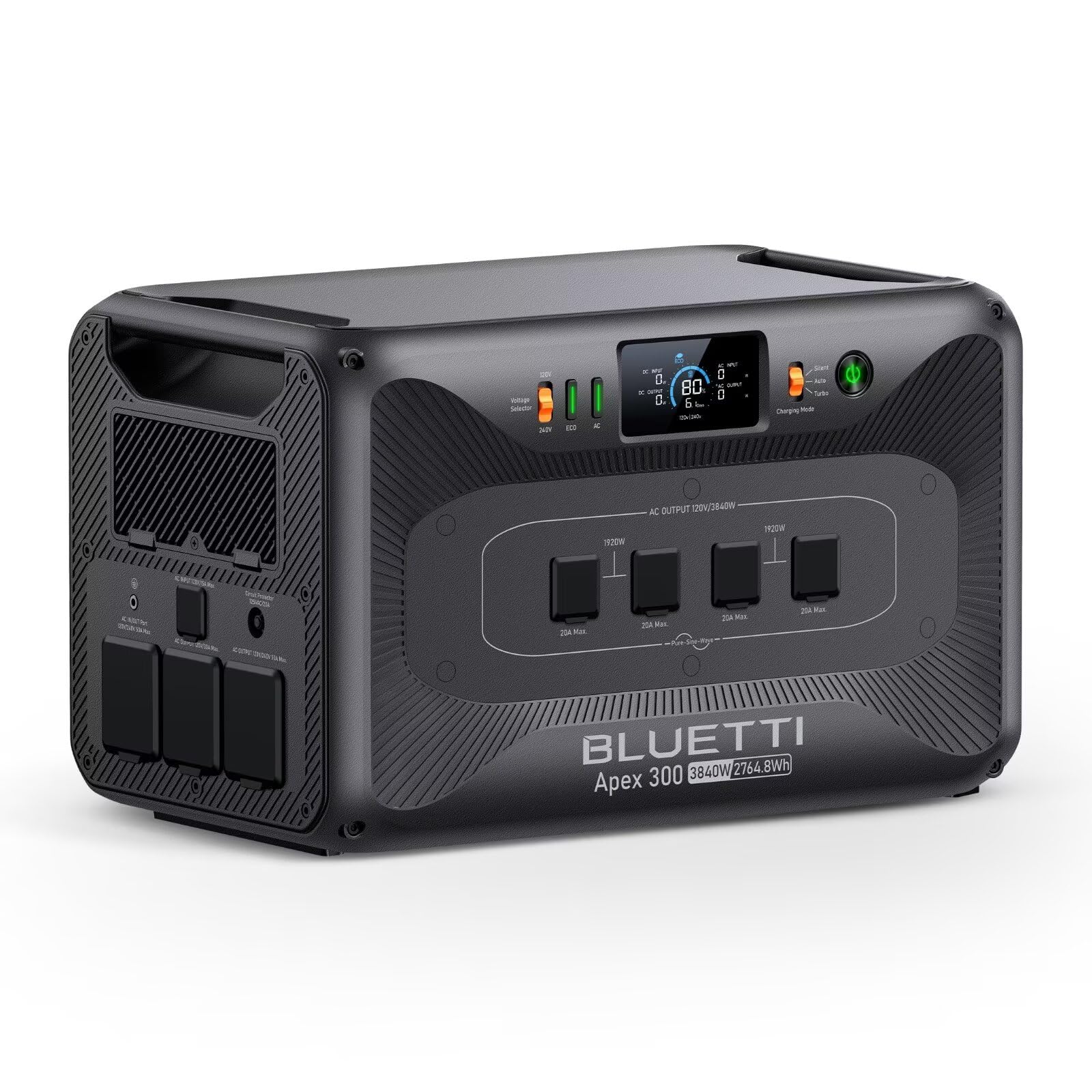
The BLUETTI Apex 300 is a modular powerhouse designed for users who need both 120V and 240V output from a single portable chassis. The base unit delivers 2765Wh capacity and 3840W continuous output (7680W surge), with the ability to switch between 120V and 240V via the app or onboard controls. The 0ms UPS ensures zero-transfer-time backup for the most sensitive electronics, including medical devices and servers.
The expansion ecosystem is BLUETTI’s most versatile yet: add B300K or B500K batteries for extra capacity, connect Hub D1 for RV 12V DC loads, use Charger 1 or Charger 2 for high-speed alternator charging, and integrate SolarX 4K for huge solar input. The BLUETOPUS AI-BMS manages six parallel battery modules with thermal and load balancing. The unit runs nearly silent at 22 dB under light loads, making it viable for bedroom backup.
The 60Voc PV input limit is a genuine constraint — a 110Voc solar array falls in an unsupported voltage gap, limiting panel-series configurations. The 85-lb base weight demands a cart or dolly for any distance. The lack of dedicated DC ports is a deliberate cost reduction, but the modular add-ons fill that gap. For homeowners building a scalable, phone-controlled 120/240V backup system, the Apex 300 is the most forward-looking platform available.
Why it’s great
- True 120V/240V output in a single portable unit
- 0ms UPS for zero-interruption backup
- Modular expansion for battery, alternator, and solar
- 22 dB near-silent operation under light load
Good to know
- 60Voc PV limit constrains solar array configuration
- 85-lb base weight requires a cart for mobility
- No built-in DC ports; requires Hub D1 add-on
FAQ
Can a 1000Wh power station run a full-size refrigerator?
How long does it take to recharge a 1000Wh station from empty?
What is the difference between pure sine wave and modified sine wave inverters?
Can I leave a 1000Wh power station plugged in 24/7?
How long do LiFePO₄ batteries last in a power station?
Final Thoughts: The Verdict
For most users, the best 1000wh power station winner is the DJI Power 2000 because it combines a 2048Wh LFP battery, a 3000W inverter, and the fastest AC recharge speed in its class at a price that undermines the established players. If you want the lightest portable unit for RV travel, grab the Jackery Explorer 2000 v2. And for whole-home 240V backup with modular expansion, nothing beats the BLUETTI Apex 300.