
You hit play, the action builds, but every whispered conversation and subtle line of dialogue gets buried under rumbling bass and ambient effects. The result is a frustrating cycle of rewinding, cranking up the volume at night, and missing half the story. A dedicated soundbar for TV solves this exact problem by decoding multi-channel audio into a clear, spatial soundstage that TV speakers cannot produce on their own.
I’m Min — the co-founder and writer behind Gadgets Feed. My deep-dives into home theater audio specs, channel configurations, and real-world listening modes help me separate marketing terminology from performance that actually transforms your living room experience.
The final section of this guide delivers a head-to-head comparison of nine systems, leading you to the soundbar for tv that balances dialogue clarity with immersive surround performance for your specific viewing habits.
How To Choose The Best Soundbar For TV
Selecting a soundbar for TV comes down to matching your room size, content preferences, and priority on voice clarity or immersive effects. The following framework walks you through the three decision layers that matter most.
Channel Configuration and Driver Layout
The first number in a channel spec (5.1.2, 3.1, 11.1.4, etc.) refers to the front and surround drivers, the second to the dedicated subwoofer, and the third to upward-firing height channels. A 2.1 setup works for small apartments and vocal-heavy content, while a 5.1.2 or higher system with dedicated rear speakers creates a convincing wraparound field for blockbuster films and gaming. The driver layout — front-firing only versus a mix of side and up-firing components — determines whether sound feels confined to a horizontal plane or expands into a 3D bubble.
Dialogue Clarity Systems
Drown-out dialogue is the single biggest complaint among soundbar owners. Look for proprietary solutions like Bose’s A.I. Dialogue Mode, JBL’s PureVoice 2.0, or Samsung’s Active Voice Amplifier Pro. These systems use real-time signal processing to analyze background noise and boost vocal frequencies without affecting the overall mix. If news, sports, or dialogue-heavy dramas make up most of your viewing, prioritize a soundbar with a dedicated voice enhancement feature over raw channel count.
Quick Comparison
On smaller screens, swipe sideways to see the full table.
| Model | Category | Best For | Key Spec | Amazon |
|---|---|---|---|---|
| Samsung HW-Q990D | 11.1.4ch | Cinema immersion | 11 front/height drivers + rear kit | Amazon |
| Sonos Arc Ultra | 9.1.4ch | Smart multi-room audio | 9 front/height drivers + Speech Enhancement | Amazon |
| Bose Smart Ultra | All-in-One | Room-filling single bar | 6 transducers + AdaptIQ room tuning | Amazon |
| JBL Bar 500MK2 | 5.1ch | Deep bass and dialogue | 750W, 10″ sub + PureVoice 2.0 | Amazon |
| Samsung HW-Q800F | 5.1.2ch | Gaming and action films | Active Voice Amplifier Pro | Amazon |
| Bose Smart Soundbar | All-in-One | Compact premium sound | 5 transducers + TrueSpace upmixing | Amazon |
| ULTIMEA Skywave F40 | 5.1.2ch | Budget Atmos immersion | Up-firing Neodymium drivers, 40 Hz sub | Amazon |
| LG S40TR | 4.1ch | Surround with rear speakers | Wireless rear speakers + Clear Voice Plus | Amazon |
| TCL S55H | 2.1ch | Entry-level value | AI Sonic room calibration, 220W | Amazon |
In‑Depth Reviews
1. Samsung HW-Q990D

Samsung’s flagship HW-Q990D delivers an 11.1.4-channel array with four up-firing drivers built into both the soundbar and the included rear speakers, creating a true bubble of overhead sound without needing in-ceiling installation. The bundled subwoofer pairs a 6.5-inch active driver with an 8-inch passive radiator, delivering tight, tactile bass that shakes the couch but stays controlled enough for late-night viewing. Q-Symphony synchronizes the soundbar with compatible Samsung TV speakers, expanding the front soundstage by using the TV’s own drivers as an additional center and height channel.
SpaceFit Sound Pro uses built-in sensors to measure the room’s acoustic properties — wall distance, ceiling height, and furniture placement — and automatically adjusts EQ, bass output, and channel levels for the listening position. Active Voice Analyzer works in the background to isolate dialogue from ambient noise, raising vocal clarity without affecting the mix’s dynamic range. The included rear satellite speakers each carry a forward, side, and upward-firing driver, creating a dense surround field that tracks objects smoothly across the hemisphere.
Game Mode Pro activates automatically when a console is connected, engaging 3D spatial audio that sharpens directional cues like footsteps and environmental sounds. The HW-Q990D supports Wireless Dolby Atmos between the soundbar and a compatible Samsung TV, eliminating the need for a direct HDMI cable for audio return, while the HDMI eARC input handles lossless 7.1.4 PCM and Dolby TrueHD from external players. The only compromise reported is occasional micro-dropouts when using eARC with LG OLED panels, but the standard ARC fallback resolves the issue.
Why it’s great
- Complete 11.1.4 system with rear speakers in the box
- SpaceFit Sound Pro automates room calibration
- Wireless Dolby Atmos with compatible Samsung TVs
Good to know
- Best performance when paired with a Samsung TV
- eARC dropouts reported with certain LG models
2. Sonos Arc Ultra

Sonos Arc Ultra introduces Sound Motion technology — a new acoustic architecture that uses dedicated low-frequency drivers inside the soundbar itself to generate bass extension down to 35 Hz without requiring an external subwoofer for a convincing low-end. The 9.1.4-channel layout includes seven front-firing tweeters, two up-firing drivers for height effects, and a set of passive radiators that produce room-pressurizing bass from the main bar’s slim profile. Trueplay tuning, executed via the companion app, uses the iPhone’s built-in microphones to measure how sound reflects off walls, furniture, and ceilings, then sets equalization and channel delays accordingly.
Speech Enhancement, an AI-driven feature, analyzes the audio track in real time to identify and boost vocal frequencies, ensuring dialogue cuts through complex soundtracks without the listener needing to adjust a separate equalizer. The Arc Ultra connects via a single HDMI eARC cable to the TV, and the Sonos app handles all setup, grouping, and source switching. Apple AirPlay 2, Spotify Connect, and built-in Amazon Alexa provide wireless streaming and voice control without leaving the Sonos interface.
Adding a Sonos Sub (Gen 4) and a pair of Era 300 speakers transforms the system into a 7.1.4 layout with discrete rear height channels, but even as a standalone bar, the Arc Ultra produces a wider and more articulate soundstage than the previous generation. The Sonos ecosystem locks you into wireless multi-room grouping, so if you already own Sonos speakers in other rooms, the integration is seamless; new buyers should factor in the cost of adding rears and a sub for true theater-level immersion.
Why it’s great
- Outstanding bass from a single bar
- AI Speech Enhancement keeps dialogue crisp
- Trueplay auto-calibration adapts to any room shape
Good to know
- Requires phone app for full setup and control
- Optimal performance requires adding sub and rears
3. Bose Smart Ultra

The Bose Smart Ultra Soundbar packs six transducers — including two custom-engineered upward-firing dipole speakers — into a chassis that measures just 41 inches wide, making it a fit for 55-inch TVs and smaller entertainment centers. Bose TrueSpace technology analyzes stereo or 5.1 audio signals and upmixes them to simulate height and width channels, giving non-Atmos content a spatial lift. The included AdaptIQ headset runs a multi-point calibration routine that plays test tones through the soundbar and measures the resulting reflections at different listening positions around the room.
A.I. Dialogue Mode is a separate processing layer that uses machine learning to separate human speech from the rest of the mix, boosting vocal clarity in real time without the listener hearing a change in the background effects. The soundbar supports Amazon Alexa and Google Assistant built-in, plus AirPlay 2, Chromecast, and Spotify Connect for music streaming, all controllable through the Bose Music app. HDMI eARC provides lossless Dolby Atmos passthrough, and the optical input serves older TVs without ARC support.
The Smart Ultra supports expansion with the Bose Bass Module 700 and Bose Surround Speakers 700, converting the system into a full 5.1.4 setup. Without the subwoofer, the bar delivers respectable mid-bass but lacks the sub-50 Hz extension needed for chest-thumping explosions — a limitation that budget-conscious buyers should weigh. Some users report a finicky initial setup process that requires a phone, Bluetooth, a Bose account, and internet connection before the soundbar works with the TV remote.
Why it’s great
- Compact footprint fits smaller media consoles
- AdaptIQ room tuning for precise calibration
- A.I. Dialogue Mode effectively separates speech from noise
Good to know
- Setup requires app and internet connection
- Bass extension requires additional Bass Module
4. JBL Bar 500MK2
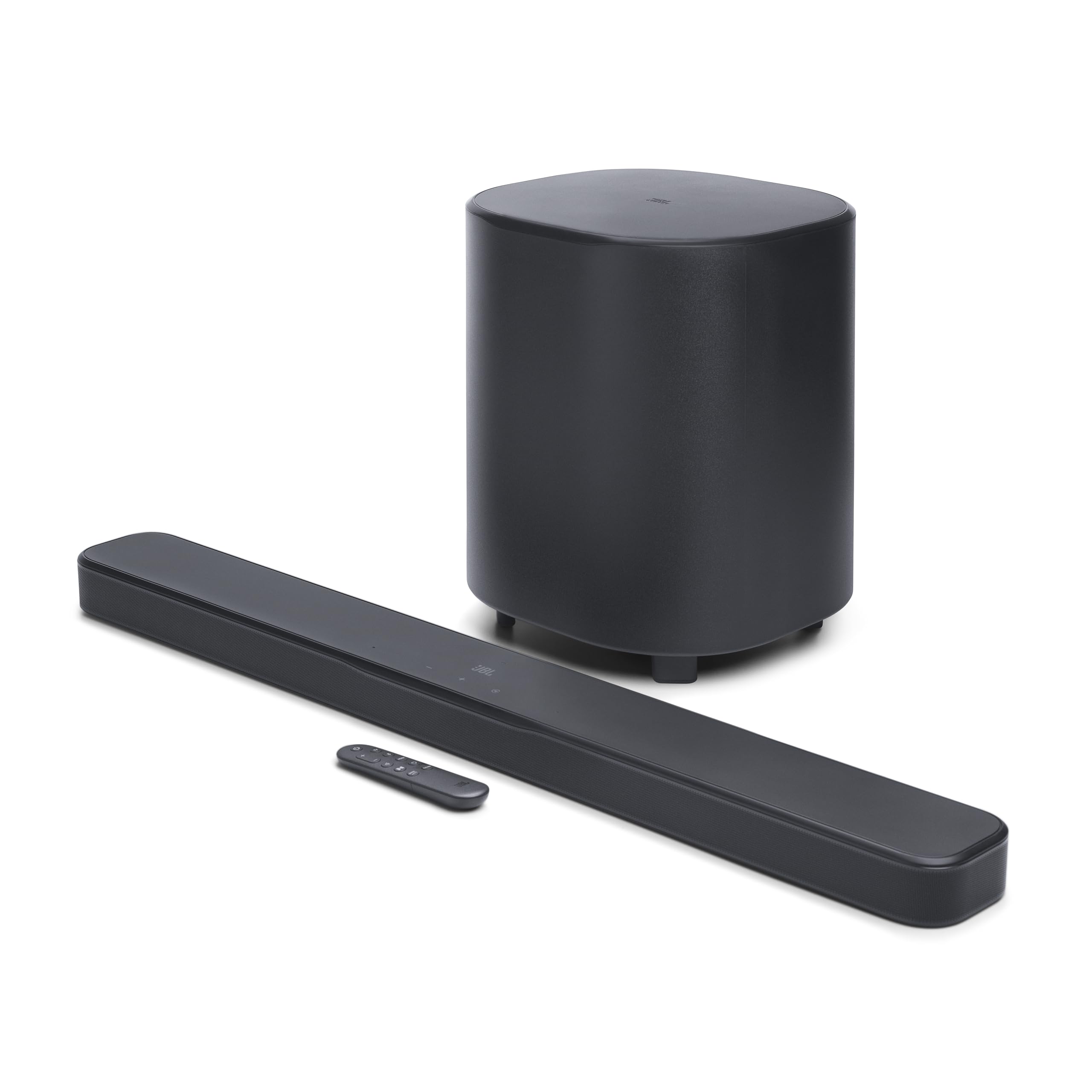
JBL’s Bar 500MK2 puts out a rated 750 watts of total system power, driven by a 10-inch wireless subwoofer that pressurizes medium to large rooms with deep, distortion-free bass down to 20 Hz. The main soundbar houses five drivers arranged in a 5.1-channel layout, using MultiBeam 3.0 technology to bounce sound off sidewalls and create a simulated surround field without dedicated rear speakers. PureVoice 2.0 is JBL’s second-generation dialogue enhancement that uses real-time frequency analysis to raise vocal intelligibility during quiet scenes without dulling the high-frequency detail of effects.
Easy Sound Calibration runs a quick test tone that measures the room’s reflections and automatically adjusts the EQ and beam direction for optimal immersion from the listening position. The chassis measures 37 inches wide and 2 inches tall, fitting cleanly under most 55- to 65-inch TVs. HDMI eARC support delivers uncompressed Dolby Atmos pass-through, and the included HDMI cable carries 4K Dolby Vision from a source device to the TV. The JBL ONE app offers a precise 31-band equalizer for users who want to fine-tune the response curve.
MultiBeam 3.0 does a convincing job of placing sounds to the sides without physical satellites, though rear-channel separation is not as distinct as a true 5.1.2 system with dedicated back speakers. Some reviewers note that at very high volume levels the front-array can sound slightly harsh, but the overall voicing remains balanced out of the box. The 37-inch length may overhang a 50-inch TV stand, and the subwoofer’s wireless connection is stable even when placed behind a sofa or inside a media cabinet.
Why it’s great
- 10-inch subwoofer produces genuine sub-30 Hz extension
- PureVoice 2.0 keeps dialogue clear at any volume
- MultiBeam 3.0 simulates surround without rear speakers
Good to know
- Soundbar length may overhang smaller TV stands
- No dedicated rear speakers in the box
5. Samsung HW-Q800F
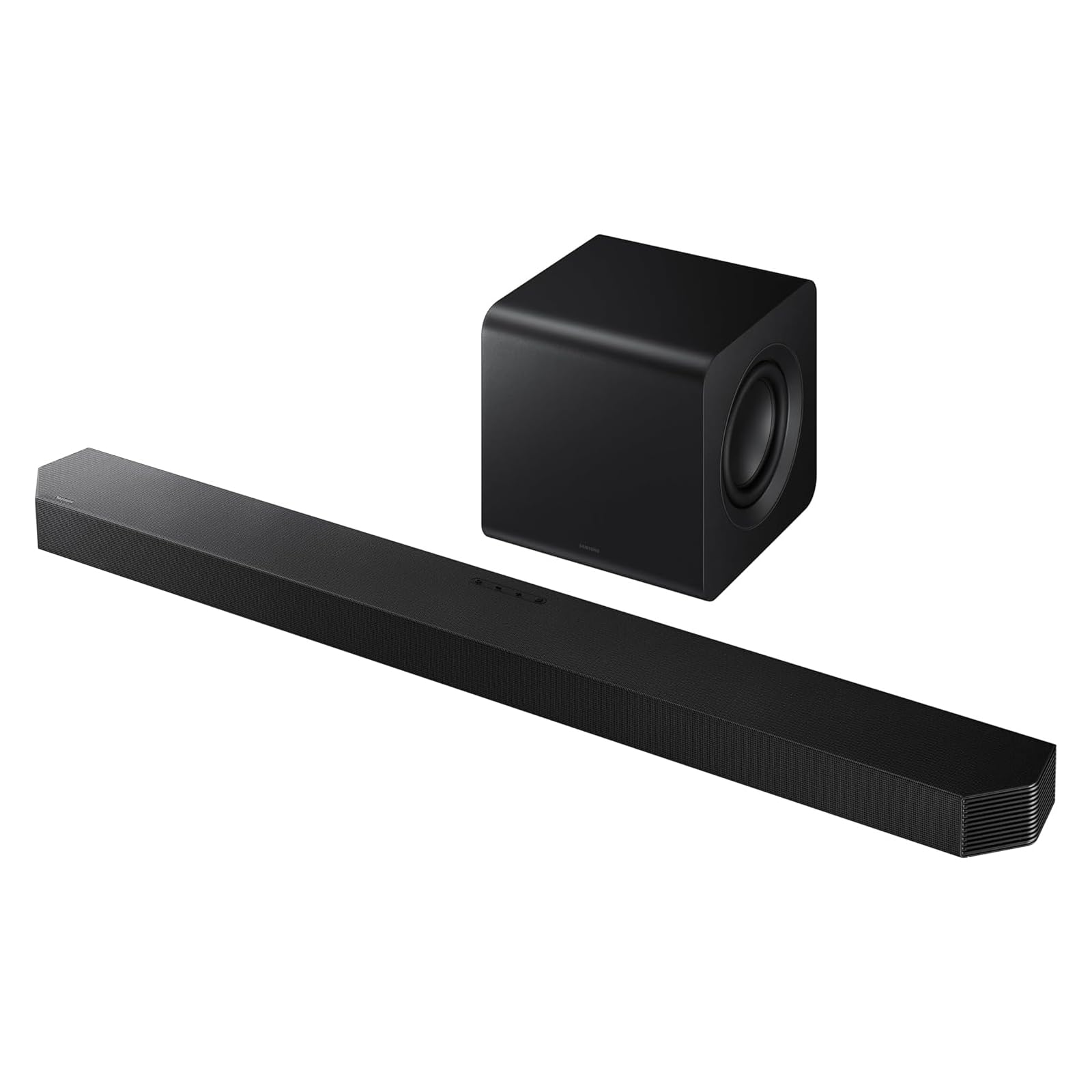
Samsung’s HW-Q800F configures a 5.1.2-channel array with side-firing and top-firing drivers, plus a separate 8-inch passive radiator subwoofer that moves enough air to fill rooms up to 400 square feet. Wireless Dolby Atmos eliminates the HDMI cable between the soundbar and a compatible Samsung TV, relying instead on the Wi-Fi band to transmit 5.1.2-channel height audio. Game Mode Pro activates automatically when a console is connected, using the soundbar’s up-firing drivers and beam tweeters to render 3D spatial cues that let you pinpoint enemy footsteps and explosions by ear.
SpaceFit Sound Pro measures the room acoustics through a built-in sensor and adjusts the audio — including the subwoofer’s EQ — to compensate for placement inside a cabinet, against a wall, or in an open layout. Active Voice Amplifier Pro listens to the environment’s ambient noise level through the soundbar’s mic and dynamically raises dialogue frequencies when the dishwasher, vacuum, or traffic noise increases. Q-Symphony pairs the soundbar with compatible Samsung TV speakers to create a wider front soundstage by using the TV’s built-in drivers as additional height and center channels.
The subwoofer’s compact enclosure — 6.5-inch active driver plus an 8-inch passive radiator — keeps the bass unit small enough to hide beside a sofa or inside a console without sacrificing the 40 Hz extension needed for action scenes. HDMI input handling 4K Dolby Vision passthrough is limited to one port, so users with multiple external devices will need an HDMI switch. The soundbar does not include rear satellite speakers, but the side-firing drivers and Virtual Surround mode recreate a surprisingly wide rear stage.
Why it’s great
- Wireless Dolby Atmos with compatible Samsung TVs
- Game Mode Pro enhances 3D positional audio
- Active Voice Amplifier Pro adapts to room noise in real time
Good to know
- Only one HDMI input for external sources
- No rear speaker kit included
6. Bose Smart Soundbar

Bose’s entry-level Dolby Atmos soundbar squeezes five transducers into a chassis just 31 inches wide, including two upward-firing drivers that bounce sound off the ceiling to create overhead effects in a compact form factor. TrueSpace technology processes non-Atmos signals — whether stereo music, 5.1 broadcasts, or gaming audio — and upmixes them to a multi-channel spatial presentation that fills the room. A.I. Dialogue Mode applies machine-learning separation between voice and background effects, ensuring dialogue stays intelligible even during loud action sequences or soundtracks with heavy reverb.
Voice control options include Amazon Alexa built-in, plus Bose Voice4Video which lets you control TV power and channel switching through voice commands. The soundbar connects via Bluetooth, Apple AirPlay 2, Spotify Connect, or Chromecast, and the Bose Music app provides EQ adjustment for bass, treble, and mid-range. HDMI eARC supports full Dolby Atmos passthrough, and an optical input is available for older televisions. The included remote features dedicated buttons for dialogue mode and bass control, reducing the need to open the app during a movie.
The soundbar can be paired with the Bose Ultra Open Earbuds (sold separately) to act as personal rear surround speakers for the user, a novel feature for late-night viewing without waking others. Without a subwoofer, the bar’s bass is punchy for its size but rolls off around 55 Hz — acceptable for dialogue and music but lacking floor-shaking rumble. Customers note the setup can be cumbersome on iPhone due to the unsecured Bose platform, but sound quality after setup is consistently praised for clarity and imaging precision.
Why it’s great
- Ultra-compact width fits small TV stands
- A.I. Dialogue Mode elevates vocal clarity effectively
- TrueSpace upmixes any content to spatial audio
Good to know
- Bass roll-off starts around 55 Hz without subwoofer
- Setup process requires phone, app, and internet
7. ULTIMEA Skywave F40
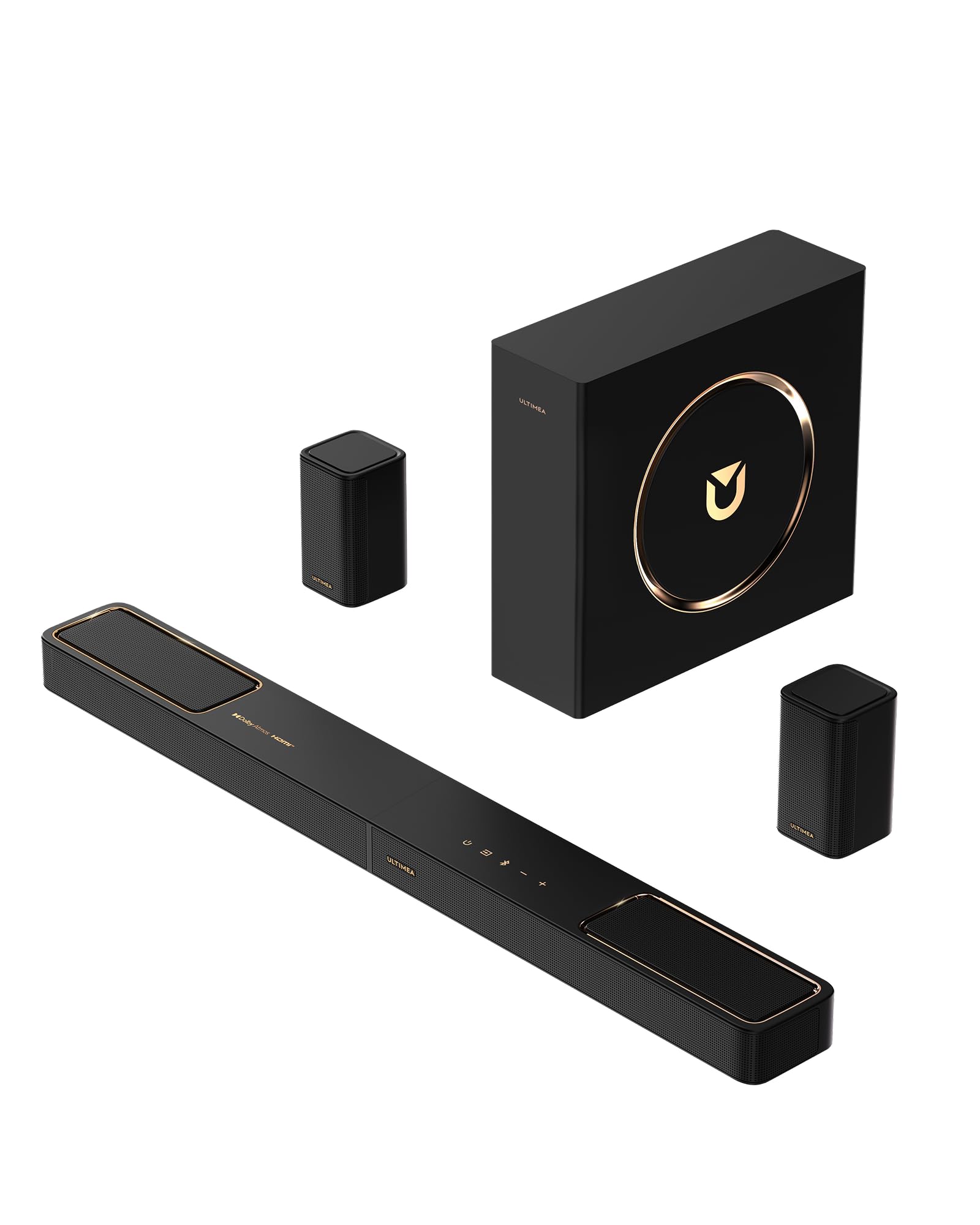
ULTIMEA Skywave F40 delivers a 5.1.2-channel layout with dedicated up-firing drivers built around neodymium internal magnets and 18-core large voice coils, a configuration typically found in premium speakers, to improve height-channel precision and extension. The system includes two surround speakers and a 5.25-inch wired subwoofer with BassMX technology that produces a rated 40 Hz low-frequency reach — enough to reproduce the bass drops and explosions in action movies. SurroundX technology uses a spatial algorithm to place audio accurately around and above the listener, integrating the rear satellites and up-firing drivers into a unified 360-degree field.
HDMI eARC support passes lossless 5.1.2-channel Dolby Atmos at up to 37 Mbps bandwidth, ensuring uncompressed height data reaches the up-firing drivers without lossy compression. The ULTIMEA App provides 13-step level adjustment for each channel, a 10-band graphic equalizer, and 121 preset sound settings, giving advanced users granular control over the sound signature. VoiceMX technology centers the dialogue channel, reducing the need to increase overall volume during conversations in mixed-audio scenes.
Connection options include HDMI eARC, Bluetooth 5.4, and optical input, with CEC synchronization allowing the soundbar to power on and off with the TV using a single remote. The subwoofer is wired to the soundbar via a provided 6-meter cable, which may require cable management planning in rooms where the sub needs to sit across from the media console. Customers report clear, loud sound at 25 percent volume, and the surround effects create a convincing bubble for the entry-level price tier, though the bass is described as solid rather than chest-thumping.
Why it’s great
- Up-firing Neodymium drivers improve height detail
- Comprehensive app with 10-band EQ and 121 presets
- SurroundX creates accurate 360-degree audio placement
Good to know
- Subwoofer is wired, requires cable routing
- Not compatible with DTS audio formats
8. LG S40TR

The LG S40TR is a 4.1-channel system that includes a wireless subwoofer and a pair of wireless rear surround speakers, creating a genuine wraparound sound field without running speaker wires across the floor or baseboards. The rear speakers connect wirelessly to the soundbar over a dedicated RF band, not Bluetooth, ensuring there is no lip-sync delay. Clear Voice Plus analyzes the audio stream to isolate vocal frequencies and reduce the masking effect of background music and sound effects, a benefit for news broadcasts and dialogue-heavy dramas. The soundbar supports Dolby Audio and DTS Digital compatibility, delivering enhanced sound quality for Blu-rays and streaming services that use these codecs.
WOW Orchestra allows the LG soundbar to work in harmony with a compatible LG TV’s internal speakers, using the TV’s drivers as additional front-height channels for a wider soundstage. WOW Interface enables the user to control soundbar volume, audio modes, and EQ directly via the TV’s on-screen menu using the LG TV remote. The soundbar’s Crest Design features a metal grill that helps prevent dust buildup, and the compact 35-inch width fits TVs from 48 to 60 inches. The LG Soundbar App offers a 3-band equalizer for bass, treble, and mid-range adjustments.
Customers report that the rear speakers are initially silent until enabled through the LG app, a step that some users miss during setup. The subwoofer delivers thumping bass that satisfies for movies and music but is not powerful enough to disturb neighbors in apartment settings — a balance of output and restraint. The system is limited to optical and HDMI ARC input, with no HDMI eARC or multi-channel PCM support, so it will not pass lossless Atmos from external Blu-ray players.
Why it’s great
- Includes wireless rear speakers for true surround
- Clear Voice Plus preserves dialogue in mixed audio
- WOW Orchestra integrates with LG TV speakers
Good to know
- Rear speakers must be enabled via the LG app
- No HDMI eARC input for lossless Atmos
9. TCL S55H

TCL’s S55H is a 2.1-channel system that delivers 220 watts of total power through a 5.5-inch dynamic driver soundbar and a wireless subwoofer, offering genuine bass extension for its price tier. The soundbar supports Dolby Atmos and DTS Virtual:X decoding, using psychoacoustic processing to simulate height and side channels from a two-channel physical driver layout — a clever approach that expands the perceived soundstage without adding upward-firing speakers. AI Sonic Auto Room Calibration runs a one-time tuning sequence through the TCL app that adjusts the EQ and speaker levels based on the room’s dimensions and furniture placement.
Connection options include HDMI eARC/ARC, optical, analog AUX, and Bluetooth, with the wireless subwoofer pairing automatically to the soundbar out of the box. The soundbar measures 31.9 inches wide, fitting neatly under TVs from 40 to 55 inches. Included accessories comprise an HDMI cable, a remote with batteries, and a wall-mount kit, allowing buyers to get the system operational without additional purchases. The TCL app provides basic EQ control and firmware updates, and customers consistently report that setup is completed in under 15 minutes.
Reviewers note that the wireless subwoofer adds noticeable warmth and low-end presence for movies and music, but describes its output as moderate rather than room-shaking — ideal for small rooms or 55-inch screens. The AI Sonic calibration significantly improves speech clarity, with one hearing-aid user reporting that dialogue became more intelligible after the calibration completed. The plastic and metal enclosure looks refined for the price, and the low-profile height of 2.36 inches clears most TV stands without obstructing the TV’s IR sensor.
Why it’s great
- AI Sonic room calibration improves dialogue clarity
- Dolby Atmos decoding with virtual height simulation
- Includes HDMI cable and wall-mount kit in the box
Good to know
- Wireless subwoofer output is moderate, not powerful
- 2.1-channel layout lacks physical surround speakers
FAQ
What is the difference between HDMI ARC and eARC for a soundbar?
Is a subwoofer necessary for good soundbar performance?
How do I know if my TV supports Dolby Atmos passthrough?
Final Thoughts: The Verdict
For most users, the soundbar for tv winner is the Samsung HW-Q990D because it delivers a complete 11.1.4-channel system with rear speakers in the box and wireless Dolby Atmos that transforms any living room into a cinema. If you want a modular ecosystem with multi-room music and future upgrade potential, grab the Sonos Arc Ultra. And for a budget-conscious entry point that still delivers Dolby Atmos and AI room calibration, nothing beats the TCL S55H.