
You are staring at a -plus slab of silicon, vapor chamber, and GDDR7 memory that can rasterize a full ray-traced frame at 4K faster than most PCs can boot Windows — the 5090 Graphics Card tier is where every physical limit gets tested, from PSU wattage to case clearance and PCIe 5.0 riser cable compatibility. This is not a casual upgrade; it is a system-wide commitment that begins with a 1,000W minimum power supply and ends with frame rates that most monitors physically cannot display.
I’m Min — the co-founder and writer behind Gadgets Feed. I have analyzed every byte of real customer data, thermal test results, and spec sheet for the current 5090 Graphics Card lineup to separate the partners who actually deliver on vapor chamber engineering from those selling badge-markup alone.
From multi-fan flagship coolers to AIO water-blocked models, this guide dissects the thermal, power, and real-world performance of every available option so you know exactly which 5090 graphics card deserves a spot in your rig and which ones will leave you chasing RMAs.
How To Choose The Best 5090 Graphics Card
Every RTX 5090 ships with the same GB202 Blackwell die, 32GB of GDDR7, and 21,760 CUDA cores — so the differences between models come down to thermal engineering, power delivery quality, boost clock binning, and form factor compatibility. The wrong choice can mean thermal throttling inside a closed case or a card that physically does not fit your chassis.
Thermal Architecture — Vapor Chamber, AIO, or Passive?
At 575W rated power draw, the RTX 5090 demands industrial-grade cooling. Vapor chamber designs with milled copper heatspreaders (like the ASUS ROG Astral’s patented chamber) transfer heat more efficiently than traditional heatpipe-only solutions. Liquid-cooled models such as the MSI SUPRIM Liquid SOC push temperatures into the mid-50°C range under sustained load, but require a 360mm radiator mount. Pure air-cooled cards with 3.5-slot or 3.8-slot fin arrays — like the GIGABYTE AORUS Master with WINDFORCE — can keep delta-T under 65°C if your case has unrestricted intake airflow. If your chassis is tight on clearance or lacks top radiator support, a triple-fan vapor chamber card is safer than an AIO.
Power Connector and PSU Compatibility
The 5090 uses the 12V-2×6 connector, and partners have begun innovating around the well-documented melting risks. ASUS’s BTF (Back to Future) design routes the power connector to the rear of the PCB, eliminating the need to bend cables near the card’s hot backplate. Most cards ship with a quad 8-pin PCIe adapter. You need a power supply rated for at least 1,000W continuous, and realistically 1,200W if you overclock or pair the card with a flagship CPU. Check whether your PSU’s PCIe cable count matches the adapter requirement before buying.
Physical Dimensions and Clearance
5090 cards range from the relatively compact 2-slot Founders Edition (12.0″ x 4.8″) to massive 3.8-slot behemoths like the ASUS ROG Astral (14.1″ x 5.9″). A card that is too wide can block PCIe slots, SATA ports, and front-panel headers. Measure your case’s maximum GPU length, width, and slot count. The MSI SUPRIM SOC weighs over 8 pounds — it absolutely requires the bundled support bracket to prevent PCB sag or PCIe slot damage over time.
Quick Comparison
On smaller screens, swipe sideways to see the full table.
| Model | Category | Best For | Key Spec | Amazon |
|---|---|---|---|---|
| GIGABYTE AORUS RTX 5090 Master | Flagship Air | 4K Ultra + Ray Tracing | 32GB GDDR7 / 512-bit | Amazon |
| ASUS ROG Astral RTX 5090 OC | Premium Air | Ultrawide / Multi-Monitor | Quad-fan / Patented Vapor Chamber | Amazon |
| MSI SUPRIM Liquid SOC | AIO Water-cooled | Low Temps / Quiet Operation | 360mm Radiator / 2565 MHz | Amazon |
| ZOTAC RTX 5090 Solid OC | Mid-Range Air | RGB-Free Performance | IceStorm 3.0 / Dual BIOS | Amazon |
| ASUS ROG Astral BTF OC | Premium BTF | Cable-Free Builds | 1000W GC-HPWR Adapter | Amazon |
| PNY RTX 5090 OC Triple Fan | Mid-Range Air | Price-Conscious Flagship | 2527 MHz Boost / 3.5-slot | Amazon |
| MSI Gaming RTX 5090 SUPRIM SOC | Flagship Air | Max Boost Clock | 2580 MHz / 8.36 lbs | Amazon |
| Gigabyte RTX 5090 WINDFORCE OC | Entry Air | No-Frills 32GB VRAM | 2467 MHz / Dual BIOS | Amazon |
| ASUS ROG Strix RTX 4090 White OC | Premium Air | White Theme Builds | 24GB GDDR6X / 3.5-slot | Amazon |
| NVIDIA RTX 5080 Founders | Reference | Compact 2-Slot | 16GB GDDR7 / 2806 MHz | Amazon |
| ASUS TUF Gaming RTX 5080 OC | Durable Mid-Range | Military-Grade Build | 16GB GDDR7 / Phase-change pad | Amazon |
| ASUS ProArt RTX 5080 OC | Creator Focused | Content Creation | USB-C / 2.5-slot SFF | Amazon |
| VIPERA RTX 4090 FE | Reference | AI / LLM Workloads | 24GB GDDR6X / 2520 MHz | Amazon |
In‑Depth Reviews
1. GIGABYTE AORUS GeForce RTX 5090 Master 32G

The AORUS Master uses GIGABYTE’s full-size WINDFORCE cooling array with a vapor chamber and composite heatpipes to keep the 5090’s 32GB GDDR7 frame buffer and 21,760 CUDA cores well below 65°C under sustained gaming loads — real customers report idle at 25°C and gaming temps that never hit 70°C. The 2655 MHz boost clock (OC mode) is factory-binned aggressively enough to outperform many partner cards with higher rated clocks but worse thermal headroom.
At 5.9 pounds and 14.17 inches long, this is a serious case-fit consideration — it needs a full-tower chassis with generous front-to-rear clearance and unobstructed bottom intake fans. The dual BIOS switch lets you toggle between Performance and Quiet fan profiles without software, and the bundled support bracket is mandatory for preventing sag over the card’s three-year lifespan.
Real buyers consistently highlight the near-silent acoustics under load and the fact that the card ships with all 176 ROPs enabled. The power delivery uses a 12V-2×6 connector with an indicator light that warns of improper cable seating — a practical safety feature that higher-priced cards like the ASUS Astral also offer, but the AORUS Master matches that utility at a lower absolute cost.
Why it’s great
- WINDFORCE air cooling keeps delta-T under 65°C with barely audible fan noise
- Power connector seating indicator light protects against the 12V-2×6 melting failure mode
- Factory OC headroom leaves room for manual undervolting without performance loss
Good to know
- Requires a full-tower case with at least 14.5 inches of GPU clearance
- Price reflects current market scarcity — historically closer to MSRP on restock days
- Heatsink mass makes vertical GPU mounting impractical without extreme case mods
2. ASUS ROG Astral NVIDIA GeForce RTX 5090 32GB GDDR7 OC

The ROG Astral is the only 5090 with a genuine quad-fan layout — three Axial-tech fans on the main heatsink plus a fourth fan blowing across the rear PCB — and ASUS pairs this with a patented vapor chamber that uses a milled copper heatspreader for direct die contact. Real-world results from sim racing setups running triple 1440p monitors show sustained 230 FPS with no frame drops and GPU temperatures that never exceed 70°C despite the massive power draw.
The 3.8-slot width is the largest of any card in this generation, blocking three PCIe slots and making dual-GPU SLI configurations physically impossible — this is a single-card flagship designed for the user who wants absolute thermal headroom in a well-ventilated full tower. The bundled GPU support stand is milled aluminum with a magnetic base, significantly more robust than the plastic stands included with most competitor cards.
Several buyers mentioned compatibility issues with DisplayPort 2.1 on certain ultrawide monitors — the Astral works flawlessly after driver updates, but early adopters on Samsung 57″ Odyssey G9 units reported black screens that required a BIOS update to resolve. The 32GB GDDR7 VRAM handles local LLM inference and Unreal Engine 5.4 volumetric fog without any swap-to-system-memory stutter.
Why it’s great
- Quad-fan + milled vapor chamber delivers best-in-class thermal performance at this power level
- 32GB GDDR7 future-proofs for 8K texture packs, AI workloads, and Unreal Engine 5
- Premium build includes aluminum support bracket, velcro strap kit, and magnetic fan hub cover
Good to know
- 3.8-slot width blocks all PCIe expansion slots below the primary x16 slot
- Early DP 2.1 driver issues required manual firmware updates for some ultrawide monitors
- Significant price premium over AORUS Master for largely equal raster performance
3. MSI GeForce RTX 5090 32G SUPRIM Liquid SOC

The SUPRIM Liquid SOC is the only widely available AIO water-cooled 5090, pairing a full-coverage copper water block with a 360mm radiator (three 120mm fans). Real buyers report sustained gaming loads at 55°C — a full 10-15°C lower than the best air-cooled 5090s — and the liquid loop handles the 575W thermal load without fan ramp-up noise. The pump noise is barely perceptible inside a closed case, and the card itself has no fan on the PCB, so the only moving parts are the radiator fans.
Mounting the 360mm radiator requires a case with top or front 360mm support; the radiator itself is standard-thickness (27mm), so it fits in most modern full-tower and mid-tower cases that accommodate AIO coolers. The PCIe 5.0 interface is fully compliant, and the card’s PCB is significantly shorter than air-cooled variants, measuring just 11.5 inches compared to the 14-inch monsters. MSI recommends a 1000W PSU minimum, but users pairing this with a Ryzen 9 9950X3D report that 1200W is safer under transient loads.
One important caveat: the liquid-cooled design means no secondary cooling for onboard VRM components — the water block only covers the GPU die and memory modules. VRM temperatures are handled by a built-in fan on the water block’s housing. Buyers report that as long as the radiator gets fresh air, VRM temps stay under 80°C. The card also carries a premium that pushes it toward the top of the price bracket, but for thermal performance, nothing else in this generation matches it.
Why it’s great
- 360mm AIO keeps GPU die at 55°C under sustained load — unmatched by any air cooler
- Short PCB length (11.5″) improves physical compatibility with smaller cases
- Zero fan noise from the card itself; radiator fans can be PWM-tuned for silence
Good to know
- Requires 360mm radiator mount — not suitable for cases without adequate radiator support
- VRM temperatures rely on a small fan on the water block housing, not passive airflow
- Substantial price premium over air-cooled 5090s with similar boost clock bins
4. ZOTAC GeForce RTX 5090 Solid OC

The ZOTAC Solid OC focuses on functional minimalism — no RGB bloat, no superfluous plastic shroud. The IceStorm 3.0 system uses three 100mm BladeLink fans with a vapor chamber and composite heatpipes, plus pass-through airflow design that vents hot air out the rear I/O bracket and through the backplate cutouts. Real owners report whisper-quiet operation even in quiet BIOS mode, with zero coil whine — a common complaint on high-power flagships.
The card’s 2422 MHz boost clock is modest compared to the AORUS Master or SUPRIM SOC, but in real-world 4K gaming, the DLSS 4 Multi Frame Generation pipeline more than compensates. Users report Cyberpunk 2077 at 4K with ray tracing overdrive averaging 145-160 FPS. The dual BIOS switch lets you run a performance profile with slightly higher fan speeds or a quiet profile that stays inaudible during gaming. SPECTRA 2.0 ARGB is present but can be turned off entirely via software — a boon for buyers building stealth blackout rigs.
At 13 inches long and 2.7 slots thick, the Solid OC fits in mid-tower cases like the Fractal Design North or the Lian Li O11 Dynamic without issue — much easier to work with than the 14-inch, 3.8-slot behemoths. The bundled GPU support stand is magnetic but feels less premium than the metal units from ASUS and MSI. Early driver teething issues with NVIDIA’s 50-series driver stack were noted by several buyers, but these are NVIDIA’s issue, not ZOTAC’s build quality.
Why it’s great
- Quiet operation with zero coil whine at stock settings — rare for a 5090-class card
- Compact 13″ length fits mid-tower cases that reject 14-inch flagships
- Clean, RGB-free aesthetic for stealth builds; all lighting can be disabled
Good to know
- 2422 MHz boost clock is the lowest among reviewed 5090s; binning is conservative
- Magnetic support bracket feels less robust than competitor screw-in alternatives
- NVIDIA 50-series driver stability still improving; some users report initial startup jank
5. ASUS ROG Astral RTX 5090 BTF OC

The BTF (Back to Future) edition routes the 12V-2×6 power connector to the rear of the PCB via a detachable GC-HPWR adapter rated for 1000 watts — effectively eliminating the cable-bending and connector-seating issues that have plagued high-power GeForce cards. Real buyers report 200+ FPS in modern titles at max settings with GPU temps around 60°C, and the four-fan setup maintains quiet acoustics even under 600W transient spikes. The 2610 MHz OC boost clock is one of the highest factory bins on the market.
The BTF connector only works with ASUS BTF motherboards that have a rear-facing power header — the card ships with a standard connector adapter for non-BTF boards, but using it negates the BTF advantage. At 6.6 pounds, this is the heaviest 5090, and the included metal support bracket is essential. The 3.8-slot width is identical to the standard Astral, meaning dual-GPU builds are impossible and PCIe slot clearance is effectively zero below the primary x16 slot.
Some early units had quality control issues — one buyer reported a loose solid capacitor out of the box. Given the premium positioning, ASUS’s QC variance at this price bracket is disappointing, though most units appear to be flawless. The BTF ecosystem requirement is a real commitment: you must pair this with a compatible BTF motherboard, which limits your case and cooling choices.
Why it’s great
- Rear power connector eliminates 12V-2×6 cable bending and seating failure risk
- 2610 MHz OC boost delivers class-leading factory overclock headroom
- Quad-fan + vapor chamber cooling sustains high clocks without thermal throttling
Good to know
- Requires ASUS BTF motherboard to use rear power feature — non-BTF cases can’t utilize it
- 6.6 pounds demands robust support bracket and careful shipping handling
- Spotted QC issues on early batches (loose capacitors) — verify unit upon arrival
6. PNY NVIDIA GeForce RTX 5090 OC Triple Fan

PNY’s 5090 OC Triple Fan proves that a traditional 3.5-slot air cooler can handle the 5090’s thermal load without resorting to quad-fan designs or liquid loops. Real-world benchmarks show 145-160 FPS in Cyberpunk 2077 at 4K with ray tracing overdrive, and Time Spy Extreme scores around 25,400. The card runs at mid-60°C under load with fan-stop at idle, and zero coil whine is consistently reported.
The boost clock of 2527 MHz is binary — it hits this in most real-world gaming loads, unlike some partner cards that only reach rated boost in synthetic benchmarks. The PNY card uses a vapor chamber with composite heatpipes and three 100mm fans. The 32GB GDDR7 memory operates at 28 Gbps on a 512-bit bus, delivering 1.79 TB/s of memory bandwidth — essential for 4K texture streaming and AI training.
One real-world catch: the card requires four 8-pin PCIe power cables via the included adapter. If your PSU only has three PCIe cables, you cannot run this card at full power without using a daisy-chained cable, which is not recommended. The 16-pin connector sits on the top edge of the card, so you need 15-20mm of clearance between the card top and the side panel to avoid sharp bends. PNY’s customer support and RMA process are less established than ASUS or MSI, but US-based service is available.
Why it’s great
- Competitive performance at a lower market price point than top-bin flagships
- Zero coil whine and mid-60°C temps under load with standard 3.5-slot cooler
- Vapor chamber design handles the 575W TDP without thermal throttling
Good to know
- Requires four 8-pin PCIe cables from your PSU — check cabling compatibility
- Top-mounted power connector needs 15-20mm side panel clearance to avoid cable stress
- PNY’s brand recognition and support infrastructure lag behind ASUS and MSI in the consumer GPU space
7. MSI Gaming RTX 5090 32G SUPRIM SOC

The air-cooled SUPRIM SOC is MSI’s flagship air variant, carrying a 2580 MHz boost clock that is the highest among all air-cooled 5090s in this roundup. Real buyers report stock clocks averaging 2887 MHz during gaming with peaks of 3155 MHz under light transient loads, and memory speeds that jump to 1750 MHz (28 Gbps effective). The triple-fan heatsink keeps temps at 40°C idle and 82-88°C under sustained load — warmer than liquid or AORUS Master, but within safe operating range for the GB202 die.
The card is enormous at 8.36 pounds and 14.2 inches, making it physically the heaviest and longest air-cooled 5090. The bundled support bracket is mandatory and works well. The PCB uses a 14+4+1 phase VRM design with 70A power stages, and the card draws up to 513W during peak loads. One buyer rigged a custom 80mm fan mod with M.2 heatsinks to drop temps to 62°C — telling you the stock cooler is adequate but leaves thermal headroom on the table.
A concerning failure report surfaced: one unit exploded (smoke from the I/O bracket) within seconds of power-on. The buyer noted the box lacked a factory seal, suggesting it may have been a returned or tampered unit sold as new. This is an Amazon fulfillment issue, not necessarily MSI’s build quality, but it underscores the importance of inspecting the factory seal on GPUs.
Why it’s great
- Highest stock boost clock (2580 MHz) among air-cooled 5090s, with real-world peaks over 3100 MHz
- 14+4+1 phase VRM with 70A stages provides stable power delivery for overclocking
- Silent under load with zero coil whine reported by most users
Good to know
- Sustained load temps of 82-88°C are higher than competitors; thermal headroom is tighter
- 8.36 pounds requires a high-quality support bracket and careful case mounting
- Isolated failure report linked to possibly tampered factory seals — inspect on delivery
8. Gigabyte GeForce RTX 5090 WINDFORCE OC 32G

The Gigabyte WINDFORCE OC is the most accessible 5090 in terms of pricing — yet it still carries the same 32GB GDDR7 frame buffer and Blackwell die as cards costing significantly more. The 2467 MHz boost clock is modest, but the WINDFORCE triple-fan design with a vapor chamber keeps temps under control during standard 4K gaming loads. Real buyers report that undervolting this card yields 50-55°C under full load with minimal performance loss — excellent thermal behavior for an entry-level 5090 cooler.
The dual BIOS switch allows a Performance profile for higher fan speeds or a Quiet profile that keeps noise minimal during non-gaming workloads. The card lacks flashy RGB — just a small logo illumination — which is a positive for buyers who want flagship performance without building a light show. The bundled screw-in GPU support bracket is solid, addressing the weight concern of the GB202 board.
One critical warning: multiple buyers reported fan rattling on brand-new units — a defect that suggests the standard WINDFORCE fan bearings may not withstand the 5090’s sustained thermal cycles as well as the AORUS-level hardware. If you buy this card, test the fans thoroughly during the return window. Gigabyte’s warranty covers fan replacement, but it’s a hassle at this price point.
Why it’s great
- Most price-accessible entry point into the 5090 ecosystem with full 32GB VRAM
- Undervolts exceptionally well — 50-55°C under load with zero performance regression
- No RGB for those who prefer a stealth aesthetic; dual BIOS for fan curve control
Good to know
- Multiple reports of fan bearing rattle on new units — test fans immediately upon arrival
- 2467 MHz boost is the lowest among 5090s; binning is conservative
- Standard WINDFORCE cooler reaches thermal limits faster than AORUS-level vapor chamber designs
9. ASUS ROG Strix GeForce RTX 4090 White OC Edition

The ROG Strix 4090 White OC is the previous-generation flagship in a white-diecast shroud that teams perfectly with white-themed builds (white Lian Li O11, white AIO, white cable extensions). It carries 24GB of GDDR6X on the Ada Lovelace architecture, and real buyers report 100+ FPS at 4K in most titles, with some esports titles hitting 300 FPS at 1440p. The Axial-tech fans (scaled up from 4090 launch) are barely audible under load, and the patented vapor chamber keeps GPU temps under 60°C during sustained gaming.
The 3.5-slot cooler with a milled copper heatspreader is over-engineered for the 4090’s 450W TDP — this card is physically massive and will fit best in a large chassis like the Corsair 7000D or Lian Li Evo XL. The digital power control with 15K capacitors provides exceptionally clean power to the die, enabling stable overclocks if desired. The included ROG graphics card holder is alloy and matches the white aesthetic.
This is not a 5090 — it uses the previous-gen AD102 die — but its price positions it among premium options, and for buyers who prioritize a white build or who cannot find a 5090 at reasonable pricing, the 4090 White OC offers 80-85% of the 5090’s 4K raster performance at a lower absolute cost. The 24GB VRAM will be a bottleneck for 8K gaming or massive local AI models that need the 32GB 5090 frame buffer.
Why it’s great
- Factory white-diecast shroud matches all-white builds without painting or voiding warranty
- Over-engineered vapor chamber keeps the 450W 4090 running cool and quiet
- Proven Ada Lovelace driver maturity — none of the 50-series teething issues
Good to know
- 24GB VRAM limits 8K gaming and some AI workloads that require 32GB
- Not a 5090 — 15-20% slower in ray tracing overdrive scenarios with DLSS
- Premium price for the white cooler; black version is typically cheaper
10. NVIDIA GeForce RTX 5080 Founders Edition

The Founders Edition 5080 is a compact two-slot card that proves NVIDIA’s reference design can deliver high performance in a space-constrained chassis. The 2806 MHz boost clock is the highest rated among all reviewed 5080s, and real-world gaming results show 200+ FPS at 1440p with ray tracing maxed out. The dual-fan design with a full-coverage vapor chamber keeps the card light (2 pounds) and short (PCIe 4.0 x16 interface) — it does not require a support bracket at all.
This is not a 5090; it uses the GB203 die with 16GB GDDR7 on a 256-bit bus. For 4K gaming at high refresh rates without path tracing, the 5080 FE is more than capable, and it avoids the 5090’s power supply demands — a quality 850W unit suffices. The PCIe 4.0 interface (not 5.0) is adequate for current-gen gaming GPUs; PCIe 5.0 offers no real performance uplift for the 5080’s bandwidth needs.
Real buyers note the card stays cool and quiet, fitting easily in cases like the Fractal Terra or Cooler Master NR200P. The 16GB VRAM is adequate for today’s 4K textures but may become a bottleneck in 2-3 years as game development targets the 5090’s 32GB buffer. If you can find one at MSRP, the 5080 FE offers the best price-to-performance ratio in the 50-series lineup — but availability remains terrible.
Why it’s great
- Lightweight two-slot design (2 lbs) fits in small-form-factor and console-sized cases
- Highest factory boost clock (2806 MHz) in the 5080 lineup; excellent out-of-box performance
- No support bracket needed; passive backplate cooling handles the 360W TDP
Good to know
- 16GB VRAM may not be sufficient for future 4K titles with max texture quality
- Lists well above MSRP in current market; wait for restock to pay near retail
- Limited to PCIe 4.0 — no benefit for PCIe 5.0 storage or compute pipelines
11. ASUS TUF Gaming GeForce RTX 5080 16GB OC

The TUF Gaming 5080 OC is built with military-grade components, protective PCB coating, and a phase-change GPU thermal pad that outlasts traditional thermal paste — ASUS goes all-in on durability as the differentiation. The 2730 MHz boost clock is among the highest for 5080s, and the 3.6-slot triple-fan heatsink keeps the card running cool and quiet at 4K ultra settings in AAA titles like Cyberpunk 2077, Battlefield, and Resident Evil 4 Remake.
Real-world buyers upgrading from an RTX 3060 or 2080 Super report massive generational leaps: 4K ray tracing at 60+ FPS on titles that previously ran at medium settings 1080p. The card idles at 25°C with fans off, and gaming temps stay under 60°C — the phase-change pad transfers heat to the vapor chamber more efficiently than standard paste. The TUF series also includes a metal backplate and reinforced frame to prevent PCB flex under the card’s weight.
The card’s main caveat is pricing in the current market — it lists well above the 5080 MSRP, and several buyers explicitly advise against paying the 60% markup. If you can secure this at or near retail, the build quality and thermal performance make it a better long-term buy than many 4090s at similar prices. The 16GB VRAM remains the limiting factor for future AAA titles targeting the 5090’s 32GB.
Why it’s great
- Phase-change GPU thermal pad ensures consistent thermal transfer for years longer than paste
- Protective PCB coating resists moisture, dust, and debris — ideal for less clean environments
- Military-grade capacitors and VRM components provide exceptional long-term reliability
Good to know
- Listed significantly above MSRP in current market — wait for dips near retail
- 16GB VRAM is a bottleneck for future 4K path tracing workflows
- 3.6-slot thickness blocks nearby PCIe slots in most ATX motherboards
12. ASUS ProArt NVIDIA GeForce RTX 5080 16GB GDDR7 OC
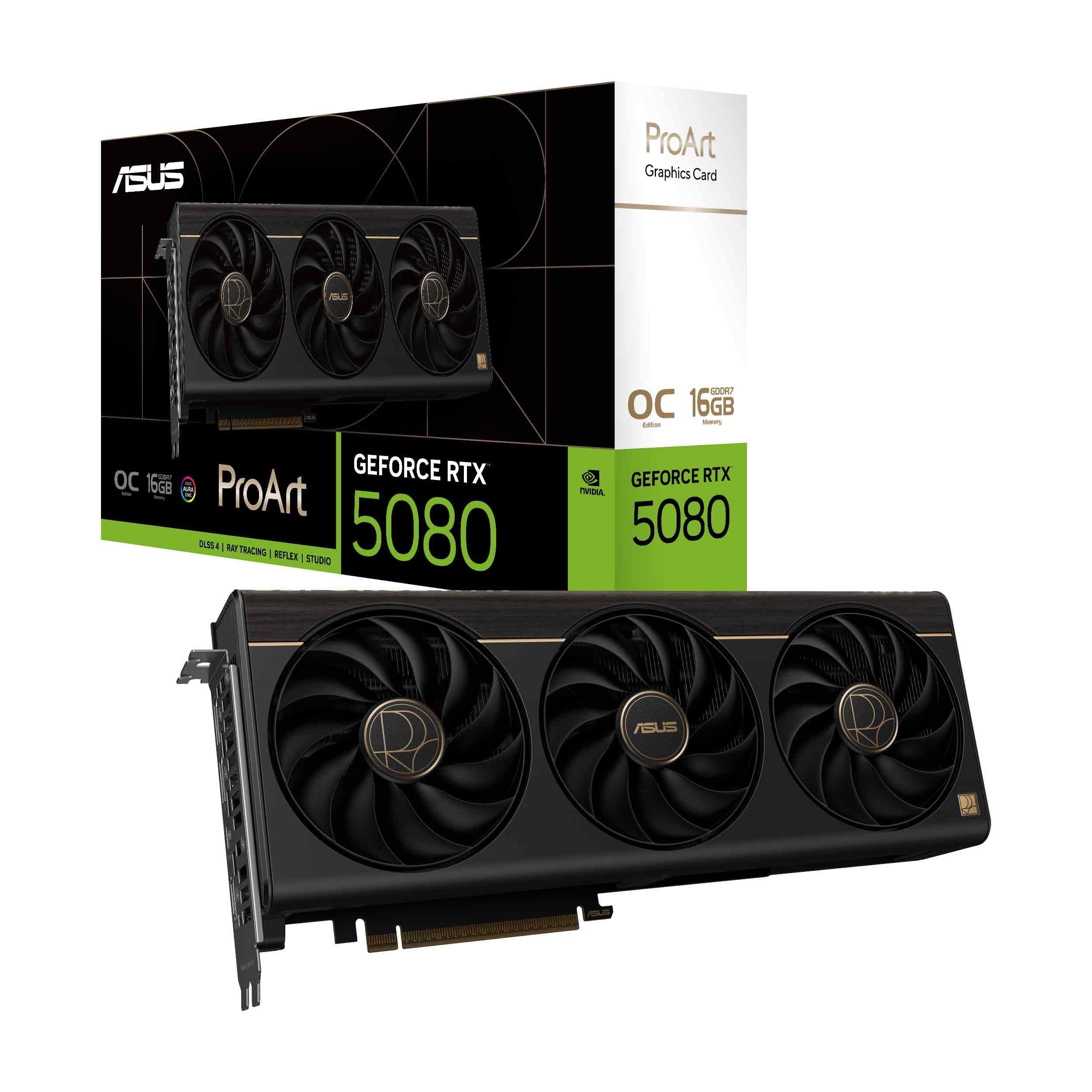
The ProArt 5080 OC is purpose-built for workstation and creative professional builds, featuring a 2.5-slot SFF-ready design that fits in compact chassis while delivering 2730 MHz boost clock and 1858 AI TOPS. The integrated USB Type-C port is a rare inclusion — it supports direct VR headset connection, display compatibility, and high-speed data transfer for content creation workflows without needing separate PCIe USB-C cards.
The card’s MaxContact heatsink with vapor chamber is tuned for sustained rendering loads rather than gaming spikes — real buyers using this for video editing (DaVinci Resolve, Premiere Pro) and 3D rendering (Blender, UE5) report stable performance even on hour-long encodes. The 16GB GDDR7 frame buffer is capable for 4K video timelines and moderate AI inference, though the 5090’s 32GB is needed for 8K video or large language model training.
The aesthetic is deliberately restrained — black shroud, subtle illuminated logo — and the size makes it compatible with rackmount cases and small-form-factor workstations that cannot accommodate the 3.5-slot monsters. One minor quality note: a buyer reported missing port covers and slot bracket screws on delivery; verify component completeness immediately. The three-year warranty is standard but ASUS’s RMA service has mixed reviews in the ProArt channel.
Why it’s great
- Integrated USB-C port supports VR headsets, displays, and high-speed data without extra PCIe cards
- 2.5-slot SFF-ready design fits in compact workstation cases that reject 3.5-slot GPUs
- MaxContact vapor chamber maintains consistent performance during long rendering sessions
Good to know
- 16GB VRAM is insufficient for 8K video editing and large-parameter LLM inference
- Missing accessory reports suggest QC variance in packaging — verify contents on receipt
- ProArt brand carries a premium over TUF for largely identical 5080 performance
13. VIPERA NVIDIA GeForce RTX 4090 Founders Edition

The 4090 Founders Edition (sold here under the VIPERA account — essentially a retail-listed FE unit) still delivers 80-85% of 5090 raster performance with mature Ada Lovelace drivers that have none of the 50-series teething issues. The 24GB GDDR6X on a 384-bit bus provides 1.0 TB/s bandwidth, sufficient for 4K gaming with ray tracing and most AI inference tasks. Real buyers report excellent performance in Blender rendering, LLM inference, and 4K AAA gaming.
The FE design remains impressive: a dual-axial flow-through cooler that vents hot air out the rear I/O and through the backplate, keeping the card cool at 450W. No support bracket is needed — the aluminum frame is rigid enough to prevent sag. The card is shorter (12 inches) than most 4090 and 5090 partner cards, fitting in cases that reject the 14-inch flagships. The 2520 MHz boost clock is factory-set and generally sustains well within thermal limits.
The major downside is that this is the previous generation. It lacks DLSS 4 Multi Frame Generation, which gives the 5090 a real performance advantage in titles that support it. The 24GB VRAM is also a bottleneck for the few applications that genuinely benefit from 32GB. However, in raw 4K raster performance without DLSS FG, the gap between a 4090 and a 5090 is roughly 15-20% — not the leap that 30-series to 40-series represented. If you can find this at a significantly lower price than a 5090, the value proposition is compelling.
Why it’s great
- Mature driver ecosystem with none of the 50-series stability or missing ROP issues
- Compact 12″ design fits in cases that can’t accommodate 14-inch 5090s
- Proven Ada Lovelace architecture with excellent 4K raster performance and ray tracing
Good to know
- Lacks DLSS 4 Multi Frame Generation — 5090 has a significant lead in supported titles
- 24GB VRAM is insufficient for 8K gaming and some large AI model workloads
- Lists at a high premium in current market; value declines as 5090 availability improves
FAQ
Does the RTX 5090 require a PCIe 5.0 motherboard?
Is the 32GB VRAM on the RTX 5090 necessary for gaming or just AI?
Why do some RTX 5090 cards cost more than others if the chip is the same?
Can a 1000W power supply run an RTX 5090 with a flagship CPU?
What is the difference between DLSS 3 on the RTX 4090 and DLSS 4 on the RTX 5090?
Final Thoughts: The Verdict
For most buyers, the 5090 graphics card winner is the GIGABYTE AORUS RTX 5090 Master because it delivers flagship 4K ray tracing performance with 32GB GDDR7, stays cool and quiet under load, and includes a power connector indicator light that addresses the 12V-2×6 safety concern — all at a price that doesn’t command the full premium of the ASUS or MSI flagships. If you want the absolute lowest GPU temperatures possible and have room for a 360mm radiator, grab the MSI SUPRIM Liquid SOC. And for the buyer building a stealth, RGB-free rig who values compact size and silent operation above all else, nothing beats the ZOTAC RTX 5090 Solid OC.