
An automatic incubator takes the hardest part of hatching eggs—maintaining precise temperature and humidity around the clock—and handles it with sensors and motors. You load the eggs, set the species, and the machine manages the turning schedule and climate control until your chicks, ducklings, or poults start pipping.
I’m Min — the co-founder and writer behind Gadgets Feed. I’ve spent hundreds of hours analyzing hatch-rate data, temperature sensor accuracy, and user reports across dozens of incubator models to isolate the units that actually stabilize the internal environment rather than just displaying a number on a screen.
This guide breaks down the specs that separate a reliable hatcher from a freezer of dead eggs and ranks the top performers. Read on to find the best automatic incubator for your flock size and budget.
How To Choose The Best Automatic Incubator
Not all automatic incubators deliver on the “automatic” promise. Some units display temperature and humidity but fluctuate enough to kill embryos. Others use flimsy turners that jam on day 18. Before you buy, anchor on three factors that directly drive hatch rate: airflow design, turner type, and sensor reliability.
Airflow: Forced-Air vs. Still-Air
A forced-air incubator uses a motor-driven fan to circulate warm air evenly across every egg, eliminating hot and cold spots. This is the only acceptable design for capacities above 20 eggs. Still-air incubators rely on natural convection and produce a temperature gradient that can exceed 4°F from top to bottom—enough to delay hatch or kill embryos. Every incubator on this list uses forced air.
Egg Turner Mechanism
Side-to-side rocker turners tilt the entire tray at intervals (typically every 60–120 minutes). Horizontal roller turners rotate each egg individually on its long axis. Roller mechanisms handle shipped eggs better because the air cell stays oriented correctly. Both types should auto-stop 3–4 days before hatch (lockdown) to prevent disturbing pipping chicks. Check whether that stop is programmed or requires manual removal of the turner frame.
Humidity Control: Auto vs. Manual
True auto-humidification uses a pump or siphon to add water without opening the lid, preventing temperature crashes during refills. Manual units require you to open the lid and pour water into channels, which can drop the internal temperature by 5–8°F for 20 minutes. If you hatch in a dry climate, prioritize a model with auto-humidification and a large external reservoir (1000mL or more).
Quick Comparison
On smaller screens, swipe sideways to see the full table.
| Model | Category | Best For | Key Spec | Amazon |
|---|---|---|---|---|
| Farm Innovators 2450 Pro Series | Premium | Large flocks requiring durable insulation | 41-egg capacity, circulated air fan | Amazon |
| IBKINXX 48-Egg Incubator | Premium | High-volume, precision humidity control | 48-egg, auto humidity motor, 360° view | Amazon |
| 26-Egg Voice Control Incubator | Premium | Hands-free operation and brooder combo | 26-egg, voice control, 1500mL tank | Amazon |
| CluckRun 25-Egg Incubator | Mid-Range | Quiet operation and stainless steel build | 25-egg, adjustable turn interval (60/120/180 min) | Amazon |
| MATICOOPX 20-Egg Incubator | Mid-Range | Shipped eggs with detached air cells | 20-egg, upright egg orientation, external refill | Amazon |
| CoInceptus 36-Egg Incubator | Budget-Friendly | Multiple species in one batch with adjustable rollers | 36-egg, 7 adjustable rollers, dual power (110V/12V) | Amazon |
| Sailnovo 56-Egg Incubator | Budget-Friendly | Set-and-forget dry hatching with large capacity | 56-egg, auto humidification pump, transparent lid | Amazon |
In‑Depth Reviews
1. Farm Innovators Model 2450 Pro Series
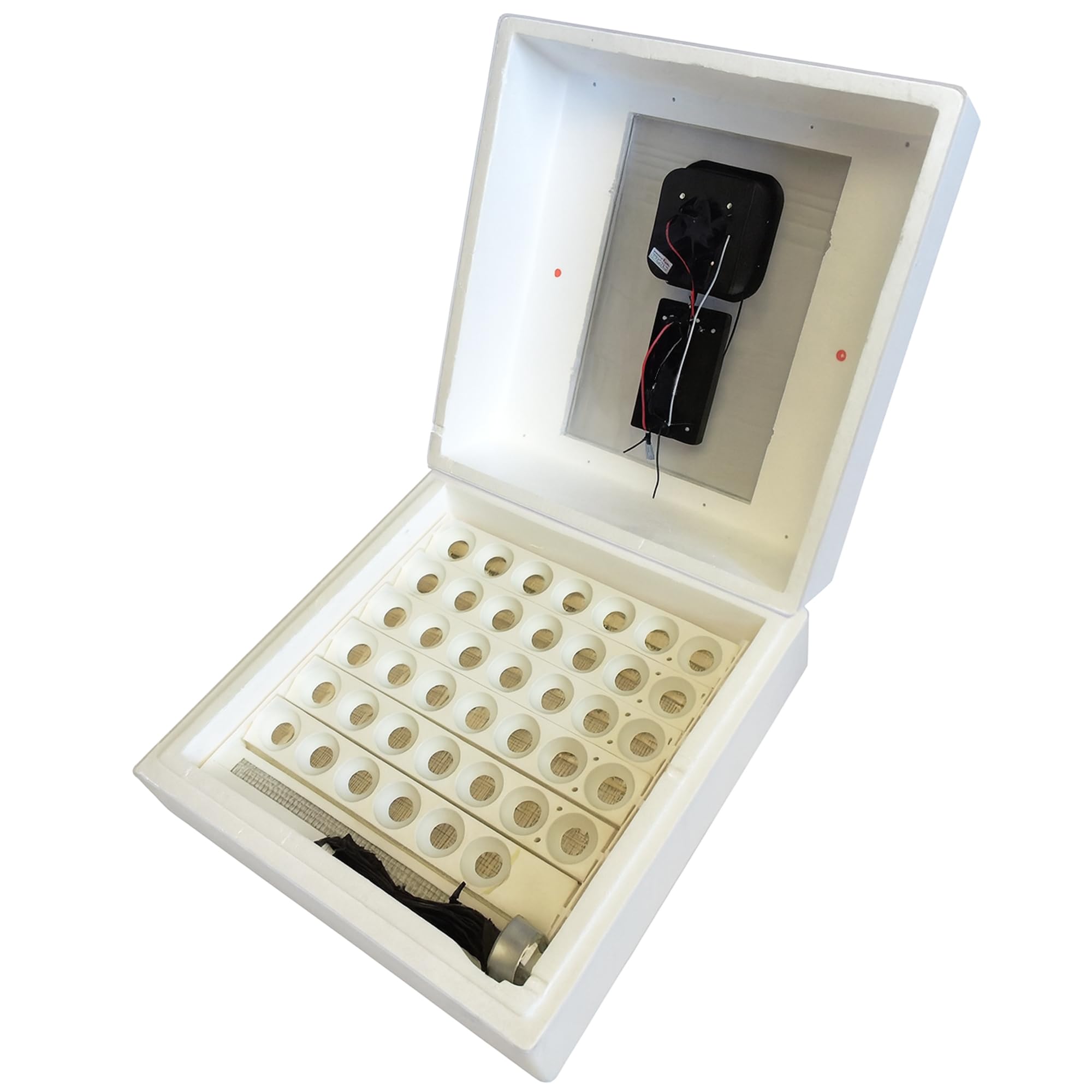
The Farm Innovators 2450 is built from recycled polystyrene foam that provides exceptional thermal insulation, keeping the internal temperature stable even when your ambient room temperature swings by 10°F. Its forced-air fan circulates warm air across all 41 eggs, minimizing the hot-spot issue that plagues still-air designs. The E-Z Fill water channels let you add moisture without cracking the lid, which is critical for maintaining humidity during the last three days of lockdown.
Customer reports over five years of use show the built-in hygrometer holds calibration reasonably well, though the top-mounted temperature display can drift from actual egg-level temperature by 1–2°F. Serious hatchers pair this unit with a separate Govee thermometer placed at egg height for real accuracy. The auto egg turner works on an adjustable countdown timer that accommodates chicken, duck, goose, and quail settings.
The deep bottom tray handles larger eggs like duck and goose without crowding, and the large viewing windows give you a 360° look at the action. The trade-off is the Styrofoam shell: it insulates superbly but can dent during cleaning, and some units arrive with minor cosmetic damage from shipping. For flock owners who need a proven, repeatable hatcher at this capacity, the 2450 is the benchmark.
Why it’s great
- Polystyrene construction delivers a tight thermal seal with minimal power draw
- E-Z Fill water channels allow lid-closed humidity maintenance
- Five-year track record with documented spare-part availability
Good to know
- Top-mounted temperature display can read 1–2°F off from egg-level reality
- Styrofoam body can chip or compress during cleaning if handled roughly
2. IBKINXX 48-Egg Incubator

The IBKINXX stands apart with its motor-driven humidity control system that precisely meters water drips into the incubation chamber instead of relying on passive evaporation. You can dial in a target humidity percentage (30–60% for incubation, 65–75% for lockdown), and the motor adjusts drip frequency to hold that level within ±3%. For hatchers in arid climates or those managing species with opposing humidity requirements (quail vs. goose), this level of control is a genuine step up from siphon-based systems.
The 360° clear lid gives an uninterrupted view of all 48 eggs, and the built-in egg candler is bright enough to see veins in standard brown eggs. The horizontal egg-turning structure rolls each egg on its long axis, which is safer for shipped eggs where the air cell may be detached. The 8 adjustable card strips let you narrow the track for quail eggs or widen it for duck eggs in the same batch.
User-reported hatch rates cluster around 50–80% depending on initial egg fertility and pre-heat stabilization. A few buyers reported the internal turner feeling slightly flexible, though no failures were documented in the review pool. The external water inlet is a meaningful convenience—you replenish the reservoir without cycling the internal climate. For intermediate and advanced hatchers who want active humidity regulation rather than passive wicking, the IBKINXX delivers.
Why it’s great
- Active motor-driven humidity control maintains setpoint within ±3%
- Horizontal roller turner prevents air cell dislodgment in shipped eggs
- 360° transparent lid with integrated candler for embryo monitoring
Good to know
- Turner mechanism feels slightly less robust than the cabinet-style competitors
- Top vent requires manual adjustment; new users may overshoot ventilation
3. 26-Egg Smart Voice Control Incubator
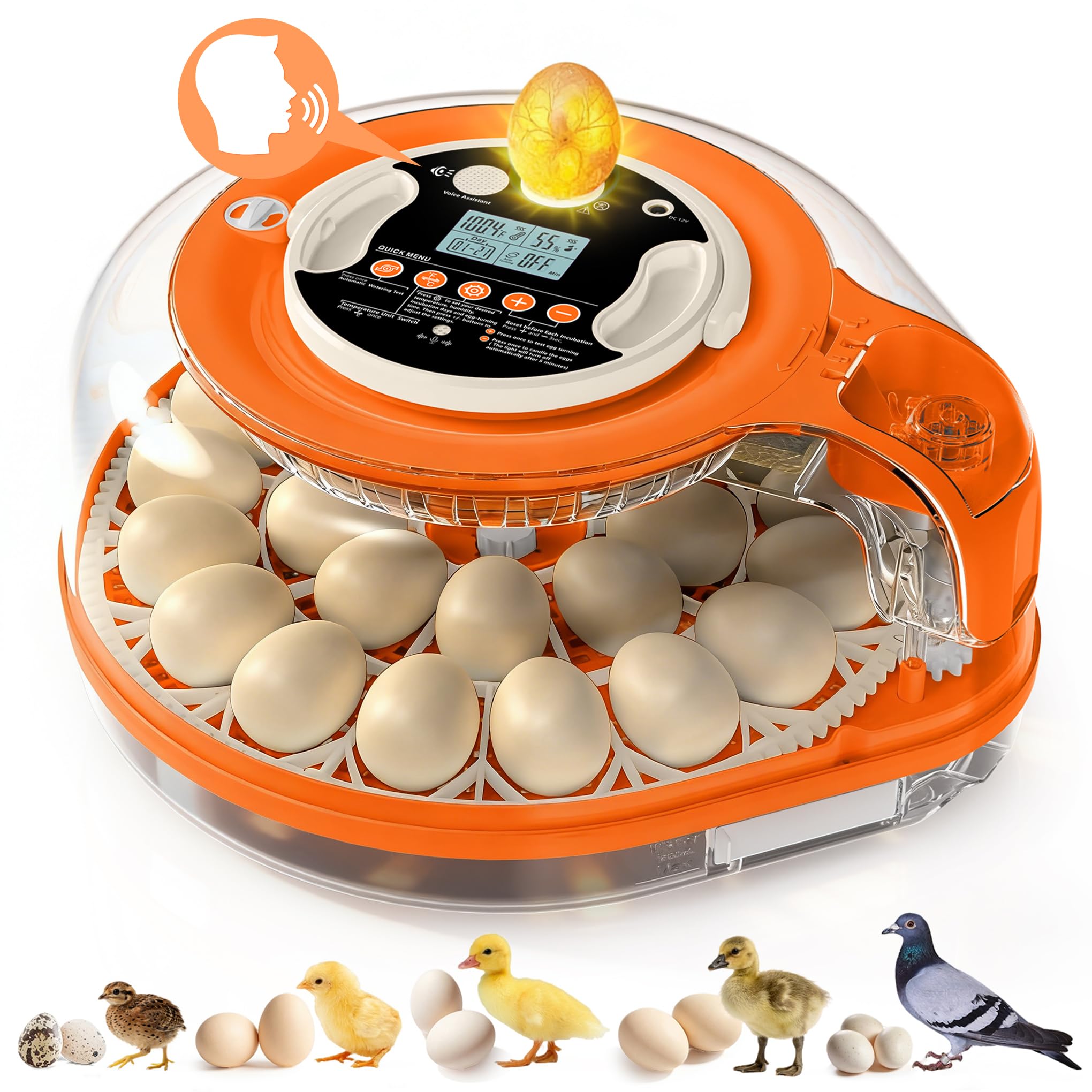
This is the only incubator on the list that can transition from incubation to brooding without transferring chicks to a separate enclosure—the 3-in-1 mode shifts from hatch to brooder, holding up to 20 chicks with enough floor space for feeders and waterers. The voice control system (wake word “Hello DanDan”) lets you adjust temperature, toggle the egg candler, and check humidity hands-free, which is genuinely useful when your hands are full with hatchling management.
The 1500mL external water tank supplies humidity for up to seven days without a refill, and the 360° circulating airflow system prevents the cold-edge effect that kills eggs near the perimeter of smaller still-air units. The 26-chicken-egg capacity converts to 59 quail eggs using the adjustable card strips. Auto egg turning pauses during the final four-day lockdown, and the detachable body cleans up easily under running water.
Early adopters report solid temperature stability within ±0.5°F once the unit reaches steady state, though the first 2–3 hours of initial warm-up require attention to confirm setpoint. The integrated brooder mode saves counter space for hobbyists who don’t want a separate brooder setup. Downsides include a slight learning curve for the voice command vocabulary and the need to manually separate the fan area when cleaning to avoid water damage to the electronics.
Why it’s great
- Combined incubator and brooder eliminates stressful chick transfer on day one
- 1500mL tank provides a week of humidity without lid opening
- Voice control reduces lid lifts that destabilize climate conditions
Good to know
- Voice commands require memorizing trigger phrases; no app control available
- Detachable components need careful drying to avoid electronic moisture issues
4. CluckRun 25-Egg Incubator
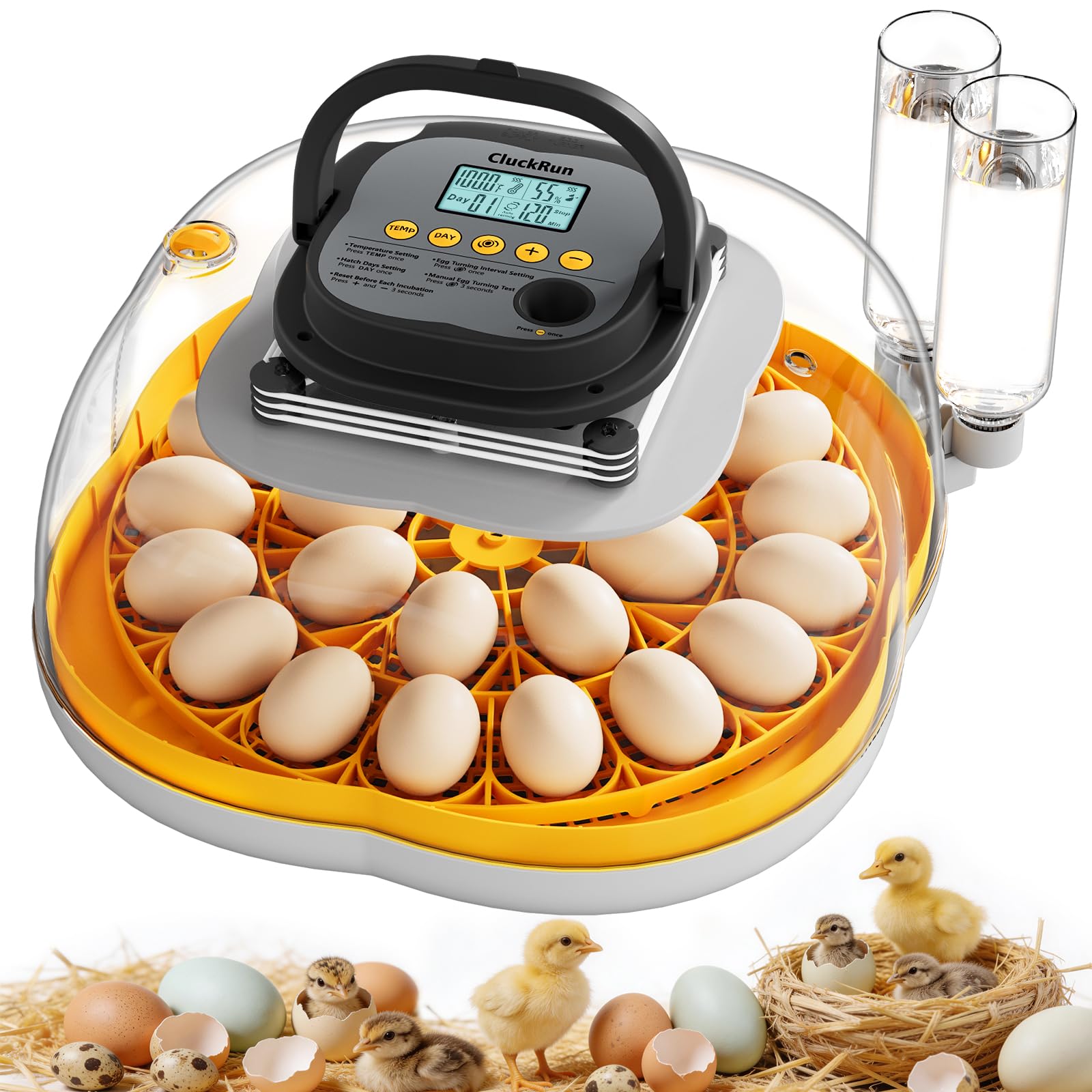
The CluckRun CK25 uses a stainless steel accent construction that feels more substantial than the all-plastic alternatives at this capacity. Its standout feature is the adjustable egg-turning interval—you can set it to rotate every 60, 120, or 180 minutes. This matters when you’re incubating mixed species: quail eggs benefit from more frequent turning (60 min), while goose eggs can handle the longer interval without internal damage.
The high protective walls in the hatching area prevent day-old chicks from tumbling out when you open the lid for quick checks. The integrated egg candler is bright enough for standard chicken and quail eggs, though darker Marans or olive-egg layers may need a supplementary penlight for clear vein visibility. The display shows incubation day count, turn countdown, temperature, and humidity on a single screen.
User hatch rates average around 75% for quail and chicken eggs, with several reviewers reporting 100% hatch rates on their first run. The included dual 10oz water bottles simplify refill without opening the main lid. The loud alarm that sounds when temperature or humidity drifts outside the set range is abrasive but effective—it ensures you wake up to a power outage rather than discovering it hours later. For a 25-egg machine, this hits a sweet spot of flexibility and build quality.
Why it’s great
- Adjustable turn interval (60/120/180 min) suits multi-species incubation
- Stainless steel accents provide a sturdier frame than all-plastic units
- Protective walls prevent chick falls during lid-open inspections
Good to know
- Built-in candler struggles with very dark eggshells
- Alarm is loud—reliable but may startle household members at night
5. MATICOOPX 20-Egg Incubator

The MATICOOPX uses an upright egg orientation with side-to-side turning, which means eggs sit vertically (pointed end down) and rock side to side rather than rolling on their sides. This is beneficial for shipped eggs because the air cell remains at the top, reducing the risk of embryo drowning during transport recovery. The external water refill port lets you top off the humidity reservoir without opening the lid and crashing the internal temperature.
The 20-egg capacity is ideal for small flocks or trial hatches before scaling up. The built-in egg candler provides enough light to check development on standard chicken and quail eggs through the clear lid. The forced-air fan circulates heat evenly across the relatively small chamber, and multiple reviewers noted stable temperature readings within ±0.5°F after initial warm-up.
One reviewer reported using the same unit for 13 consecutive hatches without mechanical failure, which speaks to the turning motor’s reliability. The one-year warranty provides a safety net. The main limitation is the 20-egg ceiling—you’ll outgrow it quickly if your flock expands. But for a starter incubator that prioritizes egg safety during the turning cycle, the MATICOOPX is hard to beat.
Why it’s great
- Upright egg orientation handles shipped eggs with detached air cells better than roll designs
- External water refill port prevents temperature crash during humidity maintenance
- Proven motor durability across a dozen-plus hatch cycles
Good to know
- 20-egg capacity limits scalability; not suitable for large flocks
- Side-to-side turner may not suit eggs with extremely fragile shells
6. CoInceptus 36-Egg Incubator
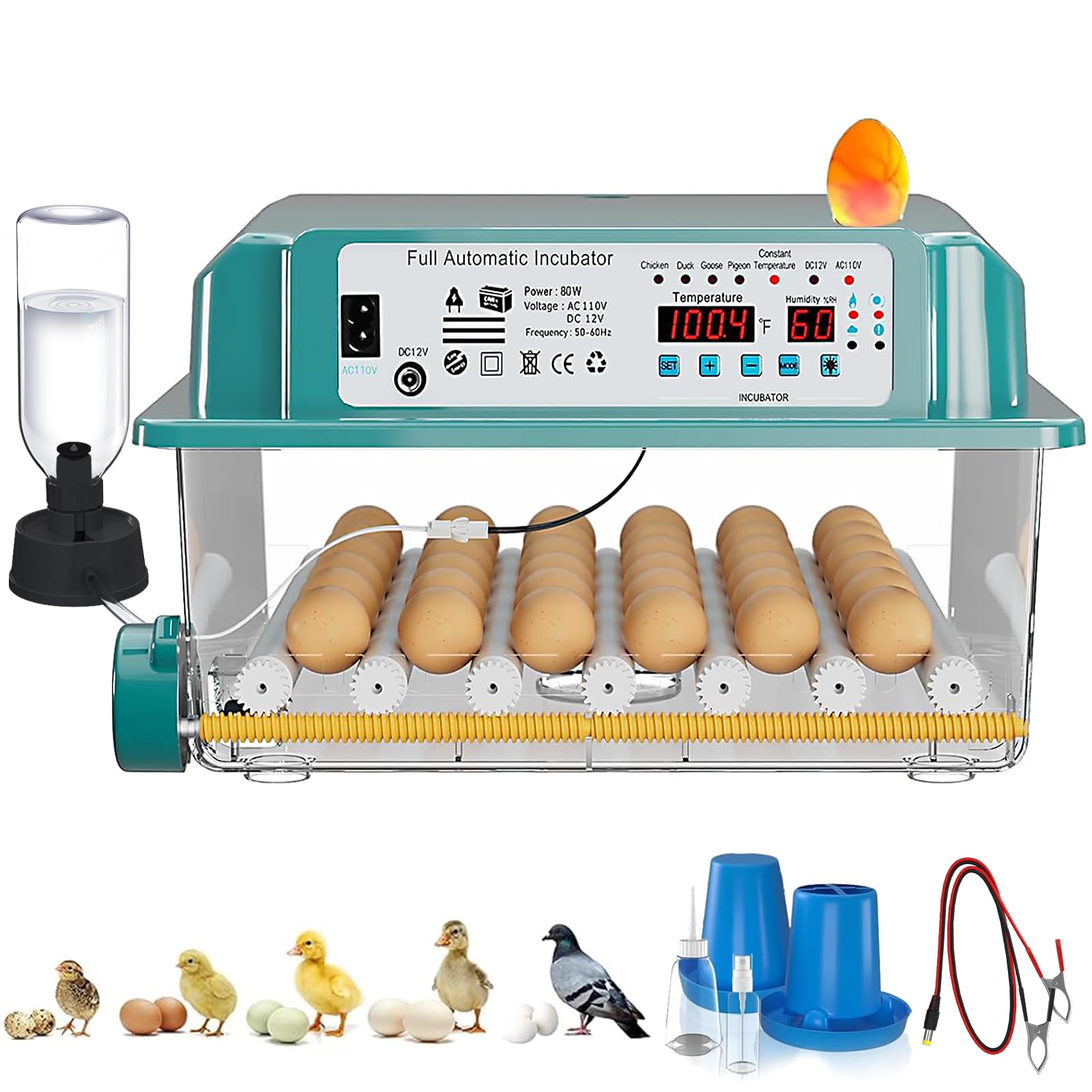
The CoInceptus 36 uses seven adjustable roller bars whose spacing you can modify to accommodate everything from tiny quail eggs to large goose eggs in a single batch. The four auto-modes (chicken, duck, goose, pigeon) automatically calibrate temperature and turning intervals, which removes the need to manually calculate incubation parameters for each species. This is a genuine time-saver if you run mixed hatches regularly.
The dual power system supports both standard 110V AC and a 12V battery cable, making it usable off-grid or during power outages. The integrated egg candler is housed in the lid and allows real-time embryo tracking. The motor turns eggs every 90 minutes, which aligns with natural hen behavior. The pulse heating method reduces temperature overshoot compared to continuous heating elements.
Hatch rate reports range from 66% to 100%, with the lower end associated with humidity calibration issues. A notable design flaw: the water system does not include a bottle (you supply your own), and some users report the internal hose can leak if not seated correctly. The 36-egg capacity and adjustable spacing make this a strong budget-conscious choice for keepers who need species flexibility on a single machine.
Why it’s great
- Adjustable roller spacing accommodates quail through goose eggs in one basket
- Dual 110V/12V power enables off-grid and emergency operation
- Four preset auto-modes eliminate manual parameter math for mixed species
Good to know
- Water hose requires careful seating to prevent leaks inside the chamber
- No humidity bottle included; must supply your own for the auto-refill system
7. Sailnovo 56-Egg Incubator
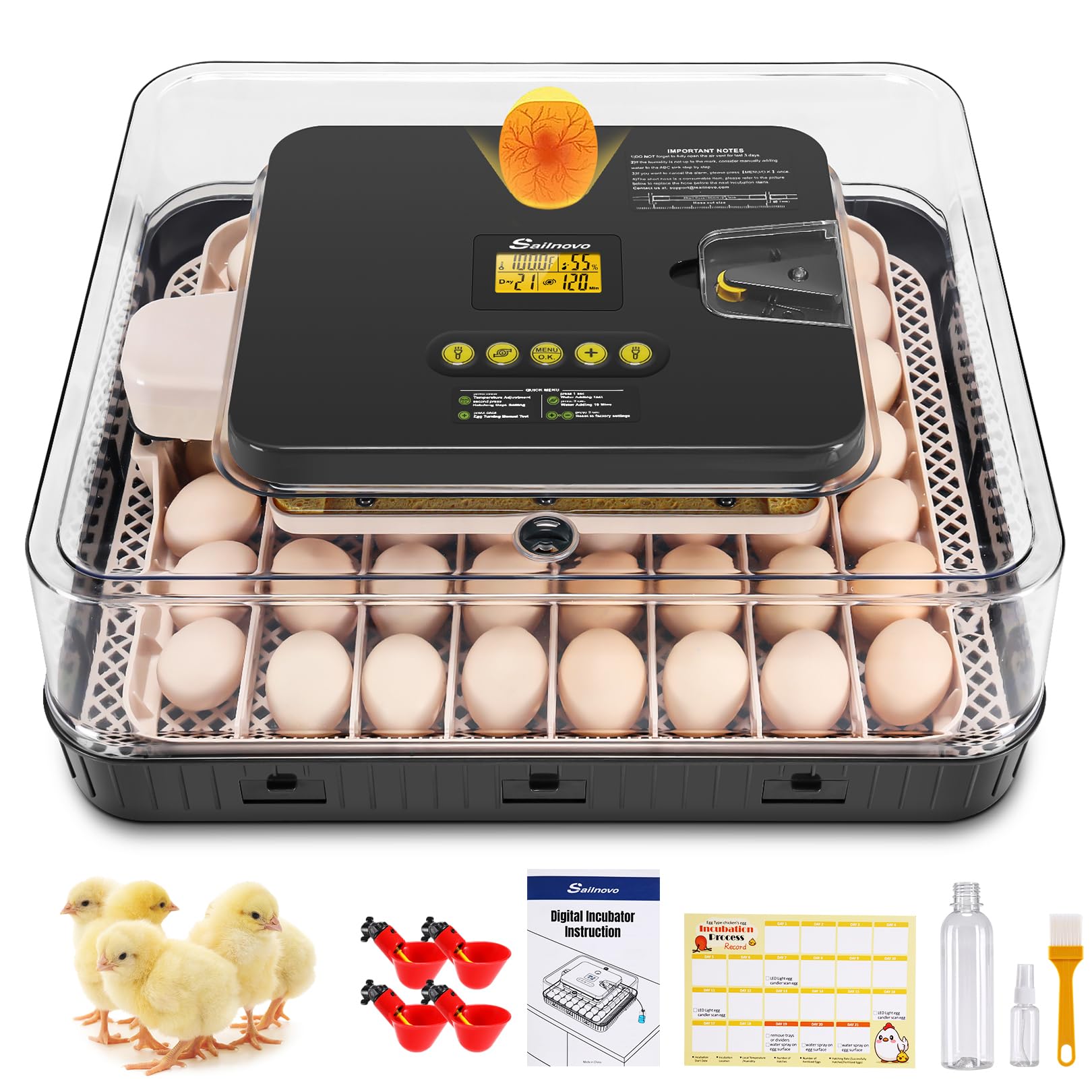
The Sailnovo 56 is a set-and-forget machine for keepers who want maximum capacity at a low per-egg cost. Its auto-humidification pump draws water from an external bottle via siphon, maintaining humidity at 55% for the first 18 days and automatically stepping up to 75% during lockdown. The forced-air fan and external water addition mean you rarely need to open the lid during the incubation cycle.
The transparent ABS cover provides clear visibility for monitoring and educational settings, and the egg turner rotates eggs every two hours with a countdown timer. The adjustable alarm system can be temporarily silenced for 30 minutes or fully disabled for dry hatching—a useful feature since many experienced hatchers prefer dry incubation (40–45% humidity) until day 18. The included styrofoam packaging doubles as extra insulation around the unit.
Customer hatch rates average 80–85%, with one user reporting 42 out of 52 eggs hatched successfully. The side-rolling turner works well for standard chicken eggs but can struggle with irregularly shaped bantam or duck eggs. The lid seal has been criticized as shallow—some users add a bead of silicone to improve the seal and prevent humidity loss. For the capacity, the Sailnovo delivers strong value, though it rewards minor modifications.
Why it’s great
- 56-egg capacity offers the lowest per-egg footprint in this lineup
- Auto-humidification pump progresses from 55% to 75% without manual intervention
- Alarm disable function supports dry-hatch methodology
Good to know
- Lid-to-base seal is shallow; silicone bead modification improves humidity retention
- Side-roller turner may not suit irregular or bantam-size eggs
FAQ
What does lockdown mean in an automatic incubator?
Can I hatch chicken and duck eggs in the same batch?
Why does my incubator’s digital humidity reading not match my separate hygrometer?
Final Thoughts: The Verdict
For most users, the best automatic incubator winner is the Farm Innovators Model 2450 Pro Series because its polystyrene insulation and forced-air fan deliver the most stable incubation environment at a proven price point with a five-year track record. If you want active humidity control and a 360° view, grab the IBKINXX 48-Egg Incubator. And for a combined incubator and brooder that saves counter space and reduces chick stress, nothing beats the 26-Egg Voice Control Incubator.