
Your 2TB hard drive is the single point of failure for your entire digital life. One drop, one power surge, one accidental knock off the desk — and years of photos, project files, and irreplaceable documents vanish. The question isn’t if a drive will fail, but when. Choosing the right one means understanding the trade-off between raw transfer speed, physical durability, and long-term reliability, not just grabbing the cheapest option on the shelf.
I’m Min — the co-founder and writer behind Gadgets Feed. I’ve pored over hundreds of hours of benchmark data, customer stress tests, and specification sheets to separate the drives that genuinely protect your data from those that will leave you scrambling for a recovery service.
This guide compares seven of the most compelling options on the market, breaking down every measurable detail you need to confidently select your next 2tb hard drive, whether your priority is rugged portability, blistering SSD speeds, or pure value per terabyte.
How To Choose The Best 2TB Hard Drive
Selecting a 2TB drive is rarely about capacity alone — nearly every model offers the same 2TB ceiling. The real differentiation comes down to three factors: the internal technology (HDD vs. SSD), the physical resilience of the enclosure, and the interface speed that governs how quickly you can move data in and out.
SSD vs. HDD: Speed vs. Cost per Gigabyte
A 2.5-inch mechanical hard disk drive (HDD) offers the lowest cost per terabyte, but its spinning platters and moving read/write heads make it vulnerable to physical shock and limit transfer speeds to roughly 130-160 MB/s. A solid-state drive (SSD) uses NAND flash memory with no moving parts, delivering 1,000 MB/s or more on a USB 3.2 Gen 2 interface, with far greater resistance to drops and vibration. The price premium for an SSD is significant — often two to three times more than an equivalent HDD — so the choice hinges on whether your workflow demands speed (video editing, game libraries) or is fine with slower archival backup.
Ruggedness and Enclosure Build Quality
If the drive leaves your desk, its enclosure matters as much as its internal components. Look for IP68 (fully dust-tight and submersible beyond 1 meter) or IP65 (dust-tight and water-jet resistant) ratings for environmental sealing. Drop protection is typically stated in meters of fall survival onto a hard surface — MIL-STD-810G certification (surviving 1.22 meters) is the baseline for ruggedized portables. An aluminum or metal unibody enclosure dissipates heat far better than a plastic shell, which is critical for sustained SSD performance during long transfer sessions.
Interface and Real-World Transfer Performance
The advertised data transfer rate — whether 5 Gbps (USB 3.2 Gen 1 / USB 3.0), 10 Gbps (USB 3.2 Gen 2), or 20 Gbps (USB 3.2 Gen 2×2) — is a theoretical ceiling, not a guarantee. An HDD will never saturate a 5 Gbps bus, so the slower interface is irrelevant. An SSD, however, needs the faster Gen 2 or Gen 2×2 connection to realize its full potential. Check your computer’s port capabilities before buying a high-speed portable SSD, as plugging a Gen 2×2 drive into a Gen 1 port will cap its speed at roughly 5 Gbps.
Quick Comparison
On smaller screens, swipe sideways to see the full table.
| Model | Category | Best For | Key Spec | Amazon |
|---|---|---|---|---|
| SABRENT Rocket Nano V2 | Premium SSD | 8K video / pro workflows | 1500 MB/s read — USB 3.2 Gen 2×2 | Amazon |
| Samsung T7 | Premium SSD | Cross-platform reliability | 1050 MB/s read — USB 3.2 Gen 2 | Amazon |
| SanDisk Extreme Portable SSD | Premium SSD | Rugged outdoor use | 1050 MB/s read — IP65 & 3m drop | Amazon |
| ADATA HD710 Pro | Mid-Range HDD | Military-grade durability | IP68 waterproof / MIL-STD-810G | Amazon |
| WD 2TB Elements | Mid-Range HDD | Everyday backup | USB 3.2 Gen 1 — 5 Gbps interface | Amazon |
| Toshiba Canvio Basics | Budget HDD | Budget-conscious buyers | USB 3.0 — 5 Gbps interface | Amazon |
| Seagate Portable 2TB | Budget HDD | Simple plug-and-play | 130 MB/s transfer rate — USB 3.0 | Amazon |
In‑Depth Reviews
1. SABRENT 2TB Rocket Nano V2

The SABRENT Rocket Nano V2 is the fastest 2TB portable drive in this lineup, hitting a sustained 1500 MB/s read and write over its USB 3.2 Gen 2×2 interface. That throughput is nearly 10 times faster than any HDD-based competitor here, making it the only drive genuinely suited for editing 8K ProRes RAW directly off the drive or running a game library without asset-loading delays.
Its aluminum enclosure with an external silicone sleeve keeps thermals in check during prolonged transfers — a critical detail for a drive that can push hot data for minutes at a time. At roughly half the physical footprint of the SanDisk Extreme Pro, the Rocket Nano V2 is also remarkably portable, and it ships with both Type-C to Type-C and Type-C to Type-A cables for maximum device compatibility. The native UFD controller minimizes the compatibility hiccups that sometimes plague third-party NVMe enclosures.
The premium for this performance is steep compared to HDD options, and the Gen 2×2 speed advantage is only realized if your computer has a matching USB 3.2 Gen 2×2 port (many laptops still top out at Gen 2). On a standard USB 3.2 Gen 1 or Gen 2 port, speeds drop to around 500-1050 MB/s — still excellent, but no longer class-leading.
Why it’s great
- Unmatched 1500 MB/s sustained transfer speed for 8K video and large file workflows
- Aluminum body with silicone sleeve keeps drive cool and protected under heavy load
- Includes both USB-C to C and USB-C to A cables for universal connectivity
Good to know
- Full Gen 2×2 speeds require a matching host port — verify your device before buying
- Significantly more expensive than HDD-based alternatives at the same capacity
2. Samsung T7 Portable SSD

The Samsung T7 has become the default recommendation for anyone who needs a fast, reliable, and broadly compatible portable SSD. Its sequential read speed of 1050 MB/s and write speed of 1000 MB/s (over PCIe NVMe via USB 3.2 Gen 2) makes it roughly twice as fast as its predecessor, the T5. It handles 4K 60fps video recording directly from a camera or iPhone 15 Pro without dropping frames, and its solid aluminum unibody construction provides excellent passive cooling and drop protection up to 6 feet.
One of the T7’s strongest advantages is its cross-platform compatibility: it works out of the box with Windows, macOS, Android phones, iPads, and gaming consoles, and ships with both USB-C and USB-A cables. The 256-bit AES hardware encryption via the Samsung Magician app adds a layer of data security that the SABRENT and several HDD competitors lack. The drive arrives formatted in FAT32/MBR; you will want to reformat it to exFAT or NTFS/GPT depending on your primary OS, which is a quick one-time step.
The included USB-C cable is only 18 inches long, which can be restrictive for desktop setups, and the Magician software’s auto-launch behavior may occasionally cause ejection issues on some systems (disabling the startup option resolves it). For most users, however, the T7 offers the best balance of sustained speed, build quality, and security features in the 2TB portable SSD class.
Why it’s great
- Reliable 1050/1000 MB/s read/write speeds with PCIe NVMe interface
- Aluminum unibody construction provides effective heat dissipation and 6-foot drop resistance
- 256-bit AES hardware encryption protects sensitive data without slowing transfers
Good to know
- Included USB-C cable is only 18 inches — plan for a longer Gen 2 cable for desktop use
- Arrives in FAT32/MBR format; most users will need to reformat to GPT
3. SanDisk Extreme Portable SSD

The SanDisk Extreme Portable SSD matches the Samsung T7’s peak read speed of 1050 MB/s, but differentiates itself with an IP65 water and dust resistance rating and an upgraded 3-meter drop protection certification. This makes it the go-to choice for field photographers, drone operators, and anyone who needs a fast SSD that can survive being tossed in a backpack, rained on, or accidentally dropped off a tailgate. The integrated carabiner loop lets you clip it directly to a pack or belt loop for quick access.
Performance-wise, the SanDisk delivers 1000 MB/s sequential writes, and the included 256-bit AES hardware encryption ensures data stays private even if the drive is misplaced. The drive includes a USB-C cable and a USB-A adapter, covering both modern and legacy ports. It is slightly larger than the T7 but remains pocketable, and its rubberized silicone exterior adds grip and shock absorption that the all-metal T7 lacks.
The primary drawback is that this is the “old model” in SanDisk’s lineup — the newer Extreme Pro version pushes 2000 MB/s over Gen 2×2, but at a significantly higher price. At 2TB, this version is still a competent performer for 4K video editing and daily backups, though the drive can warm up noticeably during sustained writing. The IP65 rating means it is water-jet resistant but not submersible (IP68 required for that), so keep it out of puddles.
Why it’s great
- IP65 dust and water resistance with 3-meter drop protection for demanding outdoor use
- 1050 MB/s read / 1000 MB/s write with NVMe performance
- Carabiner loop and silicone jacket make it easy to secure and handle
Good to know
- IP65 rating means splash-resistant, not submersible — avoid full immersion
- Slightly larger physical footprint than the Samsung T7
4. ADATA HD710 Pro

The ADATA HD710 Pro is the most physically resilient HDD in this guide, carrying both an IP68 waterproof rating (fully submersible beyond 1 meter) and MIL-STD-810G 516.6 shock certification. Its triple-layer construction uses a metal core inside a thick rubberized casing with a gasketed USB port cover, making it genuinely drop-proof from typical desk heights and splash-proof in a way no plastic-shell HDD can match. The blue color option and neat cable management channel on the back are thoughtful design touches for a drive that will see fieldwork.
As a 2.5-inch mechanical HDD, the HD710 Pro’s data transfer rate caps out around 625 Mbps (roughly 78 MB/s) over its USB 3.1 interface — fine for overnight backups, time machine archives, or transporting media libraries, but unsuitable for editing video or running applications directly from the drive. Customer reviews consistently praise its two-year survivability under clumsy daily use, and the company offers reasonable warranty replacement support if the drive does fail.
The trade-off for the ruggedness is weight and portability: the HD710 Pro is noticeably heavier and bulkier than the svelte SSD options above, and the old-style USB connector can be difficult for users with hand dexterity issues. It is not an SSD, so seeker noise and vibration are audible during operation, and the drive is incompatible with high-throughput workflows that require sustained random I/O.
Why it’s great
- IP68 waterproof and MIL-STD-810G shock resistance for extreme physical protection
- Triple-layer rubberized construction with metal core and USB port cover
- Neat cable management channel and travel-ready design
Good to know
- Mechanical HDD speeds cap around 78 MB/s — not suitable for active editing
- Heavier and bulkier than SSD alternatives of the same capacity
5. WD 2TB Elements Portable

The WD Elements 2TB is the quintessential “just works” external HDD. Its USB 3.2 Gen 1 interface delivers up to 5 Gbps theoretical bandwidth, and while the spinning drive inside will never reach that ceiling, real-world sequential transfers land around 120-140 MB/s — competitive among HDD peers. The small, lightweight plastic enclosure holds a 2.5-inch mechanical drive and offers plug-and-play compatibility with Windows out of the box (Mac requires reformatting). It is quiet in operation and runs warm to the touch under load, which is normal for this class.
WD has refined the Elements line over years, and customer feedback reflects solid reliability for weekly Time Machine backups, photo archiving, and general file storage. The USB cable is notoriously prone to failure — investing in a quality replacement is a common recommendation from long-term users. The drive is not truly “portable” in the rugged sense; its plastic casing offers minimal drop protection, so treat it as a desktop backup drive that occasionally travels in a padded bag.
At 2TB, the Elements offers one of the lowest per-terabyte costs in this comparison. The catch is the mechanical drive’s inherent fragility and slower random read/write speeds, which make it a poor choice for gaming, video editing, or running software. For pure archival value, however, it remains a top contender in the budget-to-mid-range HDD segment.
Why it’s great
- Excellent cost per gigabyte for large-capacity archival storage
- Quiet operation and whisper-quiet seek for background backups
- USB 3.2 Gen 1 interface delivers competitive 120-140 MB/s transfers
Good to know
- Plastic enclosure offers minimal drop protection — not suitable for frequent travel
- Included USB cable has a reputation for premature failure; budget for a replacement
6. Toshiba Canvio Basics 2TB

The Toshiba Canvio Basics delivers the raw 2TB capacity at one of the most accessible price points in this guide, making it a strong candidate for budget-conscious buyers who just need extra space for document backups, media libraries, and occasional file transfers. Its USB 3.0 interface supports up to 5 Gbps theoretical speed, and real-world read/write performance is adequate for sequential file copies — customer reports indicate backup times under one hour for typical user data sets. The matte, smudge-resistant finish on the polycarbonate housing keeps the drive looking clean over time.
The Canvio Basics is pre-formatted in NTFS for Windows compatibility and requires reformatting for macOS. Setup is genuinely plug-and-play: no software installation, no driver searching, and the drive does not require an external AC power cord, operating entirely via bus power from the USB port. The LED indicator blinks slowly during operation to confirm the drive is active, which is a useful visual cue during backups. It is compact and lightweight enough to slip into a laptop bag pocket for occasional travel.
As a mechanical HDD, the Canvio Basics shares the same limitations as the WD Elements and Seagate Portable: it is slower than even a budget SSD, vulnerable to damage if dropped, and not suitable for running applications or editing video directly from the drive. Some users report that the drive can feel warm to the touch during extended use, though this is normal for bus-powered 2.5-inch HDDs and not a cause for concern.
Why it’s great
- Very competitive price per terabyte in the HDD segment
- Plug-and-play setup with no software required, compatible with Windows and Mac
- Compact, lightweight design with matte smudge-resistant finish
Good to know
- Mechanical HDD speeds top out well below SSD performance
- Vulnerable to physical shock — treat as a desktop drive that occasionally travels
7. Seagate Portable 2TB
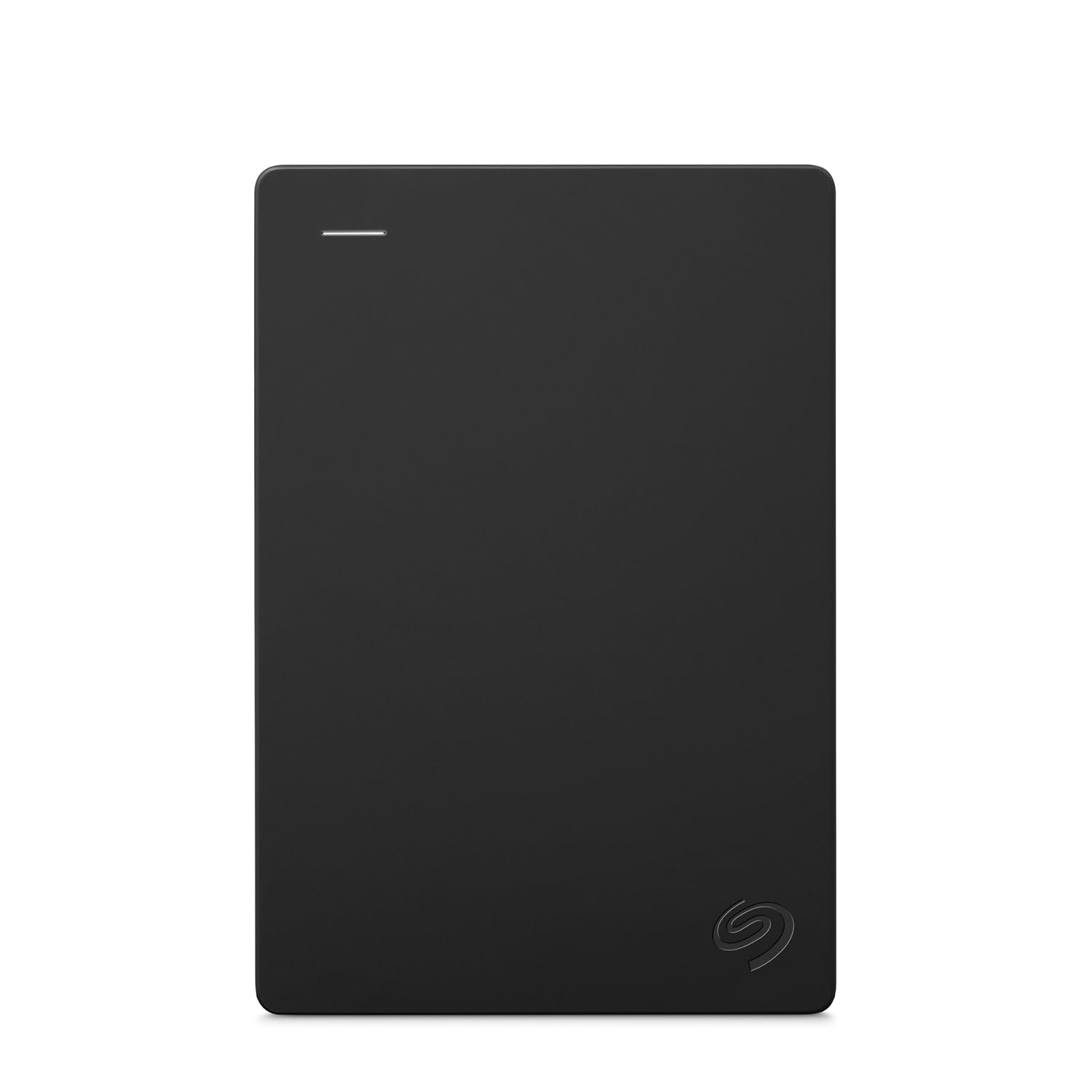
The Seagate Portable 2TB is a no-frills external HDD designed for straightforward drag-and-drop storage expansion. It connects via USB 3.0 and delivers up to 130 MB/s sequential transfers — sufficient for moving music libraries, student documents, or offloading smartphone photos. The drive is recognized automatically by Windows without any software installation, making it an easy recommendation for less tech-savvy users who want to plug in and start copying files immediately. Mac users should note the drive is pre-formatted for NTFS and will need reformatting via Disk Utility.
Seagate backs this drive with a 1-year Rescue Service plan, which provides data recovery assistance in the event of drive failure — a differentiator among budget HDDs that typically offer only the standard limited warranty. The drive is compact and lightweight, fitting easily into a backpack pocket or laptop case. Customer reviews consistently mention its quiet operation and reliable performance as a backup destination for college students and home users managing photo archives or class projects.
The Seagate Portable lacks any ruggedization features — the plastic enclosure offers no meaningful drop protection, and it lacks an IP rating for water or dust resistance. Some users have reported power delivery issues on certain USB ports, where the drive may not spin up reliably. The LACK of SMART monitoring is also a notable omission for anyone who wants to proactively check drive health, and the smaller cache (most variants use a 2MB cache) means the drive is more susceptible to slowdowns during small-file random I/O compared to the WD Elements.
Why it’s great
- Plug-and-play simplicity with automatic Windows recognition
- Includes 1-year Rescue Service for data recovery — rare at this price level
- Quiet, lightweight, and portable for daily carry
Good to know
- Plastic enclosure provides minimal physical protection
- Lacks SMART monitoring and has a small cache, impacting small-file performance
FAQ
Which is faster for everyday transfers: USB 3.0 HDD or USB 3.2 Gen 2 SSD?
Can I use a 2TB portable HDD for gaming on a PS5 or Xbox Series X?
What does reformatting a drive for Mac involve?
Final Thoughts: The Verdict
For most users, the 2tb hard drive winner is the Samsung T7 because it strikes the best balance of sustained 1050 MB/s speed, aluminum build quality, 256-bit hardware encryption, and broad compatibility across Windows, Mac, Android, and consoles. If your priority is raw transfer speed for 8K video or large game libraries, grab the SABRENT Rocket Nano V2 and ensure your system supports USB 3.2 Gen 2×2. And for outdoor fieldwork where water, dust, and drops are the real threat, nothing beats the ADATA HD710 Pro.