
An 8-inch subwoofer sits in the Goldilocks zone of low-frequency reproduction: small enough to tuck under a desk or next to a bookshelf, yet capable of delivering chest-thumping bass that fills a medium-sized room. The real challenge isn’t size — it’s choosing between passive car-audio drivers and powered home-theater units while navigating impedance options that affect amplifier compatibility. The wrong 8-ohm match can leave your system starved for power or with muddy, uncontrolled lows.
I’m Min — the co-founder and writer behind Gadgets Feed. I’ve spent hundreds of hours dissecting subwoofer specifications, measuring enclosure impact on frequency response, and comparing Class-D amplifier performance across budget and premium tiers in the 8-ohm category.
This guide filters out the noise and delivers a clear verdict on the best 8 ohm subwoofer for music lovers, home theater builders, and studio engineers who demand tight, accurate bass without wasting money on oversized drivers or underpowered amps.
How To Choose The Best 8 Ohm Subwoofer
An 8-ohm subwoofer is typically easier on your amplifier than a 4-ohm model, drawing less current and running cooler — but it also needs more voltage to reach the same SPL. This makes amplifier matching critical. Focus on three pillars: power handling, enclosure type, and connectivity.
Power Handling: RMS Over Peak
Ignore peak power figures; they are marketing numbers. Look at the RMS (continuous) wattage. For an 8-inch 8-ohm sub, an RMS rating between 70W and 250W covers most home and car audio setups. Pairing a high-RMS sub with an amplifier that delivers at least 75% of that RMS value ensures clean, undistorted bass.
Enclosure Design: Sealed vs Vented
Sealed enclosures produce tighter, more accurate bass with better transient response — ideal for music. Vented (ported) enclosures boost output at specific frequencies, delivering louder bass for home theater LFE effects. Your choice depends on whether you prioritize precision or sheer low-end rumble.
Connectivity and Integration
Powered subwoofers with LFE inputs, adjustable crossover, and phase control integrate seamlessly with AV receivers. Passive 8-ohm subs need an external amplifier and careful wiring (single or dual voice coils) to match impedance. For desktop systems, line-level RCA inputs and auto-on features reduce hassle.
Quick Comparison
On smaller screens, swipe sideways to see the full table.
| Model | Category | Best For | Key Spec | Amazon |
|---|---|---|---|---|
| WiiM Sub Pro | Smart Powered Sub | Wireless multi‑room systems | 25 Hz low-end, AI RoomFit | Amazon |
| Yamaha HS8S | Studio Sub | Critical monitoring & mixing | 22 Hz – 150 Hz response | Amazon |
| Audioengine S8 | Powered Desktop Sub | Desktop & near‑field listening | 250W RMS, down‑firing | Amazon |
| Kanto SUB8VMB | Sealed Powered Sub | Accurate musical bass | Sealed enclosure, 300W peak | Amazon |
| Edifier T5s | Compact Powered Sub | Bookshelf speaker augmentation | 70W RMS, 35 Hz extension | Amazon |
| Klipsch R-8SW | Home Theater Powered Sub | Compact home theater | 150W peak, down‑firing | Amazon |
| Dayton Audio CS800 | Budget Powered Sub | Value‑focused music systems | 150W Class D, 35 Hz | Amazon |
| Rockville Rock Shaker 10 | Powered Enclosed Sub | Budget living‑room LFE | 300W RMS, 10″ driver | Amazon |
| Pioneer TS-A250D4 | Passive Car Sub | Car audio upgrades | Dual 4Ω, 400W RMS | Amazon |
In‑Depth Reviews
1. WiiM Sub Pro

The WiiM Sub Pro redefines the 8-inch subwoofer category by packing a 250W Class-D amp, an 8-inch high-excursion woofer, and room-shaking 25 Hz extension into a compact piano-black chassis. The standout feature is AI RoomFit — one-tap calibration that automatically tailors bass response to your specific room dimensions without requiring a microphone kit or manual EQ adjustments.
Wireless connectivity is next-gen with Wi-Fi 6 and Bluetooth 5.3, letting you place the sub anywhere near a power outlet while streaming losslessly from any WiiM streamer. The free WiiM Home App provides deep control: 10-band parametric EQ, adjustable crossover, phase, and latency settings — plus ongoing firmware updates that continuously refine performance.
Pairing wirelessly with WiiM amps creates a seamless multi-room system, and the RCA input ensures compatibility with any receiver or soundbar that has a subwoofer pre-out. The heavy, non-vibrating cabinet and glossy finish give it a premium feel that matches high-end bookshelf speakers like KEF LS50s.
Why it’s great
- AI RoomFit auto-calibration integrates bass perfectly without guesswork
- Wi-Fi 6 and Bluetooth 5.3 provide true wireless flexibility
- 25 Hz extension delivers deep, distortion-free lows for movies and music
Good to know
- Best performance achieved within the WiiM ecosystem
- Temporary limitation on bass output during some streaming protocols
2. Yamaha HS8S Studio Subwoofer

The Yamaha HS8S is the professional studio reference for 8-inch subwoofers, offering an astonishing 22 Hz to 150 Hz frequency response that reveals sub-bass details most subs simply miss. Its 150W amplifier drives an 8-inch cone woofer through a bass-reflex design, delivering tight, articulate low end without coloration or port noise.
Connectivity is pro-grade with balanced XLR inputs and outputs, plus a HIGH CUT control (80-120 Hz) and LOW CUT switch that allow precise integration with studio monitors. The PHASE switch ensures seamless blending with main speakers, preserving imaging and stereo focus.
Users consistently praise its noise-free operation and ability to handle both critical mixing and casual listening. The solid build, heat-sinked amplifier, and thorough manual make it a long-term investment for any serious audio workspace.
Why it’s great
- Outstanding 22 Hz low-end extension for critical monitoring
- Balanced XLR I/O integrates cleanly with pro studio gear
- HIGH CUT and PHASE controls allow precise speaker blending
Good to know
- No wireless connectivity; requires XLR cable runs
- Heat sink may obstruct angled XLR connectors in tight racks
3. Audioengine S8 Powered Subwoofer

The Audioengine S8 has been a benchmark in the desktop audio world for years, and for good reason: its 250W amplifier drives an 8-inch down-firing woofer to produce deep, tight bass that pairs perfectly with powered bookshelf speakers like the Audioengine A5+ or A2+. The down-firing design lets you place it under a desk without aiming the driver at a wall.
Setup is straightforward with RCA line-level inputs and a variable crossover that lets you blend the sub seamlessly with your main speakers. The sleep mode auto-engages after a period of inactivity, saving power without sacrificing responsiveness.
Users report that the S8 transforms near-field listening — adding weight to kick drums and low-end synth without muddying vocals or midrange. The compact footprint fits under most desks with ample footroom, making it an ideal choice for desktop gaming, music production, and casual listening.
Why it’s great
- 250W output provides clean, high-impact bass for near-field use
- Down-firing design offers flexible placement without sacrificing clarity
- Variable crossover and sleep mode simplify integration and energy use
Good to know
- Sharp feet may scratch hardwood floors without pads
- Not designed for large living rooms or extreme SPL
4. Kanto SUB8VMB Sealed Powered Subwoofer

The Kanto SUB8VMB chooses accuracy over brute force with its sealed enclosure design, which delivers faster transient response and lower distortion than ported alternatives. The 300W peak amplifier drives an 8-inch paper cone woofer that reproduces bass notes with musical precision — perfect for jazz, acoustic, and rock where timing matters.
At roughly 11 inches in each dimension, the SUB8 fits under desks or in tight spaces where traditional subwoofers dominate. The adjustable high-pass filter and phase switch ensure seamless integration with Kanto speakers or any third-party bookshelf pair.
Users consistently praise its ability to add warmth and authority to music without the one-note boominess common in budget ported subs. The matte white or black finish blends into any decor, making it a style-forward choice that doesn’t compromise on sonic accuracy.
Why it’s great
- Sealed enclosure delivers tight, accurate bass with low distortion
- Compact 11-inch form factor fits under desks easily
- Adjustable high-pass filter and phase switch ensure system integration
Good to know
- Limited sub-40 Hz extension compared to ported designs
- Premium pricing reflects build quality and aesthetic finish
5. Edifier T5s Powered Active Subwoofer
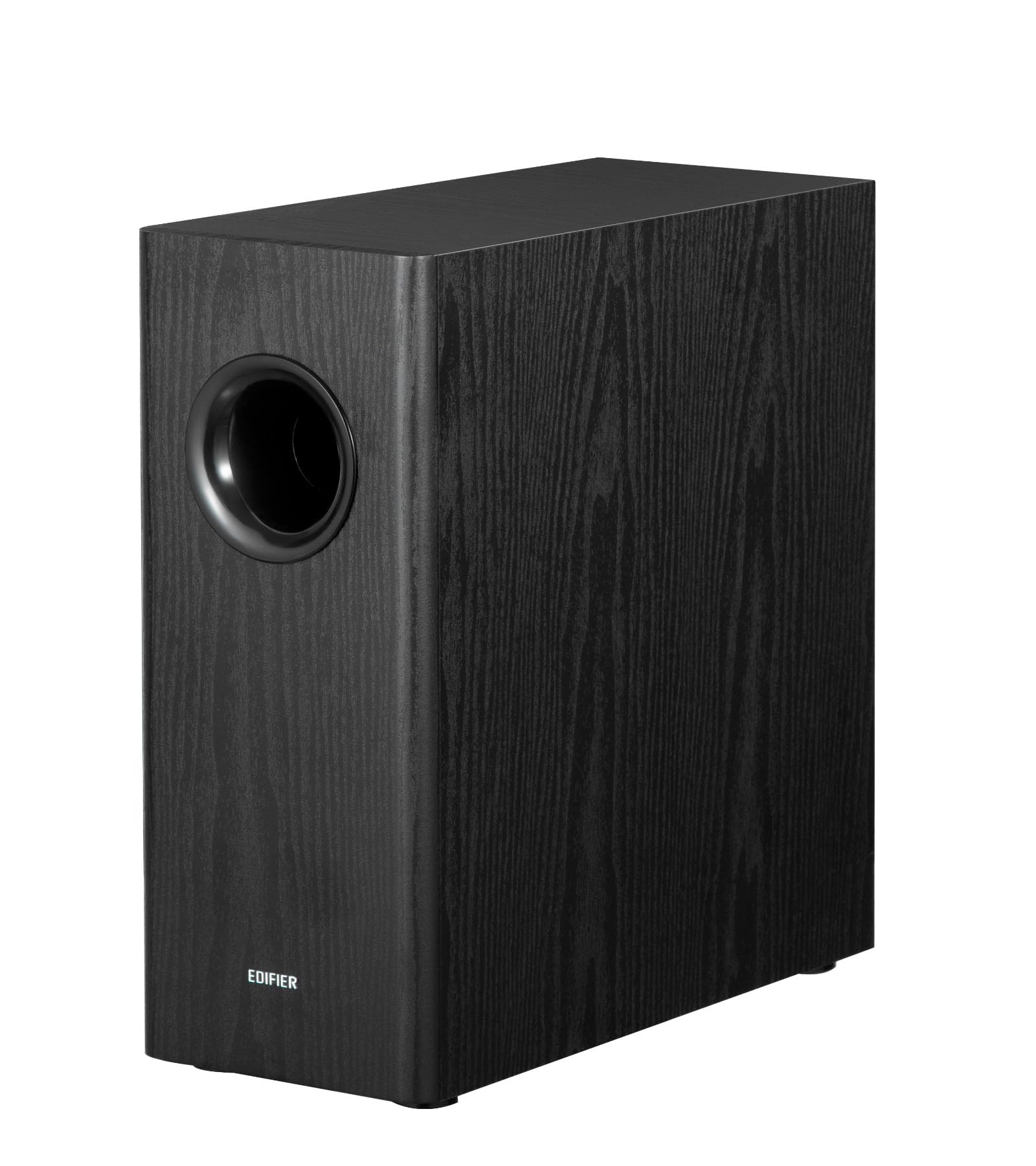
The Edifier T5s is purpose-built to augment desktop bookshelf speakers, with an 8-inch long-throw woofer and a 70W RMS Class-D amplifier that reaches down to 35 Hz. Its slim, tower-like profile (6.7 inches wide) and wood-grain finish make it easy to place next to a desk or entertainment unit without dominating the room.
Control is comprehensive for its class: a low-pass filter adjustable from 30 Hz to 160 Hz, a phase selector (0°/180°), and a volume knob let you tune the sub to your main speakers. Auto-standby kicks in after 15 minutes of inactivity, saving power in desktop setups.
Users pair the T5s with Edifier R1280Ts or R1700BTs speakers for a dramatic low-end boost, noting that it adds weight to EDM and movie explosions without distorting. The 18mm MDF cabinet with front-firing driver keeps resonance low, producing clean bass that doesn’t bleed into the midrange.
Why it’s great
- Compact vertical footprint fits tight desk or shelf spaces
- 35 Hz extension adds genuine sub-bass to desktop systems
- Low-pass filter, phase switch, and auto-standby enhance usability
Good to know
- 70W RMS output is modest for large rooms
- Not suitable as an LFE sub for home theater without sub-out
6. Klipsch Reference R-8SW Subwoofer

The Klipsch R-8SW brings the brand’s signature down-firing design and spun-copper IMG woofer to a compact 8-inch package, powered by a 150W peak all-digital amplifier. It’s built for small to medium home theater rooms where space is tight but bass impact can’t be compromised.
Setup is plug-and-play with RCA and LFE inputs, and the down-firing orientation makes it pet-friendly and easy to hide. The compact brushed black vinyl cabinet blends with modern furniture without shouting for attention.
Users report that the R-8SW produces clean, tight bass that enhances movies and music without overwhelming neighbors in apartment settings. While it won’t shake a large room, its focused output excels in spaces up to 15×20 feet, where it adds realistic low-end to explosions and bass lines.
Why it’s great
- Down-firing design with pet-friendly orientation
- Compact footprint fits small living rooms and apartments
- Spun-copper IMG woofer delivers clean, controlled bass
Good to know
- No wireless connectivity; requires RCA cable
- Audible pop when powered off in some units
7. Dayton Audio Classic CS800
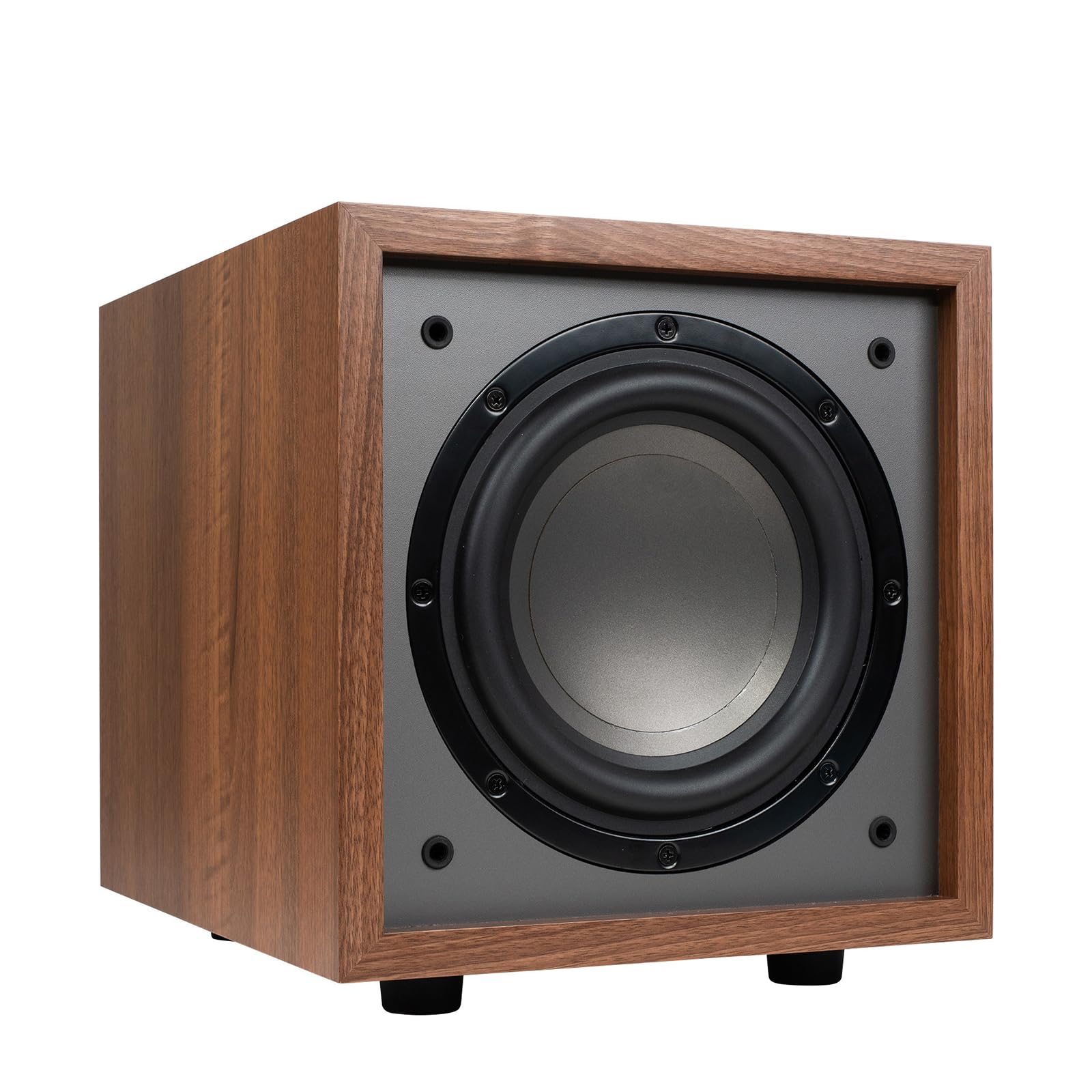
The Dayton Audio Classic CS800 proves you don’t need to spend a fortune for clean, low-distortion bass. Its 150W Class-D amplifier and rigid, braced MDF cabinet deliver tight 35 Hz low-end that outperforms many larger, more expensive subs in small to medium rooms.
Connectivity covers all bases: stereo RCA, LFE, and speaker-level inputs ensure compatibility with any system, while auto-on and simple controls make setup fast. The wood-grain finish with a swappable grille (gray included; black sold separately) lets it blend into living spaces.
Users consistently note that the CS800 sounds like a much more expensive sub — delivering clean, musical bass that improves both movies and music. The 5-year warranty from Dayton Audio (designed in the USA) adds long-term peace of mind that’s rare at this price point.
Why it’s great
- Excellent value with 150W Class-D power and 35 Hz extension
- RCA, LFE, and speaker-level inputs for broad compatibility
- 5-year warranty backs long-term reliability
Good to know
- Screws on woofer/amp may vibrate loose after extended use
- Grille cloth is less durable than the cabinet
8. Rockville Rock Shaker 10 Black

The Rockville Rock Shaker 10 offers the most bass per dollar in this roundup, with a 10-inch driver and 300W RMS output that shakes living rooms at half gain. The built-in Class-D amplifier, adjustable crossover, volume, and phase controls give you real tuning flexibility without needing an external amp.
Connectivity includes RCA line-level inputs/outputs and high-level speaker inputs, making it compatible with both home theater receivers and older integrated amps. The MDF enclosure with vinyl finish and detachable foam grille looks clean and handles the rigors of daily use.
Users describe the Rock Shaker as a “chest-thumping” sub that transforms TV and movie watching. While the bass can be slightly loose at the lowest frequencies compared to more expensive sealed subs, the sheer output and adjustability make it an unbeatable entry point for adding low-end to a budget system.
Why it’s great
- Massive 300W RMS output for room-shaking bass
- Adjustable crossover, volume, and phase for system tuning
- RCA and high-level inputs ensure broad compatibility
Good to know
- 10-inch driver requires more floor space than 8-inch alternatives
- Bass can sound slightly loose at deepest frequencies
9. Pioneer TS-A250D4 10” Car Subwoofer

The Pioneer TS-A250D4 is the passive champion for car audio enthusiasts, featuring dual 4Ω voice coils that can be wired for 2Ω, 4Ω, or 8Ω impedance. At 400W RMS (1300W peak) with a Glass-Fiber & Mica Reinforced IMPP cone, it delivers high-impact bass that upgrades factory car subwoofers dramatically.
With a 5.875-inch mounting depth, it fits most sealed or vented enclosures — Pioneer recommends 0.7 cu. ft. sealed or 1.0 cu. ft. vented. The 74 dB efficiency means you need a decent external amplifier to drive it, but the flexible wiring lets you match almost any amp.
Users rave about how easily this sub replaces the B&O unit in Ford Mustangs, delivering tighter, louder bass with less distortion. The one-hour install with basic tools makes it a favorite among DIY car audio enthusiasts looking for a significant upgrade without breaking the bank.
Why it’s great
- Dual 4Ω voice coils offer flexible wiring for any amplifier
- 400W RMS handles serious power for loud, clean bass
- Direct upgrade for popular factory car subwoofer locations
Good to know
- Requires external amplifier; not a powered sub
- Best performance requires specific enclosure volume
FAQ
What amplifier power do I need for an 8-ohm 8-inch subwoofer?
Can I use an 8-ohm subwoofer with a 4-ohm rated amplifier?
Is a sealed or ported enclosure better for an 8-inch 8-ohm sub?
How do I wire a dual-voice-coil subwoofer to achieve 8 ohms?
Final Thoughts: The Verdict
For most users, the best 8 ohm subwoofer winner is the WiiM Sub Pro because its AI RoomFit calibration and Wi-Fi 6 connectivity set a new standard for integration and ease of use. If you want accurate musical bass for critical listening, grab the Kanto SUB8VMB. And for studio-grade monitoring with 22 Hz extension, nothing beats the Yamaha HS8S.