
A score that pinches instead of glides, pliers that crush rather than snap, and solder that beads up instead of flowing flat — these frustrations separate a productive afternoon in the studio from a drawer full of failed offcuts. The difference between a crisp suncatcher and a pile of jagged shards often comes down to the specific combination of cutter wheel hardness, solder alloy ratio, and backing paper you choose for each project. Getting those choices right from the start transforms the entire experience of working with colored sheet glass.
I’m Min — the co-founder and writer behind Gadgets Feed. I’ve spent hundreds of hours cross-referencing manufacturer spec sheets, user testing reports, and material composition data to separate the studio-ready tools from the frustrating options that end up collecting dust on a workbench. This guide focuses on the measurable performance traits that actually matter when you’re building a reliable glass working kit.
After weighing cutting head durability, solder flow characteristics, and glass sheet consistency across dozens of reviews, I’ve built a practical breakdown of the best art glass supplies for anyone serious about getting clean cuts and solid joins session after session.
How To Choose The Best Art Glass Supplies
Building a reliable glass studio isn’t about buying every tool in the catalog. It’s about picking the right cutter for your hand size, the right solder for your panel weight, and the right glass sheets for your design complexity. The three factors below will guide your buying decisions more than any brand name will.
Cutter Wheel Hardness and Oil Feed
Carbide scoring wheels cut differently than steel wheels. A tungsten carbide or YG8 carbide wheel holds its edge much longer on dense cathedral glass, and it produces a deeper, more consistent score line. The oil feed mechanism matters just as much — an automatic drip system keeps the wheel lubricated on every pass, preventing skips and reducing friction that causes micro-chipping along the score. Avoid cutters that require manual oiling every few inches; they slow you down and produce inconsistent scores.
Solder Alloy Ratio and Diameter
For copper foil construction, 60/40 (tin 60% / lead 40%) solder remains the standard because it melts at a lower temperature than 50/50 and flows more smoothly into seams. A diameter of 1/8 inch (3mm) feeds well into most soldering irons without excessive wire waste. Thinner solder creates cold joints on long copper foil lines, while thicker solder is harder to control on small details. Always check that the spool is wound evenly to avoid kinks that disrupt consistent feeding.
Glass Sheet Consistency and Cut Predictability
Not all art glass sheets cut the same way. Machine-made transparent cathedral glass tends to score more predictably because its thickness variation stays within 0.5mm. Hand-mixed opalescent glass can have internal stress points that cause it to break off-score. Beginners should start with consistently-thinned cathedral sheets to build muscle memory before graduating to less predictable art glass. Also look for sheets that are at least 3mm thick — anything thinner risks shattering under breaking plier pressure.
Quick Comparison
On smaller screens, swipe sideways to see the full table.
| Model | Category | Best For | Key Spec | Amazon |
|---|---|---|---|---|
| YOTINO 33PCS Stained Glass Kit | Premium Kit | All-in-one starter studio | 33 pieces, YG8 carbide cutter, 3 cutting heads | Amazon |
| GINWORD 9Pcs Glass Cutter Tool Set | Value Kit | Budget-friendly starter set | 9 pieces, carbon steel, auto oil pistol cutter | Amazon |
| LITMIND 24ct Cathedral Glass Variety Pack | Transparent Sheets | Practice and suncatcher projects | 24 sheets, 4×6 inches, 3mm thick | Amazon |
| LITMIND 24ct Opaque Art Glass Variety Pack | Opaque Sheets | Tiffany-style lamps and privacy panels | 24 sheets, 4×6 inches, 3.2mm thick | Amazon |
| Ecarke Diamond Grinder Bit 4-Pack | Grinder Bits | Shaping and detail grinding | 1, 3/4, 1/4, 1/8 inch, brass core | Amazon |
| ANOSON 60/40 Solder 1lb Spool | Consumable | Copper foil soldering | 60/40 ratio, 1/8 inch diameter, 1 lb | Amazon |
| Bullseye Thin FIRE Kiln Shelf Paper 30ct | Kiln Supply | Glass fusing separation | 30 sheets, 6.8×10.25 inches, single-use | Amazon |
In‑Depth Reviews
1. YOTINO Glass Cutters Tools 33PCS Stained Glass Kit
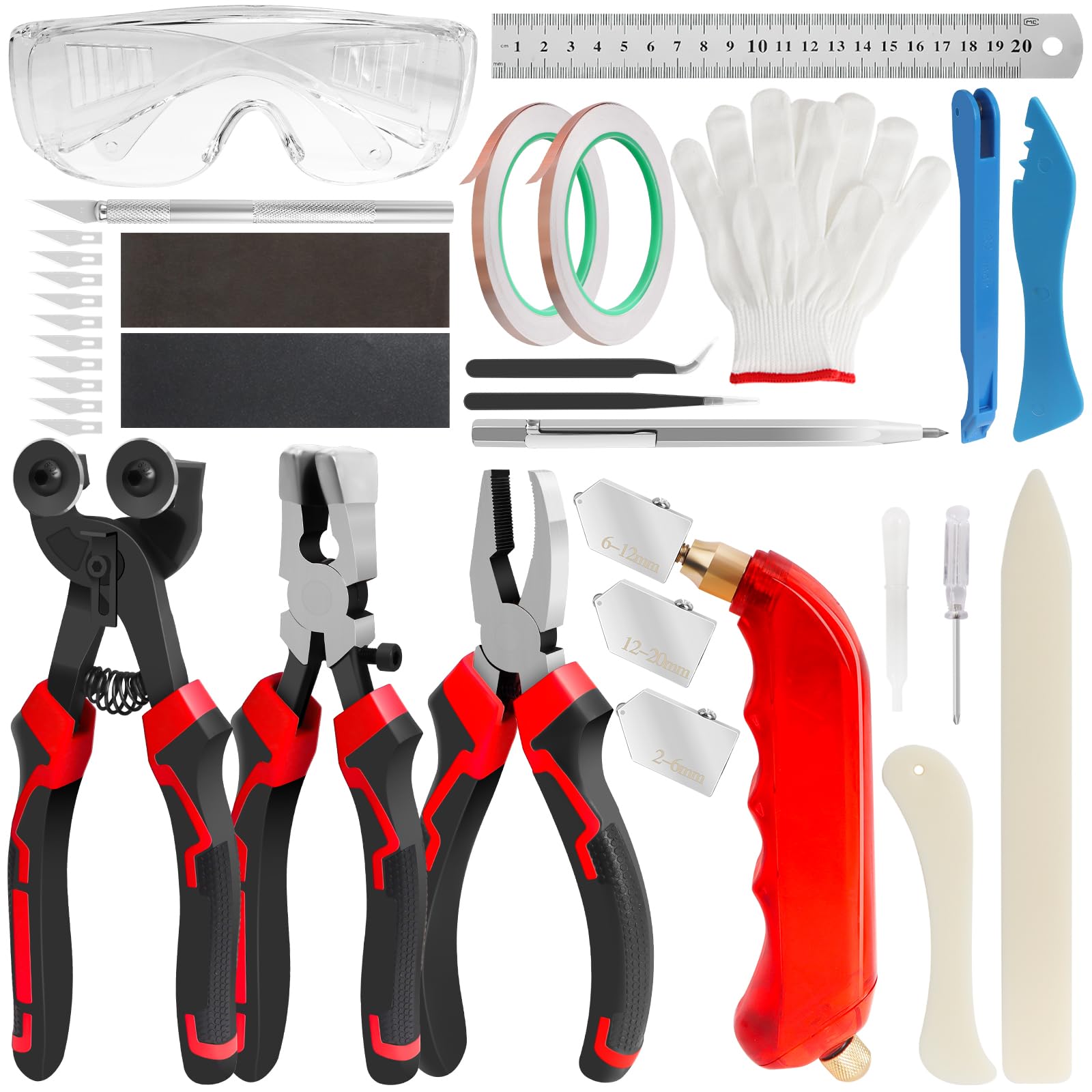
The YOTINO 33-piece kit is the most complete all-in-one solution a glass artist can grab without assembling individual tools from different brands. The pistol-grip glass cutter uses a YG8 carbide wheel that reviewers consistently report produces cleaner scores than the standard Toyo pencil-grip cutter, especially on thicker 6-12mm glass. It includes three interchangeable cutting heads covering 2-6mm, 6-12mm, and 12-20mm thickness ranges, plus a hydraulic oil feed system that keeps the wheel lubricated automatically.
The kit doesn’t skimp on pliers either — it includes dedicated breaking pliers, running pliers, and brick pliers, each with ergonomic non-slip handles and spring-loaded jaws that reduce hand fatigue during repetitive snapping. The tungsten steel scoring pen, steel ruler, safety goggles, copper foil tools, and tweezers mean you can start your first project immediately without sourcing a single additional item.
One practical note from experienced users: the angled breaking pliers require some hand strength to operate effectively on thick glass, so smaller-framed artists may want to test the grip tension before committing to long sessions. However, for the combination of cutter quality, kit completeness, and the included carbide scoring pen, this is the strongest value proposition in the mid-premium tier.
Why it’s great
- YG8 carbide wheel out-scores standard steel cutters, especially on thick glass
- Three interchangeable cutting heads adapt to glass thickness from 2mm to 20mm
- Includes copper foil tools, tweezers, and safety gear — truly ready-to-go
Good to know
- Angled breaking pliers need significant hand strength for thick glass snaps
- Pistol-grip design may feel bulky for artists accustomed to slim pencil cutters
2. GINWORD 9Pcs Heavy Duty Glass Cutter Tool Set

The GINWORD 9-piece set strips away the extras and focuses on the essential cutting trio: a pistol-type oil-fed cutter with two interchangeable heads (3-12mm and 6-19mm), a pair of movable running pliers, and arc-breaking grozer pliers. The cutter’s automatic oil distribution system is a standout feature at this price tier — it keeps the wheel wet on every pass, which is critical for smooth scores on mosaic and stained glass projects alike.
Both pliers use heavy-duty carbon steel with a nickel-iron surface treatment on the breaking jaws, which resists corrosion from glass dust and cutting oil better than untreated steel. The arc-breaking pliers have spring-loaded jaws that release pressure automatically after each snap, which speeds up repeated breaking of small pieces for mosaic work. The included tungsten carbide scriber is a welcome bonus for detailed pattern transfers onto glass surfaces.
A consistent theme in user feedback is that the breaking plier jaws are slightly smaller than standalone professional models, making them less effective for large 6mm+ panels. They work excellently for the thinner 3-4mm glass common in stained glass and mosaic projects, but heavier-duty users may want to upgrade the breaking pliers separately. For its target use case — student kits, hobbyist setups, and first-time stained glass learners — this set delivers reliable performance with minimal fuss.
Why it’s great
- Automatic oil feed ensures smooth scores without manual lubrication every pass
- Nickel-iron treated breaking jaws resist corrosion from oil and glass grit
- Compact hard-shell case keeps all 9 pieces organized and protected
Good to know
- Breaking plier jaws are small — not ideal for thick panels over 6mm
- Pistol-grip cutter head changes require the included small screwdriver, not tool-free
3. LITMIND 24 Sheets Transparent Cathedral Stained Glass Variety Pack

This 24-sheet transparent variety pack from LITMIND is exactly what its name suggests — a rainbow of cathedral-style glass that lets beginners practice scoring on multiple colors without committing to full 12×12 sheets. Each piece measures 4×6 inches at approximately 3mm thickness, a standard size that fits most small suncatcher patterns and mosaic tiles. The transparent formulation allows excellent light transmission, making these sheets ideal for window hangings and Tiffany-style lampshades where light diffusion matters.
Cutting consistency is the primary consideration here. Multiple user reports note that while the glass cuts smoothly for beginners, it occasionally breaks into tiny unpredictable pieces during snapping, which suggests some sheets have internal stress points. This is typical of budget-friendly stained glass packs — the manufacturing process doesn’t include the controlled annealing that pricier art glass undergoes. For mockups, practice pieces, and family craft projects, the trade-off is acceptable given the per-sheet cost.
Packaging is worth highlighting — the box arrived without a single broken sheet in the majority of reviews, a sign that LITMIND uses adequate foam padding between layers. The color variety includes all the standard cathedral hues (red, blue, green, amber, clear) with some less common tints mixed in. For artists building a color reference library or teaching a beginner class, this pack offers a low-risk entry point into stained glass work.
Why it’s great
- 24 unique colors provide a broad spectrum for small projects without bulk buying
- 3mm thickness is compatible with standard copper foil and lead came techniques
- Excellent light transmission for suncatchers and window decorations
Good to know
- Some sheets can break unpredictably due to internal stress points
- Thin 4×6 size limits larger panel projects — not suitable for big windows
4. LITMIND 24 Sheets Vibrant Stained Glass Variety Pack (Opaque)

Where the transparent LITMIND pack focuses on light transmission, this opaque version delivers vibrant, solid colors that are better suited for Tiffany-style lampshades, privacy panels, and murals where you want rich color without seeing through the glass. The 24-sheet set includes reds, oranges, yellows, blues, greens, and pinks — all in an opalescent finish that scatters light rather than transmitting it directly.
The 3.2mm thickness is slightly thicker than the transparent pack, which gives it marginally better resistance to breaking during cutting, though the same caveat applies: this is budget-priced art glass, not precision-annealed Bullseye or Spectrum sheets. Some pieces have beautiful internal patterns from the hand-mixing process, but that also means you can’t predict exactly what each sheet will look like until you open the package. The frosted surface of opalescent glass also requires slightly more grinding pressure at the grinder bit to achieve a smooth edge.
Several experienced users noted that this glass works best with copper foil technique rather than lead came, because the opalescent finish can hide solder lines better when using foil. Beginners will find the cutting experience similar to the transparent pack — generally smooth with occasional unpredictable breaks. For the price per sheet, this is a practical way to build a broad color palette without the per-sheet cost of premium brands.
Why it’s great
- Opalescent finish creates rich, saturated color without see-through effect
- Slightly thicker 3.2mm sheets resist breakage better than thinner alternatives
- 24 colors provide a wide palette for Tiffany lamp and privacy panel projects
Good to know
- Color patterns vary between sheets — you can’t predict the exact look in advance
- Opalescent glass requires more grinding time to achieve a clean edge
5. Ecarke Diamond Grinder Bit Head Tools for Stained Glass

The Ecarke 4-piece diamond grinding bit set addresses one of the most common frustrations in stained glass work — worn grinder bits that stop cutting efficiently. This set includes four sizes (1 inch, 3/4 inch, 1/4 inch, and 1/8 inch) with a standard 8mm shank that fits most major grinder brands including Inland, Glastar, and Gryphon. The brass core reduces shaft binding, which is a frequent cause of wobble in cheaper steel-core bits.
Real-world testing feedback is generally positive, with users reporting that the 1-inch bit handles bulk grinding quickly and the smaller 1/8-inch bit provides excellent control for tight interior curves in complex designs. The diamond abrasive bonding is double-plated, which extends the usable life compared to single-plated budget bits. However, a minority of reviewers noted that the bits wore out faster than premium brand replacements after heavy use — this is consistent with the price tier, where the diamond grit density is typically lower.
One practical advantage of this set is the included matching allen wrenches for bit changes, a detail that sounds minor but saves significant frustration when the grinder chuck needs adjustment. For hobbyists who grind glass weekly rather than daily, these bits strike a good balance between cost and cutting performance. Heavy-volume studios producing multiple panels per week should budget for more frequent replacement compared to mid-range Glastar bits.
Why it’s great
- Four sizes cover everything from bulk shaping to detailed interior curve work
- Brass core reduces shaft binding and vibration in the grinder chuck
- Includes matching allen wrenches for easy bit swaps without separate tools
Good to know
- Diamond grit wears faster than premium brands under daily heavy use
- 8mm shank doesn’t fit some older grinder models with non-standard chucks
6. ANOSON 60/40 Solder for Stained Glass (1 lb Spool)

The ANOSON 60/40 solder spool is the consumable that holds your stained glass pieces together, and its performance directly determines whether your solder lines look smooth and professional or lumpy and disconnected. The 60% tin / 40% lead ratio melts at approximately 188°C, which is lower than 50/50 solder, reducing the risk of thermal stress cracking on your glass pieces during the soldering process. The 1/8 inch diameter feeds consistently through most soldering iron tips without frequent wire tangling.
User feedback from hobbyist and professional stained glass artists is largely positive, with particular praise for how smoothly the solder flows into copper foil seams. The low residue after soldering means less cleanup time before patina application, and the finished joints brighten up nicely under standard flux. One professional artist noted that while the solder works beautifully for small decorative panels and suncatchers, the relatively soft and malleable nature of 60/40 makes it less ideal for large outdoor panels that need structural rigidity.
Packaging is straightforward — a 1-pound spool that fits standard solder dispensers and wire feeders. The one-year warranty is a confidence signal for a consumable product where quality control varies between batches. For the typical stained glass hobbyist producing small-to-medium panels, this spool offers 60/40 performance at a competitive per-foot cost compared to branded alternatives.
Why it’s great
- 60/40 ratio flows smoothly at lower temperatures, reducing glass thermal stress
- Low residue means less cleanup work before applying patina
- 1/8 inch diameter feeds well in most irons without tangling or kinking
Good to know
- Soft 60/40 alloy lacks structural rigidity for large outdoor panels
- Only available in 1/8 inch — no thinner or thicker diameter options in this spool
7. Bullseye Thin FIRE Kiln Shelf Paper (30 Sheets)

Bullseye Thin FIRE kiln shelf paper is a specific consumable designed to prevent glass from sticking to your kiln shelf during fusing and slumping processes. Each sheet measures 6.8 x 10.25 inches, which fits standard hobby-sized kilns without needing to trim. The paper provides excellent separation at temperatures up to 1500°F, which covers the full range of tack fusing, full fusing, and slumping that most home kiln users work within.
This product is a direct alternative to traditional kiln wash (a liquid coating you brush onto the shelf). The biggest advantage of shelf paper is convenience — you place it on the shelf, set your glass on top, fuse your piece, and peel the paper away after firing. No mixing, no brushing, no sanding the shelf between firings. The trade-off is that Thin FIRE leaves a slightly textured matte finish on the bottom of your glass, whereas kiln wash produces a smoother fire-polished surface. For most decorative pieces, this texture is invisible on the back side.
The 30-sheet count is generous for hobbyist use, lasting through multiple practice firings and a few larger projects. One minor consideration is that the paper is somewhat delicate before firing — it can tear if handled roughly while positioning heavy glass pieces. Users who fire complex multi-layer stacks should place the glass gently to avoid puncturing the paper. For the convenience of peel-and-place setup and consistent release results, this is the most hassle-free separation solution available for glass fusing.
Why it’s great
- No mixing, brushing, or shelf sanding — just lay down and fire
- Holds separation reliably up to 1500°F for full-fuse and slump projects
- 30 sheets provide many firings for the hobbyist budget
Good to know
- Leaves a slightly textured matte finish on the bottom of fused pieces
- Thin paper can tear under heavy glass stacks if placed carelessly
FAQ
What is the best solder ratio for stained glass copper foil work?
How often should I replace my grinder bit for stained glass?
Why does my glass break unpredictably when I try to snap it?
Final Thoughts: The Verdict
For most users building a reliable stained glass studio from scratch, the best art glass supplies winner is the YOTINO 33-piece kit because its YG8 carbide cutter, three interchangeable heads, and comprehensive tool selection eliminate the guesswork of assembling individual pieces. If you want budget-friendly cutting essentials with automatic oil feed, grab the GINWORD 9-piece set. And for smooth, low-residue soldering on copper foil projects, nothing beats the ANOSON 60/40 solder spool for consistent results at a fair price.