
Dead zones don’t care about your schedule. Whether you’re parked between mountain passes, idling at a truck stop, or living the van-life dream, a reliable car hotspot turns a cellular black hole into a streaming, working, and browsing oasis. The wrong pick leaves you tethered to coffee shop WiFi or burning through your phone’s data cap.
I’m Min — the co-founder and writer behind Gadgets Feed. I’ve spent countless hours dissecting the cellular modems, battery chemistries, and connection protocols that separate a true road-warrior hotspot from a disposable dongle.
After combing through real-world performance data and user reports, this guide cuts through the noise to deliver the only verdict you need on the best car hotspot for your specific driving life.
How To Choose The Best Car Hotspot
Car hotspots live in a harsh environment — temperature swings, constant vibration, limited airflow. Choosing the right one means matching the device’s electrical and mechanical design to your driving habits, not just raw speed numbers.
Battery vs Battery-Free Safety
A lithium battery left in a parked car during summer can swell, leak, or worse. Battery-free hotspots that draw power directly from your vehicle’s USB or 12V port eliminate that risk entirely. For permanent or semi-permanent installation, no-battery designs are the responsible choice.
Modem Generation and Carrier Compatibility
4G Cat4 modems handle basic browsing and navigation. Cat6 and Cat13 modems — capable of carrier aggregation — deliver consistent streaming and video-call quality. Also check band support: a device that covers bands 2, 4, 5, 12, 13, and 66 will work across AT&T, T-Mobile, and Verizon networks. Dual-band WiFi (2.4GHz and 5GHz) prevents congestion when multiple devices connect.
Data Plan Flexibility
Many hotspots ship with trial data, then require you to buy top-ups through a proprietary app or website. Others accept any physical SIM, letting you shop for the cheapest data plan from any carrier. The best car hotspot balances modem performance with the freedom to choose your own plan.
Quick Comparison
On smaller screens, swipe sideways to see the full table.
| Model | Category | Best For | Key Spec | Amazon |
|---|---|---|---|---|
| STATELINKER S2 | Mid-Range | Data plan simplicity | 15-hour battery, 8 devices | Amazon |
| BNBDE Vehicle Hotspot | Mid-Range | Battery-free car install | 16 devices, vSIM global | Amazon |
| EIOTCLUB 4G | Mid-Range | LCD screen & battery balance | 3000mAh, 10 devices | Amazon |
| RoamWiFi R10 | Premium | Global roaming with dual-band | Dual-band WiFi, 10 devices | Amazon |
| GL.iNet Beryl 7 | Premium | VPN security & WiFi 7 | 120 devices, dual 2.5G ports | Amazon |
| GL.iNet Mudi | Premium | 4G LTE with large battery | 7000mAh, OpenWrt, VPN | Amazon |
| GlocalMe MeowGo G40Pro | Premium | Fastest 4G+ speeds | 390Mbps Cat13, 200+ countries | Amazon |
In‑Depth Reviews
1. GL.iNet GL-E750V2 (Mudi) 4G LTE Portable Hotspot

The Mudi earns its premium position through a massive 7000mAh battery that delivers a confirmed 8 hours of active use — enough for a full workday on the road. Its integrated Cat6 4G module supports carrier aggregation, meaning it can bond multiple LTE bands simultaneously for more stable speeds in fringe coverage areas. The dual-band WiFi (2.4GHz at 300Mbps and 5GHz at 433Mbps) keeps your laptop and passenger tablets on separate channels, preventing one streaming device from choking navigation.
What truly separates the Mudi from simpler hotspots is the OpenWrt firmware. This is not a locked-down consumer device — you can install VPN clients (WireGuard hits 50Mbps, OpenVPN hits 10Mbps), configure port forwarding, run AdGuard Home for ad blocking, and even repair IMEI settings if your carrier requires it. The 128MB RAM and 128MB NAND Flash are modest by today’s router standards, but for a portable LTE hotspot, the customization headroom is unmatched. The MicroSD slot also allows local file sharing over the network.
Downsides are thermal and physical: the Mudi runs noticeably warmer than competing hotspots, and its 285g weight alongside a 5.7-by-3.1-inch footprint makes it bulkier than pocket-sized alternatives. The battery life, while long, is balanced by that weight — you feel it in a jacket pocket. For permanent car installs where weight doesn’t matter, this is a non-issue. For public transit commuters swapping between car and backpack, consider the trade-off.
Why it’s great
- 7000mAh battery offers full-day wireless freedom without hunting for power outlets.
- OpenWrt software allows deep configuration — VPN, ad blocking, and custom firewall rules.
- Cat6 modem with carrier aggregation pulls faster speeds from weak signals than standard Cat4 chips.
Good to know
- Runs hot during continuous 4G sessions with multiple devices connected.
- Heavier and bulkier than most competitors — not ideal for pocket carry.
- Default setup requires some networking knowledge to unlock full potential.
2. STATELINKER S2 Portable WiFi Hotspot
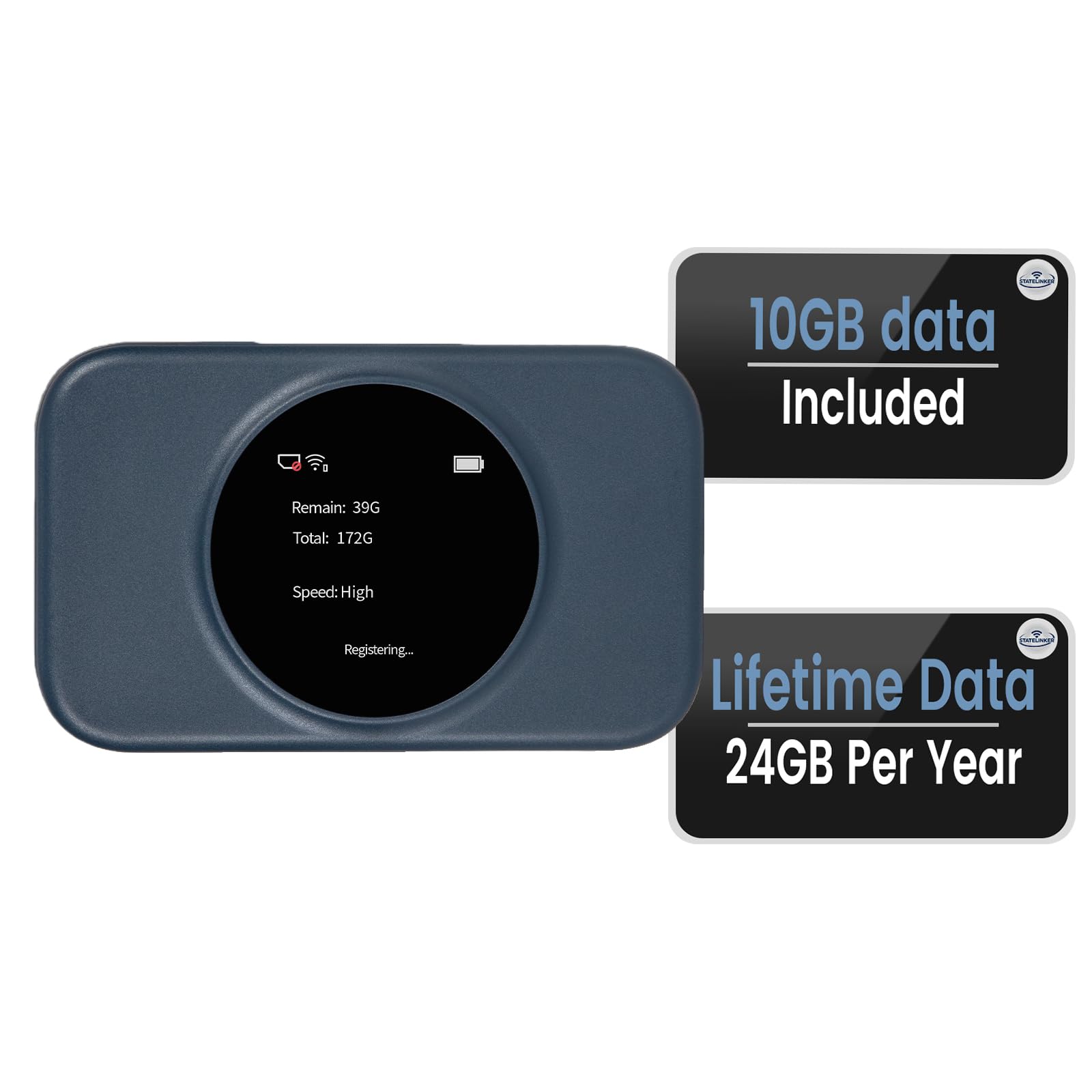
The STATELINKER S2 strikes a rare balance: it’s compact at just 100 grams, yet packs WiFi 6 for improved multi-device efficiency and a battery that lasts up to 15 hours on a single charge. That combination makes it the most practical daily driver for long-haul drivers and regular commuters. The 4G LTE modem is locked to North American bands, which means reliable coverage across the US and Canada without the complexity of global roaming certifications.
The standout feature is the included 10GB of free data valid for 30 days, plus a recurring 2GB monthly data allowance with rollover — effectively giving you a low-maintenance connectivity solution without a physical SIM card. The built-in display shows real-time remaining data, which removes the anxiety of hitting a cap mid-trip. Connection setup is genuinely plug-and-play: power on, wait for the network registration, and connect up to 8 devices. No carrier activation calls, no APN configuration.
Some users report that the S2 struggled in extremely remote areas where carriers like Verizon have zero coverage — though it performed well in mountain campgrounds where T-Mobile and AT&T signals were weak but present. The single-band 2.4GHz WiFi limits throughput ceiling compared to dual-band competitors, but for typical browsing, navigation, and streaming at 720p, the stability is more than adequate. The lack of an ethernet port means you cannot hardwire a laptop or gaming console.
Why it’s great
- WiFi 6 compatibility improves battery efficiency and reduces latency with multiple devices.
- Pre-loaded data plan with monthly rollover eliminates SIM card hassle for domestic US users.
- Ultra-light 100g build and 15-hour runtime make it ideal for glovebox or backpack storage.
Good to know
- Single-band 2.4GHz WiFi caps maximum network throughput below dual-band alternatives.
- North America-only LTE bands — not suitable for international road trips.
- No ethernet port for connecting wired devices like gaming consoles or security cameras.
3. BNBDE Vehicle WiFi Hotspot
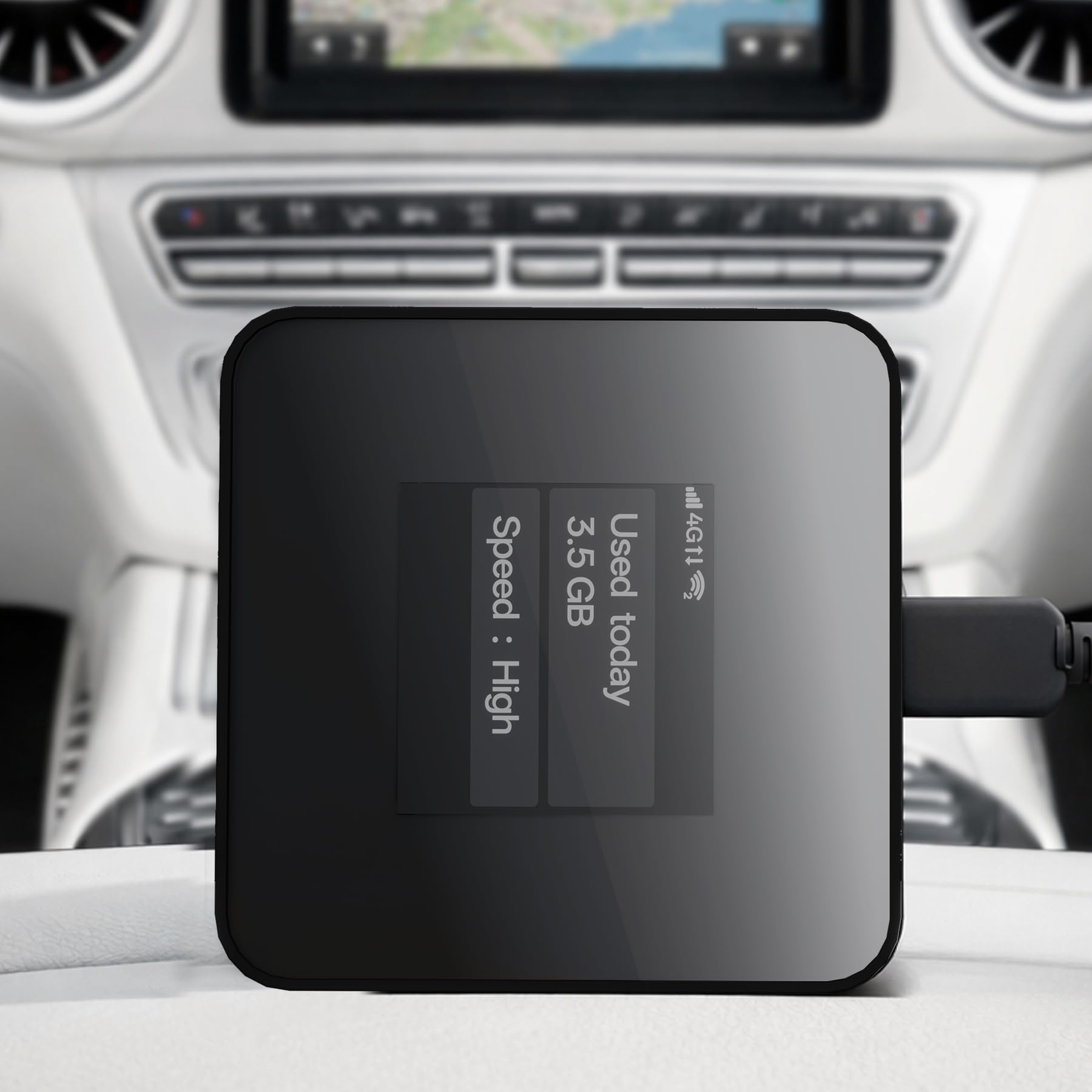
The BNBDE hotspot attacks a specific and real problem: lithium battery safety in parked vehicles. With zero internal battery, this device must be powered through a USB cable connected to your car’s charging port or a power bank. That design trade-off eliminates the risk of battery swelling or fire during summer heat, making it the safest choice for permanent or semi-permanent installation in cars, trucks, and RVs. The vSIM technology works in 150+ countries without requiring a physical SIM card.
Despite the battery-free design, the BNBDE delivers robust performance through a 4G LTE Cat4 modem paired with WiFi 6, supporting up to 16 simultaneous devices. That’s double the device capacity of most competitors, which matters for families or work crews sharing a single connection. The included 10GB of US data provides immediate usability, and the pay-as-you-go data plans (3-day, 7-day, 30-day, 1-year) offer flexibility for irregular travel schedules. Users report reliable connections even in remote areas where Verizon had zero coverage.
The obvious limitation is the tethering requirement: your car’s USB port must remain powered whenever you need WiFi. Some users solve this with a dedicated 12V-to-USB adapter that stays on with the ignition. The single-band 2.4GHz frequency limits peak WiFi speeds compared to dual-band routers, and the lack of a screen means you manage data plans and connection status through a phone app rather than glancing at the device. For drivers who set it and forget it, these are minor inconveniences.
Why it’s great
- Zero-battery design eliminates fire risk from lithium cells in hot vehicles.
- Supports 16 devices simultaneously — double the capacity of most portable hotspots.
- vSIM technology provides global coverage without needing physical carrier SIM swaps.
Good to know
- Requires constant USB power — device turns off when car is off unless wired to always-on port.
- Single-band 2.4GHz WiFi only, limiting throughput for bandwidth-intensive tasks.
- No display screen; all configuration and data management handled via smartphone app.
4. EIOTCLUB 4G LTE Portable Hotspot
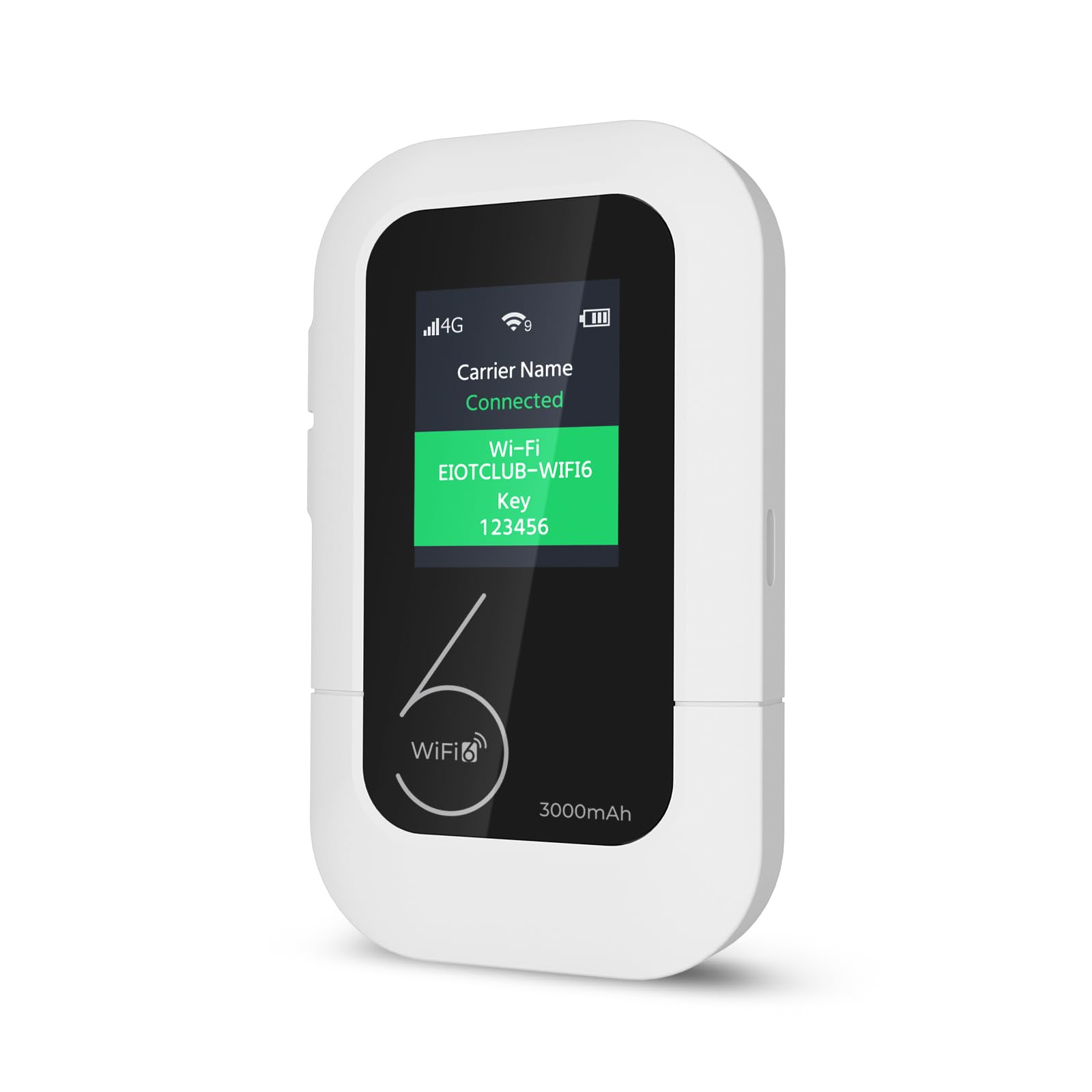
The EIOTCLUB hotspot differentiates itself with a practical 1.7-inch LCD screen that displays connection status, carrier name, number of connected devices, and a QR code for instant data top-ups. This eliminates the guesswork of checking a phone app or logging into a web portal to see how much data remains. The 3000mAh battery provides up to 12 hours of continuous use, and the smart power-saving mode puts the device to sleep when idle and wakes it with a button press — extending battery life during long gaps between driving sessions.
Setup is straightforward: the device ships with a pre-installed, US-locked SIM card and 1GB of trial data. Powering on and scanning the QR code on the LCD screen lets you immediately purchase additional data plans. The hotspot connects up to 10 devices over 2.4GHz WiFi. Real-world performance from truck drivers shows signal retention even in remote interstate segments, with consistent speeds for streaming and browsing. The customer support responsiveness, particularly from a representative named Emily, has been noted as a strong suit when users had billing or plan questions.
The primary caveat involves data plan structure: EIOTCLUB’s plans have both time limits and data caps, and the auto-renew function may trigger early if you consume your data allotment before the 30-day window expires. This means you could accidentally double-pay if you’re not monitoring usage through the LCD screen. The single-band 2.4GHz WiFi again limits peak speeds, and the device is US-only — no international roaming. For domestic drivers who want a straightforward prepaid solution with a helpful display, this is a strong mid-range contender.
Why it’s great
- Built-in 1.7-inch LCD screen provides at-a-glance data usage and connection status without a phone app.
- Smart power-saving mode extends effective battery life during idle periods between drives.
- Pre-installed US SIM with trial data and QR-based top-up makes activation effortless for non-technical users.
Good to know
- Data plans have combined time-and-data limits; auto-renewal may trigger early if full data is used before period ends.
- US-only coverage limits — no international or cross-border roaming capability.
- Single-band 2.4GHz WiFi restricts overall network throughput in congested environments.
5. RoamWiFi R10 4G LTE Mobile Hotspot

The RoamWiFi R10 targets the cross-border traveler who needs seamless connectivity across the US, Canada, and Mexico out of the box, with the option to purchase data for 170+ additional countries. Its dual-band WiFi (2.4GHz and 5GHz) allows you to offload high-bandwidth tasks like video streaming to the less congested 5GHz band while keeping navigation and messaging on 2.4GHz. The device requires no physical SIM — the integrated eSIM technology handles carrier selection automatically.
Battery life is a strong point, with users reporting it survives a full workday of moderate use without needing a recharge. The compact form factor is pocket-friendly, and the build quality has survived drops without issue. The companion app makes plan purchases flexible — you can buy as little as one day of data for short trips or larger packages for extended stays. The intelligent network selection technology automatically scans and connects to the strongest signal from available carriers, which is especially useful in areas with patchy coverage.
The main limitation is data expiration: unused data expires after 90 days, which penalizes infrequent travelers who want to keep a balance for emergency use. The device also runs warm during continuous streaming sessions, though users report it stays within acceptable limits. Some overseas carriers may have compatibility quirks — one user reported the initial provider didn’t support EU activation, though it was resolved after contacting support. For drivers who regularly cross borders and want a single device that works without SIM swaps, the R10 is a capable choice.
Why it’s great
- Dual-band WiFi (2.4GHz and 5GHz) provides better performance for streaming and video calls.
- Global roaming via eSIM supports 170+ countries without physically changing SIM cards.
- Flexible data plans down to 1-day purchases suit irregular travel schedules.
Good to know
- Unused data expires after 90 days — no rollover for infrequent users.
- Device runs warm during sustained high-throughput sessions.
- Initial carrier compatibility may need customer support intervention in certain regions.
6. GL.iNet Beryl 7 (GL-MT3600BE) Travel Router
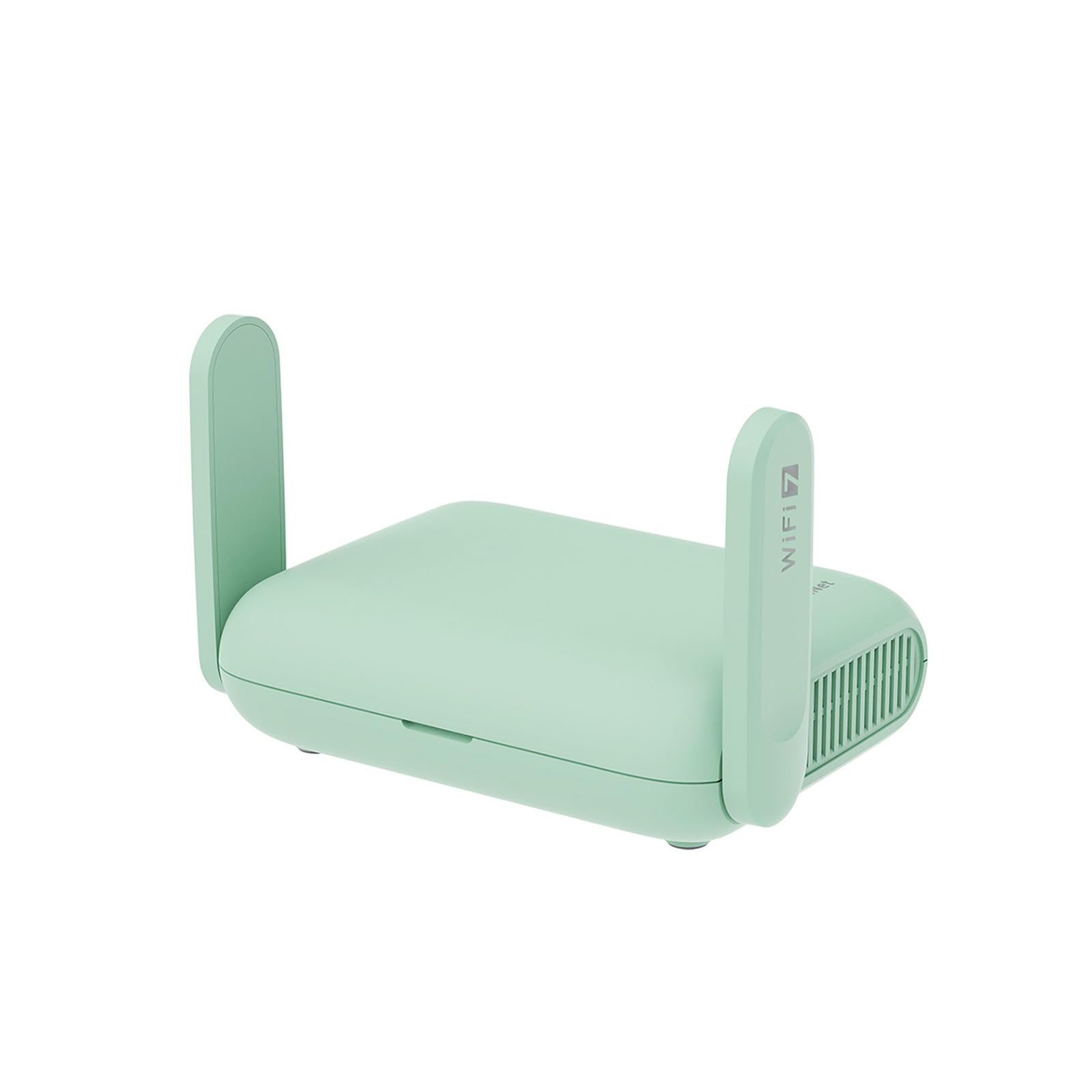
The Beryl 7 is not a traditional hotspot — it’s a portable travel router that creates a private, encrypted WiFi network from any internet source, including public WiFi in hotels, cafes, and airport lounges. For car-based use, this means you can pull internet from a campground’s WiFi or a truck stop’s public network and broadcast your own secure 5GHz and 2.4GHz WiFi 7 network to all your devices. The dual 2.5G ethernet ports allow you to hardwire a laptop for maximum throughput.
The headline feature is WiFi 7 (802.11be), delivering up to 2882Mbps on the 5GHz band and 688Mbps on 2.4GHz — more than enough for 4K streaming and large file transfers. But the real value for security-conscious travelers is the VPN performance: WireGuard tunnels hit 1100Mbps, and OpenVPN with Data Channel Offload hits 1000Mbps. That’s server-grade VPN routing in a device smaller than a smartphone. The physical toggle switch lets you instantly enable or disable VPN and AdGuard Home without digging through admin panels.
The trade-off is that the Beryl 7 lacks a built-in cellular modem. It does not have a SIM slot — it must be connected to an existing internet source via ethernet or WiFi uplink. For car hotspot purposes, you would pair it with a cellular modem like the Mudi or a phone’s hotspot feature. The OpenWrt firmware, while powerful, has a learning curve; casual users may find the configuration options overwhelming. And despite the name, WiFi 7’s full potential is only unlocked with compatible client devices — most current phones and laptops use WiFi 6 or 6E.
Why it’s great
- WiFi 7 delivers the highest wireless throughput of any travel router on the market.
- VPN speeds over 1Gbps allow secure tunneling without performance bottlenecks.
- Dual 2.5G ethernet ports enable wired connections for maximum stability in fixed car installations.
Good to know
- No built-in cellular modem — requires separate internet source (hotspot, phone, or campground WiFi).
- OpenWrt configuration is complex for non-technical users; default settings may not suit everyone.
- WiFi 7 benefits are only realized with compatible client hardware — most current devices cannot fully utilize it.
7. GlocalMe MeowGo G40Pro 4G+ Hotspot
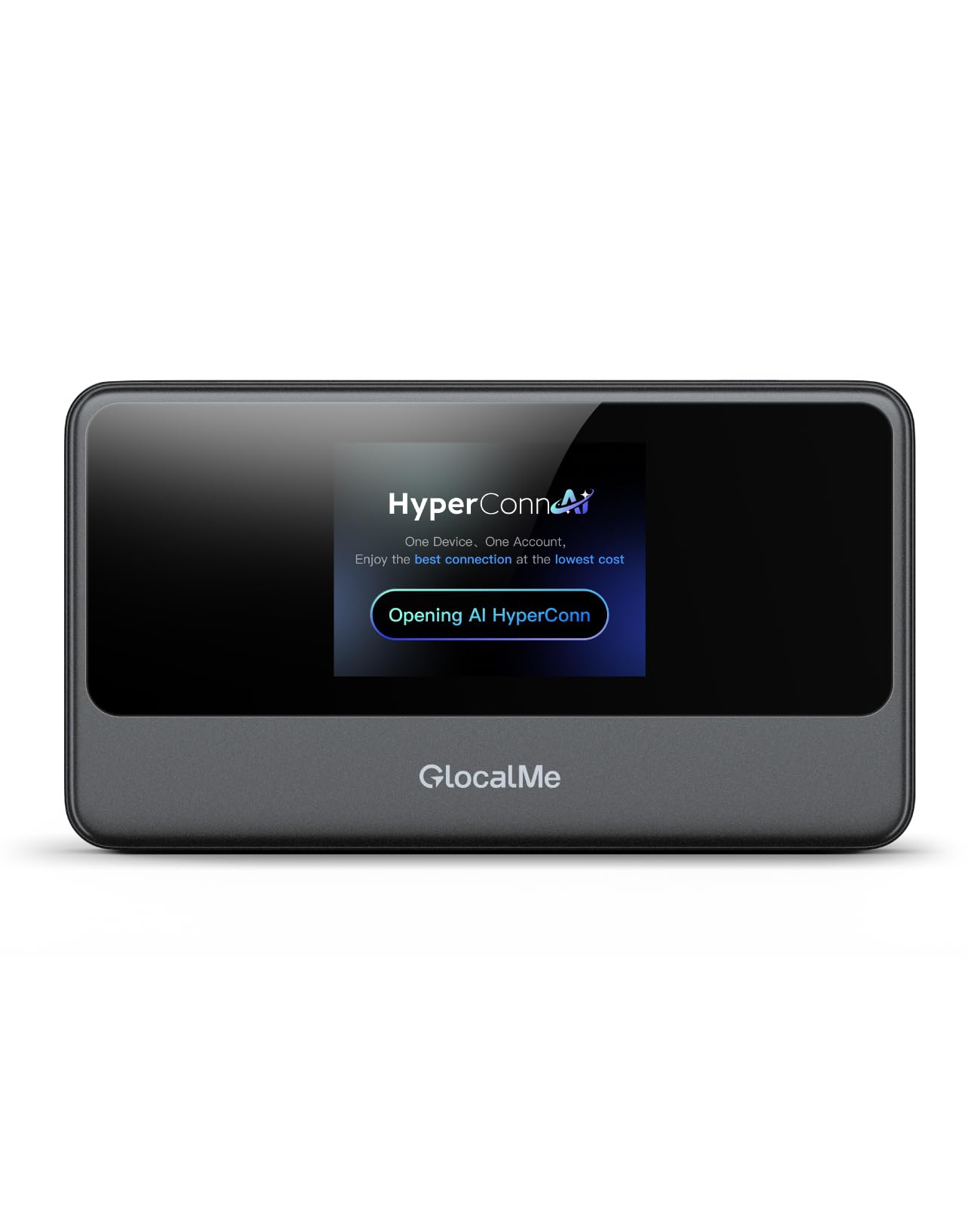
The GlocalMe MeowGo G40Pro is the fastest 4G hotspot in this lineup, thanks to its Cat13 modem that aggregates multiple LTE bands for peak download speeds of 390Mbps and uploads of 150Mbps — roughly three times the theoretical maximum of standard Cat4 devices. The 2-inch 1080P touchscreen is a luxury feature that makes status checking and data management feel seamless. HyperConn technology intelligently monitors network congestion and triggers AI-driven carrier reselection, automatically shifting to the strongest local signal without user intervention.
Global coverage spans 200+ countries and 390+ carriers, making this the best choice for international road trips that cross multiple national borders. It supports both the built-in CloudSIM (no physical SIM required) and a physical SIM slot, giving you options to shop for the cheapest local data in any country. The 3200mAh battery delivers over 15 hours of use, which is impressive given the power draw of the Cat13 modem and the touchscreen. Users report strong WiFi signal strength that outperforms premium competitors like the Nighthawk series.
The catch is price — the G40Pro sits at the top of the cost range, and GlocalMe’s own data plans (purchased through the app) are not the cheapest per-gigabyte. While the device is unlocked and accepts any physical SIM, the eSIM-only CloudSIM plans are tied to GlocalMe’s pricing structure. Some users reported that the data prices could be more competitive. The 1.1GB trial data is generous for testing but vanishes quickly if you’re streaming. For drivers who need maximum speed, global flexibility, and a premium interface, the G40Pro delivers — but the ongoing data cost is a material consideration.
Why it’s great
- Cat13 4G+ modem delivers up to 390Mbps — the fastest cellular speeds in this guide.
- 2-inch 1080P touchscreen provides intuitive, glanceable device management without a phone.
- Coverage in 200+ countries with AI-driven carrier switching for optimum signal quality.
Good to know
- Premium device cost with ongoing data plan fees that may be higher than prepaid SIM alternatives.
- Trial data (1.1GB) depletes quickly; budgeting for recurring top-ups is essential.
- Some users report the device runs warm during extended high-speed sessions.
FAQ
Can I leave a car hotspot plugged into my vehicle all the time?
What’s the difference between vSIM, eSIM, and a physical SIM in a car hotspot?
How many devices can realistically stream on a single car hotspot?
Final Thoughts: The Verdict
For most users, the best car hotspot winner is the STATELINKER S2 because it combines WiFi 6, 15-hour battery life, and zero-configuration setup with a free recurring data plan — making it the most practical daily driver for commuters and long-haul drivers alike. If you want battery-free safety for permanent car installation and global vSIM coverage, grab the BNBDE Vehicle Hotspot. And for maximum speed with global carrier flexibility, nothing beats the GlocalMe MeowGo G40Pro.