
An indoor cat’s digestive system isn’t built for the high-carb, low-moisture profile of most shelf-stable kibble. The result is stool that smells worse than it should and a cat that doesn’t get the hydration its urinary tract desperately needs. Feeding the wrong wet food can leave even the most pampered house cat dehydrated, bloated, and producing litter box emissions that clear a room.
I’m Min — the co-founder and writer behind Gadgets Feed. I’ve spent hundreds of hours cross-referencing veterinary nutritional guidelines with real-world owner feedback to isolate the protein-to-fat ratios and fiber profiles that actually work for cats who never step outside.
This guide breaks down the seven wet formulas that address the specific metabolic and digestive realities of life indoors — the foods that reduce stool odor, support hydration, and manage weight without forcing a cat to eat something it hates. You’re reading the definitive resource for anyone searching for best canned cat food for indoor cats because every recommendation here targets an actual physiological need of a housebound feline.
How To Choose The Best Canned Cat Food For Indoor Cats
Indoor cats move less and eat more available calories than their outdoor counterparts. The ideal wet food compensates with higher protein density, moderate fat, and specific fiber blends that keep the GI tract moving efficiently. Here’s what to look for.
Protein-to-Fat Ratio
A sedentary cat needs at least 40 percent of its calories from protein on a dry-matter basis to maintain lean muscle mass. Look for a crude protein minimum of 10 percent on the guaranteed analysis. Fat should sit between 5 and 8 percent — enough for coat health without tipping into weight gain. Foods that lead with named meat sources (chicken, salmon, ocean whitefish) rather than vague “meat by-products” deliver superior amino acid profiles.
Fiber Type and Hairball Management
Indoor cats groom more out of boredom and shed more in climate-controlled homes. Soluble fibers like psyllium husk or oat bran bind to ingested hair and move it through the tract, reducing hairball regurgitation. Insoluble fibers (cellulose) add bulk to stool but can cause gas if overdone. A food listing a specific fiber source rather than just “crude fiber” shows intentional formulation.
Moisture Content and Urinary Health
Dry food contains roughly 10 percent water; canned food hovers around 78 percent. Indoor cats are genetically poor thirst-drivers, meaning they get most of their water from food. A moisture-rich pate or cuts-in-gravy formula dilutes urine concentration, reducing the risk of struvite crystals and urinary blockages — the single most expensive and dangerous chronic condition in male indoor cats.
Quick Comparison
On smaller screens, swipe sideways to see the full table.
| Model | Category | Best For | Key Spec | Amazon |
|---|---|---|---|---|
| Royal Canin Indoor Adult Morsels | Mid-Range | Digestive health & stool quality | Highly digestible proteins, 3 oz cans | Amazon |
| Wellness CORE+ Indoor Chicken | Mid-Range | Weight management | 35% fewer calories than standard CORE | Amazon |
| Fussie Cat Variety Pack | Mid-Range | Picky eaters | Three flavors, grain-free pate | Amazon |
| Purina ONE Indoor Advantage | Value | High protein on a budget | Real fish #1 ingredient, 3 oz cans | Amazon |
| IAMS Perfect Portions Chicken | Premium | Convenience & portion control | Twin-pack trays, grain-free | Amazon |
| Purina Pro Plan Indoor Balance Salmon | Premium | Weight & digestive support | Added fiber, 24 pack, 3 oz cans | Amazon |
| Natural Balance Ultra Premium Chicken | Premium | Whole-body nutrition | Chicken #1, 5.5 oz cans (24 count) | Amazon |
In‑Depth Reviews
1. Royal Canin Feline Health Nutrition Indoor Adult Morsels in Gravy
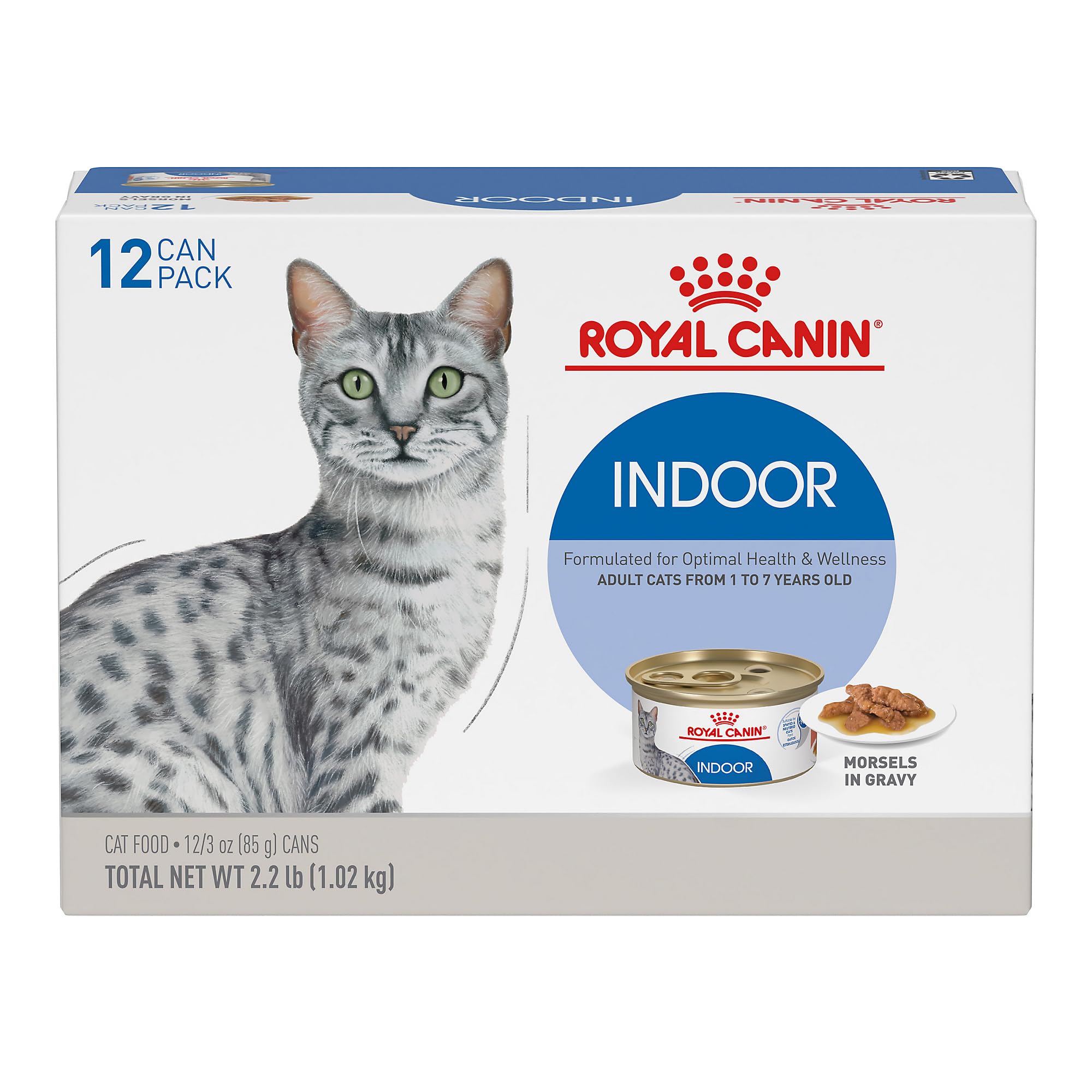
Royal Canin’s Indoor formula is engineered specifically for the 1-to-7-year-old house cat segment. The “morsels in gravy” format provides a texture that bridges the gap between pate and whole chunks — ideal for cats transitioning from kibble who need a soft, palatable introduction to wet food. The protein is sourced from highly digestible chicken, which reduces the amount of undigested material reaching the colon, directly leading to smaller, firmer, less pungent stools.
The formulation includes a precise blend of insoluble and soluble fibers calibrated to the slower gut transit time of indoor cats. Owner reports consistently note that litter box odor drops noticeably within two weeks of switching. The 3-ounce can size aligns with a single meal for a 10-pound cat, eliminating half-can refrigeration hassle. Many breeders start kittens on this line, and the instinctive palatability ratio — the specific balance of protein, fat, and carbohydrate — makes it one of the most reliably accepted indoor formulas on the market.
This food also carries the Royal Canin Feline Health Nutrition badge, meaning it meets the brand’s internal standards for vitamin and mineral premixes that support urinary pH balance — a critical concern for indoor cats who drink less. It’s mixable with Royal Canin’s dry Indoor formula for owners who prefer a hybrid feeding strategy. For a mid-range price point, the ROI in terms of digestive quality and owner convenience is unmatched.
Why it’s great
- Highly digestible protein reduces stool volume and odor
- Texture appeals to picky eaters and kibble-transition cats
- Calibrated fiber blend for indoor gut transit times
Good to know
- Higher cost per ounce than generic grocery brands
- Some cats prefer pate texture over morsels
2. Purina ONE Indoor Advantage Ocean Whitefish & Rice

Purina ONE’s Indoor Advantage line delivers the protein density of premium brands at a price point that makes it realistic for multi-cat households. The number one ingredient is real ocean whitefish — a named species rather than a generic “fish meal” — providing a complete amino acid profile that supports muscle retention in less active cats. The pate texture is consistent and hydrates well when mashed with a fork, increasing water intake for cats who are reluctant drinkers.
The formula incorporates a natural fiber blend targeting hairball reduction. Owners of long-haired indoor cats report a noticeable decrease in hairball frequency — from weekly to monthly — when feeding this as a staple. The rice inclusion provides a gentle carbohydrate source that doesn’t spike blood glucose the way corn or wheat can. It’s also free of soy, corn, wheat, and potato fillers, making it one of the cleaner options in the value tier.
Pull-top cans eliminate the need for a can opener, a minor but real convenience when feeding multiple cats daily. The 3-ounce size is standard, and the 12-count case fits neatly into a pantry rotation. Cat owners who switched from budget grocery pates to this formula frequently report shinier coats and less litter box odor within three weeks. If you need to stretch a dollar without compromising on protein source quality, this is the pick.
Why it’s great
- Real fish is the #1 ingredient at a low cost per can
- Fiber blend measurably reduces hairball frequency
- No corn, wheat, soy, or artificial fillers
Good to know
- Some cats dislike the pate texture
- Fish-based formula may cause fishy breath odor
3. Wellness CORE+ Pate Adult Canned Wet Cat Food for Indoor Cats

Wellness CORE+ is the only formula on this list that specifically reduces calorie density — 35 percent fewer calories than the brand’s standard CORE Adult recipe — without sacrificing protein content. It achieves this by adjusting the fat profile and increasing the moisture-to-nutrient ratio, meaning a cat can eat a full volume portion without consuming excess energy.
L-Carnitine is added as a supplemental amino acid to support fat metabolism, helping the cat utilize stored body fat for energy rather than storing more. The grain-free pate is built around chicken as the primary protein with added fruits and vegetables for antioxidant support. Owners of senior indoor cats report that this formula helps maintain a healthy weight without the muscle wasting associated with strict diet rations.
The 3-ounce can size is consistent across the CORE line, and the pate is dense enough that a single can mixed with a tablespoon of warm water creates a gravy that entices even reluctant eaters. The tradeoff is that some cats — particularly those accustomed to higher-fat foods — may initially reject the leaner profile. Gradual transition over seven days is recommended. For the indoor cat who needs to lose weight without losing its mind, this food delivers.
Why it’s great
- 35% fewer calories without reducing protein density
- L-Carnitine supports fat metabolism
- Grain-free, high moisture content for hydration
Good to know
- Some cats reject the leaner fat profile
- Quality control can vary between batches
4. Fussie Cat Premium Grain Free Canned Cat Food Variety Pack

Fussie Cat occupies a unique position in the indoor canned food landscape because of its ingredient sourcing. The fish in the Tuna with Chicken, Tuna with Salmon, and Ocean Fish recipes is wild-caught, meaning the omega-3 fatty acid profile is naturally higher than farmed alternatives. For indoor cats whose skin and coat can become dry from central heating, these fatty acids provide a measurable improvement in dander reduction and coat gloss within four to six weeks.
The variety pack format — four cans of each of three flavors — solves the “menu fatigue” problem common among indoor cats who eat the same protein source daily. Offering rotational proteins within a single brand reduces the risk of developing a food intolerance or simply refusing the bowl. The pate is fine-grained and mixes easily with water or bone broth, helping increase total moisture intake for urinary tract health.
Owner feedback consistently mentions that Fussie Cat is one of the only brands their cat will eat when sick, recovering from dental work, or during periods of low appetite. The human-grade quality claims are supported by the ingredient transparency — chicken and fish are both wild-caught or raised without antibiotics. The premium price per case reflects this sourcing, but for the finicky indoor cat who turns its nose up at everything else, Fussie Cat is frequently the last resort that works.
Why it’s great
- Wild-caught fish provides superior omega-3 levels
- Three-flavor rotation prevents menu fatigue
- Human-grade quality, high acceptance by sick cats
Good to know
- Higher cost per can than most mid-range options
- Some tuna cuts may be less palatable than whole muscle
5. IAMS Perfect Portions Grain Free Wet Cat Food, Chicken Recipe Cuts in Gravy
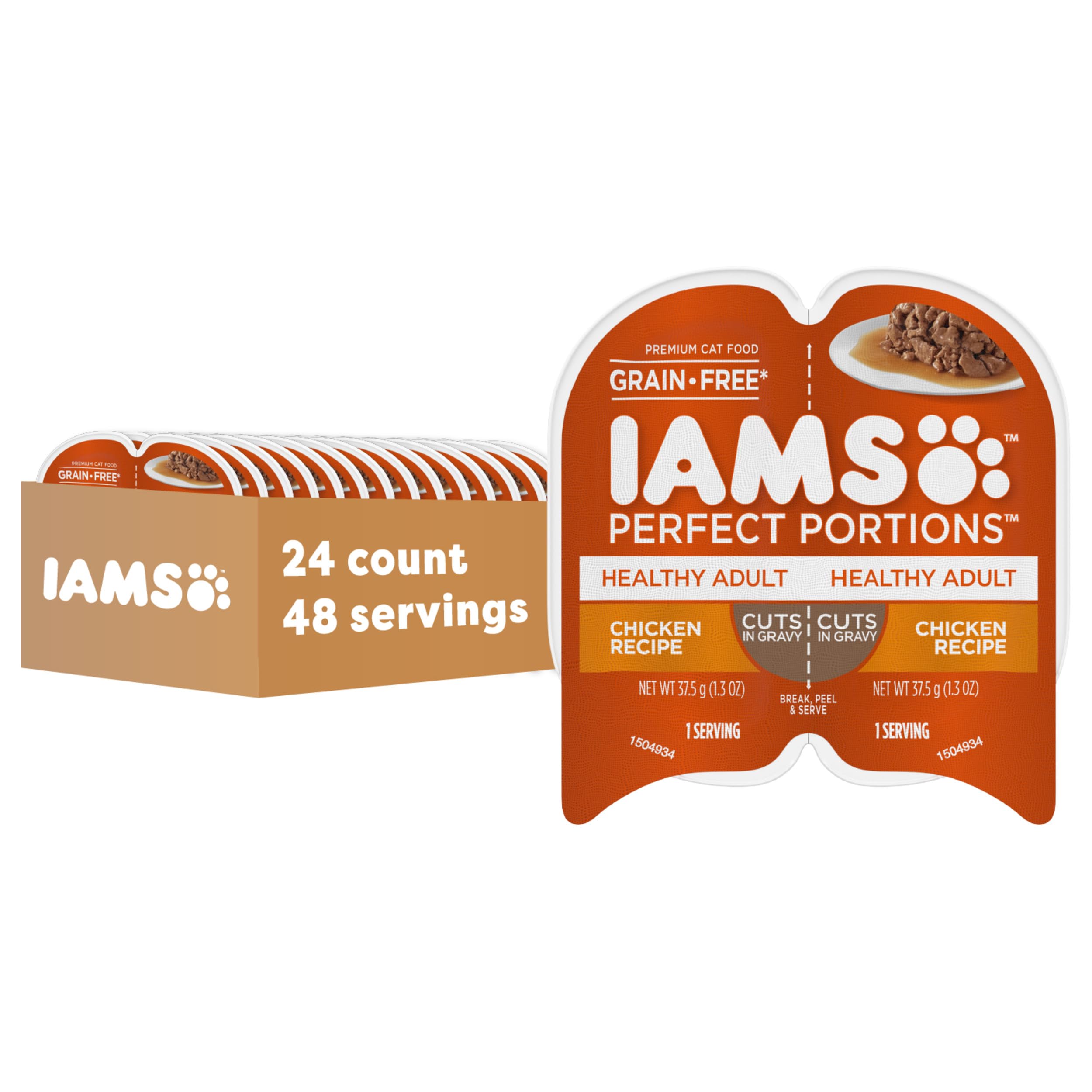
IAMS Perfect Portions solves the single biggest friction point of canned food — leftover management. Each twin-pack tray contains two individually sealed servings that snap apart, peel open, and serve. No half-empty can in the fridge, no metal lid to lose, no dried-out leftover that the cat rejects. For owners who feed wet food only as a supplement or treat, this format nearly eliminates food waste.
The food itself is a grain-free “cuts in gravy” recipe that provides a texture distinct from the pates dominating this category. The chicken is the primary protein, and the gravy adds enough moisture to support urinary dilution without turning the meal into soup. Vitamin E is added as an antioxidant specifically for immune support, a relevant feature for indoor cats who may have lower environmental immunity challenges than outdoor counterparts.
Cats who dislike pate — a surprisingly common preference — almost universally accept the cuts-in-gravy format. Owner reviews indicate high acceptance even among notoriously picky eaters who have rejected multiple pate brands. The 24-count case provides 48 individual servings, making it a cost-effective option for owners who prioritize convenience. The only drawback is the plastic tray waste, which is less recyclable than aluminum cans in most municipal systems.
Why it’s great
- Individual peel-open servings eliminate leftovers
- Grain-free cuts-in-gravy texture accepted by pate haters
- Vitamin E supports indoor cat immune function
Good to know
- Plastic trays have higher environmental footprint than cans
- Some cats report hyperactivity after feeding
6. Purina Pro Plan Indoor Balance Grilled Salmon Entree in Sauce
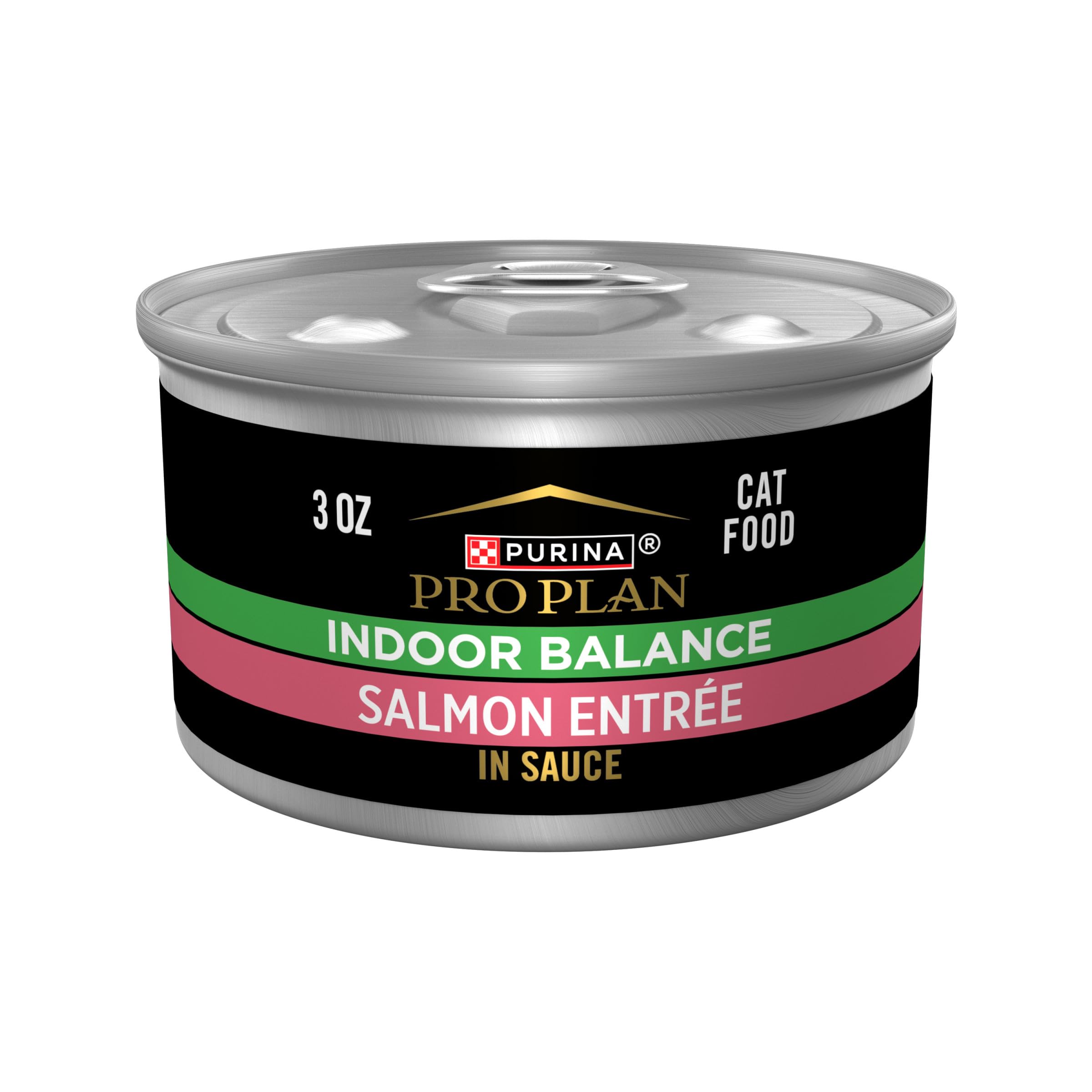
Purina Pro Plan’s Indoor Balance line is the most nutritionally comprehensive option in the premium tier. The formula includes 25 essential vitamins and minerals plus added taurine — the amino acid that is absolutely critical for feline cardiac and retinal health but which cats cannot synthesize on their own. The salmon is real, grilled, and presented in a sauce that provides the high moisture content indoor cats need for urinary tract maintenance.
The key differentiator here is the fiber addition for healthy digestion and weight management. Indoor cats with slower metabolisms benefit from the bulk that insoluble fiber provides, helping them feel full on fewer calories without triggering hunger-driven begging behavior. Owner feedback from multi-cat households reports that even picky cats finish their bowls consistently, reducing inter-cat food competition.
The 24-count case at 3 ounces per can offers one of the best values in the premium tier when calculated on a per-meal basis. Pull-top lids add convenience, and the salmon base provides a distinct protein source that rotates well with chicken-based foods. Many veterinarians recommend Pro Plan over ultra-premium boutique brands because of the rigorous AAFCO feeding trial data behind the formula. If your indoor cat needs weight support, digestive regularity, and complete nutritional coverage, this is the vet-backed choice.
Why it’s great
- Vet-recommended with AAFCO feeding trial support
- Added fiber promotes satiety and digestive health
- Real salmon provides high-quality omega-3s
Good to know
- Recent formula change altered texture from flaked to chunked
- Premium price point relative to Purina ONE
7. Natural Balance Ultra Premium Chicken Indoor Cat Food

Natural Balance’s Ultra Premium Indoor formula is built on a philosophy of limited ingredients with maximum nutritional impact. Chicken is the first ingredient, followed by chicken liver and brown rice — a short ingredient list that reduces the likelihood of food sensitivities. The brown rice provides a moderate glycemic carbohydrate source that won’t spike insulin, important for indoor cats prone to weight gain.
The 5.5-ounce can size is a significant differentiator here. Most indoor formulas come in 3-ounce cans, requiring two cans per feeding for larger cats or multiple-cat households. The larger format means one can feeds an average adult cat for a full day (split into two meals), reducing packaging waste and per-can handling time. The “Feed with Confidence” program tests every batch for nutritional consistency, which is reassuring for owners whose cats have reacted poorly to formula changes from other brands.
Owner reviews from multi-cat colonies and rescue groups indicate that this is one of the few foods that even the most finicky shelter cat will accept. Senior cats — including an 18-year-old cat whose owner reported improved activity and mood — seem to tolerate this formula well, possibly because the limited ingredient profile reduces digestive inflammation. The holistic approach to whole-body nutrition makes this a strong choice for owners who want a single food that works across multiple cats with different needs.
Why it’s great
- 5.5 oz cans reduce packaging waste and handling time
- Limited ingredient list reduces allergy risk
- Batch-testing program ensures formula consistency
Good to know
- Larger can requires refrigerated storage for leftovers
- Some non-Ultra variants may be shipped by mistake
FAQ
How much wet food should I feed my indoor cat per day?
Why do indoor cats need different nutrition than outdoor cats?
Is grain-free wet food better for indoor cats?
Can I mix wet and dry food for my indoor cat?
How do I transition my indoor cat to a new wet food?
Final Thoughts: The Verdict
For most owners, the best canned cat food for indoor cats winner is the Royal Canin Indoor Adult Morsels in Gravy because its highly digestible protein directly reduces stool odor and supports digestive health — the two biggest pain points of indoor cat ownership. If you want the most budget-friendly option without sacrificing protein quality, grab the Purina ONE Indoor Advantage. And for weight management with full satiety, nothing beats the Wellness CORE+ Pate with its 35 percent calorie reduction.