
You’ve been there: flipping breakers one by one while a partner yells “Is it off?” from the other room. That guessing game isn’t just annoying — it’s a slow, unreliable way to trace circuits. An ARC Fault Tester turns that chaos into a quiet, one-person job. Plug in the transmitter, scan the panel with the receiver, and the right breaker announces itself with a beep and a blink. No more running back and forth.
I’m Min — the co-founder and writer behind Gadgets Feed. I’ve spent many hours researching these tools, cross-referencing specs like minimum voltage ranges, sensitivity adjustment methods, and accessory kit completeness to cut through marketing fluff and give you a straight answer.
Whether you’re labeling a new panel, troubleshooting a dead outlet, or testing GFCI protection, you need a reliable tool that doesn’t waste your time. This guide breaks down the best arc fault tester options for every budget and skill level.
How To Choose The Best ARC Fault Tester
Not all circuit tracers are built alike. Some rely on simple audible beeps that can false-trigger on adjacent breakers, while others pair signal-strength metering with a digital display for pin-point accuracy. Here’s what separates a good tester from a frustrating one.
Voltage Range and Panel Compatibility
Most residential panels run 90–120V AC, but commercial or older setups may dip lower or run higher. A tester with a minimum operating voltage of 90V covers standard homes, while units rated to 135V or more handle borderline conditions. Always check the minimum operating voltage — a tester that doesn’t lock onto a weak signal is useless on a distant subpanel.
Sensitivity Adjustment and Filtering
Crowded breaker panels with multiple circuits running in parallel can confuse a basic receiver. Look for sensitivity adjustment — manual or automated — that lets you dial in the threshold so the tool only beeps on the correct breaker. Models with a “learning” pass (first scan calibrates, second scan identifies) dramatically reduce false positives.
GFCI and AFCI Testing Capability
A true ARC fault tester does more than trace: it diagnoses. GFCI outlet testing verifies ground-fault protection and measures trip time. Premium units also test AFCI breakers, which require specific fault simulation to confirm they’ll actually trip during an arc event. If you work with modern AFCI-protected circuits, don’t settle for a basic tracer.
Accessory Kit and Build Quality
The transmitter plugs into a standard outlet, but what about light sockets or bare wires? A quality kit includes a light socket adapter, alligator clips, and a 3-to-2-prong grounding adapter. Durable EVA cases keep everything organized. Flimsy plastic housings crack on job sites — look for impact-resistant ABS and a receiver with an anti-slip grip.
Quick Comparison
On smaller screens, swipe sideways to see the full table.
| Model | Category | Best For | Key Spec | Amazon |
|---|---|---|---|---|
| Klein Tools RT390 | Premium | Full AFCI & GFCI diagnosis | AFCI + GFCI + 12/15/20A load test | Amazon |
| Fluke BK120 | Premium | Professional tracer with NCV | Dual-sensitivity NCV, CAT III safety | Amazon |
| Klein Tools ET310 Kit | Mid-Range | Trusted brand for reliable tracing | Visual + audible indication, accessory kit | Amazon |
| KAIWEETS KT301P | Mid-Range | LCD display & NCV in one | LCD backlight, 7 wiring fault diagnoses | Amazon |
| Focemta FTCT01 | Mid-Range | All-in-one with digital LCD | Real-time voltage & signal strength display | Amazon |
| NOYAFA NF-827 | Budget | Adjustable sensitivity on a budget | Sensitivity knob + NCV detection | Amazon |
| AstroAI ABCBFET120BK | Budget | Entry-level kit with GFCI tester | Adaptive learning scan, 4 adapter set | Amazon |
In‑Depth Reviews
1. Klein Tools RT390 Circuit Analyzer

The RT390 is the most comprehensive outlet analyzer in this lineup. It doesn’t just find breakers — it diagnoses wiring faults, tests GFCI and AFCI devices, measures trip time in milliseconds, and performs 12A, 15A, and 20A load tests to flag voltage drops. The large color LCD displays results in plain language, making it usable even if you’re not an electrician.
On a 120V 3-wire outlet, the RT390 identified an open neutral that a basic three-light tester missed. The dual wiring fault detection caught an open neutral combined with an open ground — a condition that can leave homeowners unprotected. The detachable cord stores neatly in the included pouch, and the 5-minute auto-off saves battery life.
This unit is overkill if you only need to trace breakers, but if you’re evaluating the integrity of an entire home’s wiring — particularly AFCI-protected circuits in bedrooms and living areas — the RT390 is the gold standard. The only gap is the lack of alligator clips for bare-wire testing, which would round out an otherwise stellar kit.
Why it’s great
- Tests AFCI breakers, not just GFCI — rare in handheld testers
- Load testing reveals voltage drops before they cause issues
- Large color LCD shows results instantly
Good to know
- No alligator clip adapter for bare-wire testing
- Higher price than simple breaker finders
2. Fluke BK120 SmartTrace Breaker Finder

Fluke’s BK120 is a 4-in-1 tool that prioritizes accuracy and safety. The transmitter is powered directly by the AC circuit — no batteries needed — and the receiver uses a unique dual-sensitivity non-contact voltage mode for detecting live wires on terminal strips and supply cords. The learning scan auto-adjusts sensitivity on the first pass, and the second pass pinpoints the correct breaker with clarity.
In a 42-panel with tightly packed breakers, the BK120 correctly identified the target circuit while cheaper tracers beeped on six adjacent breakers. The built-in LED flashlight illuminates dark panels, and the socket tester LEDs confirm wiring conditions at the outlet. It’s rated CAT III for higher transient-voltage immunity than typical CAT II testers.
The trade-off is that the BK120 doesn’t perform GFCI or AFCI testing — it’s purely a tracer and voltage detector. For pros who already carry a dedicated outlet tester and need a rock-solid breaker finder with industrial safety margins, the Fluke justifies its cost. The carrying case and adapters are sold separately, so factor that into your budget.
Why it’s great
- Transmitter runs on line power — no batteries to replace
- Dual-sensitivity NCV detects voltage on individual wires
- CAT III safety rating handles higher-energy circuits
Good to know
- No integrated GFCI/AFCI testing
- Accessory kit sold separately
3. Klein Tools ET310 Breaker Finder Kit

Klein’s ET310 is the trusted workhorse for residential and light commercial tracing. The receiver provides clear visual and audible indications when it passes the correct breaker, and the included GFCI outlet tester (RT250) checks wiring faults and GFCI trip time. The accessory kit adds a light socket adapter, alligator clips, and a 3-to-2-prong adapter.
On a 200A panel with 30+ breakers, the ET310 required a second slow pass to confirm the correct circuit, but it never false-triggered on adjacent breakers — a common complaint with cheaper units. The receiver has a physical OFF switch, unlike older Klein models that left the battery drain risk. The GFCI tester’s auto-hold function retains the last reading, useful for outlets behind furniture.
It works on 90–120V AC circuits and comes with a clear carrying case. The main limitation is that it doesn’t test AFCI breakers. If you only need breaker tracing and GFCI verification, this kit is a near-perfect balance of price and performance. For AFCI work, step up to the RT390.
Why it’s great
- Reliable breaker identification with low false-positive rate
- Includes GFCI tester with trip-time measurement
- Durable Klein build quality with accessory kit
Good to know
- No AFCI testing capability
- Requires patient scanning for best accuracy
4. KAIWEETS KT301P Circuit Breaker Finder
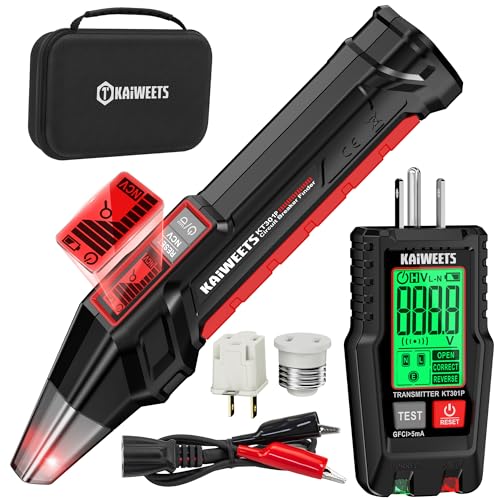
The KT301P packs features usually found on premium units into a mid-range package. The large LCD screen with backlight displays real-time voltage (30–150V), signal strength, and outlet wiring status. The receiver includes non-contact voltage detection for quick safety checks before touching wires. The transmitter doubles as a GFCI outlet tester with auto trip testing and an auto-hold function.
In testing, the KT301P diagnosed seven common wiring faults, including open neutral and reverse polarity, which three-light testers miss. The sensitivity adjustment narrows the detection zone effectively, though turning off nearby LED lighting was necessary to eliminate interference on a busy panel. The compact case holds the receiver, transmitter, and all adapters securely.
One quirk: the transmitter must be reset between uses, which isn’t obvious from the instructions. Once you know the procedure, the tool is fast and accurate. For DIYers who want a digital display and NCV without jumping to the + bracket, the KT301P is the smart middle ground.
Why it’s great
- Backlit LCD shows voltage and signal strength in real time
- NCV detection on the receiver enhances safety
- Diagnoses 7 wiring faults with clear icons
Good to know
- Needs manual reset between tracing sessions
- LED lights nearby can cause false readings
5. Focemta FTCT01 Circuit Breaker Finder

The FTCT01 combines a circuit breaker finder, outlet tester, and GFCI tester in a compact orange housing. The dual-function LCD simultaneously displays real-time voltage (90–135V) and signal strength, giving you live feedback as you scan the panel. Red/green LEDs confirm wiring conditions, and the large screen details trip time for GFCI outlets.
Weighing only 0.9 pounds with an impact-resistant ABS housing, the FTCT01 is built for on-site durability. The receiver’s anti-slip design helps maintain grip during scanning. The kit includes a 9V and two AAA batteries, a screwdriver for opening the transmitter’s battery compartment, and a carrying case. Certificate CAT II 135V with ETL compliance covers standard residential safety.
The learning curve is mild — the tiny font on the instructions makes initial setup a bit tedious, and the receiver demands a specific angle for consistent readings. However, once you understand the scanning technique, the FTCT01 delivers accurate results faster than basic beeper-only units. It’s a strong choice for DIYers who want a digital readout without spending over .
Why it’s great
- Live voltage and signal strength on one screen
- Lightweight, impact-resistant design for worksites
- Complete ready-to-use kit with batteries and case
Good to know
- Instructions have very small print
- Transmitter drains battery if left plugged in overnight
6. NOYAFA NF-827 Circuit Breaker Finder

The NF-827 punches above its price bracket with a physical sensitivity adjustment knob — a feature usually reserved for mid-range tools. This lets you manually dial down the receiver’s range when scanning a tightly packed panel, reducing false triggers. The receiver also has a non-contact voltage detection mode for quick live-wire checks before you touch anything.
Plugged into a GFCI-protected outlet, the NF-827 correctly identified the “landscape” breaker on a 12-circuit subpanel while ignoring adjacent breakers. The LED indicator panel on the transmitter shows test status, and the automatic shutdown feature saves battery. The EVA carrying case holds the receiver, transmitter, light socket adapter, alligator clip adapter, and 3-to-2-prong adapter.
The main compromise is that the NF-827 doesn’t display numeric voltage readings — you get beeps and flashes, not a digital readout. For simple tracer-only work, that’s fine. The sensitivity knob compensates for the lack of a learning algorithm, but it requires a bit of patience to find the sweet spot. Excellent value for homeowners on a tight budget.
Why it’s great
- Adjustable sensitivity knob reduces false triggers
- NCV detection adds a safety layer
- Complete accessory set with durable EVA case
Good to know
- No numeric voltage display — only beeps and LEDs
- Manual sensitivity tuning takes practice
7. AstroAI ABCBFET120BK Circuit Breaker Finder
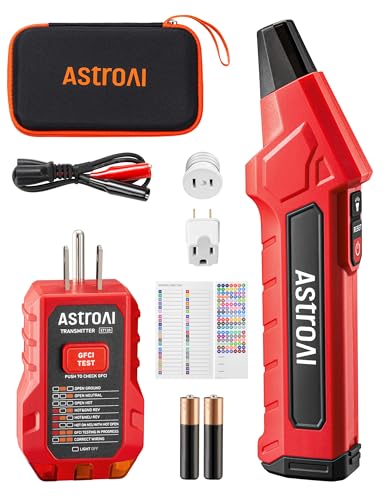
The AstroAI uses an adaptive learning algorithm: the first slow scan calibrates sensitivity to the panel’s electrical noise, and the second scan zeroes in on the correct breaker. This two-pass method dramatically cuts false positives, a common issue with basic testers. The receiver beeps and flashes red when it locks onto the target, and a built-in LED helps in dim panels.
The included GFCI outlet tester checks wiring conditions and confirms GFCI functionality. The accessory kit is generous for the price: a light socket adapter, 3-to-2-prong plug, alligator clips, and labels for marking breakers. The EVA storage case keeps everything organized. It works on 90–120V AC at 50/60Hz, covering most US households.
Accuracy is impressive for the price point — users report consistent results after learning to hold the receiver flat and perpendicular to the breakers. The main downside is that the receiver can be oversensitive on the first pass if the panel has heavy parallel runs. Still, for a first-time buyer or low-budget project, the AstroAI delivers reliable results without breaking the bank.
Why it’s great
- Adaptive learning scan reduces false positives
- Complete adapter kit with labeling stickers
- Integrated GFCI tester included
Good to know
- First scan can be oversensitive on noisy panels
- Receiver requires flat perpendicular positioning for best results
FAQ
Do I need an AFCI tester or is a standard breaker finder enough?
Why does my circuit breaker finder beep on multiple breakers?
Can I use a circuit breaker finder on a live panel?
Final Thoughts: The Verdict
For most users, the best arc fault tester winner is the Klein Tools RT390 because it combines breaker tracing, full AFCI/GFCI diagnostics, and load testing in one rugged tool — no second device needed. If you want a high-precision tracer with superior safety ratings and don’t need outlet testing, grab the Fluke BK120. And for budget-friendly reliability with an accessory kit that rivals more expensive models, nothing beats the AstroAI ABCBFET120BK.