
Carrying a camera around your neck all day is a fast track to a sore cervical spine, a swinging body that smacks into door frames, and missed frames because your rig is buried in a bag. A dedicated holster system solves every one of those pain points by keeping your camera secured to your hip, belt, or backpack strap, ready to draw in under two seconds without ever taking your eyes off the scene.
I’m Min — the co-founder and writer behind Gadgets Feed. I’ve spent hundreds of hours cross-referencing carry-system designs, material science, Arca-Swiss plate compatibility, payload stress tests, and real-user field reports from trail photographers, event shooters, and street documentarians to separate the true quick-draw systems from the floppy imitations.
This guide breaks down the seven most capable designs currently on the market, evaluating every locking mechanism, load rating, strap interface, and safety feature so you can confidently choose the best camera holster for your specific rig and shooting style.
How To Choose The Best Camera Holster
A camera holster is a literal extension of your body’s carry system during a shoot. Get the wrong one and you’ll fight with zippers, worry about accidental drops, or suffer a sore hip from a poorly padded pin system. Get it right and the camera practically teleports from holster to eye. Here are the four most critical areas to evaluate.
Locking Mechanism: Passive vs. Active
Passive holsters rely on zippers, Velcro flaps, or friction fit to hold the camera. They’re simple, cheap, and work for casual carry, but they add a full second to your draw because both hands are usually needed to open the enclosure. Active holsters use a physical latch, pin, or slide-in plate that locks the camera into the holster and releases instantly via a button or twist. Active systems are the only ones that support true one-handed draw-and-shoot flow.
Payload Capacity and Connector Strength
Every clip-style holster has a rated maximum weight. A mirrorless body with a standard zoom might sit around 600-800g, but a full-frame DSLR with a 70-200mm f/2.8 lens can push past 2kg. If your holster’s rated capacity is low, the mechanical connection between plate and clip can fail, sending your gear to the ground. Look for a minimum rating of 30kg for full-frame kits to ensure the margin of safety addresses shock loads from fast walking or accidental bumps.
Mounting Versatility: Strap, Belt, or Both
Some holsters are belt-only designs that require a waist belt at least 1.5 inches wide. Others clamp onto backpack shoulder straps, which is ideal for hikers because the weight is distributed across the torso instead of hanging off one hip. The best holsters offer tool-free adjustment and accept straps from 20mm to 65mm wide, letting you switch between a belt, a backpack strap, or a sling in seconds.
Arca-Swiss Plate Integration
If you already use an Arca-Swiss quick-release tripod head, your camera already has a plate attached. The best holsters either accept that same plate directly or include a plate that is Arca-Swiss compatible on its bottom face. This eliminates the need to swap plates when moving from holster to tripod, saving time and preventing the dreaded “forgot the plate at home” scenario on location shoots.
Quick Comparison
On smaller screens, swipe sideways to see the full table.
| Model | Category | Best For | Key Spec | Amazon |
|---|---|---|---|---|
| Peak Design Capture Clip V3 | Active Clip | Pro full-frame rigs, strap & belt versatility | 200 lb (90 kg) capacity | Amazon |
| Spider Holster Full System | Active Pin | One-handed belt carry, no plate swap needed | Stainless steel pin, ambidextrous | Amazon |
| FALCAM F38 Clip V2 | Active Clip | 30kg-heavy-load hiking with DSLR | 30 kg / 66 lb capacity | Amazon |
| SMALLRIG Camera Clip 5053 | Active Clip | Cross-brand Arca plate compatibility | 40 kg / 88 lb capacity | Amazon |
| Spider Holster BlackWidow | Active Pin | Compact mirrorless & point-and-shoot | Ambidextrous self-locking pin | Amazon |
| Ape Case ACPRO625 | Passive Pouch | Compact DSLR with pancake/small zoom | 5-compartment interior | Amazon |
| USA Gear Hard Shell Zoom Case | Passive Pouch | Travel storage with long-zoom lens attached | Molded EVA hard shell | Amazon |
In‑Depth Reviews
1. Peak Design Capture Clip V3

The Capture Clip V3 is the gold standard for active camera holstering, and for good reason: it holds over 200 lb of force, far exceeding the demands of any full-frame DSLR or mirrorless body with a telephoto zoom attached. The all-metal construction with an anodized finish feels dense and premium in the hand, while the embedded grip pad on the back keeps the clip from shifting, even when you’re wearing it against a sweaty backpack strap on a steep climb.
Compatibility is a standout here — the included plate is Arca-Swiss compatible, so it drops directly into any Arca tripod head without an adapter. The quick-release button is intuitive and lockable via a small toggle switch, preventing accidental drops when you’re bushwhacking or navigating tight crowds. It clamps to straps up to 2.5 inches wide, covering most hiking backpack straps and heavy-duty belts, though users with extra-thick tactical straps have noted the clamp reaches its limit.
Where the Capture V3 truly earns its premium status is in the ecosystem: it pairs with Peak Design’s Pro Pad for heavier loads, their Lens Kit for carrying extra glass, and their Slide strap system for dual carry. If you’re building a modular carry system that needs to transition from a day hike to a wedding reception to an air travel day without changing hardware, this is the platform to build around.
Why it’s great
- Extreme 200 lb safety margin handles any pro rig
- Arca-Swiss plate eliminates tripod swap friction
- Lockable release button prevents accidental drops
- Works on belts, backpack straps, and slings up to 2.5″ wide
Good to know
- Clamp may not fit extra-thick padded backpack straps beyond 0.6″ thickness
- Release button can feel slick to operate with cold or wet fingers
- Best paired with the separate Pro Pad for all-day comfort with heavy kits
2. Spider Holster Full System

The Spider Holster system takes a fundamentally different approach from the clip-style holsters — instead of a plate that slides into a receiver, it uses a threaded pin that screws into the camera’s tripod mount and then drops into a belt-mounted receiver. The pin is machined from stainless steel and the receiver body is glass-filled nylon, creating a self-locking connection that requires a deliberate twist to release, virtually eliminating any chance of accidental disconnection during movement.
This design has two concrete advantages for event and wedding shooters. First, the pin system allows the camera to swivel freely on the receiver, so the rig naturally orients itself against your hip rather than fighting your gait. Second, because there is no plate involved, the camera can be mounted directly to a tripod without removing anything — the pin sits recessed on the bottom of the camera, so the tripod plate catches the same 1/4-20 thread without interference. Users running Sony A7IV bodies with Tamron 28-200mm lenses report zero issues with the lock holding fast even during active walking.
The trade-off is that this system is belt-only, meaning it won’t clamp onto a backpack strap. And while the unlocked quick-release mode is fast, the fully locked mode requires a two-step process (unlock safety, then twist) that isn’t one-hand operable. It’s also one of the more premium options on the list, but for shooters who value a low-profile, plate-free belt carry that doesn’t interfere with tripod workflow, the investment pays for itself in saved time.
Why it’s great
- No plate to swap when moving between holster and tripod
- Stainless steel pin with self-locking receiver is extremely secure
- Camera swivels on the belt for natural hip-riding carry
- Eliminates neck and shoulder strain for all-day events
Good to know
- Belt-only mount — not compatible with backpack straps
- Fully locked mode requires two hands to release
- Lens focus ring may rub against pants depending on body size
3. FALCAM F38 Backpack Clip V2
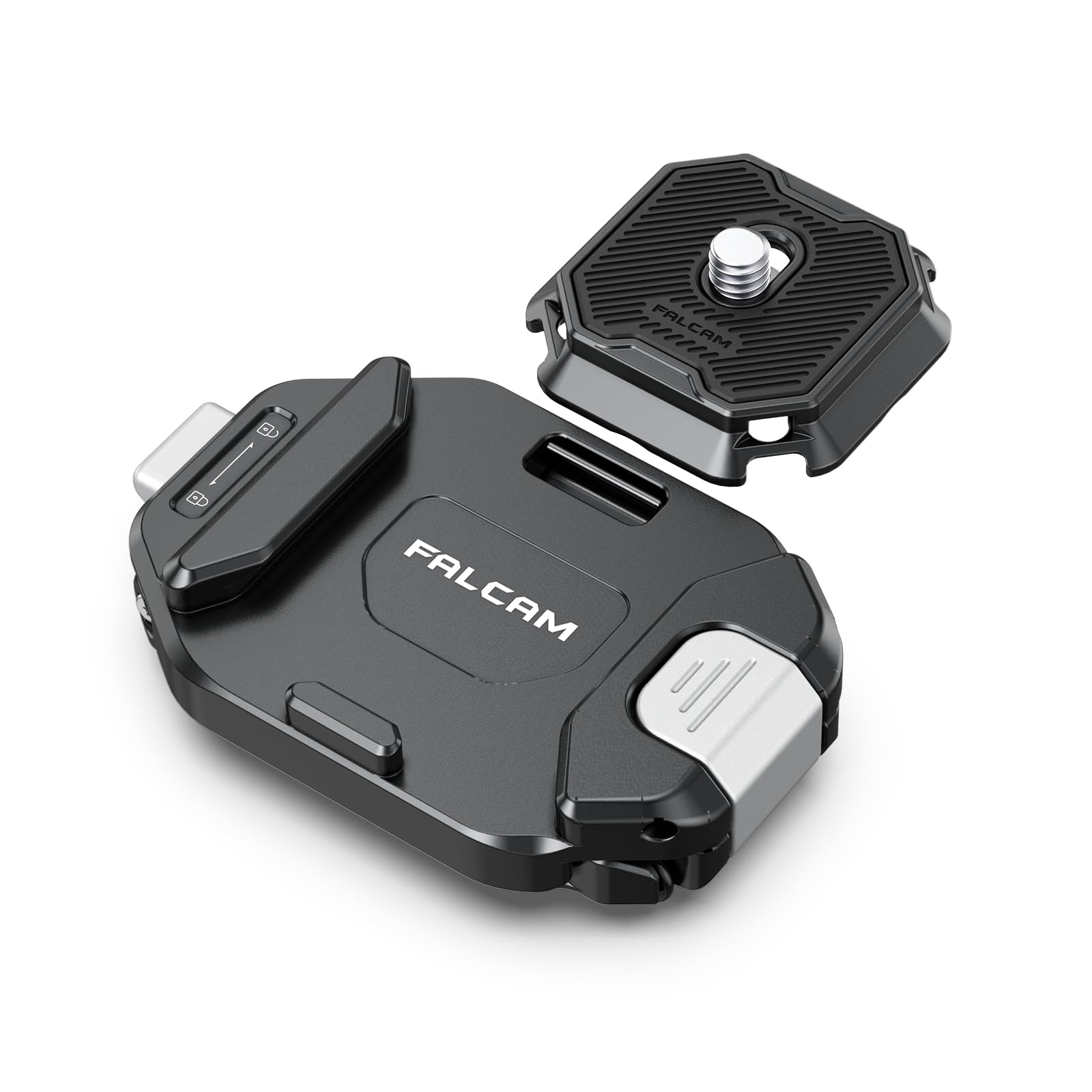
FALCAM’s F38 V2 is the lightest heavy-duty clip in this roundup at just 71g, yet it supports a staggering 30kg load capacity, making it an exceptional choice for outdoor photographers who carry full-frame bodies with telephoto zooms. The body is machined from 6061 aluminum alloy with a thermoplastic backplane, and the oversized anti-slip rubber pads grip backpack straps so tightly that users report zero bouncing or shifting even on 6-mile rocky trail hikes with a Sony A7III.
The flip-lock mechanism is genuinely innovative — you slide the Arca-Swiss plate into the clip from any angle (front, back, or sideways), and it auto-locks with an audible click. No buttons to hold, no levers to flip during the mounting motion. To release, you press the quick-release button and draw the camera in one fluid motion, and a secondary safety switch locks the button itself to prevent accidental presses. The Dyneema safety lanyard with its three-layer wear indicator is a thoughtful addition, giving visual confirmation before the cord degrades under heavy field use.
Where the F38 V2 truly differentiates itself is its cross-ecosystem compatibility — it accepts Arca-Swiss plates from Peak Design, SmallRig, PGYTECH, Ulanzi, and Spider Holster, so you don’t have to replace your existing quick-release plates. The T-shaped buckle offers three clamping gears for straps up to 80mm wide and 20mm thick, with tool-free adjustment that lets you swap between a backpack and a belt in seconds. For backcountry shooters who need maximum load security in a minimal package, this is the serious contender to beat.
Why it’s great
- Ultra-light 71g body supports 30kg load for heavy pro rigs
- Auto-locking flip mechanism with one-touch release button
- Accepts Arca-Swiss plates from multiple brands
- Dyneema safety lanyard with wear indicator for extra security
- Tool-free 3-gear strap adjustment fits belts and backpack straps
Good to know
- Initial learning curve on the dual-lock safety system
- Plate has slight lateral wiggle reported after months of use
- Not compatible with Peak Design Capture clip plates
4. SMALLRIG Camera Clip 5053
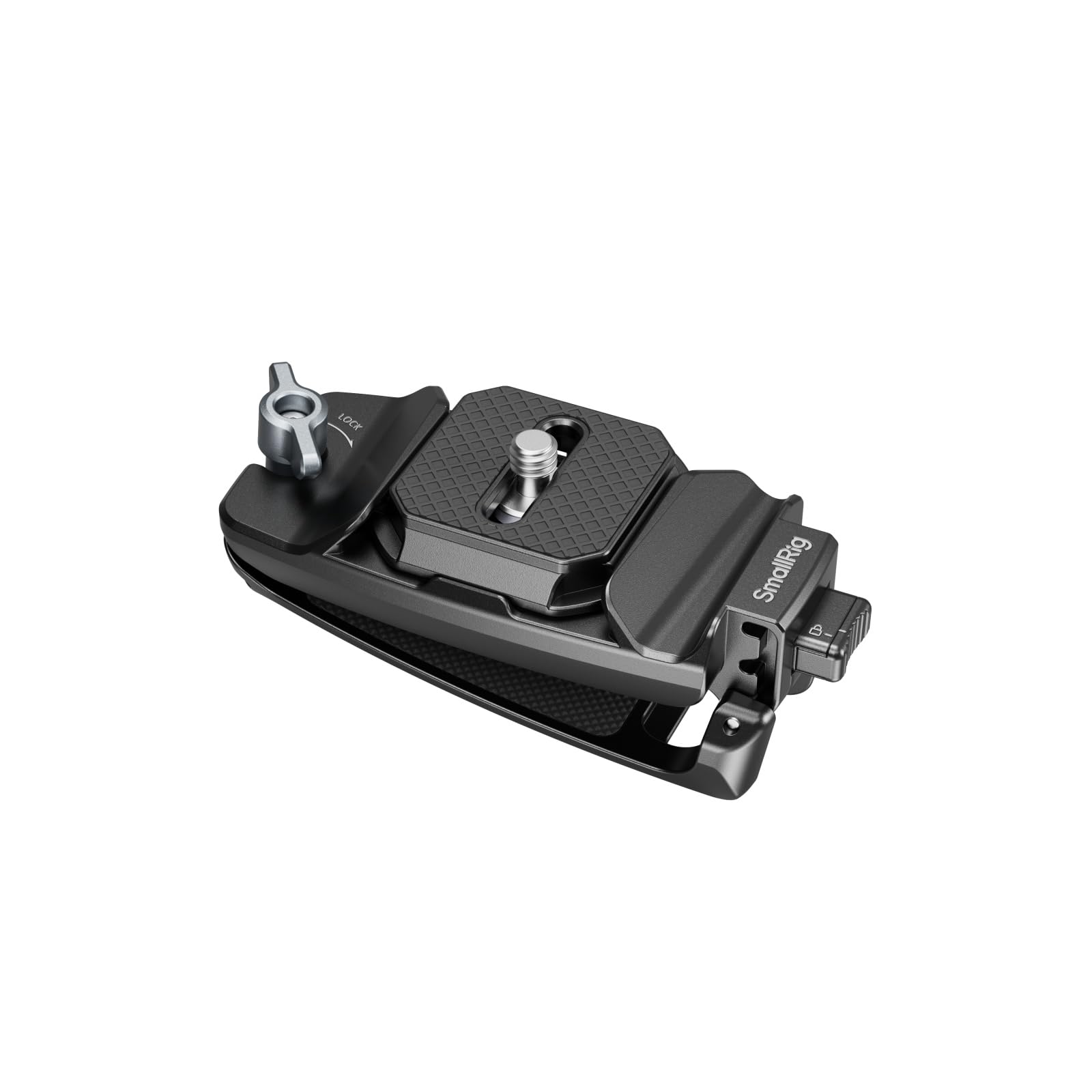
SmallRig’s 5053 clip enters the conversation as the strongest active clip by rated capacity — it claims a 40kg vertical load, enough to secure any professional rig with a significant safety buffer. The clip body is aluminum with silicone grip inserts, and the 96g weight sits right in the middle of the category, heavier than the FALCAM but lighter than many belt-only holsters. The clamping mechanism uses a front locking knob plus a side-mounted safety lock with an unlock button, creating a dual-layer retention system that users describe as “a lock for the lock.”
One of its strongest features is the 3-level adjustment for strap compatibility, accepting widths up to 65mm and thicknesses up to 15mm. This makes it suitable for everything from thin waist belts to padded hiking backpack straps. The included quick-release plate is Arca-Swiss compatible and designed to slide in from the front, back, or sideways for flexible mounting angles. Users have tested it with Sony A7IV bodies paired with heavy Tamron 150-500mm zooms on backpack straps, and report the clip stays solid with no movement during long hikes.
Where the 5053 really delivers value is in its cross-brand plate compatibility — SmallRig explicitly states it works with Peak Design and Ulanzi quick-release plates, though it is not itself compatible with Peak Design’s Capture clip body. This makes it an excellent upgrade path for users who already own an Arca-Swiss plate from another system but want the stronger, lockable clip body. For photographers who need a burly, affordable active clip that doesn’t skimp on safety or versatility, the 5053 punches well above its price tier.
Why it’s great
- Highest rated capacity in the roundup at 40kg
- Dual safety lock system with unlock button prevents accidental drops
- 3-level strap adjustment fits belts and backpack straps
- Accepts Peak Design and Ulanzi quick-release plates
Good to know
- Not compatible with Peak Design Capture clip body itself
- Slightly heavier (96g) than some competitor active clips
- Lock mechanism takes a moment to learn for first-time users
5. Spider Holster BlackWidow

The BlackWidow is Spider Holster’s entry-level pin system, purpose-built for compact point-and-shoot cameras and smaller mirrorless bodies. The concept is the same as the full-size Spider system — a pin screws into the tripod mount and the receiver loops through your belt — but the BlackWidow receiver is smaller and constructed from high-strength nylon rather than the full-size system’s glass-filled nylon. It’s rated for cameras lighter than 4 ounces, which puts it in Sony RX100, Fuji X100 series, and Panasonic LX100 territory.
The self-locking design engages automatically when the pin is inserted into the receiver, preventing the camera from sliding out unless you deliberately rotate it. This passive lock adds a layer of security that zippered pouches simply cannot offer. Users report excellent results with Sony RX100 cameras carried in a leather case inside the holster, and the system works especially well for theme park days or casual walks where you want hands-free carry but quick access for spontaneous shots. The included adjustment wrench lets you tighten the pin’s tension to your preference.
Where the BlackWidow falls short is load capacity — it’s simply not designed for full-frame DSLRs or even larger mirrorless bodies with standard zooms. Several users have tried mounting Nikon D5300 bodies onto the system, and while it held, the margin of safety is uncomfortably narrow. The belt loop also requires a belt that’s at least 1.5 inches wide to stay upright; on thinner belts the holster tends to tilt forward. For its intended use case (sub-400g cameras), it’s a nimble, well-made solution that’s significantly cheaper than the full Spider system.
Why it’s great
- Self-locking design prevents accidental camera drops
- Ultra-compact receiver is unobtrusive on a belt
- One-handed attach and detach with practice
- Adjustable pin tension via included wrench
Good to know
- Rated for cameras under 4 oz — not for full-frame or larger mirrorless bodies
- Belt loop tips forward on thin or narrow belts
- Plastic locking tab feels less durable than stainless steel alternatives
6. Ape Case ACPRO625
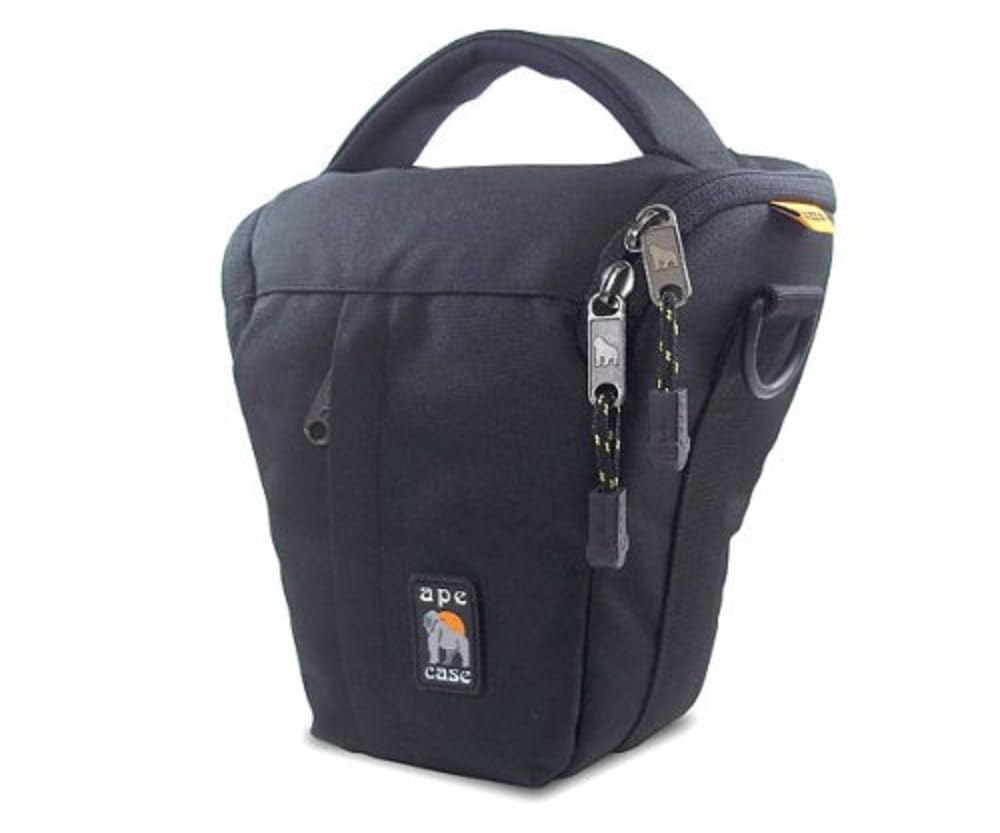
The Ape Case ACPRO625 is a classic passive holster pouch, and for photographers who don’t need sub-second draw speed, it’s a well-built, affordable option. The exterior is rugged nylon with a water-resistant coating, and the top-access flap uses dual zipper pulls that open outward, away from your body, giving you clear access to the camera without having to wrestle with the bag. The interior uses a camera cradle system with adjustable dividers, allowing you to customize the fit for a compact DSLR with a lens up to 5 inches long.
Versatility is the ACPRO625’s main selling point — it offers three carrying modes: a padded top handle, an integrated belt loop, and a removable, adjustable shoulder strap with a contoured, grippy shoulder pad. The built-in rain cover deploys from a hidden pocket, which is a welcome feature for photographers who work in unpredictable weather. Users report that it fits Nikon D3300 and D5100 bodies with standard 18-55mm kit lenses snugly, and the dual zippers allow partial unzipping to access the camera without fully opening the flap.
The trade-offs are inherent to the passive pouch format. Drawing the camera requires two hands — one to unzip, one to pull the camera — and the zipper can bind on curves, especially when the pouch is stuffed. The belt loop is functional but not as secure as a dedicated clip system, and users have reported that the loop can feel uncomfortable against the hip with heavy bodies. For minimalist shooters who prioritize storage and protection over speed, the ACPRO625 offers excellent build quality at an entry-level price.
Why it’s great
- Rugged nylon construction with water-resistant coating
- Built-in rain cover for wet weather protection
- Three carrying modes: handle, belt loop, shoulder strap
- Adjustable interior dividers for custom fit
Good to know
- Requires two hands for camera access
- Zipper can bind on curves when fully packed
- Belt loop can feel uncomfortable with heavier camera kits
7. USA Gear Hard Shell Zoom Case

The USA Gear Hard Shell Zoom Case is a storage-first holster, optimized for photographers who want to carry their camera with a long zoom lens attached (up to 300mm equivalent) inside a protective hard shell. The exterior is molded EVA material — the same stuff used in hard-sided camera cases — and the interior uses egg crate foam that conforms around the camera body and lens, providing superior impact absorption compared to standard padded nylon pouches. The rigid shell also offers some protection against light rain, making it a decent option for travel carry-on storage.
The case has two carrying modes: a reinforced top handle and a belt loop with a secure hook-and-loop flap. The belt loop is functional for short carries, but the case is relatively bulky (9.3 inches long), so it will hang conspicuously off your hip. Where this case really shines is as an inner bag inside a larger backpack or duffel — the hard shell prevents the camera from being crushed by other gear, and the 235g weight is reasonable for the protection level. Users have successfully fitted Canon T6 bodies with 18-135mm zooms, and the case leaves a small amount of extra space for accessories like spare batteries and SD cards.
The main limitation is draw speed — this is a passive case with a zippered top and a Velcro safety flap, so it’s not designed for rapid deployment. It’s also height-limited; some users with Nikon Z8 bodies have found the internal height insufficient, requiring the camera to be squeezed in. If you need a hard-sided storage case that can also be worn on a belt for short stretches, the USA Gear offers solid construction at a budget-friendly price point. But if quick draw is your priority, an active clip system will serve you far better.
Why it’s great
- Molded EVA hard shell protects against impacts and light rain
- Egg crate foam interior conforms snugly to camera and lens shape
- Reinforced handle and metal zippers with rubber pullers
- Light enough (235g) to serve as inner storage in a backpack
Good to know
- Not a quick-draw system — requires two hands and unzipping
- Internal height may be too short for larger pro bodies like Nikon Z8
- Belt loop is too narrow for thick padded belts
FAQ
Can I use an active clip holster with a body-mounted cage?
Why does my camera swing too much when I wear a belt-only holster?
What happens if my camera plate loosens inside the holster over time?
Are passive zipper holsters safe for running or climbing?
Final Thoughts: The Verdict
For most users, the best camera holster winner is the Peak Design Capture Clip V3 because it offers the broadest compatibility across straps and belts, the highest safety margin of any active clip, and a mature accessory ecosystem that grows with your kit. If you want a belt-only holster that eliminates tripod plate swaps and gives you natural hip swivel, grab the Spider Holster Full System. And for backcountry photographers who need a featherweight 71g clip that can still handle 30kg of pro gear, nothing beats the FALCAM F38 Backpack Clip V2.