
Stepping up to a larger screen isn’t just about seeing more inches — it’s about whether the panel technology, processing power, and connectivity can handle what you throw at it without artifacts, blooming, or lag. The difference between a good 65-inch TV and a great one comes down to how many local dimming zones it packs, whether it can sustain high brightness without crushing blacks, and if its refresh rate keeps up with fast-paced content. That’s where this category separates the brands worth your investment from the ones that just look big in the showroom.
I’m Min — the co-founder and writer behind Gadgets Feed. I’ve spent hundreds of hours analyzing panel technology roadmaps, chipset performance benchmarks, and user experience patterns across the 65-inch category to separate marketing fluff from genuinely superior engineering.
Whether you’re outfitting a dedicated home theater or upgrading a bright living room, this research-backed guide cuts through the noise to help you confidently choose the best 64 inch tv for your specific viewing habits and room conditions.
How To Choose The Best 65-Inch TV
A 65-inch class TV is a long-term investment, so understanding the panel technology, processing capabilities, and connectivity options is essential to avoid regret six months down the line. The three most critical factors are the backlight system, the refresh rate infrastructure, and the quality of the smart platform. Each determines how well the TV handles different content types — from streaming movies to sports to console gaming — in your specific room’s lighting conditions.
Mini-LED vs. OLED vs. QLED: Which Panel Wins?
OLED panels deliver perfect blacks and infinite contrast because each pixel emits its own light and can turn off completely. This makes OLED the undisputed king for dark-room movie watching. Mini-LED technology, on the other hand, uses thousands of tiny LEDs behind an LCD panel to control brightness zones more precisely than traditional LED-backlit TVs. Mini-LED sets can achieve much higher peak brightness — often exceeding 1,400 nits — making them ideal for bright living rooms with lots of ambient light. QLED is essentially a marketing term for quantum dot enhancement layered on top of a standard LED or Mini-LED backlight, boosting color volume and vibrancy. For a mixed-use room with variable lighting, a high-end Mini-LED with good local dimming often provides the most versatile experience.
Refresh Rates and Gaming Features
Native 120Hz or 144Hz panels are no longer exclusive to niche gaming monitors. A 65-inch TV with a native 120Hz panel and HDMI 2.1 ports can accept a 4K 120Hz signal from a PS5, Xbox Series X, or gaming PC, delivering smooth motion in fast-paced titles. Variable Refresh Rate (VRR) eliminates screen tearing when frame rates fluctuate, while Auto Low Latency Mode (ALLM) automatically switches the TV to its lowest input lag setting when a game console is detected. If gaming is a primary use case, prioritize models with native 144Hz panels, AMD FreeSync Premium Pro certification, and at least two HDMI 2.1 inputs to connect both console and PC without cable swapping.
Smart Platform and OS Responsiveness
The operating system governs how quickly you can launch apps, switch inputs, and discover content. Google TV offers deep integration with Chromecast and Google Assistant, along with a vast app library, but some implementations can feel sluggish without enough RAM. Roku OS is lauded for its simplicity and speed — it rarely lags even on lower-end hardware. Fire TV provides tight Amazon ecosystem integration but can become cluttered with ads over time. LG’s webOS is polished and intuitive, while Samsung’s Tizen is reliable but can be restrictive with app availability. For a TV you’ll use daily for five years or more, a responsive platform with guaranteed software updates is non-negotiable.
Quick Comparison
On smaller screens, swipe sideways to see the full table.
| Model | Category | Best For | Key Spec | Amazon |
|---|---|---|---|---|
| Samsung S90F OLED | OLED | Best Overall Picture Quality | 4K 144Hz, NQ4 AI Gen3 | Amazon |
| LG G5 OLED evo | OLED | Premium Bright Room OLED | 165Hz, Alpha 11 Gen2 | Amazon |
| LG G4 OLED evo | OLED | High-End Movie & Gaming | 120Hz, a11 AI Processor | Amazon |
| Sony Bravia 8 (XR80) | OLED | PS5 Integration Specialist | 120Hz, XR Contrast Booster 15 | Amazon |
| Sony Bravia XR8B | OLED | Pure Black OLED Value | 120Hz, XR Processor | Amazon |
| Hisense U7 | Mini-LED | Best Gaming Value | Native 165Hz, 3000 Zones | Amazon |
| TCL QM7K | Mini-LED | Bright Room Mini-LED King | 144Hz, LD2500 Zones | Amazon |
| iFFALCON 65U85 | Mini-LED | Hospitality & Multi-HDMI 2.1 | 144Hz, 4x HDMI 2.1 | Amazon |
| Amazon Ember Mini-LED | Mini-LED | Fire TV Ecosystem Integration | 144Hz, 512 Dimming Zones | Amazon |
| Roku Plus Series | Mini-LED | Best Value Mini-LED | 60Hz, Roku OS | Amazon |
| Samsung M70H | Mini-LED | Entry-Level Mini-LED | 60Hz, Pure Spectrum Color | Amazon |
In‑Depth Reviews
1. Samsung 65-Inch Class OLED S90F (2025)

The Samsung S90F leverages a QD-OLED panel that combines the deep black levels of OLED with the expanded color volume of quantum dots, resulting in one billion true-to-life colors without the color washout that plagues traditional WOLED panels. The NQ4 AI Gen3 processor, powered by 128 neural networks, upscales SDR and HD content to near-4K quality in real time, analyzing each scene to boost brightness, sharpen edges, and reduce banding in gradient-heavy content like sunsets or fog.
Motion Xcelerator delivers up to 4K 144Hz for tear-free gaming, and the panel’s infinite contrast ratio means black bars in letterboxed movies are truly black, not gray. HDR performance is outstanding with strong peak brightness for an OLED, handling specular highlights in dark scenes without blooming. The Anti-Glare coating works well in moderately lit rooms, though direct sunlight still washes out the image as with any OLED.
The Tizen smart platform is responsive and integrates well with Samsung soundbars via Q-Symphony, allowing TV and soundbar speakers to work together. The remote is minimalist with no visible input switching button — a common frustration that requires using the on-screen menu. Build quality feels premium with a thin metal frame, but the panel is fragile and requires careful handling during installation.
Why it’s great
- QD-OLED delivers best-in-class color volume and perfect blacks
- NQ4 AI Gen3 scaling makes 1080p content look excellent
- 4K 144Hz with VRR for smooth gaming
Good to know
- Panel is fragile and prone to damage during shipping
- Remote lacks input switching and dedicated volume buttons
- Not ideal for very bright rooms with direct sunlight
2. LG 65-Inch OLED evo G5 (2025)

The LG G5 represents the pinnacle of OLED engineering with Brightness Booster Max technology that magnifies each pixel’s luminance, achieving over 2,000 nits peak brightness in HDR — a figure that rivals high-end Mini-LED sets. This makes the G5 the first OLED that can genuinely compete in a bright living room without sacrificing the perfect black levels that define the technology. The Alpha 11 AI Processor Gen2 handles AI Super Upscaling with precision, and the 165Hz refresh rate with 0.1ms response time makes it a reference-grade gaming display.
The One Wall Design leaves virtually no gap when wall-mounted, and the included flush wall bracket simplifies installation. Four HDMI 2.1 ports with full 48Gbps bandwidth support 4K 120Hz plus VRR for all connected devices. Dolby Vision and Dolby Atmos support is comprehensive, and Filmmaker Mode preserves the director’s intent without motion smoothing. The webOS platform is fluid and receives five years of software updates.
The remote lacks backlit buttons, which is surprising at this price point. The stand is not included — the G5 ships with a wall bracket only — so buyers who plan to use it on a TV stand must purchase a separate pedestal. The anti-reflective coating is effective but can be scratched if wiped improperly.
Why it’s great
- Brightness Booster Max reaches ~2000 nits for an OLED
- Four full-bandwidth HDMI 2.1 ports
- 0.1ms response time and 165Hz native refresh
Good to know
- No stand included — designed for wall mounting
- Remote has no backlit buttons
- Premium price reflects flagship OLED status
3. LG 65-Inch OLED evo G4 (2024)

The LG G4 is the predecessor to the G5 but remains an incredibly capable OLED evo panel with Brightness Booster that still outshines most OLEDs on the market. The a11 AI processor provides excellent upscaling and motion handling, and the 120Hz native refresh with NVIDIA G-Sync and AMD FreeSync Premium support ensures tear-free gaming across all major platforms. The infinite contrast ratio and 100% Color Volume with 100% Color Fidelity mean HDR content looks reference-grade.
webOS remains one of the most polished smart TV platforms, with a clean interface and quick app launches. The Magic Remote with pointer navigation is a love-it-or-hate-it feature, but it allows for fast text input and cursor control. The G4 supports Dolby Vision and Dolby Atmos, and the Filmmaker Mode works well for reducing soap opera effect without manual adjustment. The One Wall Design leaves minimal gap when mounted, though the G4 also ships without a stand.
Some units have been reported to arrive with minor defects that self-resolve after a burn-in cycle, but this is rare. The remote uses AA batteries rather than a rechargeable battery, which feels outdated. The Wi-Fi 6E support is absent, relying on standard Wi-Fi 5, which may cause buffering with high-bitrate 4K streaming on congested networks.
Why it’s great
- Infinite contrast with excellent brightness for an OLED
- NVIDIA G-Sync and AMD FreeSync Premium certified
- Polished webOS with Magic Remote
Good to know
- No stand included in the box
- Remote uses AA batteries, not rechargeable
- No Wi-Fi 6E support
4. Sony 65-Inch OLED Bravia 8 (XR80)

The Sony Bravia 8 combines a WRGB OLED panel with the XR Contrast Booster 15 to deliver deep black levels with notably higher peak brightness than standard OLEDs, making HDR specular highlights pop without blooming. The XR Processor uses Sony’s years of image processing expertise to produce natural skin tones and accurate color reproduction straight out of the box — no calibration required for most viewers. The inclusion of Sony Pictures Core with five free 4K UHD movie credits adds value for film enthusiasts.
Exclusive PlayStation 5 integration is the standout feature: Auto HDR Tone Mapping and Auto Genre Picture Mode work seamlessly with the console, detecting when you launch a game versus streaming a movie and adjusting picture settings accordingly. The 120Hz panel with VRR support ensures smooth frame pacing in PS5 titles, and the input lag is competitive with dedicated gaming monitors. Acoustic Surface Audio+ uses the OLED panel itself as a speaker diaphragm, delivering surprisingly directional sound that matches on-screen action.
The Google TV platform is comprehensive but can be sluggish at times, especially when switching between apps quickly. The remote is straightforward but feels plasticky compared to LG and Samsung’s offerings. Dark room performance is exceptional, but the panel struggles with bright ambient light like OLEDs in this class typically do.
Why it’s great
- Best-in-class PS5 integration with auto HDR mapping
- Acoustic Surface Audio+ delivers directional sound
- Sony Pictures Core includes 5 free movie credits
Good to know
- Google TV can feel sluggish with heavy app switching
- Remote feels less premium than competitors
- Not ideal for bright rooms without controlled lighting
5. Sony 65-Inch OLED Bravia XR8B

The Sony Bravia XR8B offers OLED’s pure black contrast and self-lit pixel precision at a more accessible price point than the Bravia 8, making it the entry point into Sony’s OLED lineup. The XR Processor handles upscaling and motion clarity effectively, and the inclusion of Dolby Vision, Dolby Atmos, IMAX Enhanced, and DTS:X means it supports every major HDR and audio format without compromise. Studio Calibrated picture modes for Netflix and Prime Video ensure accurate out-of-box color for streaming content.
PS5 integration is present with Auto HDR Tone Mapping and Auto Genre Picture Mode, though without the XR Contrast Booster found on the higher-tier Bravia 8, the peak brightness is lower. This means darker scenes in HDR movies won’t have quite the same specular pop, though black levels remain perfect. The XR OLED Motion system effectively handles motion without the soap opera effect artifacts that plague cheaper sets, and the Acoustic Surface Audio+ provides immersive sound from the screen itself.
The Google TV platform offers full access to streaming apps and works well with voice control via Google Assistant. Some users report that the built-in software can be buggy with occasional audio dropouts in streaming apps, which may require a software update to resolve. The TV is designed for dark room viewing and will show reflections more than brighter Mini-LED alternatives.
Why it’s great
- Perfect OLED blacks at a more accessible price
- Full HDR format support including IMAX Enhanced
- PS5 auto mapping and low input lag
Good to know
- Lower peak brightness than Bravia 8
- Google OS can have audio dropout bugs
- Requires dark room for best performance
6. Hisense 65″ U7 Mini-LED ULED (2026)
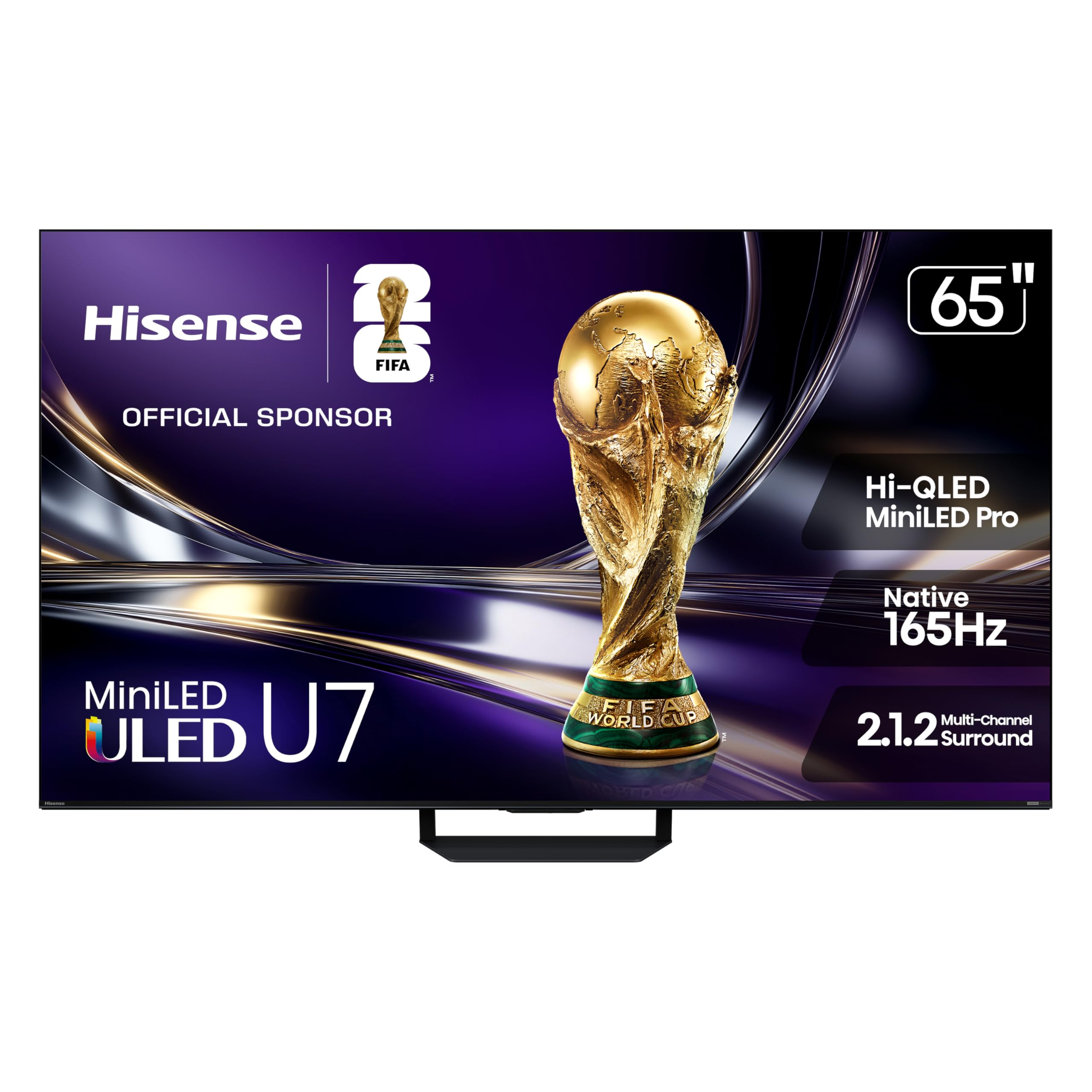
The Hisense U7 is a Mini-LED powerhouse that delivers up to 3,000 local dimming zones and 3,000 nits peak brightness, making it one of the brightest TVs in its class and ideal for rooms with significant ambient light. The native 165Hz refresh rate with VRR up to 330Hz support is rare at this price point, ensuring buttery smooth gameplay for competitive PC gaming and next-gen consoles. The Hi-QLED MiniLED Pro technology produces vibrant, accurate colors with Pantone validation, and the Hi-View AI Engine Pro constantly optimizes picture in real-time.
The Anti-Reflection and Glare-Free coating uses a dual-layer screen treatment that effectively suppresses reflections from windows and overhead lights, maintaining picture clarity in challenging lighting conditions. Google TV integration provides broad app support and works well with Google Assistant voice commands. Filmmaker Mode is available for purists who want to disable motion smoothing and preserve the original frame rate.
Built-in 2.1.2 channel sound with Dolby Atmos is better than average for a flat screen, but serious viewers will still want a dedicated soundbar or home theater system to match the visual performance. The remote is functional but not premium, and the overall build quality doesn’t match the OLED competitors — the bezels are slightly thicker and the chassis is mostly plastic.
Why it’s great
- Up to 3,000 dimming zones and 3,000 nits brightness
- Native 165Hz refresh with VRR up to 330Hz
- Excellent anti-reflection coating for bright rooms
Good to know
- Plastic chassis feels less premium than OLEDs
- Built-in sound is decent but not home theater grade
- Remote is basic and feels cheap
7. TCL 65-Inch QM7K Mini-LED QLED (2025)
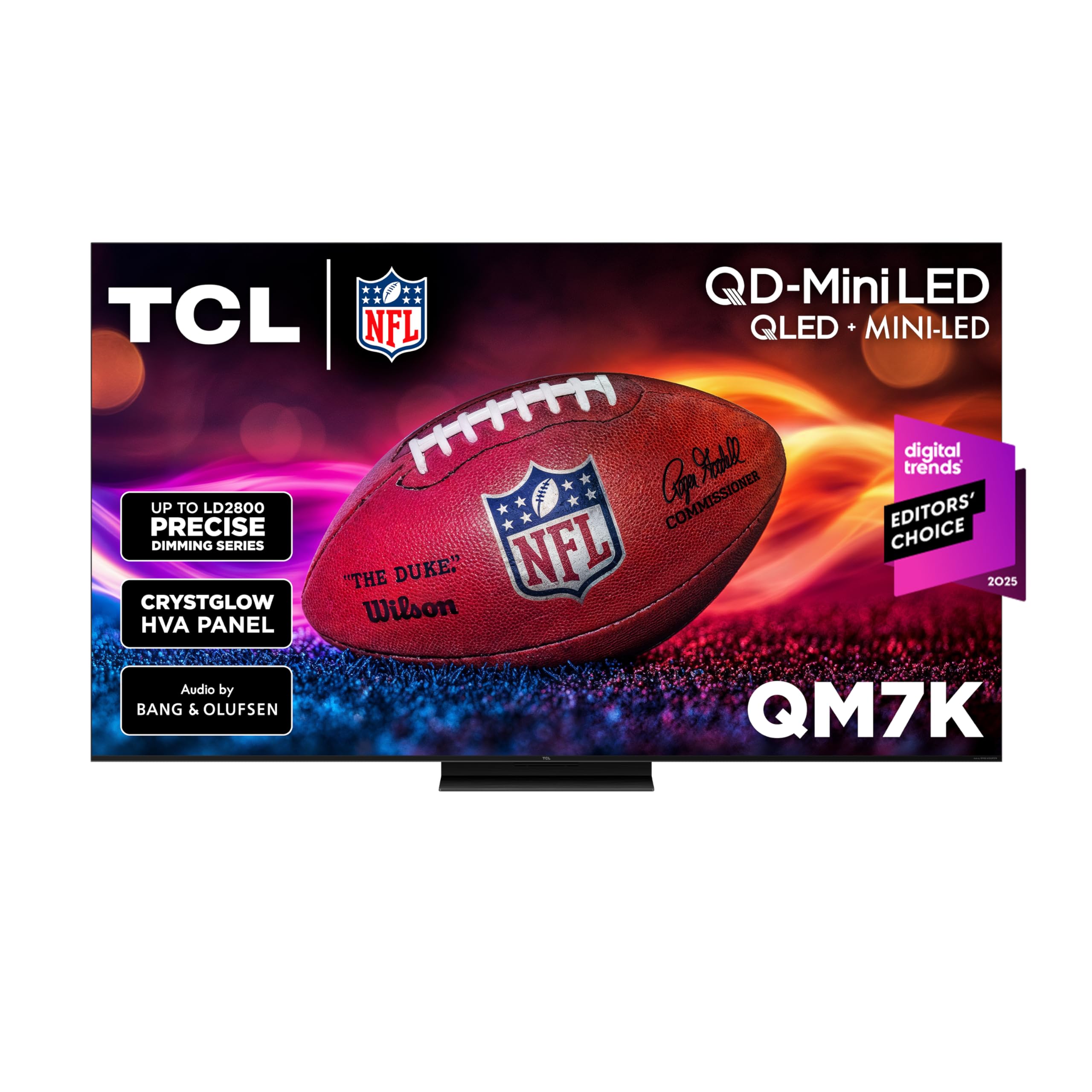
The TCL QM7K brings QD-Mini LED technology with up to 2,500 precisely controlled local dimming zones via the TCL Halo Control System, delivering near-OLED black levels without the brightness ceiling. The high HDR brightness and CrystGlow HVA Panel with anti-reflective coating make this a top choice for living rooms with large windows or glass doors. The 144Hz refresh rate with up to 288Hz in variable gaming mode ensures fluid motion for sports and gaming content.
Google TV with the included voice remote provides access to the full streaming ecosystem, and the addition of Bang & Olufsen audio tuning gives the built-in speakers above-average clarity and presence, though they still lack the bass weight of a dedicated system. The LD2500 dimming system provides excellent zone density for the price, minimizing blooming around subtitles and bright objects against dark backgrounds — a common weak point for less sophisticated Mini-LED implementations.
The remote control feels cheap and lacks direct input buttons, which is a common frustration across TCL’s product line. The Google TV interface can feel bloated with pre-installed apps, but most can be hidden or uninstalled. Some users report that streaming app navigation can stutter occasionally, though firmware updates have improved responsiveness over time.
Why it’s great
- Up to 2,500 dimming zones for deep black levels
- CrystGlow HVA panel with excellent anti-reflection
- 144Hz refresh with 288Hz VRR gaming mode
Good to know
- Remote feels cheap and lacks input button
- Google TV can feel bloated with pre-installed apps
- Occasional UI stutter in streaming apps
8. iFFALCON 65″ 4K MiniLED 65U85
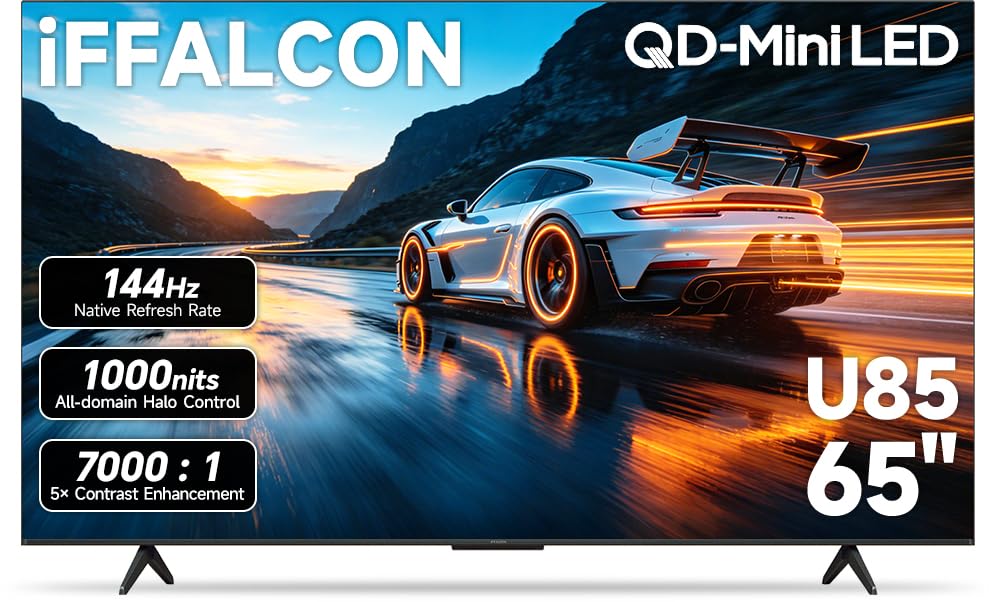
The iFFALCON 65U85 is built on a native 144Hz Mini-LED panel with VRR support up to 288Hz and AMD FreeSync Premium Pro certification, making it a compelling gaming-centric option. The standout feature is the inclusion of four HDMI 2.1 ports — two at 4K 144Hz and two at 4K 60Hz — allowing simultaneous connection of PS5, Xbox Series X, gaming PC, and a soundbar without needing to swap cables. Dolby Vision Gaming, Dolby Vision IQ, HDR10+, and IMAX Enhanced support covers every major HDR format.
The 50W 2.1-channel audio system (2x15W tweeters plus a 20W woofer) delivers surprisingly robust sound for built-in speakers, with Dolby Atmos passthrough via eARC for external soundbar upgrades. The TV includes Google TV for smart functions, and also features built-in Hotel Mode with IP/IR control — a rare inclusion that makes it suitable for commercial installations, Airbnb properties, or office meeting rooms where locked-down menus and remote management are required.
The panel achieves up to 1,000 nits peak brightness with a 7,000:1 contrast ratio and local dimming, which is solid for the price but falls short of the zone density and peak brightness of premium Mini-LEDs from TCL and Hisense. The bezels are slightly thicker than the ultra-slim competition, and the Google TV interface can occasionally feel sluggish when loading high-bitrate content. The USB port is Type-C only, which may require adapters for older devices.
Why it’s great
- Four HDMI 2.1 ports — rare at this price point
- Built-in Hotel Mode for hospitality and commercial use
- FreeSync Premium Pro for tear-free gaming
Good to know
- 1,000 nits brightness lags behind top Mini-LED competitors
- Bezels are thicker than premium models
- Only USB Type-C port requires adapters for legacy devices
9. Amazon Ember 65″ Mini-LED Series
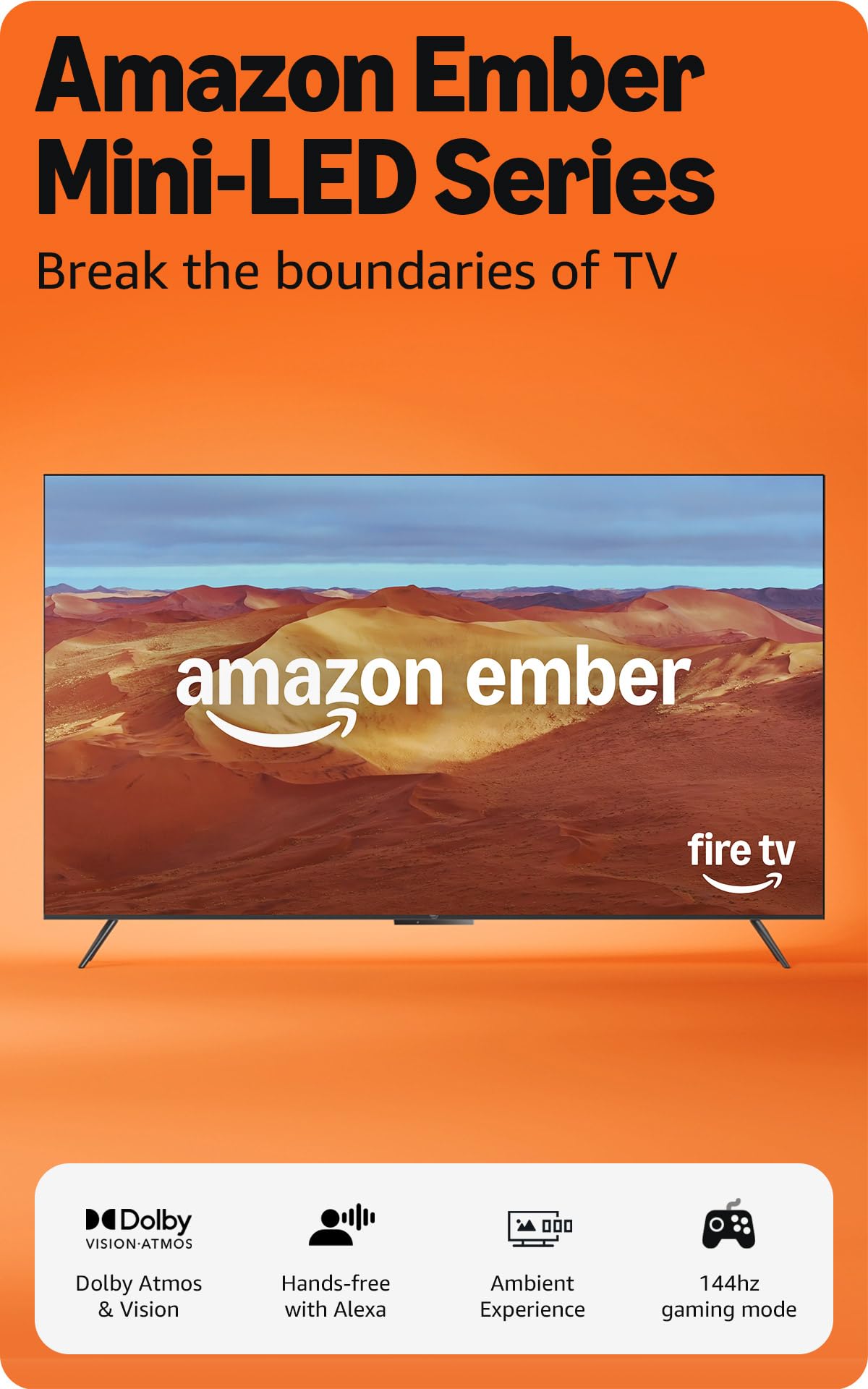
The Amazon Ember 65″ Mini-LED Series combines a QLED Mini-LED panel with 512 local dimming zones and up to 1,400 nits peak brightness, delivering strong HDR performance that approaches OLED-like contrast for bright objects against dark backgrounds. Dolby Vision IQ and HDR10+ Adaptive automatically adjust picture based on room lighting, and the Fire TV Intelligent Picture processor fine-tunes content scene-by-scene. The 144Hz panel with AMD FreeSync Premium Pro certification makes this Amazon’s best TV for gaming, with tear-free and low-latency performance.
The new Fire TV experience focuses on reducing scrolling time with dedicated content categories and personalized Alexa+ recommendations. Hands-free Alexa voice control works even when the screen is off, and the Omnisense technology wakes the display when you enter the room, showing your favorite artwork or content instantly. The 2.1 Dolby Atmos audio with integrated subwoofer delivers immersive sound that outperforms most built-in TV speakers, providing clear dialog and impactful bass.
The Fire TV platform can feel aggressively ad-driven, with recommendations and promoted content dominating the home screen. Some users report that the interface becomes laggy over time as more apps are installed, though the 2026 software update has improved responsiveness. Occasional random reboots have been reported, which can interrupt viewing sessions. The privacy-conscious may want to note that the TV has a microphone and camera sensors, though a physical switch disconnects the microphones.
Why it’s great
- 1,400 nits peak brightness with 512 dimming zones
- 144Hz with FreeSync Premium Pro for gaming
- Alexa+ integration and Omnisense wake-on-presence
Good to know
- Fire TV home screen is ad-heavy
- Interface can lag as apps accumulate
- Some units experience random reboots
10. Roku Smart TV 65-Inch Plus Series
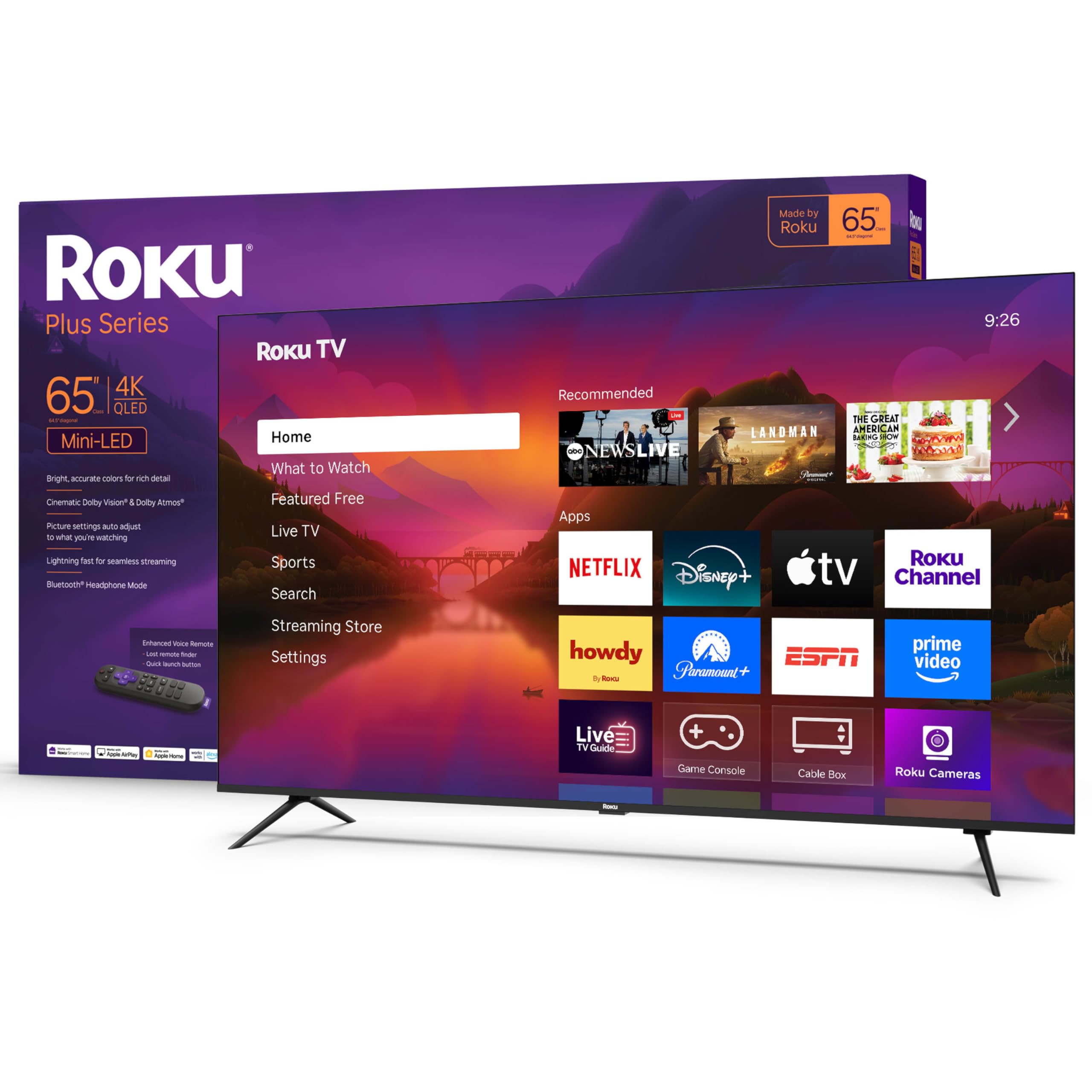
The Roku Plus Series brings Mini-LED backlighting and QLED color technology with Dolby Vision support at an accessible price point, delivering punchy HDR highlights and decent black levels for the cost. The 60Hz panel is the main limitation — fast-paced sports and action movies will show motion blur that a 120Hz+ panel handles better, and gaming consoles are capped at 60fps output. For streaming movies, TV shows, and casual viewing, the picture quality is genuinely impressive for the price tier, with vibrant colors and acceptable contrast.
The Roku OS is the star of this TV: it’s fast, intuitive, and gets automatic software updates with new features and apps. The Enhanced Voice Remote includes lost remote finder, personal shortcuts, and voice search across apps. The built-in audio with Dolby Atmos includes a subwoofer that delivers surprising bass presence for a flat screen TV, making dialog clear and action scenes immersive. Bluetooth Headphone Mode lets you listen privately without waking others.
The limited 60Hz refresh rate means this isn’t a TV for serious gamers or sports enthusiasts who want silky-smooth motion. The black levels, while better than standard LED, don’t approach the deep blacks of higher-end Mini-LED or OLED sets — you’ll notice blooming around subtitles and bright objects in dark scenes. The USB port is Type-C only, and there’s no support for HDMI 2.1 features like VRR or ALLM.
Why it’s great
- Roku OS is the fastest and most intuitive smart platform
- Mini-LED+QLED delivers good picture for the price
- Built-in audio with subwoofer and Dolby Atmos
Good to know
- 60Hz panel limits motion clarity and gaming
- No HDMI 2.1 features like VRR or ALLM
- Blooming visible in dark scenes with subtitles
11. Samsung 65-Inch Mini LED M70H (2026)
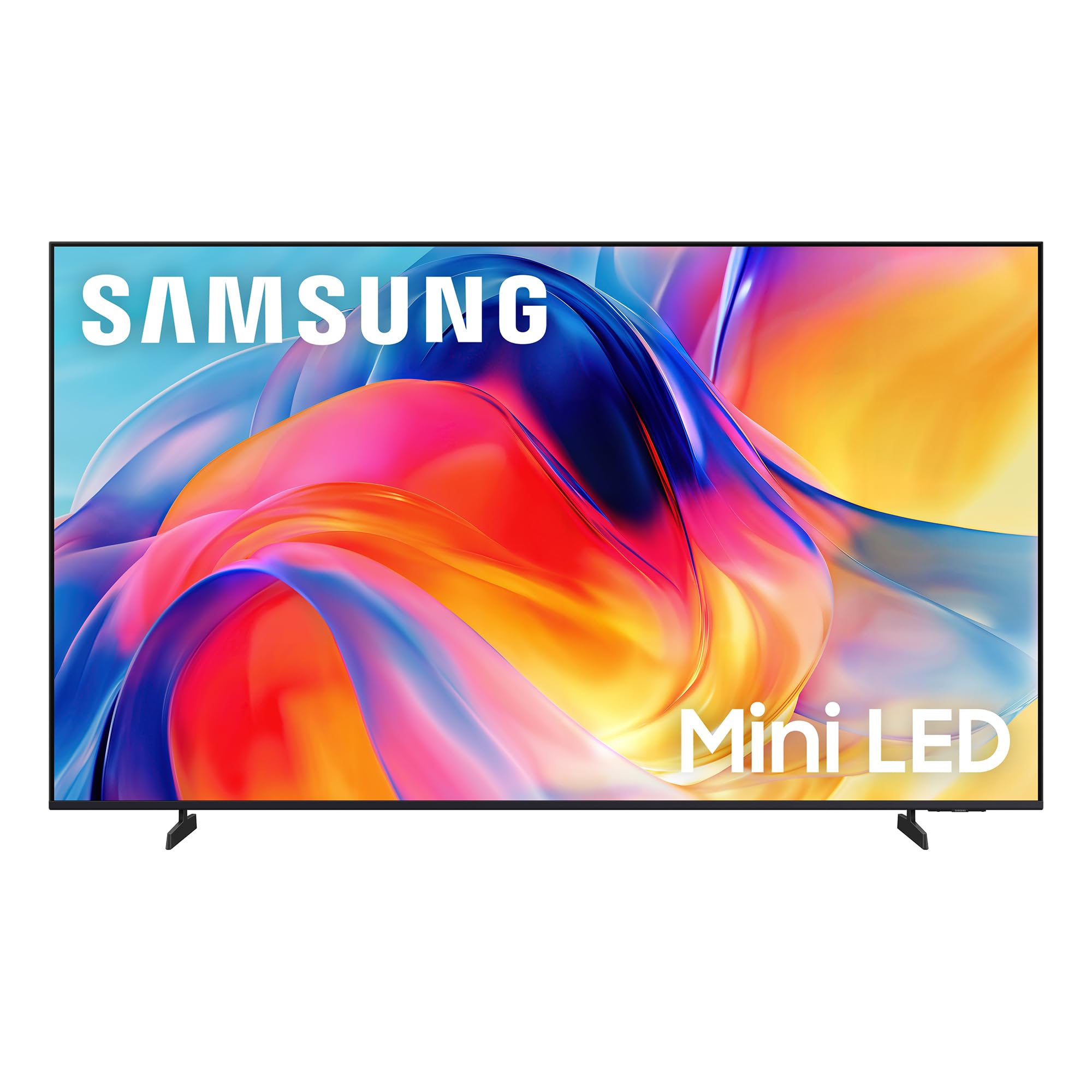
The Samsung M70H is an entry-level Mini-LED that brings the brand’s Pure Spectrum Color technology and Mini LED HDR to a 60Hz panel at a competitive price. The Mini LED Processor 4K handles upscaling and delivers brighter highlights and deeper blacks than standard LED TVs, but the limited zone count means blooming is more noticeable than on higher-tier Mini-LED models. Color accuracy is solid out of the box, with vibrant reds, blues, and greens that make content pop.
The Motion Xcelerator + DLG 120Hz technology uses Digital Low Latency upscaling to simulate 120Hz motion, but this is not native 120Hz — it works by inserting frames, which can introduce artifacts in fast-moving content. Soccer Mode optimizes settings for sports viewing with 40% clearer motion for fast action and 30% more vibrant greens for realistic turf. The Gaming Hub consolidates cloud gaming services, consoles, and gaming apps into a single interface, though the lack of native 120Hz limits its appeal for serious gamers.
The Tizen smart interface offers 2,700+ free streaming options via Samsung TV Plus, providing plenty of free content. The remote has been a major point of frustration for users — it lacks direct input switching buttons, has no volume button in some configurations, and the TV often forgets the last input used, defaulting to Pluto TV on startup. Alexa and Google Assistant support is available but can be inconsistent in execution.
Why it’s great
- Samsung Pure Spectrum Color delivers vibrant visuals
- Mini-LED backlight improves HDR over standard LED
- 2,700+ free streaming channels via Samsung TV Plus
Good to know
- 60Hz panel with simulated 120Hz, not native
- Remote lacks input and volume buttons
- TV defaults to Pluto TV on startup — forgets last input
FAQ
What is the difference between Mini-LED and OLED for a 65-inch TV?
Is a 60Hz TV enough for gaming on a 65-inch screen?
How many HDMI 2.1 ports do I need on a 65-inch TV?
Does a 65-inch TV fit in my apartment or bedroom?
Final Thoughts: The Verdict
For most users, the best 64 inch tv winner is the Samsung S90F OLED because its QD-OLED panel delivers the best balance of perfect blacks, vibrant color volume, and strong brightness for mixed use. If you want the brightest possible image for a sunlit living room, grab the Hisense U7 Mini-LED. And for pure gaming performance with multiple HDMI 2.1 devices, nothing beats the iFFALCON 65U85.