
The $400 GPU segment is the most contested battlefield in PC hardware. One wrong choice and you are locked into a card that chokes on modern textures, stutters through 1440p, or forces you to compromise on core settings within a year. The difference between a smart buy and a regretful one comes down to specific architectural decisions, VRAM capacity, and the efficiency of the cooling solution — not the brand name on the box.
I’m Min — the co-founder and writer behind Gadgets Feed. I analyze the raw performance data, power draw figures, and memory bandwidth of every card in this bracket to isolate the models that deliver genuine long-term value from those riding on marketing hype.
Whether you prioritize raw rasterization, ray tracing fidelity, or AI-accelerated workloads, this guide breaks down the best $400 gpu options by matching real-world benchmarks to your specific build goals.
How To Choose The Best $400 GPU
Every $400 GPU buyer faces the same core tension: does the card prioritize raw frame rates today, or does it build in headroom for the games releasing two years from now? The answer lies in three critical specs that separate a three-year card from a five-year card.
VRAM Capacity and Memory Bandwidth
At this price tier, 8GB is the baseline and 12GB or 16GB is the longevity sweet spot. Modern texture packs for 1440p frequently exceed 8GB allocations, forcing cards like the 8GB RTX 5060 to stream assets from system RAM, causing visible stutter. A 12GB Intel Arc B580 or a 16GB RX 9060 XT handles those same scenes with headroom to spare. Memory bus width also matters — a 192-bit bus paired with 12GB delivers noticeably higher bandwidth than a 128-bit 8GB configuration in texture-heavy titles.
Ray Tracing and Upscaling Architecture
NVIDIA’s DLSS 4 and AMD’s FSR 4 handle image reconstruction very differently. DLSS 4, exclusive to the RTX 50 series, uses neural rendering to recover fine detail at lower internal resolutions, while FSR 4 on RDNA 4 cards relies on temporal upscaling with less overhead. If you play ray-traced titles, the 5060’s dedicated RT cores provide a measurable advantage. If you prioritize native rasterization and larger VRAM pools, the RX 9060 XT or Intel Arc B580 offer better raw performance per dollar.
Power Draw and Thermal Management
A $400 GPU that pulls 200W may save you today but cost extra in electricity over three years. The Arc B580 idles around 100W under light loads, the RTX 5060 sips 150W at peak, and the 16GB RX 9060 XT can hit 220W under sustained gaming. Check your power supply’s 12V rail rating before buying. Dual-fan coolers from ASRock and Gigabyte now deliver 0dB silent modes for low-load scenarios, making noise levels a genuine differentiator.
Quick Comparison
On smaller screens, swipe sideways to see the full table.
| Model | Category | Best For | Key Spec | Amazon |
|---|---|---|---|---|
| ASRock Intel Arc B580 Challenger 12GB | Mid-Range | 1440p Value / SFF Builds | 12GB GDDR6 / 192-bit | Amazon |
| ASUS Dual NVIDIA GeForce RTX 5060 8GB | Mid-Range | Ray Tracing / DLSS 4 | 8GB GDDR7 / 128-bit | Amazon |
| GIGABYTE Radeon RX 9060 XT Gaming OC 8G | Mid-Range | Quiet 1080p High FPS | 8GB GDDR6 / 128-bit | Amazon |
| PNY NVIDIA GeForce RTX 5060 Epic-X ARGB OC | Mid-Range | Competitive eSports | 8GB GDDR7 / 128-bit | Amazon |
| XFX Swift AMD Radeon RX 9060 XT OC 16GB | Mid-Range | Texture-Heavy AAA Games | 16GB GDDR6 / 128-bit | Amazon |
| PNY NVIDIA GeForce RTX 5060 Ti Epic-X ARGB OC | Premium | Content Creation / Ray Tracing | 8GB GDDR7 / 128-bit | Amazon |
| GIGABYTE GeForce RTX 5070 WINDFORCE OC SFF | Premium | High-Refresh 1440p | 12GB GDDR7 / 192-bit | Amazon |
| ASUS Prime AMD Radeon RX 9070 XT 16GB | Premium | 4K Capable Rasterization | 16GB GDDR6 / 256-bit | Amazon |
| Sapphire 11348-01-20G Nitro+ RX 9070 XT 16GB | Premium | Silent High-End 1440p/4K | 16GB GDDR6 / 256-bit | Amazon |
| MSI Gaming RTX 5070 Ti 16G Shadow 3X OC | Premium | 4K Ultra / Heavy Workloads | 16GB GDDR6X / 256-bit | Amazon |
| EVGA GeForce RTX 3090 FTW3 Ultra 24GB | Premium | AI/ML Workloads | 24GB GDDR6X / 384-bit | Amazon |
In‑Depth Reviews
1. ASRock Intel Arc B580 Challenger 12GB OC Graphics Card

The ASRock Arc B580 Challenger brings 12GB of GDDR6 on a 192-bit bus to the bracket, a configuration that typically commands a higher price. Powered by Intel’s Xe2-HPG architecture with 20 Xe cores, this card delivers smooth 1440p gameplay at 60+ FPS on ultra settings across a wide range of modern titles, and its 0dB Silent Cooling mode stops the fans entirely under light loads. The 2740 MHz GPU clock and 19 Gbps memory speed provide the bandwidth needed for high-fidelity textures without stutter.
Real-world performance lands between an RTX 3060 Ti and an RTX 3070 in rasterization, while power draw remains impressively low at around 100W at 60Hz and maxing out near 150W. The card supports PCIe 4.0 x8, three DisplayPort 2.1 outputs (one reaching UHBR13.5), and a single HDMI 2.1a port, enabling up to 8K displays. Linux users report excellent compatibility, with Fedora delivering stable driver performance out of the box.
The catch is that the Arc B580 requires Resizable BAR support — meaning a 10th-gen Intel CPU or newer, or a compatible AMD Ryzen platform — to reach its full potential. Without REBAR, performance drops significantly in CPU-limited scenarios. The card also measures 249mm long, so it fits most compact cases but may conflict with front-mounted radiators in smaller enclosures.
Why it’s great
- 12GB VRAM on a 192-bit bus offers exceptional texture headroom for 1440p
- 0dB silent fan mode eliminates noise during desktop use and light gaming
- Power draw rivals entry-level cards while delivering mid-range performance
Good to know
- Requires Resizable BAR support for optimal performance
- Driver installation process is more complex than NVIDIA or AMD alternatives
2. ASUS Dual NVIDIA GeForce RTX 5060 8GB GDDR7 OC Edition

ASUS’s Dual RTX 5060 leverages the NVIDIA Blackwell architecture and GDDR7 memory to deliver 623 AI TOPS, making it the strongest AI-accelerated card in the bracket. The GDDR7 memory, running across a 128-bit bus, achieves memory bandwidth improvements over GDDR6 that compensate for the narrower interface in texture-heavy workloads. The Axial-tech fan design with a smaller hub and longer blades increases downward air pressure, keeping the card cool within its 150W TDP envelope.
In rasterization, the 5060 matches the RTX 3070 and RTX 2080 Ti based on TechPowerUp benchmarks, while DLSS 4 with Multi Frame Generation smooths out 1% and 0.1% lows in supported titles. The card supports PCIe 5.0, though it operates at x8 lanes, which means PCIe 4.0 systems still see negligible performance loss. The dual-slot design measures 9 inches long, making it fully SFF-ready for compact builds.
The primary concern is the 8GB VRAM ceiling — a regression from the 12GB found on the RTX 3060. Modern titles at 1440p can exceed 8GB with ray tracing enabled, forcing texture streaming that introduces stutter. This card is best suited for 1080p high-refresh gaming or 1440p in titles that do not push VRAM limits. ASUS backs it with a standard 3-year warranty, and the included Speedsetup manual simplifies installation for first-time builders.
Why it’s great
- DLSS 4 provides best-in-class upscaling and frame generation for ray-traced titles
- GDDR7 memory delivers bandwidth that compensates for the 128-bit bus
- SFF-ready dual-slot design fits compact cases without clearance issues
Good to know
- 8GB VRAM is a hard limit for 1440p ray tracing and high-res texture packs
- Rasterization performance is competitive but does not exceed the 12GB Intel Arc B580
3. GIGABYTE Radeon RX 9060 XT Gaming OC 8G Graphics Card

GIGABYTE’s RX 9060 XT Gaming OC brings the RDNA 4 architecture to the mid-range with a 2700 MHz boost clock and the company’s signature WINDFORCE cooling system. The Hawk fan blades paired with server-grade thermal gel keep temperatures under control while maintaining near-silent operation via zero-RPM mode during light loads. The card handles 1080p effortlessly, pushing 240 FPS in competitive titles like Fortnite, and delivers smooth 1440p at high-to-ultra settings in most AAA releases.
The 8GB GDDR6 memory on a 128-bit bus is adequate for current-gen gaming but leaves little room for future texture demand. Where this card shines is in its thermal management — the dual-fan setup runs quietly even under sustained load, and the metal backplate provides structural rigidity. PCIe 5.0 support ensures compatibility with the latest motherboards, while the RGB lighting adds customizable aesthetics via GIGABYTE’s software suite.
Buyers should note that the card measures 11.06 inches in length, so case compatibility should be verified for smaller mid-towers. The display output is capped at 3840×2160, so 8K monitors will not reach full resolution. FSR 4 provides solid upscaling in supported titles, but the 8GB VRAM means ray tracing should be used sparingly at higher resolutions. GIGABYTE’s build quality is consistently reliable, making this a safe choice for builders prioritizing quiet operation.
Why it’s great
- WINDFORCE cooling with zero-RPM mode delivers silent operation under low load
- Sustained 240 FPS in competitive esports titles at 1080p
- PCIe 5.0 support provides future compatibility with new platforms
Good to know
- 8GB VRAM limits ray tracing and high-resolution texture performance
- Display output capped at 4K, no 8K support
4. PNY NVIDIA GeForce RTX 5060 Epic-X ARGB OC Triple Fan
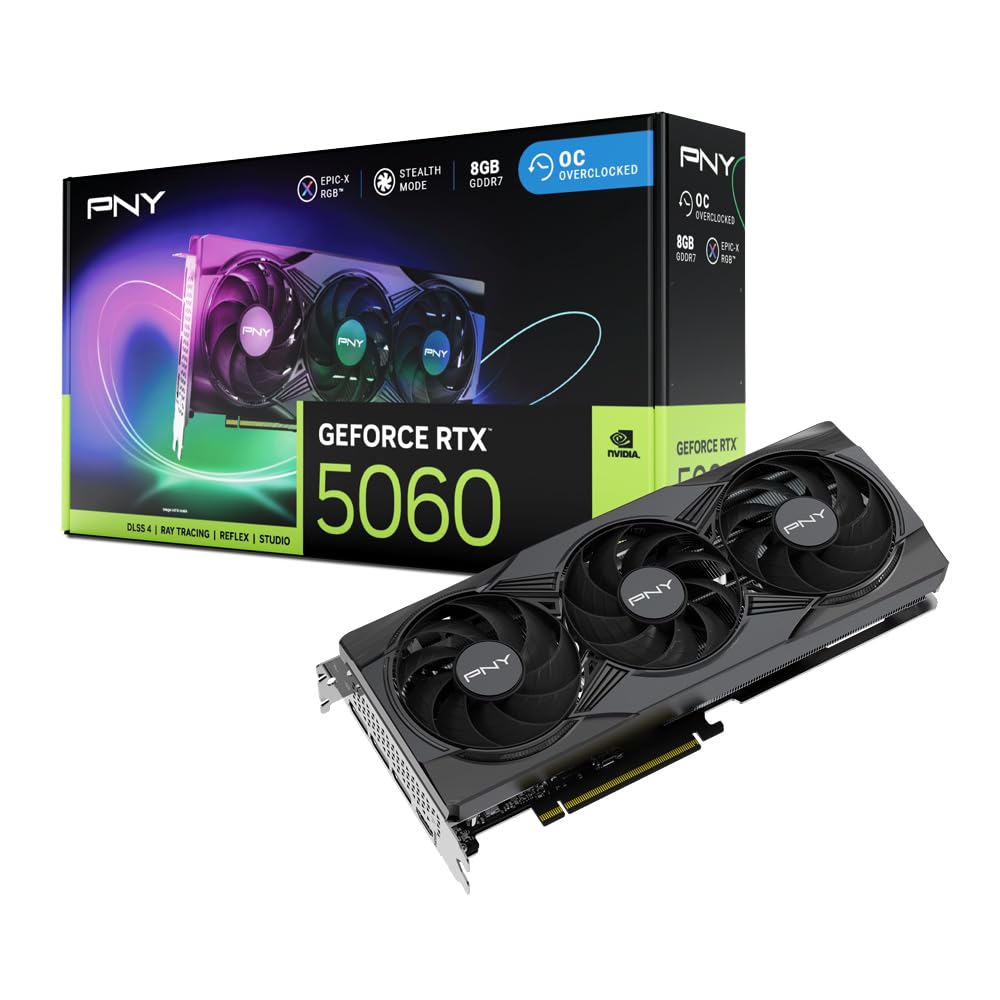
PNY’s Epic-X RTX 5060 distinguishes itself with a triple-fan cooling solution on an otherwise compact 2-slot card, delivering aggressive thermal performance in a small footprint. The core clock runs at 2280 MHz base with GDDR7 memory across a 128-bit bus, and with 100+ FPS on high settings across almost every modern game, this card targets high-refresh 1080p and capable 1440p gaming. The ARGB lighting adds visual customization without adding bulk.
NVIDIA Reflex technology, built into the RTX 50 series, reduces system latency in competitive shooters — a critical advantage for players chasing faster reaction times. The card uses PCI Express x8 interface, so pairing it with a Gen 5 motherboard maximizes bandwidth, though Gen 4 loss is minimal. Installation is straightforward, and the card’s power draw stays reasonable, making it compatible with a wide range of power supplies.
Where the Epic-X falls short is in memory bandwidth for texture-heavy scenes — the 8GB GDDR7 on a 128-bit bus can bottleneck in ray-traced 1440p gaming. Users also report that driver updates were needed immediately out of the box, though once updated, the experience is stable. PNY’s customer support and pricing are competitive, making this a solid option for builders who prioritize high frame rates in esports titles over raw VRAM capacity.
Why it’s great
- Triple-fan cooling keeps temperatures low in SFF and mid-tower cases
- DLSS 4 and Reflex deliver competitive latency reductions for shooters
- GDDR7 memory provides excellent bandwidth for a 128-bit card
Good to know
- 8GB VRAM may become a limitation for future AAA titles at 1440p
- PCIe x8 interface requires Gen 5 platform for full bandwidth potential
5. XFX Swift AMD Radeon RX 9060 XT OC Gaming Edition 16GB
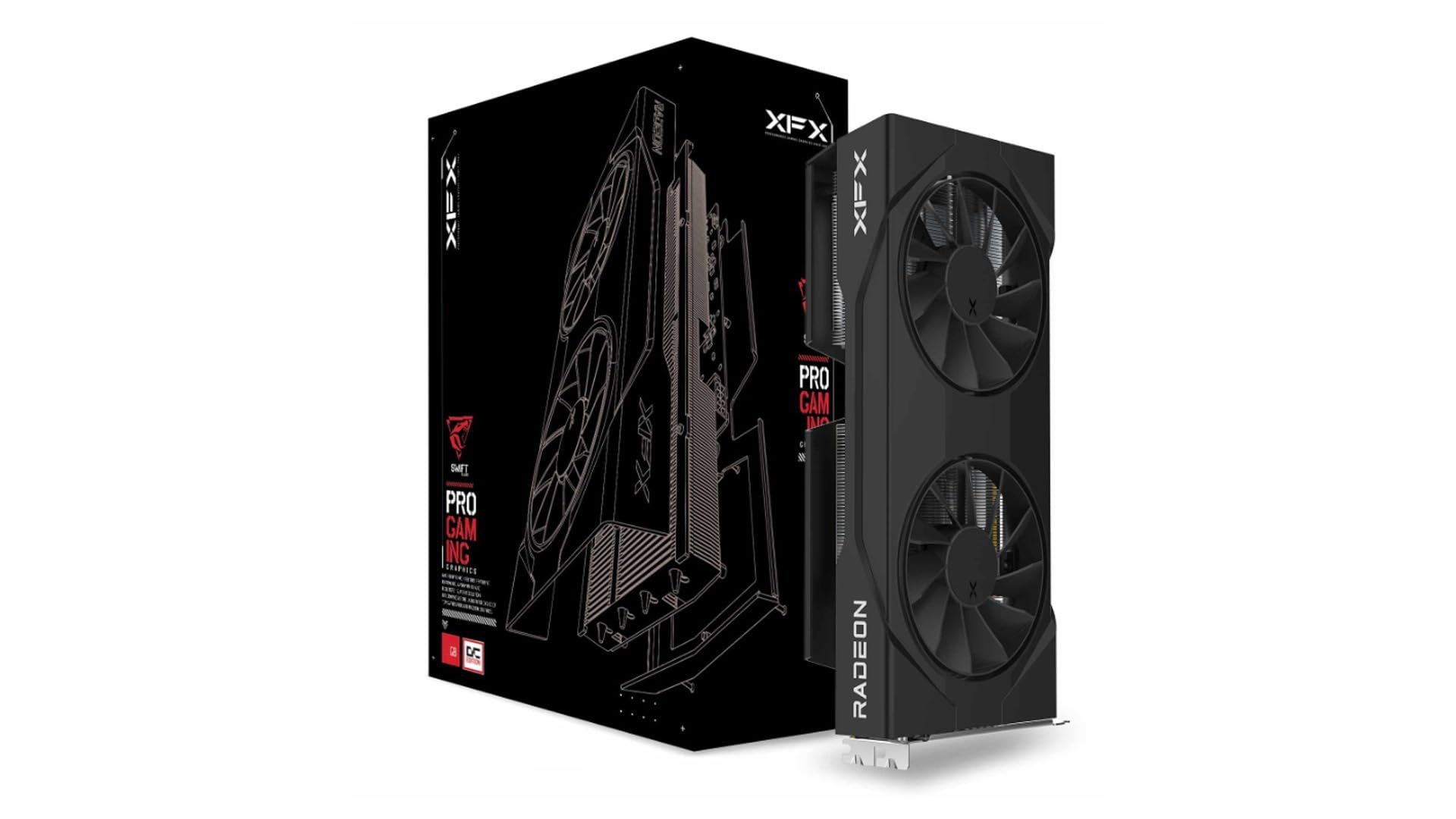
The XFX Swift RX 9060 XT delivers 16GB of GDDR6 memory — double the capacity of most competitors at this price — making it a standout option for texture-heavy AAA gaming and creative workloads that exceed the 8GB threshold. The boost clock reaches up to 3320 MHz, and the dual-fan XFX SWFT cooling solution keeps temperatures around 60°C under load, producing Timespy scores around 17000. This card runs 95% of modern AAA titles at 1080p max settings without breaking a sweat, and handles 1440p with ease in most scenarios.
The increased VRAM pool means texture pop-in and streaming stutter are virtually eliminated in titles like Hogwarts Legacy and Cyberpunk 2077 at high settings. The card measures 10.63 inches in length and fits standard mid-tower cases, though only offers two DisplayPort outputs and one HDMI, which may be limiting for multi-monitor setups beyond three displays. RDNA 4 architecture brings improved ray tracing over the RX 7000 series, though it still trails NVIDIA’s dedicated RT cores in heavy ray-traced scenes.
Power efficiency is a strong point — the card runs cool and quiet even during extended gaming sessions, with no coil whine reported. The 16GB buffer makes this card future-proof for the next generation of consoles’ texture demands. XFX includes a quick install guide in the box, and the build quality is robust with a solid backplate. The only output limitation is the 3840×2160 max resolution, and the card lacks PCIe 5.0 support.
Why it’s great
- 16GB VRAM eliminates texture stutter in high-fidelity AAA titles
- Boost clock up to 3320 MHz delivers strong rasterization performance
- Temps stay around 60°C with near-silent operation
Good to know
- Only three display outputs, limited to 4K maximum resolution
- Ray tracing performance still lags behind NVIDIA RTX 50 series
6. PNY NVIDIA GeForce RTX 5060 Ti Epic-X ARGB OC Triple Fan

The 5060 Ti variant from PNY pushes boost clocks to 2692 MHz, positioning it as the highest-clocked 8GB card in the RTX 50 series lineup at this price tier. The triple-fan Epic-X cooler keeps the GDDR7 module temperatures in check even during extended rendering sessions, making this card a strong candidate for content creators who need CUDA acceleration for video editing and 3D modeling. DLSS 4 and fourth-gen ray tracing cores provide a meaningful upgrade in supported creative applications.
Gaming performance at 1440p high settings reaches 144 FPS in most titles, and the card’s 2-slot footprint makes it SFF-ready for compact workstation builds. The NVIDIA Studio driver ecosystem offers stability for professionals running Adobe Premiere, DaVinci Resolve, or Blender. Reflex technologies further optimize the graphics pipeline for reduced latency in real-time workflows and competitive gaming alike.
The critical limitation is PCIe 3.0 compatibility — this card does not support PCIe 3.0 at all, potentially causing issues for users on older platforms. At 8GB, the VRAM is the same capacity as the base 5060, leaving no headroom for future-proofing beyond what the 128-bit bus allows. PNY includes the NVIDIA App for driver management, and the build quality is solid, but the price premium over the standard 5060 is justified almost entirely by the higher boost clock and triple-fan cooling.
Why it’s great
- 2692 MHz boost clock offers highest factory OC in the 5060 family
- Triple-fan cooling handles sustained creative workloads efficiently
- DLSS 4 and Reflex provide versatility for gaming and professional use
Good to know
- No PCIe 3.0 support, incompatible with older motherboards
- 8GB VRAM is the same as the lower-tier 5060, no capacity upgrade
7. GIGABYTE GeForce RTX 5070 WINDFORCE OC SFF 12G

The GIGABYTE RTX 5070 WINDFORCE OC pushes into premium territory with 12GB of GDDR7 memory on a 192-bit bus, directly addressing the VRAM concerns that plague the 8GB cards. The NVIDIA Blackwell architecture powers DLSS 4 and fourth-gen ray tracing cores, delivering smooth 1440p gaming at 180Hz without compromise. Triple-fan WINDFORCE cooling keeps the card under 75°C even under maximum load, and the 0dB silent mode stops the fans entirely during light desktop use.
User reports confirm that this card outperforms the RTX 3080 in rasterization while consuming significantly less power, making it a genuine upgrade for users on older 30-series cards. The SFF-ready design measures 11.1 inches long and fits standard ATX cases comfortably. The lack of RGB lighting appeals to builders seeking a sleeker, professional aesthetic, though the metal backplate includes subtle branding for visual interest.
The main barrier is the price increase over the $400 target — this card commands a notable premium for the 12GB GDDR7 combination. The WINDFORCE cooling system is effective but produces audible fan noise under sustained heavy loads, though reviews note it is quieter than the triple-fan 2080 Super. GIGABYTE’s build quality is consistent, and the card runs stable at stock settings without requiring overclocking tweaks.
Why it’s great
- 12GB GDDR7 on a 192-bit bus provides excellent VRAM headroom for 1440p
- WINDFORCE cooling keeps temps below 75°C under sustained load
- DLSS 4 delivers significant frame rate boosts in supported titles
Good to know
- Price exceeds the $400 target by a considerable margin
- Fans can become audible under extreme sustained gaming loads
8. ASUS Prime AMD Radeon RX 9070 XT 16GB OC Edition

The ASUS Prime RX 9070 XT brings RDNA 4 to the high-end with 16GB of GDDR6 on a 256-bit bus, clock speeds reaching 4000 MHz, and a 2.5-slot design that balances cooling efficiency with build compatibility. The Axial-tech fan system with smaller hubs and longer blades increases downward air pressure, while dual-ball bearings extend fan lifespan to twice that of standard sleeve bearings. The phase-change GPU thermal pad optimizes heat transfer for sustained performance under load.
Real-world testing shows this card running 1440p ultra settings at 100-110 FPS in demanding titles like Red Dead Redemption 2, a significant jump from the RX 6800. The card supports 8K output via DisplayPort 2.1 and includes a Dual BIOS switch for users who want to toggle between performance and quiet modes. Power draw sits around 180-190W under stress, with idle temperatures between 28-32°C and stressed temperatures around 55-59°C.
The 16GB VRAM pool makes this card viable for 4K gaming without ray tracing, though maintaining 4K 144Hz on max settings in AAA titles is a stretch. Linux compatibility is excellent, with Fedora users reporting stable out-of-box performance. The card measures 311mm in length and requires 3 PCIe power connectors, so case and PSU compatibility need verification. ASUS backs it with a 3-year warranty, though customer support reputation is mixed.
Why it’s great
- 16GB GDDR6 on 256-bit bus provides ample VRAM for 4K textures
- Axial-tech fans with dual-ball bearings deliver long-term reliability
- Dual BIOS switch allows users to choose between performance and quiet modes
Good to know
- Large 311mm length may not fit smaller cases without careful measurement
- Ray tracing performance still trails NVIDIA in heavy RT workloads
9. Sapphire 11348-01-20G Nitro+ AMD Radeon RX 9070 XT 16GB

Sapphire’s Nitro+ RX 9070 XT is the premium Radeon card for this generation, delivering 16GB of GDDR6 on a 256-bit bus with boost clocks reaching 3.06 GHz. The massive triple-slot cooler is engineered for near-silent operation — users report no coil whine and whisper-quiet fans even under 4K gaming loads. This card offers 60-90% performance uplift over the RX 6750 XT, with significantly improved 1% lows for smoother frame pacing in demanding titles.
The Nitro+ design includes a clean 12V cable routing channel integrated into the backplate, reducing cable clutter for clean builds. Dual HDMI and dual DisplayPort outputs support multi-monitor configurations beyond the standard three-display setup. The card runs stable at stock settings with no manual overclocking required, and the high boost clock means the GPU stays near 3.0 GHz across most gaming scenarios without throttling.
The downsides are physical — the card occupies 3+ slots and measures over 300mm, requiring a spacious case with adequate clearance. An 850W power supply is recommended, and the included GPU brace is insufficient to prevent sag over time, necessitating an aftermarket support bracket. Users have reported fragile power and RGB connectors that bend easily. The price also sits at a premium well above the $400 target, reserved for enthusiasts who demand the best Radeon experience.
Why it’s great
- 3.06 GHz boost clock and 16GB VRAM deliver exceptional 1440p/4K rasterization
- Cooling solution is near-silent even under sustained gaming loads
- Dual HDMI and dual DisplayPort support flexible multi-monitor setups
Good to know
- 3+ slot design requires a spacious case with room to spare
- Power and RGB connectors are fragile and can break during installation
10. MSI Gaming RTX 5070 Ti 16G Shadow 3X OC

MSI’s RTX 5070 Ti Shadow 3X OC is the ultimate 16GB card in the RTX 50 series, using GDDR6X memory on a 256-bit bus to deliver uncompromising 4K and 1440p ultra performance. The TORX Fan 5.0 system uses linked ring arcs to stabilize high-pressure airflow, while the nickel-plated copper baseplate and square-design core pipes maximize heat transfer from the GPU die. This card auto-boosts to 2800 MHz out of the box, exceeding the factory spec.
Users upgrading from the RTX 3060 report a massive leap in performance, with Cyberpunk 2077 and Red Dead Redemption 2 running at 4K ultra without upscaling. The card handles video editing, 3D rendering, and streaming simultaneously without bottlenecks. The build quality is robust, with a metal backplate and reinforced PCB, though the card measures 15 inches in length, requiring spacious cases.
The primary concern is the significant price premium, which places this card well above the $400 budget for most buyers. Some users reported initial backplate vibration that was resolved with a simple adjustment, and fan noise during the first stress tests diminished after a month of use. The 16GB GDDR6X buffer is future-proof for 4K gaming, but the investment is substantial for users who do not utilize the VRAM or rendering performance.
Why it’s great
- 16GB GDDR6X on 256-bit bus delivers uncompromising 4K performance
- Auto-boosts to 2800 MHz, exceeding factory spec for extra headroom
- TORX Fan 5.0 and copper baseplate provide excellent thermal management
Good to know
- Price premium is significant, well above the $400 target bracket
- 15-inch length requires a large case for proper fitment
11. EVGA GeForce RTX 3090 FTW3 Ultra Gaming 24GB

The EVGA RTX 3090 FTW3 Ultra is a last-generation flagship with 24GB of GDDR6X memory on a 384-bit bus, featuring 10496 CUDA cores and a 1800 MHz boost clock. While PCIe 4.0 and lacking modern features like DLSS 4, the sheer VRAM capacity makes this card the current champion for AI and machine learning workloads. Users report running 2x8GB AI models simultaneously without performance degradation, alongside 90+ FPS in benchmarks while background AI processes run.
Gaming performance at 1440p near-maximum settings remains strong in 2025, with 70-120 FPS in 3D Unity games at 4K ultra. The iCX3 cooling system with three fans and ARGB LED logo keeps thermals manageable, though the card is physically massive and heavy, requiring a vertical GPU mount in many cases. The 3x 8-pin power connectors demand an 800W PSU minimum, and power spikes can hit 420W under combined gaming and AI loads.
The drawbacks are substantial for gaming-focused buyers: the card runs hot, with backside VRAM temperatures reaching 90°C, and the fans are loud at full speed. The age means no DLSS 4, no HDMI 2.1b, and no PCIe 5.0 support. For AI and ML users, however, the 24GB VRAM is irreplaceable at this price point, offering a proven workhorse with no compatibility issues. EVGA’s legendary build quality and support further sweeten the deal for professionals.
Why it’s great
- 24GB GDDR6X VRAM is unmatched for AI/ML workloads at this price
- 10496 CUDA cores deliver strong compute performance for rendering
- EVGA build quality and support are considered industry best
Good to know
- Runs hot and loud, with backside VRAM reaching 90°C
- No DLSS 4, HDMI 2.1b, or PCIe 5.0 support
FAQ
Is 8GB of VRAM enough for a $400 GPU in 2025?
Should I prioritize ray tracing performance or raw rasterization at this price?
What power supply wattage do I need for a $400 GPU?
Final Thoughts: The Verdict
For most users, the $400 gpu winner is the ASRock Intel Arc B580 Challenger 12GB because its 12GB VRAM, 192-bit bus, and sub-150W power draw deliver the best balance of longevity, performance, and efficiency in this bracket. If you want DLSS 4 and ray tracing capabilities, grab the ASUS Dual RTX 5060 8GB. And for texture-heavy 1440p gaming with future-proof VRAM, nothing beats the XFX Swift RX 9060 XT 16GB.