
The jump to a 27-inch OLED panel changes how you see games and media. You get perfect blacks, infinite contrast, and pixel-level response that LCD technology cannot match. The challenge is picking the right model for your refresh rate needs, HDR expectations, and build quality preferences without overspending on features you won’t use.
I’m Min — the co-founder and writer behind Gadgets Feed. I’ve spent hundreds of hours analyzing panel technologies, refresh rate data, color gamut measurements, and real user feedback to separate the genuine OLED standouts from the marketing noise in this specific size class.
This guide focuses exclusively on the best 27-inch OLED monitor options across QD-OLED and WOLED panels, comparing specs like refresh rates from 240Hz to 480Hz and contrast ratios up to 1.5M:1 to find your ideal match.
How To Choose The Best 27 Inch OLED Monitor
OLED monitors at 27 inches hit the sweet spot for pixel density and desk footprint. The decision comes down to panel generation, refresh rate target, and specific color technology. These three factors define the experience more than brand loyalty or generic specs.
QD-OLED vs WOLED: The Panel Divide
QD-OLED panels from Samsung Display deliver wider color volume and higher peak brightness in HDR, especially in well-lit rooms. WOLED panels from LG Display tend to have better text clarity out of the box and a more accurate color calibration for professional work. QD-OLED can show a purple tint under bright direct light, while WOLED typically uses a glossy finish with a micro-lens array for improved brightness. Your lighting environment determines which panel type works best.
Refresh Rate: 240Hz, 360Hz, or 480Hz
240Hz remains the value sweet spot for most gamers — it pairs perfectly with a mid-range GPU running QHD resolution. 360Hz and 480Hz targets demand top-tier hardware and benefit competitive players in fast-paced shooters. The 0.03ms response time is consistent across nearly all modern 27-inch OLEDs, so the motion clarity difference between 240Hz and 480Hz is real but diminishing returns kick in quickly unless you play esports titles at high frame rates.
HDR Certification and Brightness
VESA DisplayHDR True Black 400 and True Black 500 are the relevant certifications for OLED monitors. True Black 500 guarantees higher sustained brightness across a larger window of the screen. Entry-level OLED panels sometimes peak below 250 nits in standard SDR mode, which can feel dim in bright rooms. Models with higher brightness specs and anti-glare coatings handle mixed-lighting environments significantly better.
Quick Comparison
On smaller screens, swipe sideways to see the full table.
| Model | Category | Best For | Key Spec | Amazon |
|---|---|---|---|---|
| Acer Predator X27U | QD-OLED | Budget entry to OLED | 240Hz, 0.03ms, DCI-P3 99% | Amazon |
| LG 27GX704A-B | WOLED | Balanced gaming and media | 240Hz, 0.03ms, HDR True Black 400 | Amazon |
| ASUS ROG Strix XG27AQDMG | WOLED | Premium glossy OLED gaming | 240Hz, 0.03ms, custom heatsink | Amazon |
| Samsung Odyssey OLED G5 | QD-OLED | Value QD-OLED experience | 180Hz, 0.03ms, anti-glare | Amazon |
| MSI MPG 271QRX | QD-OLED | High-refresh esports | 360Hz, 0.03ms, True Black 400 | Amazon |
| AOC Q27G4ZD | QD-OLED | Budget high-refresh OLED | 240Hz, 0.03ms, 147.6% sRGB | Amazon |
| Sony INZONE M10S | WOLED | Competitive 480Hz play | 480Hz, 0.03ms, heatsink cooled | Amazon |
| GIGABYTE MO27Q28G | WOLED | Premium HDR and KVM | 280Hz, 0.03ms, HDR True Black 500 | Amazon |
In‑Depth Reviews
1. LG 27GX704A-B
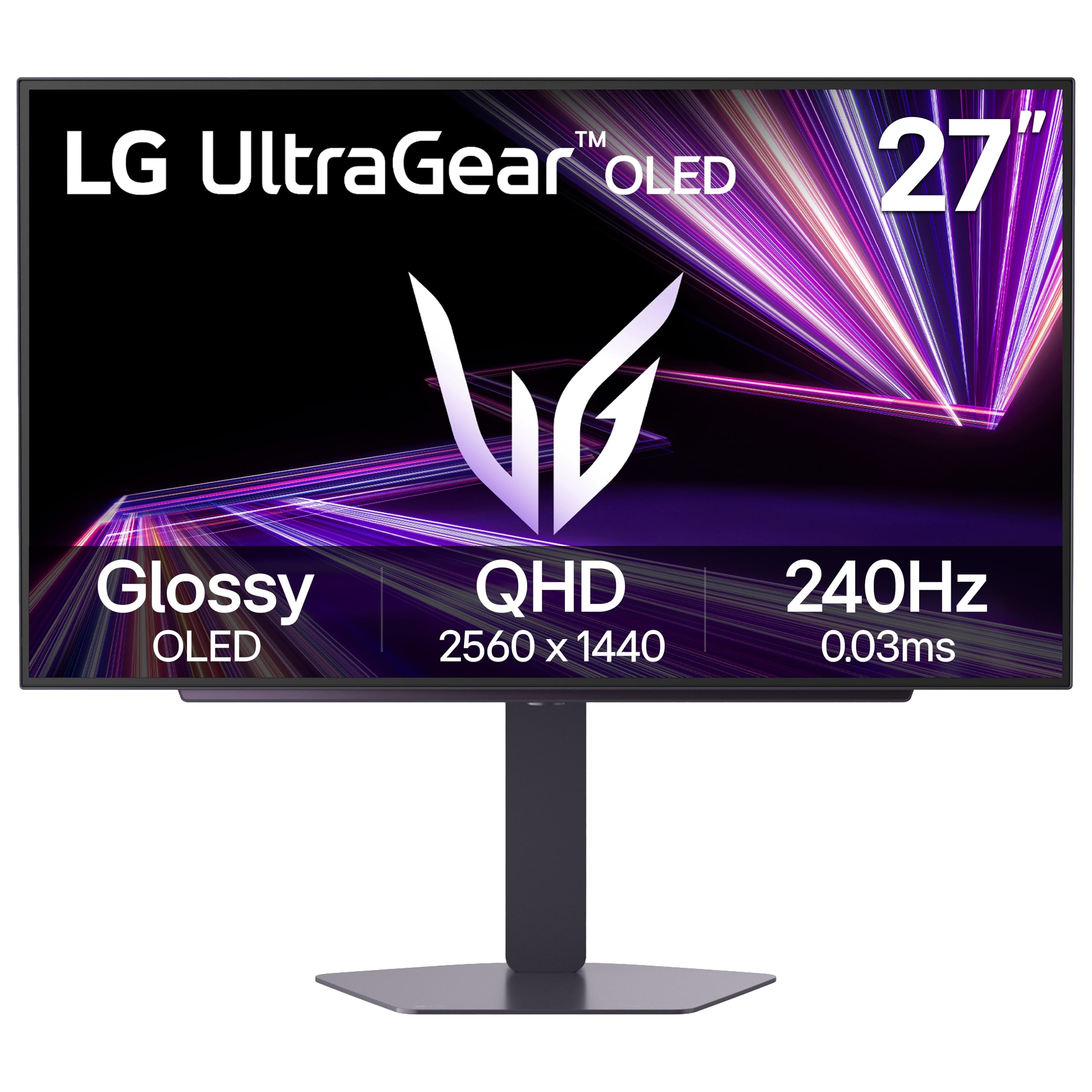
The LG 27GX704A-B brings a glossy WOLED panel with 240Hz refresh rate and 0.03ms response time to a mid-range price. Peak brightness reaches 1300 nits on small highlights, making HDR content pop while maintaining the deep blacks OLED is known for. The 1.5M:1 contrast ratio ensures shadow detail remains visible even in dark game scenes.
Three UL certifications for anti-glare, flicker-free operation, and low blue light make this monitor comfortable for long sessions. The fully adjustable stand supports swivel, tilt, height, and pivot — a rare feature at this tier. Dual HDMI 2.1 ports allow full-bandwidth 4K 120Hz from consoles, and the USB hub adds convenience for peripheral connections.
Color accuracy measured at 98.5% DCI-P3 with Delta E under 2 out of the box. The OLED Care suite includes pixel refresh and static image detection, automatically running during standby. No Dolby Vision support is the only notable omission at this price.
Why it’s great
- Glossy WOLED with 1300-nit peak HDR brightness
- Fully ergonomic stand with height, tilt, swivel, pivot
- Dual HDMI 2.1 handles consoles at 4K 120Hz VRR
Good to know
- No Dolby Vision HDR support
- SDR brightness caps at 275 nits typical
2. ASUS ROG Strix XG27AQDMG

The ASUS ROG Strix XG27AQDMG uses third-generation WOLED technology with a custom heatsink and advanced airflow design to reduce burn-in risk. The glossy coating delivers the deepest black levels and most vibrant colors in a dim or controlled lighting environment. The 240Hz refresh rate combined with 0.03ms response time provides instant motion clarity.
ASUS includes OLED Anti-flicker technology that reduces flicker during refresh-rate fluctuations, addressing a common complaint on earlier OLED monitors. The uniform brightness setting locks luminance levels across the screen, preventing areas from dimming independently. The 99% DCI-P3 color gamut and factory calibration keep Delta E below 2.
ROG-exclusive features like Dynamic Crosshair and DisplayWidget software add convenience for competitive play. The 3-year warranty includes burn-in coverage, which removes the main hesitation for OLED adoption. No built-in speakers and a finicky VESA mount installation process are the main drawbacks.
Why it’s great
- Third-gen WOLED with custom heatsink for burn-in resistance
- OLED Anti-flicker reduces eye strain during VRR dips
- 3-year warranty with burn-in coverage included
Good to know
- No integrated speakers
- VESA mount attachment is difficult to install
3. Acer Predator X27U
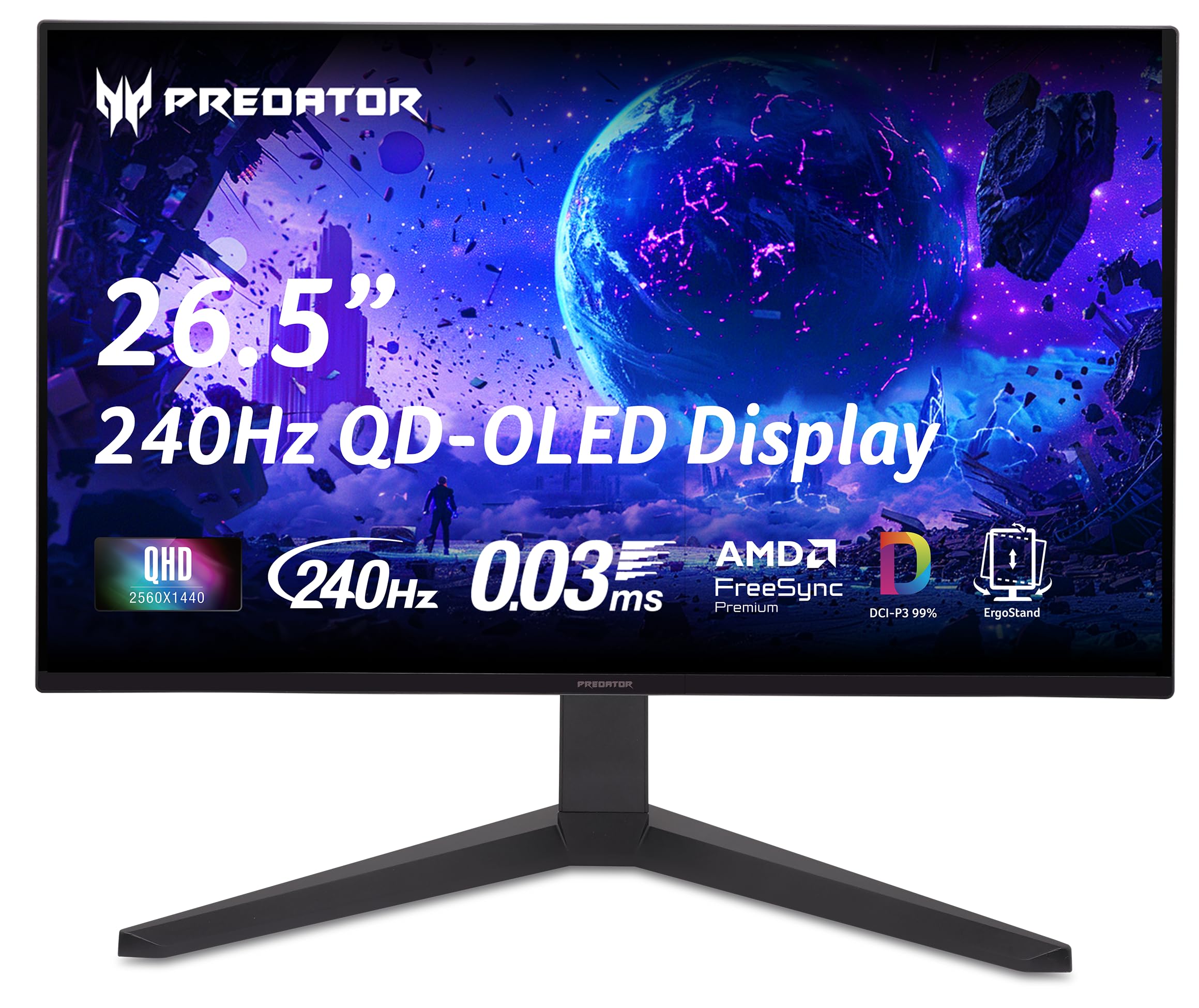
The Acer Predator X27U brings QD-OLED technology at an entry-level price point without cutting corners on the core panel. The 26.5-inch WQHD resolution with 240Hz refresh rate and 0.03ms response time matches far more expensive models. The Quantum Dot layer delivers 99% DCI-P3 coverage with Delta E under 2, producing rich reds and vibrant greens that WOLED panels sometimes struggle to match.
The stand offers full ergonomic adjustments including height, pivot, swivel, and tilt. Connectivity includes two DisplayPort 1.4 and two HDMI 2.1 ports, giving flexibility for multi-platform setups. The ZeroFrame design minimizes bezel distraction and keeps the focus on the image.
Brightness is the main trade-off — users report it feels dimmer than higher-tier OLEDs even at 100% SDR. The plastic build quality is noticeable, and the menu system lacks sharpness and overdrive controls. For buyers prioritizing panel performance over chassis luxury, this is a compelling entry point.
Why it’s great
- QD-OLED panel with 99% DCI-P3 and Delta E<2
- Full ergonomic stand included in box
- 240Hz and 0.03ms for competitive fluidity
Good to know
- Peak brightness feels lower than premium OLEDs
- Menu lacks sharpness and overdrive settings
4. Sony INZONE M10S

The Sony INZONE M10S targets competitive gamers with a 480Hz WOLED panel and 0.03ms response time. Developed with the Fnatic esports team, it includes a Tournament Mode that switches the display to 24.5-inch mode for a smaller active area that matches standard tournament monitors. The FPS Pro and FPS Pro+ modes adjust contrast to reveal enemies in dark corners without washing out the image.
The low-profile stand measures just 4mm thin at its base, freeing desk space for mouse movement. Height, tilt, and 180-degree swivel adjustments are included alongside 100x100mm VESA compatibility. DisplayPort 2.1 input provides enough bandwidth for uncompressed 1440p at 480Hz without needing DSC.
The fan-less passive cooling system uses a custom heatsink to prevent burn-in during extended sessions. The 3-year OLED limited warranty covers burn-in directly. Some units have reported pixelation issues on day one, and the premium price puts it outside casual buyers range, but for frame-rate-focused players, the 480Hz fluidity is unmatched.
Why it’s great
- 480Hz refresh rate with DP 2.1 uncompressed bandwidth
- 24.5-inch tournament mode for esports standard sizing
- Fan-less heatsink cooling with 3-year burn-in coverage
Good to know
- High price limits to competitive-focused buyers
- Some units reported day-one pixelation issues
5. MSI MPG 271QRX

The MSI MPG 271QRX uses a next-gen QD-OLED panel with a 360Hz refresh rate and 0.03ms GtG response time, placing it as a high-frequency alternative to 240Hz standard models. The QD Premium Color certification guarantees Delta E ≤ 2 accuracy, and VESA DisplayHDR True Black 400 ensures deep blacks with bright highlight detail. The QD-OLED panel delivers wider color volume than equivalent WOLED panels, especially in red and green spectrums.
MSI OLED Care 2.0 includes pixel shift, panel refresh, and static image detection to reduce burn-in risk. The KVM function lets you control two connected devices with one keyboard and mouse, useful for mixed PC and console setups. The 48 Gbps HDMI 2.1 port supports full 4K 120Hz from consoles with VRR enabled.
The chunky base takes significant desk space, and some users report a purple tint on the QD-OLED coating under direct room light. The stand lacks height adjustment compared to competitors. For gamers with GPUs capable of pushing 360+ fps in esports titles, this panel offers an observable smoothness advantage over 240Hz models.
Why it’s great
- 360Hz QD-OLED with Delta E ≤ 2 color accuracy
- 48 Gbps HDMI 2.1 full bandwidth for consoles
- KVM function for multi-device control
Good to know
- Chunky base consumes desk space
- Stand lacks height adjustment out of the box
6. AOC Q27G4ZD

The AOC Q27G4ZD delivers QD-OLED performance at a price that undercuts most competitors. The 27-inch QHD panel runs at 240Hz with 0.03ms GtG response, matching the core specs of models costing significantly more. The color gamut covers 147.6% sRGB and 110.2% DCI-P3, making colors punchy and saturated out of the box.
HDR10 support adds richness to compatible content, and G-Sync compatibility ensures tear-free gameplay. The 3-year Zero-Bright-Dot warranty provides peace of mind specific to OLED defect coverage. Connectivity includes two HDMI 2.0 ports and two DisplayPort inputs, though HDMI 2.1 is absent for console users wanting full 4K 120Hz.
The stand lacks height, tilt, and swivel adjustments — you will want a VESA arm for proper positioning. Some users report text clarity issues with rainbow chromatic aberration around pixel edges, a known QD-OLED trade-off. For pure gaming value with minimal ergonomic demands, this monitor is hard to beat.
Why it’s great
- QD-OLED 240Hz 0.03ms at entry-level pricing
- 3-year Zero-Bright-Dot warranty included
- 147.6% sRGB color gamut for vivid saturation
Good to know
- Stand has no ergonomic adjustments
- Text shows rainbow chromatic aberration on some units
7. GIGABYTE MO27Q28G
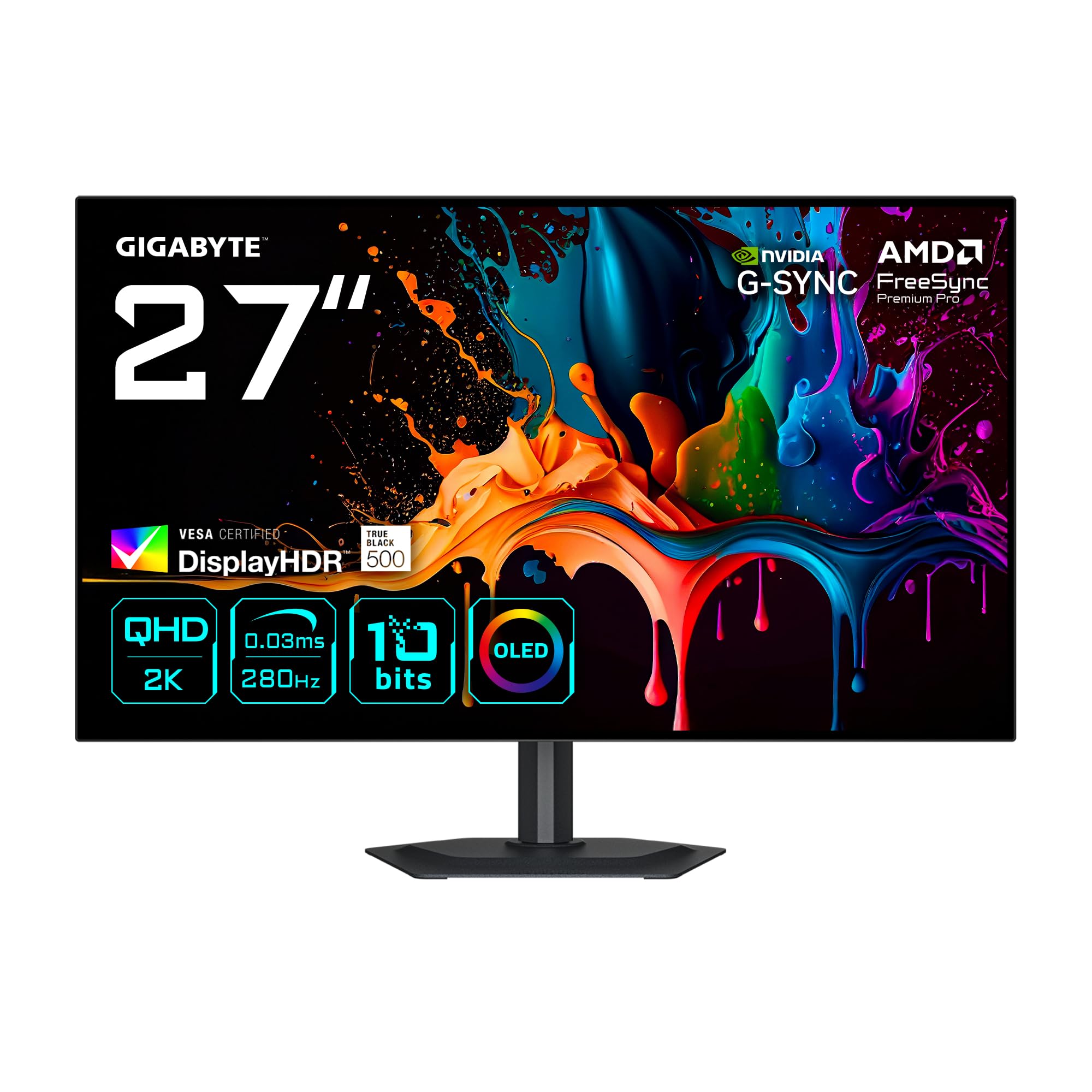
The GIGABYTE MO27Q28G uses a 27-inch WOLED panel with 280Hz refresh rate and VESA DisplayHDR True Black 500 certification — a step above the True Black 400 standard found on many competitors. The 99.5% DCI-P3 coverage and 84% BT 2020 color space make it suitable for HDR content creation alongside gaming. The 0.03ms response time matches the fastest OLED panels available.
Multi-platform KVM control lets you switch between two connected systems with a single keyboard and mouse. The borderless four-side design looks clean on a desk. Ergonomic adjustments include altitude, tilt, swivel, and rotation settings. Built-in speakers remove the need for external desktop speakers in basic setups.
The True Black 500 certification translates to higher sustained brightness across larger screen areas compared to True Black 400 panels. Some users report needing firmware updates to fix initial color accuracy, and the price point sits at the premium end of the spectrum. The 1500:1 contrast ratio listed is low for OLED — this likely refers to a different measurement method than the typical 1.5M:1 dynamic contrast.
Why it’s great
- VESA DisplayHDR True Black 500 for higher sustained brightness
- 280Hz refresh rate with 99.5% DCI-P3
- Built-in speakers and KVM functionality
Good to know
- Premium price limits accessibility
- Firmware update may be needed for optimal color
8. Samsung Odyssey OLED G5

The Samsung Odyssey OLED G5 brings QD-OLED visuals at a 180Hz refresh rate and 0.03ms response time, offering a lower-cost entry to OLED gaming. The Glare Free technology reduces reflections effectively, making it usable in brighter rooms without sacrificing black levels. Pantone Validation ensures accurate reproduction of over 2100 colors for creative work.
OLED Safeguard uses a Thermal Modulation System to actively cool the panel and prevent burn-in. Auto Source Switch+ seamlessly switches between connected devices without manual input. The 1,000,000:1 contrast ratio delivers the deep blacks expected from OLED technology.
The 180Hz refresh rate sits below the 240Hz standard for competitive gaming, and the non-adjustable stand limits ergonomic flexibility. There are no built-in speakers, and peak brightness is lower than premium OLED panels at around 280 cd/m². For media consumption and casual gaming, this is a solid value entry point into QD-OLED.
Why it’s great
- QD-OLED with Glare Free coating for bright rooms
- Pantone Validated color accuracy for creative work
- Thermal Modulation System reduces burn-in risk
Good to know
- 180Hz refresh rate lower than 240Hz competitors
- No built-in speakers and non-adjustable stand
FAQ
What is the difference between QD-OLED and WOLED for a 27-inch monitor?
Will a 240Hz OLED monitor feel smoother than a 165Hz IPS monitor?
Is burn-in still a real risk on modern 27-inch OLED monitors?
Do 27-inch OLED monitors work well for productivity and text work?
Final Thoughts: The Verdict
For most users, the best 27 inch oled monitor winner is the LG 27GX704A-B because it balances glossy WOLED image quality, 240Hz fluidity, full ergonomic adjustments, and dual HDMI 2.1 connectivity at a mid-range price. If you want the highest possible refresh rate for competitive play, grab the Sony INZONE M10S for its 480Hz panel and tournament-ready features. And for pure value without sacrificing OLED performance, nothing beats the Acer Predator X27U.