
A printer that jams on the first multi-page job, drops its Wi-Fi connection mid-scan, or guzzles a fifty-dollar cartridge in a single afternoon is the fastest way to kill productivity at a home office. The real measure of an all-in-one inkjet isn’t the marketing claims on the box — it’s whether the automatic document feeder actually feeds, whether duplex printing arrives on the correct side of the page, and whether the ink lasts long enough that you forget the last time you replaced it.
I’m Min — the co-founder and writer behind Gadgets Feed. I’ve spent hundreds of hours cross-referencing spec sheets, digging through verified buyer reports, and comparing page yields, connectivity protocols, and real-world failure rates to separate the genuinely capable machines from those that look good only on paper.
After methodically sorting through speed benchmarks, ink costs, and build quality across multiple price tiers, this guide distills the research into a clear verdict for the best all-in-one wireless inkjet printer for various home and small office needs.
How To Choose The Best All-In-One Wireless Inkjet Printer
Selecting the right unit means looking past the brand name and digging into three specific areas: how much each page costs to print, whether the connectivity holds up under daily use, and which paper handling features actually save you from manual intervention.
Page Yield and Ink Economics
The initial purchase price is a fraction of the total cost of ownership. A budget-friendly printer that ships with “starter” cartridges containing minimal ink will demand a full replacement set within weeks. Premium supertank models include enough fluid for thousands of pages, dropping the per-page cost dramatically for anyone printing more than a few dozen sheets a month.
Automatic Duplex and Document Feeder
Automatic two-sided printing is non-negotiable for anyone who wants to save paper and avoid flipping stacks by hand. An automatic document feeder (ADF) lifts scanning and copying from a single-page chore to a proper multi-page workflow. Models without an ADF force you to place each page on the scanner glass one at a time, which becomes tedious with any document longer than a few sheets.
Connectivity Reliability
Wireless dropouts are the most common complaint across all reviews. Look for dual-band Wi-Fi (supporting both 2.4GHz and 5GHz bands) to reduce interference. An Ethernet port offers the most stable connection for stationary desk setups, while mobile printing support through AirPrint, Mopria, or the manufacturer’s own app determines how easily you can print from a phone without a computer involved.
Quick Comparison
On smaller screens, swipe sideways to see the full table.
| Model | Category | Best For | Key Spec | Amazon |
|---|---|---|---|---|
| Epson EcoTank ET-2980 | Supertank | High-volume, low-cost ink | 6,600 pages black per ink set | Amazon |
| HP OfficeJet Pro 8125 | Office Pro | Professional color documents | 20 ppm black print speed | Amazon |
| HP Envy Photo 7975 | Photo Home | Borderless photo printing | Separate photo tray included | Amazon |
| Brother MFC-J1410DW | Work Smart | Low ink cost per page | 16 ppm black / 9 ppm color | Amazon |
| Canon PIXMA TR7120 | Budget Duplex | Compact with auto 2-sided | 14 ppm black / 9 ppm color | Amazon |
| Canon PIXMA TS7720 | Entry Home | Compact with touchscreen | 15 ppm black / 10 ppm color | Amazon |
| Epson WorkForce WF-2960 | Home Office | Fax and ADF in compact size | 14 ppm black / 7.5 ppm color | Amazon |
In‑Depth Reviews
1. Epson EcoTank ET-2980
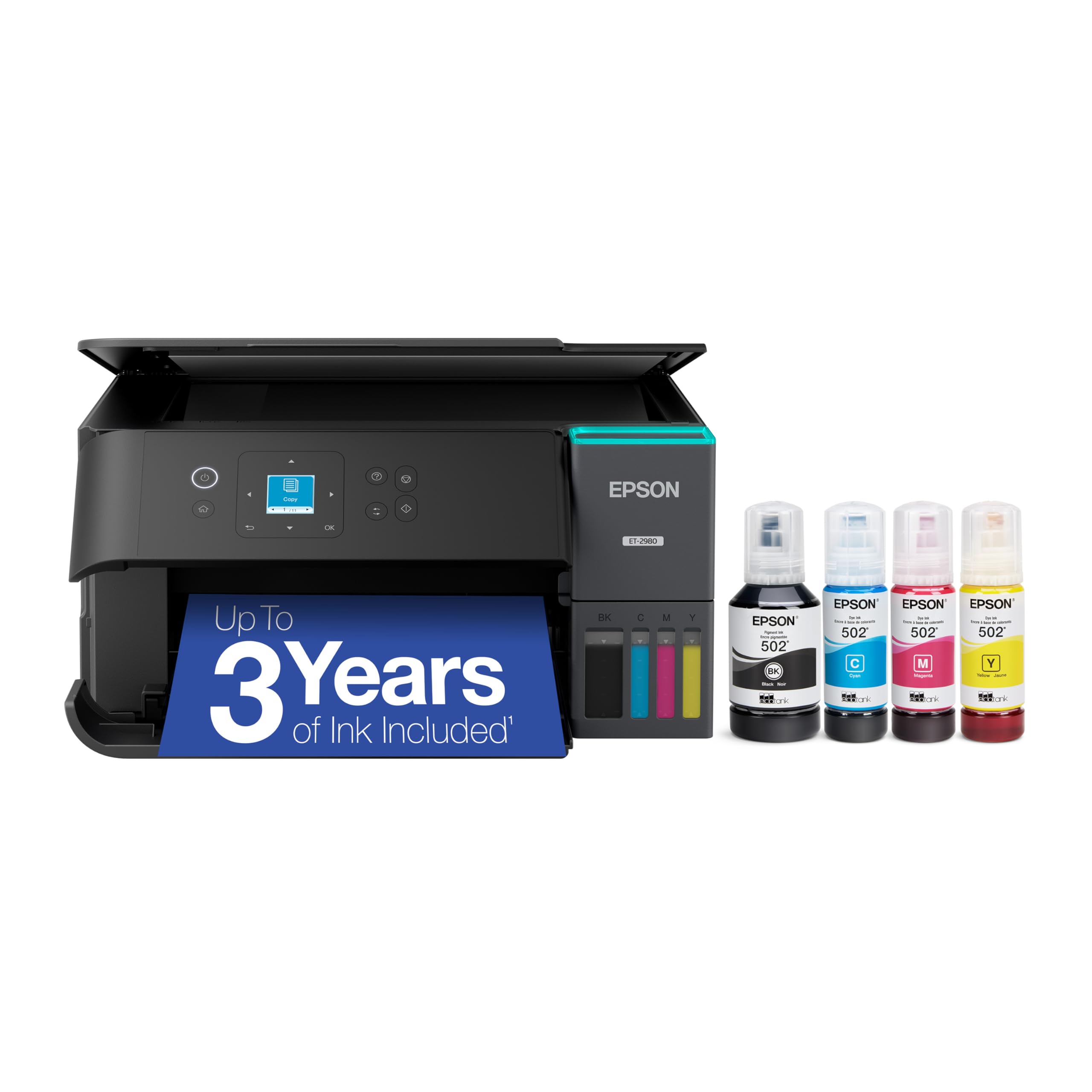
The Epson EcoTank ET-2980 fundamentally changes the inkjet economics by including refillable ink tanks that ship with enough fluid for up to 6,600 black pages and 5,500 color pages. That volume effectively removes the “starter cartridge” trap — the bottles included in the box can last the average home office user several years before a single replacement set is needed. The 15 ppm black print speed and 8 ppm color pace fit comfortably within a moderate-volume workflow without forcing you to wait.
Automatic duplex printing is standard, and the 2.4-inch color touchscreen provides straightforward navigation for copy and scan tasks. The EcoFit bottle design uses a keyed nozzle that only fits the correct color tank, eliminating the spill risk that plagued older refill systems. Wireless connectivity supports mobile printing through the Epson Smart Panel app, and multiple reviewers confirm stable Wi-Fi retention after the initial setup, with no dropouts during scanning or multi-page document jobs.
The trade-off is the lack of an automatic document feeder, which means scanning multi-page documents requires lifting the lid for each sheet. The LCD screen is on the smaller side with a narrow viewing angle, and some users report that the duplex printing algorithm occasionally misroutes pages when handling heavier stock paper.
Why it’s great
- Includes 3 years of ink in the box for 6,600+ pages
- No-mess bottle refill system with keyed nozzles
- Automatic duplex printing saves paper
Good to know
- No automatic document feeder for multi-page scanning
- Small LCD with narrow viewing angle
- Initial setup can be time-consuming on Windows
2. HP OfficeJet Pro 8125
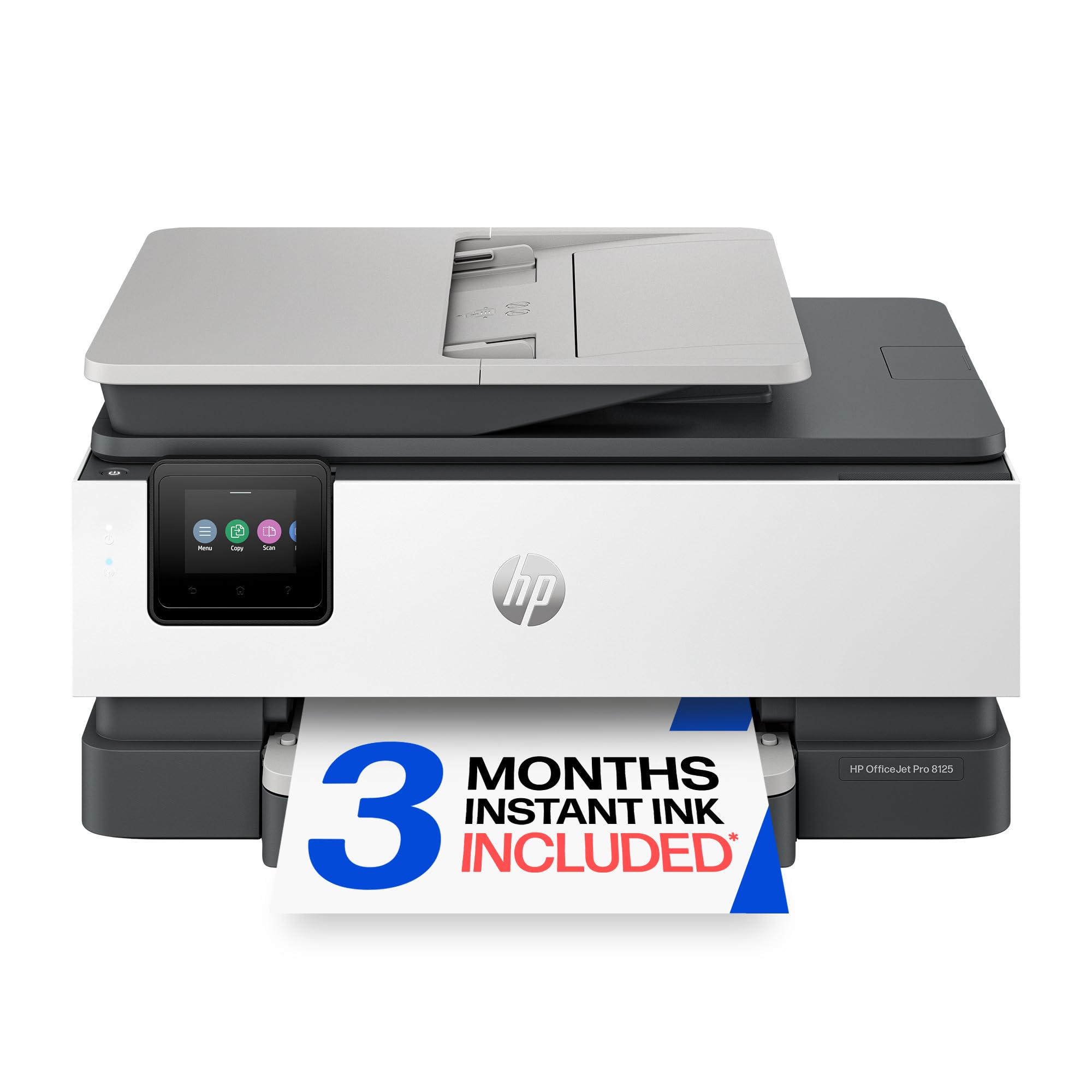
The HP OfficeJet Pro 8125 is built around PrecisionCore-derived printhead technology that delivers 20 ppm black and 10 ppm color speeds, placing it at the faster end of the mid-range office segment. The 225-sheet input tray and automatic document feeder handle larger jobs without constant reloading, and the 2.7-inch color touchscreen with a phone-like interface makes menu navigation responsive. The 18-second first-page-out time means you are not left staring at a blank screen while the printer warms up.
Dual-band Wi-Fi with automatic connection troubleshooting reduces the chance of wireless dropouts, and the inclusion of both Ethernet and USB 2.0 gives installation flexibility for wired or wireless networks. The HP Instant Ink trial is built into the purchase, allowing three months of ink delivery before any subscription fee applies — a useful buffer for evaluating whether the per-page cost fits your volume. HP’s AI-powered formatting tool strips unnecessary blank pages from web print jobs, a surprisingly helpful feature when printing directions or online articles.
The mandatory use of cartridges with original HP chips means third-party refills are blocked, locking users into HP’s ink ecosystem. Some buyers note that the build quality feels lighter than previous OfficeJet Pro generations, with more plastic flex in the paper tray assembly. The 8125 is a strong choice for home offices that prioritize speed and professional-grade color output and are willing to commit to a branded ink subscription for long-term cost management.
Why it’s great
- Fast 20 ppm black and 10 ppm color print speeds
- Dual-band Wi-Fi with automatic connection fixes
- 3-month Instant Ink trial included
Good to know
- Blocks non-HP cartridges via chip checks
- Build quality feels lighter than previous models
- Setup software on PC had occasional connection hiccups
3. HP Envy Photo 7975
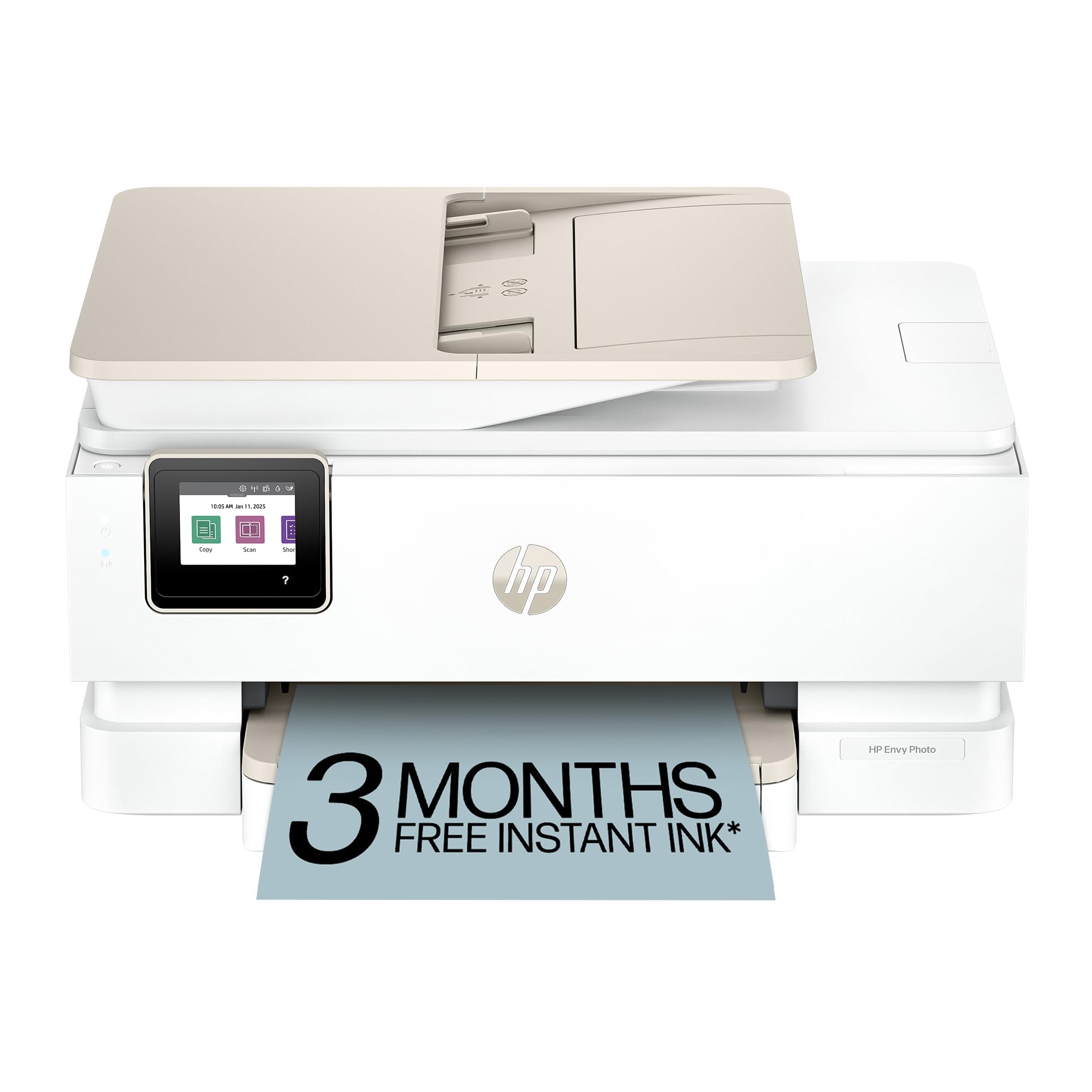
The HP Envy Photo 7975 targets the home user who wants a single machine equally capable of printing school handouts and borderless 5×7 glossy photos. A separate photo tray means you can keep plain paper in the main cassette and glossy media loaded without swapping trays mid-project. Print speeds measure 15 ppm black and 10 ppm color, which is adequate for a mixed-use home environment. The AI-powered print optimizer automatically removes unwanted ads and blank pages from web content before sending it to the paper tray.
Setup through the HP Smart App is fast — multiple reviews confirm a sub-10-minute process from unboxing to first print — and the dual-band Wi-Fi holds a stable connection throughout scanning and photo jobs. Automatic duplex printing is standard, and the automatic document feeder supports multi-page scanning without manual intervention. The 2.7-inch touchscreen uses an icon-based layout that is straightforward for navigating copy settings and ink levels. The Instant Ink trial allows you to test the subscription model without immediate commitment.
Reliability reports are split: a significant minority of buyers report the printer developing a persistent “out of paper” false error within the first month, or experiencing paper jams on roughly 75 percent of duplex jobs. The “Quiet Mode” cannot be disabled, which some users find frustratingly slow — page output can stretch to 60 seconds per sheet in this mode. The Envy Photo 7975 delivers strong photo quality and easy setup when it works correctly, but the failure rate in early ownership means it carries more risk than the more consistent EcoTank or OfficeJet Pro alternatives.
Why it’s great
- Separate photo tray for glossy media
- Quick setup via HP Smart App under 10 minutes
- AI removes blank pages from web print jobs
Good to know
- Quiet mode cannot be disabled, slowing output
- Some units develop paper jam issues within weeks
- Expensive genuine cartridges for ongoing use
4. Brother MFC-J1410DW
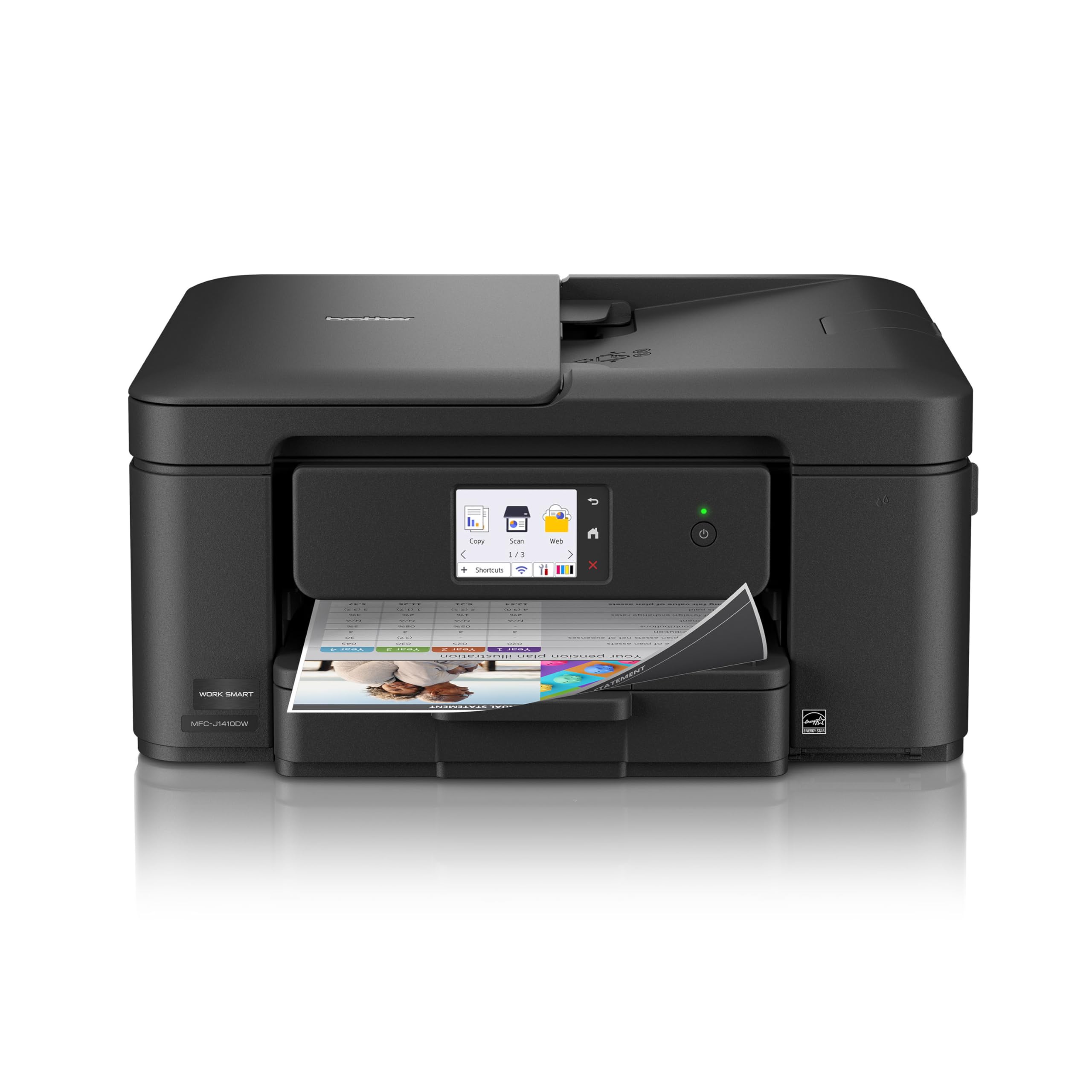
The Brother MFC-J1410DW strikes a compelling balance between low purchase price and economical long-term operation. With print speeds of 16 ppm black and 9 ppm color, it keeps pace with more expensive competitors while offering a 20-sheet automatic document feeder for scanning and copying multi-page documents. The 150-sheet input tray is standard for this price tier, and automatic duplex printing is included. The 2.7-inch color touchscreen provides cloud app integration for direct printing from Google Drive, Dropbox, and OneDrive without needing a computer.
Brother’s LC501 ink cartridges are significantly cheaper than the proprietary cartridges used by HP and Epson in the same class, and the startup cartridges included in the box last through hundreds of pages before replacement is needed — multiple users report getting six months or more out of the initial set under moderate use. The Brother Mobile Connect app gives full control over scanning, copying, and ink monitoring from a smartphone. The compact footprint fits easily on a small desk or shelf.
Setup involves a few extra steps compared to a plug-and-play printer, and the unit is noticeably louder during printing than its competitors, producing a mechanical hum that might be distracting in a quiet home office. Some isolated reports mention paper jams and reliability issues after several weeks of use, though the majority of long-term reviews indicate dependable performance. For users who want a low running cost and a proper ADF without spending premium money, the MFC-J1410DW is a rational, budget-conscious pick.
Why it’s great
- Low-cost LC501 cartridges reduce per-page expense
- 20-sheet ADF for unattended scanning and copying
- Cloud app integration via touchscreen
Good to know
- Noisier during operation than comparable models
- Setup takes longer than plug-and-play competitors
- Occasional reliability complaints after initial weeks
5. Canon PIXMA TR7120

The Canon PIXMA TR7120 brings automatic duplex printing and a 1.42-inch monochrome OLED display to a compact chassis designed for small desks and shared workspaces. Print speeds of 14 ppm black and 9 ppm color are competitive within its price segment, and the 2-cartridge hybrid ink system — one black pigment cartridge and one tri-color cartridge — delivers crisp text alongside acceptable color graphics. The single-color cartridge approach simplifies replacement but means the entire color system must be swapped when one channel runs dry.
Dual-band Wi-Fi supports both 2.4GHz and 5GHz bands, providing a more stable connection than single-band alternatives and eliminating the dropout issues that plague some budget printers. The unit includes a 20-sheet automatic document feeder, which is a welcome addition at this price point for scanning multi-page contracts or school worksheets. Mobile printing is handled through the Canon PRINT App, Apple AirPrint, and Mopria, giving phone and tablet users multiple paths to send a job. The compact design means the paper tray holds around 50 to 100 sheets depending on media type.
The starter ink cartridges included in the box run out noticeably faster than standard-capacity replacements — several users report exhaustion after roughly 500 pages, which is typical for starter packs across all brands but still worth factoring into a purchase decision. Replacement cartridges are expensive relative to the printer’s low entry cost, and compatible third-party options are limited due to Canon’s ink authentication checks. The TR7120 is a capable, space-saving choice for light home use or a hybrid worker who prints occasionally and values duplex capability and a physical display for monitoring ink levels.
Why it’s great
- Auto duplex printing in a compact footprint
- Dual-band Wi-Fi reduces connection dropouts
- ADF included for multi-page scanning
Good to know
- Single tri-color cartridge wastes unused ink when one color empties
- Starter ink runs out quickly
- Replacement cartridges are expensive
6. Canon PIXMA TS7720

The Canon PIXMA TS7720 is the most affordable entry in this roundup, designed for households that need print, copy, and scan capability without spending on features they won’t use. The 2.7-inch LCD touchscreen provides intuitive navigation for selecting media types and checking ink levels, and the 15 ppm black and 10 ppm color speeds are respectable for a machine at this tier. The two-cartridge system — one black and one color — keeps the number of spare cartridges needed to a minimum, which matters in a home that doesn’t want to manage a full CMYK set.
Automatic duplex printing is included, and the compact white body fits easily on a shelf or corner desk. Print quality for text is crisp at standard resolution, and borderless photo prints up to 8×10 inches produce colors that are vivid enough for family albums and school projects. The Canon PRINT app handles wireless setup and day-to-day mobile printing, though initial Wi-Fi pairing sometimes requires a manual read of the included guide rather than the promised fully automatic connection. The default power-saving mode shuts the printer off after four hours of inactivity, which can be adjusted in settings to avoid the manual wake-up.
The absence of an automatic document feeder means scanning a multi-page document requires lifting the lid and repositioning each sheet individually — a significant workflow bottleneck for anything beyond a single page. Some users report that starter cartridges run out rapidly under moderate use, sometimes within three days of heavy photo printing. The TS7720 is a sensible pick for the home user whose print volume stays low and who does not need ADF, but the hidden ink cost and lack of feeder limit its usefulness as a primary office machine.
Why it’s great
- Low entry price with touchscreen navigation
- Automatic duplex printing at this tier
- Compact design fits tight spaces
Good to know
- No automatic document feeder for scanning
- Starter ink cartridges run out quickly
- Default 4-hour auto-off requires manual adjustment
7. Epson WorkForce WF-2960
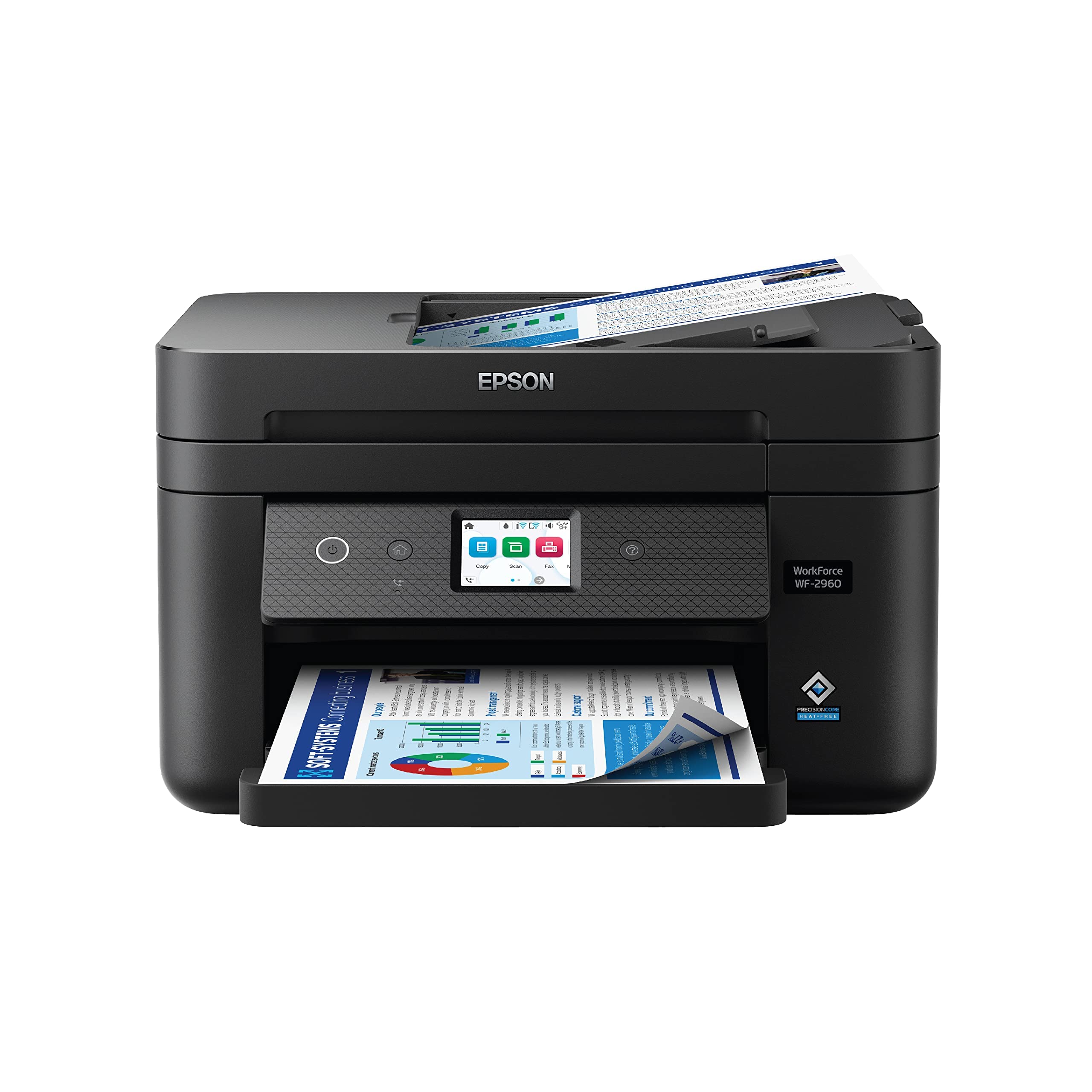
The Epson WorkForce WF-2960 packs fax capability, a 2.4-inch color touchscreen, and an automatic document feeder into a chassis that costs less than many basic home printers. Print speeds are rated at 14 ppm black and 7.5 ppm color, which is on the slower side but still functional for a home office that does not demand high-volume throughput. The 150-sheet paper tray handles standard letter-sized paper without requiring constant refilling, and automatic duplex printing is standard for paper-saving two-sided documents.
Connectivity options are comprehensive for the price point: dual-band Wi-Fi, Ethernet, and USB 2.0 are all available, giving you the flexibility to hardwire the printer for the most stable connection possible. Epson’s PrecisionCore printhead technology is designed to last the life of the printer, and the heat-free inkjet mechanism reduces energy consumption compared to thermal inkjet alternatives. Voice-activated printing through Alexa and Siri is supported, which is a niche but occasionally useful feature for hands-free reprints of common documents.
Ink consumption is the WF-2960’s Achilles’ heel. Multiple verified reports indicate that the printer uses color ink even when printing black-and-white documents, rapidly depleting the tri-color cartridges and driving up per-page costs. The included startup cartridges are low-yield, with some users reporting exhaustion within three weeks of typical home use. The lack of a USB port for direct flash drive printing and the absence of WIA scan support on some operating systems create compatibility hurdles. The WF-2960 offers useful office features at a low buy-in, but the aggressive ink usage makes it best suited for light, infrequent printing where cartridge consumption is less of a financial burden.
Why it’s great
- Fax, Ethernet, and ADF at budget pricing
- PrecisionCore printhead built to last the printer’s life
- Voice-activated printing via Alexa and Siri
Good to know
- Uses color ink during black-only print jobs
- Starter cartridges deplete within weeks
- No USB port or WIA scan support
FAQ
How often should I expect to replace ink in a standard all-in-one inkjet printer?
Can I use third-party ink cartridges in my all-in-one printer?
What is the difference between a standard inkjet and a supertank printer?
Final Thoughts: The Verdict
For most users, the best all-in-one wireless inkjet printer winner is the Epson EcoTank ET-2980 because it eliminates the recurring cartridge cost burden by including years of ink in the box, delivering the lowest per-page cost of any unit in this guide. If you need faster print speeds and professional color output for client-facing documents, grab the HP OfficeJet Pro 8125. And for budget-conscious buyers who want an automatic document feeder without sacrificing too much on running costs, nothing beats the Brother MFC-J1410DW.