
Connecting a modern soundbar to a vintage amplifier, or an old gaming console to a new TV without an AV jack, usually ends in frustration. The missing link is always the same: a dedicated signal translator that handles the handshake between incompatible audio formats and connector types.
I’m Min — the co-founder and writer behind Gadgets Feed. My buying guides are built on hours of cross-referencing technical documents, parsing real user feedback, and comparing measurable specs like sampling rates, channel support, and output impedance across dozens of models.
Whether you need to extract ARC audio from a TV or convert RCA from a turntable into a USB stream, this breakdown of the best audio input converter options will match the right hardware to your specific signal path.
How To Choose The Best Audio Input Converter
The right converter depends entirely on what you are connecting and the signal format you need. A DAC (digital-to-analog converter) handles optical or coaxial input and outputs analog RCA or 3.5mm. An ARC extractor pulls audio from an HDMI ARC/eARC port and converts it to optical, coaxial, or analog. An RF modulator takes composite RCA video and audio and encodes it onto a coaxial RF channel for older TVs. A USB capture device digitizes analog audio from RCA or 3.5mm and sends it to a computer as a WAV or MP3 file.
Identify Your Source and Destination Ports
Check the output ports on your source device — is it HDMI ARC, optical Toslink, coaxial SPDIF, or composite RCA? Then check the input ports on your destination. If your source has optical out and your amplifier only has RCA in, you need a DAC with 192KHz sampling to preserve detail. If your source has HDMI ARC and your soundbar only takes optical, you need an ARC audio extractor. Mismatching port types is the single most common mistake.
Sampling Rate and Audio Format Support
For digital-to-analog conversion, a 192KHz / 24-bit DAC delivers noticeably cleaner high-frequency extension and lower noise floor compared to a 48KHz unit. If you plan to pass Dolby 5.1 or DTS, verify the converter explicitly supports those codecs — many budget DACs downmix multichannel to stereo PCM 2.0. For RF modulators, NTSC format is mandatory for North American TV sets. For USB capture devices, check that the recorded bitrate (128Kbps MP3 vs uncompressed WAV) matches your archival needs.
Power and Physical Compatibility
Most compact converters are powered via USB (5V, 1A minimum), but some analog-output devices require a dedicated AC adapter. Verify the cable length and orientation of ports — a short, rigid coaxial cable may not reach a recessed TV port. The build material (metal vs plastic) affects heat dissipation and long-term durability, especially for units that run continuously in a rack setup.
Quick Comparison
On smaller screens, swipe sideways to see the full table.
| Model | Category | Best For | Key Spec | Amazon |
|---|---|---|---|---|
| ClearClick Audio to USB 2.0 | USB Capture | Digitizing vinyl & cassette to PC | USB-C Plug & Play | Amazon |
| OREI HDMI ARC/eARC DA25 | ARC Extractor | TV ARC to analog speaker | 192KHz / 24-bit DAC | Amazon |
| YAODEMA HDMI eARC/ARC Extractor | ARC/Optical | TV to soundbar or home theater | Dolby 5.1 & DTS 5.1 | Amazon |
| PROZOR 192Khz DAC | Digital to Analog | Optical/Coaxial to RCA | 192KHz / 24-bit | Amazon |
| SatelliteSale RF Modulator | RF Modulator | Retro consoles to coax TV | NTSC, Channel 3/4 | Amazon |
| HopCentury Music Digitizer | Standalone Recorder | No-PC cassette digitizing | 128Kbps MP3 to USB | Amazon |
| AoeSpy RF Coaxial Modulator | RF Modulator | Budget retro setup | Channel 3/4 switch | Amazon |
In‑Depth Reviews
1. ClearClick Audio to USB 2.0

The ClearClick Audio to USB 2.0 is a modern USB-C capture device that digitizes analog audio from 3.5mm or RCA sources at up to 48KHz sample rate. It ships with recording software for Windows, Mac, and Linux and saves directly as WAV or MP3 files. The supplied USB-A adapter ensures backward compatibility with older laptop ports.
Users pairing it with the ClearClick video2usb for VHS Hi-Fi stereo capture report consistent sync and clean signal transfer when routed through OBS Studio. The device handles line-level input from turntables with RCA splitters without introducing audible hum, and sampling vinyl into Ableton Live for beat production works at under thirty dollars — versus a five-hundred-dollar USB turntable.
Some users experienced dropouts or distortion, typically linked to underpowered USB ports or the complexity of the bundled editing software. The unit is most stable when connected to a USB 3.0 port on a desktop or high-power laptop. It is not compatible with phones, tablets, or Chromebooks due to driver limitations.
Why it’s great
- True USB-C plug-and-play with cross-platform driver support
- Simultaneous RCA and 3.5mm input for flexible source switching
Good to know
- Not compatible with phones, tablets, or mobile devices
- Some users report dropouts on low-power USB ports
2. OREI HDMI eARC & ARC Audio Extractor DA25
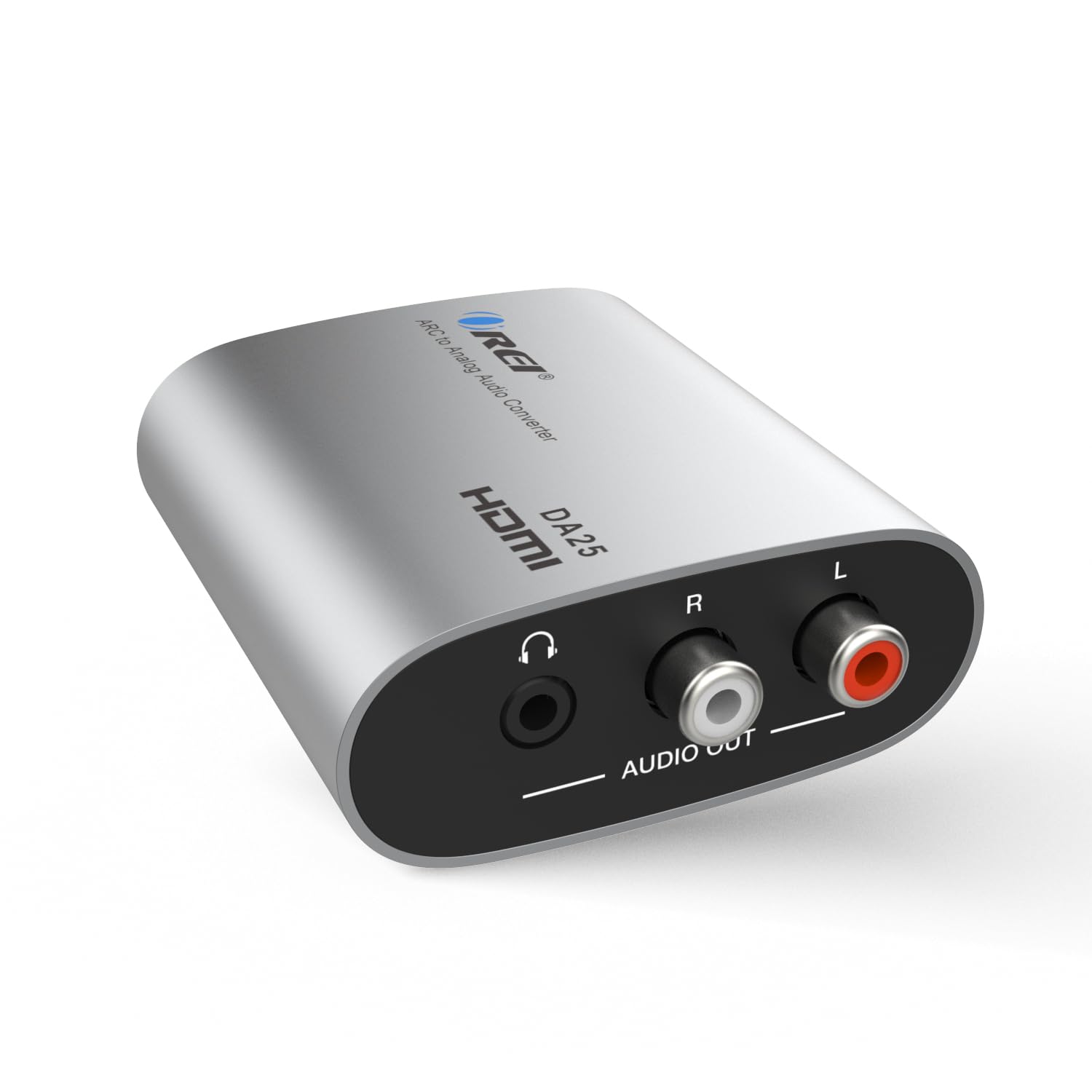
The OREI DA25 takes HDMI ARC/eARC digital audio from your TV and converts it to simultaneous RCA L/R and 3.5mm analog outputs. Its internal DAC supports PCM 2.0 up to 192KHz / 24-bit, which yields clean stereo separation and low noise for connecting powered speakers, headphones, or an older receiver.
Users running an Apple TV through an Integra AVR used the OREI to feed analog Zone 2 audio across the house without compromising 5.1 surround in the main zone. The compact aluminum housing dissipates heat well during extended sessions, and the on/off switch with LED indicator provides clear power status. Setup requires no drivers — just plug the HDMI cable into the TV’s ARC port and power via USB.
Critically, this unit does not support Dolby Digital, DTS, or any multichannel format — it outputs stereo only. Some users noted a design where a power interruption requires manually unplugging the DC cable to reset the unit. CEC volume control is also absent, so volume must be managed on the amplifier or speaker.
Why it’s great
- 192KHz / 24-bit DAC for high-resolution stereo audio
- Simultaneous RCA and 3.5mm output for multiple destinations
Good to know
- No Dolby or DTS support — stereo only
- May require manual DC reset after power loss
3. YAODEMA HDMI eARC/ARC Audio Extractor
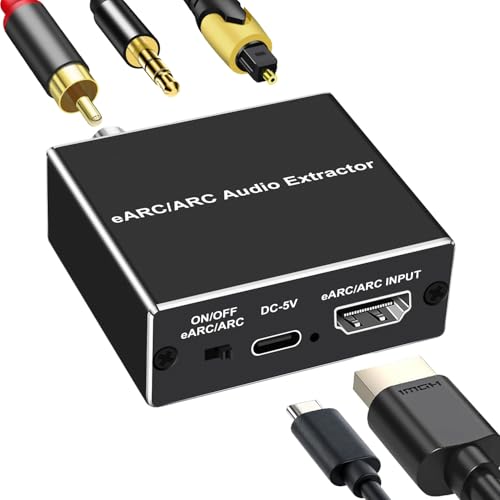
The YAODEMA is a full-featured ARC/eARC audio extractor that outputs to optical (Toslink), coaxial, and 3.5mm simultaneously. Unlike stereo-only extractors, this unit passes Dolby 5.1 and DTS 5.1 from the TV’s ARC port, preserving multichannel audio for a soundbar or home theater receiver. The DAC handles up to 24-bit / 192KHz for high-resolution stereo sources.
Users report seamless pairing with Sonos Ray and older Bose speakers that lack HDMI inputs — the optical output connects directly, solving the missing-port problem. The unit requires the TV’s ARC function to be enabled via the remote, and it must be powered via the included USB cable (a 5V adapter is needed separately). The plug-and-play design works immediately once the HDMI handshake is established.
Optical and coaxial outputs do not support CEC, so TV remote volume control will not work — you must adjust volume at the soundbar or receiver. Also, if your TV does not support ARC/eARC, this unit will not work, as it requires that specific HDMI port. The compact chassis is lightweight plastic but well-ventilated.
Why it’s great
- Supports Dolby 5.1 and DTS 5.1 passthrough
- Three simultaneous outputs: optical, coaxial, 3.5mm
Good to know
- No CEC volume control on optical/coaxial outputs
- TV must support ARC/eARC and have the feature enabled
4. PROZOR 192Khz Digital to Analog Audio Converter
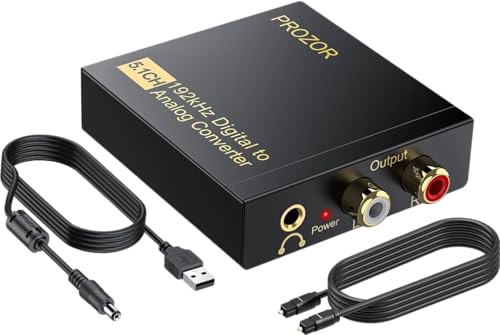
The PROZOR DAC accepts both optical Toslink and coaxial digital inputs and converts them to analog RCA L/R plus 3.5mm output. Its 192KHz / 24-bit sampling rate ensures high-fidelity audio reproduction, and the magnetic ring on the power cord reduces electrical noise for a cleaner signal path. The metal chassis adds durability for permanent rack installation.
Users commonly connect a modern TV’s optical output to this DAC to feed an older analog receiver that only has RCA inputs — solving the format mismatch without buying a new amplifier. The unit also works as a headphone output via the 3.5mm jack, and the rear switch toggles between optical and coaxial input. Included in the box are an optical cable, USB power cable, and the converter itself.
It downmixes Dolby 5.1 and DTS to PCM 2.0, so you lose surround channels if your source is multichannel. The optical input does not support ARC or eARC, so it cannot extract audio from an HDMI ARC port — it requires a direct optical output from the source. Some users noted the power adapter is not included and must be a 5V / 1A USB charger.
Why it’s great
- 192KHz / 24-bit DAC for analog output clarity
- Magnetic ring power cord minimizes electrical interference
Good to know
- Downmixes Dolby/DTS to PCM 2.0 stereo
- No HDMI ARC support — needs direct optical or coax input
5. SatelliteSale RF Modulator RCA to Coaxial

The SatelliteSale RF Modulator converts composite RCA video and stereo audio into a single coaxial RF output on NTSC channels 3 or 4. It is built with a high-quality PVC-molded casing and metal connectors that resist corrosion, and it ships with both RCA and coaxial cables plus a power supply. The lifetime warranty sets it apart from cheaper alternatives.
Users connect this between a Dish Hopper 3 and three TVs — the modulator re-encodes the RCA signal onto an RF channel that any coax-equipped TV can tune. It also works flawlessly for retro gaming consoles like NES and SNES feeding a CRT, and for sending DVD player output to a second-floor TV via existing coaxial wiring. The plug-and-play design requires no configuration beyond setting the channel switch.
The unit outputs mono audio only, which is fine for older TVs and CCTV systems but not ideal for stereo home theater setups. Some users noted the aux port can bend under repeated use, so gentle handling is recommended. The 3-foot coaxial cable included is sufficient for most shelf-to-TV distances.
Why it’s great
- Molded PVC casing and corrosion-resistant metal connectors
- Lifetime warranty backing a premium RF build
Good to know
- Output is mono audio only
- Aux port can bend under heavy repeated use
6. HopCentury Music Digitizer CD Recorder
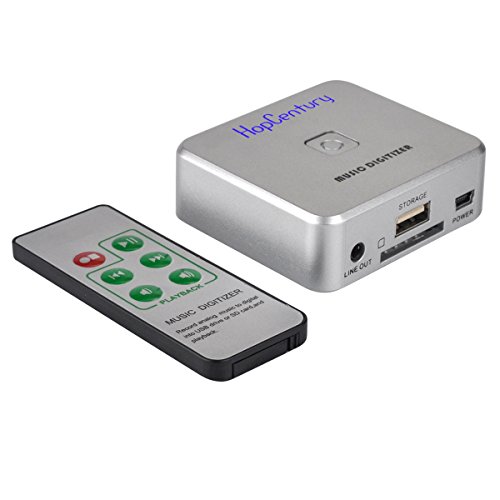
The HopCentury Music Digitizer is a standalone audio recorder that captures any 3.5mm or RCA line-level signal and saves it as 128Kbps / 44.1KHz MP3 files directly to a USB flash drive or SD card (FAT32, max 32GB). No computer is required. It includes an infrared remote control for start/stop recording, playback, and volume adjustment.
Users digitize cassette tapes, vinyl records, and CD players by connecting the audio output of the source to the HopCentury and pressing record. The unit auto-saves the file if power is interrupted, losing only about two seconds of audio. The recorded files are standard MP3 format that can be transferred to any device or edited with computer software.
Some users report the recorded audio sounds slightly hollow or mono despite the stereo input — this is due to the device recording in dual-mono rather than true stereo. The line-level input can be too quiet; using the headphone output of the source at 70% volume usually resolves this. It is not a high-fidelity recorder and is best suited for archival of voice or music where convenience matters more than audiophile quality.
Why it’s great
- Fully standalone — no computer required for recording
- Auto-save on power loss prevents file corruption
Good to know
- Records dual-mono, not true stereo
- Line-level input may be too quiet; use headphone output at 70%
7. AoeSpy RCA RF Coaxial Modulator

The AoeSpy RF Modulator takes composite CVBS RCA input and converts it to coaxial RF output on NTSC channels 3 or 4. It is designed for retro gaming consoles (PS2, PS3, NES, Nintendo Switch), DVD players, VCRs, and CCTV cameras that need to connect to older TVs without AV jacks. The unit includes an F-type female coaxial input and a separate RF coax output for daisy-chaining to additional TVs via a splitter.
Users report it works perfectly to get a PS2 running on a modern flatscreen that only has coaxial input, and it resurrects vintage 1991 CRT televisions with NES consoles. The channel 3/4 switch prevents interference with existing local broadcast channels. The 2-year limited warranty adds peace of mind for budget-conscious buyers.
Some users noted faint ghosting (double image) on CRT screens, likely due to cable quality rather than the modulator itself. The plastic casing feels less robust than premium alternatives, and the unit lacks a built-in power switch. It is a functional entry-level RF modulator for simple setups.
Why it’s great
- NTSC channel 3/4 switch for interference-free tuning
- Includes 2-year limited warranty at an entry-level price
Good to know
- Faint ghosting may appear depending on cable quality
- Plastic casing feels less durable than metal options
FAQ
Can I use an HDMI ARC extractor with a TV that does not have HDMI ARC?
Does an RF modulator reduce video quality compared to composite RCA?
Final Thoughts: The Verdict
For most users, the best audio input converter winner is the YAODEMA HDMI eARC/ARC Audio Extractor because it bridges almost any modern TV to a soundbar or receiver while supporting Dolby 5.1 and DTS 5.1. If you want a high-resolution stereo DAC for optical sources, grab the PROZOR 192Khz DAC. And for digitizing analog audio to a computer without expensive hardware, nothing beats the ClearClick Audio to USB 2.0.