
Finding a first ride-on toy that builds core stability without scaring a toddler is the central challenge parents face at this stage. A standard tricycle or a pedal bike with training wheels often forces the child to master coordination that their developing muscles and brain are not yet ready for, leading to frustration or outright refusal. A well-designed balance bike sidesteps that entire problem by letting the child focus on the single most important skill: balancing while moving.
I’m Min — the co-founder and writer behind Gadgets Feed. I’ve spent countless hours analyzing the geometry, materials, and adjustability ranges of over two dozen toddler balance bikes to separate the genuinely well-engineered options from the wobbly, poorly proportioned alternatives that can hinder a child’s progress.
The best option for your child comes down to a few concrete details that many guides ignore entirely. This guide breaks down the top contenders in the 2 year old balance bike category, focusing on seat height range, frame weight, wheel design, and the real-world durability that matters for daily use.
How To Choose The Best 2 Year Old Balance Bike
The wrong balance bike can feel clumsy, heavy, or so low-quality that the wheels bind after a few weeks of use. Narrowing down the field requires looking past the cartoon stickers and focusing on three structural elements that define whether a bike will help a toddler progress or end up leaning against the garage wall.
Seat Height Adjustment Range
A bike that is too tall forces the child to tip-toe, creating a wobbly, insecure feeling that discourages independent gliding. A bike that is too low makes efficient scooting almost impossible. The correct bike lets the child place both feet flat on the ground with a slight bend in the knee when seated. For the 2 to 3 year old window, the ideal adjustable range covers roughly 11 inches at its lowest setting up to at least 15 inches at its highest. The models with a quick-release clamp for tool-free seat adjustments offer far more practical value than those requiring a hex wrench for every change.
Frame Material and Total Weight
Weight tolerance is minimal in this category. A toddler struggles to lift or steer a 10-pound steel frame. The best balance bikes for this age group hover between 5 and 7 pounds. Aluminum frames deliver the lightest feel and resist rust, though a well-built carbon steel frame that stays under 7 pounds can still be manageable if the geometry is right. A low center of gravity matters just as much as overall weight — a bike that sits low makes mounting and dismounting feel natural, reducing the number of tumbles during the learning phase.
Wheel Design and Tire Material
Three-wheel configurations offer exceptional stability for absolute beginners but can feel sluggish compared to two-wheel setups once the child gains confidence. Two-wheel bikes with wide, foam-filled EVA tires strike the best balance between stability, weight, and maintenance. EVA tires never go flat, absorb vibration from pavement and smooth dirt paths, and keep the ride quiet enough for indoor use. Hard plastic wheels tend to slide on smooth floors and transmit every bump to the rider. Airless rubber tires are a step up in grip and shock absorption, but they add measurable weight to the bike.
Quick Comparison
On smaller screens, swipe sideways to see the full table.
| Model | Category | Best For | Key Spec | Amazon |
|---|---|---|---|---|
| Retrospec Cub | Premium | Overall Best Balance | Seat 11–14.5 in, Airless Rubber Tires | Amazon |
| banana bike LT | Premium | Lightweight Aluminum Build | 6.4 lbs, Seat 12.2–15.7 in | Amazon |
| Yvolution Y Velo Junior | Premium | Adjustable Dual Wheel Config | Dual Rear Wheel, Seat 11–14.2 in | Amazon |
| Radio Flyer Steady Start | Premium | Stable Trike-like Design | 3-Wheel Config, 7 lbs | Amazon |
| Liberry Baby Balance Bike | Mid-Range | Younger Toddler Stability | 4-Wheel Config, Seat 9.7–11 in | Amazon |
| Bobike Toddler Balance Bike | Mid-Range | Budget-Friendly Option | 135° Steering Limit, Enclosed Wheels | Amazon |
| RIDYEE Toddler Balance Bike | Mid-Range | Customizable Name Plate | Seat 13.4–15.8 in, Carbon Steel Frame | Amazon |
In‑Depth Reviews
1. Retrospec Cub Toddler Balance Bike

The Retrospec Cub earns the top spot because it gets every fundamental spec right for the 18-month to 3-year window. The seat adjusts from 11 inches to 14.5 inches, which covers the critical growth phase when a child moves from tentative walking to confident gliding. The airless, puncture-proof rubber tires provide real traction on pavement and grass without the risk of a flat that stops playtime cold.
At roughly 10 pounds, it is not the lightest bike on this list, but the low center of gravity and rounded frame geometry compensate by making the bike feel planted. The steerer clamp and handlebars use a child-proof locking hex design that prevents the bars from spinning when the bike tips. Owners consistently report the bike surviving a full year of daily abuse with nothing more than cosmetic scuffs.
The quick-release seat clamp allows height adjustments in seconds without tools, a feature that becomes essential every few months as the child grows. The blue finish is vibrant and the included stickers let a toddler personalize their ride, though the decals are an afterthought to the bike’s real engineering merit.
Why it’s great
- Puncture-proof rubber tires offer superior grip without maintenance.
- Wide seat height range fits toddlers from the earliest walkers to active three-year-olds.
- Low-profile frame makes mounting and dismounting intuitive for small children.
Good to know
- Heavier than aluminum-frame competitors, though geometry offsets the weight well.
- Stickers may peel after repeated outdoor exposure.
2. banana bike LT Balance Bike

The banana bike LT Version 4 weighs just 6.4 pounds, making it the lightest model in this review and one of the lightest balance bikes in its size class. The aluminum frame resists rust, which matters for families who store bikes in a garage or near sprinklers. The distinctive banana-shaped top tube drops low to create an easy step-through, removing the need for a child to swing a leg over a high top bar.
The seat adjusts from 12.2 to 15.7 inches via a quick-release clamp, a range that comfortably fits a small 2-year-old and stretches to accommodate a lanky 5-year-old. The handlebars adjust independently using a hex clamp, dialing in the reach as the child grows. The EVA foam tires keep the bike quiet on hardwood floors and deliver a smooth roll on asphalt without any risk of flats.
A minor criticism surfaced around the headset bearing — some owners noted a slightly gritty steering feel because the bike lacks a true cartridge bearing. For the cost and weight savings, this trade-off is acceptable, but a child who develops serious speed may notice the difference. Assembly is straightforward with clear instructions.
Why it’s great
- Extremely light at 6.4 lbs, ideal for young toddlers still building arm strength.
- Independent handlebar and seat adjustment provide a custom fit over a wide age range.
- Rust-proof aluminum frame lasts through multiple children.
Good to know
- Headset lacks a sealed bearing, which can produce gritty steering feel over time.
- Foam tires offer less traction on loose gravel compared to rubber alternatives.
3. Yvolution Y Velo Junior 9″ Balance Bike

The Y Velo Junior uses a clever dual-wheel rear axle that lets you toggle between a super-stable double-wide rear wheel and a single wheel for more dynamic riding as the child’s confidence grows. Beginners keep the double wheel engaged, which effectively creates a three-wheeled geometry that will not tip over during tight turns. After a few months, you remove the outer wheel to transition the bike to a standard two-wheel layout.
Both the seat and handlebars adjust without tools, covering a height range from 11 to 14.2 inches. The 9-inch front wheel is larger than the rear set, giving the bike better rollover clearance on uneven sidewalk cracks and mild grass. The alloy steel frame weighs 7.7 pounds, which is heavier than the aluminum banana bike but still within a manageable range for a determined 2-year-old.
A few owners mentioned that the assembly instructions could be clearer for the wheel-swap mechanism, and the bike does not include a footrest for gliding. The lack of a footrest means the child’s feet dangle or drag when coasting, which can slow down the learning curve slightly. Nonetheless, the dual-wheel transition feature makes this the most versatile option for parents who want a single bike to cover the entire learning journey.
Why it’s great
- Dual rear wheel provides unmatched stability for absolute beginners.
- Convertible design eliminates the need for a separate training bike.
- Larger front wheel handles bumps and uneven pavement better than standard sizes.
Good to know
- No footrest, so gliding position requires adjustment compared to bikes with integrated pegs.
- Assembly instructions for the wheel swap are not particularly clear.
4. Radio Flyer Steady Start Balance Bike

Radio Flyer applies its classic wagon-engineering mindset to the Steady Start, which features a wide front wheel and two small rear wheels arranged in a tricycle layout. This three-point contact patch keeps the bike standing upright when parked, so there is no kickstand to trip over. For a child who is still unsteady on their feet, this reduces the anxiety of tipping during every start and stop.
The alloy steel frame weighs 7 pounds, and the padded seat adjusts without tools using a lever clamp. The handlebars use comfort grips that are thicker than the hard plastic found on most budget bikes. The wide, treaded wheels roll quietly across wood floors, laminate, and carpet, making the Steady Start one of the better options for indoor riding during cold months.
The main drawback is that the three-wheel configuration limits the bike’s speed and agility compared to a traditional two-wheel balance bike. A child who masters balance quickly may outgrow the Steady Start’s stable geometry sooner than expected. The seat height range is not listed as precisely as some competitors, and several owners noted the seat could go a bit higher for taller toddlers. Still, for a first-time rider who needs maximum confidence, this is the safest starting point.
Why it’s great
- Three-wheel design eliminates the need for a kickstand and prevents most tip-overs.
- Quiet, treaded wheels work well on indoor surfaces and paved paths.
- Tools required for assembly are minimal, and the process is straightforward.
Good to know
- Three-wheel geometry limits the speed and agility that advanced toddlers crave.
- Seat height range is narrower than some two-wheel competitors.
5. Liberry Baby Balance Bike
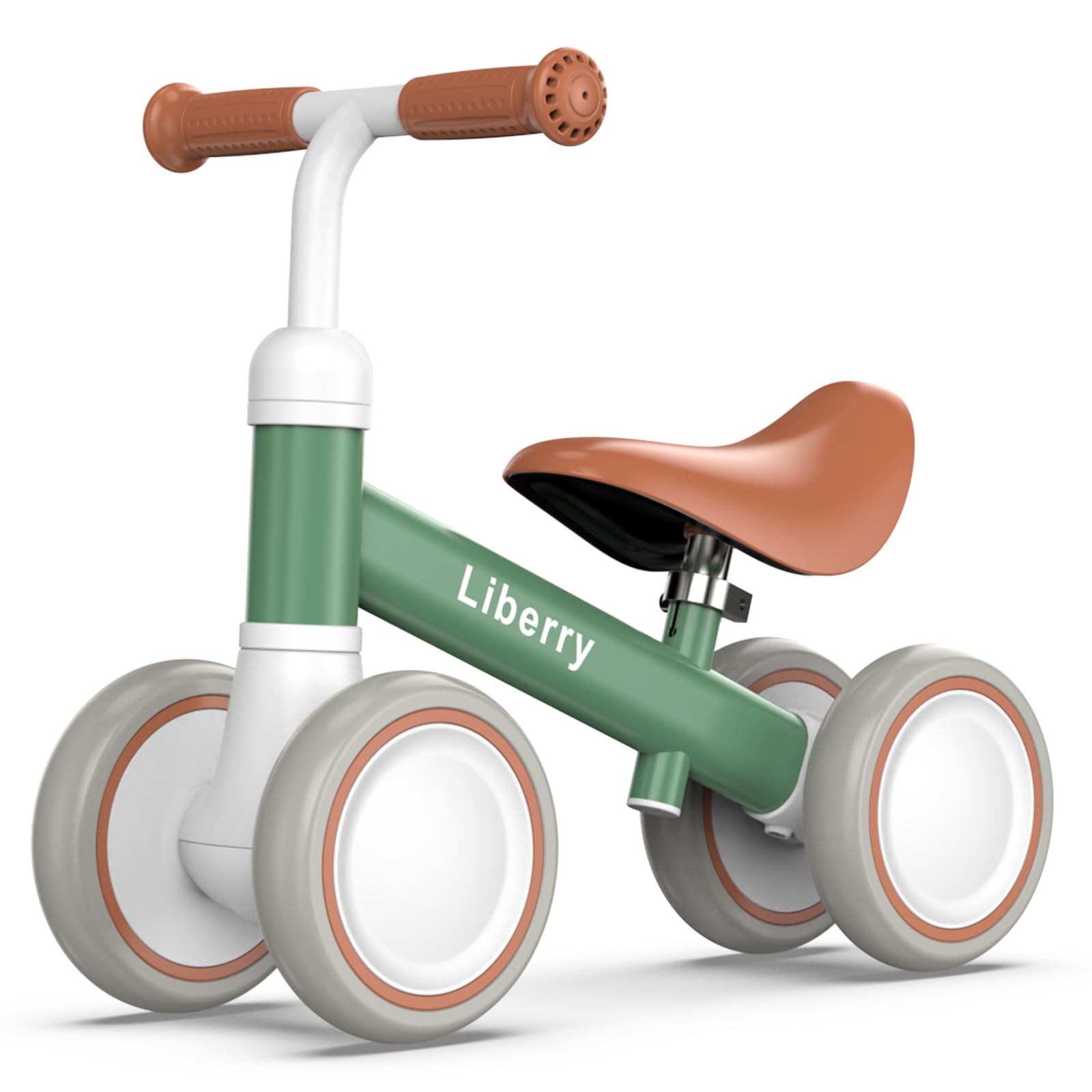
The Liberry Baby Balance Bike is purpose-built for the youngest riders in the mix — children aged 12 to 24 months who are still refining their walking gait. The bike uses four wheels arranged in a stable rectangle, which makes tipping sideways nearly impossible. The seat drops as low as 9.7 inches, allowing a child with a short inseam to sit flat-footed while grasping the rubber handlebars.
The frame is alloy steel, and the bike weighs roughly 5 pounds, which is light enough for a 1-year-old to lift and turn. The EVA tires are smooth and grip well on hardwood and tile without leaving scuff marks. The closed wheels prevent pinched fingers or feet, a genuine safety concern with spoke designs. The PU foam seat is cushioned and adjustable, though the range only goes up to 11 inches, so a tall 2-year-old will outgrow this bike quickly.
The four-wheel configuration and small wheel diameter make this an indoor-only or smooth-pavement bike. Gravel, grass, or any uneven terrain causes the wheels to bind. The included letter stickers for personalizing the frame are a nice touch, but the primary value here is the ultra-low seat height that caters exclusively to new walkers.
Why it’s great
- Four-wheel design provides maximum stability for children still mastering walking basics.
- Very lightweight at about 5 lbs, easy for a toddler to maneuver independently.
- Closed wheels prevent finger and toe injuries.
Good to know
- Seat height range is short (9.7–11 in), limiting usable life for taller or faster-growing children.
- Only suitable for indoor or perfectly smooth outdoor surfaces.
6. Bobike Toddler Balance Bike

The Bobike is the most affordable entry in this review, but it does not cut corners on the safety fundamentals. The 135-degree steering limit prevents the handlebars from swinging full-circle and throwing the child off balance during sharp turns. The fully enclosed wheels are wide enough that little feet cannot slip between the spokes, and the alloy steel frame feels solid for a budget-tier bike.
The seat height is adjustable, and the colorful pink frame offers a bright aesthetic that appeals to many young riders. Multiple owners reported assembly taking fewer than ten minutes, and the bike has held up well to daily riding on driveways and sidewalks. The grip material on the handlebars is basic rubber that provides adequate traction for small hands.
The main trade-off at this price point is the tire material. The wheels are a hard plastic compound rather than EVA foam or rubber. These plastic tires produce a louder rattle on rough pavement and offer less shock absorption compared to the premium models. The seller origin also caused some confusion for a buyer, though the bike itself performed as expected. For a budget entry that introduces the balance concept effectively, the Bobike delivers solid value.
Why it’s great
- Steering limiter prevents over-rotation and crash scenarios.
- Enclosed wheel design protects feet from getting stuck.
- Quick five-minute assembly gets the child riding immediately.
Good to know
- Hard plastic tires are louder and transmit more vibration than EVA or rubber.
- Seller information on Amazon can be misleading regarding brand origin.
7. RIDYEE Toddler Balance Bike
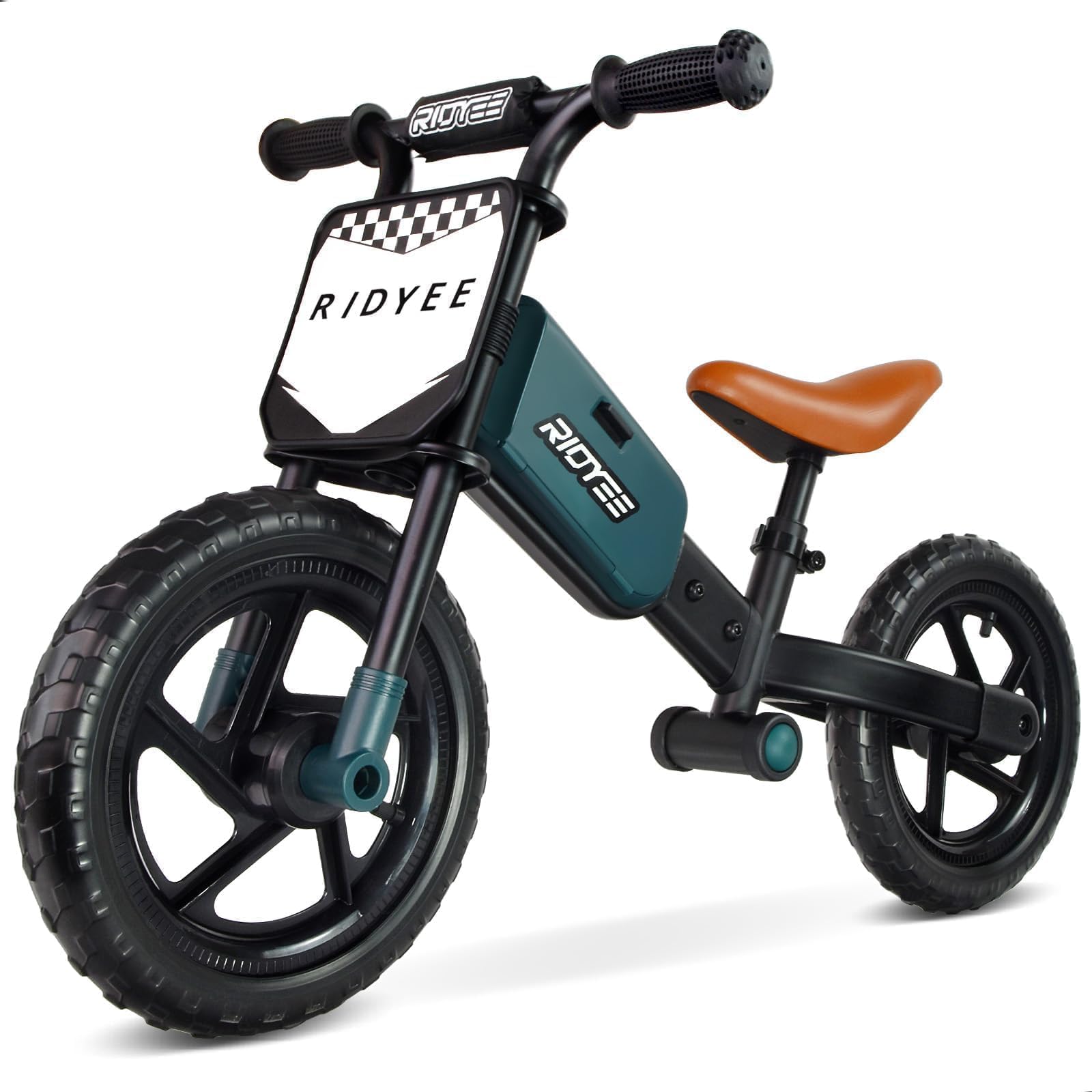
The RIDYEE sets itself apart with a customizable front plate and three sheets of letter and number stickers that let a child spell out their name or a short word. This personalization aspect adds a layer of ownership that makes a toddler more excited to ride. The frame uses carbon steel with a green sport finish styled after a sand motocross bike, and the adjustable shock-absorbing seat smooths out bumps from sidewalks and packed dirt.
The tool-free seat adjustment ranges from 13.4 to 15.8 inches, which positions the bike squarely for 2-year-olds on the taller side. The limited steering angle keeps the front end from jackknifing at low speeds, and the anti-slip grips provide a secure hold even with sweaty palms. The bike arrives fully assembled, which is a genuine convenience — you simply hand it to the child after removing the packaging.
Some owners noted that the tires are a harder plastic compound rather than soft rubber, which reduces the bike’s grip on loose surfaces like fresh pavement or damp grass. The frame weight is on the higher side for a 2-year-old, though children who are already active and strong seemed to handle it fine. The footrest is a welcome addition for gliding practice, and the overall build quality exceeds expectations for the mid-range price.
Why it’s great
- Customizable name plate with letter stickers builds excitement and ownership.
- Shock-absorbing seat provides a more comfortable ride on uneven terrain.
- No assembly required — the bike is ready to ride out of the box.
Good to know
- Hard plastic tires offer less grip and a harsher ride than rubber alternatives.
- Frame is heavier than some aluminum competitors, which may challenge smaller riders.
FAQ
Should I get a balance bike or a tricycle for my 2-year-old?
What seat height should I look for in a 2-year-old balance bike?
How much should a balance bike weigh for a 2-year-old?
Final Thoughts: The Verdict
For most families, the 2 year old balance bike winner is the Retrospec Cub because its airless rubber tires, wide seat height range, and durable alloy steel frame combine to create a bike that will survive daily abuse and support your child from their first wobbly scoot to confident gliding. If you need the absolute lightest bike for a petite or cautious rider, grab the banana bike LT. And for a child who needs the most stable possible start, the three-wheel Radio Flyer Steady Start removes tipping anxiety entirely.