
At twelve months, a child transitions from passive observation to active exploration. The toys they need at this stage must do more than make noise — they must invite grabbing, pulling, pounding, pushing, and problem-solving. The wrong toy gets ignored after thirty seconds; the right one builds motor skills, introduces cause and effect, and holds attention long enough for a parent to drink their coffee hot.
I’m Min — the co-founder and writer behind Gadgets Feed. I’ve spent dozens of hours analyzing the specifications and real-user feedback across the most popular learning toys for this age group, focusing on what separates a short-lived distraction from a genuinely developmental tool.
Whether you need a push-along walker for first steps or a quiet busy board for restaurant trips, this guide cuts through the noise to help you find the best 1-year-old toys that actually support your toddler’s growth.
How To Choose The Best 1-Year-Old Toys
One-year-olds are in a unique developmental window: they can grasp, pull up, and often take their first steps, but they still explore primarily through their senses. The best toys for this age activate multiple senses at once — sight, sound, and touch — while encouraging repetition that builds neural pathways.
Prioritize Gross and Fine Motor Development
Toys that require pounding, pulling, pushing, or twisting directly support the two motor skill tracks a one-year-old is building. A hammering toy strengthens arm muscles and hand-eye coordination. A pull-along puppy encourages walking. A busy board with switches and buttons refines finger dexterity. If a toy only lights up without requiring physical action from the child, it’s passive entertainment, not active development.
Check Safety Standards Before Anything Else
At this age, everything goes in the mouth. Look for BPA-free, non-toxic materials with no small parts that could become choking hazards. Edges should be polished smooth, and any electronic compartment must be secured with a screw. Wooden toys should use water-based, non-toxic paint. Plastic toys should be shatter-resistant ABS. A toy that fails on safety fails completely, regardless of how educational it claims to be.
Match the Toy to Your Child’s Current Mobility
Not all one-year-olds walk. Some cruise furniture, some crawl, some take a few tentative steps. A sit-to-stand walker with wheel-speed control is ideal for a child just learning to balance. A ride-on with an anti-tip feature suits a child who can sit and scoot. A stationary busy board works for any mobility level. Choosing a toy that slightly exceeds your child’s current ability — but doesn’t frustrate them — creates the optimal challenge zone for learning.
Quick Comparison
On smaller screens, swipe sideways to see the full table.
| Model | Category | Best For | Key Spec | Amazon |
|---|---|---|---|---|
| VTech Sit-to-Stand Learning Walker | Push Walker | First Steps & Balance | 2-speed wheel control; detachable panel | Amazon |
| Radio Flyer Busy Buggy | 3-in-1 Ride On | Sensory Play & Mobility | 42 lb capacity; 17 activities | Amazon |
| Joyreal Wooden Hammering Toy | Multifunctional Set | Montessori & Fine Motor | 4 activities: pounding, fishing, xylophone, gears | Amazon |
| LeapFrog Learning Friends 100 Words Book | Electronic Book | Vocabulary & Quiet Play | 100+ words; bilingual English/Spanish | Amazon |
| VTech Pull and Sing Puppy | Pull-Along Toy | Walking Practice & Colors | Light-up nose; 3 color buttons | Amazon |
| Grarain Busy Board | Sensory Board | Travel & Quiet Play | 23 LEDs; 6.7 x 5.3 x 1.1 inches | Amazon |
| HOLA Hammer Baby Toy | Musical Hammer | Cause & Effect Learning | 2 play modes; counting & music | Amazon |
In-Depth Reviews
1. VTech Sit-to-Stand Learning Walker
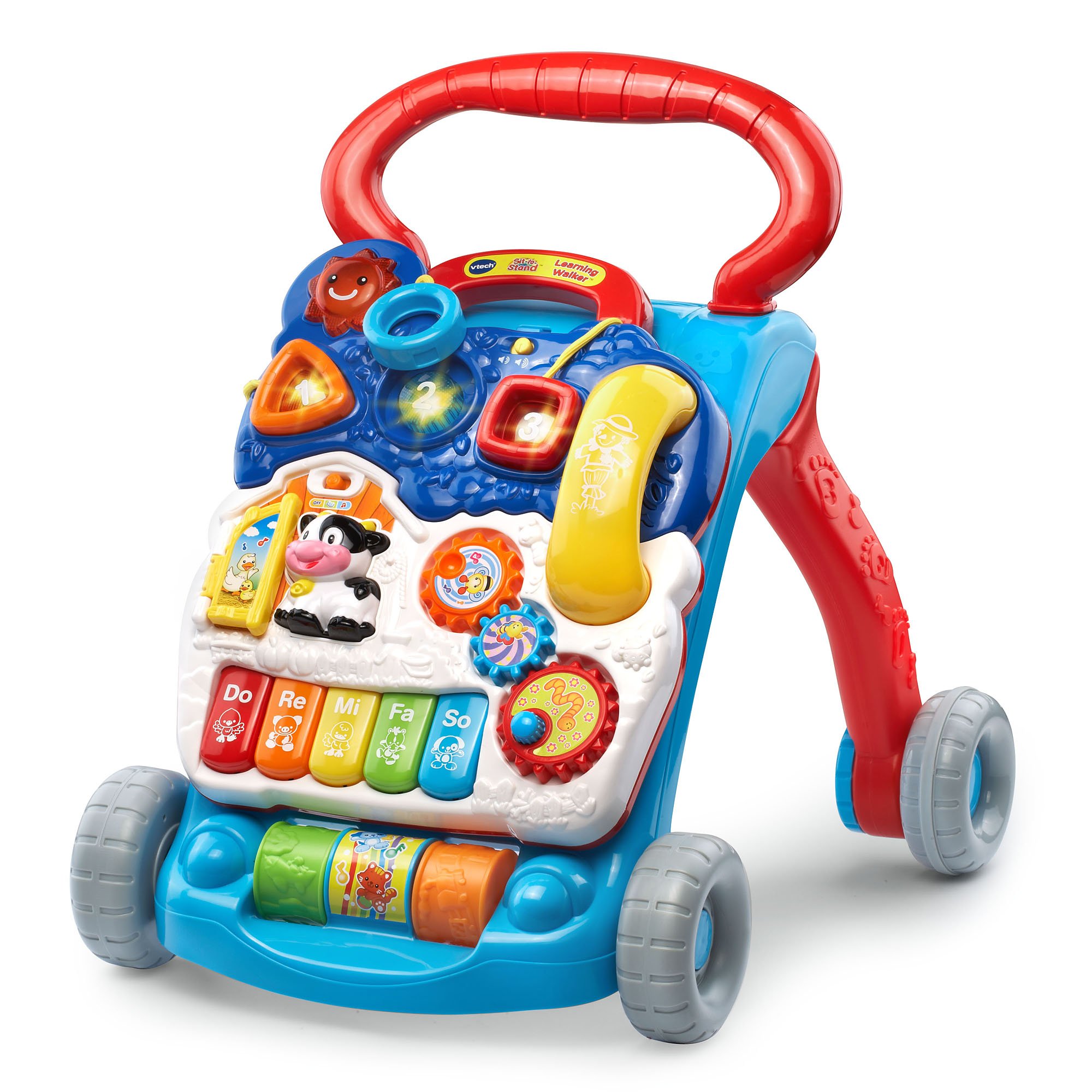
This walker solves a real engineering problem for one-year-olds: it supports babies who aren’t yet walking while still entertaining those who already are. The removable activity panel works on the floor for sitting play, then snaps onto the walker frame for cruising practice. The two-speed control switch on the back wheels lets you slow the walker down for a cautious beginner or speed it up as confidence grows — a feature most walkers in this price tier omit entirely.
The panel itself packs five piano keys, three shape sorters, light-up buttons, and a telephone handset. That variety keeps a one-year-old rotating between activities rather than losing interest in a single gimmick. The wheel stoppers prevent the walker from rolling away during stationary play, which is a genuine safety consideration for babies who pull themselves up before they’re ready to push.
At 4.6 pounds with a 35-pound weight limit, the frame is stable enough not to tip during directional changes. Parents consistently report that the activity panel outlasts the walking phase — many keep it as a floor toy well past the toddler’s second birthday. The only real drawback is sound volume; there is no low-volume setting, so some users place tape over the speaker to dampen the output during sensitive times.
Why it’s great
- Detachable panel works as both floor toy and walker — extends useful life
- Two-speed wheel control adapts to skill progression
- Five piano keys and shape sorters develop fine motor and auditory skills in parallel
Good to know
- No volume control — speaker may be loud for some families
- Panel detaches easily, which curious toddlers learn to pull off intentionally
2. Radio Flyer Busy Buggy

Radio Flyer translated its wagon heritage into a 3-in-1 walker, ride-on, and sensory station that hits a 42-pound weight capacity — significantly higher than the category average. The Busy Buggy functions as a push walker for a child just finding their feet, then converts to a ride-on scoot toy once walking is established. The anti-tip feature, a wide wheelbase with low center of gravity, prevents the buggy from flipping during sharp turns or curb bumps.
The 17 interactive activities are distributed around the entire body of the buggy, not just the dashboard. Interlocking gears sit near the wheels, sliding beads run along the side panel, and a clicking spare tire mounts on the back. This layout encourages the child to walk around the toy, reaching and rotating, which builds gross motor coordination more effectively than a front-facing-only activity center. The horn produces a real honk, not an electronic beep, which toddlers find disproportionately hilarious.
Under-seat storage lets a child carry a stuffed animal or snack cup along for the ride, adding an element of imaginative play that most walkers lack. Assembly takes under ten minutes and stickers come pre-applied. The main trade-off is size — at 21.5 inches long, it occupies floor space and won’t fit into tight apartment corners as easily as a compact busy board.
Why it’s great
- 17 activities spread around the body promote full-body movement and rotation
- 42-pound weight capacity exceeds most competitors by nearly 20 pounds
- No-pedal design teaches balance naturally without frustration
Good to know
- Larger footprint — not ideal for small spaces
- Push bar height is fixed, may be low for taller parents
3. Joyreal Wooden Montessori Toys for 1 Year Old
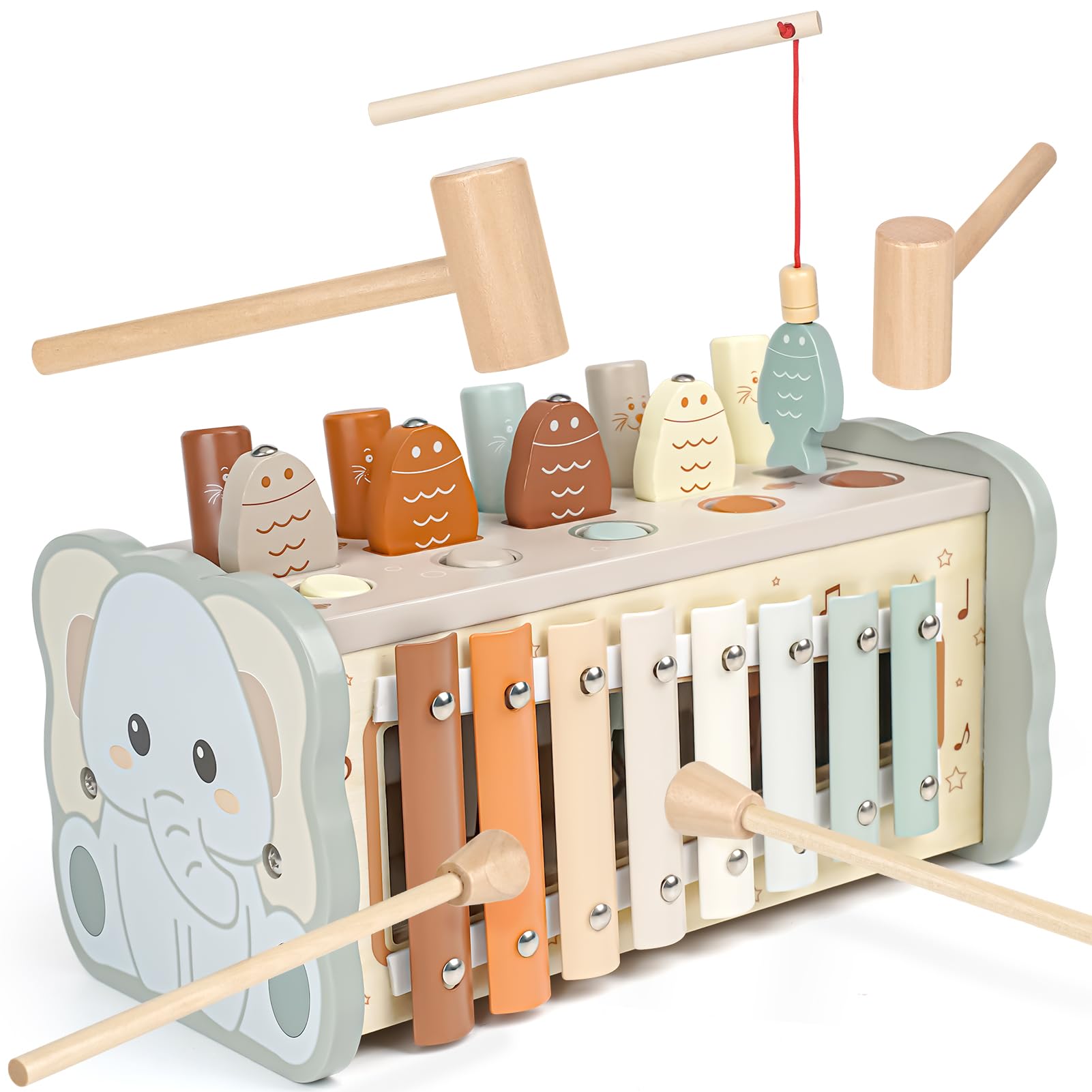
This set delivers four distinct play modes in one wooden frame: a pounding bench where mallets send hamsters bouncing, a magnetic fishing game with wooden rods, a removable xylophone, and gear-spinning activity. Each mode targets a different developmental channel — pounding builds arm strength and hand-eye coordination, fishing refines pincer grasp, the xylophone introduces auditory pitch discrimination, and gears teach mechanical cause and effect through rotation direction.
The neutral color palette sets this toy apart visually. Most one-year-old toys default to high-saturation neons that overstimulate. Joyreal uses muted tones — soft greens, warm beiges, gentle blues — that create a calmer play environment and allow the child to focus on the activity rather than the visual chaos. The wood is natural with water-based, non-toxic paint, and every edge is polished smooth. The two included hammers and two mallets let a second child or parent join in, which builds turn-taking social skills.
At 10.39 x 5.94 x 5.62 inches, the set is compact enough for a toy shelf but substantial enough to feel durable during aggressive pounding sessions. The xylophone detaches completely, which some parents report as a minor frustration when pieces scatter. The magnetic fishing rods require some initial guidance — the concept of magnetic attraction isn’t instinctive at twelve months — but once demonstrated, most toddlers pick it up within two play sessions.
Why it’s great
- Four distinct play modes in one footprint — great rotation value
- Natural wood construction with water-based paint passes strict safety standards
- Neutral color palette reduces visual overstimulation compared to neon alternatives
Good to know
- Xylophone detaches — small parts may get separated from the main set
- Fishing game requires adult demonstration before toddler understands the magnet mechanic
4. LeapFrog Learning Friends 100 Words Book

The Learning Friends 100 Words Book solves a specific problem: how to introduce vocabulary without screen time. Each page covers a category — pets, food, colors, opposites, outdoors — and the child touches a word to hear it spoken aloud. The audio is clear and unhurried, with a slightly exaggerated pronunciation that supports early speech development. Two theme songs play when the child presses the light-up star button, adding a reward loop that encourages page exploration.
The bilingual capability is the standout feature here. Every word plays in English by default, and a toggle switch swaps the entire interface to Spanish, including instructions and songs. For bilingual households, this is a massive time-saver — one toy replaces two separate language tools. Pages are made of thick coated cardstock that resists tearing from enthusiastic page-turning. The book measures 9.4 x 9.2 inches, which is large enough for a toddler to spread open on the floor without covering the page with their body.
Battery life is the primary consideration. The toy uses 2 AA batteries, and parents report needing replacements roughly every two to three weeks with heavy daily use. The sound quality is good but not adjustable in volume, though it stays within a reasonable range — loud enough to hear in a playroom but not jarring. The content skews slightly toward the 18-month end of the age range, so some twelve-month-olds may need a few weeks of growth before they consistently press the correct spots.
Why it’s great
- Bilingual English/Spanish with one-button toggle — rare in this category
- Thick cardstock pages resist tearing from enthusiastic toddlers
- Screen-free vocabulary building with clear, age-appropriate pronunciation
Good to know
- Battery life is moderate — expect replacements every 2-3 weeks with regular use
- Some 12-month-olds need time to develop the precision for accurate touch targeting
5. VTech Pull and Sing Puppy

The Pull and Sing Puppy distills early learning into a single interaction: the child pulls the cord, and the puppy responds. This simple cause-and-effect loop is developmentally perfect for twelve-month-olds who are just beginning to understand that their actions produce predictable outcomes. The light-up nose provides a visual reward, and the audio feedback — numbers, colors, body parts, and music — varies enough to prevent boredom after the tenth pull.
Three colorful buttons on the puppy’s chest let the child switch between learning modes. One button introduces numbers and counting, another focuses on body-part vocabulary, and the third triggers musical responses. This mode-switching keeps the toy fresh without requiring any parental intervention. At 6.69 x 3.94 x 7.87 inches and under a pound, the puppy is small enough to toss in a diaper bag yet large enough not to pose a swallowing hazard.
The biggest complaint among parents is the pull cord length — at roughly eight inches, it’s short enough that a toddler walking behind the puppy has to stoop. A longer cord would make walking practice more natural. The sound volume, while adjustable on some VTech toys, is fixed here. That said, the toy’s durability is exceptional; multiple reviewers report it surviving daily use across multiple children over a year without any degradation in sound quality or button responsiveness.
Why it’s great
- Simple pull-cord mechanism teaches cause and effect at a fundamental level
- Three learning modes (numbers, body parts, music) extend replay value
- Lightweight and compact — packs easily for outings
Good to know
- Pull cord is short — child must stoop to reach it while walking behind
- No volume adjustment — sound level is fixed
6. Grarain Busy Board for Toddlers
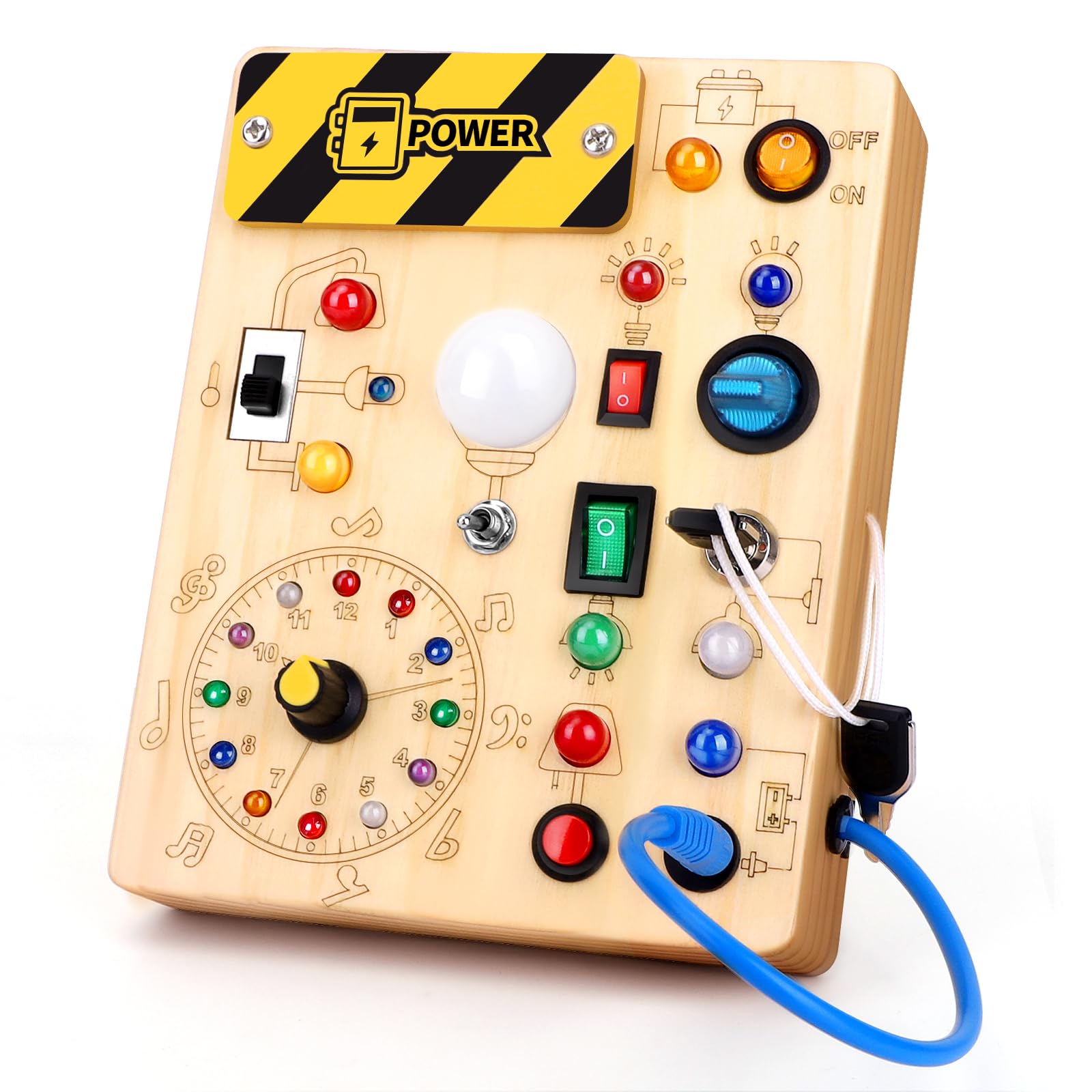
The Grarain Busy Board solves one of the most common parent complaints about electronic toddler toys: the noise. This board produces no sound whatsoever. The entire interaction is visual and tactile — switches click, toggle buttons slide, and 23 LED lights illuminate in response. For restaurants, church, airplane cabins, or any environment where a beeping toy would earn dirty looks, this board is a quiet-life hack.
Measuring 6.7 x 5.3 x 1.1 inches, the board is roughly the size of a paperback book and slips easily into a purse or diaper bag. The front panel features a clock design with interactive switches that trigger LED patterns. The back panel shows an alpha-numeric chart for additional visual engagement. The wood construction is drop-resistant and the edges are rounded and smooth. LED brightness is intentionally low to avoid eye strain during close-up play.
The Montessori philosophy behind this toy is that the child learns through self-directed exploration — there are no instructions, no right answers, no sound prompts telling the child what to do. Some parents find this lack of guidance confusing at first, but toddlers adapt quickly. The switches are intuitive enough that most one-year-olds figure out the on-off relationship between movement and light within minutes. The main limitation is that the board has finite exploration depth; after the child has mapped every switch to every light, the novelty diminishes. This typically takes several weeks of daily use.
Why it’s great
- Silent operation — ideal for restaurants, planes, and shared spaces
- Compact paperback size fits any diaper bag or purse
- Sturdy wood construction with smooth, rounded edges
Good to know
- No sound or voice feedback — purely visual interaction
- Exploration depth is finite; long-term novelty depends on the child’s pace
7. HOLA Toys Hammer Baby Toy

The HOLA hammer toy uses a single compelling mechanic — hit the button, get a reward — to teach counting, cause and effect, and gross motor coordination. In Entertainment Mode, each strike triggers music and flashing lights. In Learning Mode, the toy counts up with each hit, reinforcing number sequence through physical action. This direct physical-to-cognitive link is exactly what Piaget described as sensorimotor learning, and it works reliably with one-year-olds who are drawn to repetitive striking behavior.
The hammer is sized for small hands at roughly five inches long, and the target button is large enough that imprecise strikes still connect. The ABS plastic construction is shatter-resistant, and the toy weighs 0.2 kilograms — light enough for a toddler to wave around but heavy enough to feel substantial. The BPA-free, non-toxic material certification matters because the hammer will absolutely end up in a mouth at some point. There are no small parts that could detach and become a choking hazard.
Battery consumption is the main operational cost. The toy requires 2 AAA batteries, and parents report needing replacements every week or two with enthusiastic daily use. The sound output is fixed and energetic — some caregivers find the music loop repetitive after extended play sessions. A few reviewers also note that the hammer’s shape, while fun, can be used as a makeshift weapon during sibling interactions, so supervision during shared play is advisable. For the price, the developmental return is strong: counting sequences, color recognition, and fine motor practice in one package.
Why it’s great
- Learning Mode counts up with each hit — teaches number sequence through physical action
- Hammer size and button target are optimized for one-year-old hand precision
- BPA-free, non-toxic ABS plastic with no small choking-hazard parts
Good to know
- Battery life is short — expect replacements every 1-2 weeks with heavy use
- Hammer shape can be used as a striking tool during sibling play
FAQ
What is the difference between a push walker and a ride-on for a one-year-old?
How many activity modes should a one-year-old toy have to hold attention?
Are wooden Montessori toys better than plastic electronic toys for one-year-olds?
Final Thoughts: The Verdict
For most users, the best 1-year-old toys winner is the VTech Sit-to-Stand Learning Walker because it transitions from floor play to walking practice with a detachable panel that extends usability well past the first birthday. If you want a quiet, screen-free travel toy that entertains without noise, grab the Grarain Busy Board. And for maximum developmental variety in a single footprint, nothing beats the Joyreal Wooden Montessori Toy Set with its four distinct play modes packed into one wooden frame.