
A blind-spot collision or a parking lot scrape happens in the space your mirrors and neck cannot cover. Dedicated sensor kits and dash cams with built-in ADAS now bridge that gap with radar, visual alerts, and audible warnings that react faster than a human eye. The difference between a safe lane change and a costly sideswipe often comes down to the detection range, sensor type, and alert logic of the system you install.
I’m Min — the co-founder and writer behind Gadgets Feed. I spend my time breaking down the technical specifications and real-world performance data of automotive safety electronics to separate marketing fluff from genuine protection.
This buying guide evaluates the top sensor and camera options available today to help you find the right fit. Whether you drive a sedan, SUV, or pickup, the best anti-collision warning system for your car must deliver reliable detection without a flood of false alerts.
How To Choose The Best Anti-Collision Warning System
The core job of any anti-collision system is to detect an obstacle or closing vehicle and present a clear, timely warning. The type of sensor, the alert method, and the installation complexity determine how well each system performs that job in your specific vehicle.
Radar vs. Camera-Based Detection
24GHz millimeter-wave radar sensors detect moving objects in blind spots up to 10 meters behind your vehicle regardless of lighting conditions. Camera-based ADAS systems rely on optical recognition to identify lane markings, vehicles, and pedestrians. Radar works through fog and rain without degradation, while cameras offer richer data for identifying specific threats like a pedestrian stepping into your path.
Alert Modalities and False Positive Rates
A system that screams at every parked car or roadside bush quickly gets ignored. Look for units with adjustable sensitivity, buzzer toggles, and separate alert thresholds for when the turn signal is active versus inactive. The best systems use illuminated LED indicators as the primary cue and reserve the audio buzzer for high-risk situations where a lane change is already in progress.
Installation Requirements and Vehicle Compatibility
Radar sensors cannot penetrate metal bumpers — they require plastic fascia mounting for proper operation. Camera-based systems need a clear windshield view without tinting or obstruction. Universal kits require tapping into turn signal wires and reverse lights, while integrated dash cams with ADAS are simpler to install but offer less precise spatial awareness around the vehicle’s rear quarter panels.
Quick Comparison
On smaller screens, swipe sideways to see the full table.
| Model | Category | Best For | Key Spec | Amazon |
|---|---|---|---|---|
| THINKWARE ARC | Premium Dash Cam | Built-in ADAS + parking coverage | 2K QHD Front & Rear + GPS | Amazon |
| LINGDU LD4K Mirror Cam | Mirror Dash Cam | Blind spot + lane change assist | 4K Front / 2.5K Rear + BSD | Amazon |
| Pelsee P1 Pro | Premium Dash Cam | Starvis 2 low-light + voice control | 4K Front + STARVIS 2 Sensor | Amazon |
| BlueDex BSD Kit | Radar Kit | Dedicated blind spot radar | 24GHz Radar / 10m Range | Amazon |
| EASYGUARD EBS001 | Radar Kit | Standalone blind spot monitoring | 24GHz Radar / 12m Range | Amazon |
| ELSNU 8-Sensor Kit | Parking Sensor | Parking proximity alert | 8 Ultrasonic Sensors + Display | Amazon |
| AZDOME M01 Dual | Budget Dash Cam | Entry-level forward collision alert | 1080P Front / 720P Rear + ADAS | Amazon |
In‑Depth Reviews
1. THINKWARE ARC Front & Rear Dash Cam
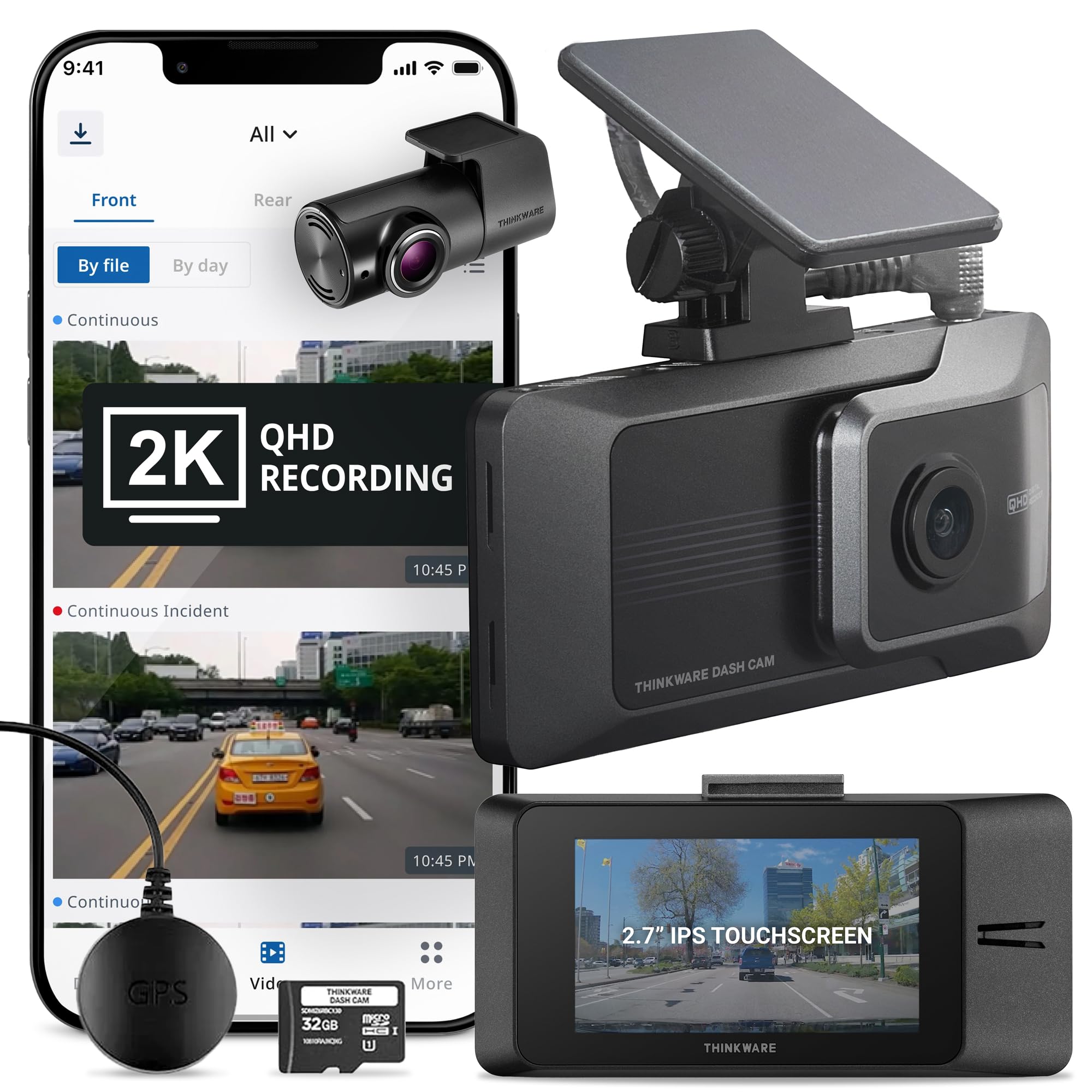
The THINKWARE ARC delivers 1440P+1440P resolution at 30fps from both cameras, with 125-degree viewing angles that minimize barrel distortion near the edges. The built-in GPS logs speed and coordinates while triggering red-light camera alerts and front vehicle departure warnings. At the premium end of the category, the ARC justifies its position with a hardwiring cable included out of the box — no separate purchase needed for 24/7 parking surveillance.
Super Night Vision 2.0 enhances low-light brightness and reduces noise, making plate capture more reliable in dim parking lots and dusk highway conditions. The 2.7-inch IPS touchscreen responds well to gloved or bare fingers, and the Wi-Fi connectivity works with the THINKWARE app for footage transfer without removing the microSD card. The 32GB card is undersized for dual 2K recording, but the slot accepts up to 256GB.
The ADAS alerts — Traffic Light Change and Front Vehicle Departure — are genuinely useful in stop-and-go traffic, and the Smart Parking Mode uses motion detection and time-lapse to conserve battery while still capturing impact events. Energy Saving Mode draws minimal power during extended parking periods. The supercapacitor design improves heat tolerance compared to lithium batteries, critical for windshield-mounted cameras in direct sun.
Why it’s great
- True 2K QHD recording from both front and rear lenses simultaneously
- Hardwiring cable included for effortless parking mode setup
- Supercapacitor power system handles high cabin temperatures
Good to know
- 32GB card needs replacement for extended high-bitrate recording
- No physical instruction manual in the box
2. LINGDU LD4K 12″ Mirror Dash Cam
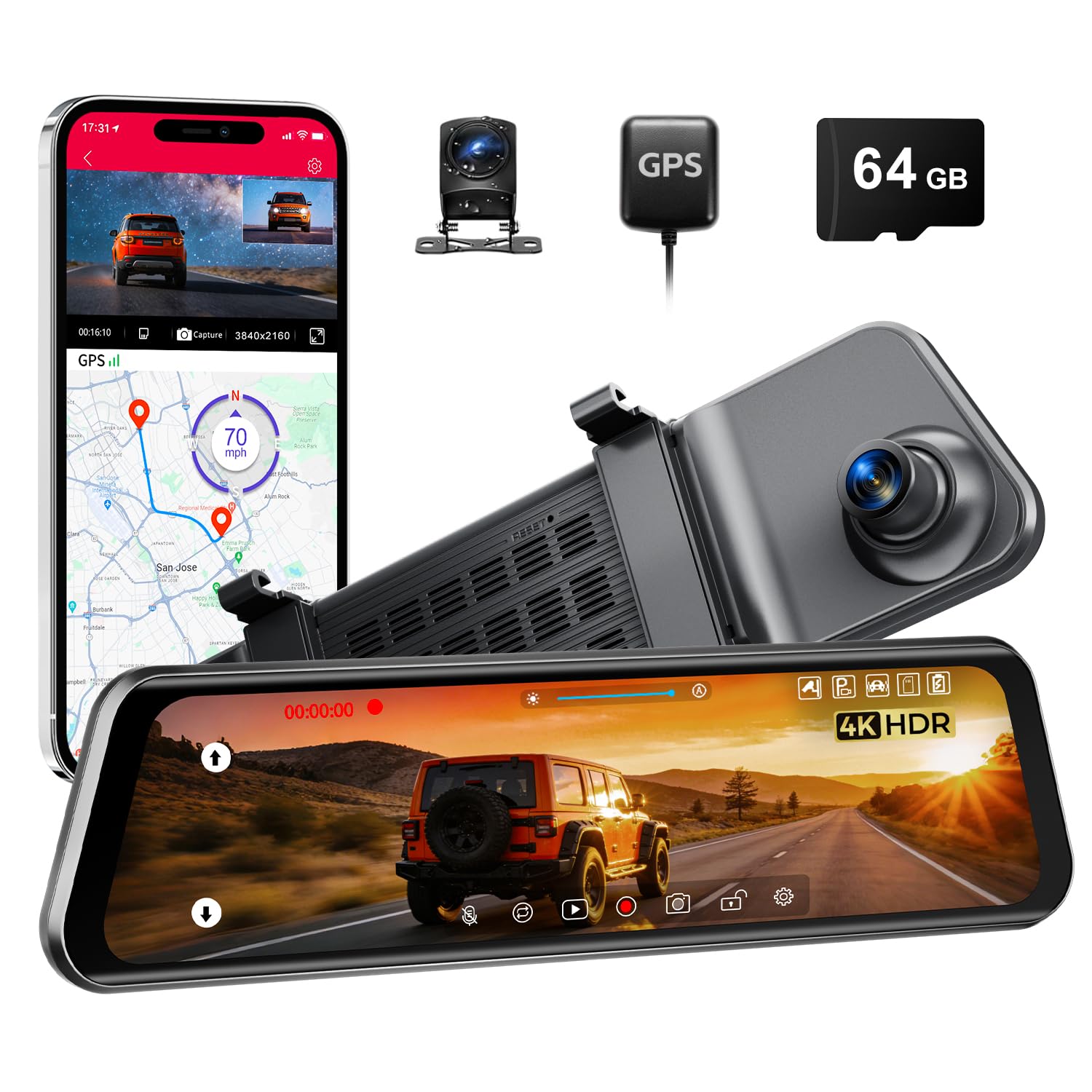
The LINGDU LD4K replaces your rearview mirror with a 12-inch LCD that displays a 4K front feed and a 2.5K rear view simultaneously. The built-in Blind Spot Detection module monitors both rear quarter zones and triggers visual and audible alerts when a vehicle enters the detection area — a feature usually reserved for dedicated radar kits, not mirror cams. The Lane Change Assist adds an extra buzzer warning when the turn signal is active and an object is present in the adjacent lane.
ADAS functions include Forward Collision Warning, Lane Departure Warning, Pedestrian Warning, and Safe Distance Monitoring, all processed on the MTK chipset with sub-second reaction times. The 5.8GHz WiFi transfers 4K clips to the LINGDU app noticeably faster than 2.4GHz equivalents. Voice control responds to ten commands including “Take photo” and “Lock video” with reasonable accuracy even with window-down road noise.
A 64GB card is included and supports up to 512GB. The 150-degree front field of view and 140-degree rear lens provide wide coverage, though the rear camera bracket lacks tilt adjustment which can cause reflections on hatchback glass. The anti-glare protective film helps reduce mirror washout but prevents using the display as a conventional reflective mirror when the screen is off.
Why it’s great
- Integrated blind spot and lane change assist in a single mirror unit
- Fast 5.8GHz WiFi for quick app-based footage review
- 4K front and 2.5K rear delivers class-leading detail
Good to know
- Rear camera mount lacks pivoting adjustment
- Screen-off mode eliminates reflective mirror functionality
3. Pelsee P1 Pro 4K Dash Cam
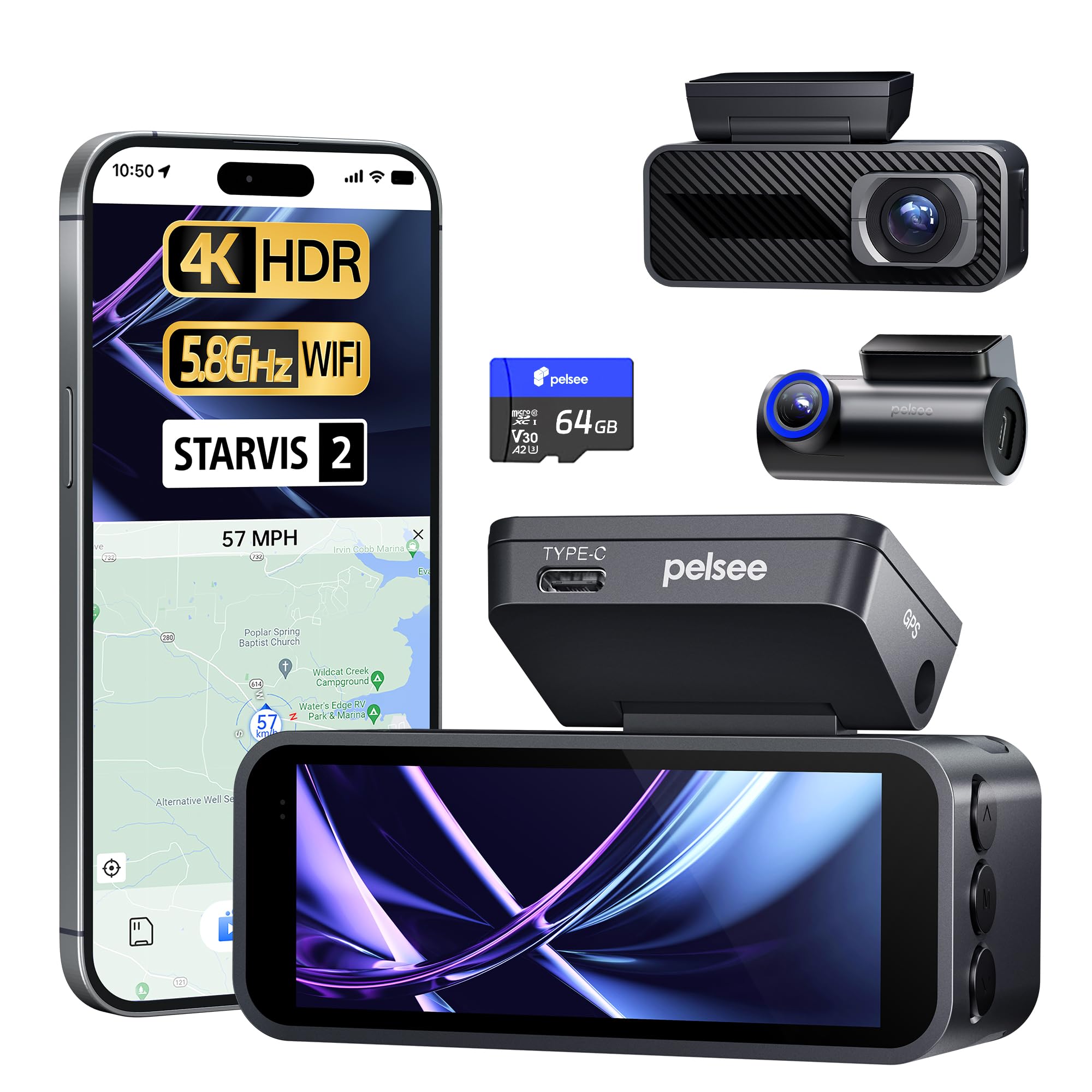
The Pelsee P1 Pro houses a Sony STARVIS 2 sensor that delivers full-color night vision in starlight conditions — a genuine advantage over conventional CMOS sensors that switch to black-and-white infrared in low light. At 4K resolution with HDR processing on the front channel, the camera maintains legible plate capture in direct sunlight where overexposed highlights normally wash out detail. The rear camera records at 1080P with WDR to balance tunnel exits and foggy backdrops.
The ADAS suite includes Forward Collision Warning, Pedestrian Collision Warning, Lane Departure Warning, and a Front Vehicle Start Reminder, with reaction times between 0.8 and 2 seconds depending on the algorithm. The 5.8GHz WiFi for app connectivity and the built-in GPS that embeds speed, coordinates, and timestamps into the video stream. Voice commands respond with noise-canceling mics that filter out cabin rumble and road roar.
24-hour parking mode requires a separate hardwire kit, but the G-sensor wakes the unit on impact and time-lapse captures continuous activity without filling the included 64GB card. The card expands up to 512GB. The 3.39-inch IPS screen numbers among the largest on-dash displays, providing live previews without straining. The magnetic mount makes removal quick for overhead storage in hot climates.
Why it’s great
- STARVIS 2 sensor captures full-color footage in near-dark conditions
- HDR front camera prevents plate blowout in harsh sunlight
- Noise-canceling voice control works reliably at highway speeds
Good to know
- Hardwire kit sold separately for 24/7 parking monitoring
- Cable length is excessive for smaller cars requiring extra tucking
4. BlueDex Blind Spot Monitoring System

The BlueDex BSD Kit uses dual 24GHz millimeter-wave radar sensors mounted inside the rear bumper to detect vehicles approaching from 1 to 32.8 feet. The detection logic distinguishes between a passing car and a stationary guardrail by measuring closing speed of at least 0.5 m/s. When a vehicle enters the blind zone with the turn signal off, the corresponding-side LED glows steadily. With the turn signal active, the LED flashes and the buzzer emits three beeps.
The included radar angle alignment tool simplifies sensor positioning — a critical step that many universal kits leave to guesswork. The buzzer emits a low 9-decibel tone that is audible without being jarring, and separate wiring for the turn signals and hazard lights enables the three distinct alert modes described in the specifications. The system draws power from a fuse-tap connection rather than the OBD-II port.
Installation requires bumper removal and drilling, so professional fitting is strongly advised. The system works only on vehicles with plastic rear bumpers because metal interferes with the radar signal. Users report that adjusting the sensor angle beyond the standard 20 degrees reduces false alerts from adjacent lanes — the angle alignment tool makes this tuning repeatable.
Why it’s great
- Genuine 24GHz radar with separate turn-signal-dependent alert levels
- Angle alignment tool improves sensor placement accuracy
- Low 9dB buzzer is audible without being annoying
Good to know
- Metal bumpers block radar signal — plastic rear bumper required
- Professional installation recommended due to wiring complexity
5. EASYGUARD EBS001 Blind Spot Monitor

The EASYGUARD EBS001 detects moving objects within a 12-meter zone behind and beside your vehicle using dual 24GHz radar modules. The system switches between two modes automatically: driving mode with LED-only alerts for general awareness, and lane-change mode where the LED flashes and a buzzer sounds when the turn signal is active. The detection range is slightly longer than the BlueDex kit at 12 meters versus 10 meters, though the effective coverage width depends on bumper curvature and sensor angle.
Mounting requires plastic bumper access only — the sensors cannot see through metal. The wiring diagram calls for tapping into the left and right turn signal wires, a 12V power source, and a ground connection. The provided harness is labeled clearly, but the instructions do not include volume adjustment or buzzer-toggling guidance. Sensor angle tuning is trial-and-error; users report adjusting from the recommended 20-degree outward angle to 35 degrees for their specific vehicle to eliminate false alerts from trailing traffic in adjacent lanes.
The LED indicator brightness is appropriate for daytime visibility without being distracting at night. The buzzer pitch is moderate and does not overlap with common backup alarm frequencies. This is a standalone blind-spot monitor only — it does not integrate with parking sensors, dash cameras, or ADAS functions.
Why it’s great
- Longer 12-meter detection range than comparable standalone kits
- Dual-mode alerts differentiate normal driving from lane-change scenarios
- Small sensor housings fit behind most plastic bumpers
Good to know
- Sensor angle is not specified for all vehicle bumper shapes
- Bumper removal required — not a plug-and-play installation
6. ELSNU 8-Sensor Parktronic System

ELSNU’s 8-sensor kit covers parking proximity with four sensors in the front bumper and four in the rear, each with a measurement accuracy of plus or minus one percent within a 0.3-meter to 2.2-meter range. The front sensors activate when the vehicle is in gear and the brakes are applied, then continue alerting for 15 seconds after the brake is released. This prevents false alarms at traffic lights while still protecting the front bumper during tight parking maneuvers.
The LCD display shows eight light bars that map obstacle position — the first bar corresponds to the left corner and the eighth to the right corner. Three alert modes (voice, buzzer, mute) are switchable via the control module. The voice mode uses a synthesized English speaker to announce distances in the sensing range. The buzzer beep rate increases as distance decreases, culminating in a continuous tone at the minimum range threshold.
Installation requires drilling 18mm holes into the bumper — the kit does not include a hole saw with a long enough shaft to avoid chuck-to-bumper contact on thicker paint finishes. The recommended mounting height is 17.7 to 21.7 inches, but the system still functions at lower heights without false triggering from ground reflections. The sensors protrude slightly from the bumper surface and come in a silver finish that may not match all paint colors.
Why it’s great
- Eight sensors provide comprehensive front and rear proximity detection
- Analog light-bar display shows obstacle position without reading numbers
- Selectable voice, buzzer, or mute modes suit different driving preferences
Good to know
- Hole saw with longer shaft would prevent bumper damage during install
- No sensitivity adjustment — fixed detection threshold
7. AZDOME M01 Dual Dash Cam

The AZDOME M01 Pro includes Forward Collision Warning and Lane Departure Warning as part of its built-in ADAS processing — rare at this tier. The front camera records at 1080P with a 150-degree wide-angle lens, while the rear camera captures 720P with a 120-degree lens. The 3-inch LCD provides a live split view or picture-in-picture display during driving and playback. A 64GB SD card ships in the box, pre-formatted and ready to record in loop mode.
The G-sensor locks footage on impact so critical clips survive loop overwrites. The parking mode activates on G-sensor detection but does not offer time-lapse or continuous recording — it is purely event-triggered. A fatigue driving reminder beeps at set intervals to encourage breaks during long trips. The included cigarette-lighter adapter provides power to both cameras through a single USB port.
Nighttime footage is adequate for general recording but struggles to resolve plates beyond standard headlight range. The WDR processing improves shadows and highlights moderately. The ADAS warnings are functional but less refined than dedicated camera systems — lane departure sensitivity can trigger on worn markings. The rear camera cable extends to the cargo area of most sedans but falls short for full-size pickup trucks.
Why it’s great
- Includes forward collision and lane departure alerts at a budget price
- 64GB card included and ready to record immediately
- G-sensor locks incident footage to prevent overwrite
Good to know
- Rear cable may be too short for large trucks
- ADAS sensitivity can cause false lane departure alerts on worn roads
FAQ
Can I install a 24GHz blind spot radar system myself?
Will a dash cam with ADAS replace a dedicated blind spot radar system?
Why do anti-collision systems sometimes trigger false alerts?
Final Thoughts: The Verdict
For most users, the best anti-collision warning system winner is the THINKWARE ARC because it combines 2K dual recording with reliable ADAS alerts and integrated parking surveillance in a single hardwired package. If you want dedicated blind spot radar without a dash cam, grab the BlueDex BSD Kit for its 24GHz sensors and turn-signal-aware alert logic. And for maximizing coverage with a dash cam that includes blind spot detection and lane change assist, nothing beats the LINGDU LD4K Mirror Cam.