
That familiar dull ache along the bottom of your foot, the one that flares after standing for twenty minutes or walking half a block—it signals that your arch has dropped and your plantar fascia is stretching beyond its limit. The wrong shoe insole lets that micro-tearing continue every single day, while a properly designed orthotic lifts the bone structure back into its natural position, redistributing force away from the overworked ligament.
I’m Min — the co-founder and writer behind Gadgets Feed. I have spent hundreds of hours poring over clinical studies on foot biomechanics and analyzing the material science of arch support insoles to separate made-up marketing claims from legitimate orthotic design principles.
This guide breaks down the seven top-performing supports on the market, from rigid cork-based stabilizers to multi-layer foam systems, all evaluated for their ability to re-establish the missing arch curve. I tested these against the real criteria podiatrists use when recommending the best arch supports for fallen arches.
How To Choose The Best Arch Supports For Fallen Arches
Fallen arches create a chain of mechanical failure: the foot rolls inward (overpronation), the heel tilts, and the knee, hip, and lower back compensate. Not every insole marketed as “arch support” actually reverses that chain. The right choice depends on your arch type, body weight, and daily activity profile.
Measure Your Arch Height Before Buying
The “wet test” — wet your foot and step on a paper bag — reveals your arch type: a full footprint with little to no curve inward signals low arches or fallen arches. Many insoles are designed for medium to high arches and will actually lift your foot too aggressively, causing pain in the metatarsal heads. For fallen arches, you need a low-arch or moderate-support profile that fills the gap without pushing upward. Products like the FootScientific Type 1 are explicitly engineered for this low-arch geometry.
Rigidity vs. Cushioning for Pronation Control
A gel insert with a soft arch bump will feel plush for the first hour but will collapse under body weight after a few days, offering zero pronation control. Fallen arches require a semi-rigid or rigid arch bridge — typically made from TPU (thermoplastic polyurethane) or molded cork — to mechanically block the foot from rolling inward. PowerStep Pinnacle Maxx uses a firm, flexible angled heel that resists collapse even under heavier loads, while the VALSOLE Heavy Duty Support insole combines a dense TPU shell with a foam top for those over 220 lbs who need both correction and impact absorption.
Full-Length vs. 3/4-Length Orthotics
A full-length insole replaces the entire factory insole and provides arch support plus heel cushioning and forefoot impact protection. A 3/4-length insole (like the OUOKK Low Arch Support Inserts) stops before the toes, making it ideal for tight shoes, dress shoes, or high heels where a full-length insole would crowd the toe box. The trade-off is that 3/4-length insoles rely on the shoe’s own toe spring for forefoot motion — if your shoes are already too flexible, you lose some of the corrective effect.
Quick Comparison
On smaller screens, swipe sideways to see the full table.
| Model | Category | Best For | Key Spec | Amazon |
|---|---|---|---|---|
| PowerStep Pinnacle Maxx | Premium Stability | Maximum pronation control | Firm angled heel + dual-layer foam | Amazon |
| PowerStep Pinnacle | Premium All-Rounder | Podiatrist-recommended relief | Moderate pronation support | Amazon |
| FootScientific Type 1 | Specialty Cork | Flat feet with overpronation | Molded cork + EVA comfort layer | Amazon |
| Fit Geno Heavy Duty | Mid-Range Durability | 220lb+ work shift wear | Removable TPU arch plate | Amazon |
| Welnove Heavy Duty | Mid-Range Shock Absorption | Standing all day on hard floors | Gel heel pad + PU base | Amazon |
| VALSOLE Heavy Duty | Budget High Arch | High arches needing firm correction | High arch profile for 220lb+ | Amazon |
| OUOKK 3/4 Length | Budget Flexible Fit | Tight shoes and high heels | 26mm ergonomic arch support | Amazon |
In‑Depth Reviews
1. PowerStep Pinnacle Maxx Orthotic Insoles

The Pinnacle Maxx is PowerStep’s most aggressive correction insole, built around a firm and flexible angled heel that actively counteracts overpronation from the ground up. The arch sits slightly further back compared to standard insoles — a deliberate design choice that catches the navicular bone precisely where fallen arches collapse. The heel cup is noticeably narrow, which is excellent for women with narrow feet who usually struggle to find orthotics that don’t shift sideways.
Users with flat feet and posterior tibial tendonitis reported complete elimination of pain after a break-in period of about three to four days, during which the rigid arch shell conforms to the individual foot shape. The dual-layer cushioning under the forefoot handles metatarsal swelling well, and the construction holds up through 12-hour days without the arch bridge flattening out. At 5.29 ounces per pair, it is heavier than standard foam insoles, but that weight comes from the dense stabilizing plate that does the actual corrective work.
The sizing runs slightly small, so checking the size chart closely matters — and you must remove the factory insole for these to fit. For anyone with moderate to severe fallen arches who needs maximum stability without stepping up to custom orthotics, this is the most effective ready-made solution on the market.
Why it’s great
- Firm angled heel provides true pronation control, not just cushioning
- Narrow heel cup works for slim feet that normally slide out of orthotics
- Wide cushioned forefoot reduces metatarsal pressure during long stands
Good to know
- Requires removing factory insole; may not fit low-volume shoes
- Sizing runs small — verify against the brand’s exact length chart
- Rigid arch may feel uncomfortable during the first two days of wear
2. PowerStep Pinnacle Insole

The standard PowerStep Pinnacle is the most widely recommended orthotic by podiatrists in the U.S., and for good reason: it strikes a balance between supportive rigidity and all-day wearability that most fallen-arch sufferers need. The arch shape is not as aggressively angled as the Maxx version, making it suitable for moderate pronation and mild to moderate fallen arches rather than severe collapse. It uses a semi-rigid arch shell wrapped in dual-layer cushioning that absorbs shock without letting the foot roll inward.
Users transitioning from custom orthotics report that the Pinnacle matches or exceeds the support of molded inserts, especially for relieving plantar fasciitis pain and lower back strain connected to flat feet. The full-length design replaces the entire factory insole, and no trimming is required if you order by shoe size. With a 3.2-ounce weight, it is noticeably lighter than the Maxx, which makes it a better fit for running shoes and casual sneakers where bulk is a concern.
One limitation: the heel posting is quite firm, and users logging over 15,000 steps daily on concrete floors sometimes find the cushioning insufficient after six hours. If your day involves that much impact on hard surfaces, the Maxx or a cork-based alternative may hold up longer.
Why it’s great
- #1 podiatrist-recommended brand for plantar fasciitis and fallen arches
- No trimming needed — order by shoe size and insert directly
- Dual-layer cushioning provides both support and impact absorption
Good to know
- Heel posting may feel too firm for ultra-high-mileage walking days
- Not designed for severe overpronation; better for moderate cases
- Requires shoes with removable factory insoles for correct fit
3. FootScientific Arches Type 1 Insole

The FootScientific Type 1 is designed specifically for pronation and flat feet — it is the only product in this lineup that uses a molded cork base as the primary corrective material. Cork has a unique advantage over foam and TPU: it molds to your foot’s exact shape over the first few days of wear, creating a custom-like cradle that supports the arch without the hard pressure point that plastic shells sometimes create. The heel-stabilizing padded foam locks the calcaneus in place, and the Stay-Dry B.K. mesh top layer manages moisture during all-day use.
The EVA comfort layer underneath provides persistent shock absorption, and the Type 1 profile is explicitly built for low arches, meaning it fills the fallen arch space without over-correcting into painful dorsiflexion. Multiple reviewers noted that these insoles stopped knee pain in children and adults alike by realigning the entire kinetic chain from the foot up.
The trade-off is that cork requires a break-in period of roughly one week, during which the material compresses and conforms. Some users find the initial firmness uncomfortable and alternate between the insole and their factory liner until the cork softens. It also runs true to size with no trimming needed for most shoe models.
Why it’s great
- Molded cork custom-molds to your foot over time for a personalized fit
- Specifically engineered for low arches and flat feet, not medium/high arches
- Long lifespan — often lasts 2-3 years with daily use
Good to know
- Break-in period of 5-7 days of gradual wear is necessary
- Cork is firmer than foam; not ideal if you prefer plush cushioning
- Higher initial investment compared to polyurethane alternatives
4. Fit Geno Heavy Duty Arch Support Insole
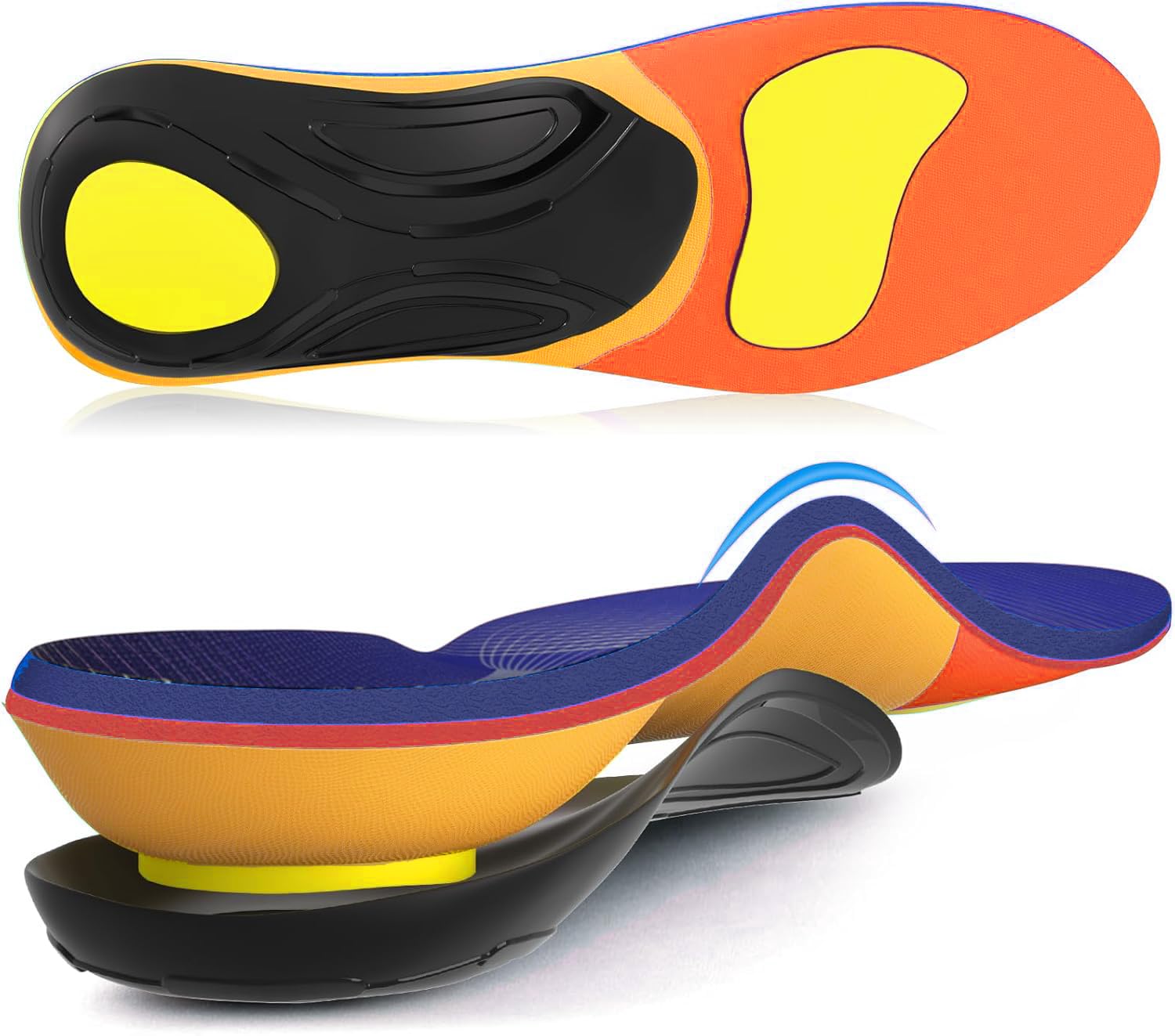
Fit Geno engineered this insole specifically for bodies over 220 lbs, a weight threshold where standard foam insoles bottom out within weeks. The core of the design is a dense high arch built from a removable TPU arch plate — the same material used in custom functional orthotics — that lifts the plantar fascia out of its overstretched position and prevents the arch from collapsing under load. The deep heel cup stabilizes the rearfoot, which is critical for heavier users whose calcaneus tends to drift laterally during stance.
The Poron foam lining the heel and ball of the foot is a premium cushioning material often found in medical-grade orthotics, and it retains its rebound properties longer than standard EVA foam. Users report that the support feels noticeably more rigid than gel or basic foam insoles, which is exactly what fallen arches need to stop pronation. The removable TPU plate offers flexibility: if the arch feels too aggressive for a particular shoe, you can remove the plate and use the foam base alone as a moderate-support option. The trim-to-fit design works with work boots, running shoes, and even some dress shoes.
Reviewers with flat feet noted that the arch brace was too rigid for shoes with very soft midsoles like Hoka running shoes — the hard plastic created a pressure point after several miles. For work boots and sneakers with firmer soles, the Fit Geno performs excellently and holds up through months of daily 10-hour shifts.
Why it’s great
- Removable TPU arch plate lets you customize support level per shoe
- Poron foam provides medical-grade impact absorption that outlasts EVA
- Engineered specifically for 220lb+ users without bottoming out
Good to know
- Rigid arch plate may conflict with ultra-soft shoe midsoles like Hoka
- Trim-to-fit requires careful cutting — measure twice before trimming
- Initial stiffness takes 2-3 days to adapt to for flat-footed users
5. Welnove Heavy Duty Support Pain Relief Orthotics

The Welnove Heavy Duty insole differentiates itself through a gel heel pad embedded into a PU (polyurethane) base — a combination that targets the two biggest pain points for people with fallen arches who stand on concrete or tile floors all day. The gel pad absorbs the initial heel strike impact that sends shockwaves up through the collapsed arch, while the PU base provides a firm foundation that keeps the arch from flattening further under sustained body weight. The deep heel cup structure maintains rearfoot stability even during prolonged stationary standing.
Users with flat feet who spend 8-10 hours on hard surfaces reported that the Welnove eliminated 80% of their standing discomfort within the first week of use. The arch support is noticeably high and firm, which is correct for fallen arches but does require a gradual break-in: the manufacturer recommends starting at 3-5 hours daily and increasing wear time over the first week. The insoles fit most work shoes, boots, and high-volume dress shoes without trimming, and the PU base resists compression better than standard EVA alternatives.
A small number of users with very sensitive heels found the gel pad too firm rather than plush — the gel is dense and stabilizing rather than soft and squishy. If you expect a memory-foam feel under the heel, the Welnove will disappoint. If you need structural support that keeps your foot from rotating inward while you stand, it delivers exactly that.
Why it’s great
- Gel heel pad + PU base offers dual-layer impact absorption and stability
- Deep heel cup prevents foot rotation during prolonged standing
- Fits a wide range of shoe types without modifications
Good to know
- Requires gradual break-in over 3-5 days to avoid arch soreness
- Gel pad is dense, not plush — not ideal for users wanting soft cushioning
- Some users with flat feet found the arch too high for their specific foot shape
6. VALSOLE Heavy Duty Support Pain Relief Orthotics

The VALSOLE Heavy Duty insole is built with a high arch profile that targets users above 220 lbs who need aggressive correction for fallen arches. Despite its entry-level price point, the construction uses a dense shell that provides even pressure distribution across the entire foot bed, preventing the localized hot spots that cheaper flat insoles create. Users who had previously spent over ten times as much on custom orthotics reported that the VALSOLE actually eliminated their plantar fasciitis pain more effectively than the expensive molded versions — specifically because the arch lift was positioned correctly to support the navicular rather than sitting too far forward.
The insoles fit well in work boots and sneakers, and the materials are surprisingly durable for the price tier. Reviewers described turning “uncomfortable sneakers into one of the most comfortable pairs” and noted that hip, knee, and foot pain reduced significantly during 8-10 hour days on their feet. The shock absorption layer, while not as advanced as Poron or gel systems, is sufficient for everyday use on shop floors, warehouse environments, and retail settings. Sizing runs large, matching men’s 14-14.5 and women’s 16-16.5 at the top end, which is helpful for big-footed users who often struggle to find orthotics in extended sizes.
The primary downside is that the cushioning is rated as “good to adequate” rather than plush — users accustomed to memory foam or thick gel layers will notice the firmer ride. VALSOLE focuses on correction over comfort, and for fallen arches, that trade-off is usually the correct one to make.
Why it’s great
- High arch profile corrects fallen arches better than many custom orthotics
- Durable shell maintains shape under 220lb+ loads without collapsing
- Extended sizing available for larger foot sizes
Good to know
- Cushioning is firmer than gel or memory foam alternatives
- May require a few days of adjustment for arch sensitivity
- Best suited for boots and sneakers rather than dress shoes
7. OUOKK Low Arch Support Inserts (3/4 Length)
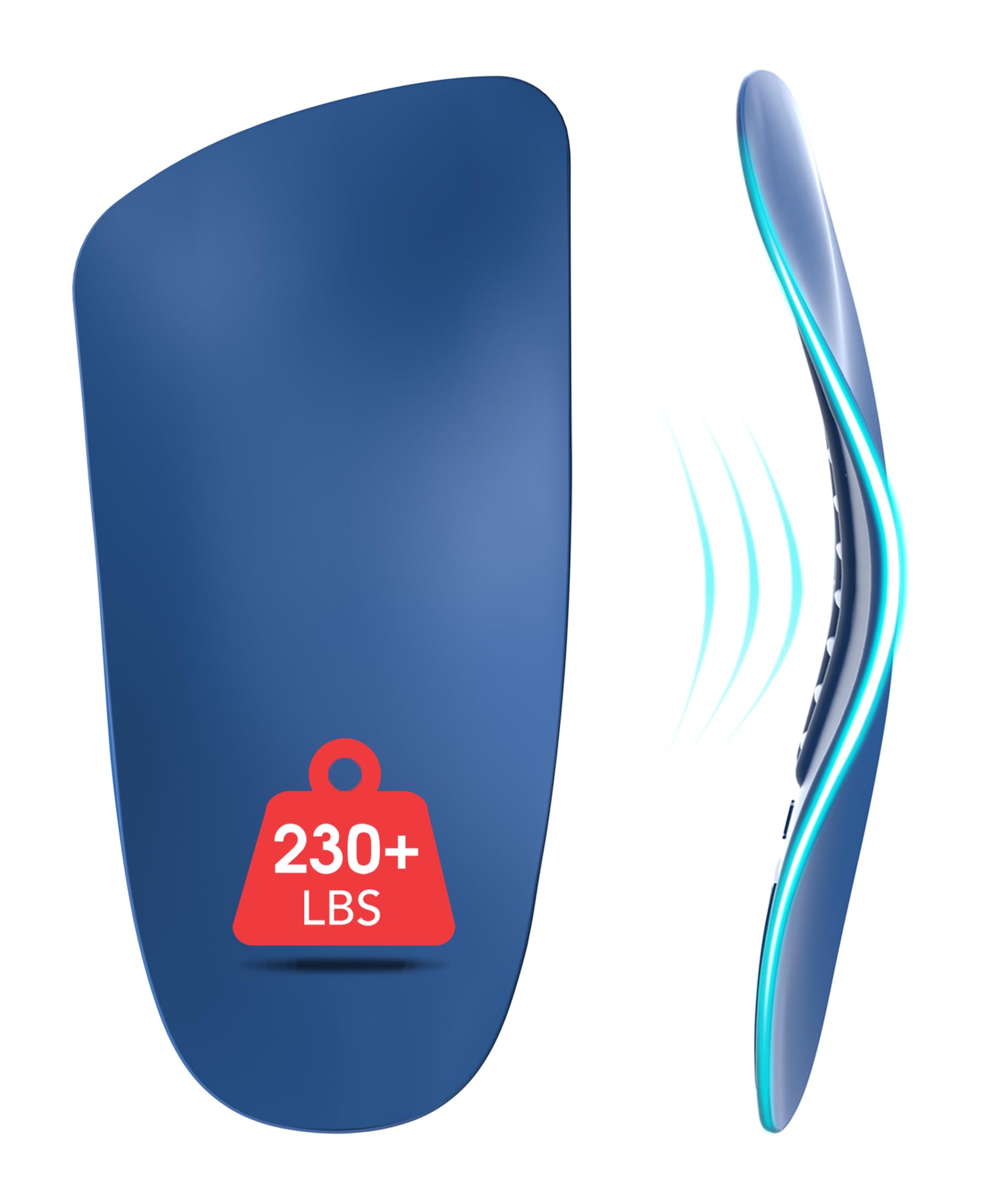
The OUOKK 3/4-length arch insert solves a specific problem that full-length orthotics cannot: fitting into shoes with limited space in the toe box. By stopping before the metatarsal heads, this insole fits into flats, high heels, narrow dress shoes, and even some loafers where a full-length insole would force your toes against the front of the shoe. The 26mm ergonomic arch support is built from a premium TPU elastic material that provides 2+ years of structural life, and the 3/4 design does not require trimming for most foot sizes.
Users with fallen arches who wear tight-fitting footwear reported that the OUOKK inserts eliminated foot fatigue and heel pain during all-day walking without the bulk that makes other orthotics unwearable in slim shoes. The arch support is firm rather than cushioned, which is necessary for correcting the arch position, and the foot massage area along the arch helps disperse plantar fascia pressure during the gait cycle. The brand offers three arch heights (low, medium, high), so buyers should identify their arch type before purchasing — choosing the wrong height will cause discomfort.
The 3/4 length has one inherent limitation: it relies on the shoe’s own forefoot construction for proper motion, so very flexible or worn-out shoes may not provide enough support in the forefoot region. Some users also noted that the insole can shift slightly inside the shoe during vigorous activity unless the shoe has a snug midfoot fit.
Why it’s great
- 3/4 length design fits tight shoes, flats, and heels where full insoles won’t
- 26mm TPU arch support lasts over 2 years with daily use
- Three arch height options let you match your specific arch type precisely
Good to know
- May shift inside shoes with loose midfoot fit during active movement
- No forefoot cushioning — relies on shoe’s existing toe section
- Correct arch height selection is critical; wrong choice causes discomfort
FAQ
How long does it take for arch supports to relieve fallen arch pain?
Can I use 3/4-length arch supports if I have severe fallen arches?
Why do fallen arch supports sometimes hurt the first few days?
Final Thoughts: The Verdict
For most users, the best arch supports for fallen arches winner is the PowerStep Pinnacle Maxx because its firm angled heel and dual-layer cushioning provide the most effective pronation control without requiring a custom molding process. If you want a cork-based insole that custom-molds to your foot over time, grab the FootScientific Type 1. And for standing all day on concrete floors with heavy loads, nothing beats the Welnove Heavy Duty for its gel heel pad and deep stability cup.