
Your carbureted vehicle cranks and cranks before finally catching, or maybe it hesitates on every incline. A tired mechanical pump or a cheap replacement isn’t delivering the consistent pressure your engine demands. Choosing the right fuel pump means matching pressure, flow rate, and voltage draw to your specific engine setup—whether it’s a classic car, a small-block V8, or a tractor.
I’m Min — the co-founder and writer behind Gadgets Feed. I’ve spent countless hours sifting through technical datasheets, buyer experiences, and real-world failure reports to isolate the pumps that actually hold pressure and keep engines running reliably.
This guide breaks down the key specs and real-world trade-offs across seven different options to help you find the best 12 volt electric fuel pump for your build without wasting money on a unit that dies after a few miles.
How To Choose The Best 12 Volt Electric Fuel Pump
Selecting a fuel pump isn’t about picking the highest flow number on the shelf. Your engine’s fuel delivery system—carbureted or electronic fuel injection—dictates the acceptable pressure range. Feeding 7 PSI into an EFI system that expects 40 PSI will starve it; feeding 90 PSI into a carburetor will blow the needle valve wide open. Focus on three pillars: operating pressure, flow rate at that pressure, and fuel type compatibility.
Match Pressure to Your Fuel System
Carbureted engines need low pressure—typically 2 to 9 PSI depending on the carburetor model. Exceed that range and fuel overflows the float bowl. EFI systems require high pressure, often 40 to 90 PSI, to force fuel through the injectors. A 12 volt electric fuel pump designed for a carburetor cannot serve an EFI build and vice versa.
Flow Rate and Horsepower
Flow rate is measured in gallons per hour (GPH) or litres per hour (LPH). A 28 GPH pump handles a stock 4-cylinder or small V6. Performance V8s need 35 GPH or more. The Holley Mighty Mite (32 GPH) is rated for naturally aspirated engines up to 400 HP. Over-speccing flow on a stock engine is fine; underspeccing causes lean conditions under load.
Fuel Composition and Materials
Most pumps labeled for gasoline alone will degrade quickly with ethanol blends above E10. If you run E85 or race fuel, confirm the pump’s internal seals and motor windings are compatible. The Holley unit explicitly supports blended alcohol, ethanol, and diesel. ENGINEMAN pumps explicitly reject E85, methanol, and race fuel—using them with those fuels voids the warranty.
Installation Position and Noise
Inline pumps should be mounted within 12 inches of the fuel tank and below the fuel level if possible to leverage gravity for priming. In-tank pumps require dropping the tank and are common in EFI conversions. Noise is a real concern: rubber mounting isolators and foam padding can tame vibration from copper-wound motors, but some pumps are inherently louder than mechanical units.
Quick Comparison
On smaller screens, swipe sideways to see the full table.
| Model | Category | Best For | Key Spec | Amazon |
|---|---|---|---|---|
| Holley 12-427 Mighty Mite | Premium Carb | 400 HP street machines | 32 GPH at 4-7 PSI | Amazon |
| CarBole 116 PSI Inline | EFI Universal | Turbo injection up to 250 bhp | 120 LPH at 6 bar | Amazon |
| EVIL ENERGY 255LPH EFI Kit | In-Tank EFI | High-horsepower EFI swaps | 255 LPH at 43 PSI | Amazon |
| ENGINEMAN Super 12S Plus | Mid-Range Carb | High-RPM V8 muscle cars | 35 GPH at 5-9 PSI | Amazon |
| ENGINEMAN Micro 4-7 PSI | Compact Carb | Tight engine bays, UTVs | 35 GPH at 4-7 PSI | Amazon |
| ENGINEMAN Full Fuel Kit | All-In-One Value | First-time DIY replacement | 30 GPH at 3-6 PSI | Amazon |
| ENGINEMAN 28 GPH Low Pressure | Budget Entry | Small engines, generators | 28 GPH at 2-3.5 PSI | Amazon |
In‑Depth Reviews
1. Holley 12-427 32 GPH Mighty Mite Electric Fuel Pump, 4-7 PSI

Holley’s Mighty Mite is a legendary name in carbureted fuel delivery, and this 12-427 model delivers exactly what the badge promises: 32 gallons per hour at 4-7 PSI, sufficient for naturally aspirated engines up to 400 horsepower. The solid-state design eliminates the mechanical points of failure found in OEM-style pumps, and the self-priming capability with a 12-inch dry lift means you can mount it near the tank and expect fuel at the carb within seconds of key-on. The all-steel body and alloy steel construction withstand road debris and underhood heat better than plastic-housed units.
Owners consistently report that the Mighty Mite runs quieter than the budget-tier alternatives, especially when isolated with rubber mounting pads or foam on the frame rail. That said, the 2-wire hookup is straightforward, but the pump draws enough current that a dedicated relay (not included) is strongly recommended to avoid frying your ignition switch contacts. A handful of buyers received units that were dead on arrival, though Holley’s warranty process is generally faster than generic Amazon brands.
What sets this pump apart is its fuel compatibility: it handles gasoline, diesel, blended alcohol, ethanol, and even E85 without degrading seals or impellers. That flexibility makes it the go-to choice for a multi-fuel shop tractor, a weekend cruiser running pump gas, or a hot rod that occasionally sips race fuel. It is not designed for aircraft use, per the manufacturer.
Why it’s great
- Broad fuel compatibility including E85 and diesel
- Self-priming with 12-inch dry lift capability
- Solid-state design with proven longevity in street and strip use
Good to know
- Requires an external relay for safe installation
- Some units arrive non-functional out of the box
- Louder than mechanical pumps without isolation mounting
2. CarBole External In Line Fuel Pump: 116 PSI High Pressure Universal 12V

The CarBole external inline pump targets the aftermarket EFI crowd who need high pressure without dropping the fuel tank. It delivers 120 litres per hour at 6 bar (87 PSI) and can push up to 116 PSI, which covers turbo and non-turbo injection systems up to roughly 250 bhp. The fuel injection molding technology used on the plastic and rubber components resists corrosion better than older composite housings, and the included mounting clamp, rubber connection covers, and insulated terminals make wiring straightforward for someone with mechanical experience.
This pump directly replaces the OEM 0580464070 and similar part numbers, but it is not a direct OE-level fit—expect to adapt hoses and brackets. The inlet is a full ½ inch (12 mm) while the outlet is ¼ inch (8 mm), which can be confusing if your existing lines use a single diameter. The pump is rated for gasoline and diesel but explicitly incompatible with fuels containing 15 percent or more methanol or ethanol, so E85 users must look elsewhere. Some owners report the pump hums audibly when running, which can be addressed by remote-mounting it toward the rear of the vehicle.
The lack of included installation instructions is a genuine friction point, especially for a first-time EFI converter. However, the build quality and pressure consistency are well-regarded by those who have run it for several months. If you need a reliable high-pressure inline solution for a moderate-horsepower EFI swap, this unit provides strong value at a fraction of the cost of a Bosch or Walbro.
Why it’s great
- 116 PSI max pressure supports turbo EFI systems
- Corrosion-resistant injection-molded body
- Includes mounting hardware and insulated terminals
Good to know
- No installation instructions included
- Not compatible with high-ethanol blends like E85
- Inlet and outlet are different diameters (1/2″ vs 1/4″)
3. EVIL ENERGY EFI 255LPH Electric Intank Fuel Pump High Flow 43 PSI Kit
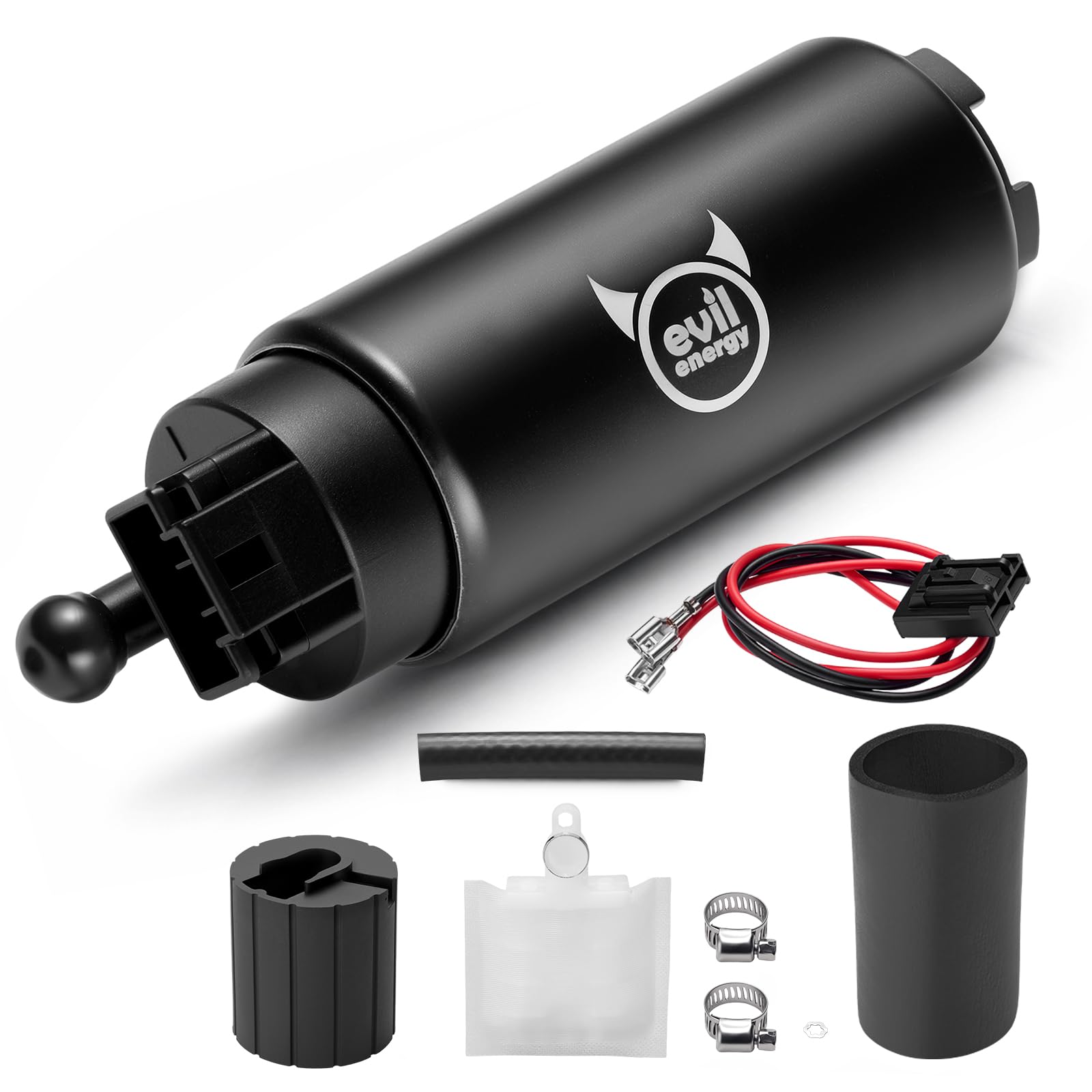
The EVIL ENERGY 255LPH in-tank pump is the budget entry into high-flow EFI territory, delivering 255 litres per hour at 43 PSI and maintaining 190 LPH at 80 PSI. It is designed exclusively for 12V DC EFI systems and the final pressure is set by your regulator, not the pump itself. The aluminum body and tank-mount design make it a direct fit for many GM and universal EFI conversion applications, though the physical diameter can differ slightly from factory pumps—some trimming or hose adaptation may be required.
Customer feedback is polarized: many owners report smooth operation and consistent pressure for months, while a notable subset experienced early check valve failures caused by tank debris or pump wall fitment issues. A pre-filter is essential, and several installed an inline spring-loaded check valve to address priming delays after the pump sits idle. The pump runs audibly, which is typical for in-tank units, but the noise seems more pronounced than OEM assemblies.
The included complete install kit with wiring and connectors simplifies the swap significantly, but professional installation is recommended if you are not comfortable dropping a tank. For the price, this pump punches well above its weight in flow capacity, but the mixed reliability reports suggest it works best as a well-maintained upgrade rather than a “set and forget” daily driver solution.
Why it’s great
- Impressive 255 LPH flow rate at 43 PSI
- Aluminum body resists corrosion in-tank
- Comes with complete install kit and wiring
Good to know
- Check valve prone to failure from tank debris
- Physical fitment may require trimming or hose adaptation
- Inconsistent longevity; some units fail within 8 months
4. ENGINEMAN Universal 12 Volt Electric Fuel Pump Super 12S Plus 5-9 PSI, 35GPH
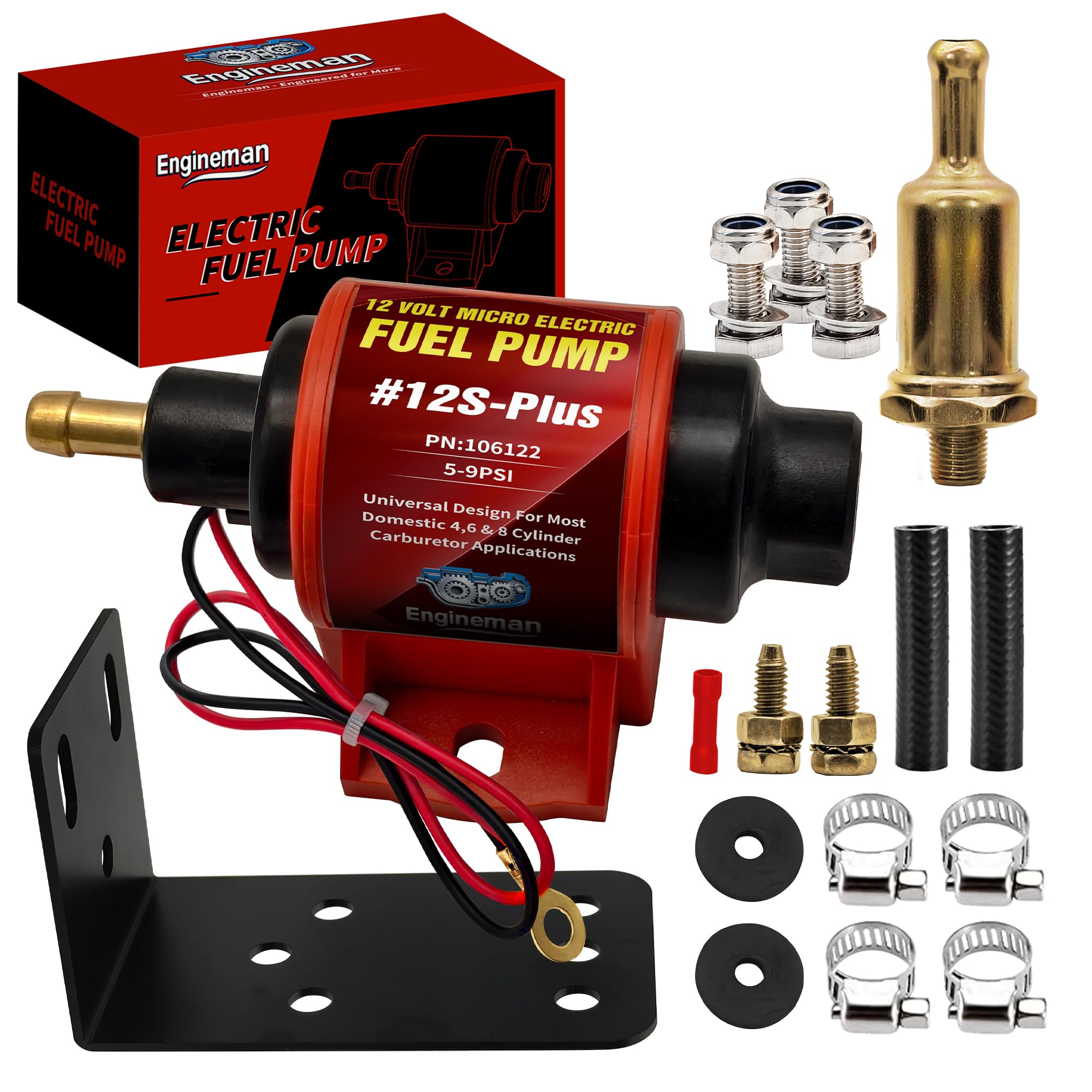
The Super 12S Plus from ENGINEMAN steps up the pressure range to 5-9 PSI while maintaining a solid 35 GPH flow rate, making it suitable for high-RPM carbureted engines in muscle cars and performance trucks where a standard 3 PSI pump would lean out under load. The copper-wound motor draws 1.0-2.0 amps, and the vibration-dampening construction helps keep noise manageable. The included mounting bracket, fuel filter, and 5/16-inch flex hoses let you complete a universal inline installation in under 30 minutes.
Mounting the pump at a 45-degree upward angle allows it to retain fuel internally between startups, ensuring the carburetor bowl refills almost instantly. The pump is designed exclusively for pure gasoline—it explicitly warns against E85, ethanol, methanol, and race fuels. One buyer reported a unit that failed after two minutes of run time, which suggests occasional quality control gaps. The 24-hour endurance testing the manufacturer claims per unit may not catch every borderline motor winding.
For the vast majority of users, however, the Super 12S delivers consistent pressure and quick priming. It is a direct competitor to the Holley Mighty Mite in function but at a fraction of the cost. If you run only pump gasoline and want a dedicated low-pressure pump for a V8 carbureted build, this ENGINEMAN unit represents strong value, provided you install a quality fuel filter upstream.
Why it’s great
- 35 GPH flow supports high-RPM carbureted V8s
- 45-degree mounting bracket retains prime between starts
- Vibration-dampened copper motor runs quietly
Good to know
- Not compatible with E85, ethanol, or race fuels
- Occasional quality control issues with early failures
- Plastic filter housing may crack under high engine bay heat
5. ENGINEMAN Micro Electric Gasoline Fuel Pump 4-7 P.S.I. 35GPH
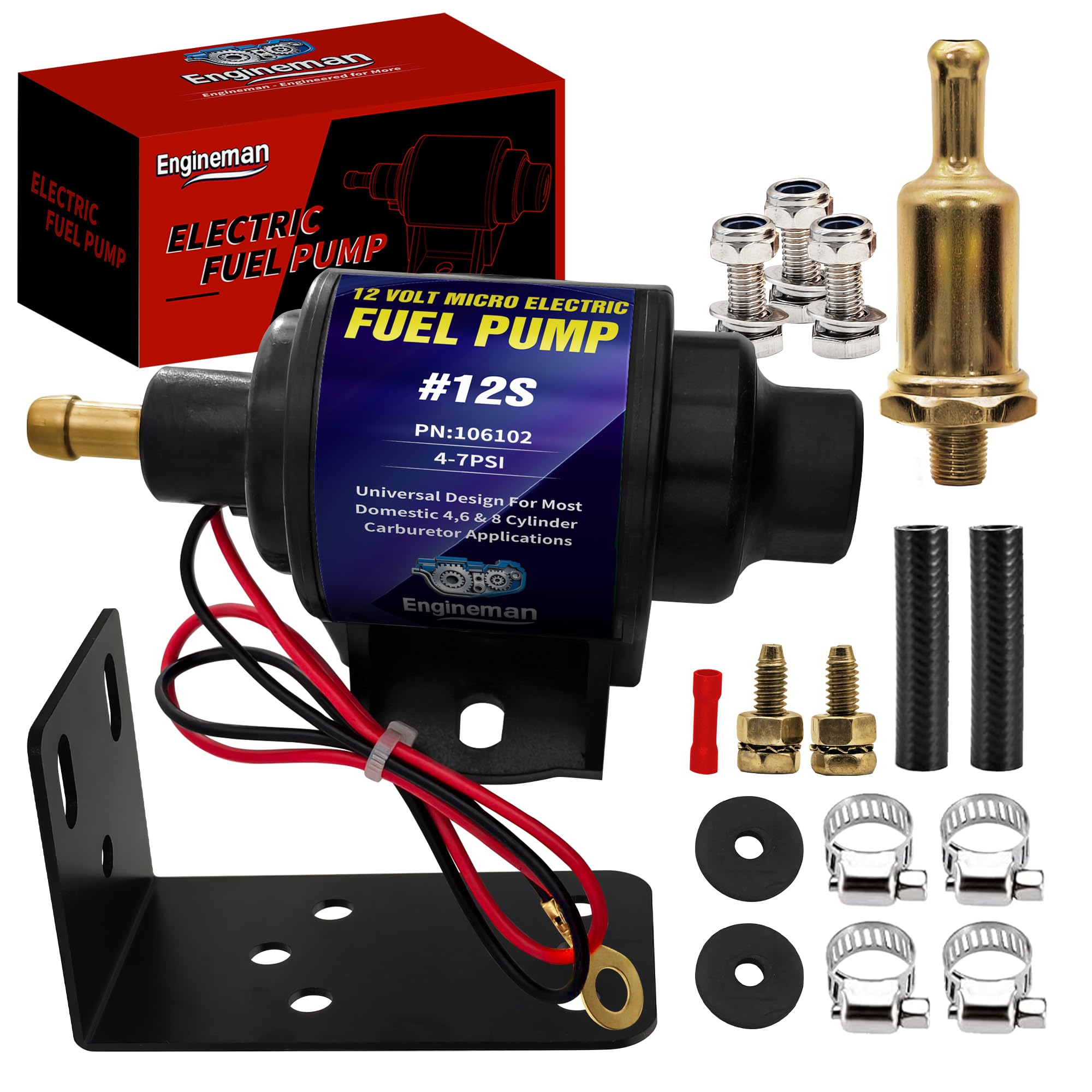
The Micro version from ENGINEMAN hits the same 35 GPH peak as the Super 12S but regulates pressure to 4-7 PSI—a sweet spot for most standard carburetors on small-block V8s and 6-cylinder engines. Its compact housing fits into cramped engine bays where a full-length pump won’t slide in next to the frame rail. Like its siblings, it includes the full mounting kit: bracket, filter, hoses, clamps, and wiring for a quick install.
Self-priming is instantaneous according to multiple verified buyers, and the pump moves fuel quickly despite its small footprint. The copper motor draws the same 1.0-2.0 amp range, so adding a relay is still a good idea on older harnesses. A few long-term users reported the pump began to lose prime after 24 hours of cumulative run time, suggesting the internal check valve may wear faster than larger, more expensive units.
The biggest limitation remains fuel compatibility: pure gasoline only. Users who tried ethanol blends or race fuel saw the internal seals swell quickly. If you need a low-pressure pump for a ’64 Chevy pickup that only sees pump gas on weekends, this Micro unit is a perfectly adequate drop-in solution that won’t strain your budget.
Why it’s great
- Compact body fits in tight bays and utility vehicles
- Self-primes instantly for quick cold starts
- Complete installation kit included
Good to know
- Check valve durability may decline after 24 hours of use
- Gasoline-only; no ethanol or race fuel compatibility
- Some users report internal wear on long daily commutes
6. ENGINEMAN Universal Electric Fuel Pump Kit 12V 3-6 PSI with Fuel Filter and Fuel Line
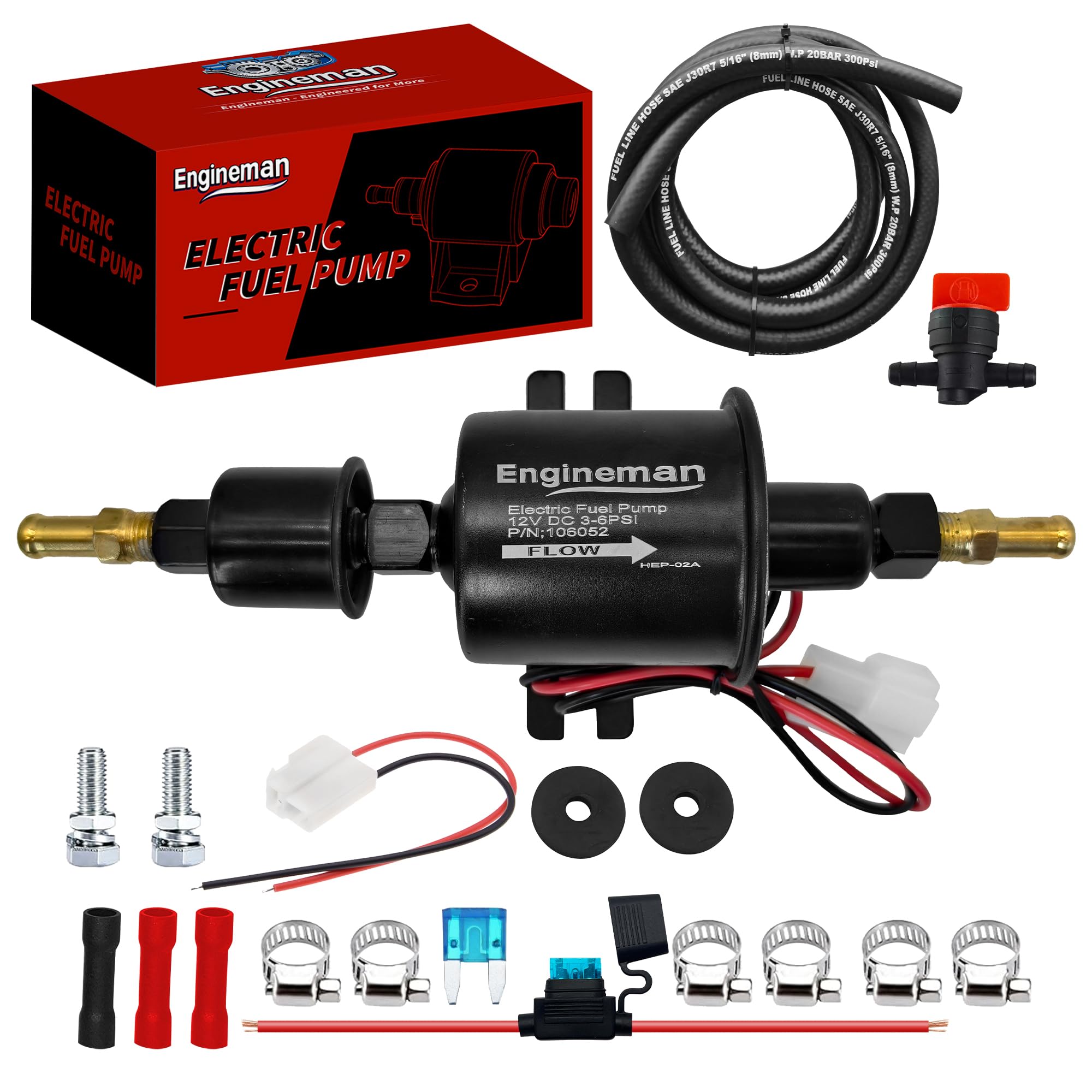
This kit is the most complete plug-and-play option of the entire group, bundling the pump with 6.56 feet of 5/16-inch ID fuel line, a fuel filter, six hose clamps, mounting screws, a 15-amp inline fuse, two shut-off valves, and wire connectors. It is designed for universal 12-volt applications on cars, trucks, boats, lawn mowers, and small engines, delivering 30 GPH at 3-6 PSI. The pump itself uses the same proven copper-wound motor family as the other ENGINEMAN units but with a refined check valve that reduces operational noise.
The included 15-amp fuse is a lifesaver for DIY installers who otherwise skip inline fusing and risk wiring fires. The fuel line is rated from -86°F to 158°F, so it handles engine bay heat better than generic rubber hose. Users have successfully installed this kit on modified Club Car golf carts, Ariens garden tractors, and old Gleaner combines, replacing pulse-operated mechanical pumps that were difficult to prime. A fuel pressure regulator is still recommended to keep the output steady, especially on engines with sensitive carburetors.
The pump handles both gasoline and diesel, but like the rest of the ENGINEMAN line, it excludes alcohol-based fuels like E85. The shut-off valves let you isolate the pump during maintenance without draining the tank, a thoughtful inclusion rarely seen at this price point. If you are converting a small engine or classic tractor from a mechanical pump to electric and want everything in one box, this kit saves you multiple trips to the hardware store.
Why it’s great
- Includes everything: pump, hose, fuse, clamps, shut-off valves
- Temperature-rated fuel line handles engine bay heat
- Quieter operation than standard ENGINEMAN units
Good to know
- 30 GPH flow may limit high-horsepower applications
- No E85 or alcohol fuel compatibility
- Shut-off valves are basic plastic; replace with metal for permanence
7. ENGINEMAN Gasoline Electric Fuel Pump Universal 5/16 Inch 12V 1-2A 28GPH 2-3.5 PSI
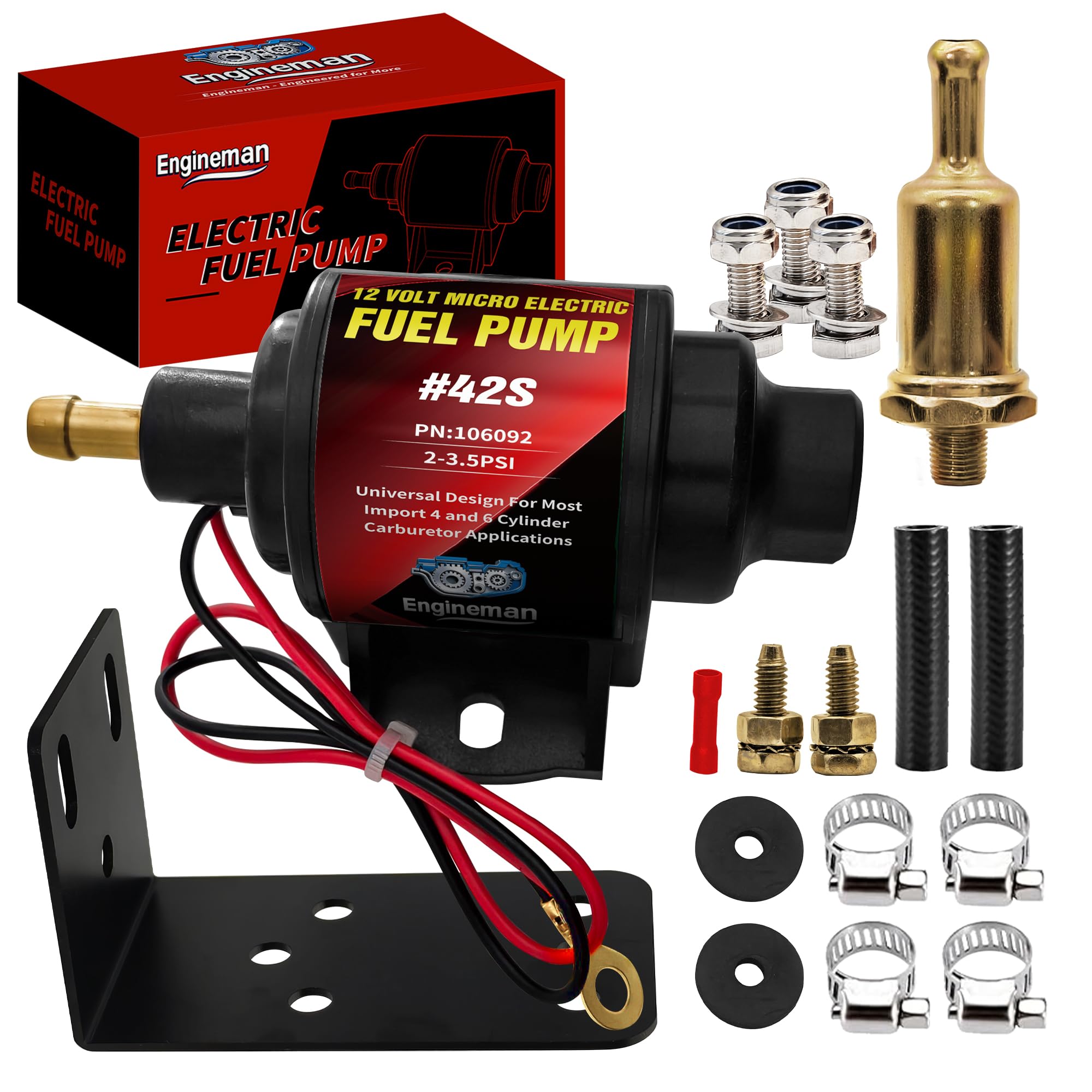
The entry-level 28 GPH pump from ENGINEMAN targets the gentlest end of the fuel delivery spectrum: 2-3.5 PSI at 28 GPH, perfect for carbureted 4-cylinder engines, small RV generators, lawnmowers, and forklifts. The copper-wound motor draws only 1.0-2.0 amps, making it safe to run on older wiring without a relay. Like the entire ENGINEMAN family, it comes with the mounting bracket, fuel filter, and 5/16-inch hoses for a universal inline install.
Buyers praise it for eliminating vapor lock on Austin-Healey 1275 engines and providing consistent fuel delivery to Briggs & Stratton-powered generators. Several owners noted the pump runs quietly enough to be heard ticking over only when the engine is off. The 45-degree mounting bracket retains prime between starts, which is critical for small engines with long fuel lines that drain back to the tank. On the flip side, the low pressure output makes it unsuitable for any performance application or high-demand V8.
One experienced user pointed out that running this pump at reduced voltage (5V instead of 12V) when fuel consumption is low can extend its lifespan by reducing heat and wear. That trick speaks to the overall design: it is a simple, affordable, low-pressure pump that thrives in applications with modest fuel demands. If you are replacing a dead pump on a generator or keeping a 1960s British roadster on the road, this unit is the most cost-effective choice available.
Why it’s great
- Ultra-low 2-3.5 PSI prevents carburetor flooding
- Minimal 1-2 amp draw safe for stock wiring
- Quiet operation suitable for generators and small engines
Good to know
- Too weak for V8 engines or any performance application
- Gasoline-only; avoid ethanol blends
- Plastic mounting bracket may crack under heavy vibration
FAQ
Can I use a 12 volt electric fuel pump meant for a carburetor on an EFI engine?
Why does my electric fuel pump need to be mounted near the fuel tank?
Does a higher GPH pump always mean better performance?
Can a 12 volt fuel pump handle E85 or race fuel?
Why does my electric fuel pump make a loud clicking noise?
Final Thoughts: The Verdict
For most users, the best 12 volt electric fuel pump winner is the Holley 12-427 Mighty Mite because it delivers reliable 32 GPH flow at 4-7 PSI, supports multiple fuel types including E85, and has proven longevity in daily drivers and weekend projects alike. If you need a high-pressure inline pump for an EFI conversion, grab the CarBole 116 PSI Inline. And for a budget-friendly small engine or generator replacement, nothing beats the ENGINEMAN 28 GPH Low Pressure pump.