
Choosing an audio capture card means sifting through specifications like maximum sample rate, gain range, and preamp noise floor to find the unit that won’t color your raw signal. Whether you’re connecting a dynamic microphone for a podcast or an instrument for a live stream, the interface between your source and your computer determines whether your final recording sounds thin or broadcast-ready.
I’m Min — the co-founder and writer behind Gadgets Feed. I’ve spent hundreds of hours combing through technical datasheets, customer feedback, and A/B comparisons of preamp performance to isolate which audio interfaces truly deliver on their promises for creators who need reliable, low-noise capture.
This guide breaks down seven of the most compelling options available today, evaluating everything from headroom and latency to onboard DSP, so you can confidently choose the best audio capture card for your specific workflow and budget.
How To Choose The Best Audio Capture Card
The landscape of audio interfaces spans from pocket-sized XLR dongles to full-fledged production consoles. Knowing which features matter most for your use case—streaming, podcasting, or music production—prevents overspending on unnecessary channels or underspending on critical preamp quality.
Preamp Gain and Noise Floor
The preamp is the heart of any audio capture card. For dynamic microphones like the Shure SM7B, you need at least 60dB of clean gain without introducing audible hiss. The noise floor, measured in dBV EIN (Equivalent Input Noise), directly determines how black your silence sounds between words. Lower is better.
Sample Rate and Bit Depth
While 48 kHz at 24-bit is the standard for video and podcasting, higher rates like 96 kHz or 192 kHz reduce latency and preserve ultrasonic frequencies for music production. However, most streaming platforms cap audio at 48 kHz, so paying extra for 192 kHz only benefits recording engineers working with virtual instruments or high-resolution formats.
Connectivity and Loopback
Loopback mixing allows you to route computer audio, microphone input, and a secondary device into one stream — essential for live streaming or remote podcasting where you need to share your screen audio without echo. Look for dedicated mix controls or software that enables independent routing for each application.
Quick Comparison
On smaller screens, swipe sideways to see the full table.
| Model | Category | Best For | Key Spec | Amazon |
|---|---|---|---|---|
| Focusrite Scarlett Solo 3rd Gen | Premium | Studio recording at 192 kHz | 192 kHz / 24-bit | Amazon |
| Universal Audio Volt 176 | Premium | Built-in analog compression | 1176-style compressor | Amazon |
| RØDE RØDECaster Duo | Premium | All-in-one production console | 76dB gain, APHEX processing | Amazon |
| Focusrite Vocaster One | Mid-range | Solo podcasting with Auto Gain | 70dB gain | Amazon |
| PreSonus Revelator io44 | Mid-range | Integrated DSP mixer | 96 kHz, 7 channels | Amazon |
| MAONO MaonoCaster AME2 | Mid-range | 10-channel mixer with sound pads | 60dB gain, 11 sound pads | Amazon |
| Shure MVX2U | Mid-range | Ultra-compact XLR-to-USB | 60dB gain, zero-latency | Amazon |
In‑Depth Reviews
1. Focusrite Scarlett Solo 3rd Gen

The Scarlett Solo 3rd Gen remains the benchmark for entry-level professional recording, offering a maximum sample rate of 192 kHz at 24-bit resolution through a rugged metal chassis. Its microphone preamp delivers clean gain with switchable Air mode that emulates the high-frequency lift of the classic Focusrite ISA preamp, adding brightness to acoustic instruments and vocals without introducing noise.
Gain Halo metering provides visual feedback to prevent clipping, while two high-headroom instrument inputs allow simultaneous guitar and vocal capture. The unit ships with Pro Tools Intro, Ableton Live Lite, and the Hitmaker Expansion bundle, giving beginners a complete recording ecosystem out of the box. Bus-powered via USB-C, the Solo requires no external power adapter for most setups.
Users consistently praise its durability after years of use and the clarity of its preamps compared to competitors in the same tier. The three-year warranty adds confidence for creators who need a reliable daily driver for both spoken word and music production without complex driver installation.
Why it’s great
- 192 kHz / 24-bit conversion for pristine audio capture
- Air mode enhances high-frequency detail without added noise
- All-metal chassis survives regular travel and setup changes
Good to know
- Only one XLR input, limiting multi-mic recording
- Air mode requires activation via software, not a hardware switch
2. Universal Audio Volt 176

The Volt 176 distinguishes itself from the crowded mid-range field by integrating an analog compressor circuit directly based on the vintage UA 1176, controllable via a single knob that blends from gentle limiting to aggressive punch. This onboard compression happens before the A/D conversion, meaning you capture compressed audio straight into your DAW without any post-processing CPU load or latency.
Its preamp also features Vintage mode, modeled after the iconic UA 610 tube preamp, adding a warm, harmonically rich character to both dynamic and condenser microphones at the flip of a switch. The unit supports 192 kHz recording and comes bundled with the LUNA DAW and a suite of UAD plugins that run natively on the host computer.
Build quality is exceptional, with a weighted metal body and tactile knobs that provide precise control. The headphone output is powerful and clean, suitable for high-impedance monitoring. While phantom power resets on sleep, all other settings persist after power cycling, making it reliable for consistent studio patching.
Why it’s great
- Hardware compressor derived from the 1176 for zero-latency dynamics
- Vintage preamp mode adds tube-emulated warmth
- High headroom instrument input handles hot pickups cleanly
Good to know
- Compressor control blends with gain rather than offering independent threshold
- Phantom power does not survive sleep mode without manual toggle
3. RØDE RØDECaster Duo
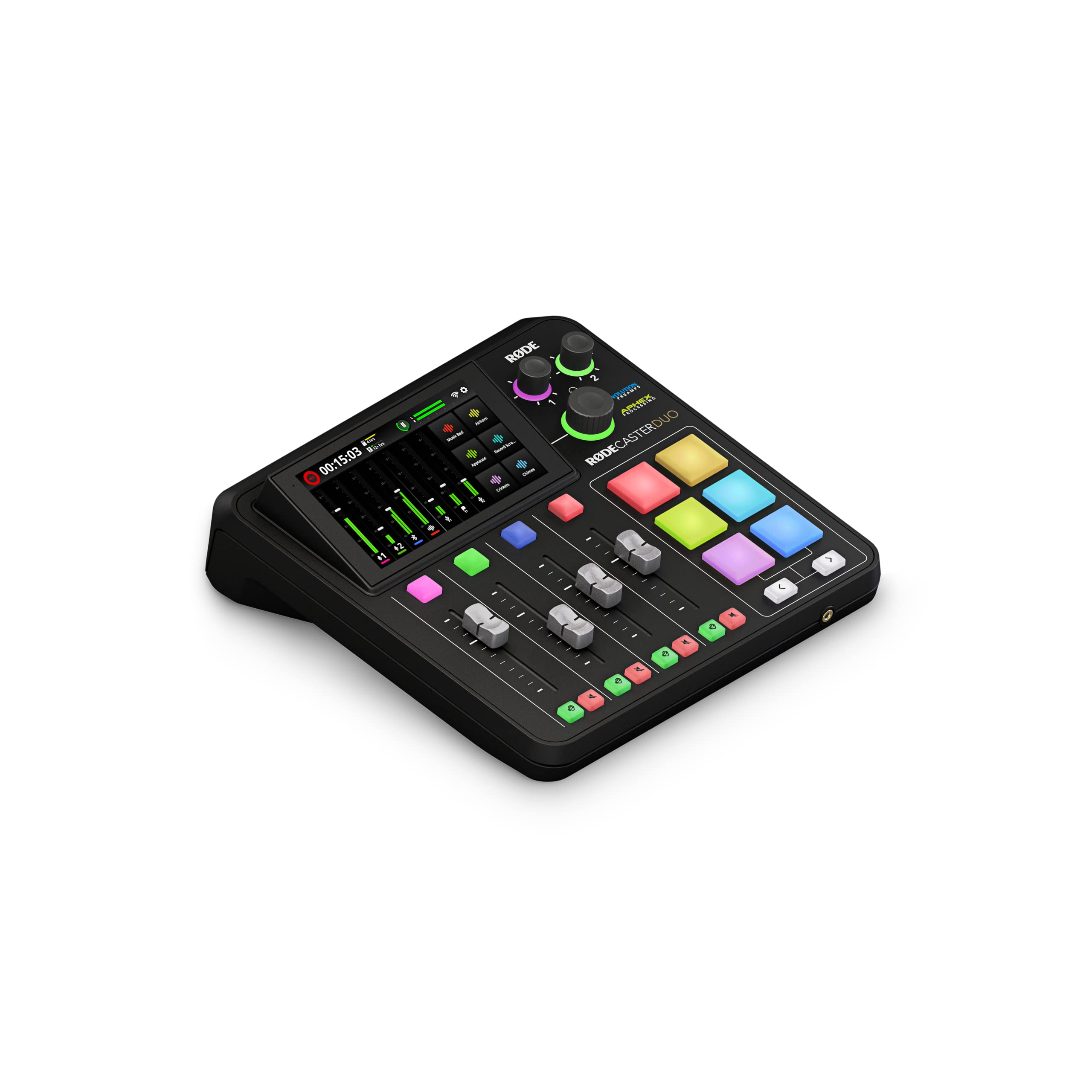
The RØDECaster Duo is a complete audio production console disguised as a compact desktop unit, featuring two Neutrik combo inputs with ultra-low-noise Revolution Preamps rated at -131.5dBV EIN and a staggering 76dB of clean gain — enough to drive the most demanding ribbon mics without external boosters. Its high-resolution touchscreen with haptic feedback provides intuitive control over routing, effects, and recording parameters.
Built-in APHEX processing includes the legendary Aural Exciter and Big Bottom effects, applied in real-time to any input channel without additional hardware or software. Four broadcast-quality faders control independent mix minus routing, ideal for remote interviews where each caller hears a custom mix without echo. Six SMART pads with bank switching trigger sound effects, jingles, or MIDI commands during live streams.
The unit records directly to microSD card or via USB-C to a computer, supporting multitrack capture for post-production editing. While the learning curve is steeper than a basic interface, creators who master its routing capabilities gain a portable broadcast studio that eliminates the need for multiple external processors.
Why it’s great
- 76dB gain and -131.5dBV EIN for whisper-quiet preamps
- Onboard APHEX processing with no CPU overhead
- Four faders with mix minus for seamless remote calls
Good to know
- Setup requires careful reading for complex routing scenarios
- Firmware bugs occasionally require full power cycle to resolve
4. Focusrite Vocaster One

The Vocaster One is purpose-built for solo podcasters who need broadcast-quality sound without technical fuss, offering over 70dB of gain that drives dynamic microphones like the Shure SM7B without an external cloudlifter. The standout Auto Gain feature sets optimal levels instantly with a single button press, while Enhance provides four podcast-approved presets that apply compression, EQ, and excitation to polish spoken word in real-time.
Phone connectivity via a single TRRS cable allows remote guest capture with full conversation recording, while stereo loopback grabs computer audio for seamless intro music or sound effects during live streams. A dedicated hardware mute button lets you cut coughs or background noise instantly, and the camera output sends processed audio directly to your DSLR or mirrorless camera for video recording.
The compact plastic chassis is lightweight and bus-powered via USB-C, making it highly portable for mobile podcasting. Some users report the included USB cable is short and susceptible to interference, but swapping to a shielded ferrite-core cable resolves connectivity issues entirely.
Why it’s great
- 70dB+ gain drives demanding dynamic mics without boosters
- Auto Gain and Enhance presets simplify post-production
- Dedicated phone and camera outputs for versatile recording
Good to know
- Plastic build feels less robust than metal competitors
- Software lacks granular EQ and compression controls
5. PreSonus Revelator io44

The Revelator io44 packs a full DSP mixer into a compact USB-C interface, enabling on-board effects processing including reverb, compression, EQ, and Voice FX that operate independently from your computer’s CPU. This makes it ideal for live streaming where low latency is critical, as audio is processed directly on the interface before reaching your streaming software.
Its four flexible inputs accept XLR microphones, instrument cables, and stereo sources simultaneously, while seven virtual channels allow you to blend audio from up to three applications (DAW, browser, game) into a single stream. The XMAX-L mic preamp delivers 50dB of clean gain with switchable +48V phantom power, suitable for both dynamic and condenser microphones.
Studio One Artist DAW is included, providing a complete recording environment for music production. The interface is bus-powered and works with Windows, macOS, and mobile devices via USB-C. Some users experienced early firmware bugs with headphone noise, but PreSonus has issued patches that resolved the issues for most configurations.
Why it’s great
- Onboard DSP processes effects without taxing the host computer
- Seven virtual channels for complex multi-application routing
- Compact design with loopback for streaming and remote collaboration
Good to know
- Preamps don’t match the headroom of dedicated high-end interfaces
- Some users report RF interference requiring ferrite-core USB cables
6. MAONO MaonoCaster AME2

The MaonoCaster AME2 delivers a 10-channel mixing board experience at entry-level pricing, featuring a professional preamp with up to 60dB of gain and 48V phantom power for XLR microphones, plus Bluetooth input for wireless audio sources. Its standout feature is the array of 11 customizable sound pads — three capable of recording up to 60 seconds each with one-key looping, and eight supporting 20-second clips — perfect for live streamers who need instant sound effect triggers.
Six reverb modes, 12-step auto-tune, three-band EQ, and pitch changer knobs give vocalists extensive tone shaping without additional plugins. The unit includes dedicated outputs for streaming via USB-C, connecting a smartphone via LIVE-OUTPUT for simultaneous recording, and monitoring through studio speakers or headphones.
Guitar and bass players can plug directly into the 6.35mm instrument input with high headroom for clean capture. While the build quality is plastic-based and lightweight, the feature density is exceptional for the price. However, some users reported reliability issues after extended use, with USB-C port failures appearing after roughly one year of regular operation.
Why it’s great
- 11 customizable sound pads with looping for live streaming flair
- Bluetooth input and six reverb modes for vocal versatility
- Dual device output for simultaneous streaming and recording
Good to know
- USB-C port failure reported after prolonged use
- Headphone monitoring differs slightly from final stream audio
7. Shure MVX2U

The MVX2U is Shure’s solution for transforming any XLR microphone into a USB plug-and-play device, condensing a full 60dB preamp, 48V phantom power, and a zero-latency headphone monitoring jack into a package barely larger than a USB stick. This tiny form factor makes it ideal for remote recording, mobile journalism, or creators who need to swap between different microphones without managing multiple interfaces.
Setup requires zero driver installation — plug the included USB-C cable into your computer or iPad, connect your XLR mic, and the MVX2U appears as a standard audio device. The ShurePlus desktop app provides compression, EQ, high-pass filter, and limiter controls, all of which persist after unplugging, so your settings travel with the device. Auto Level Mode sets optimal gain automatically for hands-free operation during live streams.
Dual mounting options allow the MVX2U to attach directly to the microphone’s XLR port or sit inline via cable. The preamp delivers clean, studio-quality sound with no audible noise floor, even with high-output condensers. While it lacks multi-channel capability or onboard DSP effects, its portability and build quality make it a compelling choice for minimalists who prioritize simplicity and reliability.
Why it’s great
- Ultra-compact design with studio-quality 60dB preamp
- Zero-latency headphone monitoring for real-time performance check
- Settings persist without software, enabling portable presets
Good to know
- Single XLR input limits multi-mic recording scenarios
- No onboard DSP effects or loopback routing
FAQ
Will a higher sample rate reduce latency in my audio capture card?
What is the difference between USB-C and USB-B on an audio interface?
Can I use an audio capture card with my iPhone or iPad?
Do I need an audio interface if my microphone has a USB output?
Final Thoughts: The Verdict
For most users, the best audio capture card winner is the Focusrite Scarlett Solo 3rd Gen because it delivers 192 kHz recording, proven preamp quality, and a durable all-metal chassis at a price that makes sense for both beginners and experienced creators. If you want built-in analog compression and vintage tube-emulated warmth, grab the Universal Audio Volt 176. And for an all-in-one broadcast console with APHEX processing and multi-fader routing, nothing beats the RØDE RØDECaster Duo.