
A stock cable is the weakest link in your chain, bottlenecking the resolution your planar magnetic drivers or balanced armatures are capable of. The wrong conductor geometry or inferior shielding introduces audible noise, smears the soundstage, and dulls the transient attack that defines live instrumentation.
I’m Min — the co-founder and writer behind Gadgets Feed. I’ve spent hundreds of hours analyzing conductor purity grades, dielectric insulation types, termination metallurgy, and weave topologies to separate genuine acoustic upgrades from placebo-marketed wire.
This guide targets the narrow market of best audiophile headphone cables, each chosen for measurable improvements in clarity, channel separation, and noise floor reduction across IEMs and full-size headphones.
How To Choose The Best Audiophile Headphone Cables
The right cable preserves the original waveform with minimal phase shift and resistance. Three specifications define whether a cable upgrades or merely replaces your stock wire.
Conductor Material and Purity
Oxygen-Free Copper (OFC) and Ohno Continuous Cast (OCC) copper are the baseline. OCC copper, often graded as 6N (99.9999% pure), reduces grain boundaries that cause signal scattering. Silver-plated OFC boosts high-frequency extension but can sound bright if the plating is inconsistent. Pure silver offers the highest conductivity but introduces a leaner tonal balance.
Termination and Connector Quality
The connector is the most mechanically stressed point. Look for gold-plated brass or beryllium copper housings with strain relief boots. Balanced terminations — 2.5mm TRRS, 4.4mm Pentaconn, or 4-pin XLR — double the voltage swing available to your headphones, improving dynamic range and channel separation when paired with a balanced amplifier.
Geometry and Dielectric
Braid patterns reduce microphonics (cable-borne noise). Twisted-pair or Litz constructions minimize inductance and skin-effect distortion. Insulation materials like polyethylene foam or nitrogen-injected dielectric lower capacitance, preserving high-frequency transients that cheap PVC jackets smear.
Quick Comparison
On smaller screens, swipe sideways to see the full table.
| Model | Category | Best For | Key Spec | Amazon |
|---|---|---|---|---|
| Meze Audio Mono 3.5mm | Silver-Plated OFC | Meze 99 users, balanced upgrade | 8-wire braid, 25 strands per wire | Amazon |
| GUCraftsman MMCX 6N Silver | 6N OCC Silver | SHURE SE846, Campfire IEMs | 26 AWG Litz, 4.4mm balanced | Amazon |
| Audio-Technica HDC114A/1.2 | Proprietary A2DC | ATH-SR9, ATH-ADX3000 owners | 4.4mm 5-pole balanced L-type plug | Amazon |
| GUCraftsman 6N Silver XLR | 6N OCC Silver | Audeze LCD, Meze Empyrean | 6 ft length, 4-pin XLR ready | Amazon |
| AudioQuest Red River (XLR) | Long Grain Copper | XLR interconnect, high-end DAC/AMP | Triple-balanced, foam dielectric | Amazon |
| AudioQuest Big Sur 3.5mm | PSC+ Copper | Portable DAC, desktop speaker link | Solid Perfect-Surface Copper+ | Amazon |
In‑Depth Reviews
1. AudioQuest Red River (XLR, 1.0m)

The AudioQuest Red River employs Long Grain Copper (LGC) conductors — a step above standard OFC — with a triple-balanced geometry that keeps the positive, negative, and ground paths electrically separate. The polyethylene foam insulation lowers dielectric absorption, preserving the attack of percussive transients and the air around cymbal crashes.
Users report tightened, cleaner bass response when replacing unbalanced cables in systems like McIntosh amps paired with Sonus Faber speakers. The triple-layer noise-dissipation system (metal and carbon-loaded synthetics) effectively shunts RFI and EMI that otherwise muddy the midrange.
This is an interconnect cable, not a headphone cable, but it belongs here because many audiophiles use XLR runs between DACs and headphone amplifiers. If your balanced chain ends at a headphone amp, the Red River ensures the signal reaching that amp is as phase-accurate as the source intended.
Why it’s great
- Triple-balanced design eliminates crosstalk between channels
- Foam dielectric reduces timing smear on high-frequency content
- Cold-welded terminations avoid solder-induced signal degradation
Good to know
- Some users found bass attenuation compared to high-quality unbalanced cables
- Best value only when XLR is the weakest link in your chain
2. Meze Audio Mono 3.5mm Silver-Plated Headphone Cable

The Meze Audio Mono cable uses eight individually insulated wires braided into four continuous strands, each containing 25 strands of silver-plated OFC. This geometry lowers resistance and inductance enough to make the 99 Classics and 99 Neo sound significantly more open, with tighter low-end and sweeter vocal presence.
Owners report that the 4.4mm balanced variant transforms the 99 Classics into a pair that competes with the – bracket — improved depth, air, and micro-detail retrieval that the stock cable masks. The soft nylon jacket eliminates the stethoscope effect that plagues stiff braided cables.
Compatibility extends beyond Meze headphones; any headphone with 3.5mm TS mono earcup inputs can use this cable. The silver-plating adds brightness without crossing into harshness, making it a safe upgrade for warm-leaning headphones.
Why it’s great
- Significant soundstage expansion and imaging accuracy improvement
- Low microphonics — no cable handling noise during listening
- Gold-plated 3.5mm TRS plug ensures corrosion-resistant contact
Good to know
- Right/Left channel markings on connector are difficult to read
- Short connection barrel on some Focal models requires careful seating
3. GUCraftsman MMCX 6N Single Crystal Silver 4.4mm

Constructed from true 6N (99.9999%) single-crystal silver with a soft PVC sheath, this cable delivers the high-frequency extension and low-noise floor expected from a pure-silver conductor at a fraction of boutique pricing. The hand-woven Litz geometry minimizes skin-effect distortion, keeping the signal coherent across the entire frequency band.
Users pairing it with SHURE SE846s and Sony WM1AM2 players report a soundstage that rivals cables costing three times as much. The MMCX connectors are tight and secure, eliminating the rotational looseness that causes intermittent channel dropout on some aftermarket cables.
Compatibility spans a wide range: Beyerdynamic Xelento, Campfire Audio Andromeda, iBasso IT04, Dunu DK4001, JVC FW001, and many more. The 4.4mm Pentaconn plug is the modern balanced standard, offering higher channel separation than 2.5mm TRRS.
Why it’s great
- 6N OCC silver purity exceeds typical OFC by a wide margin
- Hand-braided Litz weave resists tangling and microphonics
- Sturdy MMCX connectors with positive locking feel
Good to know
- Inconsistent quality control — some units arrived with bent connector pins
- PVC sheath can develop a chemical smell in hot climates
4. GUCraftsman 6N OCC Silver for Audeze / Meze (4.4mm)
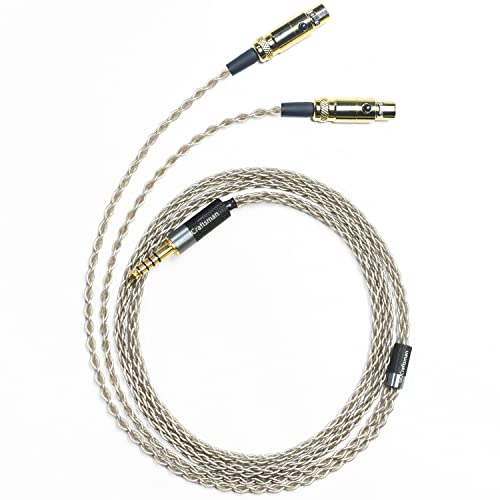
This cable uses custom-annealed 6N OCC silver conductors to achieve unusual pliability for a pure-silver cable — critical for desktop listening where stiff cables pull on headphone jacks. It terminates in a 4.4mm balanced plug and is compatible with Audeze LCD-2/3/4/X/XC, Meze Empyrean/Elite, and Kennerton Thror.
Users switching from the stock Audeze cable note a wider soundstage with more accurate imaging and increased headroom on planar magnetic drivers. The silver adds sparkle to the top end without making the midrange lean — a balance that Audeze owners often find elusive with aftermarket silver cables.
At 6 feet, this cable is long enough for rack-mounted amplifier setups without requiring an extension. The braided weave is flexible enough to route neatly behind a desk, though the PVC jacket retains a slight memory coil out of the box.
Why it’s great
- Custom annealing process makes pure-silver cable unusually flexible
- Noticeable improvement in imaging and stage width over stock Audeze cable
- Secure 4.4mm Pentaconn plug with robust strain relief
Good to know
- Multiple users reported a strong chemical or cigarette smell from the jacket
- Excessive packing tape on the original packaging made unboxing difficult
5. Audio-Technica HDC114A/1.2 4.4mm Balanced

Audio-Technica’s HDC114A is purpose-built for their A2DC (Audio Designed Detachable Coaxial) connector, found on the ATH-SR9, ATH-ES770H, ATH-ESW990H, and the ATH-ADX3000/5000. The 4.4mm 5-pole balanced L-type plug delivers full balanced operation with reduced crosstalk compared to the standard 3.5mm termination.
Owners of the ATH-WP900 report that this cable lifts the overall resolution: high-frequency harmonics on string instruments gain a sense of space, and the bass becomes tighter with better drum resonance articulation. The soundstage opens up noticeably compared to the stock unbalanced cable.
The unique conductor composition is tuned specifically for Audio-Technica’s driver voicing, meaning it maintains the house sound while adding clarity. It is not an exotic OCC silver cable, but its synergy with Audio-Technica headphones makes it the correct upgrade for owners of those specific models.
Why it’s great
- Factory-tuned conductor composition matches AT headphone voicing
- Solid build with excellent solder joints and strain relief
- Improves resolution, bass control, and soundstage depth
Good to know
- Only compatible with headphones using the A2DC connector
- Not OCC copper or silver — conductor purity is typical OFC
6. AudioQuest Big Sur 3.5mm Male to Male
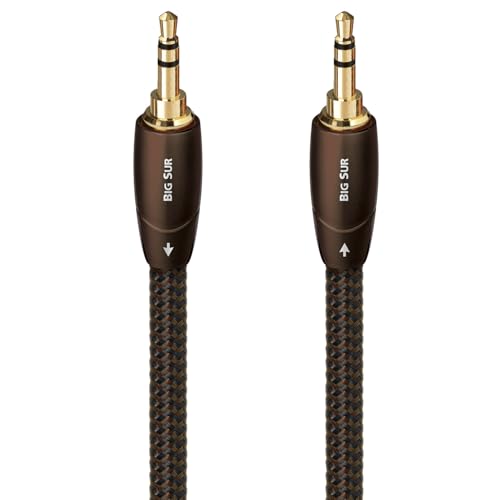
The Big Sur uses AudioQuest’s Solid Perfect-Surface Copper+ (PSC+) conductors, which are drawn to a flawless surface finish that minimizes grain boundary distortion. The nitrogen-injected foam dielectric reduces timing errors that cause soundstage smearing — a measurable benefit over solid PVC insulation.
Users report that replacing a standard 3.5mm cable with the Big Sur between a DAC and powered speakers (like the Ruark MR1 MK3) yields deeper bass articulation, airier highs, and pinpoint imaging. The difference is significant enough that some listeners rate the upgrade as transformative for desktop systems.
This is a 3.5mm interconnect, not a headphone cable, but it directly serves the audiophile who uses a portable DAC/amp stack or connects a digital source to a headphone amplifier via a mini-jack. The noise-dissipation system (carbon-loaded synthetics) is particularly effective at rejecting the RFI common in computer-heavy desktop environments.
Why it’s great
- PSC+ surface finish reduces distortion at the conductor boundary
- Nitrogen-injected foam lowers dielectric absorption vs PVC
- Multi-layer noise-dissipation rejects desktop EMI/RFI
Good to know
- Very high price point; no audible improvement in some budget systems
- Some users found no difference vs quality cables with basic gear
FAQ
Does a silver-plated cable always sound brighter than copper?
Can I use a balanced cable with a single-ended headphone output?
What cable length is ideal for desktop headphone listening?
Final Thoughts: The Verdict
For most users, the best audiophile headphone cables choice is the Meze Audio Mono because it delivers a clear, repeatable improvement in soundstage and imaging across a wide range of headphones at a mid-range price point. If you need a pure-silver IEM cable, the GUCraftsman MMCX 6N Silver offers 6N OCC purity without the boutique mark-up. And for desktop listeners who want a pristine XLR interconnect between their DAC and headphone amplifier, the AudioQuest Red River provides triple-balanced construction that eliminates crosstalk and phase smear at the source.