
An ankle heart rate monitor solves a problem wrist-based optical sensors can’t: keeping the sensor still during explosive movement, cycling toe cages, or high-rep kettlebell swings where your wrist flexes and breaks optical contact. Shifting the sensor mount point from your wrist to your lower leg eliminates the most common source of HR drift in dynamic sports — the wrist-angle dropout.
I’m Min — the co-founder and writer behind Gadgets Feed. I’ve logged hundreds of hours cross-referencing optical sensor datasheets, battery cycle tests, and Bluetooth/ANT+ pairing logs to isolate which ankle-compatible armbands actually deliver zone-accuracy without connectivity drops.
This guide compares six optical armband monitors that can be worn on the lower leg or ankle, balancing sensor precision, strap retention, and multi-protocol connectivity. After reviewing real performance data, here is the definitive lineup of the best ankle heart rate monitor options available today.
How To Choose The Best Ankle Heart Rate Monitor
Selecting an ankle-compatible heart rate monitor means evaluating optical sensor tech, strap design for lower-leg circumference, and wireless protocol support — not just battery life. Most armband HRMs can be worn on the calf or ankle, but strap length and anti-slip grip make or break accuracy during lateral movement.
Optical Sensor Generation and LED Count
First-generation optical sensors using single green LEDs have higher motion artifact rates when worn on the ankle due to thinner skin and more tendon movement near the bone. Newer models with multi-LED arrays (green, red, and infrared) compensate by sampling at higher rates and rejecting noise from leg swing. Look for sensors that advertise ±1BPM accuracy or HRV support — these use additional processing to filter out step-induced jitter.
Strap Retention and Material
An ankle mount experiences more rotational torque than a forearm or chest mount during running and cycling. Silicone-backed straps and wider webbing (1.5 inches or more) resist spinning around the calf. Velcro closures also outperform snap-button designs for the ankle because they allow micro-adjustments — a critical detail when wearing over a sock or compression sleeve.
Wireless Protocol: Dual-Band Is Not Optional
Bluetooth 5.0 alone drops signal when your leg is behind your torso during a bike pedal stroke. ANT+ broadcast is the failsafe protocol for cycling computers and gym consoles because it maintains a 360-degree signal emission. Any ankle heart rate monitor worth buying must support both Bluetooth and ANT+, not just one. Single-protocol units may work on a phone but will fail to pair with a Peloton Bike+, a Garmin Edge, or a Wattbike.
Quick Comparison
On smaller screens, swipe sideways to see the full table.
| Model | Category | Best For | Key Spec | Amazon |
|---|---|---|---|---|
| Scosche Rhythm+ 2.0 | Optical Armband | EKG-validated accuracy | 24-hour battery, IP68 | Amazon |
| COOSPO HW9 | Optical Armband | 35-hour endurance | ±1BPM, Bluetooth 5.0 | Amazon |
| HandPlus | Optical Wearable | Offline storage, swim use | 72-hour offline storage | Amazon |
| Garmin HRM 200 | Chest Strap | Garmin ecosystem pairing | 1-year battery, 3 ATM | Amazon |
| Wahoo TRACKR | Chest Strap | 200-hour rechargeable | 200-hour battery, USB-C | Amazon |
| Garmin HRM 600 | Chest Strap | Running dynamics, standalone recording | 2-month rechargeable | Amazon |
In‑Depth Reviews
1. Scosche Rhythm+ 2.0

The Scosche Rhythm+ 2.0 is the only optical armband in this group validated against a 12-lead EKG under stress test conditions, according to customer reports. Its 24-hour continuous battery life and IP68 waterproof rating mean you can wear it on the ankle for a marathon without worrying about sweat ingress or power drain. The dual Bluetooth and ANT+ stack keeps the signal locked regardless of leg position on the bike.
For ankle use specifically, the 11.5-inch strap length wraps snugly around most calf sizes, and the silicone backing prevents the band from twisting during jump rope or burpees. The optical sensor array samples at a rate high enough to capture HRV data for recovery tracking through apps like HRV4Training and Welltory.
One drawback: the strap requires a firm press on the button to operate, and some users report the unit doesn’t auto-off, so you have to manually power it down to conserve battery. Still, for raw sensor accuracy that chest-strap loyalists trust, this is the anchor pick for the category.
Why it’s great
- EKG-verified accuracy for HRV and raw HR
- IP68 rated — submersible for swim training
- Lifetime tech support and 1-year warranty
Good to know
- No auto-shutoff — must power down manually
- Button requires harder press than previous gen
2. COOSPO HW9

The COOSPO HW9 claims ±1BPM optical accuracy and backs it up with a 35-hour battery — the highest endurance in this comparison. That battery headroom matters if you want to keep the monitor attached to your ankle for multi-day race events or long training blocks without reaching for a charger. The magnetic charging cable makes topping up simpler, and the 5-color LED ring on the unit displays heart rate zones without needing a phone screen.
Bluetooth 5.0 and ANT+ both ship standard, and the unit can maintain two simultaneous Bluetooth connections — useful for pairing to a phone and a bike computer simultaneously. The strap uses a nylon-ABS blend that wicks sweat, but some customer reports indicate the webbing stretches out faster than silicone alternatives. Worn on the ankle, this means you may need to cinch it tighter after extended use.
The HW9 also supports customizable max heart rate vibration alerts — if your HR spikes above your set ceiling, the armband buzzes, which is valuable for athletes who train by feel on trails where glancing at a watch is impractical.
Why it’s great
- Industry-leading 35-hour rechargeable battery
- Dual simultaneous Bluetooth connections
- Vibration alert for max HR safety
Good to know
- Strap stretches over time — may need replacement
- No automatic power-off function
3. HandPlus
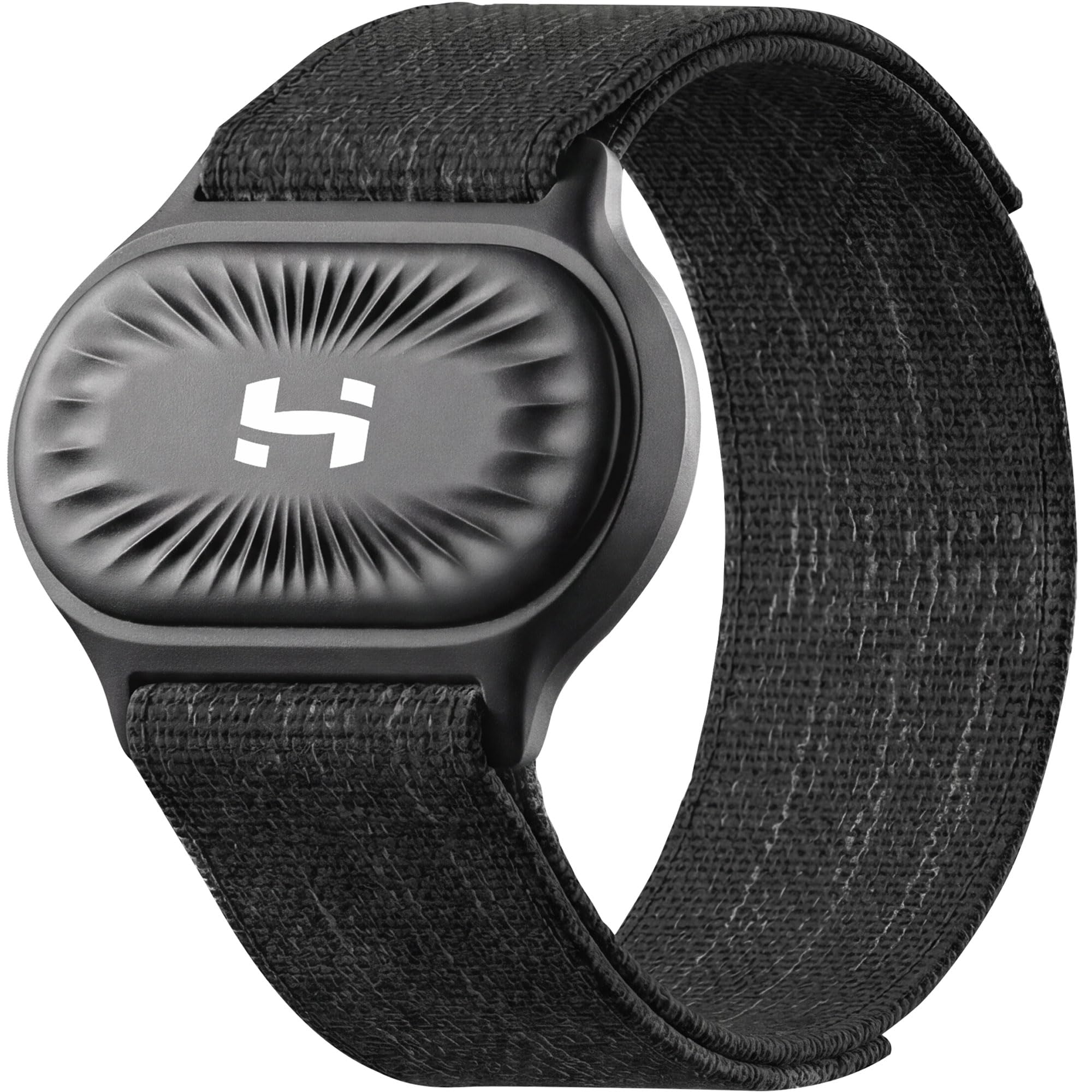
HandPlus takes a different approach: it’s a buttonless, shake-to-activate optical monitor designed for swim, run, and gym. With 72 hours of offline data storage, it can record an entire training block without requiring a phone nearby. This is a major advantage for ankle placement during open-water swims or gym sessions where you leave your phone in a locker — the data syncs later via Bluetooth or ANT+.
The unit measures not just HR zones and HRV, but also SpO₂ and body temperature, making it one of the few devices in this list to offer multi-metric recovery data. Worn on the lower leg, the lightweight plastic housing (plastic chassis rather than full silicone) stays low-profile, and the strap is easy to rinse and dry post-workout.
Pairing with the Holoswim2 AR goggles is a specific advantage for triathletes, though initial pairing requires patience — the user guide lacks clarity on which side of the swim cap the sensor must sit. Once paired, the connection is stable. The 0.2% zone accuracy claim relative to chest straps holds up in steady-state conditions, though interval transitions show slightly slower response than the Scosche.
Why it’s great
- 72-hour offline recording — no phone needed mid-session
- SpO₂ and body temp tracking alongside HR
- No buttons — shake to wake and start
Good to know
- Pairing with third-party apps requires trial and error
- Lacks advanced features for the premium price tier
4. Garmin HRM 200

The Garmin HRM 200 is a traditional chest strap, but it earns a spot because its XS-S and M-XL strap options and washable fabric strap make it the most comfortable lower-chest HRM for athletes who find optical armbands too bulky for ankle wear. The CR2032 battery lasts up to a full year — eliminating recharging anxiety. For runners who simply want reliable real-time HR paired to a Garmin watch or Edge cycling computer, this is the plug-and-play solution.
The 3 ATM water rating means it survives rain and heavy sweat but isn’t designed for swimming. The detachable pod makes the strap machine-washable, a hygiene advantage over sealed optical bands that require hand-rinsing. Setup with Garmin devices is instantaneous — the button on the pod simplifies Bluetooth pairing compared to sensor-pairing menus on other brands.
The limitation: as a chest strap, it cannot be worn on the ankle. If your use case demands a lower-leg mount, this won’t work. But for athletes who want chest-strap-grade accuracy at a value price with minimal maintenance, the HRM 200 is a proven workhorse with zero connectivity complaints.
Why it’s great
- User-replaceable CR2032 battery lasts 1 year
- Machine-washable strap for easy cleaning
- Bulletproof pairing with Garmin ecosystem
Good to know
- No real-time display without a paired watch
- Not usable as a standalone ankle-mounted device
5. Wahoo TRACKR

The Wahoo TRACKR shifts the paradigm with a 200-hour active battery life via USB-C charging — no coin cell batteries, no proprietary dock. At 200 hours, you could wear it for an entire month of daily training sessions before reaching for a charger. The slim, soft strap design keeps the pod flush against the chest without digging in during long trainer rides or back-to-back workouts.
Bluetooth and ANT+ connectivity worked out of the box with Zwift, Cyclemeter, and Wahoo’s own ecosystem. The intuitive LED indicator confirms detection, battery status, and connection health — useful when the unit is mounted under a jersey. The pod detaches from the strap, making the strap washable and the pod rechargeable separately.
Drawbacks: the strap runs small — larger athletes report needing a third-party strap extension. And at the premium end of the price spectrum, it’s an investment. But for athletes who want to eliminate disposable batteries and get consistent HR reads for zone-based training, the TRACKR justifies the cost with endurance-focused design.
Why it’s great
- 200-hour rechargeable battery eliminates all battery maintenance
- USB-C universal charging — no proprietary cables
- LED indicator for real-time status check
Good to know
- Strap too small for larger chest sizes
- Premium price point over competitors
6. Garmin HRM 600

The Garmin HRM 600 is not an ankle-wearable, but it is the most technically advanced chest strap in this roundup. It captures running dynamics — vertical oscillation, ground contact time balance, stride length — alongside HR and HRV data. For athletes who train with a Garmin watch, this data unlocks deeper form analysis that optical armbands cannot provide because armbands lack the accelerometer array needed for running metrics.
The rechargeable lithium-ion battery lasts up to 2 months per charge and uses Garmin’s standard charge cable — identical to the one you use for a Forerunner or Edge. Standalone recording is the killer feature: you can leave your watch behind during team sports or swim sessions, and the HRM 600 stores HR, calories, and distance data, syncing to Garmin Connect later.
The premium cost reflects the advanced feature set. The HRM 600 is overkill for casual joggers, but for serious runners who want running dynamics without a pod on their shoe, it’s the singular choice available today. The XS-S and M-XL strap sizes ensure a secure fit, and the detachable pod simplifies washing.
Why it’s great
- Advanced running dynamics — vertical oscillation, ground contact time
- Standalone recording for watch-free sessions
- Rechargeable via standard Garmin cable
Good to know
- Premium price — overkill for casual users
- Sizing chart can be confusing between XS-S and M-XL
FAQ
Can I wear an armband heart rate monitor on my ankle?
Why does my ankle HRM lose connection during cycling?
How do I clean an optical sensor after ankle use?
What is HRV and why does it matter for ankle monitors?
Final Thoughts: The Verdict
For most users, the best ankle heart rate monitor winner is the Scosche Rhythm+ 2.0 because its EKG-validated optical sensor, IP68 waterproofing, and dual Bluetooth/ANT+ stack cover every training scenario without compromise. If you want maximum battery endurance and don’t mind a stretch-prone strap, grab the COOSPO HW9. And for offline recording with swim-specific pairing and SpO₂ metrics, nothing beats the HandPlus.