
A sudden storm or grid failure doesn’t just flicker the lights — it shuts down your well pump, kills your HVAC system, and leaves your refrigerator’s contents spoiling within hours. The difference between inconvenience and outright crisis is whether your home has a generator capable of carrying every circuit on your breaker panel. A whole house generator is not a luxury appliance; it’s infrastructure, no different from your water heater or electrical service panel.
I’m Min — the co-founder and writer behind Gadgets Feed. I’ve spent countless hours cross-referencing engine displacements, fuel consumption rates, transfer switch compatibility, and real-world user feedback to separate the units that genuinely deliver whole-home protection from those that falter under sustained load.
This guide walks through the eleven most compelling options in the space, from portable inverter stations to permanently installed standby systems, to help you confidently choose the best whole house generator for your property’s unique load profile and budget.
How To Choose The Best Whole House Generator
Selecting a generator that can truly cover your entire home requires matching its electrical output to your home’s specific load. You must calculate the running wattage of every essential appliance — well pump, furnace blower, refrigerator, lighting circuits, and at least one window air conditioner or central AC condenser — then add a 25% safety buffer. A unit with impressive peak wattage but insufficient running wattage will trip its breaker the moment the well pump and refrigerator compressor cycle on simultaneously.
Fuel Type and Installation Complexity
Natural gas standby generators offer unlimited runtime as long as the municipal gas grid is intact, but they require a dedicated gas line, a concrete pad, and professional electrical installation with an automatic transfer switch. Liquid propane gives similar endurance but demands a bulk tank that you must refill. Portable dual-fuel and tri-fuel generators give you flexibility to switch between gasoline, propane, and natural gas, but they typically need manual setup and a manual transfer switch or interlock kit to connect to your panel safely.
Transfer Switch Type: Automatic vs. Manual
An automatic transfer switch detects a grid outage within seconds, starts the generator, and transfers the load without any human intervention. This is the defining feature of a true whole house standby system. A manual transfer switch or interlock requires you to walk to the generator, start it, flip the breakers, and plug in a cord. If you are not home when the power goes out, a manual setup leaves your home dark and your pipes at risk of freezing in winter.
Sound Level and Placement
Whole house generators produce significant noise — open-frame models often exceed 70 dB, which is louder than a vacuum cleaner. Inverter generators, particularly premium units like the Honda EU7000iS, drop to conversation-level volumes around 52 dB. Standby generators must sit at least five feet from any window, door, or fresh-air intake to prevent carbon monoxide from entering the home. Always verify local noise ordinances and setback requirements before selecting a final location.
Quick Comparison
On smaller screens, swipe sideways to see the full table.
| Model | Category | Best For | Key Spec | Amazon |
|---|---|---|---|---|
| Generac Guardian 26kW | Standby | Maximum Whole-Home Coverage | 26,000W / 999cc G-Force Engine | Amazon |
| Generac Guardian 22kW | Standby | Automatic Backup with 200A Switch | 22,000W / 999cc G-Force Engine | Amazon |
| Westinghouse 28000W | Portable | Massive Portable Power | 28,000W Peak / 999cc V-Twin | Amazon |
| Honda EU7000iS | Inverter | Ultra-Quiet Clean Power | 7,000W / 389cc Inverter | Amazon |
| Westinghouse WGen14500TFc | Portable Tri-Fuel | Fuel Flexibility for Large Homes | 18,000W Peak / 713cc V-Twin | Amazon |
| EF ECOFLOW DELTA Pro Ultra | Solar/Station | Expandable Battery Backup | 7,200W / 6,144Wh LiFePO4 | Amazon |
| OSCAL PowerMax 6000 | Solar/Station | Solar-Powered Home Backup | 6,000W / 3,600Wh LiFePO4 | Amazon |
| DuroMax XP15000HX | Portable Dual Fuel | High-Wattage Dual-Fuel Value | 15,000W / 670cc OHV | Amazon |
| GENMAX GM10500iETC | Portable Tri-Fuel | Tri-Fuel Convenience | 10,500W / 458cc Inverter | Amazon |
| EF ECOFLOW DELTA Pro | Solar/Station | Portable Solar + Battery | 3,600W / 3,600Wh LFP | Amazon |
| Jackery HomePower 3600 Plus | Solar/Station | Entry-Level Whole Home Solar | 3,600W / 3,584Wh LFP | Amazon |
In‑Depth Reviews
1. Generac Guardian 26kW with 200 Amp Transfer Switch
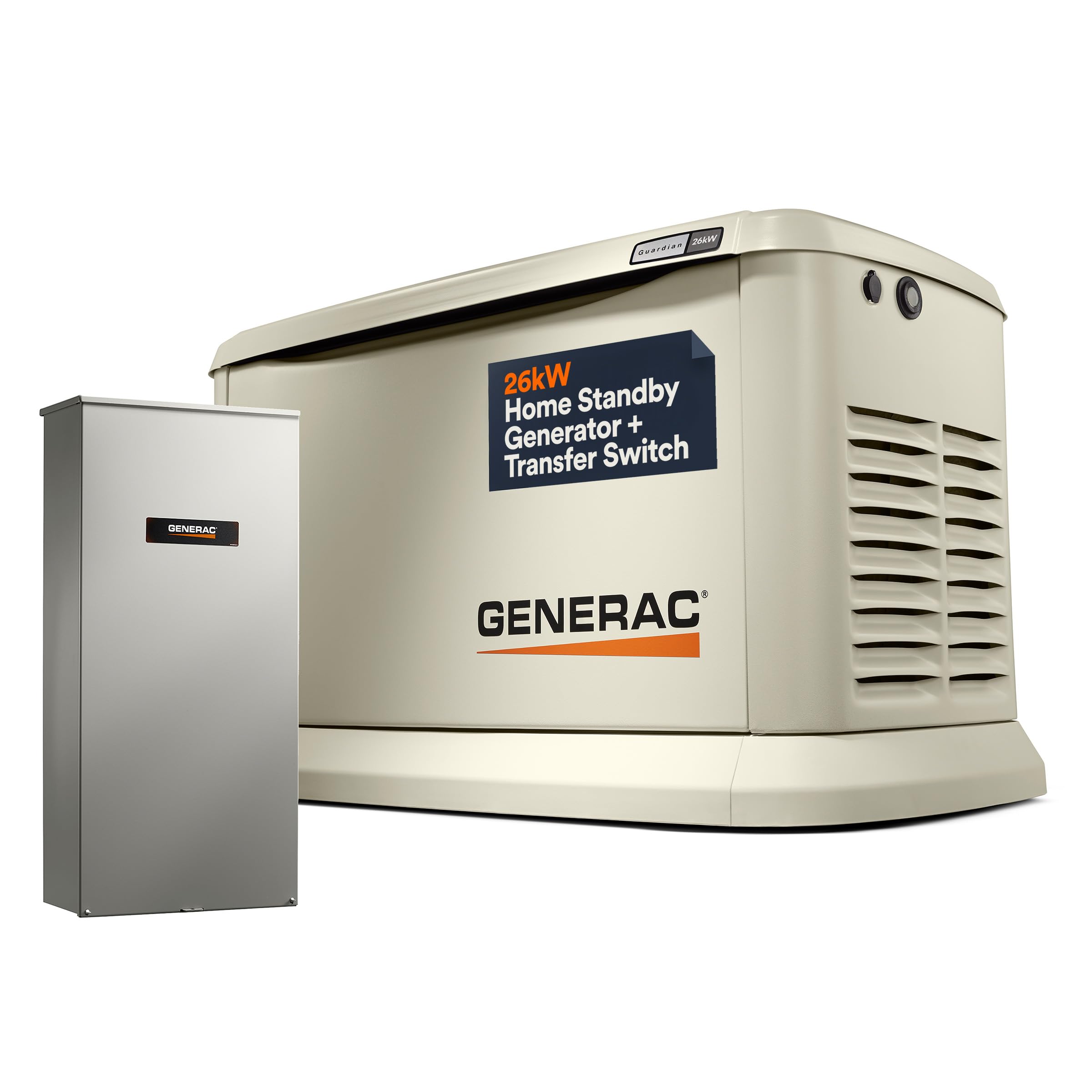
The Generac Guardian 26kW sits at the apex of residential standby power. Its 999cc G-Force engine pushes 26,000 watts on natural gas or liquid propane, enough to carry a 4-ton HVAC system, well pump, electric oven, and all lighting circuits simultaneously without load shedding. The bundled 200-amp NEMA 3R aluminum transfer switch enables true automatic failover — the generator detects a grid drop, starts itself, and transfers your entire panel within seconds.
True Power Technology holds harmonic distortion below 5%, so your sensitive electronics see clean sine-wave power comparable to utility service. The Mobile Link Wi-Fi module lets you monitor runtime, service intervals, and start failures from your phone. The 5-year limited warranty covers the engine and alternator, which matters for a piece of equipment designed to sit outside in all weather for decades.
Installation must be performed by a licensed electrician and typically requires a dedicated natural gas line or a large propane tank. The unit weighs 518 pounds and demands a concrete pad, so total installed cost runs significantly above the generator’s sticker price. For homeowners who want set-it-and-forget-it protection for a large property, this is the gold standard.
Why it’s great
- True automatic operation with included 200A transfer switch
- 26,000W sustains whole-home loads including central AC
- 5-year warranty and US-based engineering
Good to know
- Requires professional installation on a concrete pad
- Heavy at 518 pounds — delivery logistics matter
2. Westinghouse 28000W Home Backup Generator

The Westinghouse 28000W delivers the highest peak wattage in this roundup — 28,000 peak and 20,000 running watts from a 999cc V-Twin OHV engine with a cast-iron sleeve for long-term durability. This portable unit feeds two 50-amp 14-50R outlets plus two 30-amp L14-30R outlets, making it ready for dual transfer switches or direct connection to a large generator panel. The 17-gallon fuel tank provides up to 15 hours of runtime at 25% load.
Remote start via key fob and push-button electric start with auto choke eliminate the frustration of manual pull-starting, especially valuable in bad weather. The CO sensor automatically shuts down the engine if carbon monoxide accumulates, and the low-THD output is safe for laptops, TVs, and medical devices. The digital readout displays lifetime run hours, voltage, and frequency so you know exactly when maintenance is due.
At 541 pounds, this generator is among the heaviest portable options — moving it requires a dolly and at least two people. Noise is substantial (open-frame design), though the reinforced steel handles and quick-release pins help with positioning. This unit is gasoline-only, so you lose the fuel flexibility of tri-fuel models.
Why it’s great
- 28,000W peak — highest power in this comparison
- Dual 50A outlets for heavy-load distribution
- Remote key fob start and auto choke
Good to know
- Gasoline only — no propane or NG compatibility
- Extremely heavy; requires two-person setup
3. Honda EU7000iS Inverter Generator
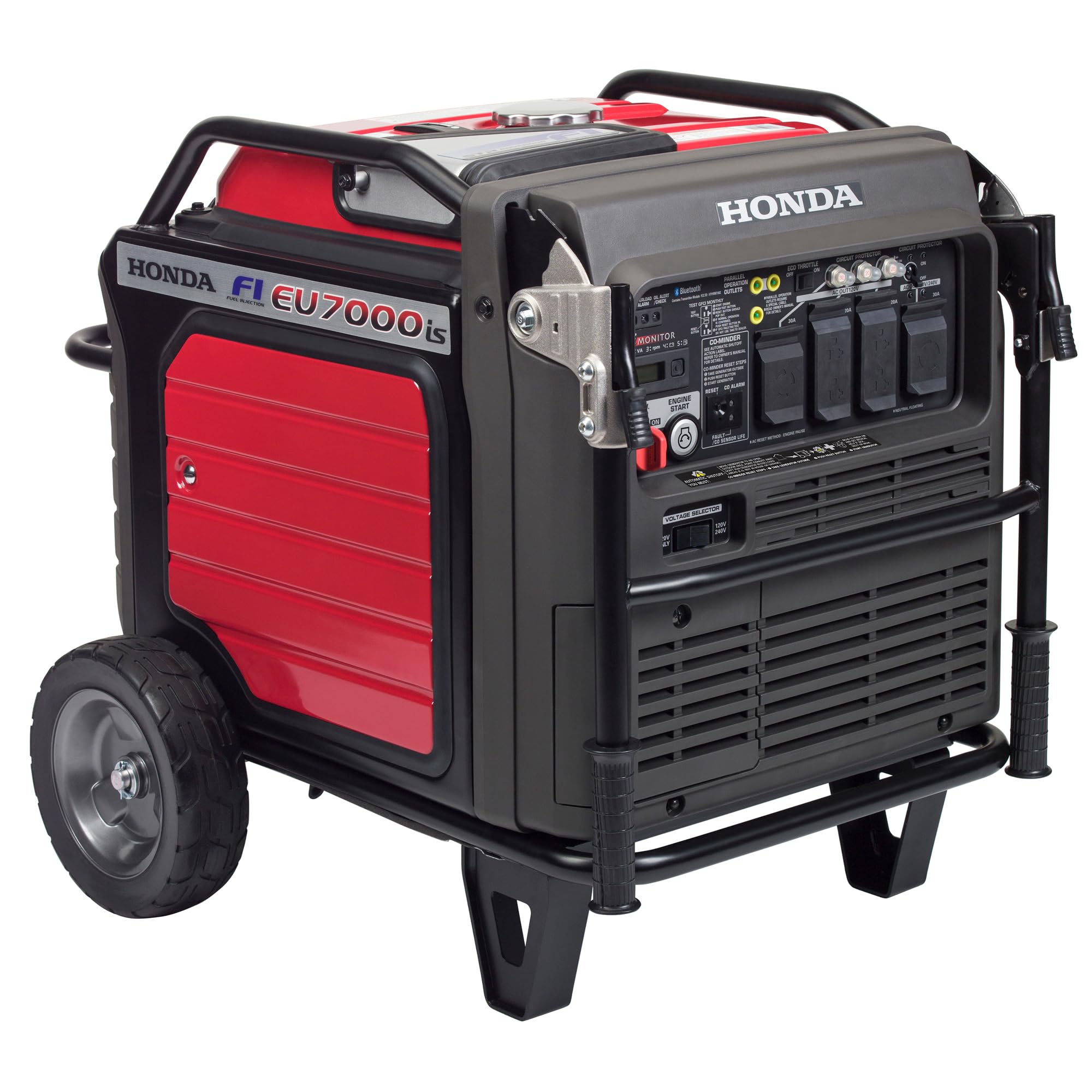
The Honda EU7000iS redefines what a portable generator can be. Its 389cc inverter engine produces 7,000 watts of utility-grade clean power — total harmonic distortion so low that running a desktop computer or a CPAP machine is as safe as being on grid power. The real differentiator is the noise profile: 52 to 58 dB, quieter than a normal conversation, which means your neighbors won’t hear it running through the night.
The Eco Throttle system adjusts engine RPM based on load, stretching the 5.1-gallon fuel tank to 16 hours at partial load. Bluetooth connectivity via the My Generator app lets you remote start, monitor power output, and receive service reminders from your phone. The CO-MINDER carbon monoxide detection system provides an additional safety layer by automatically shutting down the engine before CO levels become dangerous.
7,000 watts is modest compared to standby units — you can run a 3-ton AC with careful load management, but you won’t power an entire 4,000-square-foot home with electric heat and a well pump simultaneously. The EU7000iS is also gasoline-only, and its premium price puts it firmly in investment territory. For homeowners who prioritize silence, fuel efficiency, and power quality above raw wattage, this Honda is unbeatable.
Why it’s great
- Exceptionally quiet operation at 52-58 dB
- Ultra-clean inverter power for sensitive electronics
- Bluetooth app for remote monitoring and start
Good to know
- 7,000W may not cover a fully electric large home
- Gasoline only; premium price point
4. EF ECOFLOW DELTA Pro Ultra 6144Wh

The DELTA Pro Ultra is a modular solar generator system that treats home backup as an expandable battery bank rather than a fuel-burning engine. The base unit delivers a 7,200W AC output at 120/240V split phase from a 6,144Wh LiFePO4 battery, enough to run a 3-ton central AC. Stack up to 15 batteries for a staggering 90kWh capacity — roughly 30 days of essential power for a typical household.
Charging speed is a standout feature: a single battery refills from 0 to 100% in two hours via a 3,000W AC input, or you can use solar panels, an EV charger, or a gas generator as the source. The online UPS function provides zero-millisecond transfer time, meaning your electronics never blink during a grid outage. The EcoFlow app lets you prioritize specific circuits and monitor solar production versus consumption in real time.
The upfront investment is substantial, and the system requires a sub-panel or transfer switch for hardwired installation. Unlike a standby generator, the battery bank has finite runtime — once depleted, you must wait for recharge unless you have solar panels continuously feeding it. For those who want silent, emission-free backup with the option to expand over time, this is the most future-proof solution available.
Why it’s great
- Expandable to 90kWh for multi-week backup
- Two-hour recharge speed — fastest in its class
- Silent zero-emission operation
Good to know
- High initial cost; requires solar or grid for recharge
- Professional installation recommended for hardwired circuits
5. Westinghouse WGen14500TFc Tri-Fuel
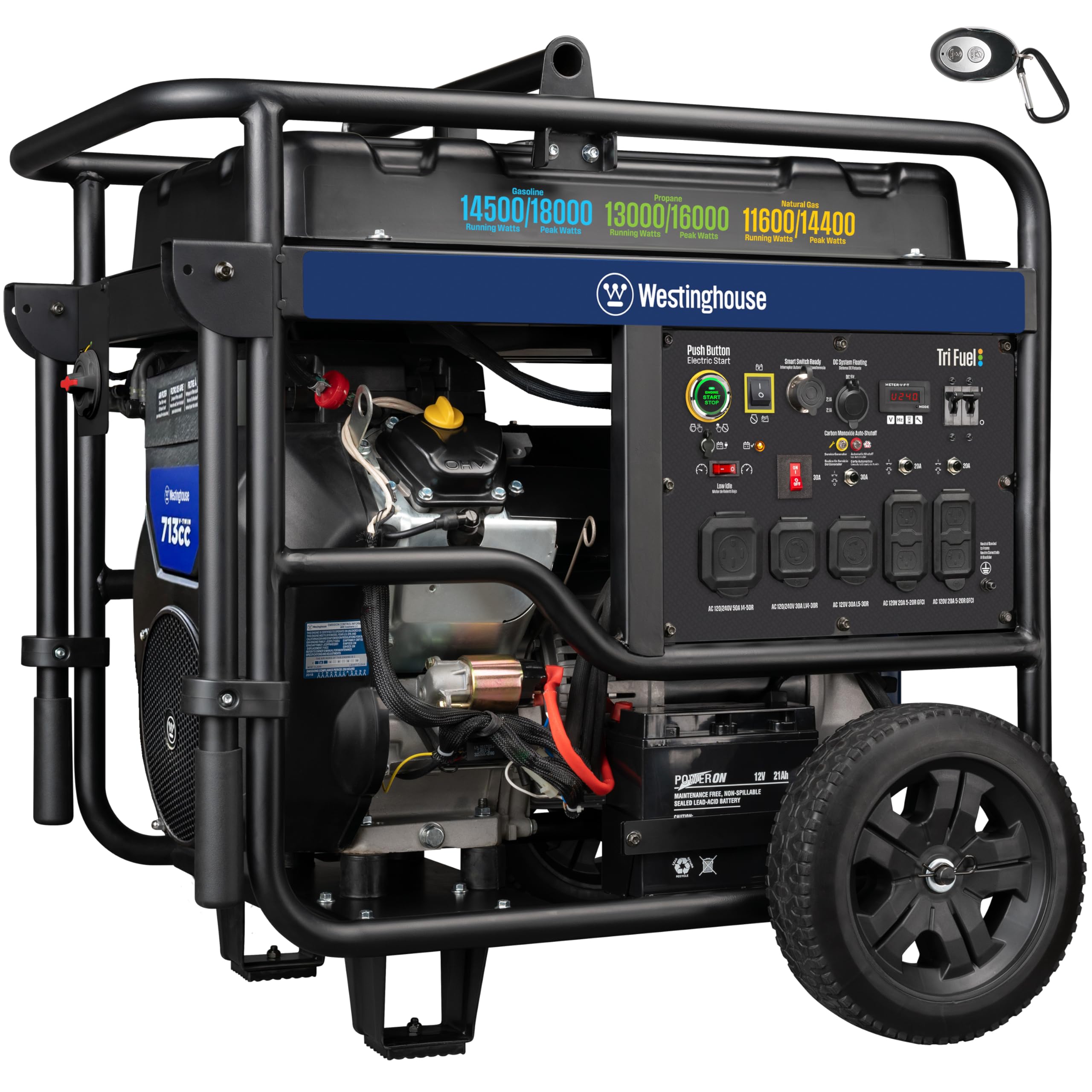
The WGen14500TFc brings tri-fuel flexibility to the portion of the market that needs serious wattage without paying for a permanent standby installation. Its 713cc V-Twin engine delivers 18,000 peak watts on gasoline, 16,000 on propane, and 14,400 on natural gas, with 14,500, 13,000, and 11,600 running watts respectively. That range is enough to power a mid-size home with a well pump, refrigerator, lights, and a window AC unit across any fuel source available to you.
The VFT data center shows voltage, frequency, and lifetime hours, and the remote key fob start lets you fire it up from inside the garage during a storm. THD stays below 5%, making it safe for sensitive electronics, and the automatic low-oil shutdown protects the engine during extended runs. The 10.5-gallon gas tank yields up to 16 hours at 25% load, and the included propane hose makes switching fuels as simple as turning a knob.
At 348 pounds and 74 dBA, this is a loud, heavy portable — placing it requires planning and preferably a wheel kit on hard ground. Some users report that the NEMA 5-15 outlets all share the same leg, so distributing 120V loads across the panel requires awareness. For homeowners who want gasoline, propane, and natural gas capability in a single machine at a mid-range price, this Westinghouse is a compelling choice.
Why it’s great
- Tri-fuel: gasoline, propane, and natural gas
- 18,000W peak handles large home loads
- Remote start and VFT data display
Good to know
- Open-frame design — loud at 74 dBA
- All 120V outlets on same leg
6. GENMAX GM10500iETC Tri-Fuel Inverter

The GENMAX GM10500iETC is the only single-cylinder inverter generator in this tier with tri-fuel capability, combining clean power output (less than 3% THD) with fuel-source flexibility. On gasoline it produces 10,500 peak and 8,500 running watts; on LPG that drops to 9,500 peak and 8,000 running; on natural gas the figures are 8,400 peak and 6,800 running. The inverter design means the engine can throttle down to match the load, improving fuel economy compared to traditional open-frame generators.
The control panel is unusually comprehensive for a portable at this price: a 50A 14-50R outlet, an L14-30R twist-lock, four 5-20R GFCI household outlets, a 12V DC cigarette port, and a CO shutdown sensor. It supports remote start via key fob, electric start, and ATS connectivity for automatic transfer switch integration. The neutral-floating design allows easy bonding for home standby use with a separate bonding plug.
Some users report that the unit arrives without oil or a printed manual, requiring a trip to the store before first startup. The natural gas cold-start can take a second press of the ignition to bleed air from the fuel line.
Why it’s great
- Tri-fuel inverter with less than 3% THD
- 50A and 30A outlets plus ATS-ready
- Remote and electric start standard
Good to know
- Lower wattage on natural gas (6,800W running)
- No oil or manual in box; single-cylinder vibration
7. OSCAL PowerMax 6000 with 3×400W Solar Panels
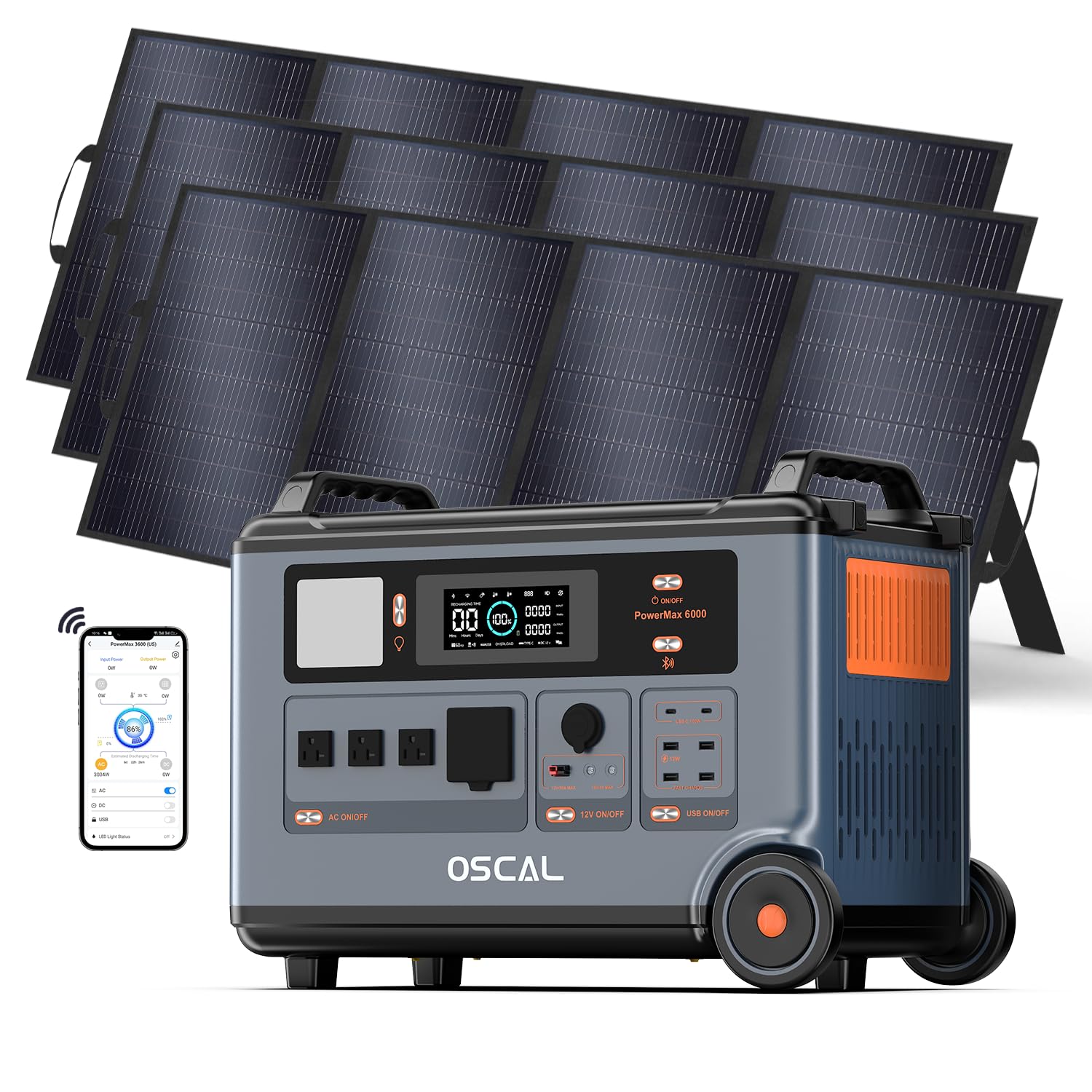
The OSCAL PowerMax 6000 delivers a 6,000W AC output (9,000W surge) with 120V/240V split-phase capability from a 3,600Wh LiFePO4 battery pack. The bundled three 400W solar panels provide a total of 1,200W of solar input, and the unit supports 2,400W solar charging for faster daytime top-ups. The bi-directional inverter can recharge the battery from AC at 2,200W, achieving 0 to 100% in under two hours.
The EPS (emergency power supply) switchover happens within 5 to 8 milliseconds — fast enough to keep network equipment and computers running without interruption. The OSCAL app provides remote monitoring of input/output wattage, battery level, and solar production. The LiFePO4 chemistry is rated for 3,500 charge cycles, translating to a service life of up to 25 years if the unit is cycled regularly.
Real-world testing shows that a single LED bulb draws the battery from 100% to 85% in two hours, suggesting internal efficiency losses or parasitic drain. The claimed 6,000W output may not sustain full load for extended periods due to the relatively small 3.6kWh battery capacity. This unit is best suited for partial-home backup — refrigerators, lights, and electronics — rather than whole-house coverage with multiple high-draw appliances.
Why it’s great
- 120/240V split-phase output from a single battery unit
- Three 400W solar panels included in the bundle
- Fast 1.44-hour AC recharge time
Good to know
- 3,600Wh capacity limits sustained heavy loads
- Some users report higher-than-expected idle drain
8. DuroMax XP15000HX 15,000W Dual Fuel
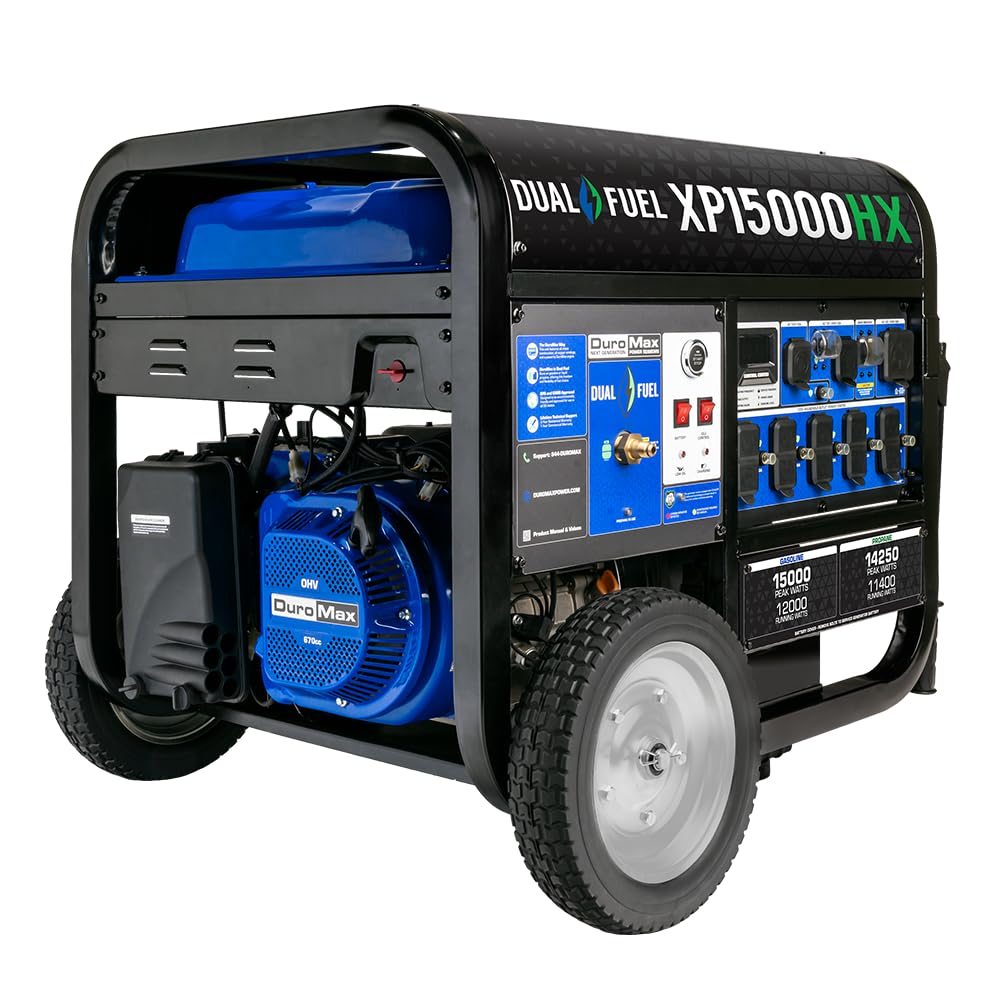
The DuroMax XP15000HX pairs a 670cc OHV engine with all-copper windings for long-term durability, delivering 15,000 peak watts and 12,000 running watts on gasoline, with similar output on propane. The dual-fuel selector switch is front-facing — you change fuel in seconds without tools. A 50A 14-50R outlet makes the unit transfer-switch-ready, and the CO Alert system automatically shuts down the generator if carbon monoxide accumulates.
The digital multimeter displays voltage, frequency, total run hours, and hours until recommended maintenance. Push-button electric start and a remote control key fob simplify operation, and the wheel kit with fold-down handles makes repositioning manageable despite the 345-pound weight. The oil-funnel and tool set included in the box help with the initial setup, which requires adding oil before first start.
Some users report idle control switch defects and inconsistent customer support response times, though the all-copper windings and 670cc engine platform are generally well-regarded for longevity. The operating volume is high — typical of open-frame dual-fuel generators — so placement away from living areas is essential. For budget-conscious buyers who need 12,000 running watts with dual-fuel capability, the XP15000HX delivers strong value.
Why it’s great
- 15,000W peak with all-copper windings
- CO Alert safety shutdown system
- Front-facing dual-fuel selector
Good to know
- Open-frame design — very loud
- Quality control issues reported on idle control switch
9. Jackery HomePower 3600 Plus Solar Generator
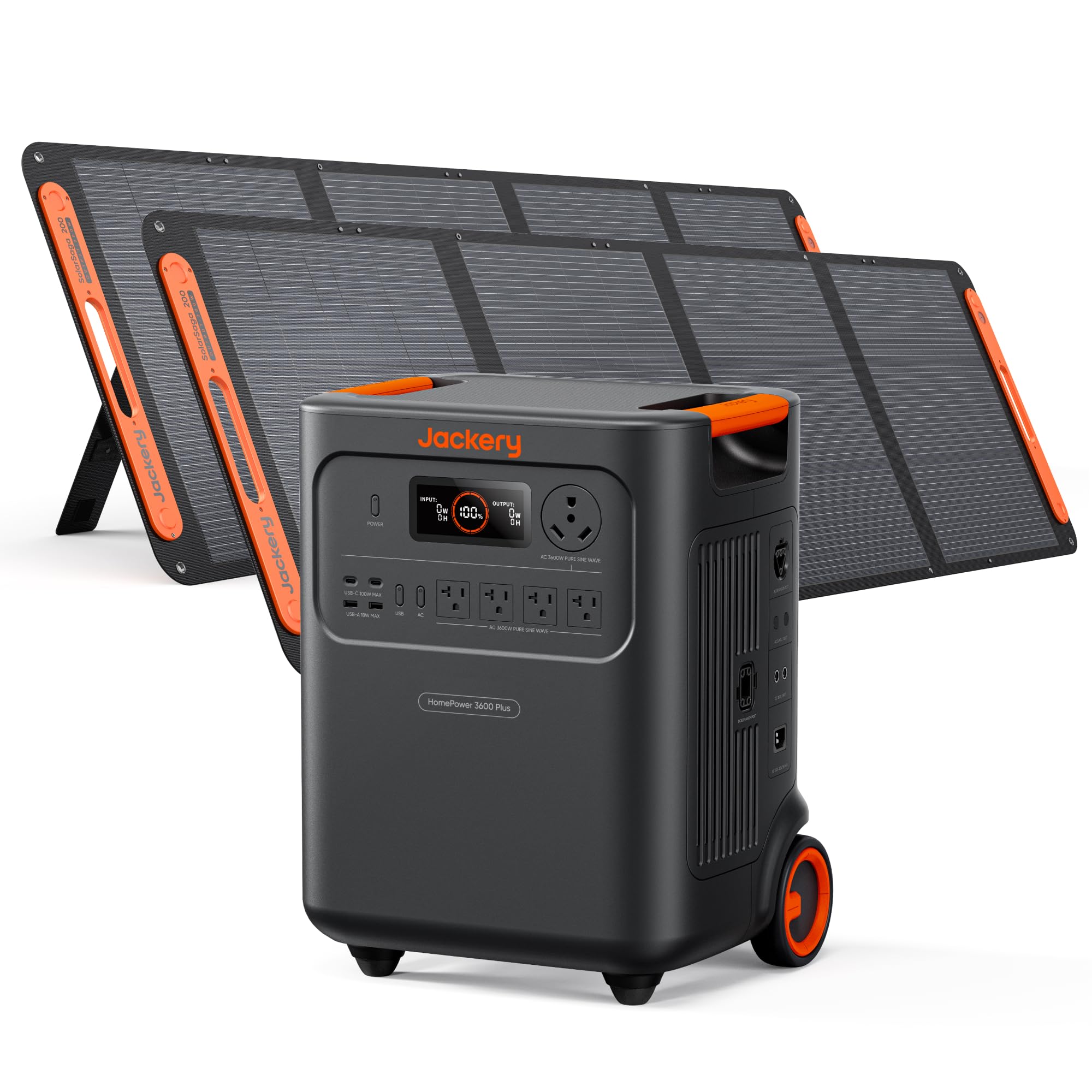
The Jackery HomePower 3600 Plus brings a 3,600W AC output (7,200W in parallel with two units) and a 3,584Wh LiFePO4 battery rated for 6,000 cycles — roughly a 10-year lifespan at daily use. The ceramic membrane battery cells are tested at 302°F for thermal runaway resistance, and the system still operates at -4°F, making it a legitimate option for cold-climate emergencies. The included two 200W solar panels deliver 400W total input, enough to recharge in about 4 hours of full sun.
The luggage-style design with wheels and a telescopic handle makes this the most portable true whole-home-capable power station available. Parallel operation for 240V split-phase output requires a second unit, which doubles the investment. The plug-and-play MTS (manual transfer switch) integration means you can backfeed selected circuits without a licensed electrician for the generator connection itself.
3,600W running capacity limits your appliance list — you can run a refrigerator, well pump, lights, and a microwave sequentially, but not simultaneously with a central AC or electric water heater. The app connectivity is basic compared to EcoFlow’s ecosystem. For entry-level whole-home solar backup that can be rolled from garage to kitchen and expanded later, this Jackery delivers strong entry-point value.
Why it’s great
- 6,000-cycle LiFePO4 battery with 10-year lifespan
- Roll-around luggage design with wheels
- Parallel-ready for 240V output
Good to know
- 3,600W output limits simultaneous high-draw appliances
- 240V split-phase requires purchasing a second unit
10. EF ECOFLOW DELTA Pro with 400W Solar Panel

The original DELTA Pro pairs a 3,600W inverter with a 3,600Wh LFP battery pack and supports expansion batteries to scale capacity as your needs grow. The bundled 400W solar panel achieves 22.4% conversion efficiency, and with three panels the unit can fully recharge in 3.5 hours. The 15-output panel includes 5 AC outlets, 4 USB-A, 2 USB-C, and DC ports, giving you enormous device flexibility beyond home circuits.
Smart app control via Wi-Fi or Bluetooth provides real-time monitoring of charge level, temperature, and discharge rates. The pass-through feature lets appliances draw grid power while the battery simultaneously charges, and the unit automatically switches to battery during an outage. The foldable solar panel is IP68 dust- and water-tight, adding durability for outdoor use.
As with the Jackery, 3,600W running capacity does not cover whole-house loads with central AC or electric heating. The unit weighs 99 pounds — heavy enough that the wheels and pull handle are essential. Some users note that the usable capacity is effectively 2.7kWh because the system shuts off at 25% to protect the battery chemistry. For a portable solar generator that can back up critical circuits and recharge from panels, this is a benchmark product.
Why it’s great
- Expandable battery architecture for future capacity
- 15 versatile output ports including dual USB-C
- IP68 solar panel for all-weather charging
Good to know
- Usable capacity reduced by 25% system shutoff
- 99 pounds — wheels required for transport
11. Generac Guardian 22kW with 200 Amp Transfer Switch
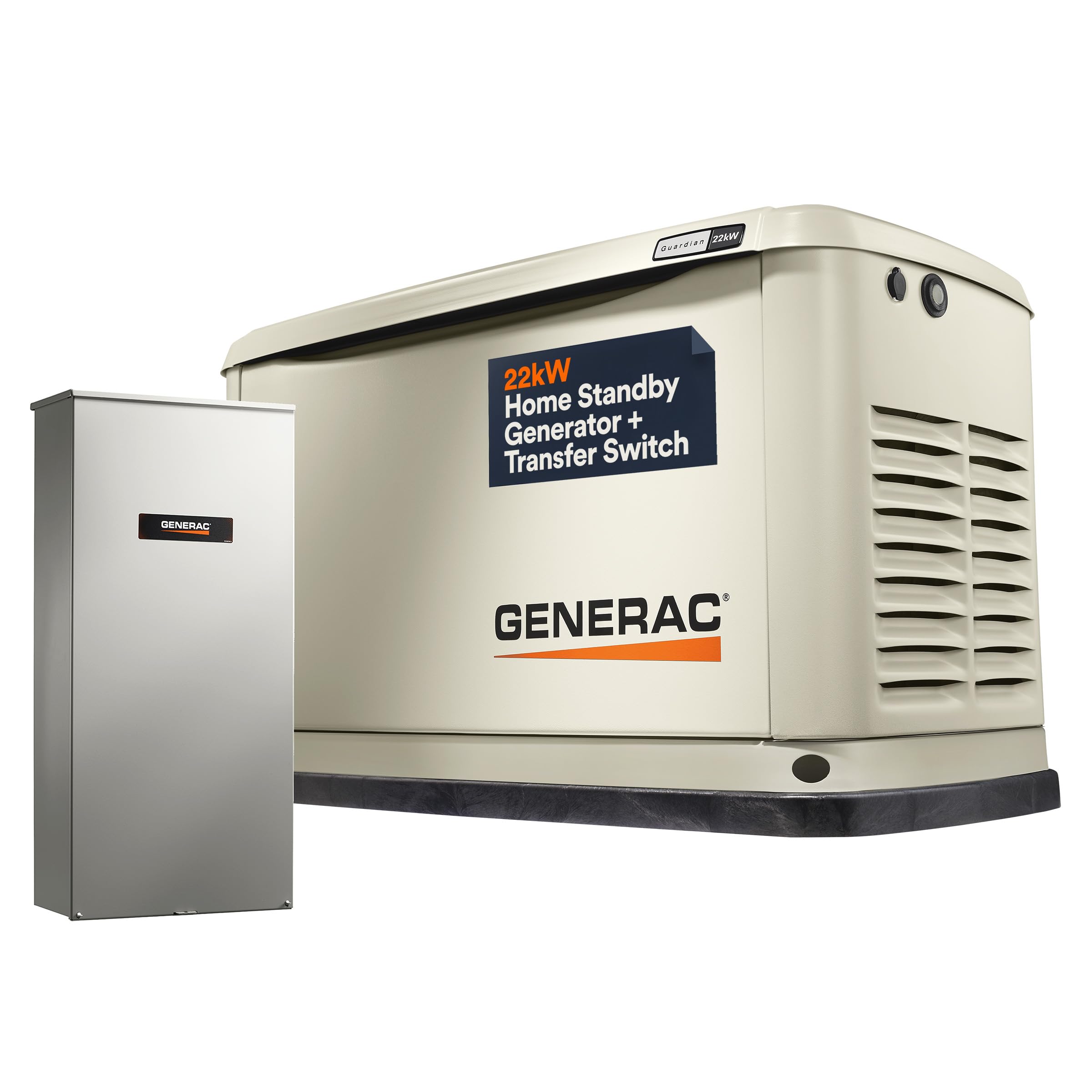
The Generac Guardian 22kW is the most popular standby generator in North America, and for good reason: its 999cc G-Force engine delivers 22,000 watts on natural gas or LP with less than 5% harmonic distortion, and the included 200-amp automatic transfer switch means the whole system is a single purchase decision. The Mobile Link Wi-Fi module sends status updates and maintenance alerts to your phone, and the 5-year limited warranty protects your investment.
True Power Technology ensures voltage and frequency remain stable under varying loads, so your electronics and HVAC controls are safe. The unit’s enclosed aluminum housing is weather-resistant and rated for outdoor installation. The engine runs quieter than Generac’s older designs and consumes less fuel per kilowatt-hour due to the stepper-controlled fuel regulator.
Professional installation is mandatory — the generator requires a concrete pad, a gas line, and an electrical connection. As with the 26kW model, the total installed cost far exceeds the purchase price. Some users report that the mandatory onboard computer and Wi-Fi can cause issues if the unit is struck by lightning or suffers a power surge. For homeowners who want reliable, automatic whole-house backup without the premium of the 26kW model, the 22kW Guardian is a proven workhorse.
Why it’s great
- Includes 200A auto transfer switch in the bundle
- 22,000W True Power Technology for clean output
- 5-year limited warranty and US-based support
Good to know
- Requires professional installation with gas line
- Electronics may be vulnerable to power surges
FAQ
How do I calculate the right size generator for my home?
Can I install a whole house generator myself?
What’s the difference between a portable generator and a standby generator?
Is it worth buying a solar generator for whole home backup?
Final Thoughts: The Verdict
For most users, the best whole house generator winner is the Generac Guardian 26kW because it combines the highest running wattage in this comparison with a fully automatic transfer switch, requiring zero human intervention during an outage. If you want ultra-quiet inverter power that your neighbors won’t hear, grab the Honda EU7000iS. And for complete fuel flexibility at a mid-range price, nothing beats the Westinghouse WGen14500TFc tri-fuel.