
The leap to 8K isn’t just about quadrupling pixel count; it’s about unlocking a grade of latitude that saves a last-minute crop, a stabilization skew, or a wide-to-tight punch that would have destroyed a 4K frame. The real shift is in dynamic range and color science that pulls detail out of shadows without the noise penalty you’d see at 4K. But the catch? Managing the massive data rates, heat dissipation, and a codec workflow that can stall even a fully loaded workstation.
I’m Min — the co-founder and writer behind Gadgets Feed. I’ve spent hundreds of hours analyzing sensor readout speeds, rolling shutter artifacts, internal cooling designs, and LUT compatibility across the 8K mirrorless and cinema landscape to cut through sensor marketing fluff and find the bodies that actually deliver on their pixel promises.
Whether you’re a wedding filmmaker needing reliable record times or a commercial shooter craving the most flexible RAW file, this guide breaks down the cooling, autofocus, and codec trade-offs to find the best 8k video camera for your workflow.
How To Choose The Best 8K Video Camera
Not all 8K sensors are equal. The resolution figure is just the start — you need to examine sensor stack architecture, data throughput, and active cooling before you commit. The wrong choice means hot cards and a dead shoot.
Sensor Stack: Stacked vs. Conventional CMOS
A stacked CMOS sensor places the memory and processing layer underneath the photodiodes, enabling dramatically faster readout speeds. This is the single most important spec for minimizing rolling shutter — the “jello effect” many 8K sensors suffer from when panning quickly or shooting on a gimbal. Cameras with conventional sensors tend to overheat faster and exhibit more skew at 8K resolutions.
Heat Dissipation and Real-World Recording Limits
8K recording generates substantial thermal load. Manufacturers use either passive heat sinks or active internal fans. A unit with a passive design may record 8K for only a few minutes before a thermal shutdown, while an actively cooled body can run indefinitely. Pay close attention to the specific recording limit at the highest resolution — many bodies throttle down from 8K to 4K after a short window.
Codec and Bit Depth Flexibility
Internal RAW recording at 8K provides the most grading latitude but generates massive file sizes — expect 2-3 GB per minute. ProRes and H.265 are more manageable but compress chroma detail. A camera that offers a choice between 8-bit and 10-bit 4:2:2 at 8K gives you the flexibility to match the codec to your storage speed and workstation horsepower.
Quick Comparison
On smaller screens, swipe sideways to see the full table.
| Model | Category | Best For | Key Spec | Amazon |
|---|---|---|---|---|
| Canon EOS R5 C | Mirrorless Cinema | Unlimited 8K Recording | Active Internal Cooling Fan | Amazon |
| Nikon Z 8 | Mirrorless Hybrid | Stills & 8K Video Hybrid | 45.7MP Stacked CMOS Sensor | Amazon |
| Canon EOS R5 | Mirrorless Hybrid | High-Resolution Hybrid Work | 8K RAW Internal Recording | Amazon |
| Sony Alpha 7R V | Mirrorless Hybrid | 61MP Stills & 8K Filmmaking | 61MP BSI CMOS Sensor | Amazon |
| Panasonic LUMIX S1RII | Mirrorless Hybrid | High-Resolution Still & Video | 44.3MP Full-Frame Sensor | Amazon |
| Blackmagic Pocket Cinema 6K | Cinema Camera | RAW Video with Budget Workflow | Super 35 Sensor, 6K RAW | Amazon |
| Sony FX3 Bundle | Cinema Line | Low-Light Cinema & Gimbal | 12MP Full-Frame Sensor | Amazon |
In‑Depth Reviews
1. Canon EOS R5 C Mirrorless Camera

This body decouples cinema and stills modes entirely, so you get independent overheating protection for video while keeping the 45MP stills capability. The internal fan vents heat continuously, which means 8K/60p internal RAW recording has no time limit — a crucial difference from the passive-cooled R5 that throttles after minutes. The RF mount gives access to excellent cinema glass and fast adapted EF lenses with reliable electronic communication.
DIGIC X processing handles 8K/60p oversampled 4K in 4:2:2 10-bit, and the timecode input/output lets you sync multi-camera setups without post-troubleshooting. The XF-AVC codec matches broadcast workflow requirements, and the simultaneous dual-format recording (MXF + MP4) is a smart safety net for client work. The absence of IBIS is a conscious trade-off — Canon argues it introduces micro-jitters and heat, but you will need a stabilized lens or gimbal for handheld shots.
Autofocus uses Dual Pixel CMOS AF with Eye Detection AF for both humans and animals, and the touch-and-drag AF confirms quickly even in 8K oversampled mode. The 12-bit 8K RAW files are huge, but the color science retains pleasing skin tones without heavy grading. The battery life is a known weak point, especially powering the active cooling — a battery grip or external V-Mount is a reasonable hedge for longer shoots.
Why it’s great
- Unlimited 8K/60p recording thanks to active internal fan — no thermal shutdown.
- Dual pixel CMOS AF with reliable Eye Detection for video and stills.
- Timecode I/O and dual-format recording for professional multi-cam workflows.
Good to know
- No in-body stabilization — relies on lens or gimbal for smooth handheld work.
- Battery life is short in 8K video mode; external power is recommended.
- Mini-HDMI port is fragile; use a cable clamp or right-angle adapter.
2. Nikon Z 8

The stacked 45.7MP CMOS sensor in this body delivers the fastest readout of any hybrid in this class, which virtually eliminates rolling shutter in 8K mode. Internal 12-bit N-RAW and ProRes RAW recording at 8K/60p produce massive latitude for color grading, and the EXPEED 7 processor keeps buffer depth high even at 20fps raw stills. The body design borrows heavily from the Z9 but in a smaller form factor that fits most gimbals.
Autofocus uses deep learning algorithms that detect subjects as dim as -9 EV, and 3D tracking follows erratically moving objects like birds or motorcycles with unusual precision. The shutterless design means no mechanical curtain wear and an adjustable electronic shutter sound. The dual slot uses one CFexpress Type B and one SD UHS-II, which is cost-effective for archiving but slower for 8K burst than dual CFexpress.
Heat management is mostly passive, and while Nikon has improved firmware for extended recording, some users still report throttling in hot environments when shooting 8K/60p continuously. The power draw is high — expect around 660 shots per charge — and the battery grip is almost mandatory for a full day of video work. The red LUTs applied after the RED acquisition significantly improve N-RAW to Rec709 conversion.
Why it’s great
- Stacked sensor readout nearly eliminates rolling shutter at 8K/60p.
- Internal 12-bit N-RAW and ProRes RAW for maximum grading flexibility.
- Deep-learning AF tracks subjects reliably in low light down to -9 EV.
Good to know
- Heat management is passive; 8K/60p may throttle in hot ambient conditions.
- High power consumption demands a battery grip for extended video sessions.
- CFexpress Type B + SD UHS-II slots; the SD card is too slow for 8K burst.
3. Canon EOS R5 Mirrorless Camera

This was the first full-frame mirrorless to deliver internal 8K RAW, and still offers that capability in a compact body without an external recorder. The 45MP back-illuminated sensor paired with DIGIC X pulls extraordinary detail from landscapes and portraiture, and the Dual Pixel CMOS AF with 1,053 points covers 100% of the frame. The mechanical shutter hits 12fps while the electronic silent shutter reaches 20fps, though rolling shutter in silent mode at 8K is noticeable during rapid pans.
The overheating narrative has been overblown in firmware updates — Canon improved the thermal threshold significantly, but the passive heat sink still means 8K/30p recording is limited to around 20-30 minutes before a cooldown. 4K HQ oversampled from 8K looks excellent, and 4K/120fps is available without cropping. The IBIS system is effective, offering about 5 stops of compensation, enough for run-and-gun handheld gimbal work at 4K.
The EVF is large and bright for manual focus peaking and composition, and the vari-angle touchscreen is useful for low-angle video. The battery life is roughly 650 shots per charge, and the rear control wheel is small for users with larger hands. The CFexpress Type B slot handles the 8K bitrate comfortably, but the SD UHS-II slot is limited for backup recording.
Why it’s great
- Internal 8K RAW recording without an external recorder in a compact hybrid body.
- Dual Pixel CMOS AF with 1,053 points and reliable Eye/Face Detection.
- Effective 5-stop IBIS for handheld shooting at 4K and lower resolutions.
Good to know
- 8K/30p is limited to about 20 minutes before thermal cooldown required.
- Rolling shutter at 8K is noticeable in electronic shutter mode during pans.
- Battery life is modest for video; external power or battery grip is wise.
4. Sony Alpha 7R V

The 61MP back-illuminated Exmor R sensor provides the highest pixel density in this comparison, offering enormous cropping latitude for stills and the ability to punch in during 8K video without visible loss. The new AI processing unit powers Real-time Recognition AF that tracks subjects with an unusually high degree of reliability, even when heads are partially obscured or when the subject is a small animal moving fast. The BIONZ XR engine handles 8K 24p/25p and 4K 60p oversampled from 8K, delivering surprisingly clean high-ISO footage.
Rolling shutter is a known compromise at 8K — the sensor readout speed is not as fast as a stacked sensor, so you’ll need careful gimbal movement and avoid fast lateral pans. The IBIS provides five stops of stabilization, enough for most tripod-free shooters. The 693-point phase detection AF array is paired with real-time eye tracking that works well for both video and stills.
The 8K video function is more of a fallback than a primary selling point — the camera is built for stills first. 8K recording does not have an active cooling fan, so it’s limited to about 30 minutes before thermal management kicks in. The S-Log3 gamma produces flexible log footage, though color grading can be tricky without a LUT. The CFexpress Type A slot is faster than SD but more expensive than CFexpress Type B.
Why it’s great
- 61MP sensor provides exceptional resolution for stills and 8K crop flexibility.
- AI-powered Real-time Recognition AF tracks subjects with high reliability.
- Effective 5-stop IBIS and high-ISO performance for low-light video.
Good to know
- Rolling shutter at 8K is significant; gimbal movement must be slow.
- No active cooling; 8K recording is limited to about 30 minutes passive.
- S-Log3 color grading can be complex without a proper LUT.
5. Panasonic LUMIX S1RII

This is Panasonic’s first attempt at an 8K-capable full-frame body, and it brings a unique 44.3MP sensor that balances resolution with dynamic range. The Phase Hybrid AF system uses AI for human recognition, but the performance is noticeably slower than Canon or Sony in low light. The color science leans into warmer skin tones with an appealing film look that grades well in DaVinci Resolve.
AFC 40 burst shooting is impressive for wildlife burst, and the high-resolution mode lets you capture 177MP images from multiple frames. Video features 8K recording with wide dynamic range log, but the lack of a high frame rate at 8K and the absence of open gate 4K slow motion are notable omissions. The false color function and the LUMIX Camera Flow app are thoughtful additions for color management on set.
The build quality is robust with weather sealing, but the body runs warm during 8K video — some users report overheating and shutdown within 2 minutes of 8K recording, which suggests a potential thermal design issue that may vary by unit. The focus peaking implementation is poor compared to Canon or Sony. The lens ecosystem is smaller than RF or Z mount, and third-party lens support is limited.
Why it’s great
- 44.3MP sensor with unique color science and warm skin tone rendering.
- High-resolution mode for 177MP still images from multi-frame capture.
- Robust weather-sealed build with false color and LUMIX Flow app support.
Good to know
- Reported overheating in 8K video mode; some units shut down quickly.
- Low-light autofocus is slower than competitors like Canon or Sony.
- Limited lens ecosystem and poor focus peaking implementation.
6. Blackmagic Design Pocket Cinema Camera 6K
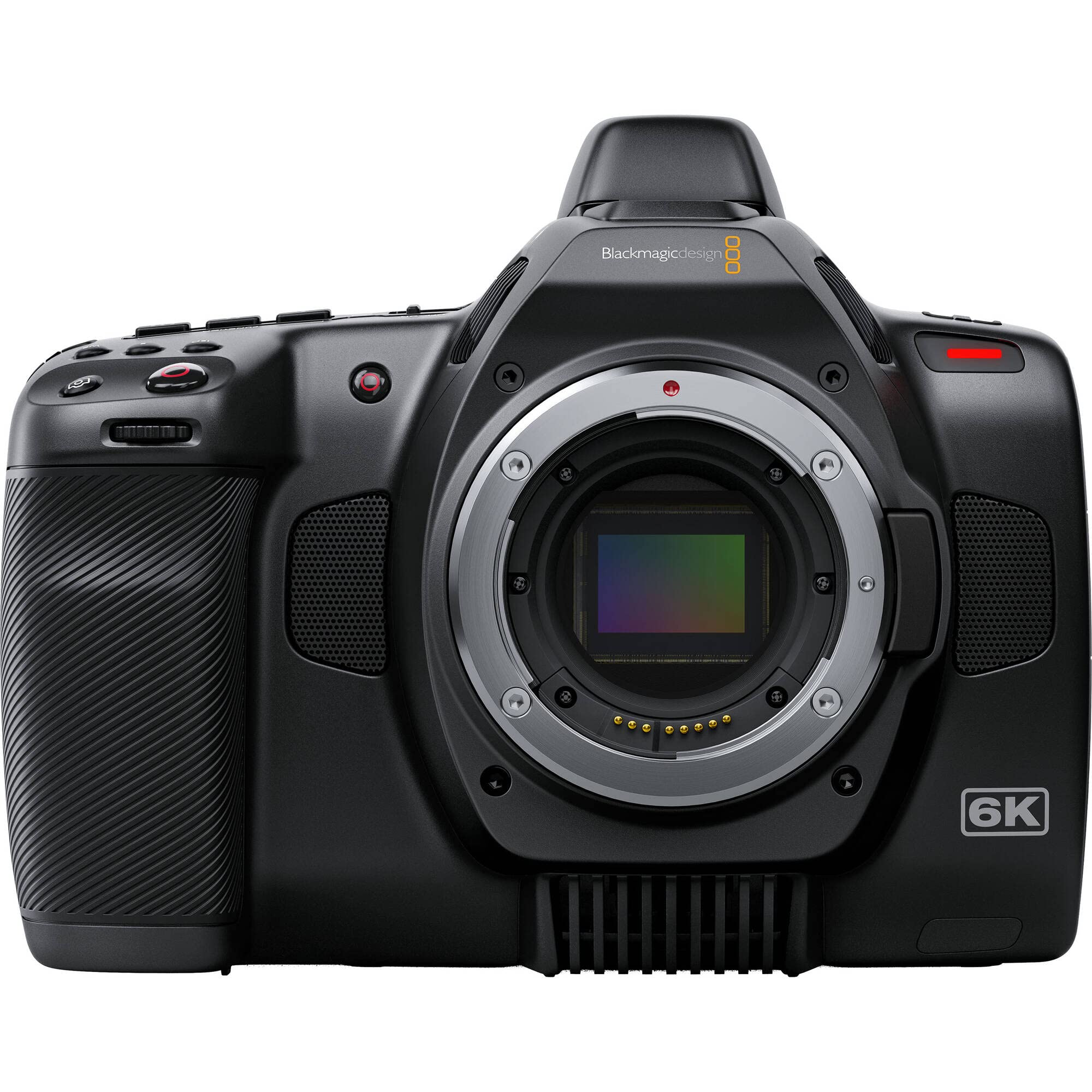
While technically not an 8K body, the Pocket Cinema Camera 6K remains a strong choice for budget-conscious filmmakers who need a color-grading-friendly RAW workflow. The Super 35 sensor delivers 6K footage at up to 50fps, with 2.8K 17:9 at 120fps for slow motion. The dual native ISO up to 6400 keeps noise manageable in low-light scenarios, and the 6K footage oversamples beautifully to 4K for sharp delivery.
The EF lens mount offers the most affordable lens ecosystem of any cinema camera on this list, with good compatibility with vintage and third-party glass. The build is compact and DSLR-like, fitting most gimbals. The menu system is well-organized, and the optional Blackmagic RAW codec provides flexible file sizes and consistent color reproduction across DaVinci Resolve.
The LCD is misleading for critical focus pullers — you really need an external monitor for accurate focus at 6K. The battery life is very short, draining the LP-E6 in about 20 minutes during recording. An external V-Mount or NPF battery is essentially mandatory. The autofocus is contrast-detection only and slow; manual focus is the only reliable approach.
Why it’s great
- Excellent Blackmagic RAW codec for flexible color grading and file sizes.
- EF lens mount gives access to a huge range of affordable and vintage lenses.
- 6K oversamples cleanly to 4K and supports up to 120fps slow motion.
Good to know
- Small LCD is not reliable for accurate focus; external monitor recommended.
- Battery life is roughly 20 minutes in active recording; external power needed.
- Contrast-detection autofocus is slow and unreliable for video work.
7. Sony FX3 Bundle with 24-70mm f/2.8 GM II

The FX3 is built as a dedicated cinema body, not a hybrid stills camera, and the 12MP full-frame sensor prioritizes low-light sensitivity over pixel count — it shoots 4K internally, not 8K, but this bundle includes the excellent 24-70mm f/2.8 GM II lens. The internal fan allows 4K/120fps recording indefinitely without overheating, and the XLR handle unit provides professional audio inputs which make it ideal for run-and-gun documentary work. The compact body fits easily on a gimbal alongside the bundled lens.
The high ISO performance is the standout here — 15+ stops of dynamic range and native ISO up to 409600 produce clean images in near-dark conditions. The S-Log3 gamma and 16-bit RAW output preserve highlight and shadow detail that exceeds most 8K bodies when graded properly. The AF system uses contrast detection but is fast and reliable for video, tracking faces and objects well. The articulating touchscreen is bright and useful in bright outdoor conditions.
The limitation is resolution: 4K is not 8K, so if your deliverable requires 8K native or you need heavy cropping in post, the FX3 won’t satisfy it. The E-mount lens ecosystem is mature but the body lacks IBIS, meaning you’ll rely on lens stabilization or gimbal. The battery life is decent for a cinema body but still requires a hot swap during long takes. The 128GB card in the bundle fills quickly at 4K 4:2:2 10-bit.
Why it’s great
- Active internal fan enables unlimited 4K 120fps recording without overheating.
- Exceptional low-light performance with 15+ stops of dynamic range.
- Bundled 24-70mm GM II lens and professional XLR audio inputs.
Good to know
- Only 4K internal recording; no 8K capability for high-resolution workflows.
- No in-body stabilization; relies on gimbal or lens stabilization.
- 128GB memory card fills fast at high bitrates; additional media required.
FAQ
Does every 8K video camera overheat during recording?
What memory card speed do I need for 8K internal recording?
Can I use my existing EF or F-mount lenses on an 8K mirrorless body?
Final Thoughts: The Verdict
For most users, the best 8k video camera winner is the Canon EOS R5 C because its active cooling fan eliminates the overheating anxiety that plagues passive 8K bodies, while offering excellent Dual Pixel AF and professional timecode I/O. If you want the highest resolution stills with 8K flexibility, grab the Sony Alpha 7R V for its 61MP sensor and AI autofocus. And for a dedicated cinema workflow with optimal rolling shutter control, nothing beats the Nikon Z 8 with its stacked sensor and 12-bit N-RAW recording.