
A robot dog that sits, wags its tail, and responds to your voice is no longer science fiction — it’s an expanding category of desktop companions and STEM robotics kits. The hard part is separating the genuinely interactive AI from the remote-control toys that just walk forward. Battery life measured in minutes versus hours, sensor suites that enable real autonomy versus basic obstacle detection, and whether the thing can actually see your face or just bump into walls are the real differentiators.
I’m Min — the co-founder and writer behind Gadgets Feed. I’ve spent dozens of hours cross-referencing servo counts, battery capacities, camera resolutions, and LLM integration layers across the current wave of quadruped robots to separate the ones that feel alive from the ones that just move.
This guide breaks down nine models ranging from programmable Raspberry Pi kits to ChatGPT-powered desk companions, so you can find the right best ai robot dog for your skill level and budget.
How To Choose The Best AI Robot Dog
An AI robot dog is a blend of hardware mechanics and software intelligence. The biggest mistake buyers make is assuming “AI” means the robot thinks for itself — most models at entry and mid-range levels still rely heavily on remote control or pre-programmed sequences. Here’s what actually matters.
Servo Count and Movement Quality
The number of servo motors dictates how many degrees of freedom the robot dog has. Eight servos (four legs with two joints each) allow basic walking and turning. Twelve to thirteen servos add neck, head, and tail articulation for sitting, shaking, and backflips. More servos also mean smoother, more dog-like gait transitions thanks to inverse kinematics calculations running in real time.
AI Integration Level
There’s a spectrum: basic “AI” means obstacle detection and line tracing. Mid-tier models add face recognition and voice command libraries. High-end units integrate with ChatGPT, Gemini, or local LLMs for open-ended conversation, object recognition via vision-language models, and memory of your name or routine. The tradeoff is that cloud-dependent models need constant Wi-Fi and app updates.
Battery Runtime and Charging
Robot dogs run on lithium-ion packs ranging from small 18650 cells to integrated 5000mAh batteries. A 5000mAh battery can power several days of intermittent use, while smaller packs in Raspberry-Pi-based kits may only run for 3–5 minutes under load. Auto-recharge docks (where the dog returns to a charging station on its own) dramatically improve daily usability over manual USB-C or battery swaps.
Assembly vs. Pre-Assembled
Raspberry Pi kits (FREENOVE, SunFounder PiDog) require building the frame from laser-cut parts, wiring servos, and flashing the SD card with Python code. These are educational experiences first, companions second. Pre-assembled models (Eilik, MechDog, Bittle X, EMO) work out of the box, making them better for younger users or anyone wanting instant interaction. Assembly times range from under an hour to over ten hours depending on complexity.
Quick Comparison
On smaller screens, swipe sideways to see the full table.
| Model | Category | Best For | Key Spec | Amazon |
|---|---|---|---|---|
| SunFounder PiDog | STEM Kit | AI & LLM learning | 12 servos, ChatGPT/Gemini | Amazon |
| Enabot EBO Air 2 Plus | Camera Robot | Pet & home monitoring | 3K camera, 5000mAh battery | Amazon |
| Petoi Bittle X V2 | Programmable | Coding education | Arduino/Python, 35+ actions | Amazon |
| EMOPET EMO | Desk Companion | ChatGPT conversations | Wide-angle camera, dance mode | Amazon |
| LOOI Robot | Desk Companion | VLM vision & memory | 10W wireless charging | Amazon |
| MechDog | STEM Kit | Scratch/Python coding | ESP32, coreless servos | Amazon |
| Enabot EBO ROLA Mini | Camera Robot | Mobile pet camera | 2K camera, 5000mAh | Amazon |
| ENERGIZE LAB Eilik | Companion Pet | Desk interaction | No Wi-Fi needed, touch sensors | Amazon |
| FREENOVE Robot Dog Kit | DIY STEM Kit | Raspberry Pi learning | 13 servos, assembly required | Amazon |
In‑Depth Reviews
1. SunFounder PiDog AI Robot Dog Kit
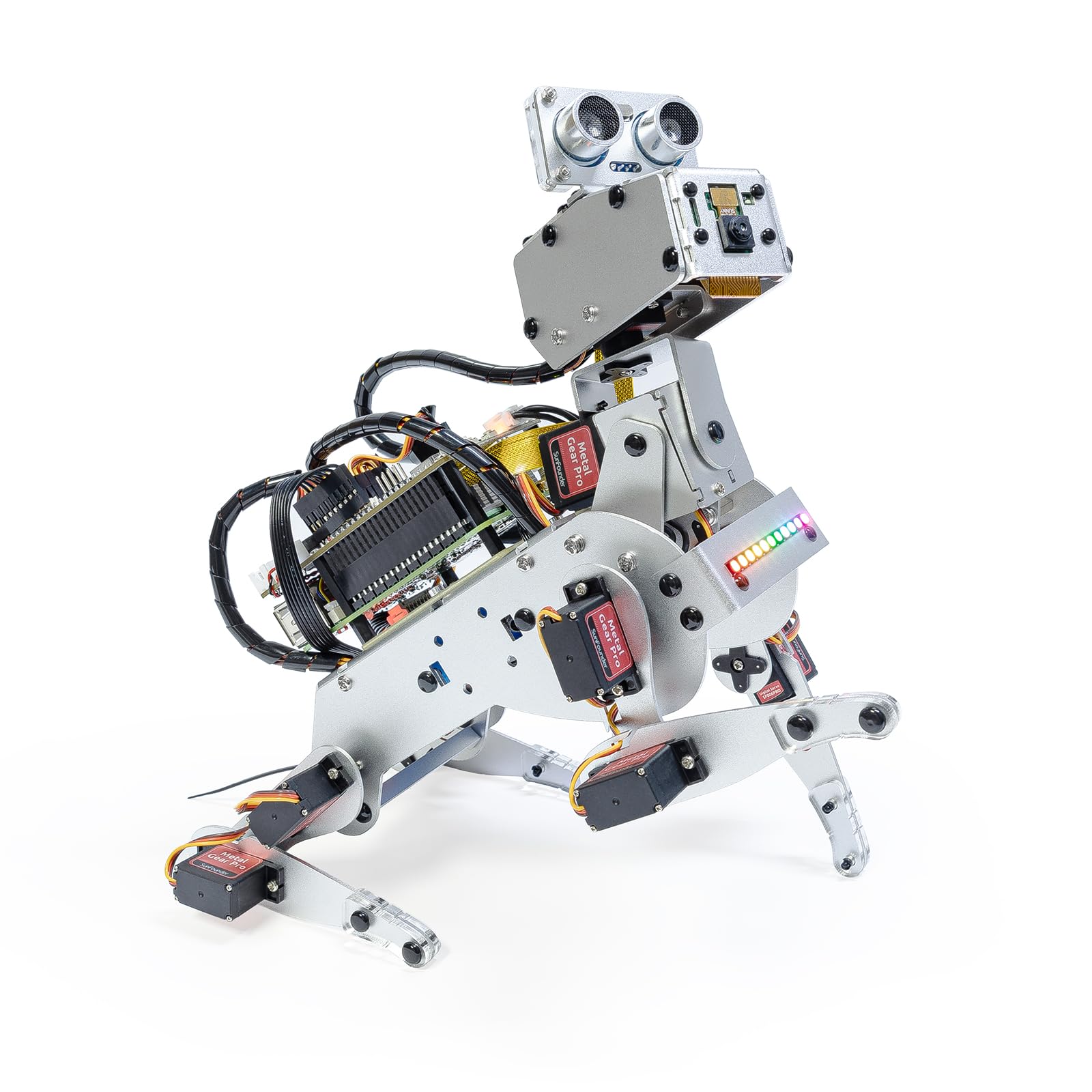
The PiDog is the strongest balanced pick because it combines a full 12-servo quadruped platform with multi-LLM support including ChatGPT, Gemini, and Grok. The included rechargeable battery, camera module, gyroscope, ultrasonic sensor, and dual touch sensors create a sensor-rich environment that supports realistic dog-like behaviors. With OpenCV, MediaPipe, and TTS/STT baked into the Python framework, this kit delivers true vision and voice interaction rather than canned responses.
Assembly takes around 70 steps and requires a Raspberry Pi (5, 4B, or 3B+) and solid dexterity. The documentation is excellent, and SunFounder’s customer support has a strong track record of replacing faulty servos or speakers quickly. Once built, the dog walks, sits, shakes its head, wags its tail, and can perform playful tricks using inverse kinematics — all controllable via the companion app with real-time FPV.
The tradeoff is that beginners will hit a learning curve with wiring and Python programming. ChatGPT integration requires an API key and some scripting knowledge. But for anyone wanting a genuinely upgradeable, AI-capable robot dog that teaches real robotics fundamentals, this is the most future-proof option in the mid-range.
Why it’s great
- Multi-LLM support for natural conversation and gesture recognition
- Comprehensive sensor suite gives near-real-dog responsiveness
- Excellent online documentation and active forum community
Good to know
- Requires Raspberry Pi and moderate soldering-free assembly
- Speaker and servo quality can vary — check unit on arrival
- Not for young children; recommended for ages 15+
2. Enabot EBO Air 2 Plus
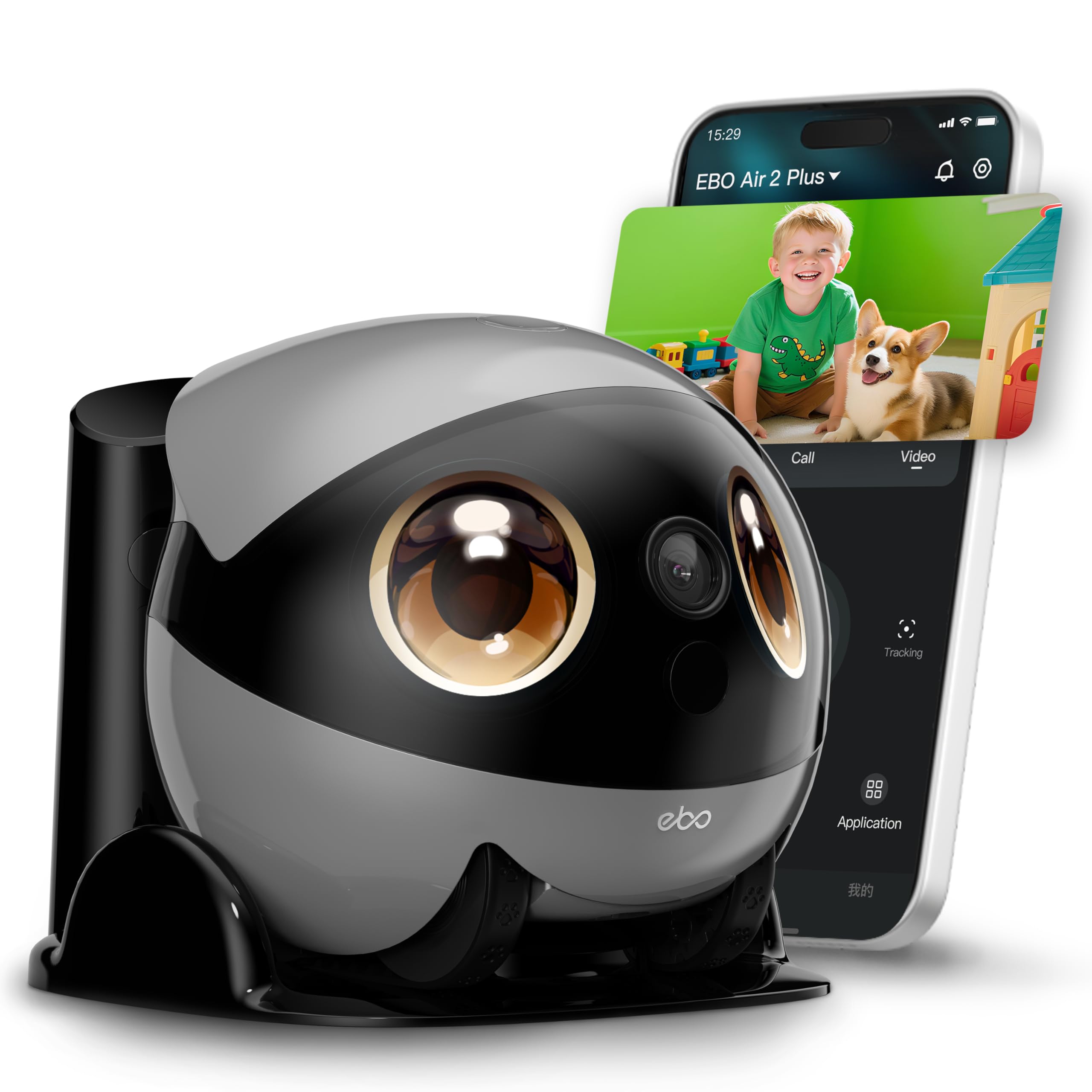
The EBO Air 2 Plus is essentially a mobile security camera that doubles as a family companion. The 3K sensor delivers sharp video day and night, and its 5000mAh battery supports extended roaming sessions before the robot automatically returns to its charging dock. The AI chat mode allows simple conversational interaction by tapping the top button, making it feel less like a surveillance device and more like a presence in the home.
The two-way video calling works reliably, and the built-in 32GB micro-SD card means no ongoing subscription fees for local recording. The tracking feature follows pets and people reasonably well, though it struggles with sharp corners and carpet transitions. The joystick-style driving controls take a few sessions to master, but the app is intuitive once you adjust.
Where it falls short versus true AI robot dogs is autonomy — the AI chat is a gimmicky add-on rather than a deep conversational partner, and the robot can’t navigate rooms independently. For home monitoring with a friendly face, it’s excellent. For a thinking companion, look at the PiDog or LOOI instead.
Why it’s great
- 3K resolution with excellent night vision
- Auto-recharge dock removes battery anxiety
- No subscription needed for local video storage
Good to know
- Struggles with carpet and following around corners
- AI chat mode is basic, not comparable to LLM robots
- Steering is jerky in portrait mode
3. Petoi Bittle X V2 Lite Servo

The Bittle X V2 is built for the coding learner. It runs on an open-source Arduino-compatible board and supports block-based coding, C++, and Python. The pre-assembled version means you avoid hours of wiring — just charge, connect, and start programming gaits and tricks. With 35+ lifelike actions including walking, sitting, and backflips, the servo feedback system enables smoother navigation than many DIY kits.
Petoi provides free robotics curriculums and the Skill Composer visual tool, which lets you chain behaviors without writing code from scratch. The upgraded lite servos offer decent torque for its size, and the 1-hour playtime is sufficient for coding sessions. Voice control through the app works for up to 10 customizable commands, though it prefers English and clear pronunciation.
The main limitation is surface sensitivity — Bittle X is optimized for flat hardwood and concrete. Carpet, grass, and uneven floors cause leg slipping and instability. Some users report the plastic leg joints come loose during high-impact moves. For STEM learning on smooth indoor floors, it’s a top-tier educational tool.
Why it’s great
- Multi-language programming (Scratch, C++, Python)
- Pre-assembled with thorough documentation and curriculums
- OpenCat ecosystem for extensive customization
Good to know
- Unstable on carpet, grass, and uneven surfaces
- Plastic leg joints can pop off during tricks
- Setup requires Wi-Fi/Bluetooth/USB calibration
4. EMOPET EMO Desk Robot

EMO brings ChatGPT-powered conversation to a compact tabletop form factor. Its wide-angle camera lets it recognize faces and gestures — you can rub its head, shake it gently, or “shoot” it with finger gestures, and it responds with expressive animations and sounds. The dance mode syncs to music via your phone, and the achievement system tracks milestones like new dance moves and birthday celebrations.
The built-in AI model handles voice commands for basic interactions, and when connected to Wi-Fi, ChatGPT enables deeper conversations. The included skateboard accessory lets it glide around, and the smart light adds ambient interaction. Assembly is zero — unbox and it’s ready to interact within minutes.
Reliability is inconsistent. Some units fail within a day with poor voice recognition and fast battery drain, while others work flawlessly for months. The app interface has room for improvement, and the lack of a charging station means you plug it in manually. When it works, it’s charming. When it doesn’t, the return process is standard Amazon policy.
Why it’s great
- ChatGPT integration for open-ended conversation
- Gesture and touch interaction with expressive animations
- Dance mode and achievement system for ongoing engagement
Good to know
- Voice recognition quality varies between units
- No auto-recharge dock included
- Battery life and charging speed are middling
5. LOOI Robot Space Black
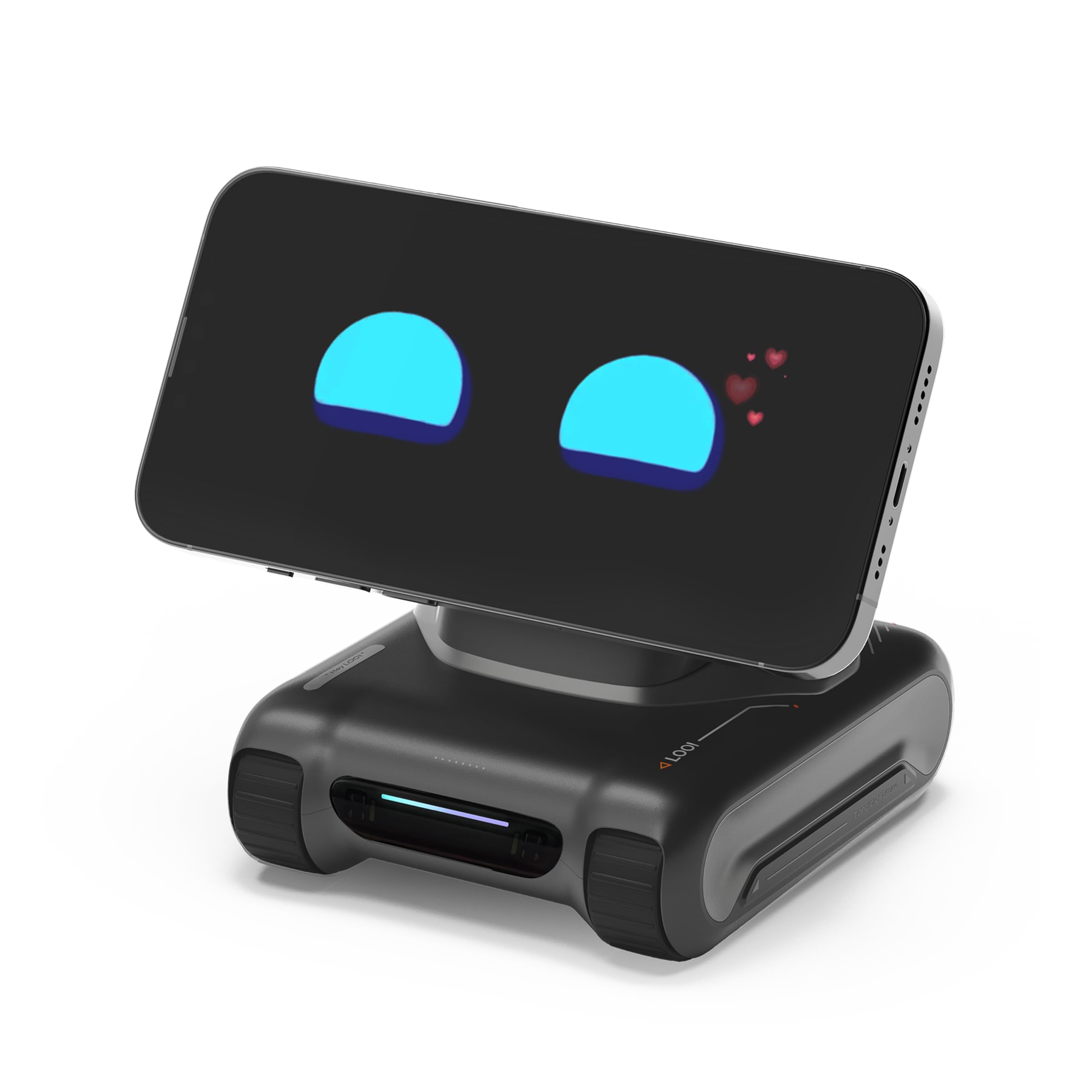
LOOI stands out because of its Vision-Language Model (VLM) integration. It doesn’t just hear you — it sees objects, recognizes multiple people simultaneously (including outfits and poses), and interprets room layouts. This visual understanding translates into contextual responses: it can identify a croissant versus a baguette, or comment on your outfit. The ChatGPT voice interaction feels natural because it uses visual context rather than relying purely on voice inputs.
The autonomous behavior system gives LOOI a degree of unpredictability — it chooses when to approach, wander, or react based on its understanding of the environment. Long-term memory stores faces and notes, so repeat interactions build familiarity. The 10W wireless charging pad on top is a genuinely useful bonus for charging your phone while LOOI sits on your desk.
The robot has a tendency to drive off table edges in explore mode, and it requires a dedicated screen — it won’t move on dark surfaces. The mic activation (touching the screen sides) is finicky, and some users report mispronunciations. When it works, it’s the most lifelike desk companion available. When it bugs out, factory resets can be necessary.
Why it’s great
- VLM vision enables object and person recognition with contextual chat
- Autonomous behavior and long-term memory make interactions feel real
- Built-in 10W wireless charging is genuinely useful
Good to know
- Tends to drive off edges unless on carpet or confined desk
- Voice activation requires precise screen touch
- Some units exhibit buggy behavior needing reset
6. LewanSoul MechDog Standard Kit

The MechDog is an ESP32-based quadruped that emphasizes educational programming over plug-and-play companionship. It comes pre-assembled, so you skip the wiring phase and jump straight into coding with Scratch, Python, or Arduino. The 8 high-speed coreless servos (four legs, two per leg) provide fast and accurate movement, and the built-in inverse kinematics engine allows real-time adjustment of walking direction and posture.
The ESP32-S3 chip handles AI camera input for target recognition and line tracing, making it suitable for classroom robotics projects. LEGO-compatible expansion ports let you attach sensors and modules creatively. The standard kit includes everything you need to start, while the ultimate kit adds a BBC Micro Bit, extra sensors, and a gripper servo for more complex builds.
Software reliability is the weak point. The development software has Bluetooth connectivity issues with iPads, and the setup process can be frustrating for non-technical users. Once running, it’s a rugged platform, but the learning curve is steep — this is a tool for serious learners, not casual play.
Why it’s great
- Pre-assembled with multiple programming language support
- Coreless servos with inverse kinematics for fluid movement
- LEGO-compatible expansion for creative builds
Good to know
- Software setup is buggy, especially Bluetooth on iPad
- 8 servos limit movement complexity compared to 12-servo models
- Not suitable for casual users — requires technical patience
7. Enabot EBO ROLA Mini

The ROLA Mini is a compact, wheeled camera robot designed for pet owners and remote family connection. Its 2K camera with night vision delivers clear video in low light, and the two-way talk feature works with minimal latency. The 5000mAh battery provides multiple days of standby or about 2.5 hours of active driving — excellent for a camera in this form factor.
The magnetic USB-C charging cable is convenient, though there’s no auto-recharge dock like the EBO Air 2 Plus. Controls via the smartphone app are responsive, with a joystick-like interface that takes some practice. The robot is durable enough to handle minor bumps and is small enough to fit under furniture — great for finding hiding pets.
The lack of AI features beyond basic motion detection makes this more of a mobile security camera than an AI robot dog. It doesn’t follow you, recognize faces, or chat. For pure pet monitoring with remote driving, it’s a solid value. For interactive companionship, the EBO Air 2 Plus or EMO are better choices.
Why it’s great
- Long 5000mAh battery life with days of standby
- Clear 2K day and night video with two-way talk
- Compact footprint fits under furniture
Good to know
- No auto-recharge; magnetic USB charging is finicky
- No AI tracking, face recognition, or conversational features
- Small track wheels struggle on thick carpet
8. ENERGIZE LAB Eilik

Eilik is a pure, offline interactive desktop pet — no Wi-Fi, no Bluetooth, no app required. Just power it on and touch its head, belly, or back to trigger different emotional responses. It communicates through expressive eye animations and sound, and when two Eiliks are near each other, they chat, play, or quarrel autonomously. A group of three or more starts a party sequence.
The appeal is simplicity. There’s no setup, no charging station anxiety, and no software updates required (though firmware updates via USB add features over time). The polycarbonate body feels solid, and the glossy finish is fingerprint-prone but visually appealing. The touch sensors are responsive for head pats and belly rubs, though the back sensor can be inconsistent.
The timer function is broken on some units (defaults to heart mode), and the mimic/recorder mode fun wears off quickly. It’s not a learning robot — it won’t remember you or grow smarter. But as a 100% offline stress-relief desk toy with genuine social behavior between units, it’s uniquely charming. Buy two for maximum fun.
Why it’s great
- Completely offline — no Wi-Fi or app needed
- Multiple Eiliks interact autonomously with unique personalities
- Touch sensors on head, belly, and back for tactile feedback
Good to know
- Timer function is buggy on some units
- No long-term memory or learning capability
- Back touch sensor can be unresponsive
9. FREENOVE Robot Dog Kit for Raspberry Pi

The FREENOVE kit packs 13 servos (three per leg plus one for the head) into an affordable Raspberry Pi platform. It includes a Pi Camera module, ultrasonic distance sensor, and RGB LEDs. The 122-page PDF manual is outstanding — it walks through assembly step by step, and the provided Python code handles face recognition, ball tracing, and self-balancing out of the box.
The build requires significant patience. The pieces are laser-cut plastic, small parts need careful handling, and wiring the 13 servos without breaking connectors is a test of fine motor skills. It requires not only a Raspberry Pi (not included) but also specific 18650 batteries, a battery charger, and an HDMI cable for initial setup. The 3-minute runtime on a single battery charge is its biggest functional weakness.
Customer reviews overwhelmingly praise the educational value and support quality. The kit is sensitive to surface type — it works well on smooth concrete and plywood but struggles on carpet and tile. FREENOVE’s support team is responsive, replacing faulty components quickly. This is the best entry-level option for learning robotics programming from scratch, provided you accept the DIY nature.
Why it’s great
- 13-servo configuration for highly articulated movement
- Excellent 122-page PDF manual with Python code examples
- Includes Pi Camera, ultrasonic sensor, and RGB LEDs
Good to know
- 3-minute battery runtime is extremely limiting
- Requires Raspberry Pi, 18650 batteries, and HDMI screen
- Only stable on smooth, hard surfaces
FAQ
Do AI robot dogs need Wi-Fi to work?
How long do the batteries last on AI robot dogs?
Can I program an AI robot dog without coding experience?
What surfaces do robot dogs work best on?
Final Thoughts: The Verdict
For most users, the best ai robot dog winner is the SunFounder PiDog because it strikes the best balance between lifelike servo mechanics, multi-LLM AI integration, and educational value for the price. If you want a plug-and-play companion with ChatGPT conversation, grab the EMOPET EMO. And for pure offline desk charm with multi-unit interaction, nothing beats the ENERGIZE LAB Eilik.