
Floor wedges blast your ears with muddy monitor mix while the crowd hears something else entirely. An affordable in-ear monitor system fixes this, isolating your personal mix from stage noise and giving you precise control over what you hear. Switching to wireless IEMs cleans up the stage, protects your hearing, and lets you move freely without tripping over cables.
I’m Min — the co-founder and writer behind Gadgets Feed. I’ve spent countless hours analyzing the technical specifications, real-world performance data, and user feedback across dozens of wireless IEM systems to find the most reliable options that balance price with professional-grade features like latency, frequency response, and wireless stability.
The result of this deep research is a curated selection of the best affordable in-ear monitor system for live performers, church worship teams, and studio musicians who demand clear, reliable monitoring without breaking their budget.
How To Choose The Best Affordable In-Ear Monitor System
Wireless IEM systems range from simple personal monitor packs to multi-channel setups for entire bands. Focus on four critical factors: frequency band, latency, audio fidelity, and battery runtime. The wrong choice means dropouts during a chorus or a delayed kick drum that destroys your groove.
Frequency Band: UHF vs 2.4GHz vs 5.8GHz
UHF systems (500-900MHz) offer the best penetration through walls and crowd bodies, making them ideal for larger venues. 2.4GHz systems like the Xvive U4 are more affordable and work without frequency coordination but share spectrum with Wi-Fi and Bluetooth, risking interference in dense environments. 5.8GHz systems like the Swiff WX520 and Xvive U45 bypass Wi-Fi congestion entirely, though their range is typically shorter.
Latency and Audio Quality
Professional IEM systems achieve sub-5ms latency, essential for live rhythm sections where a 10ms delay feels like a flamming hi-hat. Look for 24-bit/48kHz audio resolution and a wide frequency response (20Hz-20kHz) for full-bodied monitoring. Built-in limiter circuits prevent sudden volume spikes from damaging your hearing or distorting your mix.
Channel Count and Expandability
Single-transmitter systems support one or two bodypacks, ideal for solo performers or small bands sharing a mix. Multi-channel transmitters like the Phenyx Pro PTM-33-4B let each musician dial their own independent monitor mix, which is critical for bands with multiple vocalists and instrument players who need different cue levels.
Battery Life and Build Quality
Bodypack receivers should last at least 4-5 hours per charge to cover a full rehearsal plus gig without swapping batteries mid-set. Metal chassis transmitters and bodypacks survive road cases and drops better than plastic. Rechargeable packs save money long-term versus systems requiring disposable AA batteries.
Quick Comparison
On smaller screens, swipe sideways to see the full table.
| Model | Category | Best For | Key Spec | Amazon |
|---|---|---|---|---|
| Xvive U45 | 5.8GHz | Studio & live | 24-bit/48kHz / sub-5ms latency | Amazon |
| Phenyx Pro PTM-10 | Stereo UHF | Stereo monitoring | 900MHz band / 89 channels | Amazon |
| D Debra ER-202 | Dual-Channel UHF | 4 bodypack band | 510-580MHz / 300m range | Amazon |
| Phenyx Pro PTM-33-4B | 4-Channel UHF | Worship team | 4×25 frequencies / 164ft range | Amazon |
| Swiff WX520 | 5.8GHz Stereo | Versatile inputs | XLR/1/4″/3.5mm / cue mic | Amazon |
| Xvive U4 | 2.4GHz | Solo gigging | 6 channels / 90ft range | Amazon |
| W IN-MIX EM200 | Dual-Channel UHF | 6 bodypack band | 40 freqs/ch / 400ft range | Amazon |
| XTUGA IEM1200 | UHF 2-Channel | Budget duo mix | 550-580MHz / 300ft range | Amazon |
| XTUGA RW2080 | Mono UHF | Entry-level duo | 2×40 frequencies / 2 receivers | Amazon |
In‑Depth Reviews
1. Xvive U45 Wireless in Ear Monitor System 5.8GHz

The Xvive U45 stands out by operating on the 5.8GHz band, completely sidestepping the Wi-Fi and Bluetooth congestion that plagues 2.4GHz systems. It delivers 24-bit/48kHz high-resolution audio with a 110dB signal-to-noise ratio and sub-5ms latency, ensuring your monitor mix arrives clean and in perfect time. The Channel Scan mode automatically finds the clearest frequency among six channels, taking the guesswork out of setup.
Battery life reaches 5 hours per charge with USB-C charging on both transmitter and receiver, and a 10-minute quick charge provides 1 hour of playtime — critical when you’re backstage between sets. The bodypack receiver is compact and lightweight, with tactile buttons that resist accidental presses during performance. Real-world testing confirms a stable range of 100-150 feet with zero dropout in loud rock band environments alongside multiple wireless systems.
Users consistently note that the U45 matches the audio clarity of systems costing two to three times more, while the 5.8GHz frequency keeps interference non-existent even in crowded urban venues. The only downside is the limited channel count — six channels are sufficient for a full band, but you cannot expand beyond that. For solo performers or small ensembles who want premium audio isolation without fighting for spectrum, this is the smartest choice.
Why it’s great
- 5.8GHz band avoids all Wi-Fi and Bluetooth interference
- 24-bit/48kHz high-resolution audio with 110dB SNR
- 10-minute quick charge gives 1 hour of playtime
- Auto Channel Scan selects the cleanest frequency
Good to know
- Limited to 6 selectable channels — no expansion beyond that
- Bodypack battery is non-removable
2. Phenyx Pro PTM-10 UHF Stereo Wireless in Ear Monitor System

The Phenyx Pro PTM-10 delivers true stereo wireless monitoring on the less-crowded 900MHz band, offering 89 tunable frequencies with a range of 160 feet. Unlike many budget systems that sum stereo signals to mono, this unit preserves the full stereo image — vital for keyboardists, electronic drummers, and anyone whose mix relies on spatial placement. A built-in EQ, balance control, and limiter let you tailor your monitor mix precisely without distorting at high levels.
Setup is straightforward with XLR and 1/4-inch hybrid inputs on the metal transmitter, and the included rackmount kit integrates seamlessly into a standard 19-inch rack. The bodypack receiver runs on two AA batteries (included) and provides clear, dynamic sound with a frequency response of 60Hz to 16kHz. Users report zero latency and no dropouts even in venues with multiple wireless microphones and Wi-Fi networks active.
Small worship teams and gigging musicians praise the PTM-10 for its reliability out of the box — it avoids the 500-600MHz band congestion common in urban areas while delivering audio clarity that competes with Shure units at a fraction of the cost. The only tradeoff is the lack of an auto-scan feature; you must manually find a clean channel, which can be tedious in RF-dense environments. For stereo fidelity on a budget, this is the standout performer.
Why it’s great
- True stereo monitoring preserves spatial audio in your mix
- 900MHz band avoids interference from 500MHz wireless mics
- Built-in EQ, balance, limiter, and lock functions
- Includes rackmount kit and padded carrying case
Good to know
- No automatic frequency scanning — requires manual tuning
- Bodypack uses disposable AA batteries instead of rechargeable
3. D Debra Audio PRO Mono ER-202 UHF Dual Channel Wireless IEM
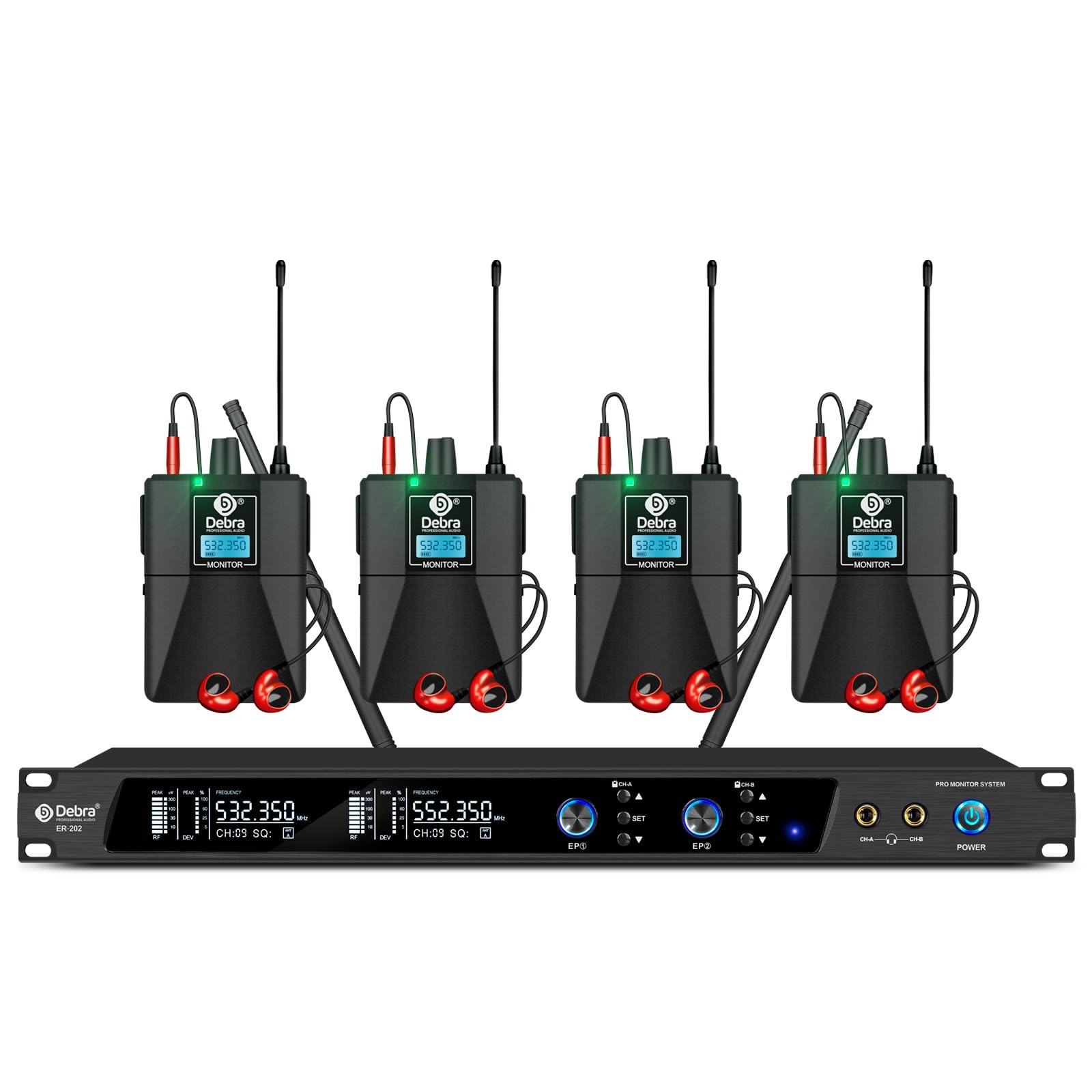
The D Debra ER-202 is a dual-channel UHF system that comes with four bodypack receivers, making it an ideal solution for a full rhythm section or worship band that needs separate monitor mixes. Operating across 510-580MHz with 100 preset frequencies per channel, it provides extensive options to avoid interference in crowded RF environments. The transmitter features both mixed 6.35mm input and two independent channel inputs, allowing each channel to feed a different mix to its paired receivers.
Each bodypack includes an LCD display showing battery power and RF reception, with intuitive push-button controls for volume and channel selection. The built-in limiter prevents distortion from sudden signal peaks, and the claimed 300-meter range in open air gives performers plenty of freedom to roam the stage. Real-world church installations report solid connections at 60 feet with no dropouts, even when multiple wireless microphone systems are active on nearby frequencies.
Users consistently highlight the excellent build quality — the metal transmitter chassis feels premium for the price point, and the bodypacks feel sturdy in hand. The included earbuds are a weak point, delivering thin bass and harsh highs; serious users should budget for aftermarket IEM earbuds. For a four-player band that wants independent feeds from a single transmitter, this system offers unmatched value if you factor in replacement earbuds.
Why it’s great
- Dual-channel transmitter with 100 frequencies per channel
- Four bodypacks included — covers an entire band
- Metal chassis transmitter with rackmount capability
- Built-in limiter protects your hearing
Good to know
- Included earbuds lack bass and sound tinny — plan to upgrade
- Mono only — no stereo transmission for spatial mixes
4. Phenyx Pro PTM-33-4B Quad-Channel Wireless IEM System

When your band has four members each demanding their own independent monitor mix, the Phenyx Pro PTM-33-4B delivers exactly that through a single rackmount transmitter. This 4-channel mono UHF system provides 25 frequencies per channel (100 total), with IR sync for rapidly pairing all four bodypacks. The transmitter accepts 1/4-inch TS inputs with loop outputs on each channel, enabling daisy-chain connection from a digital mixer like the Behringer X32 without needing an external splitter.
Each bodypack runs on two AA batteries, with users reporting 6+ hours of runtime in church settings. The audio is crisp and full-range, though the system is mono only — a deliberate choice for vocal clarity and focus, which worship teams and speech-intensive applications prefer. The 164-foot line-of-sight range holds steady even through thick sanctuary walls, and the 902-928MHz frequency band avoids the crowded 500MHz range used by most wireless microphones.
Early adopters are emphatic: this sub- 4-channel system outperforms expectations, with zero latency, minimal static, and volume output that doesn’t require an external headphone amp. The included earbuds are mediocre — plan to invest in aftermarket IEMs for full frequency response. For churches and cover bands running multiple wireless channels simultaneously, this is the most cost-effective way to get every member their own mix.
Why it’s great
- Four independent mono mixes from one transmitter
- 902-928MHz band avoids interference from wireless mics
- IR sync for fast and easy bodypack pairing
- Loop outputs enable daisy-chain from digital mixers
Good to know
- Mono only — no stereo option for spatial mixes
- Only two antennas provided for four channels; antenna paddles recommended for reliability
5. Swiff Audio WX520 Wireless in Ear Monitor System 5.8GHz
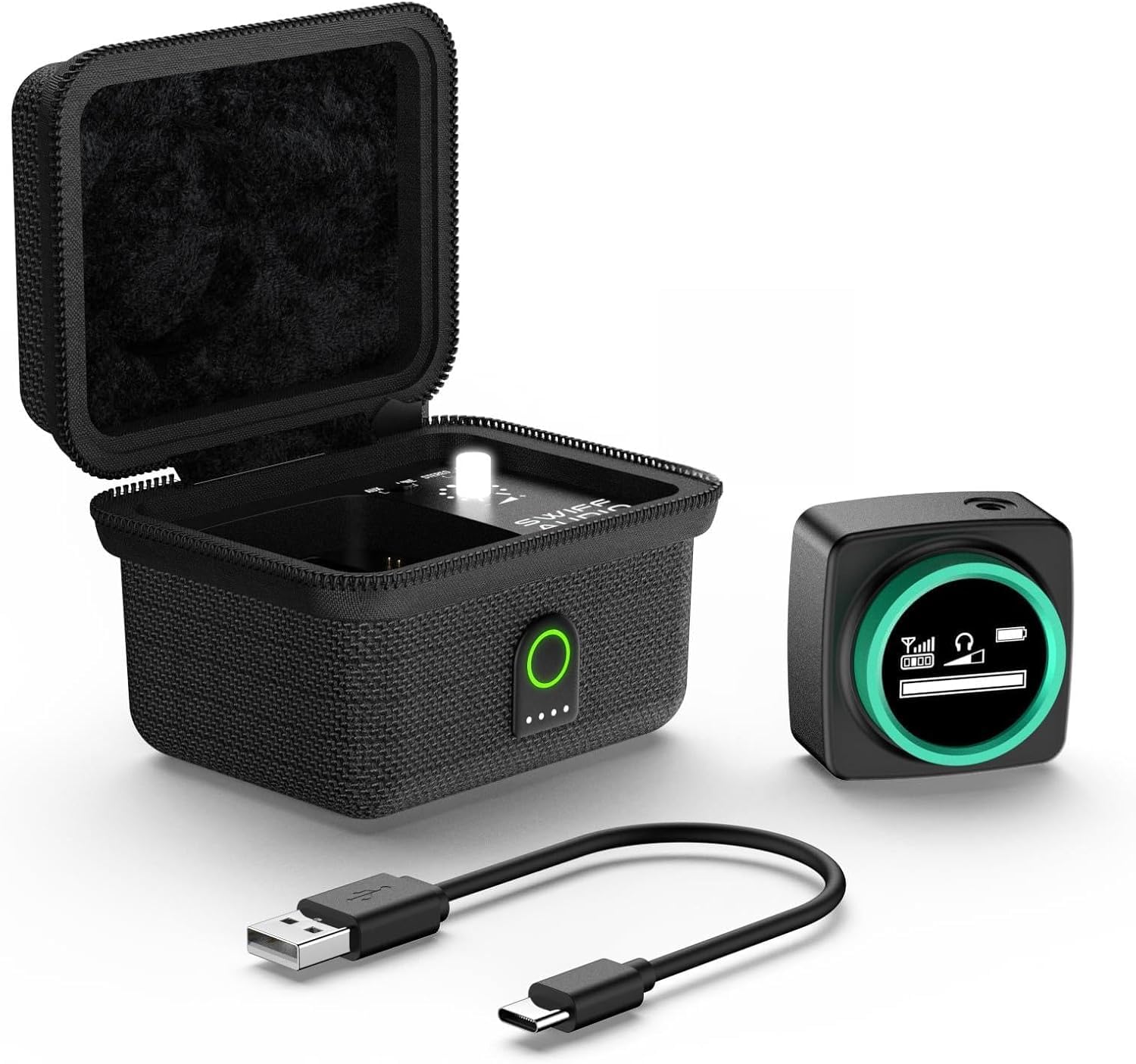
The Swiff Audio WX520 differentiates itself with a built-in cue talkback microphone on the transmitter, enabling direct communication between the sound engineer and performers without needing a separate talkback system. Operating on 5.8GHz with four selectable channels, it avoids both 2.4GHz and UHF congestion completely, delivering sub-5ms latency with stereo or mono output modes. The transmitter accepts XLR, 1/4-inch, and 3.5mm inputs, making it compatible with mixers, instruments, and consumer audio gear alike.
The receiver charges inside the transmitter’s charging case, providing up to 5 hours standalone and 10 hours total with the case. One transmitter can support multiple receivers on the same channel, making it easy to expand for a small band sharing a single monitor mix. The audio is clear and crisp with no static or dropouts at typical stage distances, though users note that staying close to the transmitter is necessary to avoid signal degradation.
Reviewers report it works well as a backup or budget main IEM compared to higher-end Audio-Technica systems, with clean stereo separation and no noticeable latency. The cue mic feature is a genuine asset for rehearsals where the engineer needs to give quick verbal directions. The main limitation is battery life — 5 hours on the receiver means it won’t cover an all-day festival without recharging. For small venues and practice spaces, the WX520 offers exceptional input flexibility at a reasonable cost.
Why it’s great
- Built-in cue talkback microphone for engineer-to-performer communication
- XLR, 1/4-inch, and 3.5mm inputs for maximum compatibility
- 5.8GHz band avoids all Wi-Fi and UHF interference
- Transmitter charging case extends total battery to 10 hours
Good to know
- Receiver battery life limited to 5 hours per charge
- Range drops quickly if you move far from the transmitter
6. Xvive U4 Wireless in-Ear Monitor System Set

The Xvive U4 is a 2.4GHz wireless IEM system with six channels and a 90-foot range, designed as the ultimate grab-and-go solution for gigging musicians who want simplicity. The transmitter and receiver both feature built-in rechargeable batteries providing 5 hours of runtime, and the entire setup fits in a small carry bag. Setup is as easy as plugging the transmitter into your mixer’s aux output via the included 1/4-inch to XLR adapter and turning on the matched receiver.
Latency is under 5ms, which is transparent for live performance — kick drums and vocal cues arrive in perfect sync. The audio quality is clean and noise-free, with no static or hiss at moderate volume levels. Users have successfully used the U4 on large stadium stages without ever going out of range, despite the modest 90-foot spec, proving its reliability surpasses its printed numbers in real-world conditions.
The main design caveat is that two transmitter units do not fit side-by-side on a standard pedalboard due to their width, which matters for dual-mix setups. The 1/4-inch adapter on the transmitter is also non-locking and can loosen over time, potentially causing intermittent signal loss. For single musicians or duos who need a painless entry into wireless monitoring without frequency coordination, the U4 delivers surprising performance in a tiny footprint.
Why it’s great
- Ultra-compact size fits in a small bag for easy transport
- Built-in rechargeable batteries eliminate AA replacement costs
- Sub-5ms latency with clean, noise-free audio
- Six channels allow multiple band members to use separate units
Good to know
- Transmitter 1/4-inch adapter does not lock — can loosen during use
- Two units don’t fit side-by-side on a pedalboard
7. W IN-MIX EM200 UHF Wireless in-Ear Monitor System
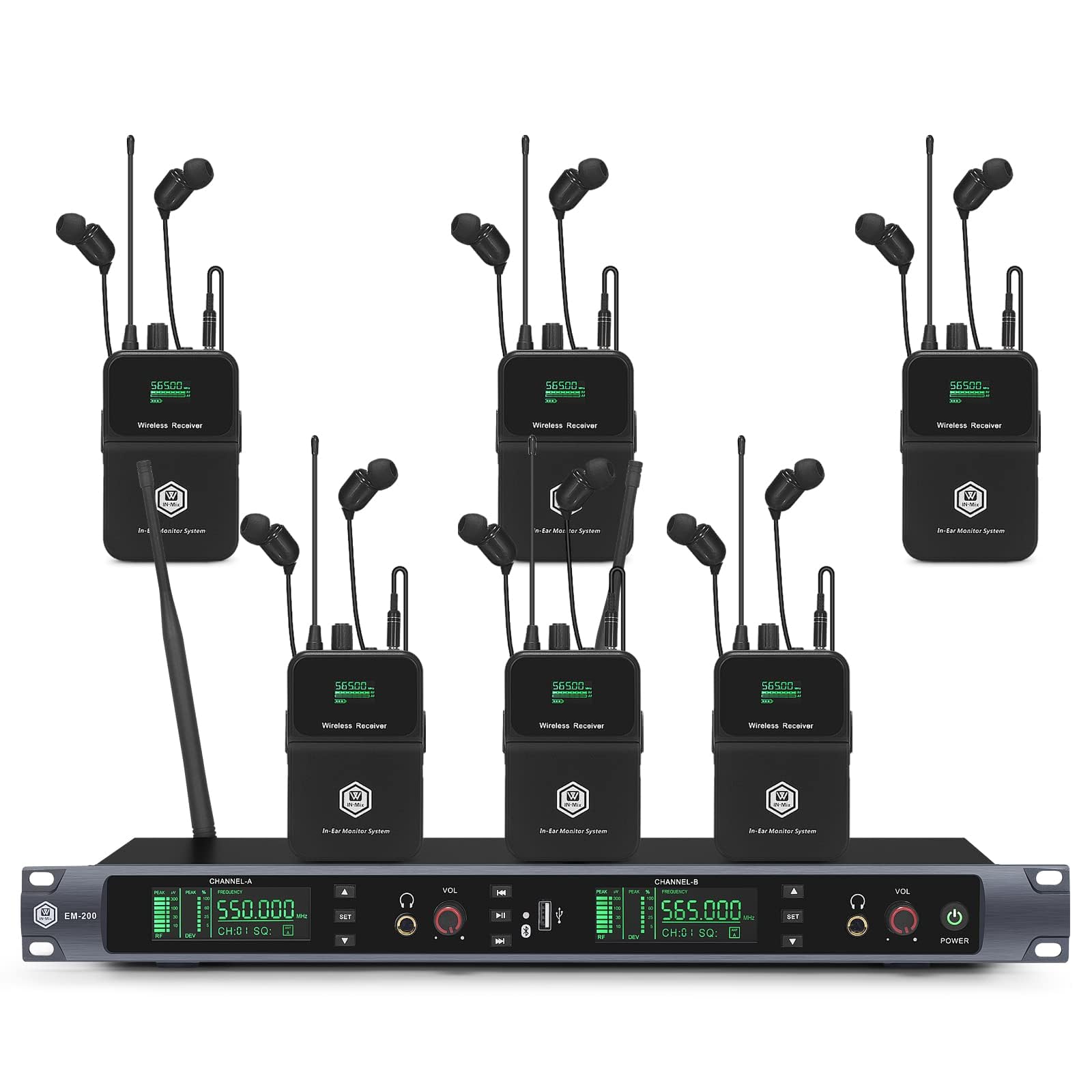
The W IN-MIX EM200 is a dual-channel UHF system that ships with six bodypack receivers, offering enough capacity for a full band plus backup. Operating on 40 preset frequencies per channel with PLL phase-locked loop technology, it delivers ultra-low latency below 5ms and a wide frequency response from 50Hz to 20kHz. The transmitter includes both 3.5mm and 6.35mm audio inputs plus a USB input, along with a real-time monitor jack for the sound engineer to check the mix.
The 400-foot range in open areas ensures reliable coverage for outdoor stages and large venues, with real-world performance holding steady at 250-300 feet without dropouts. Built-in limiter circuits prevent distortion at high volumes, protecting both equipment and hearing. The bodypack receivers are lightweight with intuitive controls, though they require two AA batteries each — you will need a significant supply for six units.
Early feedback is positive for the core hardware: the transmitter feels robust, the signal stays clean, and the multi-bodypack configuration is perfect for worship teams or large rehearsal spaces. The included earbuds are entry-level and benefit from upgrading, and some users note that high input levels can introduce static. For a band that needs six people on wireless IEMs from a single transmitter, this is one of the few options that delivers without expanding into separate rackmount systems.
Why it’s great
- Six bodypack receivers from a single dual-channel transmitter
- 400-foot open-range performance for large venues
- Built-in limiter and real-time monitor jack for engineers
- PLL technology ensures stable, interference-free signal
Good to know
- Requires 12 AA batteries for all six bodypacks
- Included earbuds are low quality — factor in upgrade cost
8. XTUGA IEM1200 in Ear Monitor System Dual Bodypack

The XTUGA IEM1200 provides two bodypack receivers on a shared UHF channel, making it a straightforward solution for duos who only need a single monitor mix. Operating on the 550-580MHz band with 40 selectable frequencies, it includes a built-in limiter circuit to prevent distortion from excessive input levels. The metal chassis transmitter is rack-mountable and features a front-panel 1/4-inch stereo monitoring headphone jack for the engineer, plus an LCD display with RF and AF indicators.
Wireless range is rated at 250-350 feet, and users confirm zero dropout and no latency at long distances, making it reliable for medium to large venues. The receiver runs on two AA batteries with real-world runtime reported at over 10 hours by some users, though others note a 3.5-hour lifespan depending on volume levels and earbud impedance. The dynamic expansion circuit improves signal-to-noise ratio, resulting in clean audio that one reviewer compares favorably to a Shure PSM700 with a lower noise floor.
There are notable drawbacks: the built-in noise gate can clip soft passages if the receiver is too close to the transmitter, and the sensitivity of the volume control makes it easy to accidentally trigger peaking cutouts at stage volume. The included earbuds are universally described as cheap and should be replaced immediately. For a drummer and vocalist who simply need isolation and reliability without spending on separate mixes, the IEM1200 gets the job done at a compelling price.
Why it’s great
- Two bodypacks included for duo or shared mix use
- 300-foot range with zero latency and no dropout
- Rack-mountable metal transmitter chassis
- Front-panel headphone jack for engineer monitoring
Good to know
- Noise gate can clip soft audio near the transmitter
- Included earbuds are poor — budget for replacement
9. XTUGA RW2080 Wireless in Ear Monitor System Dual Receiver

The XTUGA RW2080 is a mono UHF system operating on 572-599MHz with 2×40 adjustable frequencies, supporting up to six IEMs simultaneously without crosstalk — though it ships with two bodypack receivers. The transmitter features a full-metal chassis designed for rackmount durability, while the ABS plastic bodypack receivers are lightweight and comfortable for all-day wear. An intuitive LCD screen on the transmitter displays frequency and channel information clearly.
Real-world range reaches 250-350 feet with zero delay, thanks to UHF technology that avoids the latency issues inherent in 2.4GHz systems. Advanced circuit design eliminates receiving blind spots, ensuring consistent signal even as you move around the stage. Each bodypack receiver has its own volume control and LCD display showing battery life and RF status, using two AA batteries each.
Long-term users report over two years of weekly church use with excellent reliability, praising the FCC compliance and clean audio reproduction. The primary limitation is that the system sums stereo sources to mono, which can feel limiting for keyboardists or guitarists who rely on stereo effects. The included headphones are virtually unusable for monitoring, and the battery latch clips on the bodypacks are prone to breaking over time. For a band starting out with IEMs on a tight budget, the RW2080 provides functional reliability if you are prepared to supply your own earbuds.
Why it’s great
- 2×40 UHF frequencies enable multi-band operation without crosstalk
- Full-metal transmitter chassis is built for road use
- Zero latency with stable 300-foot range
- Bodypacks are lightweight and comfortable for extended wear
Good to know
- Mono output only — no stereo imaging
- Battery latch clips on bodypacks are fragile
- Included earphones are not suitable for monitoring
FAQ
Can I use a wireless IEM system with any mixer or audio interface?
How many wireless IEM channels can I run simultaneously without interference?
Do I need to replace the included earbuds on a budget IEM system?
What is the difference between phase-locked loop and diversity antennas in IEM systems?
Final Thoughts: The Verdict
For most users, the best affordable in-ear monitor system winner is the Xvive U45 because its 5.8GHz band delivers interference-free audio with 24-bit resolution and sub-5ms latency at a price that undercuts the competition by hundreds. If you need true stereo monitoring with EQ control and built-in limiter, grab the Phenyx Pro PTM-10. And for a four-piece band requiring independent mixes from a single transmitter, nothing beats the Phenyx Pro PTM-33-4B.