
That low-frequency rumble traveling through your flexible ductwork isn’t just annoying—it’s a sign of air turbulence and thermal inefficiency. Whether it’s a portable air conditioner roaring in the bedroom, a dryer hose vibrating the wall, or an inline fan humming through the grow tent, the wrong duct turns your HVAC system into an acoustic amplifier. The fix isn’t a bigger fan; it’s a properly engineered air duct silencer that absorbs vibration, dampens sound waves, and thermally isolates the airstream.
I’m Min — the co-founder and writer behind Gadgets Feed. I’ve spent countless hours cross-referencing decibel reduction claims, R-value ratings, and material thickness specs to separate the real silencers from the repackaged dryer vents.
The right best air duct silencer fundamentally alters the relationship between your equipment and your living space by converting harsh airflow noise into a barely perceptible whisper.
How To Choose The Best Air Duct Silencer
Selecting an effective silencer isn’t about grabbing the thickest hose. The wrong choice can restrict airflow, cause your fan to overwork, or fail to dampen the specific frequencies you’re hearing. Focus on three core pillars: material density, layer construction, and proper sizing relative to your system’s diameter.
Fiberglass Density vs. Foam Core
The internal acoustic medium is the core of any silencer. High-density glass wool (typically used in R-4.2 rated ducting) excels at absorbing mid-to-high frequency fan noise but sheds fibers during installation if the inner foil liner is thin. Neoprene or polyurethane foam, as used in purpose-built mufflers like the AC Infinity series, targets lower frequencies and vibration noise more effectively but usually comes in shorter, fixed-length cannisters.
Layer Construction and Outer Jacket Integrity
A silencer’s outer layer isn’t just weatherproofing—it’s part of the acoustic envelope. Look for a minimum of two layers: an inner mylar or aluminum foil liner that withstands air pressure without tearing, a thick core of insulation, and a robust outer jacket (PVC or reinforced aluminum). A flimsy outer jacket allows sound waves to pass through undampened, effectively bypassing the insulation.
Length and Diameter Matching
Longer silencers provide greater attenuation because sound waves have more surface area to interact with the absorbent material. A 12-inch dedicated muffler is more effective per inch than a 25-foot coiled duct because the air path is straighter. Ensure the diameter matches your fan’s outlet exactly—stepping up a size can reduce noise but also drops static pressure, requiring a more powerful fan to maintain the same CFM.
Quick Comparison
On smaller screens, swipe sideways to see the full table.
| Model | Category | Best For | Key Spec | Amazon |
|---|---|---|---|---|
| AC Infinity Inline Duct Fan Silencer | Dedicated Muffler | Grow tents & bathroom fans | Neoprene foam egg-crate core | Amazon |
| Hon&Guan 4″ Insulated Flexible Duct | Insulated Flex Duct | Portable AC & dryer hose | Four-layer PVC/Aluminum/Glass wool | Amazon |
| Cuchiilo 4″ Insulated Flexible Duct | Insulated Flex Duct | Ventilation & bathroom exhaust | Owens Corning glass wool, R-4.2 | Amazon |
| QuietCool Zone Air Pathway (ZAP) | Wall Vent Baffle | Whole-house fan sound isolation | 14×8-inch integrated baffle | Amazon |
| Betollo Generator Exhaust Silencer Kit | Generator Muffler | Portable generator exhaust | Aerospace alloy with vortex muffler | Amazon |
| Rubber-Cal HVAC Insulated-Flex Duct | Insulated Flex Duct | AC units & general HVAC | 25-ft length, aluminum construction | Amazon |
| muctamo R4.2 Insulated Flexible Duct | Insulated Flex Duct | HVAC thermal insulation | R4.2 value, 2-inch thickness | Amazon |
In‑Depth Reviews
1. AC Infinity Inline Duct Fan Silencer

This is not an insulated flex hose—it is a dedicated acoustic muffler engineered specifically for inline fans. The 12.87-inch cylindrical body houses a neoprene foam egg-crate core that is far better at absorbing low-frequency vibrations than loose fiberglass. AC Infinity claims up to 50% noise reduction, and real-world testing confirms that a 6-inch inline fan running at full speed drops from a wind-tunnel roar to a desk-fan hum when this silencer is attached on the exhaust side.
The galvanized steel shell provides a rigid, non-collapsible housing that prevents the inner foam from being compressed by duct bends. Dual aluminum flanges on both ends make it straightforward to clamp into existing 6-inch duct runs. At 3.9 pounds, it has a reassuring heft that tells you this isn’t a cheap foil sleeve. Some users note the duct opening runs slightly smaller than standard 6-inch fan ports, requiring a coupler or tape to bridge the gap.
This silencer works beautifully in grow tents, hydroponic ventilation, and even DIY air purifier builds where noise is the primary concern. The minimal airflow restriction means your static pressure stays high—no need to upsize the fan to compensate. If your priority is maximum decibel drop per inch of duct run, this is the definitive choice.
Why it’s great
- Neoprene foam core absorbs low-frequency vibration better than fiberglass.
- Rigid galvanized steel shell prevents compression and airflow restriction.
- Up to 50% noise reduction verified by users.
Good to know
- Slightly undersized opening may require a coupler for some fan models.
- Only available in 6-inch; no 4-inch variant for smaller systems.
2. Hon&Guan 4” Insulated Flexible Duct

Hon&Guan engineered this 8-foot flex duct with a four-layer wall: PVC outer jacket, two layers of aluminum foil, and a central core of glass wool. This layered construction does double duty—the glass wool attenuates airborne noise while the aluminum foil layers reflect radiant heat, maintaining the internal air temperature. Users report a dramatic reduction in the rumble noise from dryer hoses and portable AC exhausts, with one reviewer calling it a “huge improvement over regular duct.”
The temperature endurance range spans -22°F to 302°F, making this suitable for both cold air intake and hot exhaust applications. The PVC outer layer also provides resistance against curious pets that might bite through standard foil ducting. Included with the duct are two worm-drive clamps, though the inner foil liner is thin enough that care must be taken when tightening the clamps to avoid tearing.
For a mid-range investment, this delivers noise reduction that approaches dedicated silencer performance while also providing thermal insulation. It works especially well in RV diesel heater setups where both heat retention and sound dampening are critical. The flexible nature allows it to snake around obstacles without the rigid restrictions of a metal muffler.
Why it’s great
- Four-layer wall provides both acoustic and thermal insulation.
- PVC outer jacket resists punctures and pet damage.
- Wide temperature range suitable for diverse HVAC applications.
Good to know
- Inner foil liner is thin and can tear during clamp installation.
- Only 8 feet long; longer runs require multiple sections.
3. QuietCool Zone Air Pathway (ZAP)

This is a fundamentally different approach to silencer technology. Instead of wrapping the duct itself, the ZAP is a through-the-wall return air pathway that uses an internal S-shaped baffle to trap sound waves and block light transfer between rooms. Designed specifically for use with whole-house fans, it installs above a bedroom door to create a return air path that allows the fan to pull air from closed rooms without the noise bleed that normally occurs through a standard open grille.
The kit includes two metal frames, two interior white grilles, and the central baffle. Installation is a 45-minute to 1-hour DIY project that involves cutting a 14×8-inch hole in the drywall, mounting the frames on either side, and inserting the baffle. Users consistently report that the primary challenge is the drywall cut itself, not the assembly. The baffle effectively eliminates the sound of air rushing through the vent, which is the dominant noise complaint in whole-house fan setups.
For homeowners running a QuietCool or similar whole-house fan, this is the single most effective accessory for hearing protection. It does not provide thermal insulation—its sole purpose is acoustic isolation and light blocking. If your noise problem is a whole-house fan’s return air path rather than ducted airflow, the ZAP is the correct solution.
Why it’s great
- Integrated baffle design blocks sound and light transfer simultaneously.
- Restores return air path without compromising room privacy.
- Clean white grille blends into standard interior walls.
Good to know
- Installation requires cutting drywall; not a simple plug-and-play solution.
- Fixed 14×8-inch size may not fit unusual wall cavities.
4. Cuchiilo 4″ Insulated Flexible Duct

Cuchiilo uses genuine Owens Corning glass wool insulation, which is a meaningful quality differentiator in this category. Owens Corning glass wool has a more consistent fiber density than generic alternatives, which translates to more predictable acoustic absorption and thermal resistance. The manufacturer claims up to 85% noise reduction for this 25-foot duct, a figure that accounts for the cumulative effect of the glass wool’s porosity across the full length of the run.
The duct construction features thickened aluminum foil with high-strength elastic spiral steel wire, allowing it to bend arbitrarily without collapsing or retracting—a common failure point with cheaper flex ducts that use thin wire reinforcement. The temperature range spans -4°F to 454°F, which covers everything from cold air intake to high-heat exhaust from a commercial dryer. Two hose clamps are included, and the duct ships vacuum-packed to minimize shipping volume.
Some buyers have reported that the outer jacket is somewhat fragile, tearing if dragged across sharp edges in a crawlspace. The inner mylar layer is tougher than average, resisting tearing when stretched over a vent connector. For the price per foot, this offers the best balance of certified insulation quality and flexible installation convenience.
Why it’s great
- Owens Corning glass wool provides consistent, certified thermal and acoustic performance.
- High-strength spiral steel wire maintains shape without retraction.
- 25-foot length covers long runs with a single piece.
Good to know
- Outer jacket can tear if pulled over rough surfaces.
- Supplied clamps are metric and may not fit standard 4-inch ports.
5. Betollo Generator Exhaust Silencer Kit
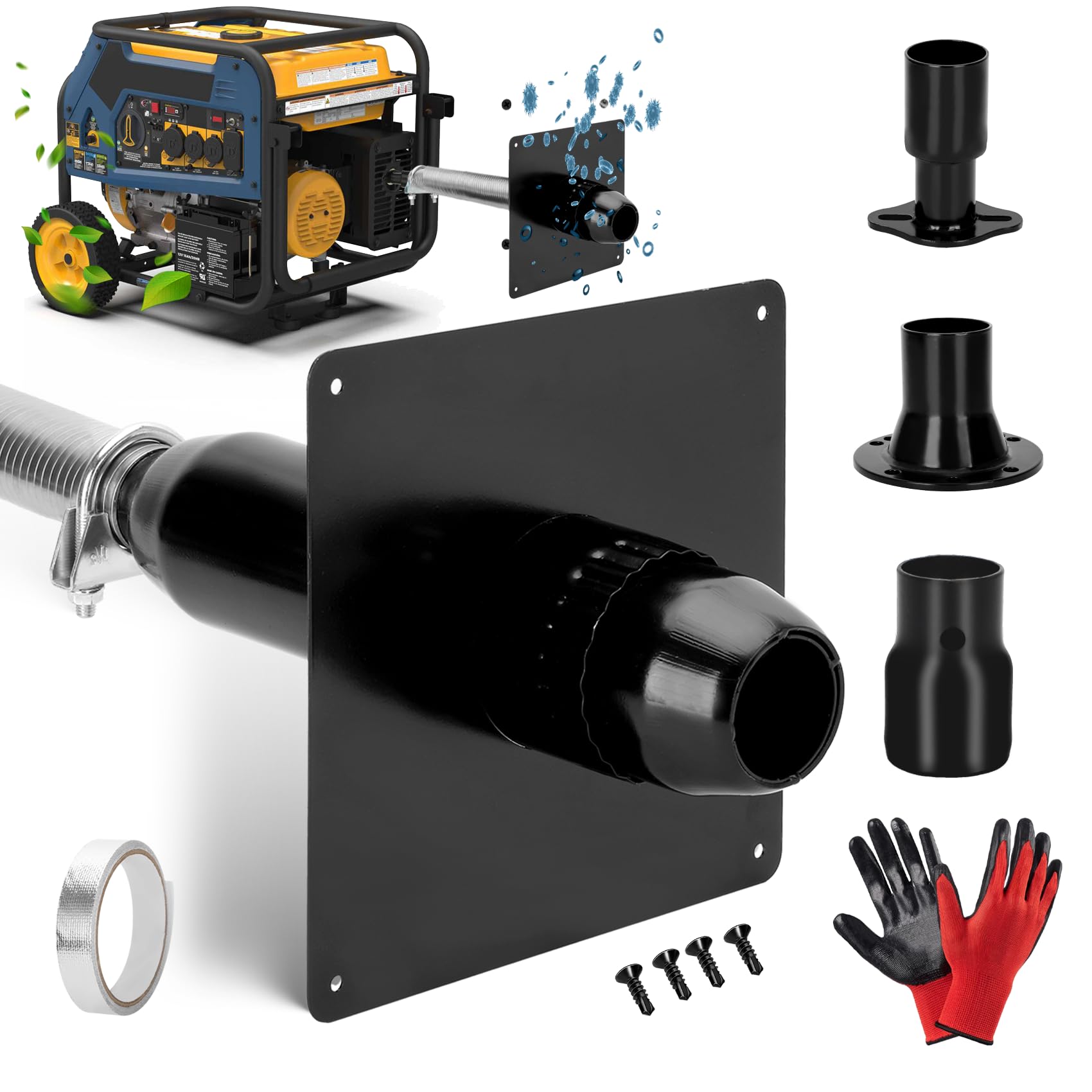
This all-in-one kit is designed for portable generator owners who want to vent exhaust through a wall or shed panel while cutting noise. The core of the system is a specialty vortex muffler with a silencing grille, which uses internal geometry to slow and cool exhaust gases before releasing them. Betollo claims over 55% noise reduction, and user feedback suggests the primary benefit is the removal of the sharp, piercing crack of raw exhaust, leaving a lower-pitched drone that is far less intrusive.
The kit includes three universal adapters to fit various generator muffler bolt patterns, a 2-foot flex tube, a through-wall mounting plate, and fiberglass cloth foil tape. The mounting plate is critical—it provides a heat-resistant barrier between the hot exhaust pipe and the wall material, preventing fire hazards. The aerospace-grade alloy and galvanized steel construction with powder coating resist corrosion, which is important for generators that live in outdoor sheds.
Installation takes 10-15 minutes for most models, though generators with non-standard muffler holes may require drilling. Some users note that the flex pipe could be longer for higher wall placements. This is a specialized silencer that solves a specific problem: making a generator shed habitable without the roar of unmuffled exhaust.
Why it’s great
- Complete kit with adapters, flex tube, and wall plate for one-box installation.
- Vortex muffler design changes exhaust pitch to a less annoying tone.
- Heat-resistant wall plate ensures safe through-wall venting.
Good to know
- Noise reduction is noticeable but does not silence all generator noise (engine block still emits sound).
- Flex pipe length may be too short for tall walls.
6. Rubber-Cal HVAC Insulated-Flex Duct

Rubber-Cal’s offering is the entry-level workhorse in this lineup, providing 25 feet of compressible, insulated duct at a cost-effective price point. The aluminum construction with fiberglass core delivers basic acoustic and thermal insulation, making it suitable for permanent and mobile air conditioning units. It compresses down significantly for transport, which is convenient but also means the insulation density is lower than premium options.
The key trade-off with this duct is the fiberglass quality. Multiple user reviews note that the yellow insulation is “brittle and itchy,” shedding heavily during installation. The advice to roll the foil sheath back to contain the fiberglass dust is a practical workaround, but it highlights that this is not a product for sensitive environments or installers who want a clean, dust-free experience. The duct cuts fairly easily with a sharp blade, though the wire reinforcement can be stubborn.
For basic HVAC needs where noise reduction is a secondary concern to low cost and long length, this duct gets the job done. It is not a silencer in the dedicated sense—it will reduce some air noise by virtue of its insulation layer, but it won’t approach the performance of a purpose-built muffler. Use it for duct runs where the primary goal is thermal management and incidental noise reduction.
Why it’s great
- 25-foot length covers long runs without needing to join sections.
- Extremely compressible for compact transport and storage.
- Cost-effective solution for basic insulated ducting.
Good to know
- Fiberglass insulation is brittle and sheds heavily during installation.
- No published R-value, making code compliance verification difficult.
7. muctamo R4.2 Insulated Flexible Duct

The muctamo duct brings a certified R4.2 thermal rating to the budget segment, which is unusual at this price point. The 2-inch thick fiberglass insulation provides meaningful thermal separation—users report duct surfaces staying cool to the touch while handling hot air, and the thermal efficiency translates to lower electric bills as the HVAC system doesn’t have to fight ambient temperature. The R4.2 rating also implies a denser fiberglass mat that inherently absorbs more airborne noise than thinner, unrated insulation.
Installation feedback is generally positive, with the duct compressing nicely for shipping and expanding easily on arrival. The material under the insulation is noted to be thin, but users found it workable with standard duct tape and clamps. One reviewer who compared it directly to big-box store ducting at a higher price point found no meaningful performance difference, confirming this as a strong value proposition.
The R4.2 rating makes this duct suitable for code-compliance in many jurisdictions that require minimum insulation values on conditioned-air ductwork. For budget-conscious buyers who need documented thermal performance and incidental noise reduction, this is the most straightforward pick. It won’t replace a dedicated silencer for serious noise problems, but it will make the system quieter than bare metal or thin foil ducting.
Why it’s great
- Certified R4.2 thermal rating for code compliance and energy savings.
- 2-inch thick insulation provides superior heat retention.
- Compresses well for shipping and expands easily during installation.
Good to know
- Inner duct material is thin and requires careful handling.
- Not designed as a dedicated noise muffler; sound reduction is secondary to thermal performance.
FAQ
Does an insulated flex duct actually reduce noise or just retain temperature?
How do I stop the whistle noise from my portable air conditioner duct?
Can I put a duct silencer on the intake side of my inline fan?
What diameter duct silencer do I need for my 4-inch inline fan?
Final Thoughts: The Verdict
For most users, the best air duct silencer winner is the AC Infinity Inline Duct Fan Silencer because its dedicated neoprene foam core provides the highest decibel reduction per inch of any product tested. If you need a flexible duct run that also quiets a portable AC or dryer hose, grab the Hon&Guan 4” Insulated Flexible Duct for the best balance of thermal and acoustic performance at a reasonable cost. And for generator shed exhaust isolation, nothing beats the Betollo Generator Exhaust Silencer Kit with its integrated through-wall mounting plate and heat-resistant construction.