
A dead rear light, a cracked phone lens from handlebar vibration, or a ride with zero data on your speed and distance — these are the small frustrations that turn a good ride into a bad one. The right bicycle gadgets solve these problems before they start, adding safety, convenience, and performance tracking without adding weight or complexity to your cockpit.
I’m Min — the co-founder and writer behind Gadgets Feed. I’ve spent countless hours dissecting specs, reading thousands of buyer reviews, and comparing real-world performance data to separate the genuinely useful bicycle gadgets from the gimmicks that clutter Amazon listings.
After evaluating lumens, battery capacities, mount security, and sensor accuracy across dozens of candidates, I’ve curated this definitive shortlist of the best bicycle gadgets to upgrade every ride.
How To Choose The Best Bicycle Gadgets
Bicycle gadgets span everything from safety lights to navigation computers to phone mounts. The key is prioritizing gadgets that solve your specific pain point — whether that’s staying visible at night, protecting your phone from vibration damage, or tracking your training metrics. Here are the three critical specs and features to evaluate before buying.
Battery Capacity & Charging Port
A 400mAh battery in a rear light might get you 50 hours of flashing, but a 10,000mAh headlight can last 16 hours on a low setting. Always check the capacity in milliamp-hours (mAh) and whether the device uses USB-C. The industry is moving fast away from micro-USB, and a USB-C port means faster charging and fewer cables to carry. For long rides or multi-day tours, capacity is everything — you don’t want a dead light 20 miles from home.
Mounting Security & Vibration Resistance
Loose mounts aren’t just annoying — they can damage your phone or drop your light mid-ride. Look for mounts with dual nut designs, rubber or silicone cushions, and specifically for phone holders, a dedicated vibration dampener. A phone mount without vibration dampening can ruin your phone’s optical image stabilization system in just a few rides. For lights, a bracket with an integrated silicone pad prevents shifting on rough terrain.
Sensor Integration & Smart Features
A basic gadget does one thing; a smart gadget communicates. Rear lights with brake sensors detect deceleration and pulse brighter, alerting trailing traffic. GPS computers with ANT+ and Bluetooth pair with heart rate monitors, speed/cadence sensors, and power meters. Turn signals operated by handlebar remote are a game-changer for commuters. The question is not just how bright or how long the battery lasts — it is how seamlessly the gadget fits into your existing riding ecosystem.
Quick Comparison
On smaller screens, swipe sideways to see the full table.
| Model | Category | Best For | Key Spec | Amazon |
|---|---|---|---|---|
| Siuyiu JW617 Headlight | Front Light | Maximum visibility at night | 4800 lumens, 10000mAh | Amazon |
| Garmin Edge 540 | GPS Computer | Serious training & navigation | 42hr battery saver mode | Amazon |
| WSDCAM Smart Tail Light | Rear Light | Commuting safety & anti-theft | 2000mAh, 160 lumen | Amazon |
| Lamicall Phone Mount | Phone Mount | Camera protection from vibration | Dual vibration dampener | Amazon |
| iGPSPORT BSC100S | GPS Computer | Budget GPS tracking & data | 40hr, 2.6” anti-glare | Amazon |
| CooSpo BC107 | GPS Computer | Compact ride tracking | 2.4” display, IP67 | Amazon |
| ROCKBROS Tail Light | Rear Light | Budget brake-sensing light | 400mAh, 50hr flash | Amazon |
In‑Depth Reviews
1. Siuyiu JW617 Headlight

The Siuyiu JW617 delivers an absurd 4800 lumens from its 17 LED beads, lighting a path up to 2624 feet ahead — that is brighter than most budget car headlights. The 10000mAh internal battery is a beast, providing 7 to 16 hours of runtime depending on the mode, and it uses USB-C with a fast-charging chip that refills three times quicker than standard light batteries. A digital display shows the precise remaining battery percentage and estimated usage time, so there is no guessing whether you have enough juice for the return trip.
The aluminum bracket uses a dual nut construction with an integrated silicone cushion that grips the handlebar firmly — no shifting over bumps or ruts. It mounts and detaches in seconds using only your hands, no tools required. Four modes (flood, spot, bright, and flashing) cover everything from quiet rail-trail cruising to aggressive single-track mountain biking at night.
At this lumen output, you must aim the light slightly downward to avoid blinding oncoming traffic, and the large battery adds noticeable weight to the front of the bike. But for sheer night-piercing power and longevity, no other front light in this class comes close.
Why it’s great
- 4800 lumen max output illuminates even unlit rural roads.
- 10000mAh battery lasts multiple long rides between charges.
- Digital battery display with percentage and time remaining.
Good to know
- Heavy — noticeable front-end weight compared to compact lights.
- Must be angled carefully to avoid blinding others.
2. Garmin Edge 540

The Garmin Edge 540 is the gold standard for serious cyclists who want button-controlled reliability over finicky touchscreens. It packs multi-band GNSS for enhanced positioning accuracy in dense tree cover or urban canyons, plus daily suggested workouts and adaptive training prompts that adjust based on your recovery and load when paired with a power meter and heart rate monitor. Battery life stretches to 26 hours in demanding use and up to 42 hours in battery saver mode — enough for multi-day brevets.
The ClimbPro ascent planner now works on every ride, not just pre-loaded courses, showing remaining ascent and grade so you can pace climbs intelligently. The power guide feature recommends wattage targets throughout a course, taking the guesswork out of pacing. The physical buttons are a deliberate design choice — they work perfectly with sweaty or gloved fingers, which touchscreens struggle with during hard efforts.
Setting up the data screens requires patience — the documentation runs 84 pages and is only available online. The price point is significantly higher than budget GPS computers. But for cyclists who train with power, navigate unfamiliar routes, and want true coaching integration, the Edge 540 justifies every dollar.
Why it’s great
- Multi-band GNSS locks satellites quickly even in forests.
- Physical buttons respond reliably with sweaty or gloved hands.
- Adaptive coaching adjusts workouts to your recovery status.
Good to know
- Setup learning curve — online manual is massive.
- Premium cost well above entry-level GPS computers.
3. WSDCAM Smart Tail Light

The WSDCAM Smart Tail Light is a five-in-one device that consolidates a rear light, brake light, turn signals, a 110-decibel horn, and an anti-theft vibration alarm into a single cargo-rack-mounted unit. The 160-lumen array uses 31 LEDs with six modes including slow flash, breathing, fast blink, steady, and emergency. The turn signals are activated via a handlebar remote, flashing with an audible click so you never forget to cancel them — a feature borrowed directly from automotive design.
The built-in accelerometer triggers the brake light for two seconds when it detects deceleration, and the remote works reliably up to 196 feet away. The anti-theft alarm has seven sensitivity levels, from gentle touch detection to full-force impact sensing, and the horn offers three sound profiles (car horn, standard horn, bird call) at adjustable volume levels. The 2000mAh battery delivers up to 70 hours in fast-blinking mode on a single charge.
Mounting to a cargo rack requires bolts and the included bracket — not a universal process for all bike frames. The tail light can also sit slightly crooked on some racks if the bracket is not perfectly aligned. But as a single-device solution for urban commuters, the WSDCAM replaces multiple accessories with one compact unit.
Why it’s great
- Combines tail light, brake sensor, turn signals, horn, and alarm in one device.
- 2000mAh battery offers exceptional runtimes for a rear light.
- 110 dB horn with 3 sound profiles provides true audible warning.
Good to know
- Mount is specific to cargo racks with bolt holes.
- Alignment can be finicky on non-standard rack profiles.
4. Lamicall Phone Mount

The Lamicall Phone Mount addresses the single biggest cause of phone camera failure on bikes: high-frequency vibration. Its patented vibration dampener uses four damping springs on a metal plate to absorb the shake that destroys optical image stabilization systems in modern smartphones. The handlebar base clamps to bars between 0.78 and 1.38 inches in diameter, while the phone cradle accommodates devices from 4.7 to 6.7 inches with cushioned rubber pads at all four corners.
The metal adjustment arm provides 720 degrees of rotation via two one-inch ball heads, letting you position the phone in portrait or landscape at any angle. An anti-theft design uses special safety screws with a wrench to prevent the mount from being easily removed, and a security lock on the cradle keeps the phone captured even over rough terrain. The mount feels heavy-duty in the hand — predominantly metal construction compared to the all-plastic competition.
The cradle corner fingers may not fully engage phones with thick protective cases, so removal of an OtterBox-style case may be necessary for a secure fit. Larger phones like the Galaxy S23 Ultra and S24 Ultra are explicitly not compatible due to their width. But for standard-sized phones in slim cases, this mount is rock-solid on everything from pavement to gravel.
Why it’s great
- Dual vibration dampener protects phone camera from road vibration.
- All-metal arm and bracket provide rock-solid stability.
- Anti-theft screws and phone cradle lock added security.
Good to know
- Thick phone cases prevent full corner-finger engagement.
- Not compatible with Galaxy S23 Ultra or S24 Ultra.
5. iGPSPORT BSC100S
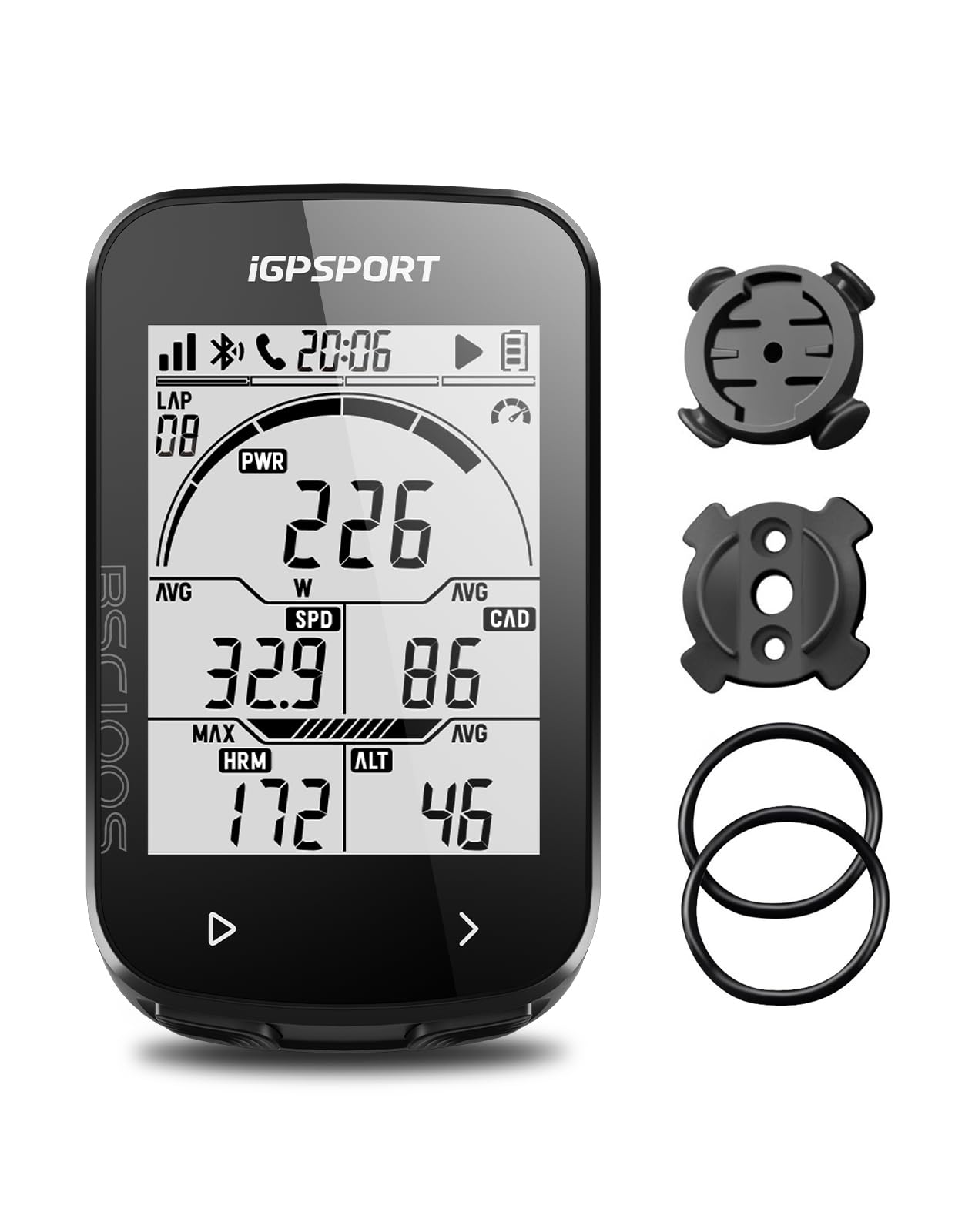
The iGPSPORT BSC100S punches far above its price tier with a 40-hour battery life on a single charge and multi-constellation GPS support (GPS, BeiDou, GLONASS, Galileo, QZSS) for fast, accurate positioning anywhere in the world. The 2.6-inch anti-glare LCD screen is large enough to read at a glance without being distracting, and the display is genuinely readable with polarized sunglasses — a complaint many budget computers fail to address.
It connects to ANT+ and Bluetooth 5.0 sensors, including speed, cadence, heart rate monitors, and power meters, and the companion iGPSPORT app syncs ride data directly to Strava and Komoot. The device offers over 40 riding data fields including grade, temperature, and calories. The IPX7 waterproof rating means it survives torrential downpours and accidental submersion without concern.
The rubber band mount can feel flimsy compared to quarter-turn Garmin mounts, and the lack of onboard GPS navigation (turn-by-turn routing) means you will need a phone for unfamiliar routes. The manual is notoriously poor, with users relying on YouTube setup videos instead. But as a pure data-recording computer with class-leading battery life, the BSC100S is a phenomenal value proposition.
Why it’s great
- 40-hour battery covers multi-day touring without a charge.
- 5-satellite GPS locks position quickly even in remote areas.
- Sunlight-readable 2.6-inch LCD with anti-glare coating.
Good to know
- No turn-by-turn GPS navigation — data recording only.
- Rubber band mount feels less secure than quarter-turn mounts.
6. CooSpo BC107

The CooSpo BC107 packs GPS and BeiDou dual-mode positioning into one of the most compact cycling computers on the market. The 2.4-inch LCD screen is wrapped in a glass-filled ABS and TPU chassis that weighs just 140 grams while remaining robust enough to handle drops. Its IP67 waterproof rating means it is fully dust-tight and survives immersion in one meter of water for 30 minutes — exceeding the IPX7 standard of many competitors.
ANT+ compatibility allows pairing with heart rate monitors, speed and cadence sensors, and power meters, though it notably does not support Bluetooth for sensor connections (Bluetooth is only used for the CoospoRide app). The app provides straightforward device setup, GPS track route maps, and activity recording that syncs to Strava. The auto-backlight feature is a welcome touch for low-light riding — many budget computers leave backlight control manual.
The BC107 supports two GPS modes (GPS-only and GPS+BeiDou) and automatically calibrates the time on power-up. It also includes a GPS-off mode for indoor trainer sessions. The orange accents and compact footprint look clean on the handlebar, though the small screen means you can only see a limited number of data fields at once without scrolling.
Why it’s great
- IP67 rating provides dust-tight and immersion-proof durability.
- Compact 2.4-inch footprint fits cluttered cockpits.
- Auto-backlight adjusts for low-light conditions automatically.
Good to know
- No Bluetooth for sensor pairing — ANT+ sensors only.
- Small display shows limited data fields per screen.
7. ROCKBROS Tail Light

The ROCKBROS Tail Light proves that brake-sensing technology is no longer limited to premium gadgets. Its built-in accelerometer detects deceleration and switches the high-intensity COB LED to a bright flash for five seconds, alerting following traffic to your slowing speed. The smart auto on/off feature uses motion and light sensors — the light turns off after 30 seconds of inactivity and reignites when movement is detected, preserving the 400mAh battery that delivers up to 50 hours in flashing modes.
Four dynamic modes (normal flash, breathing, fast flash, and steady on) cover everything from daytime running to night commuting. The body is machined from aluminum alloy with an IP65 waterproof rating, resisting rain and spray without corrosion. Dual mounting options are included — a metal under-seat clamp and a rubber band seat post mount — making it compatible with road, mountain, cruiser, and even scooter frames. The USB-C port is a welcome modern touch at this price tier.
The motion sensor can be overly sensitive; wind or a passing truck can trigger the light to turn back on after the auto-off period. The 400mAh battery is moderate — it will need charging after a few intensive rides in steady-on mode. As an entry-level intelligent rear light, however, the ROCKBROS delivers features that used to cost double the price.
Why it’s great
- Brake-sensing function activates a 5-second high-intensity flash.
- Aluminum alloy body with IP65 waterproof rating.
- Includes both clamp and rubber-band mounting options.
Good to know
- Motion sensor can be triggered by wind or passing vehicles.
- 400mAh battery requires more frequent charging in steady-on mode.
FAQ
Can a bike phone mount really damage my phone camera?
What is the difference between a basic rear light and a brake-sensing light?
Is a GPS bike computer necessary if I already have a phone?
How many lumens do I actually need for night riding?
Final Thoughts: The Verdict
For most users, the best bicycle gadgets upgrade starts with the Siuyiu JW617 headlight because its 4800 lumens and 10000mAh battery solve the single biggest night-riding problem: not being able to see or be seen. If you want turn signals and anti-theft protection in one rear gadget, grab the WSDCAM Smart Tail Light. And for riders who track data and navigate confidently, nothing beats the Garmin Edge 540 for training depth and reliability.