
You cannot see it, smell the specific molecule, or feel the spike in CO₂, but your indoor air constantly shifts between healthy and hazardous. Cooking smoke, off-gassing furniture, pet dander, and simple occupancy drive your air quality from refreshing to suffocating within minutes. An air pollution sensor removes the guesswork by giving you real-time, numeric proof of what you are breathing.
I’m Min — the co-founder and writer behind Gadgets Feed. I’ve spent hundreds of hours cross-referencing specifications across NDIR CO₂ sensors, laser particle counters, TVOC semiconductors, and formaldehyde electrochemical cells to isolate the monitors that give you actionable truth rather than decorative graphs.
Whether you want to ventilate smarter during sleep, detect a gas leak before symptoms appear, or confirm your air purifier’s real-world performance, this guide to the air pollution sensor market will show you which device delivers the precise data your lungs deserve.
How To Choose The Best Air Pollution Sensor
Buying an air pollution sensor means navigating a forest of acronyms: PM1.0, PM2.5, PM10, TVOC, HCHO, CO₂, AQI. Each measures a distinctly different threat. The wrong sensor type — a cheap semiconductor that claims to detect everything but accurately tracks nothing — leaves you with flashing lights and zero confidence. Focus on three criteria.
Sensor Technology: NDIR vs. Laser vs. Semiconductor
The CO₂ detector inside the box determines the device’s trustworthiness. NDIR (non-dispersive infrared) sensors are the gold standard for carbon dioxide — they are stable, long-lasting, and do not drift after a week of use. Laser particle counters (for PM2.5 and PM10) use a fan to pull air across a focused laser beam, counting individual particles by size. Semiconductor sensors for TVOC and HCHO are inherently broad-spectrum; they react to many volatile compounds but cannot identify which one is present. A great air pollution sensor uses NDIR for CO₂, a laser module for particulates, and a separate electrochemical cell for formaldehyde — never one chip claiming to do all three accurately.
Display Readability and Alert System
An air quality monitor you have to squint at or tap through menus to understand defeats its purpose. The best units in this category offer either a large, high-contrast color LCD or an e-ink panel readable in direct sunlight. Multi-zone AQI color coding — green, yellow, orange, red — gives you glanceable awareness. Audible alerts matter only if they have a mute button, because a sensor that beeps every time you cook dinner becomes a device you unplug.
Battery Runtime and Portability
Stationary monitors (plugged in 24/7) are ideal for a single room, but an air pollution sensor loses half its value if you cannot carry it to another room, the car, or a hotel. A built-in 2500 mAh battery provides roughly 8–12 hours of continuous use on a color screen. An e-ink display paired with a low-power algorithm can stretch that to 60 days because it only draws power when the screen refreshes. Choose based on whether your primary need is tracking one nursery or sampling every room in the house.
Quick Comparison
On smaller screens, swipe sideways to see the full table.
| Model | Category | Best For | Key Spec | Amazon |
|---|---|---|---|---|
| Temtop M10+ | E-Ink | Bedroom / 60-day runtime | 60-day battery on e-ink + app | Amazon |
| BREATHE Airmonitor Plus | Smart | App integration & trend tracking | 30-day app history + CO₂/PM/VOC/HCHO | Amazon |
| LifeBasis 11-in-1 | Portable | Budget-friendly 11-parameter pack | 2500 mAh / 11–12 hr runtime | Amazon |
| YNAK 16-in-1 Large Display | Large Screen | Glanceable 7-inch display | 7″ LED / 2500 mAh / 8 hr | Amazon |
| KDWKD Air Quality Monitor (Black) | Multi-Particle | Wide particle size range (PM0.3–PM10) | 9-hr battery / 7-level AQI alert | Amazon |
| KDWKD Air Quality Monitor (White) | Multi-Particle | Whole-home portable testing | 9-hr battery / CO₂ + PM0.3–PM10 | Amazon |
In‑Depth Reviews
1. Temtop M10+ Indoor Air Quality Monitor & CO₂ Meter

The Temtop M10+ solves the fundamental tension every air pollution sensor faces: constant monitoring versus battery anxiety. Its e-ink display consumes near-zero power between screen refreshes, enabling up to 60 days of continuous operation on a single charge. You place it in a bedroom, close the door, and forget about the charger. The sensor suite is equally thoughtful — a dedicated NDIR CO₂ meter, laser PM2.5 counter, and a VOC semiconductor that responds to real-world events like cooking oil fumes or a new paint can.
Bluetooth app connectivity enables over-the-air firmware updates and 30-day historical data, so you can correlate a CO₂ spike at 3 AM with the fact that you closed the bedroom window. The audible alarm includes a disable toggle, making it the best choice for sleepers who need quiet monitoring. Customers consistently report PM2.5 readings that match the PurpleAir reference network, confirming the laser sensor’s reliability against far more expensive gear.
The e-ink screen refreshes at a slower cadence — fine for trend watching but unsuitable if you want flicker-free real-time animations. Auto-rotate mode drains the battery significantly faster, so you will need to manage that manually if you plan to move the device between rooms. Even with those constraints, the M10+ delivers the lowest maintenance per measurement day of any unit in this price tier.
Why it’s great
- 60-day battery life removes recharging friction entirely
- Bluetooth app gives trend analytics and OTA firmware updates
- E-ink screen remains perfectly readable in direct sunlight and zero-light bedrooms
Good to know
- Auto-rotate mode drains battery in days, not weeks
- No Wi-Fi for remote monitoring away from home
- Refresh rate is slower than LCD for real-time animation
2. BREATHE Airmonitor Plus Indoor Air Quality Monitor
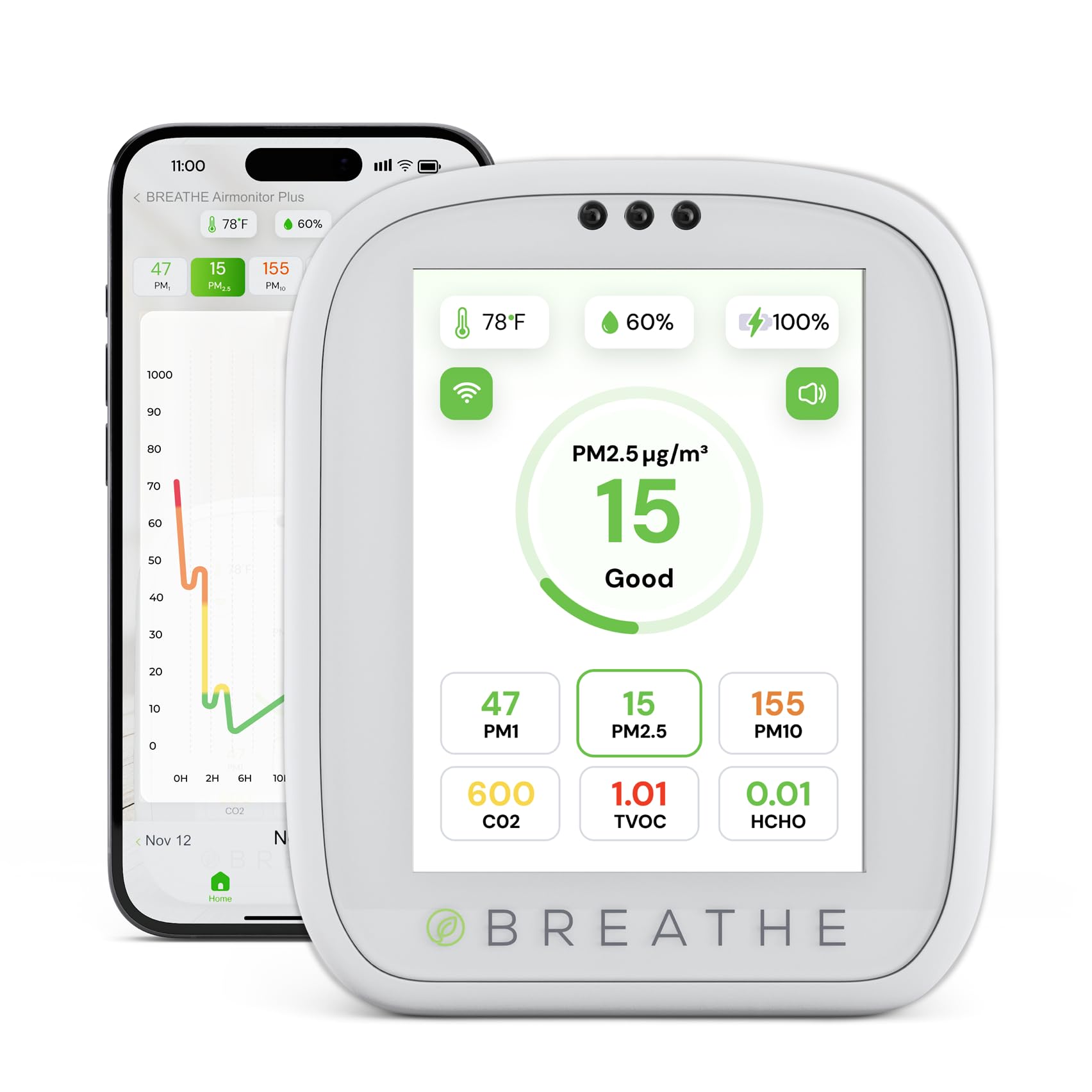
The BREATHE Airmonitor Plus prioritizes data granularity over standalone simplicity. It tracks CO₂, PM1, PM2.5, PM10, TVOC, formaldehyde (HCHO), temperature, and humidity — all eight parameters simultaneously — and pipes them into a dedicated smartphone app that stores 30-day trends. Users report seeing CO₂ levels spike to 4500 ppm in poorly ventilated offices and drop to 405 ppm within minutes of opening a window, giving immediate feedback on ventilation effectiveness.
What separates this monitor from the competition is its calibration flexibility. The built-in quick-calibration tool lets you reset the NDIR CO₂ sensor by taking the unit outside for five minutes, correcting the automatic recalibration drift that some owners flagged. The compact form factor (1.4 x 2.8 x 3.3 inches, 4 ounces) slides into a purse or desk drawer and still delivers professional-grade readings. The free app’s push notifications alert you the moment PM2.5 or CO₂ crosses your preset thresholds.
The device relies primarily on corded power for continuous operation — its internal battery lasts only a few hours, making it less portable than its pocket-friendly dimensions suggest. The display’s proximity sensor for auto-wake does not always trigger reliably, and the screen can feel overly bright in a dark room without manual dimming. These are tolerable trade-offs for anyone who values app-enabled historical analysis over untethered mobility.
Why it’s great
- Eight-parameter tracking including formaldehyde and PM1 in a single device
- 30-day data history with app alerts enables trend-based ventilation decisions
- Compact industrial design fits discreetly on any desk or nightstand
Good to know
- Battery life is measured in hours, not days — needs to stay plugged in
- Auto-recalibration can falsely lower CO₂ readings in consistently high-CO₂ homes
- Proximity sensor for waking the display sometimes fails
3. LifeBasis 11-in-1 Air Quality Monitor Indoor

The LifeBasis 11-in-1 packs an impressive sensor array — NDIR infrared CO₂, laser particle, semiconductor, photoelectric, plus temperature and humidity — into a flat 6.1-ounce package that slips into a pocket. It monitors CO₂, PM1.0, PM2.5, PM10, HCHO (formaldehyde), TVOC, AQI, particles, temperature, and humidity, then color-codes each parameter from green (good) through yellow, orange, and red (abnormal). When any reading crosses its threshold, the device emits a ticking alert and the indicator light flashes continuously.
Owners have confirmed that the PM2.5 readings track within range of reference-grade PurpleAir monitors. The unit’s 2500 mAh battery delivers 11–12 hours of continuous operation, making it genuinely portable for a full day of moving between rooms, the car, or the office. The setup procedure is straightforward: take it outside for 30 minutes to let the NDIR sensor calibrate to fresh air, then start monitoring indoors. Reviewers have also discovered its utility as a real-time “flatulence alerter” owing to its VOC sensitivity, a testament to how quickly the semiconductor TVOC sensor catches organic compounds.
Missing from the feature set are Wi-Fi, Bluetooth, and any form of data export — you read the LCD screen or you capture the numbers yourself. The faint fan hum from the laser particle counter is noticeable in a silent bedroom. If you want a standalone, no-app, broadly accurate sensor that you can carry anywhere and charge once daily, the LifeBasis covers more ground for the price than any competitor with three times the marketing budget.
Why it’s great
- Real NDIR CO₂ sensor plus laser particle counter at a remarkable price point
- 11–12 hour battery life supports true all-day portability
- Color-coded four-level alerts with audible and visual alarm
Good to know
- No wireless connectivity or data logging for trend analysis
- Laser fan produces a faint but audible hum in complete silence
- Does not measure carbon monoxide despite marketing similarities
4. YNAK 16-in-1 Air Quality Monitor Indoor (7-Inch Display)
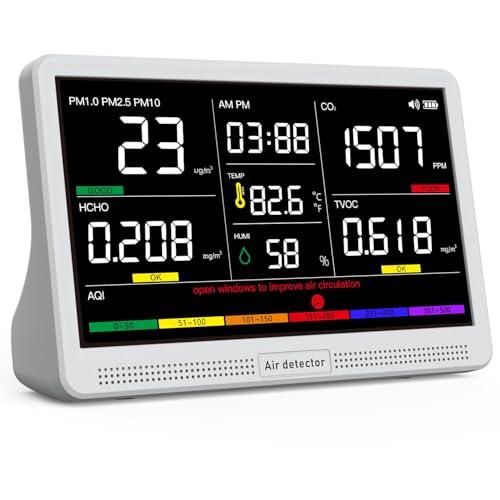
The YNAK 16-in-1 demolishes the small-screen complaint with a 7-inch LED panel that shows CO₂, PM2.5, PM1.0, PM10, HCHO, TVOC, temperature, humidity, AQI, and time simultaneously — no scrolling, no sub-menus. The three-level brightness adjustment handles everything from pitch-black nurseries to sunlit kitchen counters. Its multi-sensor array uses external high-precision modules that claim 0.001-unit accuracy for formaldehyde and VOC, and the display updates fast enough to catch the PM spike from lighting a candle or using a hair dryer.
The 2500 mAh battery delivers up to 8 hours of cordless use, which is sufficient to move the unit from room to room but will require nightly charging if you unplug it. The seven distinct AQI alert buzzers (each linked to a different pollutant) include a mute button so you can silence cooking-related warnings without disabling the entire alarm. Reviewers report immediate detection of vape smoke, UV printer fumes, and isopropyl alcohol, confirming that the semiconductor TVOC sensor is responsive even if its readings are qualitative rather than quantitative.
The device ships with a USB-C cable and a dedicated power adapter; using third-party chargers can cause erratic behavior. The time-setting process requires multiple button presses on a non-touch interface, which users found non-intuitive on first setup. The 7-inch footprint (2.95 x 5.59 x 7.91 inches) occupies significant desk real estate compared to palm-sized competitors. If readability at a distance is your priority, this is the easiest-to-read monitor to mount near a living room entryway.
Why it’s great
- 7-inch LED shows all parameters at once with no menu navigation
- External high-precision sensors with 0.001-unit accuracy claim
- 7 pollutant-specific AQI alarms with mute for quiet operation
Good to know
- Battery runtime of 8 hours requires nightly recharging
- Large footprint is not portable for pocket or small shelf
- Initial setup (time, sensor calibration) has a learning curve
5. KDWKD Indoor Air Quality Monitor (Black)
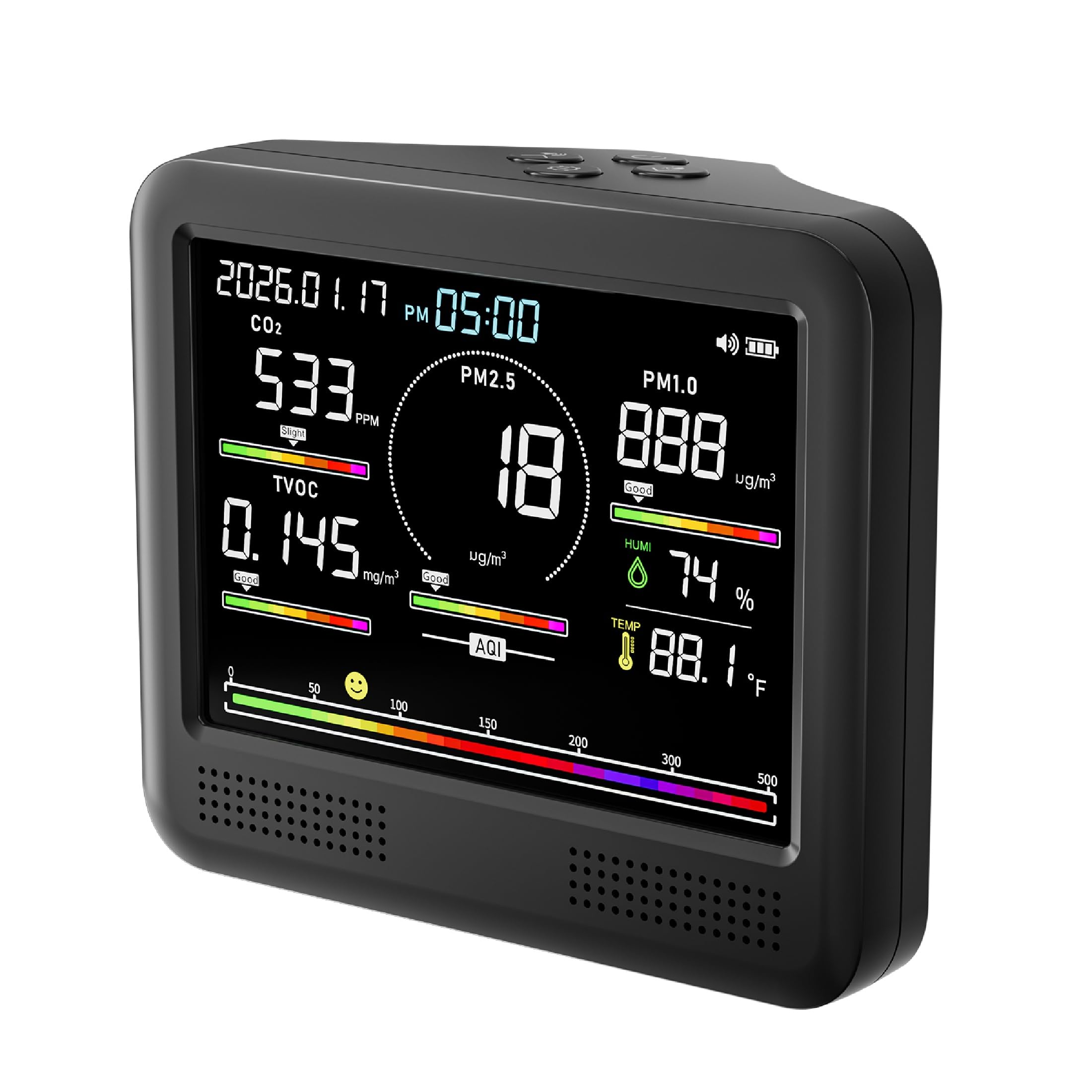
The KDWKD monitor casts the widest particle net of any unit in this roundup, detecting particulates as small as PM0.3 and as large as PM10, plus CO₂, HCHO, TVOC, temperature, and humidity. This expanded range matters most for wildfire smoke scenarios (which can carry ultrafine particles at PM0.3–PM1.0) and for new construction off-gassing where formaldehyde dominates. The 7-level AQI display combines a numerical index with color coding and optional audible alerts, giving you both precision and glanceability.
Its built-in battery delivers 9 hours of continuous operation, enough to sample every room in an average home in a single afternoon. Owners of newly renovated spaces have reported that the monitor surfaces high TVOC and formaldehyde levels that were invisible to their nose, enabling targeted ventilation before spending extended time in the room. The large color screen is readable from across a living room, and the compact ABS enclosure keeps the weight low enough for easy wall-mounting with adhesive strips.
Customer reviews occasionally note that the device responded slowly or not at all to strong chemical cleaners — a behavior that can indicate a semiconductor sensor’s saturation limit or a calibration offset. The packaging from this brand has drawn complaints about insufficient padding during shipping, so inspect the unit on arrival. For the buyer who needs the widest particle spectrum in a mid-portable form factor, the KDWKD Black delivers the broadest particulate window.
Why it’s great
- Measures particulates from PM0.3 to PM10 for ultrafine wildfire smoke
- 9-hour battery supports multi-room sampling without recharging
- 7-level AQI with color and optional audible alert
Good to know
- TVOC and HCHO sensors may not react to all chemical cleaners instantly
- Shipping packaging can be insufficient — inspect on arrival
- No app or Bluetooth for data logging or remote monitoring
6. KDWKD Indoor Air Quality Monitor (White)
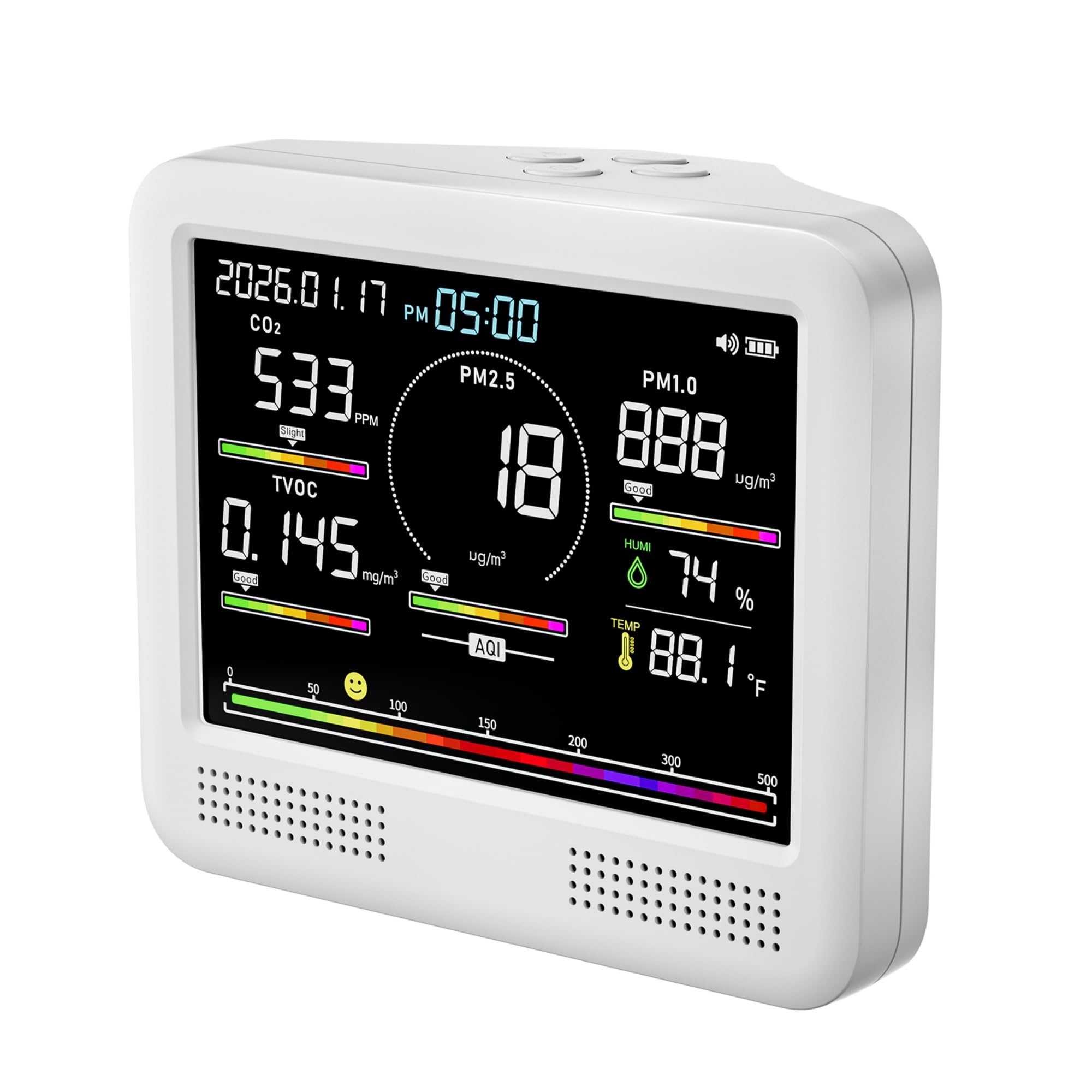
The white variant of the KDWKD monitor shares the same particle-sensing DNA as its black counterpart — detecting PM0.3, PM0.5, PM1.0, PM5.0, and PM10 alongside CO₂, HCHO, TVOC, temperature, and humidity. It is functionally identical on the inside: a laser particle counter for the fine end, an NDIR module for CO₂, and semiconductor elements for VOCs and formaldehyde. The color screen is equally large and bright, and the 9-hour rechargeable battery gives you the same all-afternoon portability.
Where the white version differentiates itself is purely aesthetic — it blends into pale kitchens, all-white nurseries, and modern office setups where a black box feels visually disruptive. Owners have reported using it to monitor air quality in newly renovated rooms, tracking the decay of paint and sealant VOCs over several days. The compact 5 x 3 x 2-inch footprint sits unobtrusively on a nightstand or shelf without dominating the surface.
Reviewers have flagged the same shipping fragility issue seen with the black version — the box is larger than necessary with minimal protective padding. A small number of units arrived with the screen or sensor displaced. As a whole, the KDWKD white delivers the exact same sensor capability as its sibling in a more design-conscious shell, making it the right choice for decor-first buyers who still demand a proper CO₂ and formaldehyde monitor.
Why it’s great
- Same wide particle range (PM0.3–PM10) as black version in a neutral color
- Large color screen is easy to read across a room
- 9-hour battery supports portable monitoring across multiple rooms
Good to know
- Identical to black KDWKD — no additional smart features or sensors
- Shipping packaging may not adequately protect the unit in transit
- No wireless connectivity for data export or remote alerts
FAQ
Can an air pollution sensor detect mold growth?
Why does my CO₂ reading stay high even with the window open?
What does TVOC mean and should I worry about high readings?
Final Thoughts: The Verdict
For most users, the air pollution sensor winner is the Temtop M10+ because its 60-day e-ink battery life eliminates the one friction that causes people to abandon their monitor — constant recharging. If you want app-based trend tracking with push alerts and a multi-parameter readout that includes formaldehyde, grab the BREATHE Airmonitor Plus. And for the widest particle detection spectrum spanning PM0.3 to PM10 in a budget-friendly portable package, nothing beats the LifeBasis 11-in-1.