
A miter saw that drifts one degree turns a beautiful baseboard into a gap-toothed mess. For anyone building shelves, trimming out windows, or tackling crown molding, the difference between a frustrating Saturday and a finished project often comes down to the saw’s rigidity, motor consistency, and blade quality — not the size of your wallet. The budget segment of the market is crowded with models that promise laser guides and compound cuts, but only a handful deliver the kind of repeatable accuracy that actually saves you time and material.
I’m Min — the co-founder and writer behind Gadgets Feed. I’ve spent hundreds of hours cross-referencing spec sheets, customer stress tests, and real-world failure reports to separate the genuine workhorses from the ones that will leave you chasing square cuts with a framing square.
Whether you’re setting up a garage workshop or need a portable saw for jobsite trim work, finding the right tool starts here. This guide breaks down the best budget miter saw options that actually earn their place on your bench.
How To Choose The Best Budget Miter Saw
Every budget miter saw makes compromises, but the best ones compromise on extras — not on cut quality or durability. Before you click buy, focus on three areas: the saw’s ability to stay square, the motor’s willingness to pull through dense material without bogging, and the blade’s compatibility with the work you actually do. A saw that can’t hold a 90-degree fence after a few weeks of use isn’t a bargain at any price.
Blade Size and Cut Capacity: 7-1/4-Inch Versus 10-Inch
A 7-1/4-inch saw is enough for 2×4 lumber, baseboards, and most trim work. It also tends to be lighter and easier to store. A 10-inch saw adds the ability to cut taller stock like 4×4 posts and deeper bevel cuts on crown molding nested against the fence. For anyone working primarily with dimensional lumber and standard trim, a 7-1/4-inch model keeps the price low and the footprint small. If crown molding or larger stock is in your future, a 10-inch saw justifies the extra spend with greater versatility.
Motor Power: Amp Rating Versus Real-World Torque
15-amp motors are standard in the mid-range, while 7.5-amp to 10-amp models are common on smaller saws. A higher amp rating usually means more raw power, but copper-wound motors and brushless designs deliver more usable torque at lower amp draws. Check the no-load RPM — anything above 4,500 RPM is adequate for clean wood cuts. If you plan to cut aluminum or thin steel, prioritize a motor with a metal gearbox and thermal overload protection to avoid burning out the windings during prolonged use.
Cutting Guidance: Shadow Line Versus Laser Guide
A laser guide projects a red line onto the workpiece, showing exactly where the blade teeth will land. A shadow line uses an LED to cast a crisp shadow of the blade’s kerf onto the material. Shadow lines are generally more accurate because they compensate for blade thickness and don’t drift out of alignment over time. Lasers are useful and easier to see in bright sunlight, but they require periodic calibration. For a budget saw, a properly aligned laser is still a huge upgrade over relying solely on the blade notch.
Bevel and Miter Range: Compound Versus Single Bevel
A single bevel saw tilts left only, which limits compound cuts when trimming inside corners. A compound miter saw can tilt and pivot simultaneously. For most DIY work — picture frames, baseboards, and furniture — a single bevel saw with left tilt handles the vast majority of cuts. If you plan to install crown molding or do complex trim work, a compound (or sliding compound) saw saves you from having to flip the material and recalculate angles. Sliding mechanisms add crosscut capacity but also add weight, maintenance points, and cost. Decide whether you need to cut boards wider than six inches before picking a sliding model.
Quick Comparison
On smaller screens, swipe sideways to see the full table.
| Model | Category | Best For | Key Spec | Amazon |
|---|---|---|---|---|
| Metabo HPT C10FCG2 | Compound Single Bevel | Lightweight all-around trim work | 15-Amp, 5000 RPM, 24.2 lbs | Amazon |
| SKIL MS6306-00 | Fixed Compact Rail | Space-saving precision with shadow line | 10-Amp, 4800 RPM, Compact Rail | Amazon |
| Evolution R185SMS+ | Sliding Multi-Material | Cutting wood, metal, and plastic | 1500W Motor, 50° Miter, 210mm Slide | Amazon |
| MarvTool JS-1013C3 | Sliding Compound | Garage workshop with extension tables | 15-Amp, 5000 RPM, 10-Inch | Amazon |
| Genesis GMS1015LC | Compound with Laser | Budget-friendly crown molding and trim | 15-Amp, 10-Inch, 9 Miter Stops | Amazon |
| NOVORIK 10-Inch | Sliding Single Bevel | Laser-guided sliding on a budget | 15-Amp, 4000 RPM, 33.9 lbs | Amazon |
| Evolution R210CMS | Compact Multi-Material | Small stock and metal tubing | 1200W Motor, 8-1/4-Inch, 13 lbs | Amazon |
| RYOBI TS1144 | Compact Compound | Light-duty garage use under 15A circuit | 9-Amp, 7-1/4-Inch, 19 lbs | Amazon |
| Hoteche P805219A | Entry-Level Compound | First-time buyers and small DIY projects | 7.5-Amp, 7-1/4-Inch, Laser Guide | Amazon |
In‑Depth Reviews
1. Metabo HPT C10FCG2
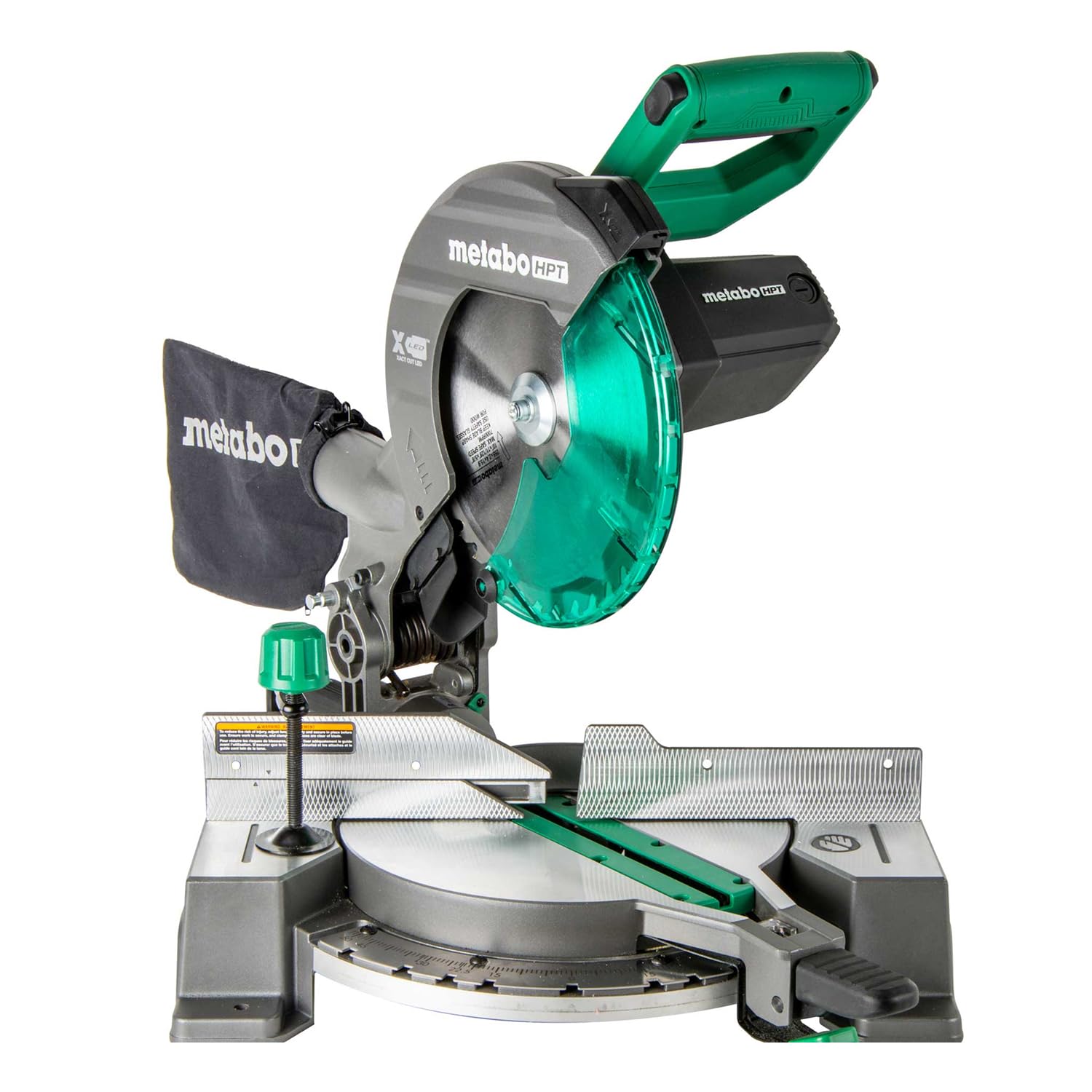
The Metabo HPT C10FCG2 strikes an almost unfair balance for a 10-inch budget saw. Its 15-amp motor spins at 5,000 RPM, which is enough torque to rip through pressure-treated 2x10s without the blade stalling mid-cut. The Xact Cut shadow line is more accurate and maintenance-free than any laser guide at this price point — it casts a zero-parallax shadow of the blade kerf directly onto the workpiece, so what you see is exactly where the teeth exit. Multiple customers confirmed it arrived square out of the box, meaning you can start cutting trim within minutes of assembly rather than fighting with fence adjustments.
At 24.2 pounds, this saw is genuinely portable. The improved miter scale and controls make angle changes fast, and the vice clamping system holds stock securely for repeat cuts. The bevel range from 0 to 45 degrees left covers most crown molding and baseboard work. The included 40-tooth TCT blade is serviceable for general woodworking, though upgrading to a finer-tooth blade (60-80T) will yield cleaner cuts on hardwoods like oak for finer joinery.
The dust collection is adequate with a shop vac attached, but the bag is nearly useless for fine sawdust. Some users noted a brief motor smell during the first few minutes of break-in — this is normal for new brushed motors and typically resolves after 10 minutes of light use. The 5-year manufacturer warranty adds peace of mind that most budget models lack, especially for a saw that sees frequent jobsite transport.
Why it’s great
- Shadow line guide is zero-maintenance and more accurate than lasers at this price
- Lightest 10-inch compound saw in the category at 24.2 lbs
- 5-year warranty is rare for a budget-tier miter saw
Good to know
- Dust collection bag is ineffective — plan to use a shop vac
- Bevel stops are adjustable but not as robust as higher-end Metabo models
2. SKIL MS6306-00

The SKIL MS6306-00 rethinks the sliding miter saw by replacing traditional sliding rails with a fixed compact rail system. This design eliminates the rail-play that plagues cheaper slider models and allows the saw to sit flush against a wall — a genuine advantage for anyone working in a tight garage or on a small benchtop. The 10-amp motor delivers 4,800 RPM, which is more than sufficient for 2×10 crosscuts and nested crown molding up to 3-1/2 inches. The shadow line is the star here: it produces a crisp, dark line on even dark wood, outperforming every laser-equipped saw in this guide for sheer speed of setup.
Experienced carpenters and first-timers alike praised this saw for its accuracy out of the box. Users reported cutting 900 square feet of engineered hardwood with consistent, splinter-free miters. The quick miter lock allows fast adjustments between 0 and 47 degrees left and 0 to 50 degrees right, with detents at all common angles (15, 22.5, 31.6, 45). The die-cast aluminum base keeps the saw rigid enough for precise 45-degree cuts on salvaged teak, as noted by one user who prefers this over larger 10-inch and 12-inch saws for most tasks.
The saw ships without a stand — the SRS0001 is sold separately. The included blade is a 24-tooth carbide model, which is coarse for finish work. Swapping to a 60-tooth or 80-tooth blade will dramatically improve cut quality on trim and molding. The dust port is compatible with most shop vacs, but the integrated dust bag is small and needs frequent emptying during longer sessions. Weight comes in under 25 pounds, making this one of the most portable sliding options available.
Why it’s great
- Fixed compact rail system eliminates blade wobble common on budget sliders
- Shadow line provides instant, drift-proof cut alignment
- One of the most space-saving miter saws you can buy for a small workshop
Good to know
- Only single bevel (left tilt) — no right tilt for complex compound cuts
- Chassis weighs 31 lbs, so it’s heavier than the Metabo HPT despite the smaller blade
3. Evolution R185SMS+

The Evolution R185SMS+ is built for a different buyer — one who needs to cut not just wood, but steel angle, aluminum extrusion, PVC trim, and even wood with embedded nails using the same blade and motor. The 1500W motor drives their proprietary Japanese tungsten-carbide-tipped (TCT) blade that cuts mild steel with virtually no sparks or burrs. The 50-degree miter range in both directions and 0-to-45-degree bevel capacity cover nearly every angle a trim carpenter or metal fabricator would need. Ball bearing slides keep the action smooth even when cutting heavy stock.
Users consistently highlight the build quality and ease of assembly. The saw arrives mostly assembled, and the included premium 3-piece clamp secures materials firmly. The laser guide is a genuine help for aligning cuts on metal where shadow lines don’t work well, though users note the onboard angle markings are less precise than aftermarket digital gauges. The dust collection bag is present but largely ineffective for metal shavings — a shop vac connected to the port is essential for keeping the workspace clear and preventing fine metal dust from settling into the plastic components.
The included blade is a 24-tooth multi-material TCT model, which cuts aggressively but leaves a rougher finish on wood. For cleaner wood cuts, swapping to a 60-tooth or higher blade is recommended — the arbor is convertible to accept standard 5/8-inch blades by flipping a collar, so you’re not locked into Evolution’s proprietary system. The 3-year manufacturer warranty is one of the best in the budget space, especially for a saw that sees mixed-material use that would destroy standard wood-cutting blades quickly.
Why it’s great
- Cuts wood, steel, aluminum, and plastic with no blade change needed
- Ball bearing slides provide smooth, slop-free travel
- 3-year warranty is excellent for a multi-material saw
Good to know
- Metal shavings can melt into plastic components if not cleaned promptly
- Angle markings are approximations — use a digital gauge for critical cuts
4. MarvTool JS-1013C3
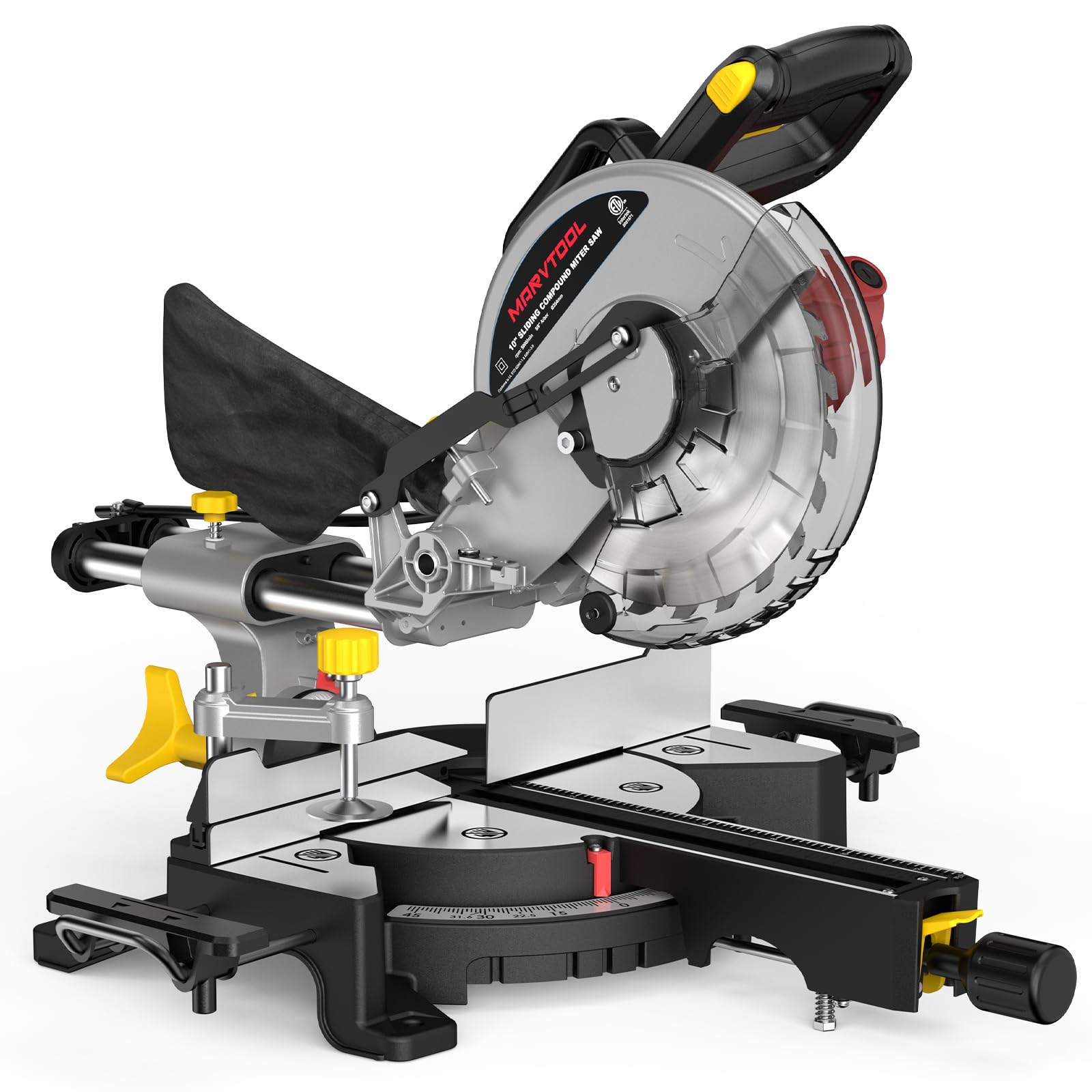
The MarvTool JS-1013C3 brings a genuine sliding compound mechanism at a price point where most competitors offer only fixed bevel or non-sliding saws. The 15-amp motor delivers 5,000 RPM of no-load speed, and the sliding rails extend the crosscut capacity enough to handle wide boards without repositioning. The included pair of extension tables stabilizes longer workpieces, which is a thoughtful addition for anyone cutting baseboard or shelf planks. The blade guard is transparent for visibility, and the vise clamp holds material securely at both 90-degree and compound angles.
Customer feedback is overwhelmingly positive for build quality and ready-to-use performance. Users noted the saw cuts straight, flush, and slides smoothly for long cuts without binding. The 36-tooth TCT blade is a reasonable compromise between speed and finish — better than the typical 24-tooth blade for trim work, though upgrading to a 60-tooth blade will noticeably reduce tear-out on veneered plywood. The dust collection bag works for larger chips but clogs quickly with fine dust; a shop vac hose connected to the 1-1/4-inch port is a better solution for cleaner work.
One notable detail: the handle is removed for shipping and packed inside the foam. Installation takes about 30 seconds, but first-time users should check the foam compartment before assuming any parts are missing. The saw weighs 25.6 pounds and includes a locking knob that secures the head to the base for storage. The 2-year warranty and 24/7 customer support are standard for this tier, but the actual responsiveness Marvtool has shown gives it an edge over less attentive brands in this price range.
Why it’s great
- Genuine 10-inch sliding action at a very low entry price
- Extension tables included for stabilizing long stock
- Powerful 15-amp motor doesn’t bog on dense hardwoods
Good to know
- No laser guide — relies on blade notch for alignment
- Slides add overall weight and require occasional lubrication
5. Genesis GMS1015LC

The Genesis GMS1015LC is one of the few budget miter saws that includes a functioning laser guide straight out of the box — and the laser actually stays aligned without constant recalibration. The saw’s 10-inch blade is driven by a 15-amp motor with an electric brake that stops the blade in seconds, a safety feature often omitted at this price point. The nine positive detent miter stops lock firmly at 0, 15, 22.5, 30, and 45 degrees (left and right), which accelerates repeated setup for trim and picture frame work.
The die-cast aluminum base keeps weight manageable while providing a flat, warp-resistant reference surface. Users report cutting 2x4s and 4x4s with ease, though the saw is clearly aimed at finish work rather than framing. The included 60-tooth carbide-tipped blade is a standout: most budget models ship with coarse 24-tooth blades that leave rough edges, but Genesis gives you a blade suitable for molding, baseboard, and cabinet work. The extension wings and hold-down clamp are functional additions that improve stability on longer pieces.
The dust bag is largely cosmetic — expect sawdust to collect around the motor housing rather than inside the bag. The saw is loud enough to demand ear protection, especially during extended trim sessions. Some users noted that the vibration from the motor can loosen the clamping hardware over time, so checking tightness before each use is recommended. The arbor lock simplifies blade changes, and the included two AAA batteries for the laser are a welcome convenience — just install them before first use.
Why it’s great
- Comes with a 60-tooth carbide blade — ready for finish work out of the box
- Electric brake stops the blade quickly for safer operation
- Laser guide holds alignment reliably for most users
Good to know
- Dust collection is ineffective — expect to clean up sawdust manually
- Motor uses bushings rather than bearings, limiting long-term heavy-use life
6. NOVORIK 10-Inch Sliding

The NOVORIK 10-inch sliding compound miter saw packs a 15-amp, 1,800W motor into a frame that includes a laser guide, sliding rails, and a 40-tooth TCT blade — all at a price that undercuts most major-brand sliders by a significant margin. The motor produces 4,000 RPM of no-load speed, which is adequate for general woodworking but noticeably slower than the 5,000 RPM competitors. The trade-off is that the torque feels strong and consistent during cuts, with fewer instances of bogging on dense hardwood like oak or maple.
The laser guide is genuinely useful for tracking cut lines on wood and soft metal. The miter bench adjusts from -45 to +45 degrees with positive stops at 0, 15, 22.5, 30, and 45 degrees in both directions, allowing quick repeatability for common angle cuts. The bevel tilts from 0 to 45 degrees left, covering standard crown molding and baseboard applications. The blade guard and dust extraction port are functional, though the included dust bag is small and requires frequent emptying — connecting a shop vac is a better long-term solution.
Customer service from NOVORIK is a standout feature at this price level. Multiple reports describe quick resolution of missing parts or minor shipping damage, with one user receiving a replacement with no hassle. The 2-year manufacturer warranty is standard, but the company’s responsiveness during the exchange process earned specific praise. The saw is on the heavier side at 33.9 pounds, so it’s less suited for frequent jobsite transport than the Metabo HPT or SKIL models, but the sliding action and laser justify the extra heft for a garage workshop.
Why it’s great
- Sliding mechanism and laser guide at a very competitive price point
- Customer service responds quickly to resolve shipping or damage issues
- Sturdy frame with solid slide rails and positive miter stops
Good to know
- 4,000 RPM is slower than the 5,000 RPM standard — minor difference in practice
- At 33.9 pounds, it’s the heaviest saw in this roundup
7. Evolution R210CMS

The Evolution R210CMS is a compact, focused version of the larger Evolution saws, built specifically for users who cut small stock — 2020 aluminum extrusion, thin steel tube, PVC trim, and wood shelving. The 8-1/4-inch blade reduces the saw’s footprint dramatically while still delivering a 45-degree bevel tilt and a 45-to-45-degree miter range. The 1200W motor drives the same Japanese TCT multi-material cutting technology found in the R185SMS+, meaning it can cut steel, aluminum, and wood with embedded nails without overheating or producing dangerous sparks.
Users praise this saw for its out-of-box readiness: it requires minimal assembly and cuts cleanly on both wood shelves and metal tubing with the included 24-tooth multi-material blade. The compact size makes it ideal for hobbyists, metalworkers, and anyone who doesn’t have the bench space for a full-size 10-inch or 12-inch saw. The convertible arbor is a clever design — by removing the stock blade and flipping a collar, the saw accepts standard 5/8-inch arbor blades, which opens up thousands of blade options for specialized woodworking.
The biggest criticism is the chip and dust management. The saw throws chips aggressively in every direction, and the included dust collection is minimal — a shop vac is essential for keeping the workspace clean. The onboard angle markings are essentially decorative; users report they’re not accurate enough for precise compound cuts without verifying with a protractor or digital gauge. The arbor screw on some units comes overtightened from the factory, occasionally breaking the blade lock button during the first blade change. Inspect and loosen the arbor nut before powering on for the first time.
Why it’s great
- Multi-material cutting with no blade change — steel, aluminum, wood, plastic
- Convertible arbor accepts standard 5/8-inch blades for woodworking upgrades
- Extremely compact footprint for small workshops and benchtops
Good to know
- Chips and fine debris spray everywhere without aggressive vacuum setup
- Angle markings are inaccurate — verify with a digital gauge for critical cuts
8. RYOBI TS1144

The RYOBI TS1144 is a 7-1/4-inch compound miter saw designed for a very specific constraint: it runs on a 9-amp motor, which makes it ideal for workshops with a single 15-amp circuit shared with lights and other tools. The smaller blade size keeps the saw light at 19 pounds, making it one of the most portable options in this guide. The compound cutting action allows bevel and miter adjustments, and the positive stops at common angles make it easy to dial in repeat cuts for baseboard and shelving projects.
First-time users, including a 75-year-old who had never used a miter saw before, reported clean, accurate cuts on MDF trim and dimensional lumber after just one afternoon of practice. The saw handles 2×4 crosscuts without bogging, and the 7-1/4-inch blade is sufficient for most trim and furniture builds. The compact design fits easily onto a small workbench or foldable stand, and the dust port accepts standard shop vac hoses to keep the workspace reasonably clean.
The most common complaint is the lack of a laser guide — users must rely on the blade notch for alignment, which is less intuitive than a shadow line or laser. The dust collection clogs quickly when cutting fine sawdust from plywood or MDF. Some users noted difficulty cutting 2-1/4-inch trim in a single pass because the motor housing contacts the workpiece before the blade finishes the cut; this is a physical clearance limitation of the 7-1/4-inch form factor. The manual is overly cautious and verbose, but the actual operation is straightforward once you ignore the safety diatribes.
Why it’s great
- Lightest saw in the guide at 19 pounds — genuinely portable
- 9-amp motor is easy on shared workshop circuits
- Proven reliability from one of the most recognized tool brands
Good to know
- No laser guide or shadow line — notch-only alignment
- Limited clearance means it struggles with tall trim in a single pass
9. Hoteche P805219A
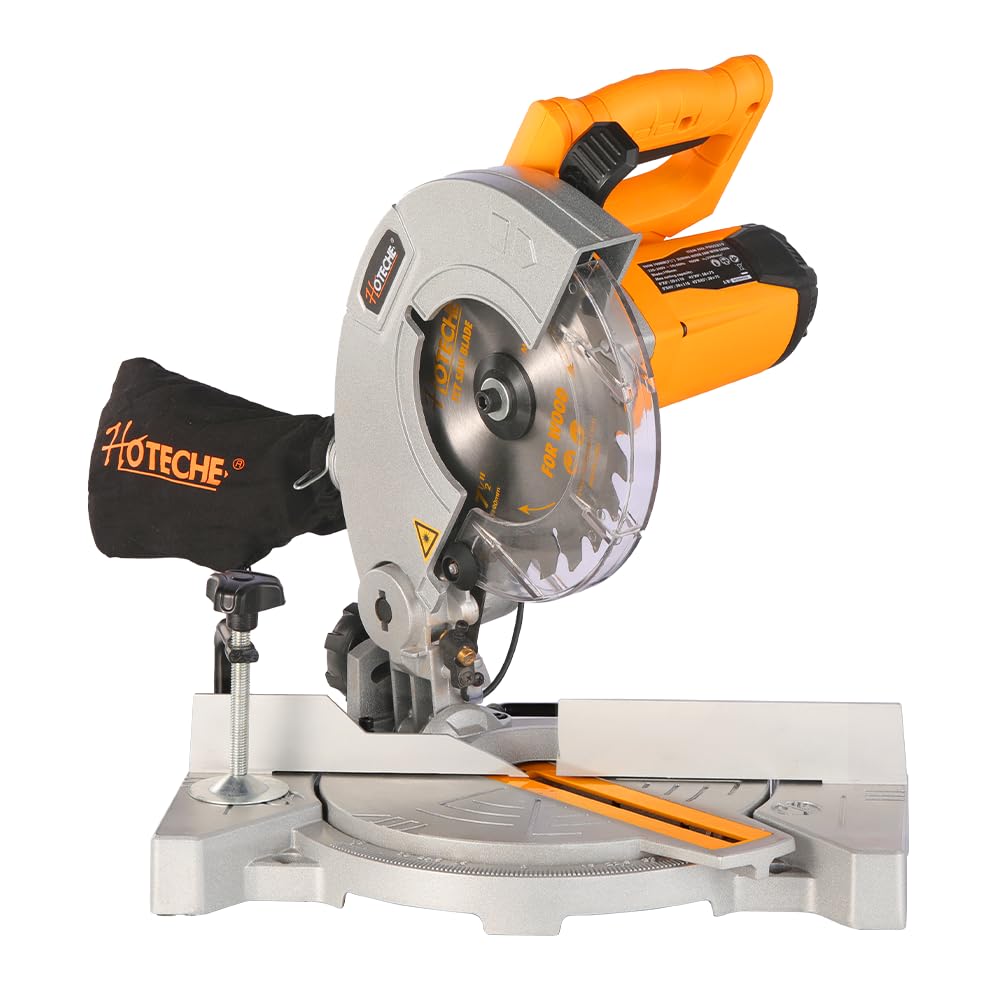
The Hoteche P805219A is the definition of an entry-level miter saw — a 7-1/4-inch, 7.5-amp compound saw with a laser guide, sliding action, and a complete accessory kit that includes extension bars, dust bag, hex wrenches, and carbon brushes. The 5,000 RPM copper motor is capable of cutting hardwood, PVC, aluminum trim, and soft metals, though users should avoid forcing it through dense material in a single pass — the motor is built for light-duty work and will overheat if pushed too hard on 4×4 pressure-treated lumber.
The laser guide is a genuine helper for beginners who aren’t yet comfortable with blade-notch alignment. Users reported accurate cuts on window casings and 1×2 strips right out of the box, with the laser staying aligned through multiple cuts. The positive miter stops at 0, 15, 22.5, 30, and 45 degrees provide quick setup for common angles. The aluminum base with rubber feet prevents slipping during use, and the sliding action extends the crosscut capacity beyond what the stationary blade alone can reach.
The included instructions are difficult to follow for first-time users, particularly for releasing the lock mechanism. The fence is set back slightly less than ideal, limiting the width of stock that can be clamped effectively. The dust bag is better than none but catches only a fraction of the sawdust generated. The G-clamp included in the kit works but feels mysterious until you realize it’s for securing the hold-down. This is not a saw for heavy daily jobsite use, but for a weekend DIYer or first-time homeowner setting up a garage shop, it represents the lowest barrier to entry in this guide.
Why it’s great
- Laser guide helps beginners align cuts accurately
- Includes extension bars, dust bag, carbon brushes, and wrenches
- Lightweight and compact for easy storage and transport
Good to know
- 7.5-amp motor is underpowered for dense hardwoods and large stock
- Fence placement limits the width of workpieces you can clamp
FAQ
Can a budget miter saw cut aluminum or thin steel reliably?
What is the difference between a single bevel and a dual bevel miter saw?
How important is the laser guide on a budget miter saw?
How do I know whether to buy a 7-1/4-inch or 10-inch miter saw?
Why does my new miter saw smell like burning motor when I first use it?
Final Thoughts: The Verdict
For most users, the best budget miter saw winner is the Metabo HPT C10FCG2 because it combines a 15-amp motor, accurate shadow line guidance, and a lightweight 24.2-pound frame that handles trim jobs and transport with equal ease. If you need a saw that fits tight bench spaces and delivers shadow-line precision without sliding rails, grab the SKIL MS6306-00. And for cutting metal, aluminum, and plastic in addition to wood without changing blades, nothing beats the Evolution R185SMS+.