
The promise of a single appliance that replaces a slow cooker, rice cooker, steamer, and sauté pan is seductive, but the reality of many all-in-one pressure cookers is a steep learning curve, scorched bottoms, and a sealed lid you’re not sure is safe. The wrong choice wastes counter space and turns meal prep into a guessing game. This guide isolates the specific metrics—wattage, pot material, safety mechanisms, and cooking surface area—that separate a workhorse from a frustrating gadget.
I’m Min — the co-founder and writer behind Gadgets Feed. I’ve spent countless hours dissecting multi-cooker specs and cross-referencing hundreds of user experiences to identify exactly which components deliver consistent, worry-free pressure cooking without the guesswork.
Whether you need a stovetop beast for batch canning or a programmable electric unit for weeknight dinners, this guide to the best all-in-one pressure cooker breaks down the real-world performance data you need before you buy.
How To Choose The Best All-In-One Pressure Cooker
An all-in-one pressure cooker is a durable purchase meant to last years, so picking the wrong format—stovetop vs. electric, aluminum vs. stainless steel—can be a costly mistake. Focus on three pillars: cooking performance, safety engineering, and capacity that matches your household size.
Electric vs. Stovetop: Which Format Fits Your Kitchen
Electric models (like Instant Pot and Ninja) offer programmable settings, keep-warm functions, and automated pressure release, making them ideal for set-it-and-forget-it cooking. They run on standard 120V outlets and require no stovetop burner. Stovetop models (like the BreeRainz or Hestroney) are purely mechanical, build pressure faster thanks to direct heat, and are often built with heavier materials for commercial-grade durability. If you want precision timing and multiple functions, go electric. If you need raw speed, massive capacity, or off-grid compatibility, a stovetop unit is the better tool.
Pot Material: Stainless Steel vs. Aluminum
Stainless steel (especially 18/8 tri-ply) is corrosion-resistant, dishwasher-safe, and won’t react with acidic foods like tomatoes or citrus. It also sears better because it can handle high heat without warping. Aluminum heats faster and is lighter, making it easier to handle during large batch cooking, but it can warp over time on high heat and may react with certain ingredients. For an all-in-one cooker that also sears, prioritize stainless steel. For a dedicated pressure cooker used primarily for beans, stocks, and canning, heavy-duty aluminum is a cost-effective choice.
Safety Features: Bar Locking, Spring Valve, and Overheat Protection
A pressure cooker without robust safety engineering is dangerous. Look for models with a locking lid that physically prevents opening while pressure is inside (this is a non-negotiable safety standard). Electronic units should include overheat protection, a float valve that indicates pressure status, and an easy-release steam switch that directs steam away from your hands. Stovetop models should have at least two independent pressure regulators and a backup safety valve. Spring-loaded valves provide more consistent pressure control than old-style weighted jiggle tops.
Capacity and Cooking Surface Area
A 6-quart electric unit is the sweet spot for households of 4–6 people, fitting a 4-pound chicken or a 3-pound roast. If you frequently cook for large gatherings or batch-prep meals, an 8- or 12-quart model gives you room for bigger cuts and whole birds. For wide-base electric models, look at the cooking surface area—models with 35% more searing area than a standard 12-inch skillet allow you to brown meat in fewer batches, which means deeper flavor with less work.
Quick Comparison
On smaller screens, swipe sideways to see the full table.
| Model | Category | Best For | Key Spec | Amazon |
|---|---|---|---|---|
| Ninja HyperHeat PC201GY | Electric | Fast, flavor-rich meals | 1200W, 6.5 Qt, PFAS-free nonstick | Amazon |
| Instant Pot Duo 6 Qt | Electric | Family meals & meal prep | 1000W, 6 Qt, 18/8 stainless steel | Amazon |
| Instant Pot RIO Wide 7.5 Qt | Electric | Wide searing surface | 1000W, 7.5 Qt, 35% more cooking area | Amazon |
| Cuisinart MSC-600 NAS | Electric | Slow cooking & steaming | 6 Qt, programmable, nonstick pot | Amazon |
| Hestroney 12 Qt Stainless Steel | Stovetop | Large batch cooking | 12.68 Qt, 8 safety features, stainless steel | Amazon |
| Hestroney 6.5 Qt Aluminum | Stovetop | Budget-friendly stovetop | 6.5 Qt, commercial-grade aluminum | Amazon |
| BreeRainz 26 Qt | Stovetop | Extra large batch & catering | 26 Qt, bar-locking system, 6.5 PSI | Amazon |
In‑Depth Reviews
1. Ninja HyperHeat 9-in-1 PC201GY

The Ninja HyperHeat is the most powerful electric option here, delivering 1200W compared to the typical 1000W from competitors. This extra wattage translates directly into faster pressure build times—users report tender braised short ribs in under 30 minutes—and a searing function that actually gets hot enough to develop a proper crust on meat without needing a separate pan. The 6.5-quart capacity fits a 4-pound chicken or 5-pound roast, and the 9.5-inch wide cooking surface provides ample room for batching searing, a clear upgrade over narrower 6-quart units.
What sets this model apart is the ceramic nonstick pot that is 100% PFAS-free, an increasingly important consideration for buyers looking to avoid forever chemicals in their cookware. The seal system also deserves special mention: reviewers consistently note that the lid retains no odors and the seal does not degrade over time, a common failure point on older multi-cooker designs. The interface is straightforward with clearly marked pressure levels (low/high) and dedicated slow cooker and sous vide functions.
The trade-off is that the unit does not include a steamer basket out of the box, a surprising omission for a 9-in-1 device. Additionally, at 1200 watts, this cooker draws enough power that users with older wiring or sensitive generators should verify compatibility, though most standard household circuits handle it without issue. For those prioritizing searing performance and faster cook times, this is the electric multi-cooker to beat.
Why it’s great
- 1200W for faster pressure build and superior searing
- 100% PFAS-free ceramic nonstick pot
- Excellent lid seal that resists odor absorption
Good to know
- No steamer basket included
- Higher power draw may stress weaker circuits
2. Instant Pot Duo 7-in-1 6 Quart

The Instant Pot Duo is the benchmark that defined the electric multi-cooker category, and it remains one of the most well-rounded options for its price. The 6-quart stainless steel (18/8) inner pot with a tri-ply bottom provides even heat distribution and is dishwasher safe, eliminating the warping and reactivity issues associated with aluminum. With 1000 watts of power, it reaches pressure reliably and cooks 70% faster than traditional methods, making it a workhorse for soups, beans, rice, and braised meats.
Where the Duo truly shines is its ecosystem: over 13 one-touch smart programs, an app with 800+ recipes, and more than 10 built-in safety mechanisms including overheat protection and a lid lock that prevents opening under pressure. The Easy-Release steam switch makes depressurization safer and more controlled than manual valves. User feedback consistently praises the consistent results—tender stews and perfectly cooked rice every time—and the fact that the stainless steel pot cleans up with minimal effort, even after sticky or burnt-on food.
The main drawback is the learning curve. The manual lacks explicit cooking cycles and sauté temperature settings, so new users often need to experiment or consult online communities to understand that the sauté function has three heat levels (Normal at 320°F, More at 338°F, and Less at 221°F). The natural pressure release takes 15-20 minutes, which is not always clearly communicated. Once you learn the quirks, the Duo is a reliable, versatile tool that justifies its popularity.
Why it’s great
- Durable 18/8 stainless steel tri-ply inner pot
- 13 one-touch programs with large recipe library
- 10+ safety features including lid lock and overheat protection
Good to know
- Steep learning curve for sauté temps and release times
- Manual lacks detailed cooking cycle data
3. Instant Pot RIO Wide 7.5 Qt

The Instant Pot RIO Wide is designed specifically for users who found standard electric pressure cookers lacking in searing and browning area. Its wide base provides 35% more cooking surface than a traditional 12-inch skillet, allowing you to brown larger cuts of meat or more vegetables in a single batch rather than working in shifts. This wider footprint also makes the pot shorter and more stable on the counter, and the anti-spin pot design keeps the insert locked in place during vigorous sautéing.
The 7.5-quart capacity serves up to 7 servings, making it a strong choice for families who regularly cook multiple pounds of meat or large batches of vegetables. The stainless steel (18/8) tri-ply bottom maintains heat evenly and resists hot spots, and the WhisperQuiet steam release system is noticeably quieter than the standard Instant Pot release. The status lights that guide you through each cooking stage provide a clear, jargon-free interface that helps new users avoid common mistakes.
The trade-off is that the wide base occupies more counter space than a standard 6-quart pot, measuring over 16 inches wide. The 1000-watt heating element is the same as the smaller Duo, so while the searing area is larger, the power density per square inch is slightly lower—meaning it may take marginally longer to bring the larger volume to pressure. For users who prioritize browning capacity over compact storage, the RIO Wide is the smarter ergonomic choice.
Why it’s great
- 35% more searing area than a 12-inch skillet
- Anti-spin stainless steel pot for stable sautéing
- Quieter steam release than standard models
Good to know
- Larger footprint requires more counter space
- Same 1000W element means slower pressurization for 7.5 Qt vs 6 Qt
4. Cuisinart 3-In-1 Cook Central MSC-600

The Cuisinart MSC-600 is a 3-in-1 multi-cooker that focuses on slow cooking, browning/sautéing, and steaming, making it a more specialized tool than a full pressure-cooking unit. The removable 6-quart nonstick aluminum pot is easy to clean and lightweight, and the blue backlit LCD display provides clear readouts for time and temperature. The glass lid with a cool-touch handle allows you to monitor food without lifting the lid and losing heat, a practical feature for slow cooking.
What this cooker does well is combination cooking: you can brown meat directly in the pot, then switch to slow cook mode without transferring to another vessel—a feature that reduces cleanup and preserves fond for richer sauces. The programmable timer adjusts in 30-minute increments and automatically switches to keep-warm mode once the timer expires. Four heat settings (high, low, warm, simmer) give reasonable flexibility for different recipes, and the steaming rack works well for vegetables and seafood.
The limitations are significant for power users: the nonstick pot is not dishwasher safe, and the 16-inch power cord limits placement flexibility. The oblong shape fits small chickens and roasts, but the 6-quart capacity fills quickly for larger families. Most critically, the Cuisinart lacks a pressure cooking function entirely—so if you are specifically looking for a pressure cooker, this unit will not deliver the fast cooking times you want. It excels as a slow cooker with browning capability, not as a standalone pressure cooker.
Why it’s great
- Combination browning and slow cooking in one pot
- Clear LCD display with programmable timer
- Glass lid with cool-touch handle for monitoring
Good to know
- Not a pressure cooker—no fast cooking function
- Nonstick pot is not dishwasher safe
- Short 16-inch power cord
5. Hestroney 12 Qt Stainless Steel Pressure Cooker
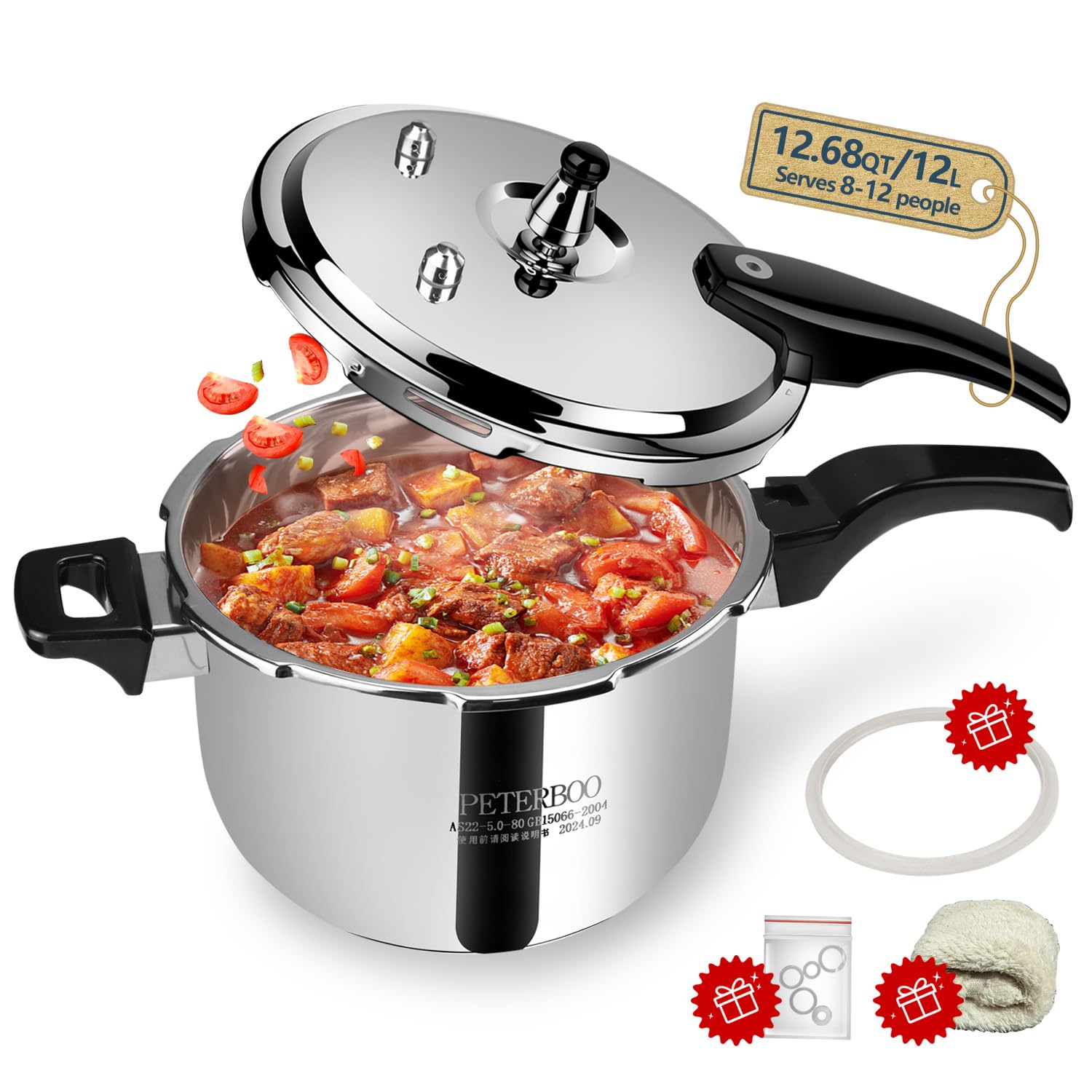
The Hestroney 12-quart stovetop model is built for serious batch cooking and canning. The heavy-duty stainless steel construction resists denting and corrosion, and the glossy finish maintains its shine even after regular use on gas, electric, or ceramic cooktops. The 8-layer safety system includes dual pressure regulators, an automatic locking lid, a pressure release valve, and a thermal fuse—a robust safety net that reviewers consistently describe as confidence-inspiring, especially for beginners who are nervous about stovetop pressure cooking.
The internal capacity of 12.68 quarts handles whole chickens, large roasts, and multiple pounds of beans in a single batch. Users report that the spring-loaded pressure control provides more consistent heat regulation than traditional weighted jiggle tops, reducing the risk of scorching. The mechanical knob control is simple and intuitive: rotate to seal, set the burner heat, and the pressure regulators maintain the desired level automatically. The included steam tray is useful for lighter cooking tasks.
The primary concern is the instruction manual, which multiple reviewers note is a poor machine translation from Chinese, lacking clear guidance on cooking times and specific pressure levels. Beginners may need to supplement with online resources to achieve consistent results. Additionally, at 12 quarts, this is a heavy unit that occupies significant storage space. For experienced cooks who value stainless steel durability and large capacity, this is a solid mid-range stovetop option.
Why it’s great
- Heavy-duty stainless steel resists warping and corrosion
- 8-layer safety system with dual regulators
- Large 12.68-quart capacity for batch cooking
Good to know
- Instruction manual has poor translation, lacks detail
- Heavy and bulky for storage
6. Hestroney 6.5 Qt Aluminum Pressure Cooker
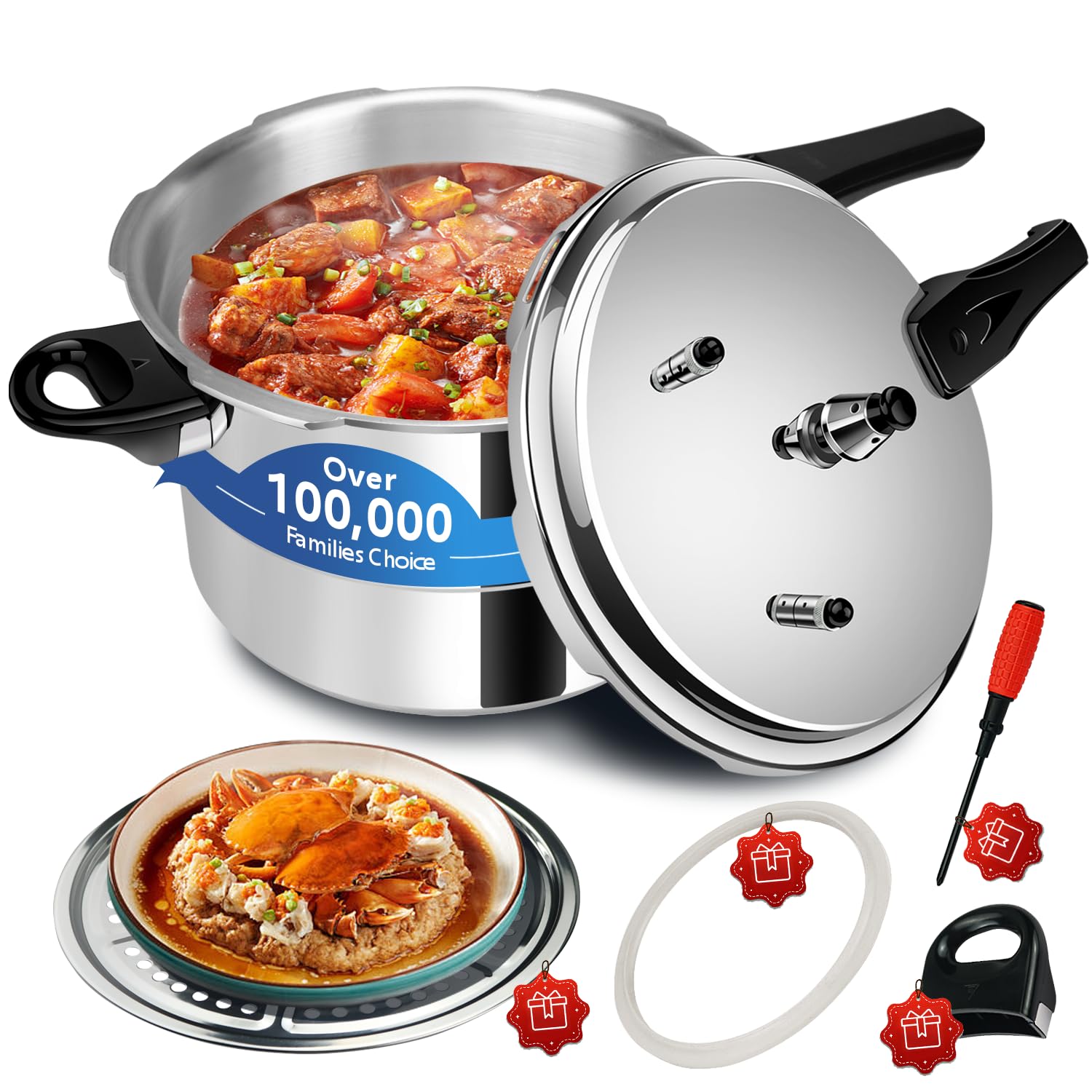
The Hestroney 6.5-quart aluminum pressure cooker is a no-frills stovetop option that prioritizes function and low cost. The thick commercial-grade aluminum provides fast, even heat distribution and is dishwasher safe for easy cleanup. The pressure locking lid, combined with a pressure release valve and safety valve, delivers worry-free operation at a price point that undercuts most electric alternatives by a significant margin.
Users consistently praise the 6.5-quart size as the perfect balance for one to two people, handling single-portion meals without excess space. The included steam tray and silicone sealing ring add utility, and the compatibility with gas, electric, and ceramic cooktops means it works with any stovetop. The performance is straightforward: heat the pot, lock the lid, and the pressure builds quickly—the spring valve provides clear visual feedback when the pot has reached pressure.
The downsides are predictable for the price tier: the aluminum material is less durable than stainless steel and may warp over years of high-heat use. The glossy finish scratches more easily than matte or brushed surfaces. There is no pressure gauge, so you must rely on the spring valve and release setting, which offers less precision than a weighted gauge model. For someone looking for a simple, effective stovetop pressure cooker without spending for stainless steel, this is a capable entry-level choice.
Why it’s great
- Budget-friendly entry point for stovetop pressure cooking
- Dishwasher-safe aluminum for easy cleanup
- Works on gas, electric, and ceramic cooktops
Good to know
- Aluminum warps over time with high heat
- No pressure gauge for precise settings
- Glossy finish scratches easily
7. BreeRainz 26 Quart Pressure Cooker

The BreeRainz 26-quart pressure cooker is a commercial-grade beast designed for serious bulk cooking—think catering, large family gatherings, or homestead canning. The bar-locking system uses a heavy-duty iron bar that slides into reinforced ears, creating a far stronger seal than traditional twist-lock lids. This clamping system combined with two 6.5 PSI pressure regulators and a backup safety valve forms a triple safety architecture that users describe as solid and confidence-inspiring, even at extreme volumes.
The aluminum construction keeps the weight manageable for a pot this size, though at 18.5 inches tall, it requires significant stovetop clearance and storage space. Cooking time savings are dramatic: the design breaks through the 212°F boiling point to 233°F, reducing cook times by up to 70% compared to conventional methods. The simple rotation-to-open mechanism is genuinely easy to operate, and the included timing chart helps new users estimate cooking durations for various foods.
The critical limitation is that this cooker reaches a maximum of only 6.5 PSI total, which is insufficient for safe pressure canning of low-acid foods—a major disappointment for buyers purchasing specifically for canning purposes. Standard canning requires at least 10-15 PSI. Additionally, the aluminum body, while lightweight, is not dishwasher safe and requires careful hand washing to avoid staining or pitting. For users who need enormous batch capacity without the need for canning, this is a capable tool, but verify your primary use case before buying.
Why it’s great
- Massive 26-quart capacity for bulk cooking
- Bar-locking system provides extremely secure seal
- Triple safety architecture with dual regulators
Good to know
- Not suitable for pressure canning (only 6.5 PSI max)
- Aluminum requires hand washing
- Very large – requires significant storage and stovetop clearance
FAQ
What is the difference between an electric and a stovetop pressure cooker?
Can I use a pressure cooker for pressure canning?
How does the sauté function performance differ between electric models?
Final Thoughts: The Verdict
For most users, the best all-in-one pressure cooker winner is the Ninja HyperHeat PC201GY because it combines 1200W power with a PFAS-free nonstick pot and superior searing capability in a user-friendly package. If you want the proven reliability and massive ecosystem for the best value, grab the Instant Pot Duo 6 Quart. And for those who need large stovetop batch capacity and are comfortable with manual operation, the Hestroney 12 Qt Stainless Steel offers commercial-grade durability at a mid-range price.