
Walk into any garden center and you see a wall of bags promising the same thing: happy plants. The difference between thriving greenery and a drooping mess often comes down to what is actually inside the bag. Air pockets, moisture-holding fibers, and nutrient density vary wildly between brands, and using the wrong mix can suffocate roots or leave them bone-dry within hours.
I’m Min — the co-founder and writer behind Gadgets Feed. This guide comes from hours of cross-referencing ingredient lists, analyzing customer experience patterns, and digging into the actual texture and pH data that determines whether your plants take off or stall out.
Whether you are repotting a fiddle-leaf fig or filling a raised bed with vegetables, you need to know which mix delivers the right balance of drainage and nutrition without mystery ingredients. That is exactly what this guide to the best all-purpose potting soil is designed to do.
How To Choose The Best All-Purpose Potting Soil
The label “all-purpose” hides a wide range of actual soil engineering. Some mixes are designed for dense moisture retention, while others prioritize air flow for root respiration. Matching the mix to your specific plants means paying attention to four key factors.
Understand the drainage components: Perlite vs. Vermiculite
Perlite is the white popcorn-like mineral that creates air pockets for root oxygenation and sharp drainage. Vermiculite is the golden flake mineral that soaks up water like a sponge and releases it slowly. An all-purpose blend typically includes both, but if you are repotting succulents or cacti, you want a mix heavy on perlite. For moisture-loving ferns or tropicals, a higher vermiculite content helps maintain consistent dampness without waterlogging.
Check the pH range and added nutrients
Most all-purpose potting soils land between 5.5 and 7.0 pH. A neutral range around 6.3 to 6.8 suits the widest variety of vegetables, herbs, and houseplants. Some blends include a starter charge of slow-release fertilizer — handy for containers, but unnecessary if you plan to feed separately. Organic mixes often rely on worm castings, kelp meal, and alfalfa meal for nutrients, which release more gently over time.
Look for certifications if organic matters to you
An OMRI (Organic Materials Review Institute) listing means the product meets organic farming standards and contains no synthetic pesticides, fertilizers, or genetic modifications. For food crops like tomatoes, peppers, and herbs, this certification provides peace of mind. Even for ornamentals, OMRI-listed soils often have richer microbial activity from composted ingredients.
Quick Comparison
On smaller screens, swipe sideways to see the full table.
| Model | Category | Best For | Key Spec | Amazon |
|---|---|---|---|---|
| Espoma Organic Potting Mix | Premium Organic | Houseplants & vegetable containers | 2 cubic ft with Myco-Tone mycorrhizae | Amazon |
| Brut Organic Potting Soil | Organic Premium | Chemical-free indoor/outdoor growing | 21 quarts with worm castings & trace minerals | Amazon |
| Miracle-Gro Potting Mix 3-Pack | Mid-Range | Outdoor containers & flowers | Feeds up to 6 months, 8 qt bags (3-pack) | Amazon |
| Michigan Peat All Purpose Premium | Mid-Range | Large pots & raised beds | 50 lbs with reed sedge peat & slow-release fertilizer | Amazon |
| Coast of Maine Acid-Loving Blend | Specialty Organic | Blueberries, azaleas, ferns | 20 quarts, OMRI listed, low pH (5.0–6.0) | Amazon |
| Midwest Hearth Premium Mix | Entry-Level | Seed starting & small pots | 4 dry quarts with peat, perlite, and vermiculite | Amazon |
| Miracle-Gro Cactus, Palm & Citrus 3-Pack | Specialty | Succulents, cacti, citrus trees | Fast-draining formula, 8 qt bags (3-pack) | Amazon |
In‑Depth Reviews
1. Espoma Organic Potting Mix

Espoma’s AP2 blend uses sphagnum peat moss, humus, and perlite as its base, then enriches it with earthworm castings, alfalfa meal, kelp meal, and feather meal. The result is a loamy, chunky texture that resists compaction and promotes strong root penetration. The proprietary Myco-Tone blend of endo and ecto mycorrhizae establishes a symbiotic fungal network around roots, improving nutrient and water uptake more effectively than standard fertilizer alone.
Users consistently note the absence of large wood chips or bark chunks that plague other budget bags. The moisture retention hits a sweet spot — it holds enough water to reduce watering frequency but drains freely enough to prevent root rot in most houseplants. The 2-cubic-foot bag covers roughly six 10-inch pots, making it a strong value for the organic quality you get.
For container vegetables like tomatoes, peppers, and basil, this mix provides sustained nutrition without the salt burn risk of synthetic slow-release granules. The pH hovers around 6.5, which suits the vast majority of food and ornamental plants. If you only buy one bag to cover your entire indoor and outdoor container garden, this is the pick.
Why it’s great
- Rich organic ingredient list with worm castings and kelp meal
- Myco-Tone mycorrhizae enhance root health naturally
- Consistently clean texture with no large debris
Good to know
- Premium price per cubic foot compared to synthetic blends
- Not ideal for cacti or succulents without additional perlite
2. Brut Organic Potting Soil
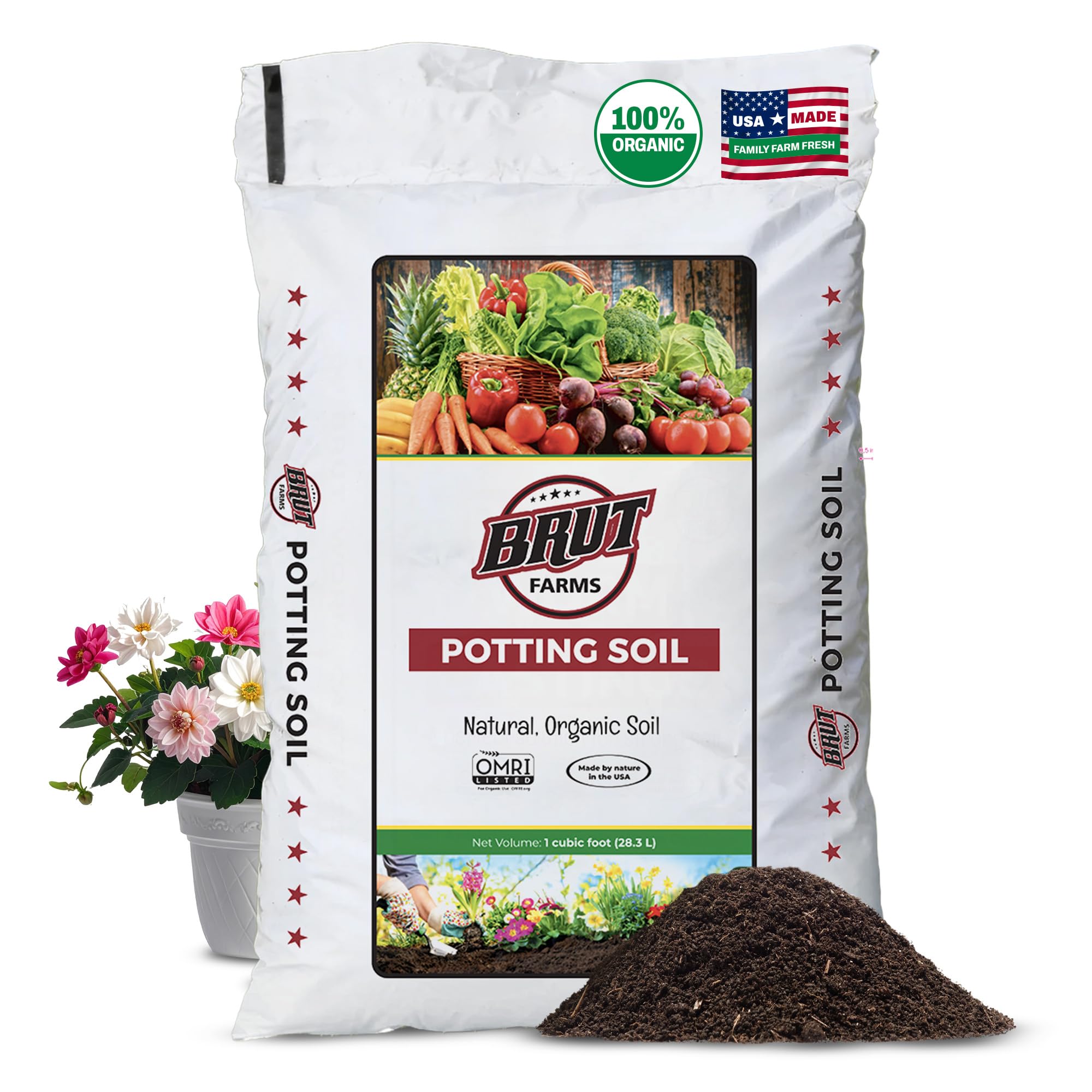
Brut builds its reputation on a filler-free formulation that skips synthetic chemicals entirely. The 21-quart bag contains microbe-rich worm castings, trace minerals from Azomite, and kelp-derived nutrients. The texture is fine and particulate rather than chunky, making it exceptionally easy to work with for both indoor repotting and outdoor container filling. No sticks, no wood chips, no mystery debris.
Natural pH balance between 6.3 and 6.5 covers the sweet spot for most vegetables, herbs, and flowering ornamentals. Customers report fast visible results — deep green leaf color and new growth within days of transplanting. The high organic matter content does attract beneficial soil microbes, but users in humid climates should watch for fungus gnats if the surface stays damp for extended periods.
Because it contains fish and bone meal as nutrient sources, using it outdoors can attract flies if the bag is left open or if the top layer is not covered with a thin sand or gravel cap. This is a sign of high-quality organic ingredients rather than a defect. For a pure, chemical-free potting medium that feeds from the root zone up, Brut delivers among the best results in its volume class.
Why it’s great
- Zero fillers — no sticks, bark, or synthetic additives
- Worm castings and trace minerals provide complete natural nutrition
- Fine texture packs well in pots without compaction
Good to know
- Attracts flies if left exposed outdoors due to fish meal content
- Premium pricing makes it less economical for large raised beds
3. Miracle-Gro Potting Mix 3-Pack

Miracle-Gro’s flagship potting mix pairs a lightweight peat-and-perlite base with a slow-release fertilizer that feeds container plants for up to six months. The 8-quart bags are easy to handle and store, and three bags together fill approximately six 8-inch containers. The texture is well-aerated straight out of the bag, requiring no additional mixing for most common annuals, perennials, and vegetables.
The built-in nutrient charge reduces the need for supplemental fertilizer during the growing season, which is convenient for casual gardeners. Users report strong growth in tomatoes, marigolds, petunias, and herbs. The mix holds moisture adequately but does not become waterlogged when drainage holes are present. Some growers note that the fertilizer can cause minor leaf burn on very sensitive seedlings if used undiluted.
This is not an organic product, so organic-purity gardeners should look elsewhere. But for sheer convenience, predictable results, and wide availability, this three-pack delivers reliable performance across the largest variety of container plants. Keep the bags sealed in a cool dry place to prevent the slow-release granules from activating prematurely.
Why it’s great
- Built-in slow-release fertilizer feeds for 6 months
- Lightweight and easy to handle in manageable 8-quart bags
- Works well across flowers, vegetables, and shrubs
Good to know
- Not suitable for strict organic gardening
- Fertilizer can burn sensitive seedlings in small pots
4. Michigan Peat All Purpose Premium Potting Soil

For large-scale projects like raised beds, multiple containers, and bulk potting, the 50-pound Michigan Peat bag delivers the highest volume-to-cost ratio in this lineup. The blend uses rich dark reed sedge peat, perlite, and sand to create a stable structure that drains well while holding enough moisture for robust root growth. Starter and slow-release fertilizers are already mixed in, so you can plant immediately without additional feeding.
The texture is denser and more earthy than fluffy peat-heavy mixes, which gives it weight in pots and resists blowing away on windy days. Customer reviews confirm it arrives moist and ready to use, with a consistency that works well for vegetables, flowers, and bulbs. The primary drawback reported is the potential for fungus gnats, which can emerge from the bag if the peat was stored in high-moisture conditions.
If gnats are a concern, spread the soil on a tarp and let it dry for 24 hours before use, or mix in a layer of sand on top of each pot. For budget-conscious gardeners who need to fill large planters without sacrificing basic performance, this is the workhorse option that gets the job done.
Why it’s great
- Massive 50-pound bag covers large containers and raised beds
- Ready-to-use with starter and slow-release fertilizers included
- Stable weight in pots prevents tipping in wind
Good to know
- Fungus gnats can appear due to moist peat content
- Denser texture may be too heavy for hanging baskets
5. Coast of Maine Organic & Natural Planting Soil

Coast of Maine targets a specific niche — acid-loving plants like blueberries, azaleas, rhododendrons, strawberries, ferns, and conifers. The 20-quart bag blends sphagnum peat moss, composted manure, and aged bark into a low-pH formulation that drops soil acidity into the 5.0 to 6.0 range. This is critical for plants that show iron chlorosis (yellow leaves) in neutral or alkaline soil.
The texture is light and fluffy with visible perlite for drainage, but the composted manure adds richness without a strong odor. Customers consistently report healthier berry yields and deeper green foliage on acid-loving ornamentals after transplanting. The OMRI listing confirms the organic purity, and the Maine-based company has a strong track record of sustainable sourcing since 1996.
Do not use this for general houseplants or vegetables that prefer neutral pH — the acidity can stress plants like tomatoes or peppers. Stick to the plants listed on the bag, or mix it 50/50 with neutral potting soil for moderate acidity. For anyone growing blueberries in containers, this is the most reliable off-the-shelf option available.
Why it’s great
- Low pH formulation ideal for blueberries, azaleas, and ferns
- Organic composted manure enriches soil biology
- Lightweight texture with good drainage for containers
Good to know
- Wrong pH for most vegetables and neutral-loving houseplants
- Bag size is moderate at 20 quarts for larger projects
6. Midwest Hearth Premium Potting Soil Mix

Midwest Hearth offers a compact 4-quart bag that punches above its size for small-scale projects. The formulation mirrors what professional growers use — a blend of peat moss for moisture retention, perlite for aeration, and vermiculite for steady water release. The pH is balanced for a broad spectrum of plant types, making it a safe choice for seed starting, small potted succulents, or houseplant repotting.
The bag features a resealable opening, which is surprisingly useful for occasional use. The texture is light and fluffy, allowing delicate seedling roots to spread without resistance. Users report excellent results with germinating petunias, herbs, and jade plants. The soil does not form a hard crust on top after watering, which is a common issue with cheaper mixes that contain too much sand.
The main limitation is volume — 4 quarts fills roughly one 8-inch pot or two 6-inch pots. For large container gardens, you would need multiple bags or a bulk option. But for apartment dwellers, windowsill gardeners, or anyone needing a small batch of high-quality mix without waste, this is a neat solution.
Why it’s great
- Professional-grade blend with peat, perlite, and vermiculite
- Resealable bag keeps unused soil fresh
- Excellent for seed starting and small houseplants
Good to know
- Small 4-quart size limits large projects
- Premium price per quart compared to bulk bags
7. Miracle-Gro Cactus, Palm and Citrus Potting Mix 3-Pack

This fast-draining formula is engineered specifically for plants that hate wet feet. Cacti, succulents, palm trees, and citrus all require a soil structure that lets water pass through quickly while still providing an anchor for roots. Miracle-Gro’s blend uses coarse sand and perlite to achieve rapid drainage, supplemented with their standard plant food for steady nutrition.
The three-pack format gives you three 8-quart bags, each capable of filling two 8-inch containers. Users consistently report that Christmas cactus, Thanksgiving cactus, and jade plants respond well, pushing new growth and blooms after transplanting. A common recipe among experienced growers is mixing half cactus mix with half standard potting soil for plants that need moderate drainage — a versatile approach for mixed container gardens.
Do not use this for moisture-loving plants like ferns, calatheas, or peace lilies — the drainage is too aggressive and will leave them thirsty. The cost per bag is higher than standard potting mix, but for cacti and succulents that rot easily in generic soil, the targeted drainage profile is worth the premium.
Why it’s great
- Fast drainage prevents root rot in cacti and succulents
- Convenient 3-pack covers multiple pots
- Can be mixed with standard soil for custom drainage levels
Good to know
- Too dry for moisture-loving tropical plants
- Premium price per quart compared to all-purpose blends
FAQ
Can I use all-purpose potting soil for succulents and cacti?
Why does my potting soil have fungus gnats and how do I stop them?
What does OMRI listed mean on a bag of potting soil?
How often should I replace potting soil in containers?
Final Thoughts: The Verdict
For most users, the best all-purpose potting soil winner is the Espoma Organic Potting Mix because it combines certified organic ingredients, mycorrhizae for root vitality, and a clean texture that works across vegetables, houseplants, and flowers. If you want a purely organic blend with worm castings and trace minerals, grab the Brut Organic Potting Soil. And for large-scale container gardening on a budget, nothing beats the sheer volume and value of the Michigan Peat All Purpose Premium Potting Soil.