
A dedicated load tester moves you beyond voltage guesswork by applying a real electrical load to measure how the battery holds up under stress, revealing the actual Cold Cranking Amps (CCA) and State of Health (SOH) in seconds.
I’m Min — the co-founder and writer behind Gadgets Feed. With hundreds of hours spent cross-referencing technical datasheets, analyzing real-world buyer feedback, and comparing measurement methodologies across dozens of automotive diagnostic tools, I’ve built this guide around the specs that actually matter when choosing a 12v battery load tester.
Whether you’re a weekend DIY mechanic or a shop technician, the right tester saves you time and prevents unnecessary battery replacements by giving you concrete data instead of a vague “it sounds weak” hunch.
How To Choose The Best 12V Battery Load Tester
Selecting a battery load tester hinges on understanding your battery types, your need for precision, and the testing environment. Digital conductance testers dominate the market because they’re fast, safe, and provide multiple data points, while analog resistive load testers still appeal to those who prefer a traditional carbon-pile approach for heavy-duty bench testing.
CCA Range and Battery Compatibility
Every 12V starter battery is rated by its Cold Cranking Amps—the current it can deliver at 0°F for 30 seconds while maintaining at least 7.2 volts. A tester must support the CCA range of your vehicles. For typical cars and light trucks, a 100-1200 CCA range covers most needs, but heavy-duty trucks or marine applications may require support up to 2000 CCA. Also verify the tester supports the specific battery chemistry—Flooded, AGM (flat plate and spiral), GEL, and EFB batteries each have distinct charging profiles and internal resistance characteristics that affect how the analyzer interprets the data.
Testing Methodology: Conductance vs. Resistive Load
Digital conductance testers pass a small AC signal through the battery to measure internal resistance and estimate CCA, SOH, and SOC in a few seconds without generating heat or draining the battery. These are ideal for quick diagnostics on installed batteries and are safe for modern sensitive electronics. Analog resistive load testers, by contrast, apply a high-current load (typically 100-130 amps) for a set duration and measure voltage drop directly. This method is more physically demanding on the battery and requires cool-down periods between tests, but it provides a direct stress test favored by some technicians for verifying actual cranking capability under load.
Display Quality and Diagnostics Breadth
A clear, readable display is non-negotiable when you’re leaning over an engine bay in varying light conditions. Look for a bright LCD or color screen that shows battery voltage, CCA, SOH (as a percentage), SOC, and internal resistance at a glance. Testers that also run a cranking test (monitoring voltage drop during engine start) and a charging system test (checking alternator output) offer a complete picture of your vehicle’s electrical health, helping you distinguish between a failing battery, a weak starter, or a faulty alternator without needing additional tools.
Quick Comparison
On smaller screens, swipe sideways to see the full table.
| Model | Category | Best For | Key Spec | Amazon |
|---|---|---|---|---|
| OTC 3181 | Premium | Heavy-duty shop use | 130A resistive load, 0-16V analog dial | Amazon |
| FOXWELL BT301 | Premium | Accurate digital diagnostics | 2.8″ color display, 6.5ft cable | Amazon |
| AUTOPHIX BAS100 | Premium | 12V/24V compatibility | 99.98% accuracy, copper clamps | Amazon |
| Clore SOLAR BA9 | Mid-Range | Lightweight and portable | 9.6oz, 40-1200 CCA range | Amazon |
| KONNWEI KW600 | Mid-Range | Waveform graphing | 2.4″ color screen, STM-32 chip | Amazon |
| TOPDON BT50 | Mid-Range | Compact and spark-free | IP67 sealed, 6-language UI | Amazon |
| Battery Tender 026-0020 | Budget | Simple analog load test | 100A load, color-coded display | Amazon |
In‑Depth Reviews
1. OTC 3181 130 Amp Heavy-Duty Battery Load Tester

The OTC 3181 is the definitive analog resistive load tester for professionals who need a direct, no-interpretation stress test on 6V and 12V batteries. Its 130-amp load coil delivers a sustained pull that reveals voltage drop under real cranking conditions, and the large 0-16V analog dial makes results instantly readable without navigating digital menus. The heavy-duty clamps are designed specifically for top and side post batteries, offering a robust grip that stays secure during testing.
With a 10-second test cycle, this unit is built for speed on the shop floor, but the carbon-pile coil requires a mandatory cool-down period between tests to prevent internal damage—users report that following the duty cycle ensures years of reliable service. The molded handle and side tabs for clamp storage, plus rear brackets for wall mounting, make this tool as practical for storage as it is for diagnostics.
OTC backs this tester with CE, RoHS, and UL certifications, and the feedback from verified buyers consistently highlights its accurate identification of borderline batteries that digital multimeters miss. If you want a tool that applies real electrical stress rather than estimating conductance, this is the benchmark.
Why it’s great
- True 130-amp resistive load provides a definitive stress test for 6V and 12V batteries.
- Extra-large analog dial with zero adjust offers clear, immediate readouts without menu scrolling.
- Clamps grip both top and side post terminals securely, and the on-tool storage is well thought out.
Good to know
- Requires a cool-down period between tests to prevent the load coil from overheating.
- Short attached cables can limit reach when testing batteries in awkward positions.
2. FOXWELL BT301 12V Car Battery Tester
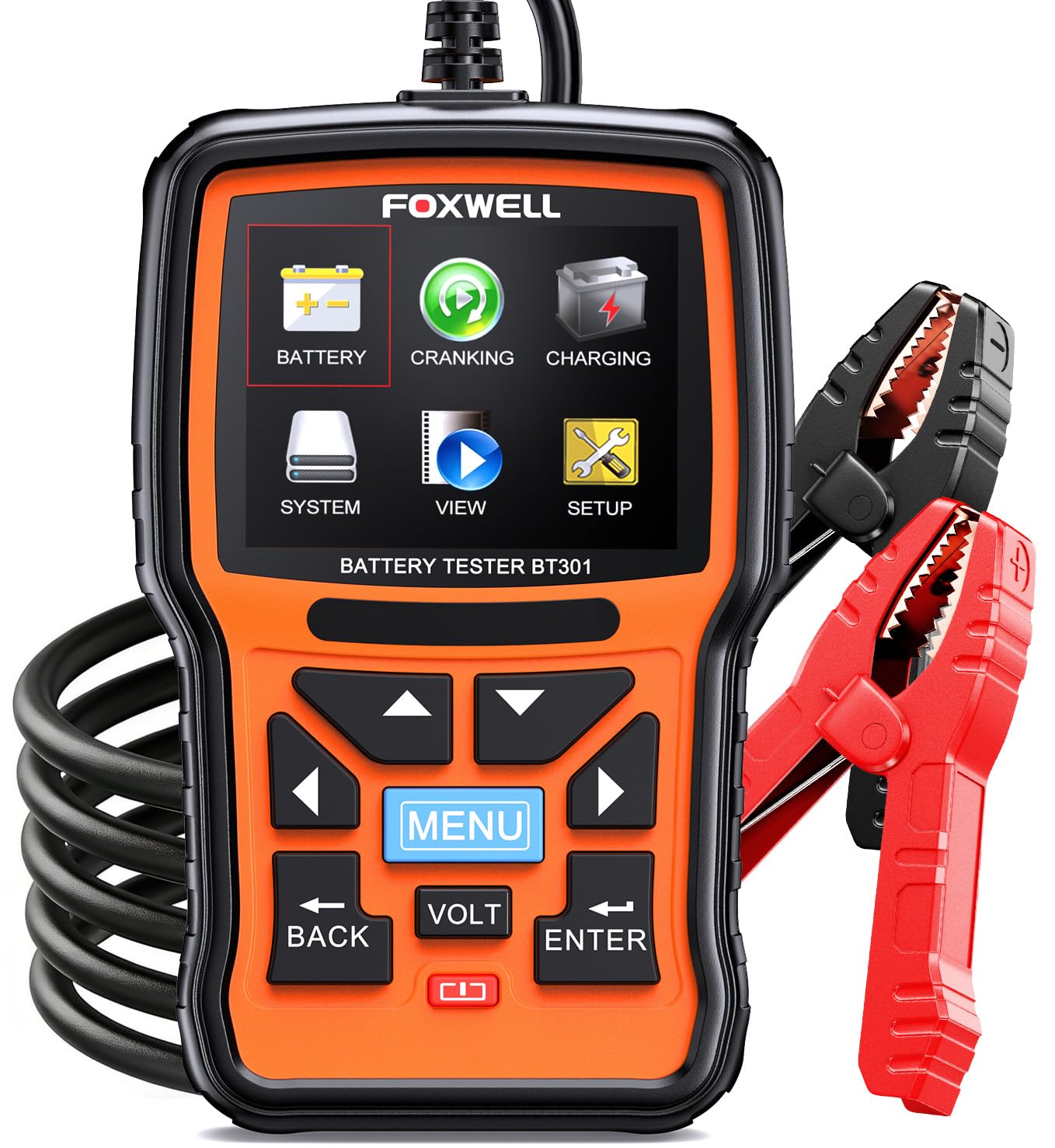
The FOXWELL BT301 elevates digital conductance testing with a vibrant 2.8-inch color display that remains readable in direct sunlight, a common pain point with smaller black-and-white LCD screens. It supports 12V flooded, AGM, EFB, and GEL batteries within a 100-2000 CCA range, delivering up to 99.9% accuracy according to the manufacturer’s claims. The 6.5-foot cable is a standout feature, allowing you to stay in the driver’s seat while the tester reaches the battery, which is especially useful for modern vehicles with tightly packed engine bays.
Beyond basic battery health, the BT301 runs comprehensive cranking and charging system tests, measuring voltage drop during engine start and checking alternator output under load. The unit is phantom-powered directly from the battery under test, so there are no internal batteries to charge or replace. The included carrying bag keeps everything organized, and reverse polarity protection adds a layer of safety for less experienced users.
Real-world buyer feedback confirms the BT301’s voltage readings match expensive Fluke multimeters within a tenth of a volt, and its CCA estimates align closely with battery ratings. For the DIY enthusiast who wants professional-level diagnostics without the steep learning curve of a full scan tool, the BT301 balances display quality, cable length, and accuracy at a premium value.
Why it’s great
- Large 2.8-inch color display provides crystal-clear readings in low light and bright sunlight.
- Long 6.5-foot cable allows convenient testing from the driver’s seat without an assistant.
- Delivers accurate cranking and charging system diagnostics in addition to battery health checks.
Good to know
- Must be connected directly to battery posts; testing at ground points can produce false results.
- The touchpad includes an unlabeled red button that doesn’t appear to have a documented function.
3. AUTOPHIX BAS100 Car Battery Tester 12V 24V

The AUTOPHIX BAS100 distinguishes itself by supporting both 12V and 24V electrical systems, making it one of the most versatile options for owners of heavy-duty trucks, buses, construction equipment, and boats that use 24V architectures. It covers a wide 100-2000 CCA range and supports multiple international standards including CCA, BCI, CA, MCA, JIS, DIN, and SAE. The high-conductivity copper alligator clips with anti-slip coating ensure a stable connection, which is critical for consistent conductance measurements.
Built around an AI smart chip, the BAS100 claims 99.98% diagnostic accuracy and runs battery, cranking, and charging tests in seconds. The intuitive LCD display guides you through selecting the correct battery type, standard, and CCA rating, and it automatically compensates for ambient temperature (above or below 0°C) to improve precision. The industrial-grade ABS shell with 4-in-1 smart protection—reverse polarity, short circuit, over-voltage, and over-current—makes this tester safe even in demanding environments.
Verified purchasers frequently mention that the BAS100 helped them avoid unnecessary alternator replacements by correctly isolating a weak battery as the root cause of starting issues. It also includes a data storage feature for tracking battery health over time, though the USB-C port is for power only and does not support data export. For anyone managing mixed 12V/24V fleets, this tester eliminates the need for separate tools.
Why it’s great
- Supports both 12V and 24V systems, covering cars, trucks, heavy equipment, and marine use.
- High-conductivity copper clips with anti-slip coating ensure reliable, repeatable conductance readings.
- Comprehensive safety protections (reverse polarity, short circuit, over-voltage, over-current) inspire confidence.
Good to know
- Cannot test batteries under 30 Ah, limiting its use for very small power sport batteries.
- The USB-C port provides power only—no data transfer or firmware update capability is available.
4. Clore Automotive SOLAR BA9 Digital 12V Battery and System Tester

The Clore SOLAR BA9 is a lightweight, conductance-based tester that punches above its 9.6-ounce frame. It covers a 40-1200 CCA range and works with flooded, AGM, spiral, and gel cell batteries, making it suitable for the majority of consumer-grade 12V systems. The four-line LCD display simultaneously shows voltage, CCA, state of health (SOH), and state of charge (SOC), so you get a complete picture without scrolling through multiple screens.
This tester measures internal resistance through conductance to determine battery condition, and it also performs starting and charging system tests. Rather than relying on a simple go/no-go LED, the BA9 displays the actual measured CCA value, allowing you to compare directly against the battery’s rated CCA. The unit is powered by the battery under test and operates within a 7-15V range, with a minimum operating voltage of 4.5V for wake-up detection.
Users consistently praise the BA9 for its ability to predict battery failure before traditional voltage checks reveal a problem. The compact size makes it easy to store in a glove box or tool pouch, and the intuitive one-button operation means minimal learning curve. The included manual is small, but the on-screen prompts are straightforward enough for most users to test without it after the first use.
Why it’s great
- Extremely lightweight at 9.6 ounces, perfect for portable and glove-box storage.
- Four-line LCD shows voltage, CCA, SOH, and SOC simultaneously for a complete battery overview.
- Measures actual CCA via conductance to identify batteries that are 20% below their rated capacity.
Good to know
- The small printed manual is difficult to read in windy conditions or with greasy hands.
- CCA range tops out at 1200, which may not cover high-performance or heavy-duty truck batteries.
5. KONNWEI KW600 Car Battery Tester 12V

The KONNWEI KW600 stands apart from the crowd with its 2.4-inch color LCD that displays test results both as numeric data and as a real-time oscilloscope-style waveform graph. This visual representation of voltage behavior during the starting event is particularly useful for diagnosing intermittent issues that a single snapshot reading might miss. It supports 12V batteries in the 100-2000 CCA range and is compatible with flooded, AGM, and GEL types.
Under the hood, the KW600 uses a top-level STM-32 main chip to deliver fast processing speeds, and it supports lifetime software updates via the included Mini-USB cable. When connected, the tester automatically powers on and immediately begins the diagnostics sequence. The screen displays the cranking waveform alongside measurements for SOH, SOC, voltage, internal resistance in milliohms, and CCA. The unit also includes a separate alternator ripple check to validate charging system health.
Buyers with multiple vehicles and even UPS battery banks praise the KW600 for its ability to quickly identify deep cycle AGM health and flag weak cells. The only repeated criticism involves the screen’s legibility in bright outdoor conditions and minor confusion when testing AGM batteries in vehicles without a conventional starter (like hybrids), where the cranking test may not run as expected. For troubleshooting battery issues with visual waveform confirmation, the KW600 is a powerful mid-range tool.
Why it’s great
- Unique waveform graphing displays voltage behavior during cranking for deeper diagnostic insight.
- Powered by an STM-32 chip for fast processing and supports lifetime firmware updates.
- Measures internal resistance in milliohms alongside SOH, SOC, and CCA in a single test cycle.
Good to know
- The color screen can be difficult to read in direct bright sunlight.
- May have trouble performing a cranking test on hybrid vehicles without a conventional starter motor.
6. TOPDON BT50 12V Battery Load Tester

The TOPDON BT50 packs professional-grade safety features into a compact, pocketable design that measures just 4.9 x 2.6 x 0.7 inches and weighs only 215 grams. Its spark-free technology eliminates the disconcerting arc that can occur when connecting traditional testers, and reverse polarity protection prevents damage from accidental misconnections. The unit is IP67 rated, meaning it is fully dust-tight and can withstand immersion in one meter of water for 30 minutes—a rare spec for a battery tester.
Operating on 12V lead-acid batteries (flooded, AGM, GEL, EFB) within a 100-2000 CCA range, the BT50 uses conductivity testing to deliver lab-grade readings in seconds. The one-button interface is deliberately simple: connect the clamps, press the button, and read the results on the bright LCD. It also includes a data review function to track historical test results, helping you monitor battery degradation over time.
Feedback from buyers, including professional lube technicians, confirms that the BT50 provides accurate readings in under 10 seconds, making it an efficient tool for shops that test batteries as part of every service visit. The main trade-offs are the relatively short cables and the clamp design, which some users find less grippy than heavier-duty alternatives. For a portable, spark-safe, and weather-resistant digital tester, the BT50 is a strong mid-range contender.
Why it’s great
- IP67 dust and water resistance makes it suitable for damp shop environments and outdoor use.
- Spark-free technology and reverse polarity protection provide excellent safety for home mechanics.
- Ultra-compact design at 215 grams is easy to carry in a pocket or tool pouch.
Good to know
- Short attached cables may limit reach on large vehicles or awkward battery placements.
- Clamp grips are not as robust as heavy-duty units, potentially affecting connection consistency.
7. Battery Tender 026-0020 Battery Load Tester
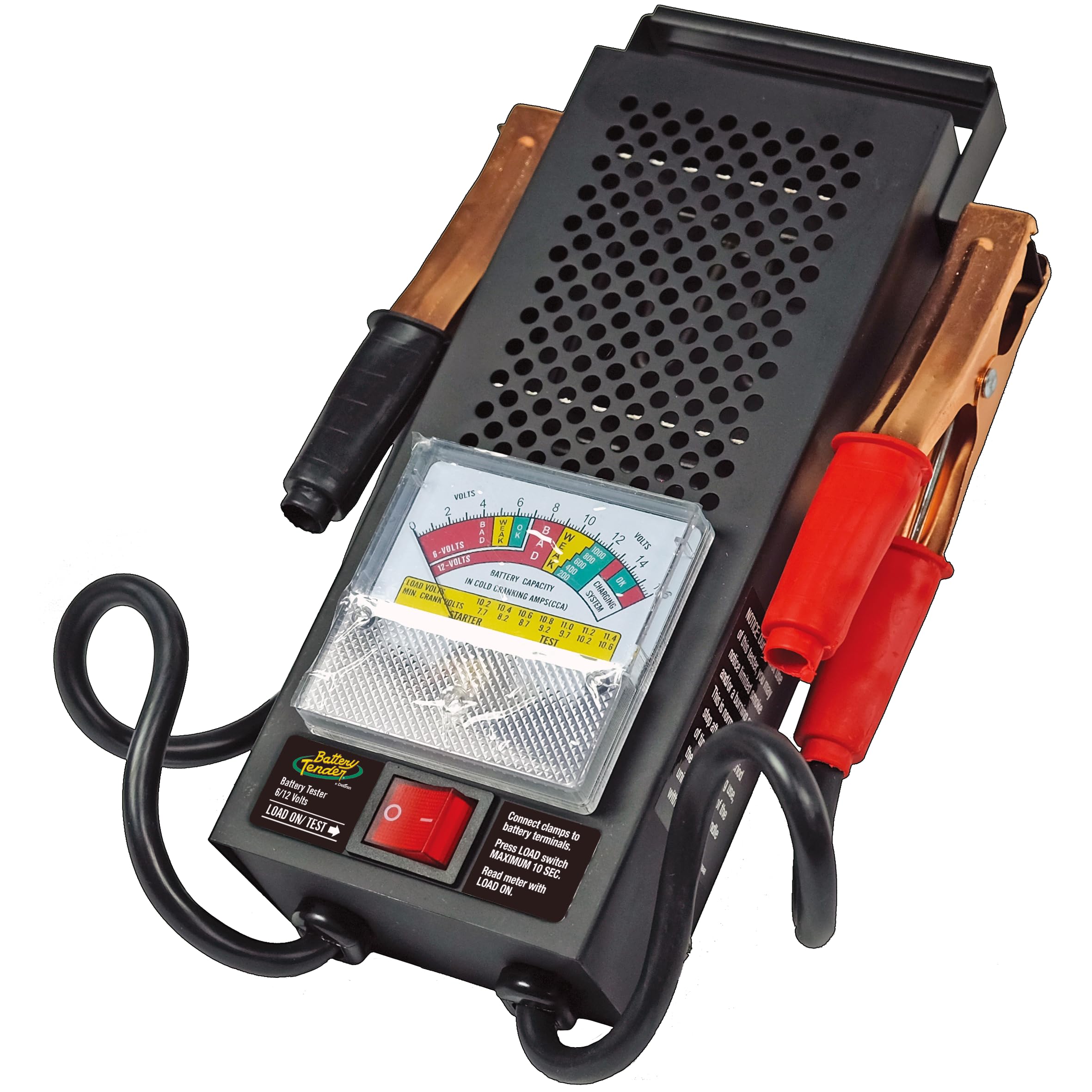
The Battery Tender 026-0020 is a no-nonsense analog load tester from a brand trusted by thousands of vehicle owners for its battery chargers and maintainers. It applies a 100-amp load on 12V batteries and a 50-amp load on 6V batteries, using a single toggle switch to engage the carbon-pile resistor. The color-coded display (green for good, yellow for marginal, red for bad) provides instant visual feedback without needing to interpret numeric values.
This unit is compatible with starter and deep cycle batteries for cars, trucks, SUVs, motorcycles, RVs, boats, and ATVs with up to 1,000 cranking amps. The rubber-insulated carrying handle and heavy-duty color-coded alligator clamps are built for durability, and the overall construction at 2.1 pounds feels substantial without being cumbersome. As an analog tester, it requires the user to read the needle position accurately and follow the duty cycle closely to avoid overheating the internal coil.
Verifiable user feedback spanning several years indicates that this tester reliably identifies batteries that need replacement. One recurring note is the distinct “slight smell” during operation, which is normal for resistive load coils burning off surface charge. For those who prefer a simple, direct connection to battery testing without digital complications, and who are willing to follow the cool-down instructions, the Battery Tender delivers proven value.
Why it’s great
- Simple color-coded analog gauge provides instant “good/marginal/bad” results without menu navigation.
- Rubber-insulated handle and heavy-duty clamps offer confident grip and electrical safety.
- Affordable entry point for anyone who needs a genuine load test rather than a voltage-only check.
Good to know
- The carbon-pile coil can burn out if the duty cycle (run/cool times) is not strictly followed.
- No digital failsafes or automatic shutdown—the user must manually control the test duration.
FAQ
What does a 12V battery load tester actually do that a multimeter cannot?
Can I use a digital conductance tester on a deeply discharged battery?
How do I interpret the results from a load test?
Are AGM and GEL batteries tested the same way as flooded batteries?
Why does my analog load tester need a cooldown period between tests?
Final Thoughts: The Verdict
For most users, the 12v battery load tester winner is the OTC 3181 because its 130-amp resistive load delivers a definitive real-world stress test that digital multimeters cannot replicate, and its analog dial provides instant, unambiguous results. If you want a digital tester with a large color display and the convenience of a long cable for in-seat testing, grab the FOXWELL BT301. And for users managing both 12V and 24V systems who need versatile battery compatibility and advanced safety features, nothing beats the AUTOPHIX BAS100.