
A 250-watt solar panel sits in a critical sweet spot—it delivers enough daily watt-hours to run a small refrigerator, charge a sizable power station, or offset a significant portion of an RV’s energy load, all without the unwieldy size of a 400W+ module. The recent industry shift from P-type PERC cells to N-Type technology, combined with bifacial backsheets and 16BB (16-busbar) cell architectures, has fundamentally redefined what buyers can expect from this wattage class.
I’m Min — the co-founder and writer behind Gadgets Feed. For this guide, I’ve analyzed real-world test data, customer validation across hundreds of installations, and the technical specs of N-Type versus P-Type cells, bifacial gain factors, and temperature coefficients to separate marketing claims from measurable performance.
After evaluating nine of the most competitive models on the market, this buying guide delivers the definitive analysis to help you select the best 250 watt solar panel for your specific off-grid, marine, or rooftop application.
How To Choose The Best 250 Watt Solar Panel
Choosing the right solar panel in the 250W class requires understanding three key differentiators: cell technology, physical size, and real-world warranty support. While the wattage rating is a starting point, the daily energy harvest depends heavily on the panel’s efficiency, bifacial capability, and tolerance to partial shading.
N-Type vs. P-Type: The Cell Technology Decision
The most significant shift in the 250W category is the move from P-type (boron-doped) cells to N-type (phosphorus-doped) cells. N-type cells don’t suffer from Light-Induced Degradation (LID), offer a lower temperature coefficient, and typically achieve higher conversion efficiency—often 25% versus 21-23% for standard P-type PERC cells. This translates directly to more watt-hours per square foot of roof or ground space.
Bifacial vs. Monofacial: Capturing Reflected Light
A bifacial panel features a transparent backsheet that captures albedo (reflected light) from the surface below. For a 250W panel mounted on a white RV roof, a light-colored ground surface, or a solar tracker, the bifacial gain can add 10-30% more power output without increasing the panel’s footprint. This makes bifacial panels significantly more valuable for ground-mounted or flat-roof installations where reflected light is accessible.
Busbar Count and Frame Durability
The number of busbars—thin conductive wires across the solar cells—directly affects reliability. 16BB (16-busbar) panels are now standard in the premium tier, offering superior current collection and reducing the impact of microcracks. Additionally, the frame construction (1.2mm+ anodized aluminum) and IP rating (IP68 for full dust and water immersion resistance) determine whether the panel will survive hail, snow loads of 5400Pa, and years of thermal cycling without delamination.
Quick Comparison
On smaller screens, swipe sideways to see the full table.
| Model | Category | Best For | Key Spec | Amazon |
|---|---|---|---|---|
| Renogy Bifacial 250W | Premium | Maximum Bifacial Gain | 250W, 22.35V, 80% Bifaciality | Amazon |
| RICH SOLAR MEGA 250 | Premium | Durability & Warranty | 250W, 18.9V, 16BB N-Type | Amazon |
| Callsun 200W Bifacial | Mid-Range | Anti-Shade Technology | 200W, 23.74V, TwinCell Design | Amazon |
| BougeRV N-Type 200W | Mid-Range | Compact Size for RVs | 200W, 21.6V, 26% Smaller Frame | Amazon |
| HQST N-Type 200W | Mid-Range | Reliable N-Type Entry | 200W, 50x30in, 25% Efficiency | Amazon |
| Rvpozwer 200W 18BB | Budget-Friendly | High Busbar Count Value | 200W, 20.52V, 18BB N-Type | Amazon |
| ECO-WORTHY 200W Bifacial | Budget-Friendly | Cost-Effective Bifacial | 2x100W, 12V, 25% Efficiency | Amazon |
| DOKIO 400W Mono | Premium | Large Surface Area Output | 400W, 67.8×44.6in, 31V | Amazon |
| Renogy 400W Portable | Premium | Portable Solar Suitcase | 400W, 23% Eff., Foldable | Amazon |
In‑Depth Reviews
1. Renogy Bifacial Solar Panel 250W N-Type 16BB

The Renogy Bifacial 250W is the benchmark in this category, pairing Grade A+ N-Type cells with a 25% conversion efficiency and an 80% bifaciality factor that is 10% higher than standard P-type PERC panels. The 16BB cell design minimizes hot spots and microcracks, directly contributing to a longer service life, and its low temperature coefficient of -0.29%/°C means you lose less power when the summer sun is baking your rooftop.
Real-world users consistently report 200-220W from a single panel under good conditions, with the bifacial backsheet scavenging extra energy from reflected light on white roofs or ground surfaces. Four panels in series have been measured at over 1000W at noon, easily charging a Delta Pro from 10% to full in about five sunny hours. The panel is physically manageable at 27.3 pounds and 60.9 inches long, fitting most RV roofs without overhang.
The main trade-off is a higher cost per watt compared to budget-tier panels, and some buyers have reported cosmetic frame bends during shipping—functionality remains unaffected, but inspect the packaging immediately. If you want the maximum daily energy harvest from a 250W footprint, this is the definitive choice.
Why it’s great
- Highest bifaciality factor (80%) in its class for extra rear-side energy capture.
- Low temperature coefficient (-0.29%/°C) maintains output during hot weather.
- Grade A+ N-Type cells with 16BB design ensure long-term reliability.
Good to know
- Premium pricing exceeds /watt in this category.
- Occasional shipping damage to frame corners has been reported.
- Bifacial gain requires at least 3 inches of clearance and a reflective surface beneath.
2. RICH SOLAR 250 Watt 12 Volt 16BB N-Type

The RICH SOLAR MEGA 250 stands out for its robust build philosophy: a heavy-duty 1.3mm anodized aluminum frame, tempered glass with anti-reflective coating, and 14 pre-drilled holes compatible with standard Z-brackets, ground mounts, and side pole mounts. Its N-Type cells deliver stable output with low LID (Light-Induced Degradation), and the 16BB configuration ensures efficient current collection across all 60 cells.
Buyers who have installed arrays of 14 panels report surviving severe hail and wind storms without a single failure, a testament to its physical resilience. Real-world output averages around 200W on partly cloudy days and can hit the full 250W rating under excellent conditions with a quality MPPT charge controller. The panel’s 60.6 x 29.9-inch footprint is standard for the 250W class, and its 25.8-pound weight is manageable for a two-person install.
The one consistent critique is the use of IP67 connectors rather than the more robust IP68 standard found on premium competitors—this is a minor concern for most installations but worth noting for marine or high-moisture environments. Backed by a 25-year power output warranty, this is a long-term investment for buyers who prioritize build quality.
Why it’s great
- Industry-leading 25-year power output warranty from a California-based company.
- Heavy-duty 1.3mm anodized aluminum frame survives hail and wind storms.
- 14 pre-drilled holes offer maximum mounting flexibility.
Good to know
- Connectors are IP67 rated, not IP68.
- Non-bifacial design limits energy capture from reflected light.
- Installation brackets are not included in the box.
3. Callsun 200W N-Type 16BB Bifacial Solar Panel

The Callsun 200W Bifacial panel brings the most important technological innovation—TwinCell anti-shade design—to the mid-range price tier. By splitting the panel into two independent halves, shading from a tree branch or a roof vent on one side doesn’t cripple the other half’s output. This is a massive advantage for RV and marine installations where partial shading is almost unavoidable.
Real-world user reports consistently show peak output exceeding the panel’s rating, with some owners measuring 420W from a pair of panels in series due to the bifacial backsheet soaking up reflected light from concrete surfaces. The compact footprint of 51.3 x 30.3 inches fits Class B vans perfectly, and the 23.8-pound weight makes solo installation feasible. The low temperature coefficient of -0.3%/K ensures stable output in hot climates.
The trade-off is that the panel’s maximum voltage of 23.74V requires a compatible MPPT charge controller to fully exploit its efficiency. Additionally, some users report actual current running slightly below the advertised 8.43A, likely due to heat-related losses. For its price, the Callsun delivers a superb combination of N-Type efficiency, bifacial gain, and shading tolerance.
Why it’s great
- TwinCell anti-shade design maintains 50% output when one half is shaded.
- Bifacial backsheet delivers up to 30% extra energy from reflected light.
- Compact dimensions perfectly sized for Class B vans and tight roofs.
Good to know
- Voltage of 23.74V requires an MPPT controller for best results.
- Some units report real-world current slightly below the 8.43A spec.
- 10-year support is solid, but warranty is not as comprehensive as Renogy’s.
4. BougeRV 12V N-Type 16BB 200W Bifacial Solar Panel

The BougeRV 200W panel is engineered for space-constrained installations, boasting a physical footprint that is 26% smaller than standard 200W panels. This is achieved through high-density N-Type cells with 16BB technology and a 25% conversion efficiency, meaning you get the same wattage from a smaller surface area—critical for RV roofs with limited real estate or multiple obstructions like vents and AC units.
Users report straightforward plug-and-play installation, with the panel delivering approximately 197W in real-world tests on a patio table at 1 PM, very close to its STC rating. The bifacial design with a transparent polymer backsheet adds energy capture from diffused and reflected light, and the corrosion-resistant aluminum frame ensures long-term outdoor durability. The panel is backed by BougeRV’s 10-year product tech support.
The main consideration is its 12V nominal voltage output (21.6V max), which is optimized for direct 12V battery systems. For higher-voltage systems or longer wire runs, you may need to consider series wiring or a higher-voltage panel. Overall, this is an excellent choice for RV owners who need to maximize power per square inch of roof space.
Why it’s great
- 26% smaller physical footprint than standard 200W panels for tight spaces.
- N-Type cells with 25% efficiency deliver near-rated power in real-world tests.
- Bifacial design captures extra energy from diffused and reflected light.
Good to know
- Optimized for 12V battery systems; less ideal for higher-voltage setups.
- Polymer backsheet may be less durable than glass in hail-prone areas.
- 10-year support is good, but warranty specifics are less detailed than premium brands.
5. HQST N-Type 16BB 200W Bifacial Solar Panel
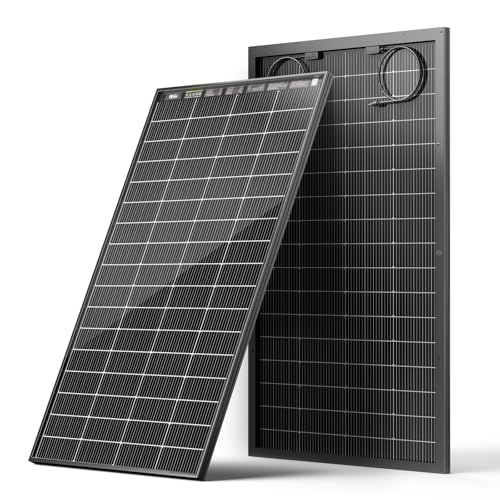
The HQST 200W panel is characterized by its use of true N-Type cells with a 30-year service life, which is five years longer than typical P-Type panels. The 25% conversion efficiency and a low temperature coefficient of -0.29%/°C ensure minimal power loss during hot summer months. The bifacial technology provides up to 12% extra output compared to standard monofacial panels of the same size.
Real-world users have been impressed with the performance, with one owner reporting that four panels in series on a Jackery 3000 consistently hit over 900W at the perfect angle, even in Central Florida’s summer heat. The panels are 6% smaller and 5% lighter than comparable P-type panels, making installation easier. The all-black, anti-corrosion aluminum frame gives a clean, premium aesthetic.
The primary limitation is that the 12% bifacial gain, while real, is lower than the 25-30% gains claimed by some competitors—likely due to the specific N-Type cell architecture used. Additionally, the panel’s IP68 rating and UL94 V-0 flame retardant certification are excellent, but the connector quality could be better for the price point. For a reliable, long-lived panel, this is a strong mid-range contender.
Why it’s great
- True N-Type cells guarantee a 30-year service life.
- Low temperature coefficient (-0.29%/°C) maintains output in high heat.
- 5% lighter than comparable P-type panels for easier handling.
Good to know
- Bifacial gain (12%) is lower than some premium competitors.
- Connector quality could be superior for the price bracket.
- Some users report scuffs from shipping, though function is unaffected.
6. Rvpozwer 200W 18BB N-Type Solar Panel
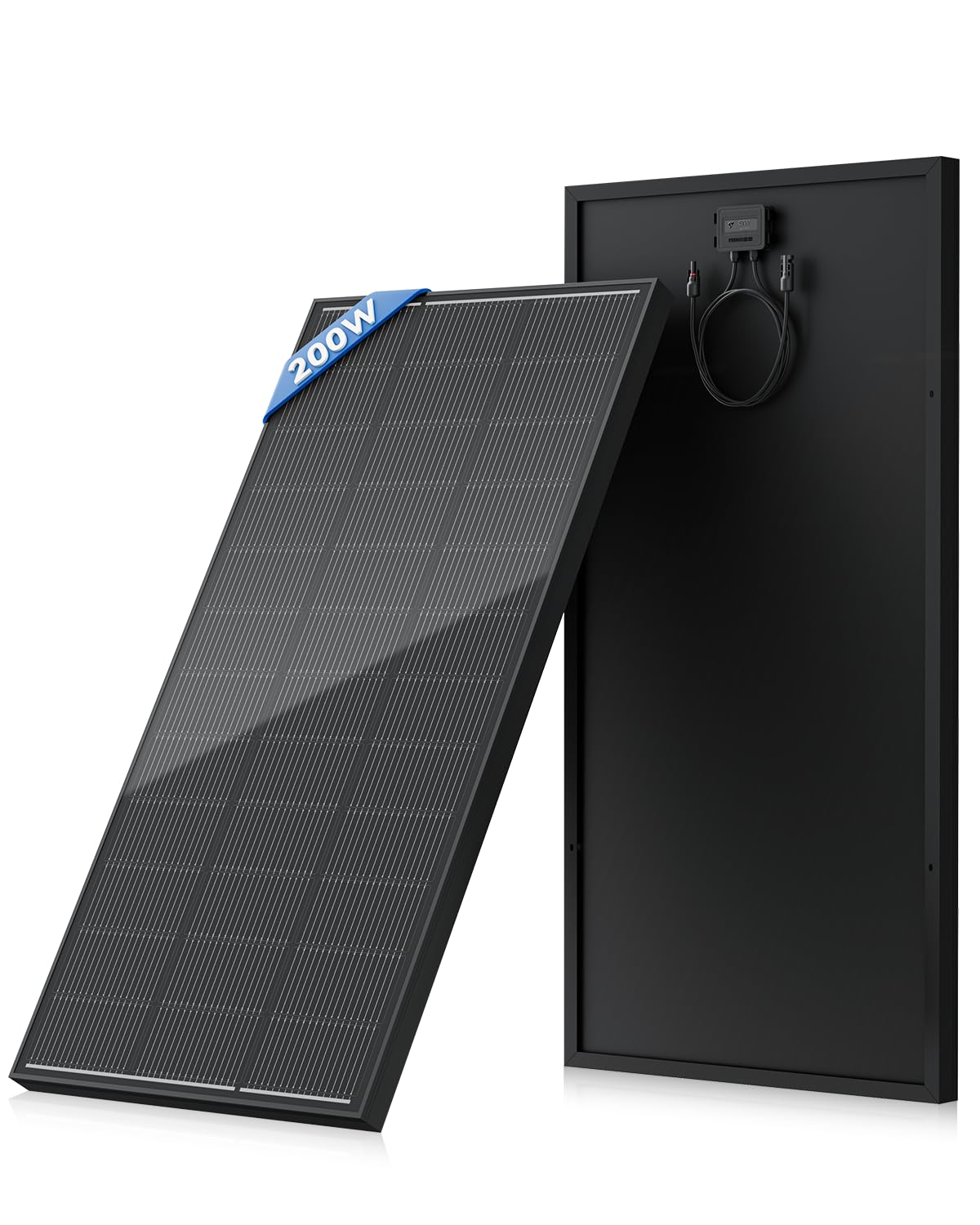
The Rvpozwer 200W panel is notable for pushing busbar count to 18BB—higher than the 16BB standard found on most premium models—which theoretically improves current collection and reduces hot spot risk. It pairs this with N-Type cells achieving 25% conversion efficiency and a claimed 30-year lifespan. The panel is IP68 rated with a corrosion-resistant electroplated aluminum frame capable of withstanding 5400Pa snow loads.
Buyers have found this to be an excellent budget option for building arrays, with one owner purchasing 10 panels for a patio pergola setup and reporting solid performance with a Victron MPPT controller and LiFePo4 batteries. The panel delivers approximately 1000 watt-hours per day in optimal conditions, and the 18BB design helps reduce the impact of microcracks during installation.
The downsides are real: some users report a maximum output of only 131W on a clear sunny day in California (significantly below the 200W rating), and there have been reports of a panel failing after just a few weeks of use, though Amazon’s return policy handled the replacement. The negative-side MC4 connectors on some units detach too easily and may require replacement. At this price point, you’re trading some consistency for upfront savings.
Why it’s great
- Highest busbar count (18BB) in the budget tier reduces hot spot risk.
- N-Type cells with 25% efficiency at a very competitive price point.
- IP68 waterproof rating with corrosion-resistant frame.
Good to know
- Output consistency varies; some units underperform their 200W rating.
- Connector quality (negative side) is unreliable; may need replacement.
- Product longevity is questionable; some failures reported within weeks.
7. ECO-WORTHY 200 Watt Bifacial Solar Panel (2x100W)

The ECO-WORTHY 200W kit provides two 100W bifacial panels, offering flexibility in mounting orientation since you can place them separately for optimal individual sun exposure. The 16BB solar cells with a composite backsheet achieve 91.5% light transmission, allowing the backside to capture diffused light on cloudy or rainy days—a genuine advantage for off-grid systems in less sunny climates.
Users have measured real-world performance that often exceeds expectations, with one reviewer noting that the bifacial panels outperformed their monofacial counterparts by 10-22% in the same space, averaging 16% more power. Another owner reported a peak of 154W from the pair and a reliable 120W under normal conditions. The panels are lightweight at 11.68 pounds each, making them easy to handle and install on roofs or brackets with pre-drilled holes.
The panel’s maximum power of 100W each means this is a 200W system total, not a single 200W panel. The diodes come pre-assembled with 2.95-foot cables, which is convenient but may be too short for some installations, requiring extensions. Overall, this is a fantastic entry-level bifacial option for those with smaller power needs or flexible mounting space.
Why it’s great
- Two 100W panels offer flexible mounting options and redundancy.
- Bifacial design with 91.5% backsheet transmission boosts cloudy-day output.
- Lightweight construction (11.68 lbs each) simplifies installation.
Good to know
- Total system output is 200W, not a single 200W panel.
- Pre-attached cables (2.95 feet) are short; extensions may be needed.
- Durable, but IP68 junction box rating is not explicitly stated for the panel itself.
8. DOKIO 400W 31V Mono Solar Panel

The DOKIO 400W is a single large-format panel that replaces four 100W units, significantly reducing the amount of hardware, wiring, and potential failure points in your solar array. Its 31V output voltage is ideal for 24V battery banks and provides better efficiency over long cable runs due to lower amperage. The built-in 9.84-foot MC4 leads eliminate the need for extension cables in most setups, keeping connections clean.
Real-world users report impressive performance, with a pair of these panels producing 560W under partial shading and expected to hit higher numbers on a clear roof. The panel is physically large at 67.8 x 44.6 inches and weighs 49.38 pounds, so it requires a solid mounting surface and preferably two people for installation. The pre-drilled holes are compatible with standard Z-brackets and tilt mounts for sheds and greenhouses.
The main caveat is that this is a 400W panel, not a 250W panel, so it is physically larger and may exceed the space available on smaller RV roofs. Additionally, the panel’s high voltage (31V) requires an MPPT charge controller for optimal charging of 12V batteries. For stationary applications like a shed or ground mount where space is not a concern, this panel offers the best watts-per-dollar ratio in this list.
Why it’s great
- Single 400W panel replaces four 100W units, reducing wiring complexity.
- 31V output voltage ideal for 24V systems and long cable runs.
- Long 9.84-foot built-in MC4 leads eliminate most extension cable needs.
Good to know
- Large physical size (67.8 x 44.6 in) requires substantial mounting space.
- Heavy at 49.38 lbs; two-person installation is recommended.
- High voltage requires an MPPT charge controller for 12V battery systems.
9. Renogy 400W Portable Solar Panel Suitcase

The Renogy 400W Portable Suitcase is a completely different form factor—a foldable, carry-case-ready panel designed for RVs, overlanding, and emergency backup. It uses A+ monocrystalline cells with 23% efficiency, reinforced with fiberglass and an ETFE coating for military-grade durability. The panel folds down to 33.7 x 27.95 x 3.2 inches and weighs just 30.2 pounds, making it 4x more compact than a rigid 400W panel.
Real-world testing shows exceptional performance even in sub-optimal conditions: 200W+ on partly overcast days, 300W+ in good sun, and a peak of 395W under full sun. The parallel wiring design ensures that shading on one section doesn’t cripple the entire panel’s output—a massive advantage over series-wired flexible panels. Setup takes about 60 seconds with sturdy rust-proof kickstands, and the IP68 solar connectors are compatible with most power stations.
The main trade-offs are weight (30.2 lbs is still substantial for carrying any distance), and the kickstands, while durable, are non-adjustable and may need PVC extensions for optimal winter sun angles. At a premium price, you’re paying for portability, durability, and instant deployment. This is the panel for anyone who needs to generate power where they park, not where they live.
Why it’s great
- Folds to 1/4 the size of rigid panels for easy transport and storage.
- Real-world output of 300W+ in good sun conditions is exceptional for a portable.
- Parallel wiring prevents partial shading from crippling total output.
Good to know
- At 30.2 lbs, it’s heavy for backpacking or long carries.
- Kickstands are non-adjustable; DIY extensions may be needed for optimal angles.
- Premium price reflects the portable form factor, not raw watts per dollar.
FAQ
What is the real-world output I can expect from a 250W solar panel?
Can I use a 250W solar panel with a 12V battery system?
What is the difference between 9BB, 16BB, and 18BB solar cells?
Does a bifacial solar panel need special mounting to work?
Final Thoughts: The Verdict
For most users, the best 250 watt solar panel winner is the Renogy Bifacial 250W N-Type because its 80% bifaciality factor and low temperature coefficient deliver the highest daily energy harvest per panel in this wattage class. If you want anti-shade resilience and a compact footprint for tight RV roofs, grab the Callsun 200W Bifacial. And for maximum portability with instant setup, nothing beats the Renogy 400W Portable Suitcase.