
A dead house battery at a remote campsite isn’t just an inconvenience — it’s a weekend-ender. The wrong 12V RV battery means voltage sag under load, minutes of usable runtime instead of hours, and a back-breaking 60-pound swap every two years. Choosing the right chemistry, capacity, and protection circuitry determines whether your rig powers a fridge all night or leaves you in the dark by midnight.
I’m Min — the co-founder and writer behind Gadgets Feed. I’ve cross-referenced hundreds of technical spec sheets, warranty terms, and user longevity reports across AGM, flooded lead-acid, and LiFePO4 chemistries to separate the batteries that actually deliver rated capacity from those that don’t.
This roundup focuses on measurable capacity, cycle life, weight savings, and built-in BMS protection to help you find a reliable 12v rv battery that matches your real-world power draw and budget.
How To Choose The Best 12V RV Battery
Three factors separate a battery that powers your RV setup reliably from one that leaves you stranded: chemistry type, usable capacity, and the quality of the built-in battery management system. Here’s what to prioritize.
Chemistry: LiFePO4 vs. AGM vs. Flooded Lead-Acid
Lithium iron phosphate (LiFePO4) batteries deliver 3,000–15,000 cycles versus the 200–500 cycles typical of AGM or flooded lead-acid, and they provide nearly 100% usable capacity without damaging the cells. AGM batteries are maintenance-free and spill-proof but only allow safe discharge to about 50% depth-of-discharge, effectively halving their rated amp-hours. Flooded lead-acid is the cheapest upfront but requires regular water checks and venting for hydrogen gas — a non-starter for most modern RV interiors.
Capacity Matching: Amp-Hours vs. Real-World Draw
A 100Ah LiFePO4 battery provides 100 amp-hours of usable energy. An equivalent-rated AGM provides roughly 50Ah usable if you want to preserve cycle life. Calculate your RV’s daily load by adding up the watt-hour consumption of your fridge, lights, water pump, furnace fan, and devices — then divide by 12 (volts) to get required amp-hours. A 100Ah lithium battery typically runs a standard RV fridge, lights, and a water pump for 24–36 hours depending on ambient temperature.
BMS and Temperature Protection
The built-in BMS in any lithium battery handles overcharge, over-discharge, short-circuit, and overcurrent protection. The critical feature for RVers who camp in freezing conditions is low-temperature charging cutoff — the BMS must prevent charging below 32°F (0°C) to avoid permanent cell damage. Most premium LiFePO4 batteries include this; budget units often omit it, which is a dealbreaker for four-season camping.
Quick Comparison
On smaller screens, swipe sideways to see the full table.
| Model | Category | Best For | Key Spec | Amazon |
|---|---|---|---|---|
| HumsiENK 12V 100Ah LiFePO4 | Lithium | Best Overall Value | 1280Wh / 15,000 cycles / 19.7 lbs | Amazon |
| SUPER EMPOWER 12V 100Ah LiFePO4 | Lithium | Group 24 Drop-in Fit | 21.6 lbs / 5 year warranty | Amazon |
| Power Queen 12V 100Ah LiFePO4 | Lithium | Proven Build Quality | 1280Wh / 24 lbs / Grade-A cells | Amazon |
| Redodo 12V 100Ah LiFePO4 | Lithium | Reliable Mid-Range | 4000 cycles at 100% DOD / 22 lbs | Amazon |
| Litime 12V 100Ah LiFePO4 | Lithium | Trolling Motor / ABYC E-13 | 22.1 lbs / low-temp protection | Amazon |
| ECO-WORTHY 12V 280Ah LiFePO4 | Lithium | High Capacity / Metal Case | 3584Wh / 200A BMS / Bluetooth | Amazon |
| Battle Born 12V 100Ah LiFePO4 | Lithium | Premium / 10-Year Warranty | 31 lbs / 3000-5000 cycles | Amazon |
| WEIZE 12V 100Ah Deep Cycle | AGM | Budget AGM / Value | 100Ah / 63 lbs / maintenance-free | Amazon |
| Newport 12V 50Ah Marine AGM | AGM | Budget / Lightweight AGM | 50Ah / 32 lbs / trolling motor | Amazon |
In‑Depth Reviews
1. HumsiENK 12V 100Ah LiFePO4 Battery

The HumsiENK delivers a rare combination of premium specs at a mid-range price point: Grade A+ LiFePO4 cells, IP67 waterproof rating, and a 100A BMS that handles low-temperature cutoff automatically. The rated 15,000 cycles at 60% depth-of-discharge translates to roughly 10 years of nightly use before noticeable degradation.
Real-world users report running a 2000W inverter setup with four units in parallel, maintaining 12-14V output for freezers and major appliances. The Bluetooth app provides per-cell voltage monitoring, state-of-charge, and alarm logging — a feature normally reserved for batteries costing twice as much. Charging at up to 50A (solar, alternator, or shore) means you can replenish the full 1280Wh pack in about two hours with the right charger.
One quirk: the BMS can enter protection mode if discharged below roughly 10V, requiring a low-current lead-acid charger to wake the battery before the LiFePO4 charger can engage. This isn’t unique to HumsiENK, but first-time lithium users should budget for a compatible charger or maintain a trickle-charge habit. The five-year warranty and 999-times lab-tested shock resistance add confidence for rough-road camping.
Why it’s great
- 15,000-cycle lifespan at 60% DOD — outlasts AGM by 30x
- IP67 waterproof and shock-resistant for rugged RV mounting
- Bluetooth app with cell-level monitoring and alarm history
Good to know
- BMS may lock out below 10V — requires low-current wake charge
- No built-in state-of-charge display on the battery itself
2. Battle Born 12V 100Ah LiFePO4 Battery
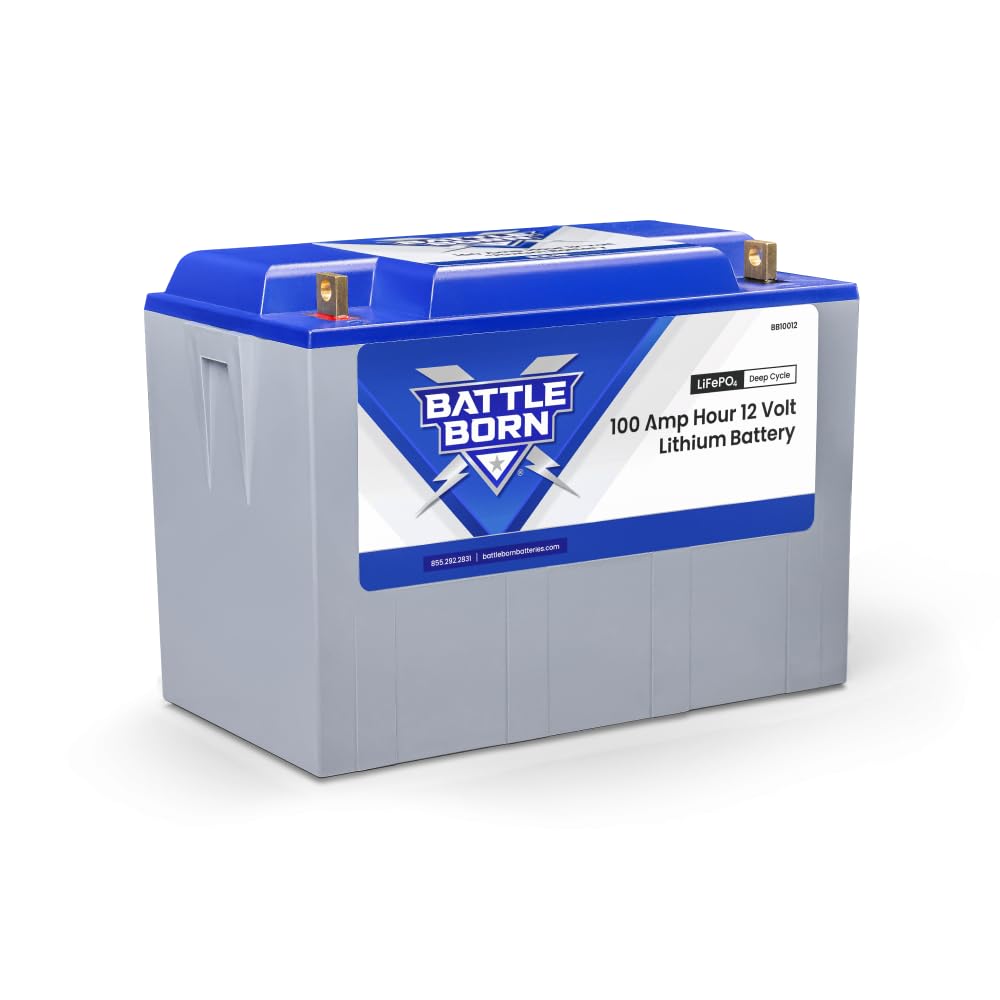
Battle Born is the established benchmark in the drop-in LiFePO4 market, and the BB10012 justifies its premium reputation with a 10-year warranty and proven field reliability. The internal BMS covers low-temperature charging cutoff, high/low voltage protection, and short-circuit prevention — all tuned for RV house battery duty cycles. At 31 pounds, it’s heavier than most 100Ah lithium competitors, but that weight comes from a thick external casing that resists vibration and impact in moving vehicles.
Owners consistently report 3,000–5,000 full-depth cycles with no capacity fade, translating to 10–15 years of regular RV use. The drop-in form factor fits Group 27 and Group 31 trays without modifications, and the included 5/16-inch terminal bolts are a small but appreciated detail. Users running dual batteries in parallel report 28 hours of runtime for fridge, lights, and water pump — more than triple the 8 hours they got from lead-acid of the same nominal capacity.
The trade-off is pricing that sits 3–4x above mid-range lithium competitors. You’re paying for the warranty support, US-based customer service, and a decade of testing across thousands of installations. If your RV setup tolerates no downtime and you want a set-and-forget solution with a proven support network, the Battle Born delivers. Just confirm compatibility with your existing converter — older models may need a lithium-compatible charger upgrade.
Why it’s great
- 10-year warranty with US-based customer support — best in class
- 3000-5000 cycles at 100% DOD for 10-15 year service life
- Drop-in fit for Group 27 and 31 trays, no modifications needed
Good to know
- Significant price premium over comparable 100Ah lithium batteries
- Heavier than many 100Ah LiFePO4 options at 31 lbs
3. ECO-WORTHY 12V 280Ah LiFePO4 Battery
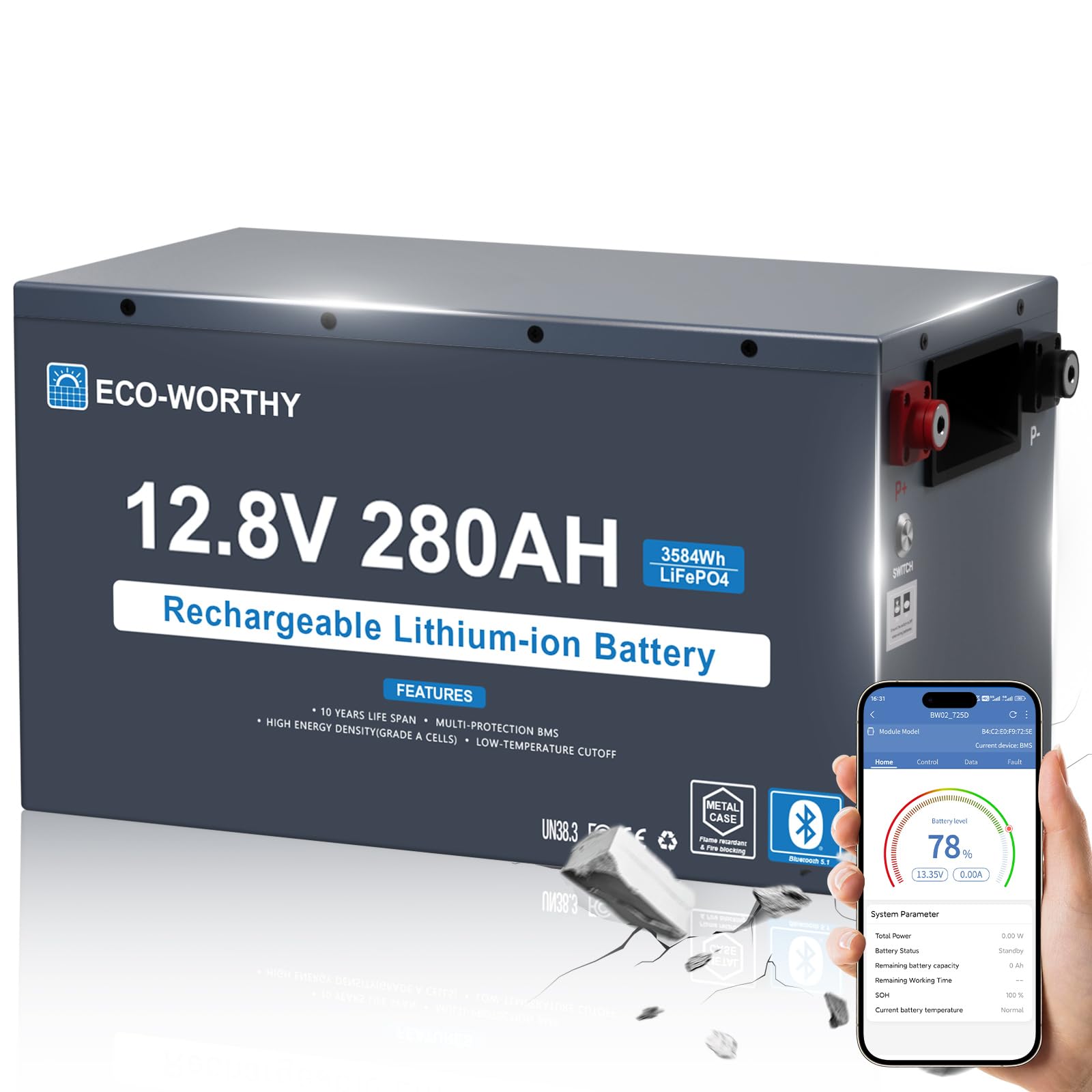
The ECO-WORTHY 280Ah is the high-capacity specialist in this roundup — a single unit stores 3584Wh of usable energy, enough to run an RV furnace, fridge, lights, and water pump for 3–4 days without solar or alternator charging. The metal case is a standout design choice: it provides superior fire resistance, includes four mounting feet for direct bolting to the RV floor, and houses an on/off switch for safe maintenance disconnection — no need for a separate battery box.
The built-in 200A BMS supports high-draw appliances like microwave ovens and induction cooktops through a 2000W inverter. Bluetooth monitoring via the Overkill Solar–compatible JBD BMS gives real-time voltage, current, and cell balance data. Owners report the battery exceeds its rated 280Ah capacity in capacity tests, and the metal enclosure keeps internal temperatures stable even during sustained high-rate discharge. The low-temperature charging cutoff engages at 20°F, protecting cells in freezing conditions.
At 68.5 pounds, this is not a lightweight option — you gain capacity at the cost of portability. The physical footprint (16.54 x 8.64 x 9.65 inches) requires a dedicated compartment, not a standard Group 31 tray. If your RV has space for a single larger battery rather than multiple paralleled 100Ah units, the ECO-WORTHY simplifies wiring and reduces connection points. The three-year warranty is shorter than some competitors, but the build quality and metal case justify the investment for full-time or extended-trip RVers.
Why it’s great
- 280Ah capacity (3584Wh) runs an RV 3-4 days without recharging
- Metal case with on/off switch and mounting feet — no battery box required
- 200A BMS supports high-draw inverters up to 2000W
Good to know
- 68.5 lbs and large footprint — not a compact or portable option
- Three-year warranty is shorter than premium lithium competitors
4. SUPER EMPOWER 12V 100Ah LiFePO4 Battery
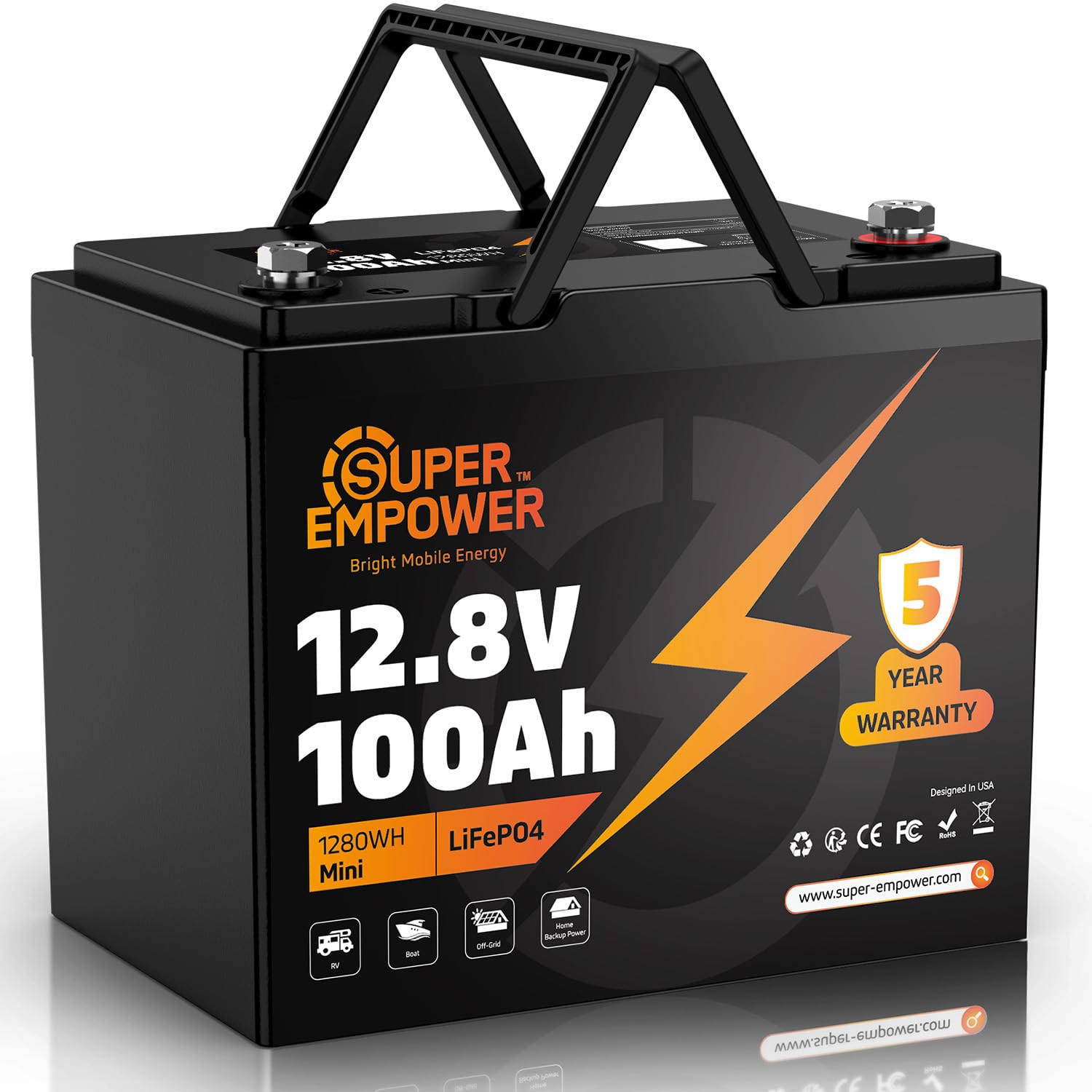
The SUPER EMPOWER LiFePO4 battery nails the Group 24 drop-in replacement brief: 6.49 x 10.24 x 8.98 inches fits standard boxes, M8 terminals match existing cables, and 21.6 pounds drastically reduces tongue or compartment weight compared to a 60-pound lead-acid. The built-in 100A BMS includes low-temperature charging cutoff (engages below 32°F) and discharge stops at -4°F, making it winter-ready for four-season campers. Grade A+ cells support 5,000 cycles at 100% DOD and 15,000 cycles at 60% DOD — typical lithium longevity.
Trolling motor users report 4+ hours of runtime on a 55lb thrust motor with no voltage sag, and solar recharging is straightforward thanks to the BMS’s compatibility with standard MPPT controllers set to lithium mode. The battery supports up to 4S4P configuration (20.48kWh total), giving off-grid builders room to scale. Folding handles are sturdy enough for one-handed carry, and the terminal caps included prevent accidental shorts during transport.
The main gap is the lack of a built-in Bluetooth or state-of-charge display — you’ll need to add an external monitor or shunt-based battery gauge to track remaining capacity. The five-year warranty provides adequate coverage, and the 40-milliohm internal resistance keeps voltage stable under load. If you want a simple, no-frills lithium swap that fits your existing Group 24 footprint, this is one of the most cost-effective options available.
Why it’s great
- True Group 24 size — drops into existing battery boxes without adapter plates
- Low-temperature charging cutoff for safe winter operation
- 5,000 cycles at full depth-of-discharge with Grade A+ cells
Good to know
- No Bluetooth or on-board charge indicator — external monitor recommended
- Charging disabled below 32°F by BMS; requires heated storage or bypass care
5. Power Queen 12V 100Ah LiFePO4 Battery
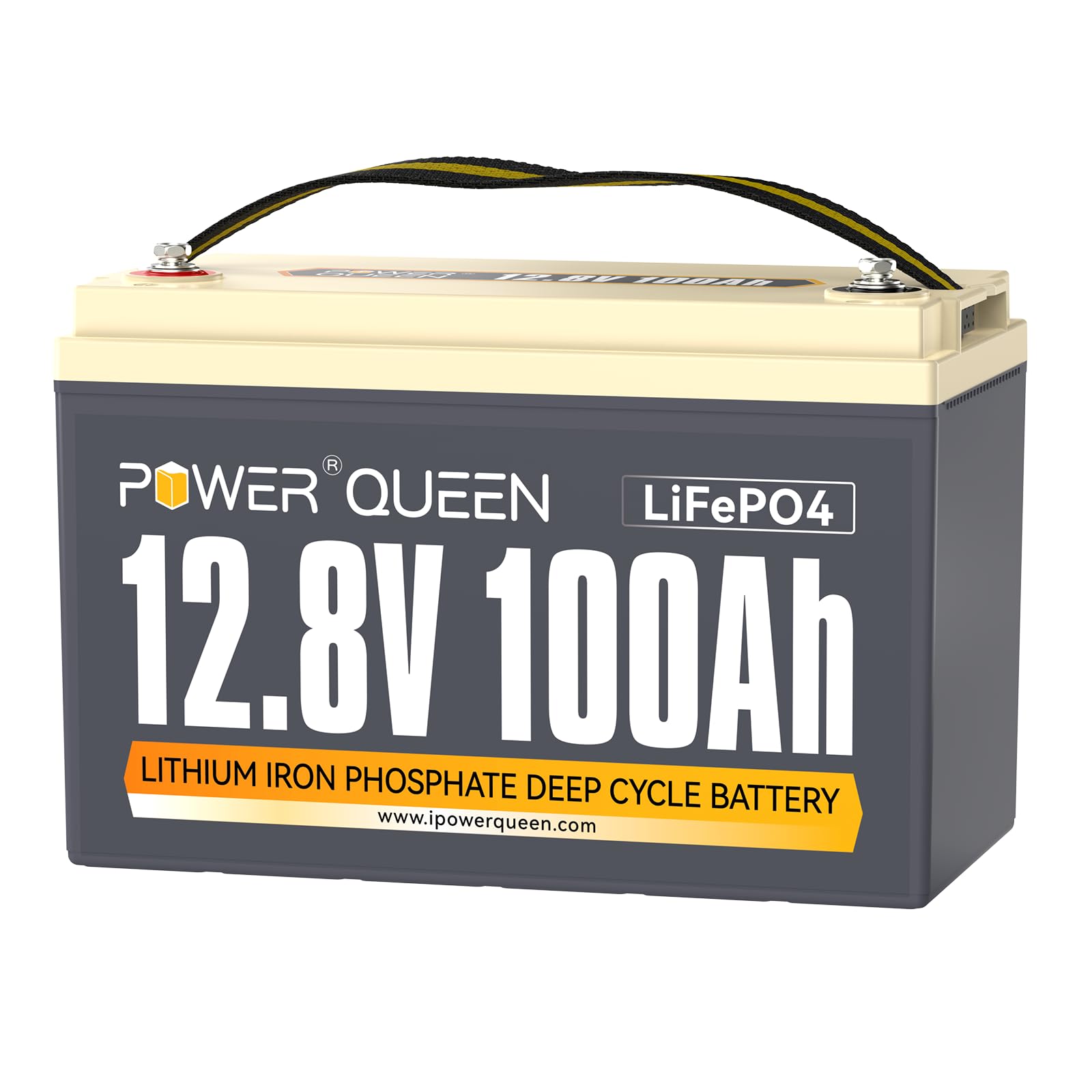
Power Queen has built a reputation for consistent build quality across its lithium line, and the 12V 100Ah Group 31 model is their most popular RV battery. Grade-A LiFePO4 cells, a 100A BMS, and a 5-year warranty back a unit that delivers 1280Wh of usable energy at 24 pounds — roughly one-third the weight of a comparable AGM. The compact Group 31 footprint (13 x 6.82 x 8.84 inches) fits most standard RV trays, and the M8 terminals accept common inverter and solar controller lugs without adapters.
Real-world testing from owners shows the battery delivers slightly above its rated capacity: one user measured 102Ah from a full charge. On trolling motor duty, a single charge powers a 55lb motor for multiple fishing trips covering roughly 6–8 miles total before needing a recharge. The BMS handles overcharge, over-discharge, short circuit, and overheat conditions, and the low self-discharge rate (3% per month) means the battery holds usable charge through months of storage without a trickle charger.
The series/parallel flexibility (up to 4S4P for 51.2V 400Ah) makes this a viable building block for larger RV solar systems. The only recurring user note is that the 6mm terminal bolts with 13mm heads can feel prone to cross-threading if over-torqued — hand-tighten with a socket, not an impact driver. At this price point, the Power Queen offers a solid middle ground between budget lithium and premium brands, with a proven track record across thousands of installations.
Why it’s great
- Tested at 102Ah actual capacity — exceeds rated spec
- Grade-A LiFePO4 cells with consistent voltage curve under load
- 5-year warranty with responsive customer support
Good to know
- 6mm terminal bolts require careful torque to avoid cross-threading
- Group 31 size may not fit all RV battery compartments without measurement
6. Redodo 12V 100Ah LiFePO4 Battery
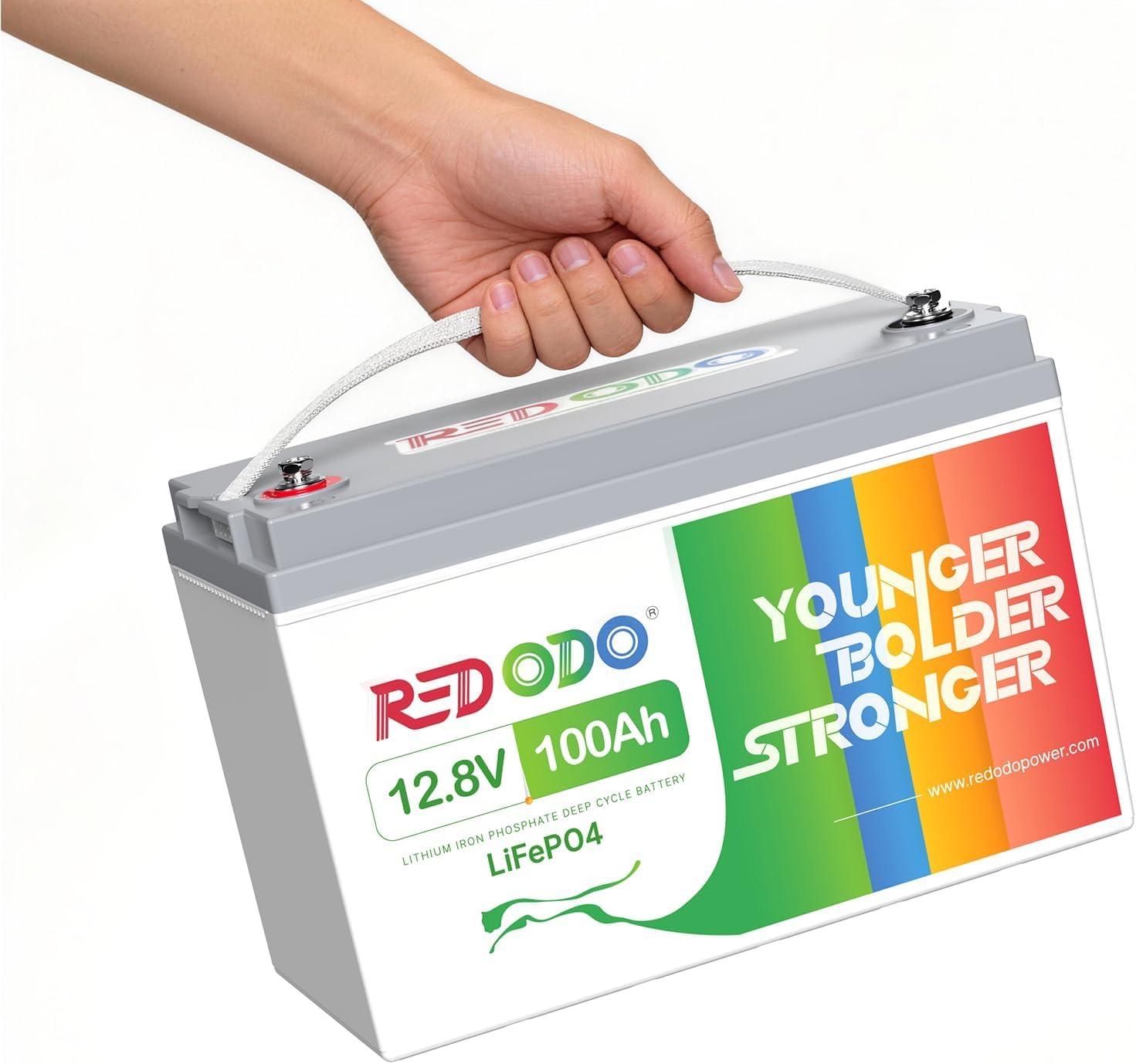
Redodo’s 12V 100Ah LiFePO4 battery targets RVers who want lithium performance without paying Battle Born prices. Automotive-grade cells deliver 4,000 cycles at 100% depth-of-discharge (6,000 at 80%, 15,000 at 60%) with a 10-year expected lifespan — competitive with lithium options costing significantly more. At 22 pounds and a standard Group 31 footprint (13 x 6.77 x 8.43 inches), it’s 60% lighter and 5% smaller than a lead-acid equivalent, freeing up payload and compartment space.
The 100A BMS covers the standard protection suite and handles 30–70lb trolling motors without issue. Users report three years of continuous use in motorhome setups with no degradation, and the battery charges via solar, alternator, or LiFePO4 charger at up to 50A. One owner uses four units in parallel to power a full off-grid home setup including routers, WiFi, desktop computers, fish tank equipment, and a freezer 24/7 — dropping only to 80% SOC overnight.
The battery is not suited for engine starting or golf cart applications — it’s a deep-cycle design optimized for sustained discharge over hours, not high-cranking amps. Some users noted that Renogy’s MPPT charge controllers required manual voltage parameter configuration to work properly with the Redodo BMS, but Redodo’s customer support provided detailed guidance. If you’re migrating from AGM to lithium and want a reliable mid-range option with proven longevity, the Redodo checks the essential boxes.
Why it’s great
- 4000 cycles at 100% DOD — strong cycle life for the price tier
- Three years of documented real-world use with no capacity fade reported
- 60% lighter than equivalent lead-acid for easy installation
Good to know
- Not designed for engine starting or high-cranking applications
- Some MPPT charge controllers need manual parameter adjustment for lithium
7. Litime 12V 100Ah LiFePO4 Battery (Group 31)

Litime’s 12V 100Ah trolling motor battery is ABYC E-13 certified, meaning it meets the American Boat and Yacht Council’s standards for electrical systems on marine vessels — a step above general-purpose lithium batteries in terms of salt-spray resistance, vibration tolerance, and safety testing. The built-in TVS (transient voltage suppression) diode protects 12V–36V trolling motors from voltage spikes, a feature unique to this model that prevents speed controller damage on rough water.
Real-world performance from owners is exceptional: one user ran a 45lb thrust trolling motor for eight hours on a 16-foot jonboat with three adults aboard in an 8-mph headwind, and the battery still showed near-full charge upon return. Another user replaced lead-acid with four Litime units in parallel for a trailer refrigerator setup, achieving six days of runtime before the BMS auto-shutdown. The Bluetooth app provides real-time monitoring of voltage, current, and cycle count, and the 22.1-pound weight improves boat handling noticeably.
The battery ships in a low-voltage “sleep” mode and may require a force charge with a standard lead-acid charger to wake the BMS — Litime’s customer service proactively contacts buyers about this, which is a welcome touch. The only other note is the flat discharge curve typical of LiFePO4: a resting voltage of 12.8V doesn’t mean 100% charge — it can mean near-depletion, so use the Bluetooth app or an external shunt monitor to track actual SOC. The 5-year warranty and aggressive pricing make this the best value for boaters who need marine-specific certification.
Why it’s great
- ABYC E-13 certified for marine safety and salt-spray resistance
- TVS diode protects trolling motor electronics from voltage spikes
- Light enough (22.1 lbs) to improve boat speed and handling
Good to know
- Ship in sleep mode — requires initial low-current charge to wake BMS
- Flat voltage curve makes SOC estimation without Bluetooth inaccurate
8. WEIZE 12V 100Ah Deep Cycle Battery

The WEIZE 12V 100Ah AGM battery is the best entry-level option for RVers who aren’t ready to switch to lithium — or who need a maintenance-free backup solution without investing in a new charger profile. The absorbed glass mat construction is spill-proof and can be mounted in any orientation, making it a safe drop-in for existing lead-acid wiring without venting concerns. At 63 pounds, it’s heavy, but it fits standard Group 31 trays and accepts common charging voltages (13.8V float, 14.4V cyclic) from most RV converters.
Owners report two years of reliable off-grid RV use with two 100Ah units in parallel — paired with 300W of solar panels and a 700W inverter, the system powers lights, a water pump, and small appliances without issue. The 3% self-discharge rate means the battery holds usable charge through months of storage without a trickle charger, and the sealed design eliminates the acid-level checks required by flooded batteries. For occasional-use campers or those with simple power needs (fridge, furnace fan, a few LED lights), the WEIZE delivers dependable runtime.
The critical limitation of any AGM is usable capacity: you should only discharge to 50% depth-of-discharge to maintain cycle life, meaning your 100Ah AGM effectively provides 50Ah — roughly half what a 100Ah lithium battery delivers. For budget-minded buyers who understand this trade-off, the WEIZE is the best AGM pick in this roundup.
Why it’s great
- Maintenance-free AGM design — no water checks or acid spills
- Fits standard Group 31 trays with common charging voltages
- Excellent value for occasional-use RV setups with simple power needs
Good to know
- Only 50Ah usable capacity (50% DOD for cycle life) — half of rated spec
- 63 lbs — nearly three times heavier than equivalent lithium battery
9. Newport 12V 50Ah Deep Cycle Marine Battery (AGM)
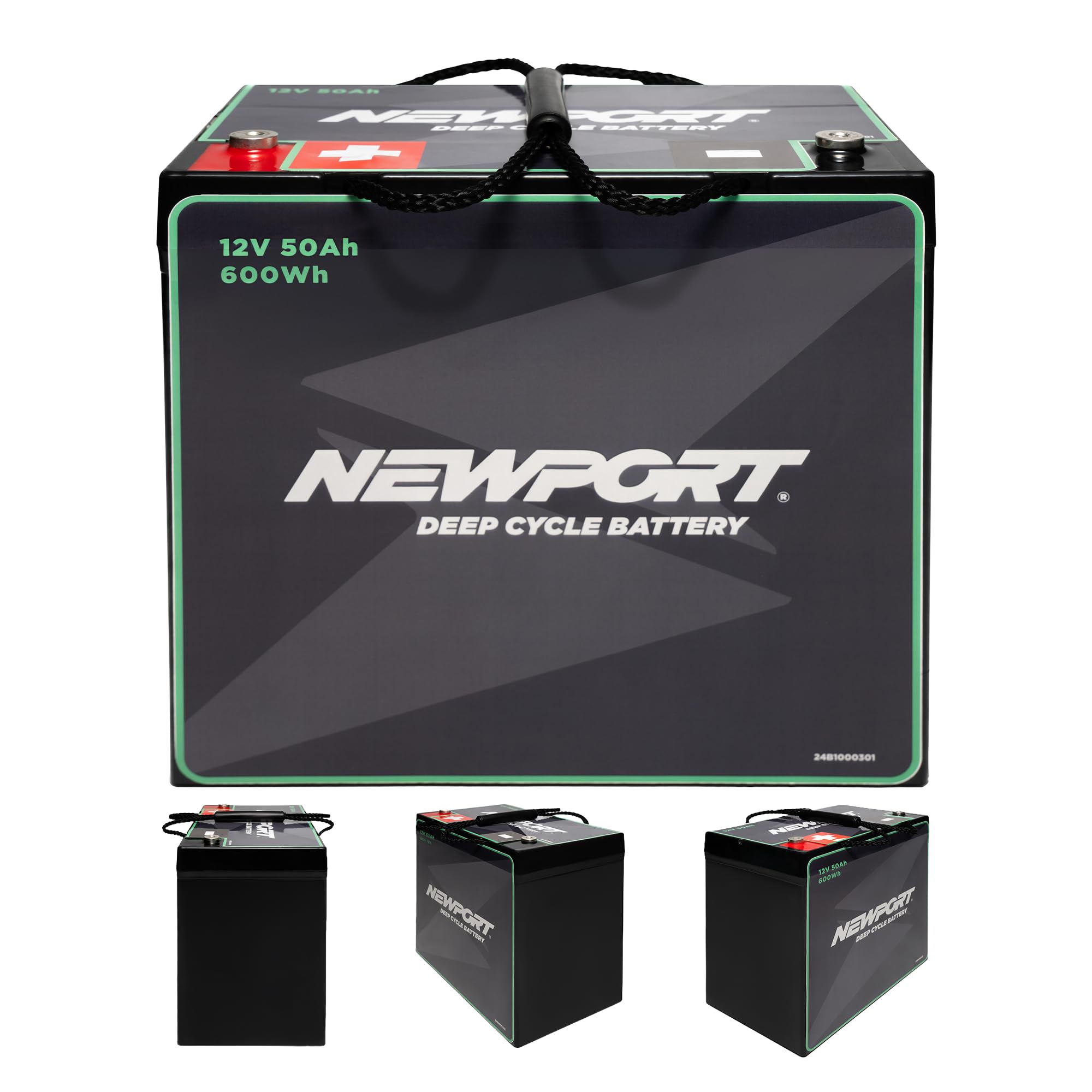
The Newport 12V 50Ah AGM battery is a lightweight, budget-friendly option for RVers with minimal power demands — or for use as a dedicated starting battery separate from the house bank. At 32 pounds, it’s one of the lightest sealed lead-acid batteries at this capacity, making it easy to install and transport. The marine terminals accept standard ring terminals, and the sealed AGM construction means zero maintenance: no water refilling, no acid spill risk, and no venting requirements for indoor compartments.
Owner reports confirm it handles trolling motor duty well: one user ran a 55lb thrust motor at moderate speeds for four hours with stable voltage output, and another kayak fisherman reported roughly seven hours on a 25lb motor at full speed. One review notably highlights the battery’s physical resilience — it survived a 20 mph tumble out of a truck bed onto asphalt with only cosmetic damage and no functional issues. For a small RV or camper van that only powers LED lights, a water pump, and USB charging overnight, the 50Ah rating (25Ah usable with AGM’s 50% DOD rule) is adequate.
The core limitation is capacity: 50Ah AGM provides roughly 25Ah of usable energy, which translates to about two nights of minimal RV loads. If you run a compressor fridge or use an inverter for device charging, you’ll deplete this battery quickly. The 1-year limited warranty is shorter than the competition. This is a niche fit for campers with ultralight setups or as a secondary battery for specific duty cycles — not a primary house battery for extended off-grid stays.
Why it’s great
- Lightweight 32 lb AGM — easy to carry and install solo
- Remarkably durable construction — survived high-impact drop test
- Sealed, maintenance-free design with marine terminals
Good to know
- Only 25Ah usable capacity (50% DOD) — not enough for extended off-grid use
- 1-year warranty is shorter than most competitors in this class
FAQ
Can I replace my RV’s lead-acid battery with LiFePO4 without changing my charger?
Why does a 100Ah AGM battery seem to run out of power faster than expected?
How many 12V RV batteries do I need for my camper?
Do I need to vent a LiFePO4 battery inside my RV?
What is the real-world lifespan of a 12V LiFePO4 RV battery?
Final Thoughts: The Verdict
For most users, the 12v rv battery winner is the HumsiENK 12V 100Ah LiFePO4 because it combines Grade A+ cells, IP67 waterproofing, Bluetooth monitoring, and a 15,000-cycle lifespan at a price that undercuts most premium competitors by hundreds. If you want marine-specific certification and TVS motor protection, grab the Litime 12V 100Ah LiFePO4. And for high-capacity off-grid setups where a single battery replaces multiple units, nothing beats the ECO-WORTHY 12V 280Ah LiFePO4 with its metal case and 200A BMS.