
Golf carts are no longer just for the fairway — they are workhorses on sprawling estates, farms, gated communities, and resort properties. The brutal summer sun turns that canvas roof into a greenhouse, making a reliable AC unit not a luxury but a necessity for comfort and safety.
I’m Min — the co-founder and writer behind Gadgets Feed. My research process for this guide involved cross-referencing dozens of technical datasheets, reading hundreds of verified owner experiences, and analyzing the real-world performance of compressors, inverter boards, and BTU ratings in confined mobile spaces to find the quietest, most efficient, and battery-friendly cooling solutions.
Dropping a massive 13,500 BTU unit onto a golf cart’s roof without checking the power draw or installation profile is a common misstep. This guide breaks down the real specs that matter so you can confidently pick the best ac for golf cart.
How To Choose The Best AC For Golf Cart
Choosing a golf cart AC is different from picking one for a house or an RV. Your cart has a limited battery capacity, a shallow roof cavity, and a sensitive electrical system that hates massive inrush currents. Focus on these four factors to avoid a costly mismatch.
Battery Compatibility & Power Draw
The single most important spec is the AC unit’s operating voltage (12V, 24V, or 48V) and its continuous amp draw. A standard 120V rooftop unit requires an inverter, which wastes up to 15% of your battery’s energy. True DC-powered units connect directly to your golf cart’s battery bank and draw less than 50 amps, allowing you to run the AC for 4-6 hours on a standard 200Ah lithium pack. Always check the starting surge versus running watts — inverter units are far gentler on batteries than traditional rotary compressors.
Physical Size & Roof Profile
Golf cart roofs are typically 48 to 60 inches long and made of thin ABS plastic or aluminum. A heavy unit (over 80 pounds) can flex or crack the roof structure. Look for a low-profile unit under 10 inches tall to maintain clearance through garage doors and golf cart storage areas. The mounting base must match a standard 14×14 inch vent opening to avoid custom fabrication and roof leaks.
Noise Level (Decibels)
Golf carts have no sound insulation — a loud AC drowns out conversation and spooks wildlife or livestock. A noise rating below 50 decibels is whisper-quiet and barely noticeable. Units with dual fans and inverter compressors typically run in the 43-48 dB range, while older single-fan scroll compressors can hit 60 dB or more, which is as loud as a normal conversation in a quiet room.
Cooling Output vs. Power Efficiency
BTU (British Thermal Units) measures raw cooling capacity, but in a golf cart’s small cabin (roughly 30-50 cubic feet), even 8,000 BTU is often enough if the unit has a modern inverter compressor. Overbuying BTU output increases amp draw and shortens battery life without making the cabin colder — the cart is simply too small to absorb that much heat exchange. Focus on units with variable speed compressors that modulate power consumption rather than cycling on and off.
Quick Comparison
On smaller screens, swipe sideways to see the full table.
| Model | Category | Best For | Key Spec | Amazon |
|---|---|---|---|---|
| TOSOT 16000 BTU | Premium | Largest Cooling Output | 43 dB / 16,000 BTU / Heat Pump | Amazon |
| FOGATTI 16K BTU | Premium | Smart Features & Build Quality | 43 dB / Dual-Sync Motor / 418 CFM | Amazon |
| RecPro 15K BTU | Premium | Ducted/Non-Ducted Flexibility | 55.4 dB / 15,000 BTU / Heat Pump | Amazon |
| Coleman-Mach 48204-066 | Premium | Brute-Force Reliability | 15,000 BTU / 105 lbs / 120V | Amazon |
| Coleman-Mach 08-0080 | Premium | Upper Unit Upgrade | 15,000 BTU / Lower Profile Shroud | Amazon |
| Airxcel 08-0079 Mach 3 Plus | Mid-Range | Proven Replacement | 13,500 BTU / 320 CFM / 115V | Amazon |
| Furrion Chill HE | Mid-Range | Dual-Fan Efficiency | 13,500 BTU / 50% Quieter / 2 Fans | Amazon |
| Countrymod 10000 BTU | Mid-Range | Best Battery Life | 44 dB Sleep / 300-900W / Inverter | Amazon |
| Outequip 10000 BTU | Mid-Range | Light-Weight Off-Grid | 43 lbs / 6″ Tall / 40 dB / 12V DC | Amazon |
| Treeligo 11000 BTU | Budget-Friendly | Lowest Entry Price | 11,000 BTU / 45 dB / 330-1000W | Amazon |
| Alphard Cybercart | Other | Motorized Golf Caddy | 36-Hole Battery / Remote Control | Amazon |
In‑Depth Reviews
1. TOSOT 16000 BTU RV Air Conditioner

The TOSOT dominates the list with a 16,000 BTU output while maintaining a whisper-quiet 43 dB profile — a feat that hides a sophisticated scroll compressor and dual-fan design. Owners report that this single unit cools a 40-foot fifth wheel without needing a second AC, which means a golf cart cabin would hit arctic temps in minutes. The Gree+ app integration lets you pre-cool the cart before you even walk to the garage, and the non-ducted design drops right into a standard 14.25-inch roof opening.
Its 12,500 BTU heat pump is a genuine differentiator for spring and fall camping, eliminating the need for a separate furnace for mild mornings. The unit ships in two separate boxes (rooftop plus interior ceiling assembly), so confirming both packages arrive before installation is a practical step owners strongly recommend. With a 2-year warranty and ETL certification, it packs safety and performance into a package that heavy users will appreciate.
The 43 dB rating is accurate — owners describe it as barely audible over ambient conversation, which is critical for a golf cart with thin walls. On a 15-amp breaker it runs comfortably, but ensure your cart’s wiring can handle startup current. The included hardware and clear guide simplify a DIY install, though a helper is recommended due to its weight on the roof.
Why it’s great
- Massive 16,000 BTU cooling with heat pump for four-season use
- Smarter than average: WiFi app, remote, and timer from anywhere
- Truly whisper-quiet operation at 43 dB
Good to know
- Shipped in two packages — track both before starting install
- Heavy unit requires at least two people for roof lifting
2. FOGATTI 16K BTU RV Air Conditioner
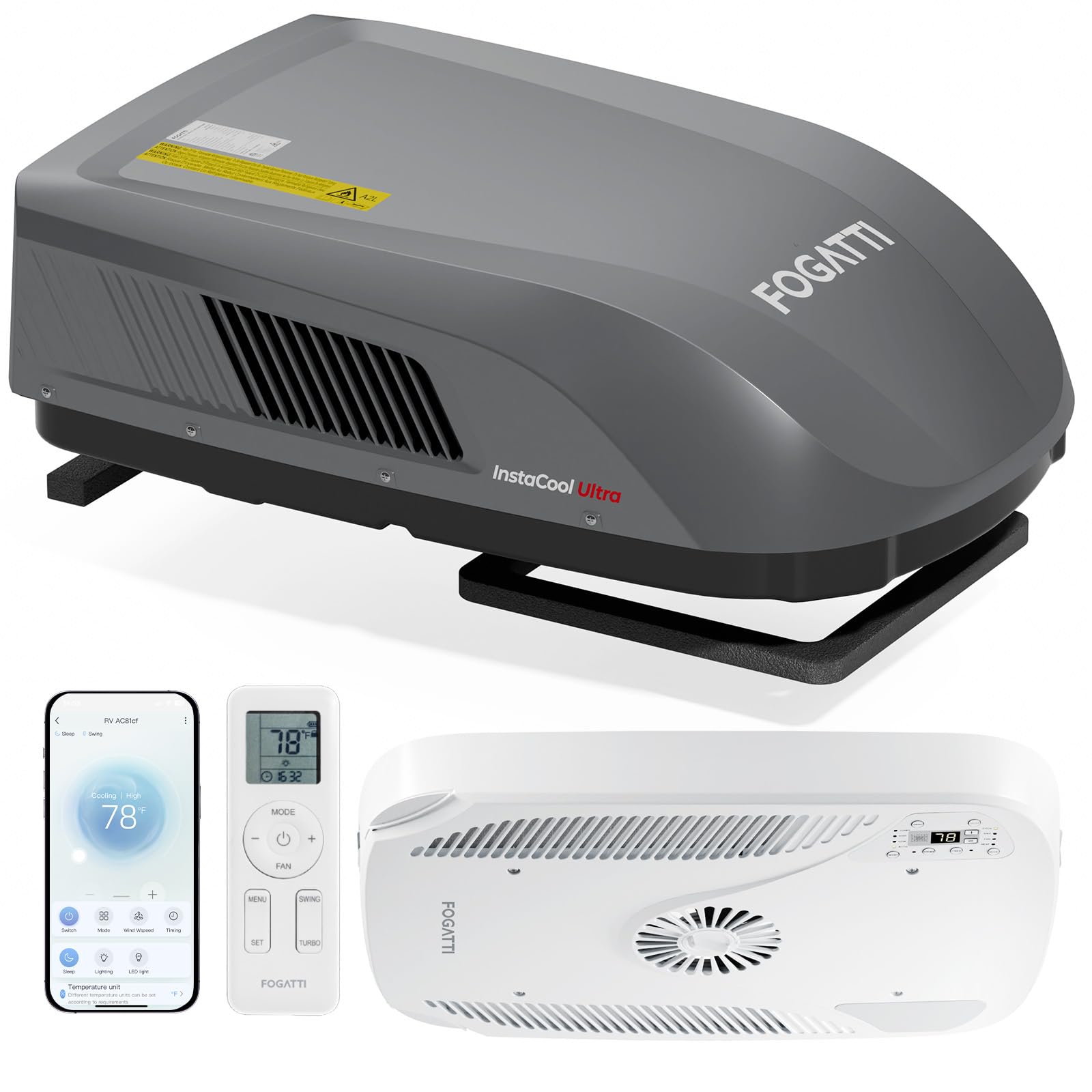
FOGATTI’s engineering team clearly prioritized noise reduction and air distribution. The dual-sync motor drives a triple-fan system that pushes 418 CFM — cooling a 36-foot RV in roughly 4 minutes according to field reports. For a golf cart, this airflow translates to immediate relief from heat soak. The 12.2-inch low-profile shroud clears most standard garage openings, eliminating one of the top clearance issues with rooftop units.
The shock-absorbing dual-layer base and foam insulation protect the compressor from rough cart paths, a common failure point for non-RV rated units. Owners note that the motorized louver fins oscillate 0-85 degrees, providing directional comfort without draught. The remote, ADB touchscreen, and WiFi app give three independent control pathways, and the 43 dB noise floor means it barely registers above conversation level inside a cart.
Installation is non-ducted and straightforward, though the interior ceiling unit’s screw alignment can be fussy — owners suggest having longer machine screws on hand. The heat/cool capability extends your cart’s usability year-round. At an EER of 11.8, it is efficient enough to run off a modest 15-amp circuit, making it viable for battery-operated carts with proper wiring.
Why it’s great
- Exceptional 418 CFM airflow cools huge spaces in minutes
- Low-profile design avoids garage roof clearance issues
- Triple control methods: remote, touch, and WiFi app
Good to know
- Interior air handler screw holes may need longer fasteners
- Not compatible with wall-mounted thermostats
3. RecPro RV Air Conditioner 15K BTU

RecPro’s 15K BTU unit hits a sweet spot with a heat pump that delivers supplemental warmth without needing a furnace. The 55.4 dB noise rating — described by one owner as “soft as gentle rain” — is louder than the premium entries but still quieter than traditional RV units. The critical advantage here is versatility: it ships ready for both ducted and non-ducted installations, so you can match it to your golf cart’s existing ductwork or run it raw.
Build quality stands out with sleeved refrigerant pipes that prevent vibration wear, an issue that shortens the life of many budget ACs. Owners upgrading from Dometic units consistently report better build, quieter operation, and stronger airflow. The remote and LED touch controls eliminate thermostat wiring, which cleans up the interior of a cramped cart. The UV-resistant plastic and aerodynamic shape reduce drag, preserving your cart’s range on longer drives.
The 2.6 EER is respectable but not class-leading — expect a continuous fan noise that some owners mention as a minor annoyance on heat pump mode. Installation takes around 2 hours for a DIY owner, and the unit weighs 80 pounds. For a golf cart, the ducted configuration might be overkill, but the non-ducted setup works perfectly with a standard roof opening.
Why it’s great
- Flexible installation — ducted or non-ducted in one unit
- Sleeved pipes reduce vibration wear for longer life
- Remote and touch controls, no thermostat wiring required
Good to know
- Continuous fan operation in heat pump mode may be noticeable
- Minor plastic shell cracking reported after prolonged sun exposure
4. Countrymod 10000 BTU 12V DC RV Air Conditioner
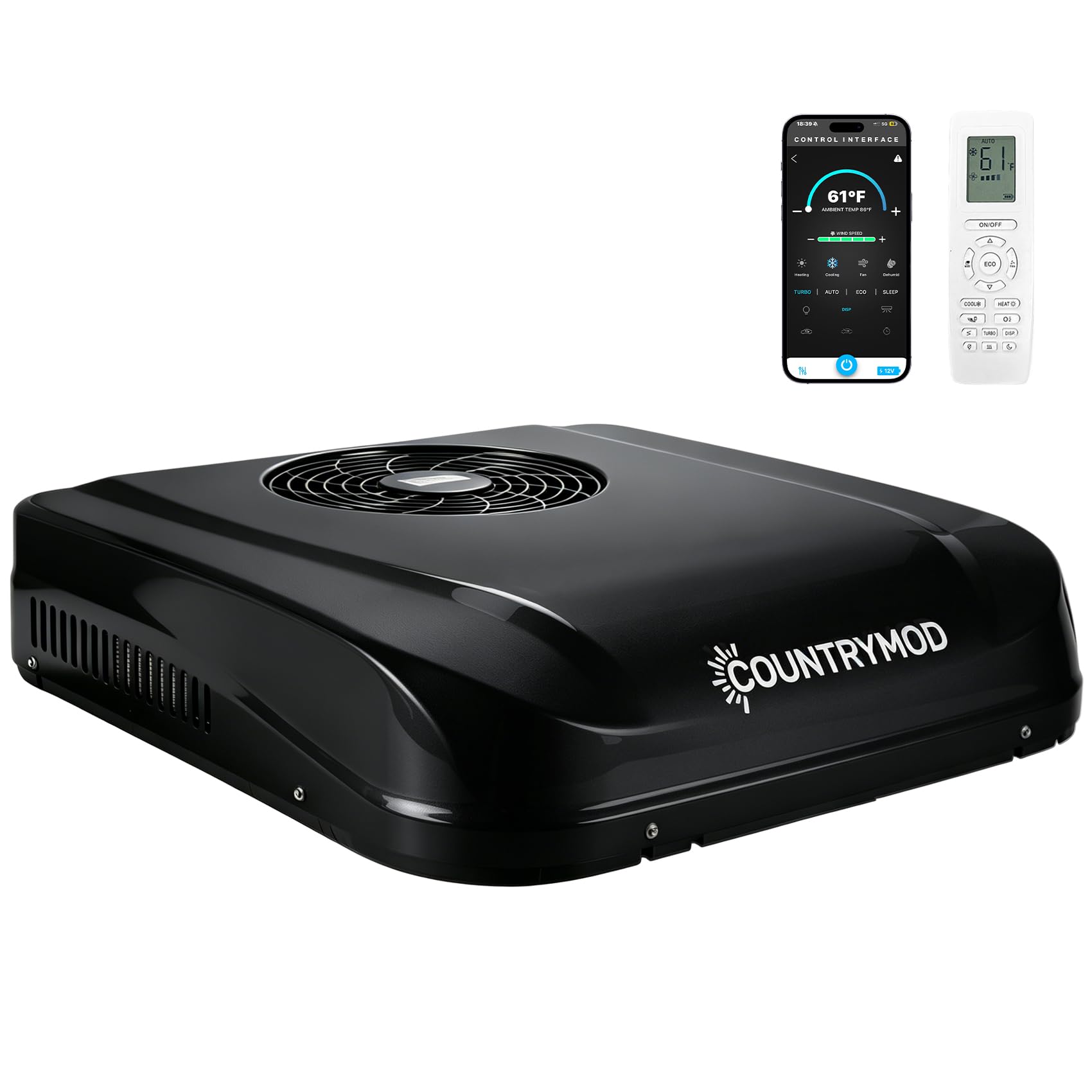
The Countrymod unit is purpose-built for battery-dominant setups. Its variable-frequency inverter compressor draws between 300 and 900 watts — versus the 1,500-watt spike of a standard unit — which translates directly to longer runtime on a fixed battery bank. With a sleep mode at 44 dB, it is barely audible, and owners report 10-hour nights on a 480Ah lithium bank. This is the unit to beat for off-grid golf cart owners who want to keep their seat cooler without draining the pack after 18 holes.
The 10,000 BTU output is conservative but sufficient for a golf cart’s tiny cabin. Owners note that it cools faster than a larger 15K BTU household unit because the inverter technology lets the compressor run at high speed initially and then taper off. The 14×14-inch roof opening fit is universal, and the ductless design skips the complexity of routing air hoses. App and remote controls add convenience, and the spring-loaded vibration mounts isolate the compressor from the roof deck.
One practical weak point: the corner brackets are plastic and can crack at 4.5 ft-lbs of torque, and the included bolts are too short for thicker roofs. Owners recommend replacing these with 8mm x 160mm metric all-thread and using longer duct extension for deep roofs. The instructions are poor, but YouTube fills the gap. For a DIY owner willing to adapt, this unit delivers the best power-to-cooling ratio on the list.
Why it’s great
- Rapid cooling with variable inverter compressor saves up to 60% energy
- 44 dB sleep mode for undisturbed overnight use
- 10-hour battery life on a 480Ah bank (verified by owners)
Good to know
- Plastic corner brackets may crack — use metal replacements
- Poor manual; YouTube install guides recommended
5. Outequip 10000 BTU 12V RV Air Conditioner
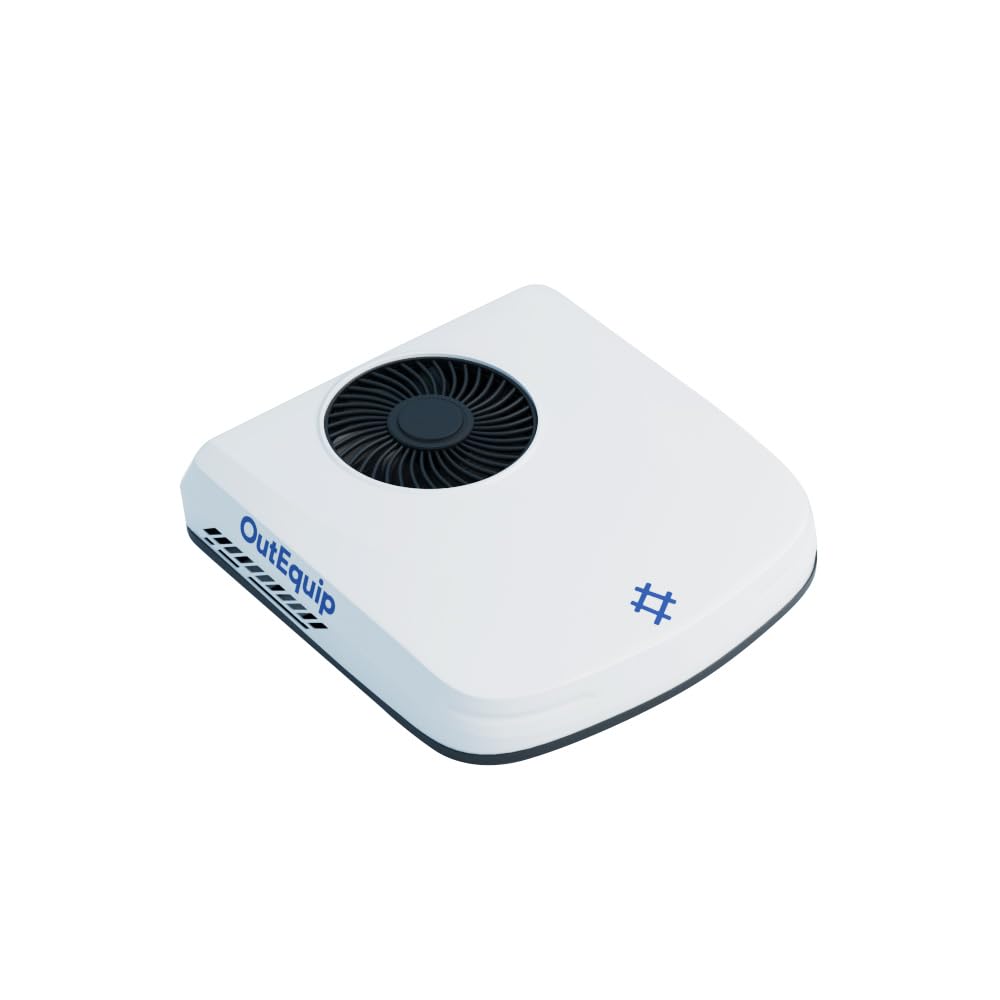
Weighing just 43 pounds and standing only 6 inches tall, the Outequip unit redefines the weight-to-cooling ratio. The 10,000 BTU inverter compressor and 4,500 BTU PTC heater split the difference between a full AC and a spot cooler. The brushless copper motor fans keep noise at 40 dB — the quietest on this list — and the spring-mounted supports and directional duct isolate vibration effectively. This is the unit for cart owners who are starting from a blank roof and want the lightest possible install.
The eco mode is a standout for off-grid use, drawing only about 200-300 watts while maintaining comfortable temperatures. Owners pairing this with a 600Ah LiFePO4 battery bank and 2,200W solar array report running the AC all night without breaking 50% depth of discharge. The unit fits both standard 14×14 and 14×9 inch roof openings, and the wiring can be routed through the return duct to avoid drilling extra holes in the roof. Customer support is responsive, with the manufacturer swapping a 12V unit for a 24V version after an owner’s install mistake.
The trade-off is that the PTC heater is only supplementary — not a primary heat source in extreme cold. Additionally, the lid screws can be brittle and strip easily, and the wiring connectors are fragile. Owners recommend having spare connectors and using a gentle hand during assembly. Once installed, the combination of low weight, minimal height, and silent operation makes it a near-perfect match for a golf cart roof.
Why it’s great
- Lightest unit at 43 lbs — gentle on thin cart roofs
- Ultra low-profile 6-inch height clears overhead obstacles
- Excellent 40 dB noise rating, barely perceptible at idle
Good to know
- PTC heater is supplementary only, not for freezing conditions
- Brittle screws and fragile connectors require careful install
6. Airxcel 08-0079 Mach 3 Plus 13.5K BTU

The Mach 3 Plus is the industry baseline — a 13,500 BTU rooftop unit that has been cooling RVs and cart toppers for decades. At 320 CFM with a 115V rotary scroll compressor, it delivers dependable cooling on 100-degree humid days, proven across thousands of installations. The 13.1 cooling amps are high but predictable, requiring a dedicated 20-amp circuit and a solid AC-to-DC inverter for battery-powered carts. Owners call it “plug and play” if your roof already has the wiring and opening from a previous unit.
Installation is straightforward with YouTube guidance (the included manual is notoriously incomplete with upside-down pages). The unit weighs around 75 pounds, so two people are needed for roof placement. A common upgrade path is swapping out an older Mach 3 — the footprint and wiring harnesses are identical, making it a simple afternoon project. The electric heat element is rated at 5,600 BTU, though it is sold separately, so verify whether you are buying just the upper unit or a complete set.
The main downsides are noise — it is louder than inverter units at roughly 58-62 dB — and the oil leak potential from the older rotary compressor design. Owners also report arrival damage (detached plates, bent condenser fins) from shipping, which is a risk with heavy rooftop units. Check the shroud and intake fins immediately upon delivery. Despite the rough edges, its legion of satisfied users and massive install base make it a safe bet for custom cart builds where raw cooling is the priority.
Why it’s great
- Proven 13,500 BTU performance on extreme heat days
- Direct swap for older Coleman-Mach units
- Widely available and well-documented for DIY install
Good to know
- No heat element included, sold separately
- Shipping damage risk — inspect full unit upon receipt
7. Furrion Chill HE 13.5K BTU RV Roof Air Conditioner

Furrion addresses the top complaint against traditional ACs — noise — with a dual-fan system that moves cool air 50% faster while cutting sound levels significantly. The 13,500 BTU output rivals the Mach 3, but the Chill HE uses a scroll compressor that reduces vibration through the roof deck. Its aerodynamic, lightweight shroud reduces drag on the move, which matters for golf carts used for transport across large properties. The Aerodynamic mid-profile design is noticeably lower than older units.
Owners replacing Dometic units consistently report better cooling and lower cabin noise. The vibrationSmart and ClimateSmart technologies protect the internals from road shock and thermal cycling, which are amplified on a golf cart’s rigid suspension. The foam seal and thermal-insulated shroud prevent condensation ingress, a common cause of electronic failure in cart roofs. A conversion kit bridges the wiring gap when swapping from a Dometic base.
The critical frustration is that the sales page advertises features (remote, thermostat, ADB controller) that are not included — they require separate purchases. The unit ships as a bare rooftop assembly with no controls, bolts, or installation kit. Some owners report that the older R-410A refrigerant is used, which makes finding a compatible controller difficult. This unit is an excellent choice if you already have compatible controls from a previous Furrion install or are building a custom control system.
Why it’s great
- Dual-fan design reduces noise and moves air faster
- Lighter and more aerodynamic than single-fan units
- Vibration- and climate-proof internals for rough terrain
Good to know
- Controls, thermostat, and install kit sold separately
- Uses R-410A refrigerant — controller compatibility must be verified
8. Coleman-Mach 48204-066 Mach 15 Plus 15,000 BTU

At 105 pounds and shipping on a wood skid, this is a heavy-duty unit designed for large RVs — but for a golf cart, its raw cooling power turns a roof into an instant ice box. The medium profile is taller than low-pro units, so measure your garage clearance carefully. The 1/3 HP fan motor moves serious air volume, and the direct plug-and-play wiring makes replacement seamless if your cart had a previous Coleman unit.
Owners unanimously report that this single AC keeps a 33-foot Class A RV frigid in Florida summers. For a golf cart cabin, that translates to overcooling potential, but the thermostat can be set to a comfortable level. The unit includes a pre-installed foam seal that blocks water leaks without extra caulking. Installation is a weekend job for two people: bolt extraction, reconnection of hot/neutral/ground wires, and reinstallation of the interior ceiling panel. The included wood skid doubles as a stable lifting platform.
The major consideration for a golf cart is the 120V requirement — you need a pure sine wave inverter and a battery bank capable of handling the starting surge. The 13.1A running draw is manageable on a 200Ah system for short trips, but continuous use will drain quickly. This unit is best for carts that are primarily plugged into a shore power outlet when parked, or for cart owners with high-capacity lithium banks and solar arrays.
Why it’s great
- Unmatched 15,000 BTU raw cooling for the hottest climates
- Easy plug-and-play wiring for existing Coleman-Mach setups
- Pre-installed foam seal prevents roof leaks
Good to know
- Very heavy (105 lbs) — needs two strong people for installation
- Requires a 120V inverter and large battery bank for off-grid use
9. Coleman-Mach 08-0080 Mach 15 Upper Unit

This is the upper unit only for the Coleman-Mach 48204 series, designed as a replacement for owners who already have a compatible lower control panel and frame. The Mach 15’s two-piece shroud is easier to handle than older one-piece designs, and the overall profile is several inches shorter than the 48204 series, saving precious headroom. It delivers the same 15,000 BTU cooling as its bigger brother but weighs less at around 80 pounds, still requiring a helper.
Owners upgrading from the Mach 3 13.5K BTU unit report a major improvement in Florida summers with a 15-20 degree delta in air temperature. The scroll compressor runs smoother than the older rotary designs, with fewer vibrations transmitted to the roof panel. The 115V wiring is prewired for a 20-amp circuit, making electrical integration straightforward. It fits a standard 14×14 inch roof vent opening without modification, which is a strong advantage for carts with existing cutouts.
The biggest catch is that this is strictly an upper unit — no bolts, no frame, no gasket, and no interior control panel. Owners must purchase these separately if they are doing a new install rather than a replacement. The lack of included hardware is clearly stated but still catches many buyers off guard. For a golf cart builder starting from scratch, this adds -100 to the total cost and requires sourcing parts. If you already have a compatible lower assembly, it is a cost-effective way to upgrade to 15,000 BTU.
Why it’s great
- Powerful 15,000 BTU cooling in a slightly slimmer package
- Scroll compressor runs smoother and quieter than older designs
- Direct fit for standard 14×14 inch roof openings
Good to know
- Upper unit only — frame, bolts, and internal controls sold separately
- Not a drop-in solution for all cart builds; verify lower assembly
10. Treeligo 11000 BTU 12V DC Rooftop RV Air Conditioner
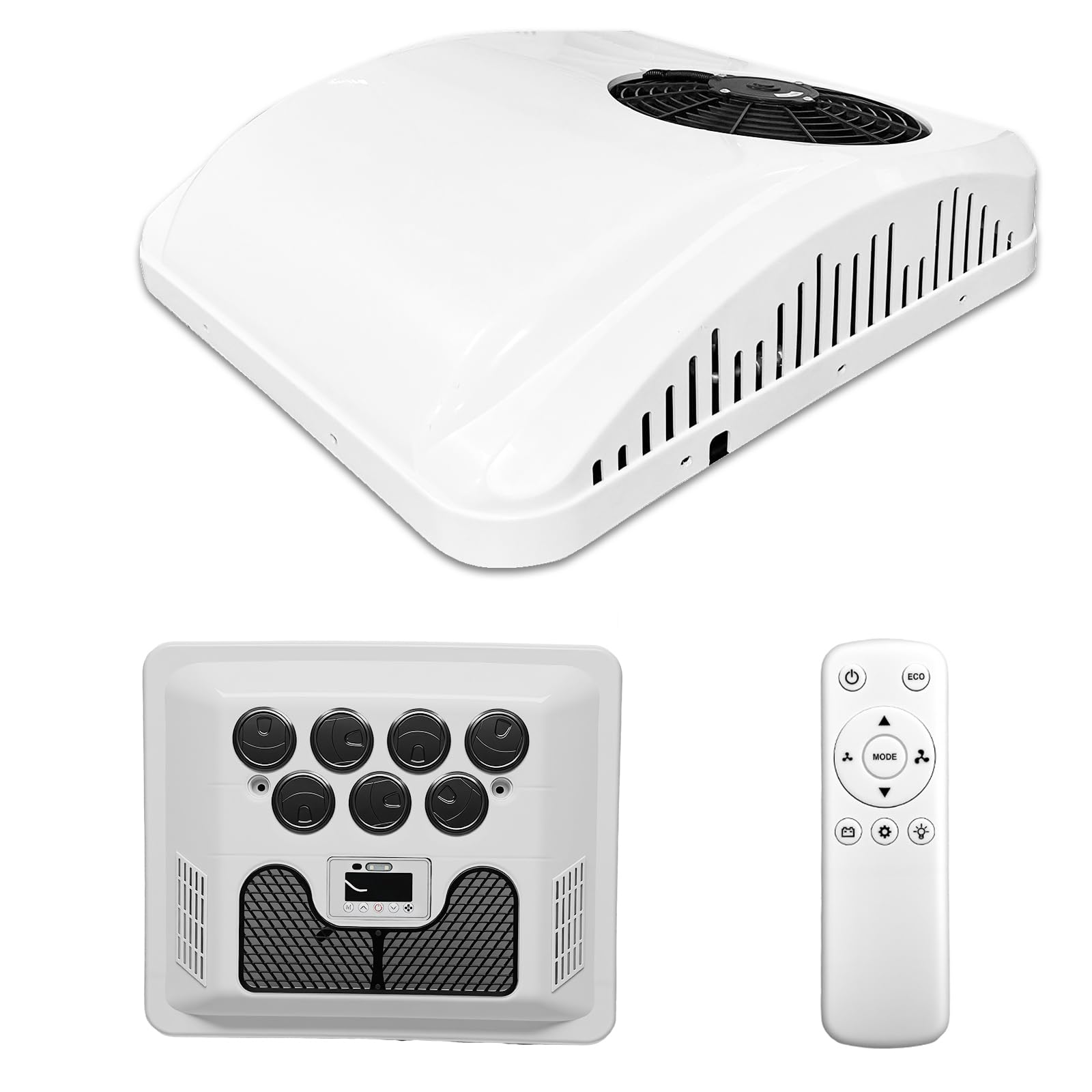
The Treeligo 11,000 BTU unit is the most budget-friendly entry point into battery-powered rooftop AC. It runs directly off a 12V battery bank (300Ah recommended) without an inverter, drawing 330W to 1000W depending on mode. The 45 dB noise rating keeps it below distracting levels, and the included heater function extends its utility to cool nights. Owners report that it cools a fifth wheel bedroom quickly in 100-degree heat, which means a golf cart cabin will reach comfortable temperatures fast.
The 12V DC design eliminates the 10-15% efficiency loss from inverter conversion, making this a strong candidate for solar-charged carts. The 11,000 BTU rating is the highest among true DC units on this list. The installation requires a minimum 12.6 x 10.24 inch roof opening and the lightweight rooftop unit saves roof stress. The remote control with digital display lets you set and monitor temperature easily. The FCC and UL compliance certifies electromagnetic safety, preventing interference with your cart’s radio or navigation.
The downside is inconsistent customer support — some owners report no response after the unit develops faults. The controller is locked to specific mode codes, and if the software glitches, the unit may not respond to temp selection. Additionally, the 6-gauge cables that ship may be too small for longer battery runs, requiring an upgrade to 4-gauge wire for peak performance. For the price, it is a high-risk, high-reward entry that works brilliantly when it works, but buyers should be prepared for a hands-on debugging process.
Why it’s great
- True 12V DC operation — no inverter needed, lower power loss
- Highest BTU rating among DC units at 11,000 BTU
- Includes a heater for cool weather and a digital remote
Good to know
- Unresponsive customer support reported in some cases
- May need 4-gauge power cable upgrade for longer runs
11. Alphard Cybercart Electric Golf Caddy
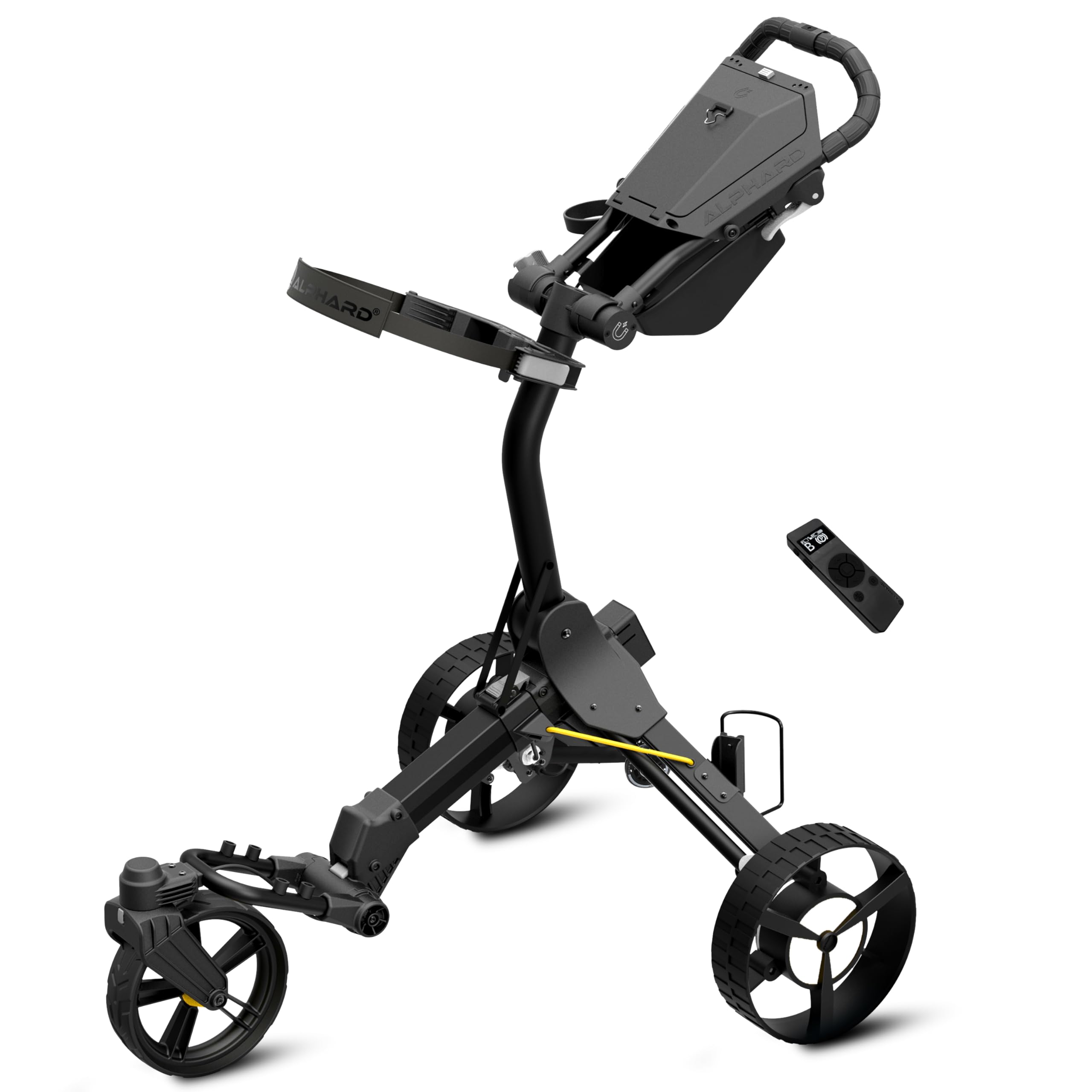
The Alphard Cybercart is not an AC unit — it is a fully motorized, remote-controlled golf push cart that could serve as a platform for carrying a portable AC unit. Its 36-hole lithium battery lasts two full rounds, and the 360-degree swivel front wheel makes it nimble on tight fairways. The 6-axis gyroscope keeps it tracking straight on slopes, and the downhill speed control prevents runaway on steep hills. For a golfer who carries their own cooler and wants battery-powered assistance, this is a high-end caddy that handles the heavy lifting.
The LCD remote has an out-of-range auto-stop, plus a mobile app for backup control and a USB-C charging port. The one-click folding system shrinks it to roughly the size of a standard push cart for trunk storage. The package includes an umbrella holder, cup holder, scorecard holder, sand bottle holder, a magnetic landing pad, and an extra-large storage bag. The automatic parking brake secures the cart when you stop to putt. It is designed and assembled in the US, which supports local manufacturing.
The noise floor on this unit is a high-pitched DC motor whine that some users find annoying — the motor brake creates a constant tone that may bother sensitive ears. The turning can be jerky, and the gyro tracking sometimes fights the user on uneven terrain. The accessory attachments (particularly the umbrella holder) feel flimsy for the price point. This cart is a strong alternative to the MGI line but at a higher price point that some may find harder to justify. It is a cool companion, not a cart AC — but for the golfer who already has everything, it makes the experience effortless.
Why it’s great
- Long 36-hole battery life from a single charge
- Remote control follow system with out-of-range safety stop
- Six-axis gyro for hill stability and downhill speed control
Good to know
- Constant DC motor whine may annoy sensitive ears
- Accessories like the umbrella holder are not robust
FAQ
Can I install an AC on a standard 48V golf cart battery system?
How long will a 200Ah lithium battery run a 10,000 BTU AC?
Will a standard RV rooftop AC fit on my golf cart roof?
What is the difference between a ducted and a non-ducted AC for a golf cart?
Final Thoughts: The Verdict
For most users, the ac for golf cart winner is the TOSOT 16000 BTU because it offers the highest cooling capacity, a built-in heat pump, whisper-quiet 43 dB operation, and smart WiFi control — all while fitting a standard roof opening. If you want the best battery-friendly performance, grab the Countrymod 10000 BTU for its variable inverter compressor that sips power. And for the lightest, lowest-profile option that barely touches your roof’s weight limit, nothing beats the Outequip 10000 BTU at just 43 pounds.