
Finding a 15 mL centrifuge tube that seals tight under high g-force without cracking or warping is the difference between reproducible results and a contaminated mess on your rotor floor. The market is flooded with commodity polypropylene tubes that look identical on the shelf but vary wildly in cap thread tolerance, graduation accuracy, and sterile assurance. Choosing the wrong one wastes time, risks sample integrity, and can even damage your centrifuge rotor when a tube bursts at full speed.
I’m Min — the co-founder and writer behind Gadgets Feed. I’ve spent hundreds of hours cross-referencing material data sheets, customer field reports, and dimensional specifications across dozens of lab consumable lines to separate the tubes that actually hold up from those that fail under routine use.
Whether you’re pelleting nucleic acids, storing soil samples, or prepping media for cell culture, this guide to the best 15 ml centrifuge tubes will help you pick the tube that matches your exact spin conditions, sterility requirements, and budget constraints without guesswork.
How To Choose The Best 15 mL Centrifuge Tubes
Selecting the right 15 mL conical tube involves more than just picking the cheapest option. Your protocol’s spin speed, the chemical resistance required, and the sterility demands of your work all determine which tube will perform reliably without leaking or introducing contaminants.
Start with the RCF rating to match your rotor speed
The maximum relative centrifugal force (RCF) a tube can withstand is the single most critical spec. Budget-friendly tubes often cap out around 5,000–8,000 x g, while premium polypropylene tubes can handle 12,000 x g or higher. Running a tube near or above its rated RCF risks catastrophic failure that can destroy your rotor and set back your work by weeks. Always check the manufacturer’s listed RCF limit before spinning.
Leak-proof cap design separates reliable tubes from failures
Not all screw caps are equal. Some tubes use a two-piece cap with a separate polyethylene liner for a tighter seal, while others rely on an integrated ring molded into the polypropylene cap. Tubes with attached caps reduce the chance of cross-threading and cap loss during handling, but loose-cap designs allow easier replacement if a cap is damaged. The thread pitch and depth also affect how well the cap reseals after repeated opening.
Graduation accuracy and marking area affect workflow efficiency
Accurate printed graduations save time by eliminating the need to transfer liquid to a separate measuring cylinder. Look for tubes with ±2% accuracy and 1 mL or 0.5 mL increments that are silk-screened rather than embossed. A large white write-on spot that resists solvent smudging is essential for unambiguous sample identification, especially in multi-user labs.
Quick Comparison
On smaller screens, swipe sideways to see the full table.
| Model | Category | Best For | Key Spec | Amazon |
|---|---|---|---|---|
| Globe Scientific 6285 | Premium | High-throughput sterile labs | RCF 8,500 x g / 0.5 mL increments | Amazon |
| Celltreat 229411 | Premium | Mobile practices & bulk users | Gamma irradiated / resealable bag | Amazon |
| SimPure 15mL 100Pcs | Mid-Range | Biochemistry & molecular biology | RCF 9,400 x g / EO sterile / DNase/RNase free | Amazon |
| United Scientific D1003 | Mid-Range | General lab & soil test kits | RCF 13,000 x g / 0.5 mL intervals | Amazon |
| Kashi Scientific 15mL | Mid-Range | Mycology slants & education | RCF 12,000 x g / EO sterilized | Amazon |
| Sunliech 15mL 100Pack | Budget | Field collection & general storage | EO sterile / DNase/RNase free | Amazon |
| Konohan 200 Pack | Budget | Classrooms & high-volume storage | 200 count / polypropylene / screw cap | Amazon |
In‑Depth Reviews
1. Globe Scientific 6285
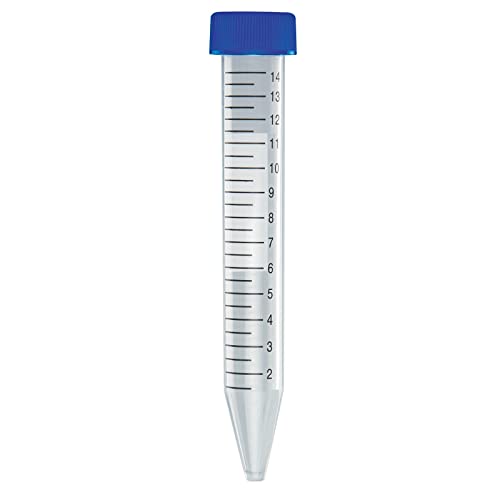
The Globe Scientific 6285 stands out because of its attached flat-top screw cap — a feature that eliminates the risk of losing or cross-threading caps during repetitive use. Rated for 8,500 x g, it comfortably handles routine pelleting and general-purpose spinning without the dimensional inconsistencies that sometimes plague cheaper bag-packed tubes. The black graduations are printed in 0.5 mL increments up to 14 mL, giving you finer resolution than typical 1 mL step markings.
This tube is supplied sterile and can be autoclaved separately from its cap, an important detail for labs that reuse tubes after cleaning. The 500-count bag pack (20 bags of 25) is ideal for medium-to-large labs that go through high volumes while wanting the convenience of resealable inner bags. The polypropylene construction gives it a temperature range from -20°C to +121°C, so you can freeze cell pellets and then thaw without tube degradation.
Some recent batches have reportedly shown plastic debris on the rim, though this appears to be a quality control variance rather than a design flaw. For most general lab applications requiring sterile, attached-cap tubes at a strong price-per-unit, this is the most reliable choice on the market today.
Why it’s great
- Pre-attached cap prevents cross-threading and cap loss
- 0.5 mL printed graduations for precise measurement
- Handles routine autoclaving and freezer storage
Good to know
- Quality control has varied in recent production batches
- Not rated for high-speed spins above 8,500 x g
2. Celltreat 229411

Celltreat’s 229411 is a solid premium option for labs that value packaging convenience and gamma irradiation over EO sterilization. Gamma irradiation penetrates the entire tube and cap uniformly, making it the preferred sterilization method for sensitive cell culture and molecular biology applications where residual ethylene oxide could interfere with assays. Each tube is packed in a resealable bag, a thoughtful touch for mobile practitioners or small labs that don’t finish an entire case in one session.
The clear polypropylene body has bold black graduations printed with ±2% accuracy, and a generously sized white marking area provides excellent contrast for handwritten labels. The HDPE snap-on cap seals reliably during standard centrifugation, and the smooth internal surface reduces sample retention after pouring. At 500 tubes per case, this is a workhorse bulk purchase for facilities that prioritize sterility assurance and organizational ease.
Volume accuracy has been questioned by some users who found the graduation line to be slightly off at the 15 mL mark, so for applications requiring volumetric precision, you may want to verify with a pipette before relying on the printed scale. For general pelleting, storage, and transport, this is a premium-tier tube with smart packaging that justifies its cost.
Why it’s great
- Gamma irradiated for superior sterility assurance
- Resealable bag packaging keeps unused tubes clean
- Excellent white marking area for sample IDs
Good to know
- Graduation accuracy may vary slightly at the 15 mL line
- HDPE cap may feel less robust than polypropylene caps
3. United Scientific D1003
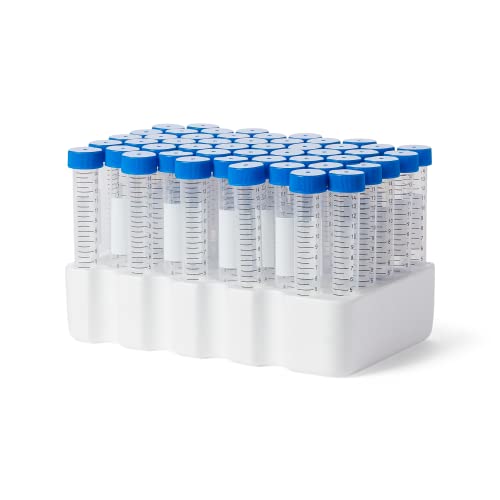
United Scientific’s D1003 punches above its mid-range price point by offering an impressive 13,000 x g maximum RCF, making it one of the few sterile 15 mL tubes that can handle aggressive pelleting protocols without failure. The black silk-screen graduations are printed in 0.5 mL intervals from 2 mL to 14 mL directly onto the polypropylene, and they resist solvent rubbing better than pad-printed markings. Each tube comes racked in a Styrofoam holder inside a sealed bag, which keeps the tubes organized and sterile until first use.
The blue HDPE screw cap provides a reliable seal, though some units arrived with loose caps during shipping due to the cap not being completely torqued at the factory. At 50 tubes per pack, this is an excellent option for small labs, field researchers, or anyone who needs a high-RCF tube without committing to a full case. The material also tolerates autoclaving at 121°C and freezing down to -45°C without cracking.
The 16.5 mm outer diameter and 117.8 mm height are standard dimensions that fit most common rotor adapters and tube racks. For labs that push their centrifuges to the limit, the D1003 delivers premium-level RCF performance at a very competitive per-tube cost.
Why it’s great
- Maximum RCF of 13,000 x g — highest in this lineup
- Silk-screen graduations resist solvent wear
- Racked and bagged for sterile, organized storage
Good to know
- Some caps arrive loose during shipping
- Only 50 tubes per pack — smaller quantity than bulk buyers may want
4. SimPure 15mL 100Pcs

SimPure’s 15 mL centrifuge tubes are designed with molecular biology workflows in mind: they are certified DNase/RNase-free, non-pyrogenic, and human DNA-free, making them suitable for PCR preparation, nucleic acid extraction, and cell culture media preparation. The EO sterilization is terminal, meaning the tubes are sterile when you open the bag, though they are not intended to be resterilized. The longer screw cap incorporates a sealing ring that provides an extra layer of leak protection during high-speed spins up to 9,400 x g.
The clear polypropylene body has black 1 mL graduated increments with ±2% accuracy, and the white write-on patch is large enough for a Sharpie to make legible labels. Users report excellent performance in field applications such as livestock diagnostics, plant propagation, and even dog sanctuary fecal testing — indicating the tubes handle both biological samples and long-term storage equally well. The 100-pack quantity is a sweet spot for small-to-medium labs that need a moderate supply without overstocking.
One limitation is that the tube cannot be re-sterilized after opening, so any unused tubes must be stored carefully in their original bag. For sterile, certified clean 15 mL tubes at a mid-range price point, SimPure delivers consistent quality that molecular biologists can trust.
Why it’s great
- DNase/RNase-free and non-pyrogenic certification
- Sealing ring on cap for enhanced leak resistance
- Versatile across cell culture, diagnostics, and field use
Good to know
- Cannot be autoclaved for re-sterilization
- RCF limit of 9,400 x g is moderate for high-speed protocols
5. Kashi Scientific 15mL
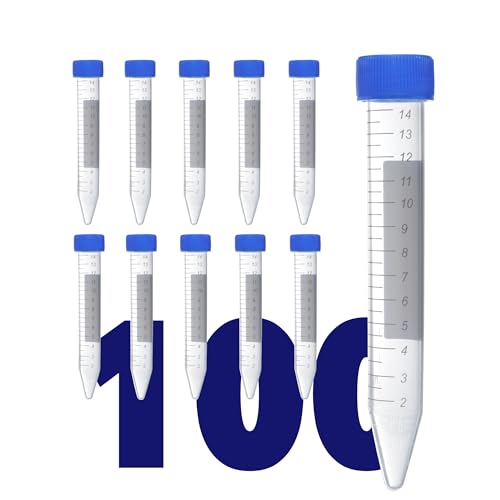
Kashi Scientific’s 15 mL tubes offer an excellent RCF rating of 12,000 x g at a price-point that competes directly with lower-rated budget options. The high-purity polypropylene is both autoclavable and freezable, and the blue polyethylene cap provides a secure, leak-proof seal during centrifugation. Users in mycology and microbiology have found these tubes ideal for creating agar slants, though the 15 mL volume is smaller than some slants require, so check your dimensions before ordering for that application.
The printed graduations are clear and easy to read, and the white write-on area stands out well against the translucent tube body. The EO sterilization is standard for lab consumables, and the sealed bag packaging maintains sterility until first use. For educators running multiple classroom labs, the 100-pack delivers enough tubes for dozens of student experiments without breaking the budget.
Occasional reports of tube failure at 10,000 x g when exposed to non-polar solvents suggest that chemical compatibility should be verified before spinning aggressive organic solvents at high speed. For standard aqueous solutions, biological samples, and seed storage, these tubes perform reliably and represent a strong value proposition for cost-conscious labs.
Why it’s great
- High RCF of 12,000 x g for demanding spins
- EO sterile with secure sealed packaging
- Great value for educational and general lab use
Good to know
- Some tubes failed at high g-force with non-polar solvents
- Wrong size occasionally shipped — verify order upon arrival
6. Sunliech 15mL 100Pack
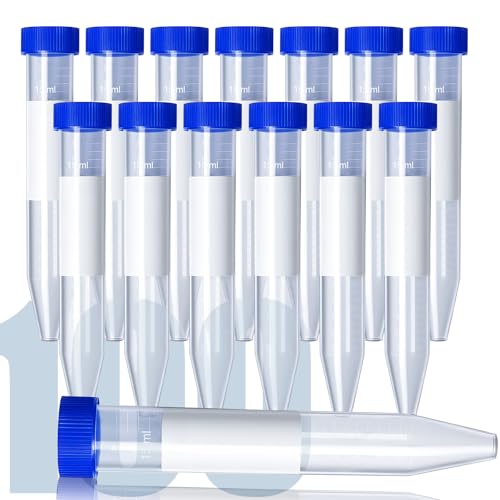
Sunliech’s entry-level 15 mL tube set proves you don’t have to spend heavily for basic functionality. These tubes are EO sterilized, DNase/RNase-free, and non-pyrogenic, matching the certifications of tubes costing significantly more. The polypropylene construction is smooth and flat internally to prevent residual solution from clinging, and the threaded cap creates a leak-proof seal that holds up well during standard centrifugation. Users have successfully collected livestock samples, stored airbrush paint, and even sealed roof screws without any leakage.
The white marking area is resistant to chloroform corrosion, a useful feature if your workflow involves solvent-based labeling or sample fixation. The graduated scale is easy to read, though the increments are standard 1 mL steps rather than the finer 0.5 mL markings found on premium tubes. The 100-pack is ideal for field samplers, small veterinary clinics, and hobbyists who need a reliable tube without the premium price tag.
These tubes lack the high RCF rating of more expensive options, so they are best suited for low-to-moderate speed applications rather than high-g pelleting. For general storage, transport, and basic centrifugation, the Sunliech pack delivers dependable performance at a budget-friendly price.
Why it’s great
- DNase/RNase-free and EO sterile at a low entry price
- Chloroform-resistant marking area for solvent labeling
- Versatile across field collection, paint storage, and sealing tasks
Good to know
- RCF rating not specified — avoid high-speed spins
- 1 mL graduations are less precise than 0.5 mL alternatives
7. Konohan 200 Pack

Konohan’s 200-pack of 15 mL centrifuge tubes is the highest-count option in this roundup, making it the obvious choice for classrooms, workshops, and hobbyists who need a large volume of tubes for general storage and light centrifugation. The polypropylene material withstands high and low temperatures, and the blue screw caps are designed to fit snugly to prevent leakage. The 1 mL increment graduations are clearly printed, and the white write-on spot provides space for sample labeling.
The tubes have found enthusiastic users among elementary school teachers for hands-on science demos, and among artists for storing and organizing airbrush paint. The cost-per-tube is extremely low, which makes them practically disposable for high-turnover environments. The stand-on-lid design keeps tubes upright on the bench, reducing the need for a separate rack in casual use.
The main concern reported by users is inconsistency: some tubes in a batch leak from the bottom rather than the lid, and the packaging does not provide sealed sterility — tubes arrive loose in a box with separate caps. For non-sterile storage, general organization, and low-speed centrifugation where leakage is not a critical risk, the Konohan pack offers unbeatable quantity per dollar.
Why it’s great
- 200 tubes per pack — highest count in this guide
- Polypropylene construction tolerates temperature extremes
- Stand-on-lid design simplifies bench organization
Good to know
- Occasional bottom leakage reported — test before critical use
- Not packaged sterile — loose in box with separate caps
FAQ
Can I reuse 15 mL centrifuge tubes after cleaning?
What is the difference between a snap cap and a screw cap on a 15 mL tube?
How accurate are the printed graduations on centrifuge tubes?
Final Thoughts: The Verdict
For most users, the best 15 ml centrifuge tubes winner is the Globe Scientific 6285 because it combines the convenience of an attached screw cap with reliable 8,500 x g performance and 0.5 mL graduated markings in a 500-count bulk pack. If you need a higher RCF rating for demanding pelleting protocols, grab the United Scientific D1003 with its 13,000 x g capacity. And for certified DNase/RNase-free tubes at a mid-range price, nothing beats the SimPure 15mL 100Pcs for molecular biology work.