
The night sky holds a quiet spectacle that most people never truly witness—Saturn’s rings as a distinct, separate shape rather than a fuzzy blob, or the cratered texture of the Moon’s terminator line. The difference between a frustrating, blurry experience and a jaw-dropping clear view comes down to one choice: the optical quality and aperture of the telescope you bring home.
I’m Min — the co-founder and writer behind Gadgets Feed. I’ve spent countless hours cross-referencing user reports against technical specifications for refractor telescopes under , analyzing everything from chromatic aberration control in 80mm objectives to the tracking precision of AZ mounts at sub- price points.
If you want a practical, honest, and research-backed guide to picking the right best at home telescope for your backyard or camping adventures, this is the only resource you need to read.
How To Choose The Best At Home Telescope
Choosing an at-home telescope isn’t about magnification numbers—it’s about aperture, mount stability, and optical coatings. Here’s what separates a usable instrument from a frustrating dust collector.
Aperture Size & Light Gathering
Aperture is the diameter of the main lens, measured in millimeters. A 90mm aperture collects roughly 26% more light than an 80mm aperture, which directly determines whether you can resolve the Cassini Division in Saturn’s rings or just see a glowing oval. For a home telescope under , 80mm to 90mm is the sweet spot—anything smaller than 70mm will leave you disappointed on all but the Moon.
Focal Length & Magnification Range
Focal length (600mm to 900mm) dictates the telescope’s native magnification potential when paired with eyepieces. A 900mm focal length tube with a 10mm eyepiece gives 90x magnification—enough to see Jupiter’s cloud bands under steady skies. Avoid cheap 400mm short-tube designs; they produce severe chromatic aberration (purple fringing) around bright objects.
Mount Type & Stability
An Altazimuth (AZ) mount is the standard for entry-level refractors. The most critical detail is slow-motion control: a vertical rod that lets you fine-tune the aim without jarring the image. A flimsy tripod with thin legs will transmit every ground vibration to the eyepiece, making high-power viewing impossible. Stainless steel legs or center-braced aluminum are essential.
Optical Coatings & Glass Quality
Fully multi-coated (FMC) optics reduce light loss at each air-to-glass surface. An FMC lens transmits up to 99% of incoming light per surface versus roughly 96% for a single-coated lens. In practice, this means brighter, higher-contrast images of the Moon’s terminator and fainter deep-sky objects like the Orion Nebula.
Quick Comparison
On smaller screens, swipe sideways to see the full table.
| Model | Category | Best For | Key Spec | Amazon |
|---|---|---|---|---|
| Celestron StarSense Explorer LT 80AZ | App-Enabled Refractor | No-experience-required sky navigation | 80mm aperture, 900mm focal length | Amazon |
| Hawkko 90900 | High-Powered Refractor | Planetary detail at 270x max magnification | 90mm aperture, 900mm focal length | Amazon |
| MEEZAA 90800 | Professional Refractor | Versatile 32x-240x lunar & planetary viewing | 90mm aperture, 800mm focal length | Amazon |
| Celticbird 80900 | Travel Refractor | Backyard to campsite portability | 80mm aperture, 900mm focal length | Amazon |
| Koolpte VAZ90700 | High-Power AZ Refractor | Smooth tracking with Vertisteel slow-motion mount | 90mm aperture, 700mm focal length | Amazon |
| YENGUAN 90800 | Professional Refractor | Detailed lunar crater observation | 90mm aperture, 800mm focal length | Amazon |
| Dianfan 90550 + Stool | Comfort Kit Refractor | Long sessions with included folding stool | 90mm aperture, 550mm focal length | Amazon |
| HUGERSTAR 80600 | Portable Starter Refractor | Family-friendly 10-minute setup | 80mm aperture, 600mm focal length | Amazon |
| Dianfan 80500 | Beginner Kit Refractor | Kids’ first telescope with customization stickers | 80mm aperture, 500mm focal length | Amazon |
In‑Depth Reviews
1. Celestron StarSense Explorer LT 80AZ

The Celestron StarSense Explorer LT 80AZ removes the single biggest barrier to entry in backyard astronomy: finding objects. Instead of a traditional finderscope, it uses your phone’s camera and Celestron’s patented StarSense technology to analyze star patterns and guide you with on-screen arrows until the target appears in the eyepiece. The 80mm aperture with high-reflectivity coatings delivers sharp lunar detail and resolves Saturn’s rings, while the 25mm and 10mm Kellner eyepieces cover 36x and 90x magnification respectively.
The manual altazimuth mount includes a slow-motion altitude rod for smooth tracking, and the StarPointer red-dot finderscope serves as a backup. Users consistently report seeing four of Jupiter’s moons and the Cassini Division under steady skies. The 900mm focal length (f/11.25) keeps chromatic aberration well controlled, even when viewing the bright limb of the Moon.
This is the most beginner-friendly telescope on this list because the app does the heavy lifting of celestial navigation. The lightweight aluminum tripod is adequate for the 80mm tube, though upgrading the eyepieces later to Plössl or wide-angle designs will noticeably improve the 90x planetary views.
Why it’s great
- StarSense app eliminates the frustration of finding objects manually
- Sharp 80mm f/11.25 optics with minimal chromatic aberration
- Includes both red-dot finder and smartphone dock for flexible use
Good to know
- Mount is manual; no motorized tracking for long exposure photos
- Stock 10mm eyepiece has narrow field of view for the price point
- Phone battery drains faster when using the app continuously
2. Hawkko 90900

The Hawkko 90900 combines the largest practical aperture in this price range (90mm) with the longest focal length (900mm) for an f/10 optical system that excels at high-magnification planetary viewing. The fully multi-coated (FMC) objective lens transmits roughly 73% more light than uncoated glass, producing bright, high-contrast images of lunar craters and Jupiter’s equatorial bands. With the included 10mm eyepiece and 3x Barlow lens, you can push magnification to 270x—enough to separate the Cassini Division under good seeing conditions.
The stainless steel AZ mount tripod adjusts from 28 to 46 inches and supports smooth 360-degree rotation, while the accessory tray adds stability. Users report assembly in under 15 minutes, and the included smartphone adapter works reliably for capturing moon shots. The straight-through finderscope is basic but functional for initial alignment.
At this price, the 90mm aperture is the standout feature—you get noticeably brighter images of deep-sky objects like the Orion Nebula than any 80mm competitor. The trade-off is that the 900mm tube makes the telescope slightly longer, but the included carry bag solves transport for backyard-to-campsite moves.
Why it’s great
- 90mm f/10 provides excellent planetary detail at 270x max magnification
- Fully multi-coated optics produce bright, high-contrast lunar views
- Stainless steel tripod is more stable than aluminum alternatives
Good to know
- Straight-through finderscope can be uncomfortable for overhead viewing
- Long 900mm tube requires a sturdy tripod; short tripods may feel shaky
- No slow-motion control rod on the mount for fine adjustments
3. MEEZAA 90800

The MEEZAA 90800 delivers the same 90mm aperture as more expensive models but at a lower price point, making it the strongest value proposition for budget-conscious buyers who still want planetary-capable optics. The 800mm focal length (f/8.88) offers a nice balance: wide enough for 32x views with the 25mm eyepiece but long enough to reach 240x with the 10mm and 3x Barlow. The fully multi-coated glass minimizes internal reflections, and users consistently praise the sharp lunar craters visible at 80x.
The stainless steel tripod adjusts from 28 to 46 inches and includes an accessory tray that prevents the legs from spreading during setup. Assembly takes about 10 minutes with the included paper manual. The straight-through finderscope is adequate for aiming at bright stars and the Moon, and the smartphone adapter works for casual lunar photography.
Where the MEEZAA shines is in its complete accessory set: two eyepieces, a Barlow lens, a finderscope, a zenith mirror for comfortable viewing angles, a phone adapter, and a padded carry bag. The mount lacks slow-motion controls, but the smooth AZ movement is sufficient for tracking objects across the sky at low magnification.
Why it’s great
- 90mm aperture at a budget-friendly price point outperforms 80mm competitors
- Complete accessory kit with carry bag, phone adapter, and Barlow lens
- Stainless steel tripod provides better stability than thin aluminum legs
Good to know
- No slow-motion control on the mount for precise tracking
- Straight-through finderscope requires awkward head positioning near zenith
- Some users report needing to re-tighten tripod leg locks occasionally
4. Celticbird 80900

The Celticbird 80900 balances portability with optical performance by packing an 80mm aperture and 900mm focal length into a lightweight package that fits in the included carry bag. The fully multi-coated lenses and 900mm f/11.25 focal ratio keep chromatic aberration minimal, producing crisp lunar views and recognizable planetary discs. With the 20mm wide-angle eyepiece, you get a comfortable 45x view of the Moon’s full disk; switching to the 10mm eyepiece pushes it to 90x for detailed crater inspection.
The AZ mount and adjustable aluminum tripod (20-45 inches) support smooth movement, though the lower tripod section can transmit vibration when bumped. Users report assembly in under 5 minutes with no tools required. The reflex finderscope is easier to use at night than a straight-through design, and the phone adapter reliably captures lunar photos.
Celticbird backs this telescope with a 3-year satisfaction service, which is unusually generous at this price tier. The 80mm aperture limits deep-sky performance compared to 90mm models, but the long 900mm focal length makes it an excellent choice for sharp, high-contrast lunar and planetary observation.
Why it’s great
- 900mm f/11.25 focal ratio delivers nearly zero chromatic aberration
- Reflex finderscope is more intuitive for beginners than straight-through designs
- 3-year satisfaction service provides long-term peace of mind
Good to know
- Lower tripod section can vibrate, making high-power viewing sensitive to bumps
- 80mm aperture limits deep-sky object brightness compared to 90mm alternatives
- Some units may have dust inside the lens tube that requires cleaning
5. Koolpte VAZ90700
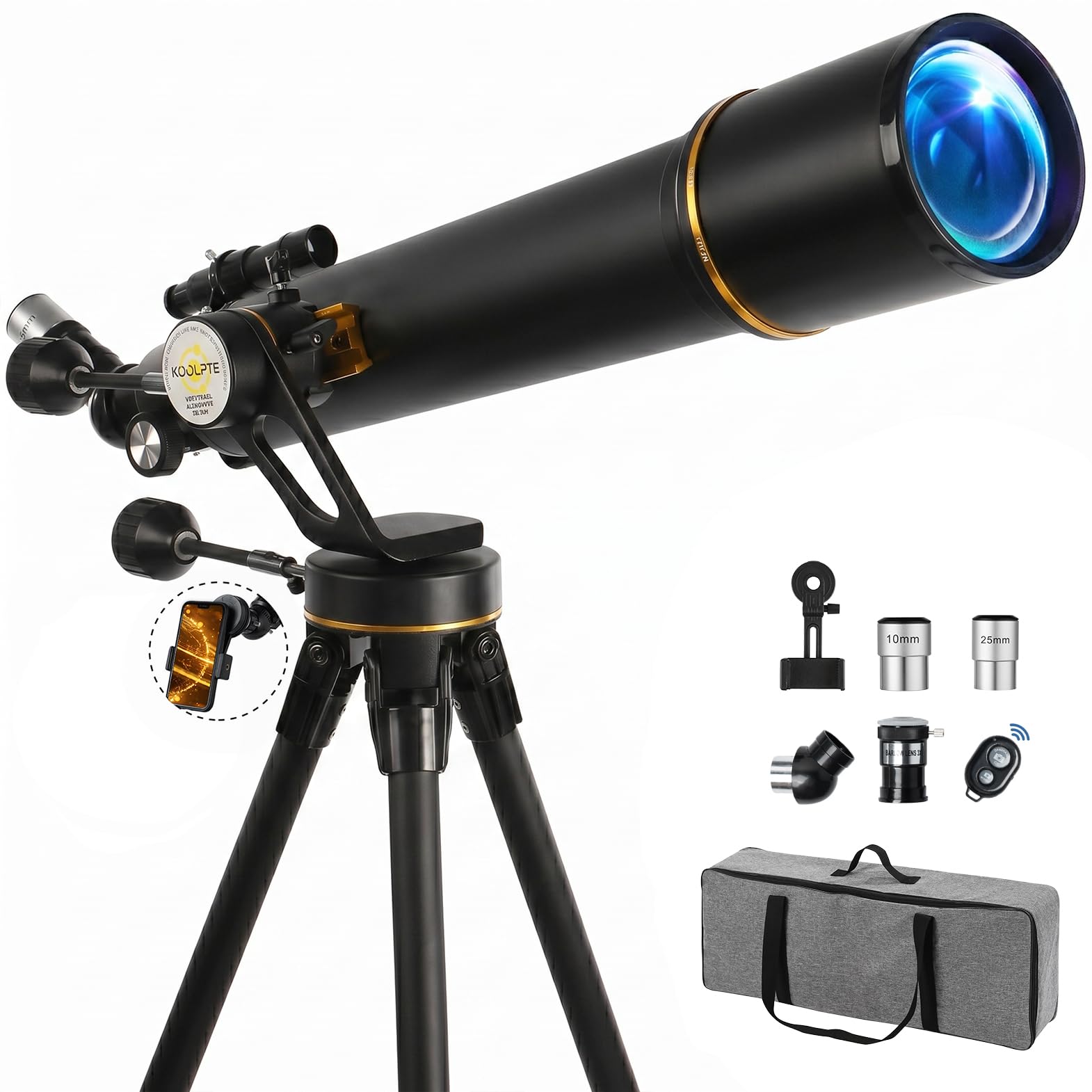
The Koolpte VAZ90700 stands out for its Vertisteel AZ slow-motion mount, which features a “follow and stop” design that eliminates the overshooting and wobble common in budget AZ mounts. This makes high-power views at 210x (10mm eyepiece plus 3x Barlow) actually usable. The 90mm fully multi-coated objective transmits 99% of incoming light, producing bright, high-contrast images of the Moon, Jupiter’s cloud bands, and Saturn’s ring structure.
The 700mm focal length (f/7.78) is shorter than the 900mm competitors, which means a wider field of view for deep-sky objects like the Pleiades star cluster. The stainless steel tripod is sturdy, and assembly takes 10 minutes with no tools. The kit includes a wireless remote for the smartphone adapter, which reduces camera shake when capturing lunar photos.
The 700mm focal ratio is slightly faster than the typical f/10 refractor, which may introduce mild chromatic aberration on very bright objects like Venus. However, the Vertisteel mount’s tracking precision is so noticeably better than standard AZ mounts that it compensates for the optical trade-off.
Why it’s great
- Vertisteel slow-motion mount provides smooth, wobble-free tracking at high power
- 90mm FMC optics deliver 99% light transmission for bright images
- Wireless remote reduces vibration for sharper smartphone astrophotography
Good to know
- 700mm f/7.78 may show mild chromatic aberration on very bright planets
- Tripod legs use thin metal with plastic ends; not as robust as heavier stainless designs
- Internal part can come loose in some units, requiring return or repair
6. YENGUAN 90800
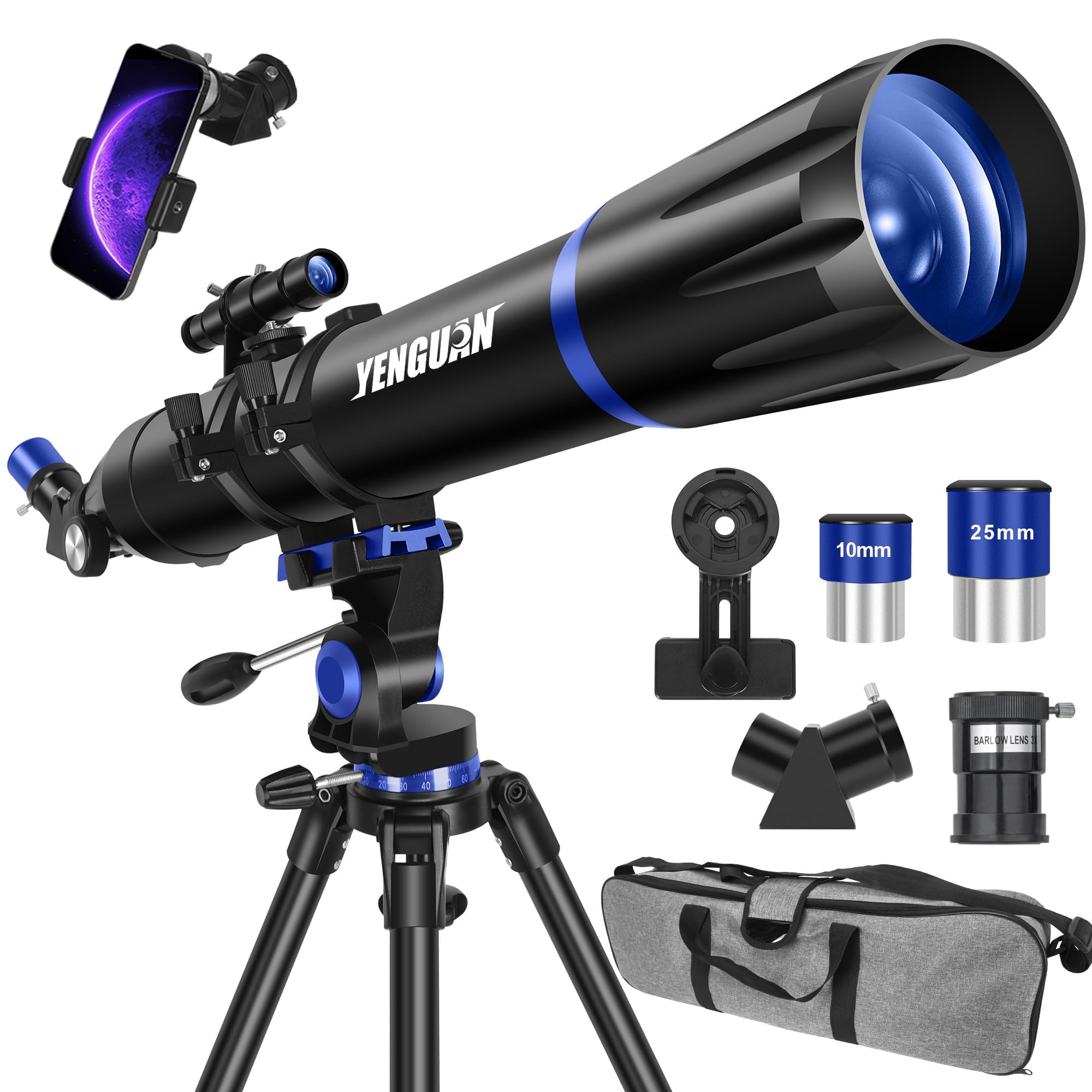
The YENGUAN 90800 uses a 90mm aperture and 800mm focal length (f/8.88) to deliver crisp, bright views that resolve intricate lunar crater textures and reveal the cloud bands on Jupiter. The fully multi-coated optics include a moisture-resistant coating that adds durability for outdoor storage. Users report that the 25mm eyepiece at 32x provides a satisfying wide-field view of the Moon, while the 10mm eyepiece at 80x shows detailed crater rims and central peaks.
The tool-free assembly takes about 15 minutes, and the comprehensive instruction manual includes a straightforward assembly guide with labeled components. The stainless steel tripod is stable enough for backyard use, and the included phone adapter works for basic lunar photography. The straight-through finderscope is standard for this price tier.
Where the YENGUAN differentiates itself is the moisture-resistant lens coating, which protects the objective from condensation during cool night sessions. The 90mm aperture provides enough light gathering to distinguish the Orion Nebula’s trapezium cluster under dark skies, making it a versatile option for both lunar and deep-sky observation.
Why it’s great
- 90mm f/8.88 optics deliver excellent lunar crater detail at 80x magnification
- Moisture-resistant coating protects the lens during humid night sessions
- Tool-free assembly with clear instruction manual for beginners
Good to know
- Some units arrive with mechanical issues that make focusing impossible
- Straight-through finderscope is basic and less intuitive than a reflex sight
- Fixed focus design limits the ability to use certain aftermarket eyepieces
7. Dianfan 90550 + Folding Stool
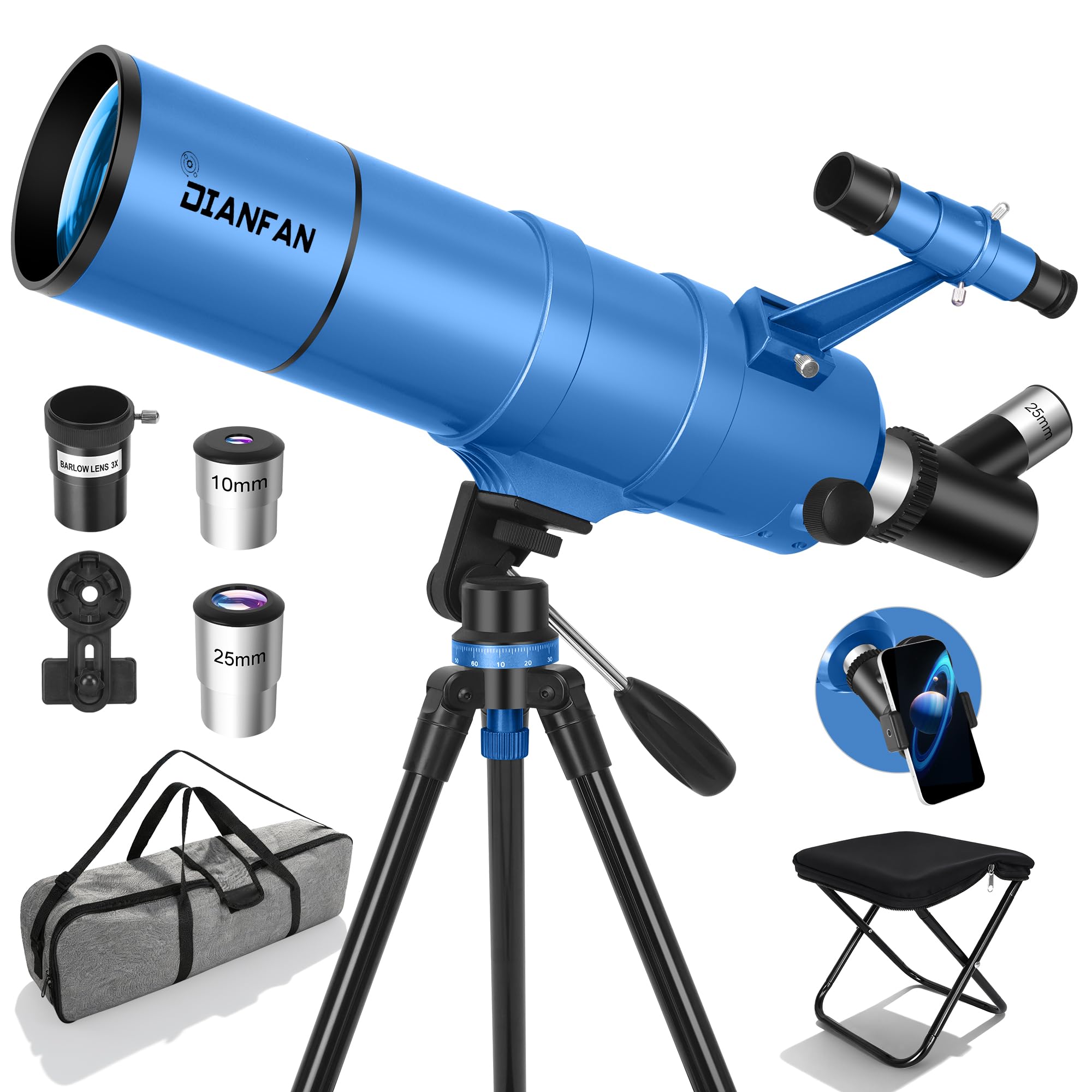
The Dianfan 90550 takes a unique approach by including a folding stool rated to 198 pounds, addressing the common complaint of back strain during long observation sessions. The 90mm aperture with fully multi-coated optics provides bright views, while the 550mm focal length (f/6.11) offers a wider field of view than the 800mm and 900mm competitors—ideal for scanning star fields and viewing large deep-sky objects like the Andromeda Galaxy. Magnification ranges from 22x (25mm eyepiece) to 165x (10mm plus 3x Barlow).
The AZ mount and tripod are lightweight and portable, with the custom-fit carry bag protecting the telescope during transport. The straight-through finderscope and quick-release components make setup straightforward in about 15 minutes. Users report that the phone adapter works well for lunar shots, and the folding stool eliminates the need to crouch or bend over the eyepiece.
The shorter 550mm focal length means the telescope is more forgiving of mount vibrations, but it also means you need higher-quality eyepieces to reach the same magnification levels as longer-focal-length tubes. The included Kellner eyepieces are adequate for the Moon and bright planets, but the f/6.11 focal ratio may show some chromatic aberration on Venus.
Why it’s great
- Included folding stool prevents back strain during long viewing sessions
- 90mm f/6.11 provides a wider field of view for deep-sky scanning
- Lightweight and portable with custom-fit carry bag
Good to know
- Shorter focal length may show chromatic aberration on bright objects
- Higher magnification requires premium eyepieces beyond the included Kellner set
- Tripod is lightweight and can be shaky in windy conditions
8. HUGERSTAR 80600
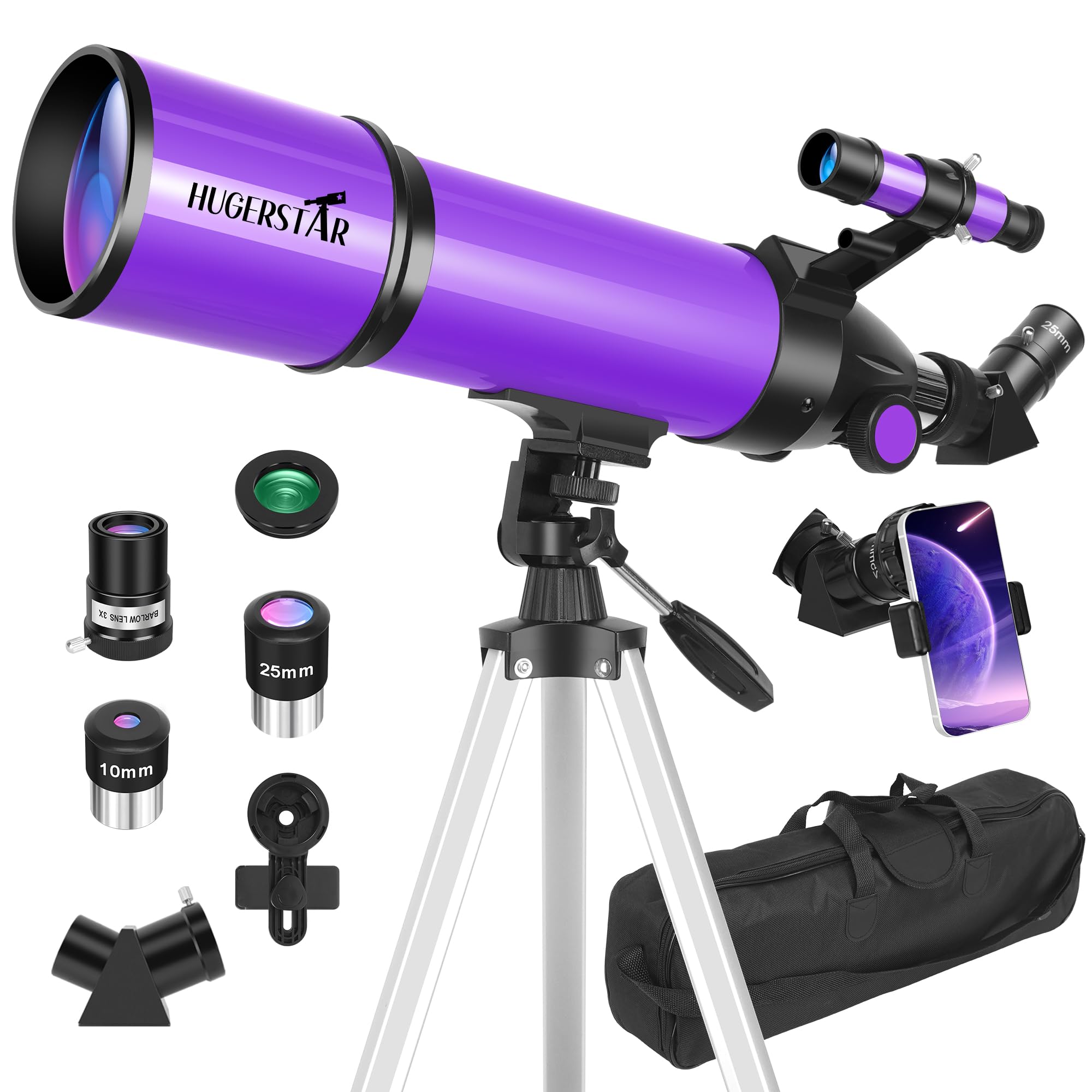
The HUGERSTAR 80600 is optimized for the absolute beginner with a 10-minute tool-free setup and an intuitive AZ mount that requires no complex balancing. The 80mm aperture and 600mm focal length (f/7.5) produce bright, wide-field views of the Moon and bright stars, with magnification ranging from 24x (25mm eyepiece) to 180x (10mm plus 3x Barlow). The fully multi-coated optics reduce glare, and the included moon filter improves contrast during full-moon viewing.
The aluminum tripod adjusts from 21.2 to 44 inches, making it accessible for both kids and adults. The kit includes a 5×24 finderscope for targeting, a smartphone adapter for photography, and a padded carry bag for transport. Users report clear views of lunar craters, bright star clusters, and even Jupiter’s four Galilean moons under steady skies.
The 600mm focal length is shorter than the 800mm and 900mm models, which means the telescope is more portable but offers slightly less native magnification potential. The 80mm aperture limits deep-sky performance, but for a family-friendly starter telescope that prioritizes ease of use, the HUGERSTAR 80600 is hard to beat.
Why it’s great
- 10-minute tool-free setup ideal for families and impatient beginners
- Moon filter reduces glare for comfortable full-moon observation
- Lightweight and compact with included carry bag
Good to know
- 80mm aperture limits deep-sky object brightness versus 90mm models
- Basic finderscope may be confusing for complete beginners
- Some units lack clear instructions for all included accessories
9. Dianfan 80500
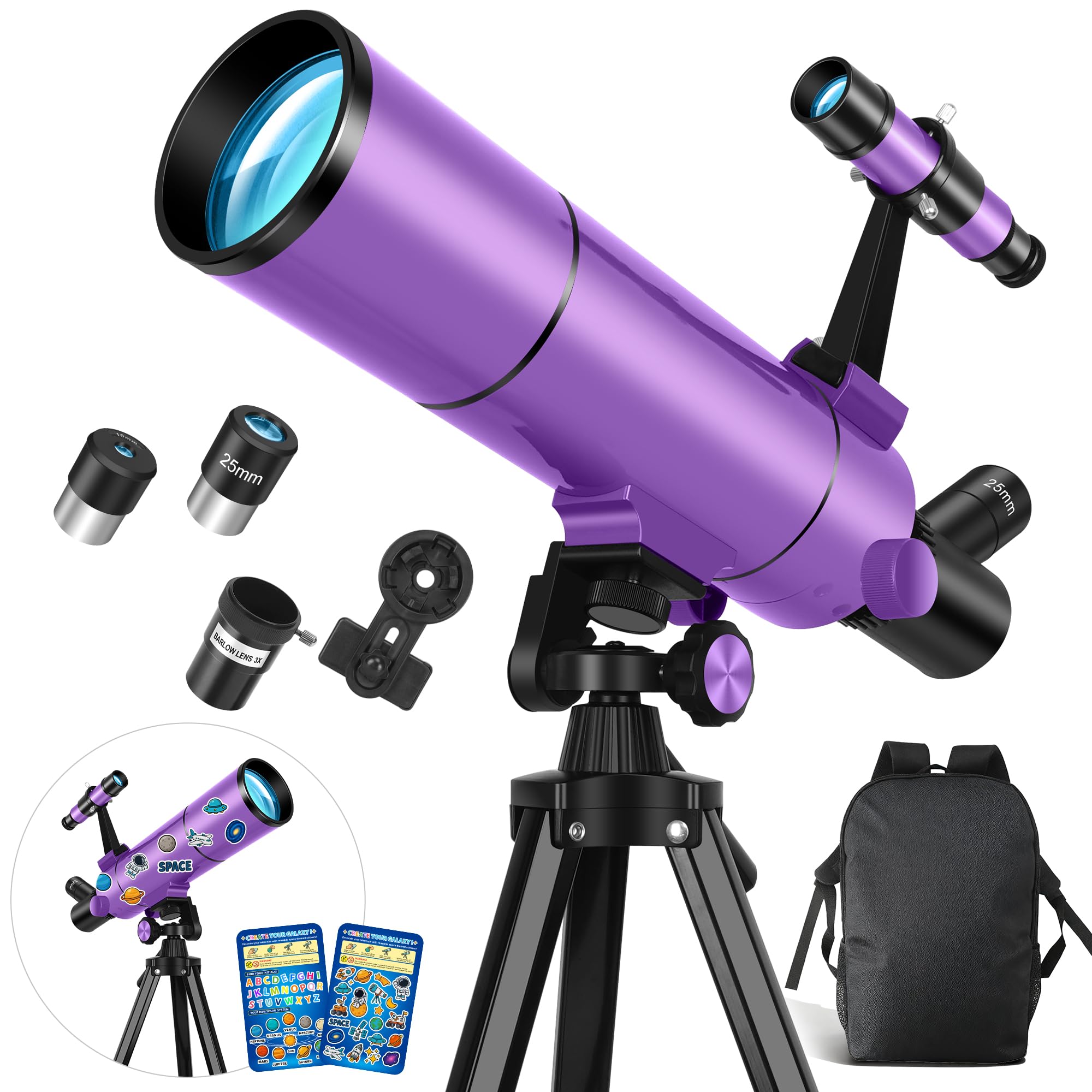
The Dianfan 80500 targets younger stargazers with its vibrant purple design and two reusable astronomy-themed stickers that let kids personalize their telescope. The 80mm aperture and 500mm focal length (f/6.25) provide bright, wide-field views suitable for the Moon, bright planets, and terrestrial observation. Magnification ranges from 20x (25mm eyepiece) to 150x (10mm plus 3x Barlow), which is sufficient for seeing lunar craters and Jupiter’s moons.
The fully multi-coated optics produce clear images with minimal chromatic aberration for the price. Assembly takes about 15 minutes with the clear illustrated manual, and the water-resistant backpack-style carry bag makes transport easy for camping trips. The kit includes a phone adapter, a finderscope, and a sturdy tripod.
The 500mm focal length means the telescope is compact (shorter tube) and easy for children to carry and set up independently. The trade-off is that the f/6.25 focal ratio and short focal length make it less suitable for high-magnification planetary work than the 900mm models.
Why it’s great
- Personalizable stickers and purple design make it engaging for kids
- Compact 500mm tube fits in a water-resistant backpack for easy travel
- Fully multi-coated optics provide bright, clear images at low magnification
Good to know
- 500mm focal length limits high-magnification planetary detail
- f/6.25 focal ratio may show noticeable chromatic aberration on bright objects
- Basic Kellner eyepieces are entry-level; upgrades will improve performance
FAQ
Can I see Saturn’s rings clearly with an 80mm telescope?
Is a Barlow lens worth buying with a beginner telescope?
What does “fully multi-coated” mean for an at-home telescope?
Final Thoughts: The Verdict
For most users, the best at home telescope winner is the Celestron StarSense Explorer LT 80AZ because its smartphone-powered navigation removes the steepest learning curve in amateur astronomy—finding objects. If you want the sharpest planetary views at 270x magnification, grab the Hawkko 90900 with its 90mm aperture and 900mm focal length. And for the best balance of performance and price, nothing beats the MEEZAA 90800 with its 90mm FMC optics and complete accessory kit.