
A portable power station isn’t just a battery — it’s the difference between a cold meal during a blackout and a functioning fridge, between cutting a camping trip short and extending it for days. The chemistry inside — LiFePO4 (LFP) with 3,000+ cycles — now defines the category, not watt-hours alone. Choosing wrong means hauling dead weight or buying a second unit within two years.
I’m Min — the co-founder and writer behind Gadgets Feed. I’ve spent hundreds of hours analyzing inverter efficiency, cycle-life warranties, solar input curves, and actual runtime data across this category to separate marketing wattage from real-world usability.
After analyzing over forty models, these nine represent the cleanest intersection of capacity, charging speed, and build quality in today’s market — making up what I consider the definitive best battery portable power station guide for 2024 and beyond.
How To Choose The Best Battery Portable Power Station
Portable power stations have matured fast — and the trap is overspending on peak wattage you’ll never use while ignoring the battery chemistry and charging inputs that determine real ownership experience. Focus on these three filters first.
Battery Chemistry & Cycle Life
LiFePO4 (LFP) is the only chemistry worth your money today. It delivers 3,000 to 4,000 charge cycles before degrading to 80% capacity — roughly a decade of daily use. NMC-based stations hit half that lifespan. If a station doesn’t specify LFP in its core specs, move on.
Inverter Wattage vs. Appliance Surge
The rated AC output (in watts) covers steady-state loads. But refrigerators, pumps, and power tools can draw 2–3x their running wattage for the first few seconds. Look for a surge rating that’s at least 50% above the rated output. A station rated 600W with a 1,200W surge handles a compact fridge start-up; a 2,400W station with 4,000W surge runs a full-size refrigerator or window AC.
Solar Input Voltage & Charging Speed
Solar recharge time depends on the MPPT voltage range and max input wattage. A station that accepts 12–60V at 200W will charge slowly with a single 100W panel. Higher-tier models with 1,000W+ PV input and dual MPPT trackers can accept two 200W panels in series, cutting solar charge time from a full day to a few hours. AC recharge speed matters too — sub-90-minute full charges remove the “is it charged yet” anxiety before a storm hits.
Quick Comparison
On smaller screens, swipe sideways to see the full table.
| Model | Category | Best For | Key Spec | Amazon |
|---|---|---|---|---|
| BLUETTI Elite 100 V2 | Mid-Range | Home backup & mobile office | 1,024Wh / 1,800W inverter | Amazon |
| GROWATT INFINITY 2000 Pro | Mid-Range | RV & overlanding | 2,048Wh / TT-30 outlet | Amazon |
| Jackery Explorer 2000 v2 | Premium | Lightweight 2kWh carry | 2,042Wh / CTB tech / 39.5 lb | Amazon |
| Anker SOLIX C2000 Gen 2 | Premium | Fast charging & alternator | 2,048Wh / 58-min full charge | Amazon |
| AFERIY P280 | Premium | High-wattage & expandability | 2,048Wh / 2,800W inverter | Amazon |
| Jackery HomePower 3000 | Premium | Full-home essential backup | 3,072Wh / 3,600W output | Amazon |
| EF ECOFLOW RIVER 3 | Entry-Level | UPS & compact carry | 245Wh / GaN tech / 7.8 lb | Amazon |
| BLUETTI Elite 30 V2 | Entry-Level | Light camping & CPAP use | 288Wh / Power Lifting 1,500W | Amazon |
| VTOMAN Jump 600X | Entry-Level | Car jump-start + backup | 299Wh / expandable to 939Wh | Amazon |
In‑Depth Reviews
1. BLUETTI Elite 100 V2
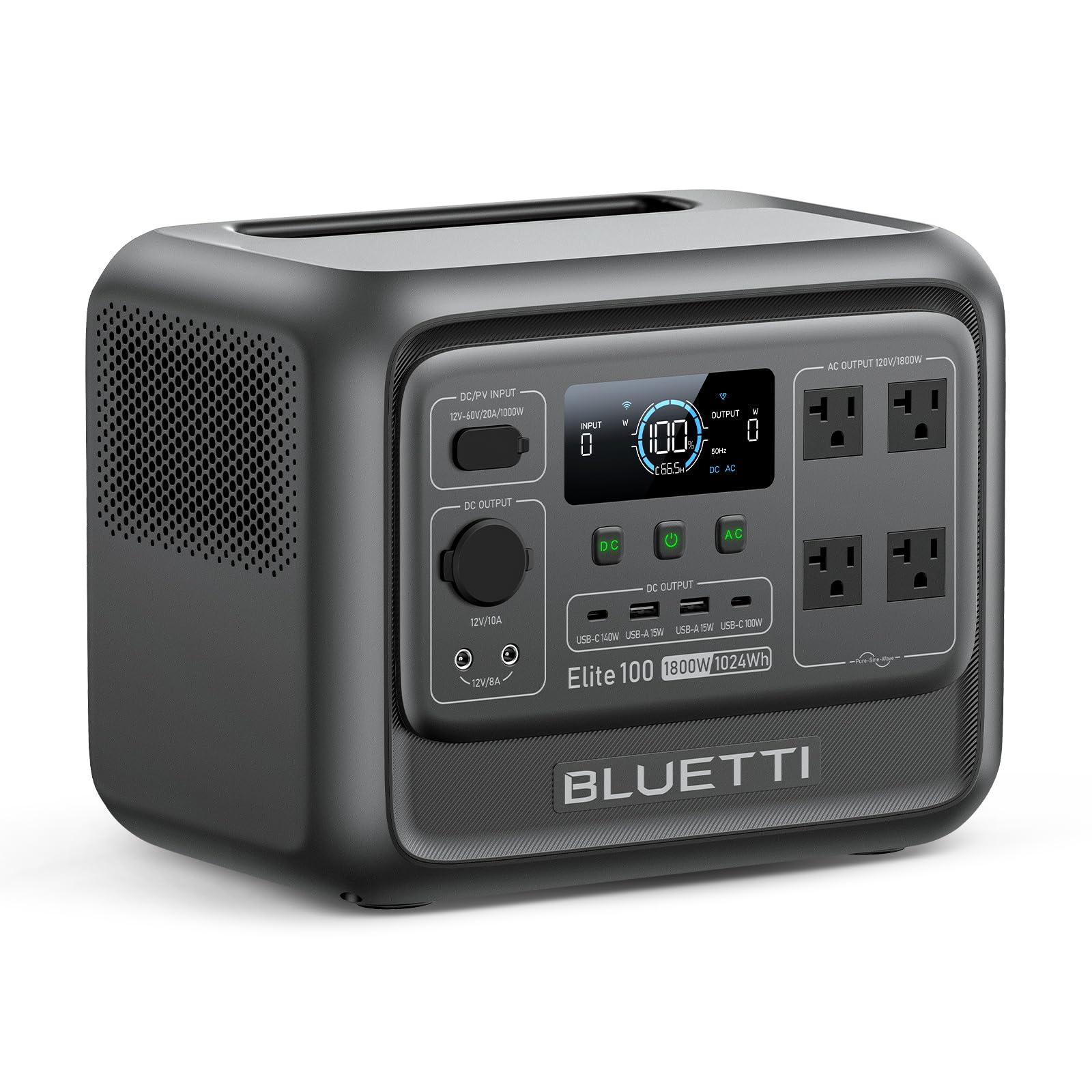
The BLUETTI Elite 100 V2 hits the sweet spot of the entire category: 1,024Wh of LiFePO4 capacity paired with four 1,800W AC outlets that surge to 3,600W. That’s enough to run a full-size refrigerator, a modem/router stack, and a handful of lights through a multi-day blackout — without stepping up to the 2kWh weight class. It’s 35% smaller than the prior Elite 100 model, coming in at 25 pounds.
Recharge speed is the headline. With 1,200W AC input (TurboBoost), it hits full in about 70 minutes. Solar input maxes at 1,000W — the fastest I’ve seen at this capacity tier — meaning two 400W panels can refill it by midday. The 10ms UPS switchover is silent and tested clean with sensitive networking gear. Operating noise at low loads stays around 30dB.
The trade-offs: there’s no built-in wireless charger, no light, and the fan becomes audible above 500W load. The 25-pound weight is manageable with the hidden handle but doesn’t feel “portable” for backpacking. The BLUETTI app (WiFi/BT) provides remote monitoring, though a few users report the Bluetooth pairing routine being unintuitive at first.
Why it’s great
- Fastest recharge in its capacity class (70 min full).
- 4 AC outlets with 3,600W surge handle most home appliances.
- 1,000W solar input supports rapid off-grid refill.
Good to know
- No physical power dial; settings locked to app.
- Fan ramps up noticeably at higher loads.
- No built-in light or wireless charging pad.
2. GROWATT INFINITY 2000 Pro
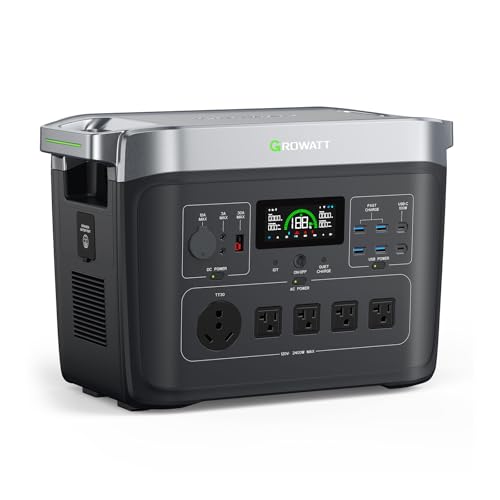
The GROWATT INFINITY 2000 Pro packs 2,048Wh and a 2,400W inverter (4,000W surge) into a 26-pound chassis — notably light for its capacity. What sets it apart for RV owners is the NEMA TT-30 port (standard RV 30-amp outlet) and the Anderson Powerpole connector, letting you plug directly into your RV’s shore power inlet without adapters. Cold Start technology allows operation down to -22°F.
AC charging hits 1,800W — full charge in about 90 minutes. Solar input maxes at 1,200W, and with dual MPPT trackers you can mix panel configurations. The app (WiFi/BT) provides full monitoring and OTA firmware updates. The 4,000-cycle LFP cells (10-year lifespan at daily cycling) match the best in class. Build quality includes rubber bumper guards on all corners.
The primary concern is customer support: several users report unresponsive warranty service for units that failed to power on after storage. The expansion battery (sold separately) connects via a dedicated cable but cannot be charged independently. The 26-pound weight is impressive, but the handle placement makes one-handed carry slightly awkward at that mass.
Why it’s great
- NEMA TT-30 and Anderson ports for direct RV integration.
- Lightest 2kWh station at 26 lb with full features.
- Cold Start function works at -22°F for winter off-grid.
Good to know
- Customer support responsiveness flagged in user reports.
- Expansion battery can’t charge independently.
- Handle design less balanced than competitors at this weight.
3. Jackery Explorer 2000 v2

Jackery’s Explorer 2000 v2 uses Cell-to-Body (CTB) technology — the same structural integration found in EV battery packs — to shrink the casing and shed weight. At 39.5 pounds and a footprint 34% smaller than the average 2kWh station, it’s the most packable full-size unit available. The 2,042Wh LFP battery and 2,200W inverter (4,400W surge) cover essentials for up to two days.
AC charging reaches 0-80% in 66 minutes (98 minutes for full). The app enables a Super Charging mode that cuts full recharge to 102 minutes, and a Silent mode that caps fan noise under 30dB — useful for overnight bedroom or campervan use. Solar input accepts up to 400W, achieving a full charge in about 6 hours with two 200W panels. The 20ms UPS switchover is UL1778 certified.
Weight savings come with compromises: there’s no expansion battery option, so you’re stuck at 2,042Wh. The solar barrel ports are recessed with plastic bezels that can flex when plugging in stiff panel cables. The Bluetooth-to-app pairing has occasional dropouts that require re-pairing. At , it’s premium-priced, but the portability metric alone justifies the cost for mobile users.
Why it’s great
- Lightest 2kWh station at 39.5 lb with EV-grade CTB construction.
- Silent charging mode under 30dB for indoor use.
- UL1778 certified UPS with 20ms switchover.
Good to know
- No expansion battery compatibility.
- Solar barrel port bezel prone to flexing under cable strain.
- Bluetooth connectivity requires occasional re-pairing.
4. Anker SOLIX C2000 Gen 2
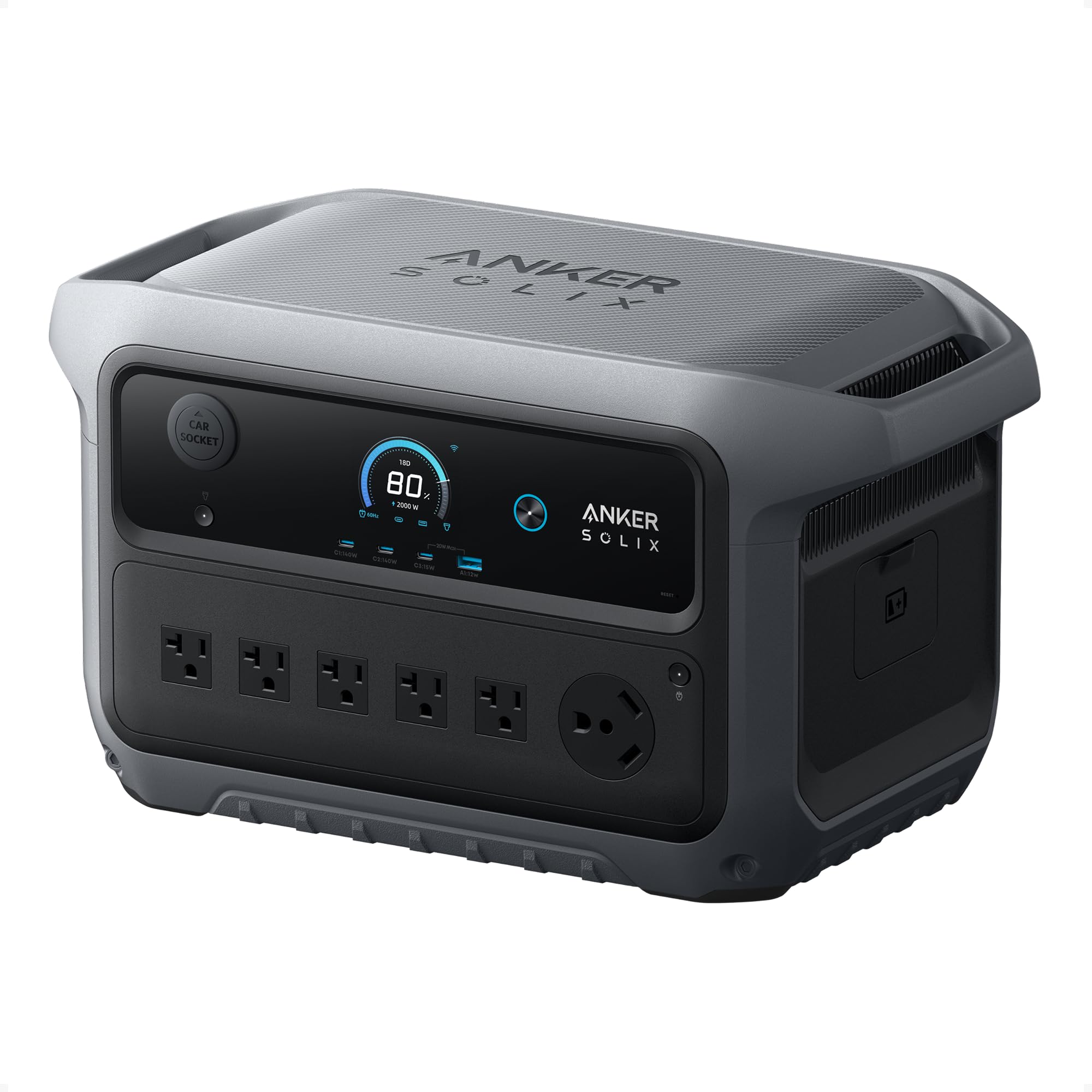
Anker’s SOLIX C2000 Gen 2 focuses ruthlessly on charging speed. Full recharge from 0-100% takes 58 minutes on AC — the fastest of any 2kWh station in this roundup. The 2,400W rated inverter (4,000W peak) can start most window AC units and RV air conditioners. Standby power draw is minimized to 9W, enabling a dual-door fridge runtime of up to 32 hours on a single charge.
The expandability is unique: a dedicated expansion battery doubles capacity to 4kWh, extending fridge runtime to 64 hours. Alternator charging at 800W (8x faster than a standard 12V socket) allows full recharge in 3 hours while driving — a genuine benefit for van-lifers and overlanders. The 41.7-pound weight is 25% lighter than comparable 2kWh models, with the form factor measuring 18.1 x 9.8 x 10.1 inches.
The most notable omission is a physical manual — setup and troubleshooting are app-based only, which can frustrate users who prefer printed documentation. The fan is audible under heavy load (above 1,500W). At list, it competes directly with Jackery and BLUETTI, and the edge goes to Anker for charging speed and alternator compatibility alone.
Why it’s great
- 58-minute full AC recharge — fastest in class.
- 800W alternator charging for road-based refuel.
- Expandable to 4kWh for extended appliance runtime.
Good to know
- No printed manual — setup is app-only.
- Fan noise audible above 1,500W load.
- Premium price tier with no solar panels included.
5. AFERIY P280

Its 2,800W inverter (5,600W surge) can run induction cooktops, space heaters, and even some RV ACs without tripping. The 2,048Wh LFP battery expands up to 10.24kWh with additional batteries — enough for multi-day whole-home essential backup. Dual PV inputs allow two separate solar arrays without extra MPPT hardware.
AC charging is aggressive: 1,800W input reaches 80% in 38 minutes. Solar input tops at 1,200W across two MPPT channels. The pure sine wave output is clean — ham radio operators in the reviews report no RF interference on 40m and 20m bands. The NEMA TT-30 outlet integrates directly with RV shore power. Server-grade UPS switchover happens under 10ms.
At 44 pounds, it’s heavy — a wheeled cart is recommended for regular movement. The companion app (BrightEMS) has been flagged for excessive data permissions (IMEI, MAC, Bluetooth device scan) governed by Chinese privacy policy. Users concerned about data privacy may want to set charging parameters once and delete the app. AC input rate cannot be adjusted via physical dial, only through the app.
Why it’s great
- 2,800W inverter handles induction cooktops and RV ACs.
- Expandable to 10.24kWh for multi-day backup.
- 38-minute 0-80% AC charge is class-leading.
Good to know
- 44 lb requires wheeled cart for convenient portability.
- App permissions raise data privacy concerns.
- No physical charge-rate dial — must use app.
6. Jackery HomePower 3000
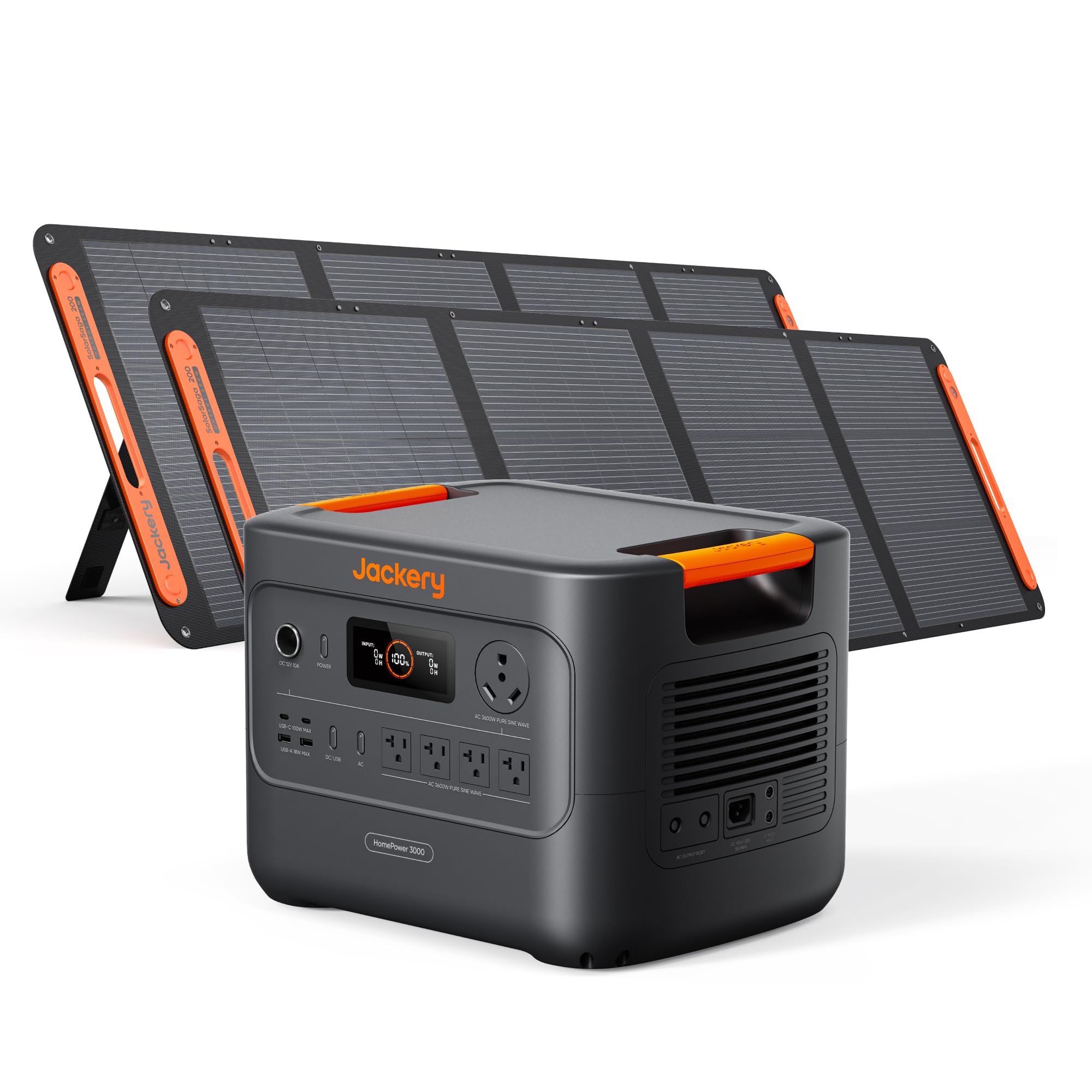
The Jackery HomePower 3000 is the largest unit here with 3,072Wh of LFP capacity and a 3,600W inverter (7,200W surge). It can run a refrigerator, freezer, WiFi router, lights, and a CPAP machine simultaneously for 10-15 hours — or keep a refrigerator alone running for up to 2 days. The dual 100W PD USB-C ports charge laptops and drones at full speed without an adapter.
AC charging takes 2.2 hours to full (1.7 hours with hybrid AC+DC). Solar charging with the included 2× 200W panels reaches 80% in 9 hours. ChargeShield 2.0 uses AI algorithms to optimize charging speed while preserving battery health — the LFP cells are rated for 4,000 cycles to 70% capacity. The built-in TT-30 RV port eliminates adapters for camper hookup. At 59.5 pounds, it’s heavy — a wheel kit is available separately.
The biggest limitation is non-expandability — you cannot add capacity beyond the internal 3,072Wh. The 60-pound weight without a wheel kit makes it effectively stationary unless you’re loading it into a truck bed. Some users found that recharging solely via solar in tree-shaded campsites was insufficient; full sun is required. At ~ with panels, it’s a significant investment aimed at users who need a single heavy-duty solution rather than a modular system.
Why it’s great
- 3,072Wh runs fridge + essentials for 2 days.
- 7,200W surge starts large appliances reliably.
- TT-30 RV port and dual 100W USB-C included.
Good to know
- Non-expandable — capacity is fixed at 3,072Wh.
- 59.5 lb is heavy; wheel kit purchase recommended.
- Solar recharge requires direct full sun for best results.
7. EF ECOFLOW RIVER 3

EF ECOFLOW’s RIVER 3 is the smallest station in this guide, but it carves a sharp niche: a UPS-grade backup that weighs 7.8 pounds and measures 30% smaller than the industry average for its class. The 245Wh LFP battery powers a router/modem stack for multiple days, and the 20ms auto-switching UPS has been tested by users with sensitive DVR and networking gear — no blips during power transitions.
The X-GaNPower technology improves efficiency below 100W loads — that’s your typical router, modem, and security camera draw. AC recharge from 0-100% takes 1 hour (X-Stream). Solar input maxes at 110W, reaching full in 2.6 hours. IP54 battery protection means it’s waterproof, fireproof, and drop-resistant. Operating noise stays below 30dB — genuinely silent.
The 300W inverter (600W X-Boost surge) limits what you can plug in: a mini fridge or small TV works, but a space heater or microwave does not. There’s no USB-C PD output (the 100W USB-C in the Elite 30 V2 is missing here). For users who want a primary camping power source, the 245Wh capacity runs out fast — this is a dedicated UPS and ultra-light travel companion, not a weekend basecamp solution.
Why it’s great
- 7.8 lb with GaN efficiency — ideal as a networking UPS.
- 1-hour AC recharge keeps downtime minimal.
- IP54 rated against water and dust ingress.
Good to know
- 245Wh capacity limited to low-draw devices only.
- No USB-C PD output for laptop fast charging.
- 300W inverter insufficient for space heaters or microwaves.
8. BLUETTI Elite 30 V2
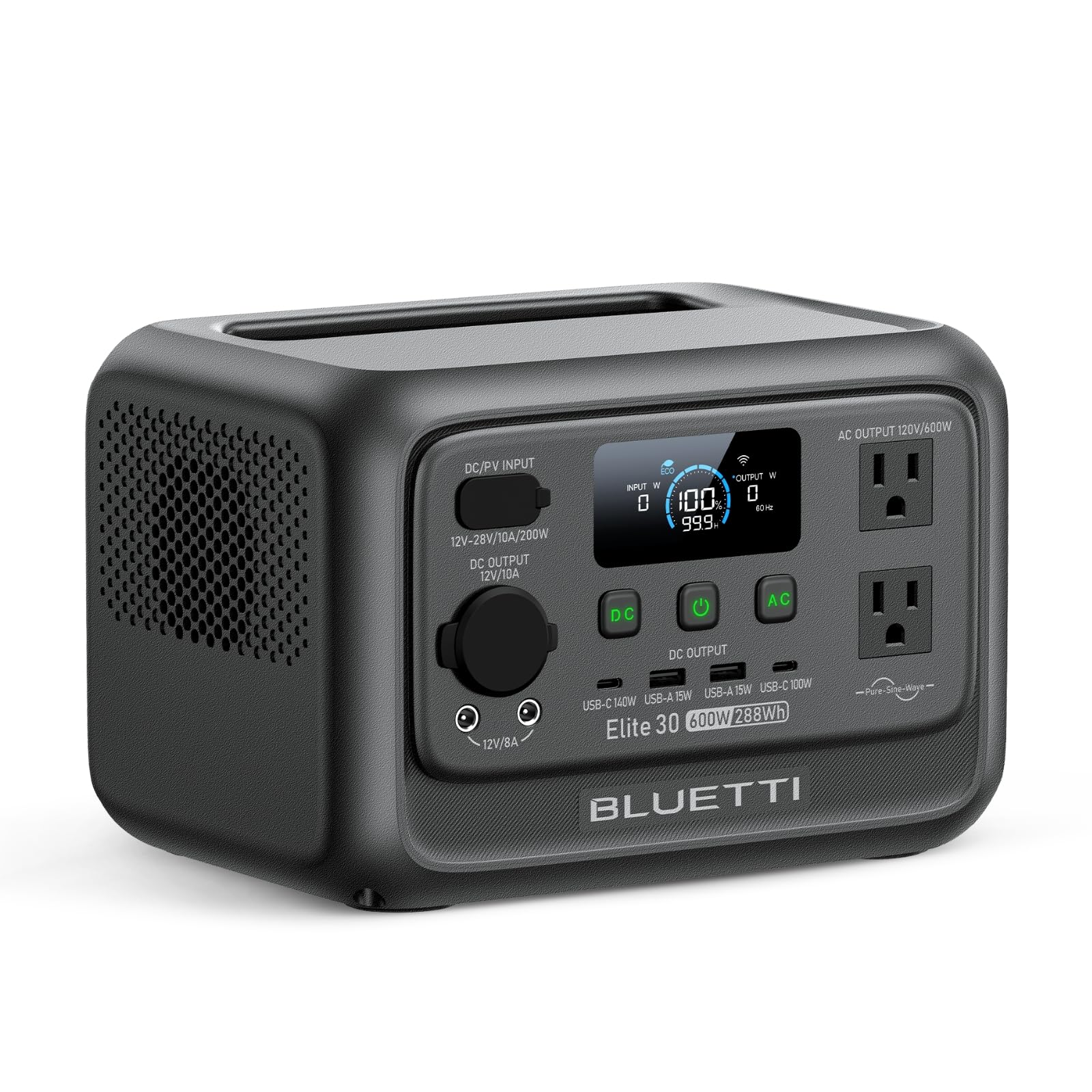
The BLUETTI Elite 30 V2 delivers 288Wh with a 600W inverter that can surge to 1,500W via Power Lifting mode — enough to briefly run a 1,200W kettle or toaster. At 9.4 pounds, it’s nearly as portable as the RIVER 3 but with double the inverter headroom. The 2C USB-C ports (140W + 100W) charge a MacBook Pro at full speed, and the 380W AC input refills the battery in 70 minutes.
The UPS switchover at 10ms is faster than the RIVER 3’s 20ms — verified by reviewers using CPAP machines without any pressure drop during grid disconnects. The app provides real-time monitoring and settings adjustments. Standby power consumption is cut 50% via upgraded UltraCell tech, dropping to 4.5W standby. Eight charging modes cover AC, solar (up to 200W), car, and generator input.
Capacity is still entry-level: 288Wh runs a CPAP for one night or a small fridge for 4-5 hours, but you’ll drain it before evening if running multiple devices. The 1,500W surge is limited to brief bursts — sustained loads above 600W will trigger protection. Build quality is solid, but initial off-gassing (typical of LFP batteries) was noted by a reviewer, requiring a brief airing-out period.
Why it’s great
- 1,500W Power Lifting mode can run small kettles and toasters.
- 140W + 100W USB-C ports for ultra-fast device charging.
- 10ms UPS switchover certified for CPAP and sensitive gear.
Good to know
- 288Wh capacity depletes quickly under multi-device load.
- Surge mode is burst-only, not sustained power.
- Initial LFP off-gassing may require ventilation before use.
9. VTOMAN Jump 600X

The VTOMAN Jump 600X is the only unit in this guide that doubles as a car jump starter — a genuine differentiator for roadside emergencies. The 299Wh LFP battery delivers 600W constant power (1,200W surge) and can jump-start a Dodge Ram at 9% battery, according to a verified review. Expandability is built in: an optional extra battery brings total capacity to 939Wh.
Output flexibility is strong: 2× AC outlets, 3× USB-A (one QC 3.0), 1× USB-C PD 60W, 2× DC5521, and a 12V car port — all with regulated 12V DC output that’s friendly to CPAP machines and car fridges. Pass-through charging lets you run devices while the station itself recharges. AC recharge takes about 3 hours to full; 110W solar input takes 5-6 hours for a full fill.
The trade-offs are visible: AC recharge is slow compared to the competition (3 hours vs. 1 hour on the ECOFLOW or BLUETTI entry units). The 14.6-pound weight is heavier than the ECOFLOW RIVER 3 (7.8 lb) for only 54 more watt-hours. The jump-start feature uses a separate port and requires jumper cables (not included). For urban users who don’t need jump-start capability, the extra weight and slower charging make the entry-level BLUETTI or ECOFLOW better value.
Why it’s great
- Integrated car jump-start saves buying a separate device.
- Expandable to 939Wh with optional extra battery.
- Regulated 12V DC ports safe for CPAP and car fridge.
Good to know
- AC recharge at 3 hours is slower than category peers.
- 14.6 lb is heavy for its 299Wh capacity.
- Jump-start cables not included — must be purchased separately.
FAQ
Can I run a 1,500W space heater from a 1,000W rated power station?
How long does a 2,000Wh station power a full-size refrigerator?
What does UPS mode mean on a portable power station?
Final Thoughts: The Verdict
For most users, the best battery portable power station winner is the BLUETTI Elite 100 V2 because it delivers the ideal balance of capacity, recharge speed, and inverter power at a mid-range price point — covering home backup and camping without the bulk or cost of 2kWh-plus systems. If you want the absolute fastest charging and expandable capacity for extended off-grid use, grab the Anker SOLIX C2000 Gen 2. And for RV owners who need direct TT-30 integration at a competitive weight, the GROWATT INFINITY 2000 Pro is the clear specialist choice.