
The wrong spool turns a functional bracket into a puddle. Standard PLA droops at 60°C, leaving engine-bay parts and outdoor fixtures deformed. The right heat-resistant filament holds its geometry up to 215°C, resists UV degradation, and withstands impact loads that shatter brittle polymers. Choosing a material built for thermal stress means the difference between a permanent fix and a melted failure.
I’m Min — the co-founder and writer behind Gadgets Feed. This guide cuts through marketing claims, analyzing glass-transition temperatures, heat deflection data, and real-world layer adhesion across seven competing spools.
After cross-referencing technical datasheets, customer endurance tests, and printability scores, I have assembled the definitive ranking of the best 3d filament for heat resistance currently available on the market.
How To Choose The Best 3D Filament For Heat Resistance
Selecting a filament for high-temperature applications hinges on three interlocking variables: the polymer’s glass transition temperature, the exact printed environment, and the mechanical load the part must carry. A material that excels at 100°C may warp severely if the printer lacks an enclosure, while a filament with extreme heat deflection may require a hardened nozzle. Understanding these trade-offs prevents wasted spools and failed prints.
Glass Transition Temperature vs. Heat Deflection Temperature
Glass transition temperature (Tg) marks the point where a polymer softens from a rigid state into a rubbery one. Standard PLA has a Tg around 60°C, making it unsuitable for car interiors or electronics enclosures. Heat deflection temperature (HDT) measures deformation under a specific load at rising temperatures. Premium materials like carbon-fiber nylon boast HDT values above 200°C, while ABS and ASA typically operate between 90°C and 105°C. Always prioritize the HDT specification for load-bearing thermal applications.
Bed Temperature, Enclosure, and Adhesion Strategy
Heat-resistant filaments demand higher bed temperatures — ABS requires 80–110°C, while nylon-based materials need 100–120°C. A heated enclosure is mandatory for ABS and nylon to prevent delamination from uneven cooling. Without an enclosure, ASA offers a slightly wider processing window than ABS but still benefits from a draft shield. PEI sheets, garolite, or adhesive layers like Magigoo are common adhesion strategies that prevent corner lifting during long prints.
Nozzle Wear and Extrusion Temperature
Glass-filled and carbon-fiber-reinforced filaments are abrasive. A standard brass nozzle will wear rapidly after a single spool of PA6-CF20 or ABS-GF. Switching to a hardened steel or ruby nozzle is essential when printing composite materials. Extrusion temperatures for high-performance filaments range from 230°C for ABS Pro up to 290°C for nylon-CF blends. Verify your printer’s hotend can sustain these temperatures before purchasing.
Quick Comparison
On smaller screens, swipe sideways to see the full table.
| Model | Category | Best For | Key Spec | Amazon |
|---|---|---|---|---|
| Polymaker Fiberon PA6-CF20 | Nylon-CF | Extreme heat & structural parts | HDT 215°C | Amazon |
| Bambu Lab ABS | ABS | Engineering-grade reliability | 0.03mm tolerance | Amazon |
| Siraya Tech Fibreheart ABS-GF | ABS-GF | Industrial & automotive parts | HDT 93°C | Amazon |
| Creality Hyper ABS | ABS | High-speed heat resistance | Impact strength 19kJ/m² | Amazon |
| FLASHFORGE ABS Pro | ABS | Low-warp, low-odor ABS | Deformation below 90°C | Amazon |
| SUNLU ASA | ASA | Outdoor UV & rain resistance | UV/rain/heat resistant | Amazon |
| 3D-Fuel Tough Pro PLA+ | PLA+ | Easy printing with heat resistance | Annealable for extra strength | Amazon |
In‑Depth Reviews
1. Polymaker Fiberon PA6-CF20 Carbon Fiber Nylon Filament

The Fiberon PA6-CF20 sets the ceiling for heat resistance in this lineup. With a heat deflection temperature of 215°C under 0.45 MPa load, this nylon-carbon fiber composite handles environments that would melt ABS twice over. The 20% chopped carbon fiber content boosts stiffness dramatically while maintaining excellent layer adhesion — prints exhibit a glassy stiffness that resists torsional and tensile loads without creeping over time.
Printing requires a hardened nozzle — 0.6mm or larger is recommended to prevent wavy extrusion from the abrasive fibers. The spool arrives vacuum-sealed in a resealable bag, and while the packaging claims it comes reasonably dry, drying at 80°C for 4–6 hours eliminates any risk of bubbling. Users report flawless Benchys straight from the factory packaging, with no stringing and excellent overhang performance.
The 0.5kg spool size is a trade-off: the material is dense and expensive by weight, but the resulting parts outperform anything in the standard ABS class. For automotive brackets, drone frames, jigs, and prosthetics that must survive sustained heat, this filament justifies its premium-tier cost through sheer engineering margin.
Why it’s great
- Extreme heat resistance (HDT 215°C) unmatched in this test group.
- Excellent layer adhesion with glassy stiffness for structural loads.
- Prints well with Bambu presets and stock enclosed printers.
Good to know
- Requires hardened steel or ruby nozzle (0.6mm+ recommended).
- 0.5kg spool is smaller than standard 1kg rolls.
- Needs thorough drying before printing for best results.
2. Bambu Lab ABS Filament 1.75mm 1kg
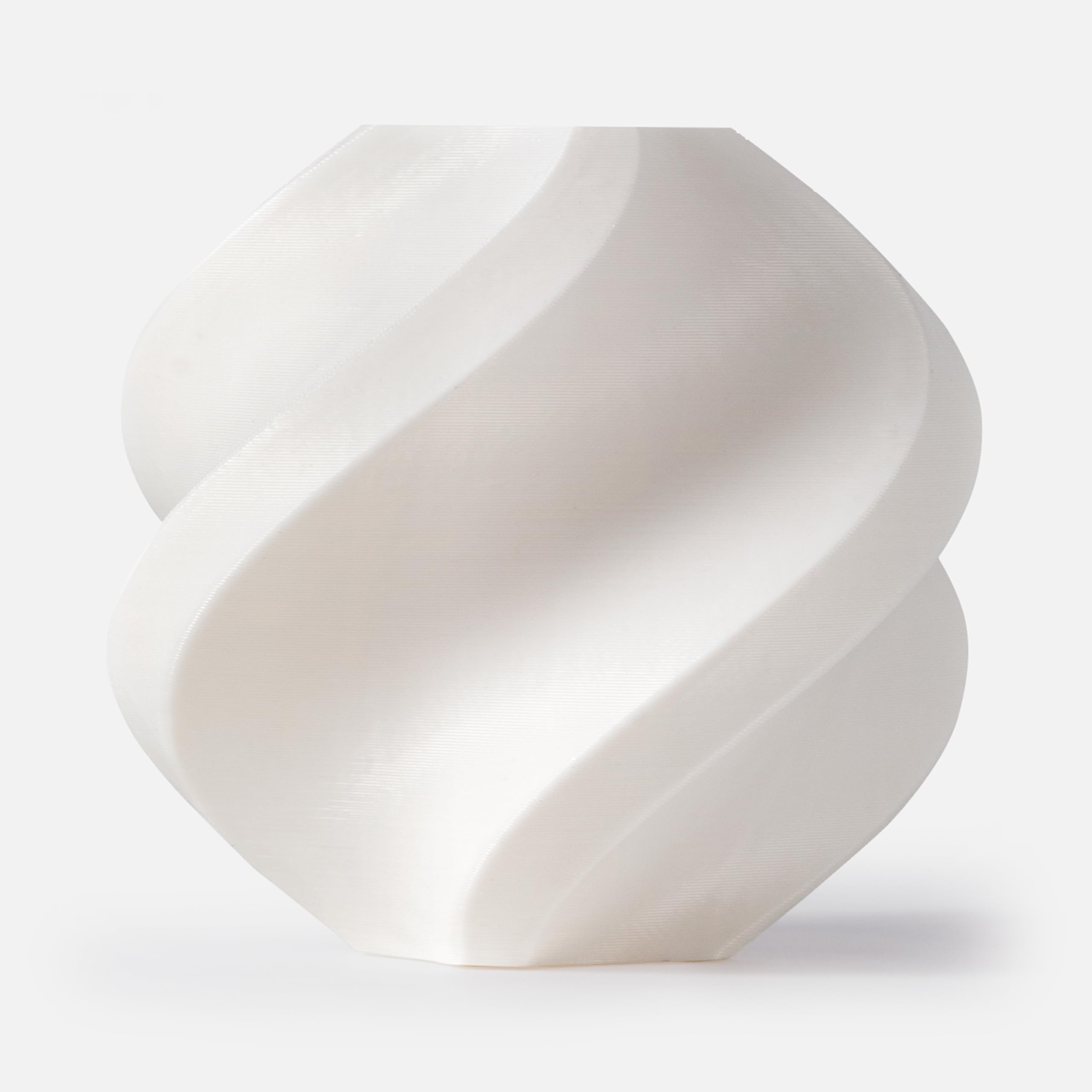
Bambu Lab’s own ABS formulation delivers consistent, engineering-grade prints straight from the AMS. The RFID-equipped spool auto-loads the correct print profile on Bambu printers, eliminating guesswork with nozzle temperature (recommended 260–280°C) and bed temperature (90–110°C). The 0.03mm diameter tolerance ensures smooth extrusion across long runs, and users report zero clogs or tangles across entire rolls.
The formulation is designed for stability and low warp. When printed in an enclosed chamber like the X1C or P1S, parts show minimal corner lifting even at full build-plate size. The white color in this SKU provides excellent contrast for post-processing — the material sands cleanly and responds well to acetone vapor smoothing for professional surface finishes.
Mechanical parts printed with this ABS hold their geometry well under sustained temperatures up to 90°C. It outperforms standard PLA by a wide margin in rigidity and long-term durability. For users already invested in the Bambu ecosystem, this spool is the friction-free path to heat-resistant functional prototypes and production parts.
Why it’s great
- RFID auto-configuration on Bambu printers saves setup time.
- Consistent ±0.03mm diameter eliminates clogging risks.
- Excellent post-processing versatility (sanding, painting, acetone smoothing).
Good to know
- Requires enclosed printer for best warp control.
- Strong ABS fumes demand ventilation.
- Premium pricing reflects brand ecosystem integration.
3. Siraya Tech Fibreheart ABS-GF Premium Glass Fiber Filament

Siraya Tech’s Fibreheart ABS-GF takes standard ABS and reinforces it with glass fibers, pushing heat deflection to 93°C while adding significant stiffness. The fiberglass content minimizes warping compared to virgin ABS, making it a forgiving material for functional prototypes that must survive engine-bay or hot-climate conditions. The matte black finish hides layer lines well, giving parts a professional injection-molded appearance.
Printing requires an enclosed chamber with bed temperatures of 90–100°C on textured PEI. The material is less abrasive than carbon-fiber nylons but still demands a hardened nozzle for spool longevity. Users note that the filament is brittle during feeding — if the AMS path has tight bends, the material can snap, so direct-feed setups are preferred. Once printed, layer adhesion is robust, and parts resist delamination under moderate impact loads.
This ABS-GF occupies a niche between standard ABS and premium nylon-CF blends. It offers noticeably higher rigidity than standard ABS without the extreme drying and nozzle requirements of carbon-fiber nylon. For automotive interior trims, jigs, and structural components that face sustained warm environments, it delivers a balanced mix of dimensional stability and affordability.
Why it’s great
- Glass fiber reinforcement boosts stiffness and reduces warp.
- HDT 93°C outperforms standard ABS and PLA.
- Professional matte finish with good layer hiding.
Good to know
- Brittle filament can snap in tight AMS paths.
- Requires thorough drying before use.
- Some users report lower shear strength than Bambu ABS-GF.
4. Creality Hyper ABS Filament 1.75mm 2KG
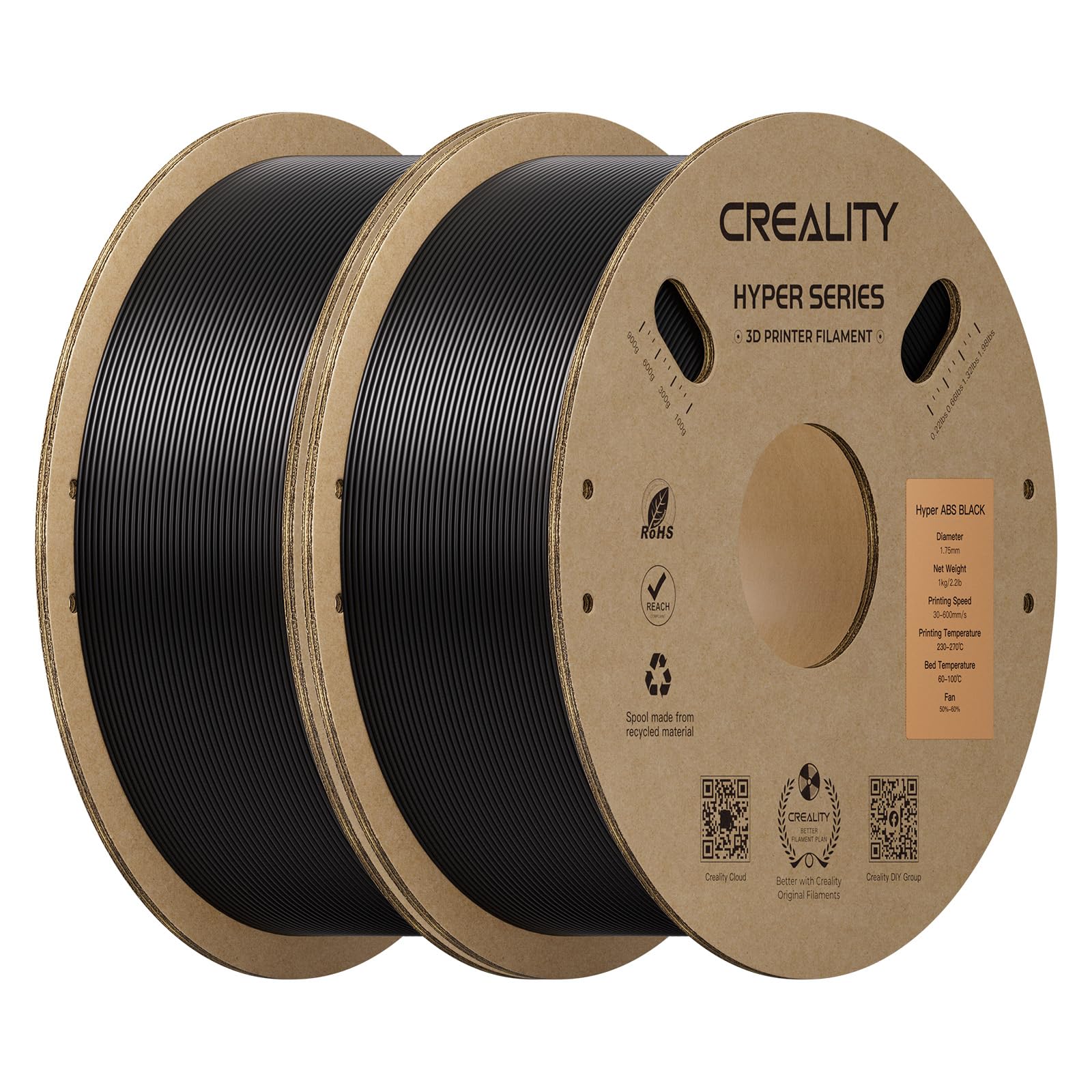
Creality’s Hyper ABS redefines what ABS can do at speed. Rated for printing up to 350mm/s without sacrificing surface quality, this filament leverages a high-fluidity, fast-cooling formula that keeps up with modern high-speed motion systems like the K1 Max and Ender-3 V3. The impact strength of 19kJ/m² nearly doubles standard PLA, making parts resilient to sudden mechanical loads.
The formulation reduces volatile emissions compared to traditional ABS, supporting a more comfortable printing environment — though an enclosure and ventilation remain recommended. Prints show clean surface finishes and solid layer adhesion even at high flow rates. The 2kg twin-pack provides excellent value for users burning through material for production runs or iterative prototyping.
Heat resistance aligns with standard ABS performance, holding structural integrity up to roughly 90°C. The softer, more flexible feel compared to conventional ABS is noticeable but does not compromise functional strength. Users report consistent diameter feeding without clogs or tangles across full spools, and the low warp characteristic allows large-format prints without corner lifting when printed inside an enclosure.
Why it’s great
- Up to 350mm/s print speed without quality loss.
- High impact strength (19kJ/m²) for durable functional parts.
- Low odor formula improves printing environment.
Good to know
- Requires higher nozzle temps than standard ABS.
- Enclosure still recommended for best warp control.
- Premium per-spool cost compared to generic ABS.
5. FLASHFORGE ABS Pro Filament 1.75mm Burnt Titanium
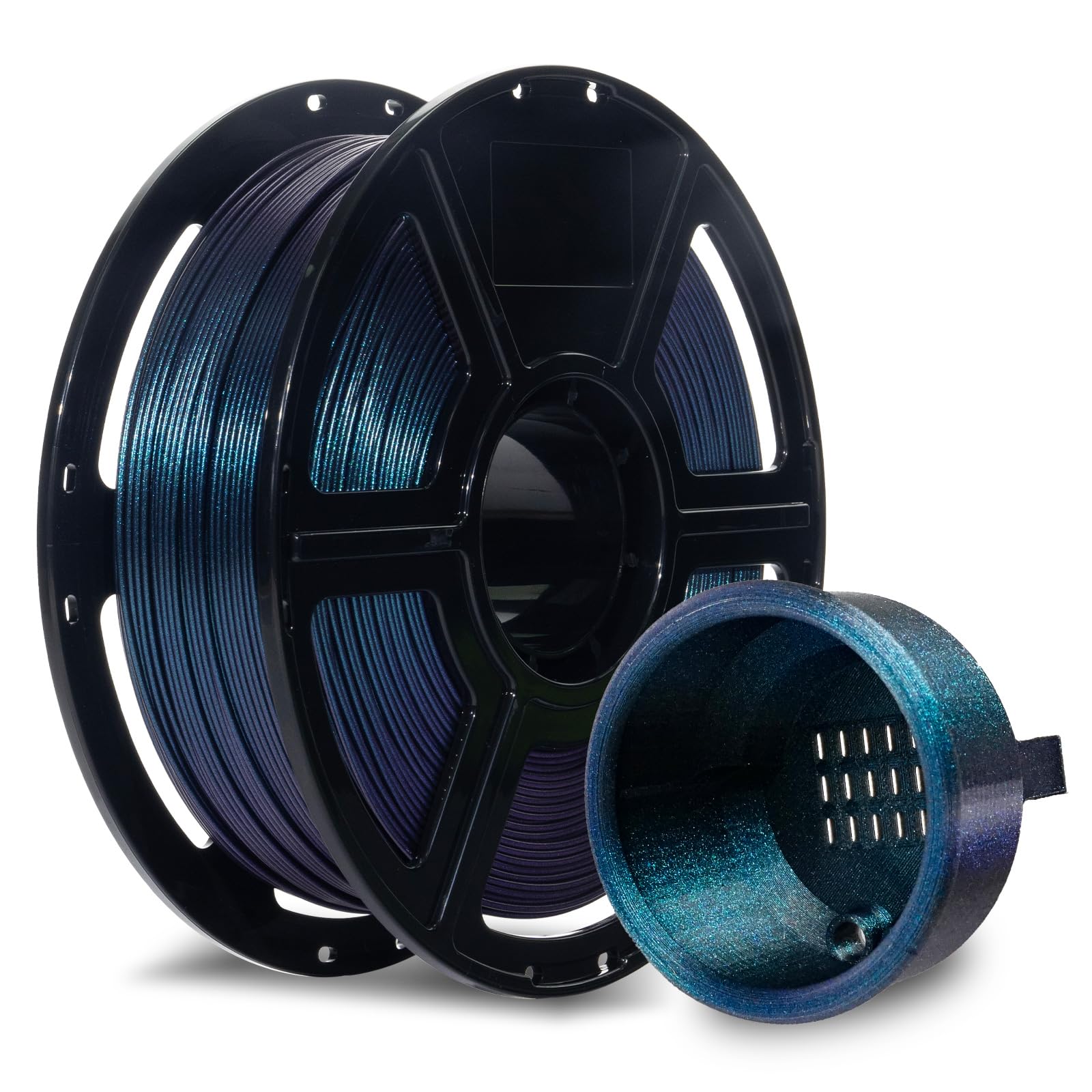
FLASHFORGE ABS Pro addresses the two biggest complaints about standard ABS: warping tendency and strong fumes. This formulation reduces shrinkage and cracking risks significantly, making it a strong contender for large-format prints that would normally fail with conventional ABS. The chameleon “Burnt Titanium” color shifts between bronze, purple, and magenta depending on lighting, effectively masking layer lines for aesthetic parts.
Print settings land at 230–240°C nozzle and 90°C bed — lower than standard ABS, which reduces thermal stress on the print chamber. Users report successful prints on Bambu P1S and Qidi machines without any adhesion aids beyond textured PEI. The low-odor characteristic makes it tolerable for garage workshops where ventilation is marginal, though proper enclosure is still recommended for dimensional stability.
Heat deformation remains below 90°C, matching the performance of standard ABS for automotive interior parts and electronics enclosures. The material is slightly more brittle than classic ABS, but layer adhesion is consistent when kept dry — this filament is notably hygroscopic for an ABS variant, requiring active drying after a week of exposure to ambient humidity. For users prioritizing low-odor prints with vibrant color shifting, this spool is a compelling choice.
Why it’s great
- Low warp tendency enables large-format prints without failure.
- Chameleon color effect hides layer lines beautifully.
- Reduced odor compared to traditional ABS.
Good to know
- More hygroscopic than standard ABS; requires drying after a week.
- Slightly more brittle than classic ABS.
- Color accuracy may shift from product photos.
6. SUNLU ASA Filament 1.75mm

SUNLU ASA is the go-to choice for prints that live outdoors. ASA shares ABS’s heat resistance (softening around 95–100°C) but adds superior UV stability — it won’t yellow or embrittle after months of direct sunlight. This makes it ideal for garden irrigation parts, house numbers, automotive exterior trim, and marine components that endure rain and thermal cycling.
The recommended nozzle range of 230–260°C with a bed at 80–120°C gives flexibility across different printer types. The diameter tolerance of ±0.02mm ensures reliable feeding, and users confirm excellent bed adhesion on garolite and textured PEI at 100–120°C bed temps. Minor warping can occur on larger prints, but this is mitigated with an enclosure or draft shield. The odor is noticeably lower than standard ABS, making it more workshop-friendly.
Some spools arrive with compromised vacuum seals — about 2 out of 5 according to experienced users — so drying the filament before printing is a wise precaution. Once dialed in, the material produces tough, weather-resistant parts that maintain their dimensional accuracy through seasons of outdoor exposure. For the price, it offers the best UV resistance of any spool in this lineup.
Why it’s great
- Outstanding UV and rain resistance for permanent outdoor use.
- Low odor compared to standard ABS.
- Excellent bed adhesion with correct temperature tuning.
Good to know
- Vacuum seal inconsistent — drying recommended before printing.
- Requires enclosure for large prints to avoid warping.
- Slightly more expensive than basic ABS spools.
7. 3D-Fuel Tough Pro PLA+ Midnight Black

3D-Fuel’s Tough Pro PLA+ bridges the gap between easy printing and respectable heat resistance. Made in the USA with NatureWorks Ingeo 3D870 resin, this PLA+ is 4.3x stronger than standard PLA and crucially supports annealing. Post-print heat treatment at roughly 80–90°C raises the material’s heat deflection significantly, allowing it to survive environments that would normally deform generic PLA.
Out of the spool, the filament prints with a smooth matte finish at 220–230°C nozzle temperature. It requires higher extrusion temps than typical PLA — users report best results at 225°C with 40mm/s speed. Adhesion on garolite or clean textured PEI is excellent, and the material exhibits less brittleness than standard PLA, making it more forgiving for snap-fit assemblies. The spool arrives vacuum-sealed with desiccant, and the packaging includes a cleverly designed box that protects against shipping damage.
The trade-off is that even annealed, it cannot match the raw heat deflection of ABS or nylon-carbon blends. For users who lack an enclosed printer or who want a single-material solution that handles moderate heat (car interiors, electronics cases) while printing on an open-frame machine, Tough Pro PLA+ is the most forgiving entry point into heat-resistant materials. It will not replace ABS for engine-bay use, but it dramatically lowers the barrier for heat resistance without requiring a printer upgrade.
Why it’s great
- Annealable for significantly improved heat deflection.
- Prints easily on open-frame printers without enclosure.
- Made in USA with premium Ingeo resin — consistent quality.
Good to know
- Heat resistance still below ABS even after annealing.
- Requires higher print temperature than standard PLA.
- Higher per-spool cost than generic PLA+ filaments.
FAQ
Can I print heat-resistant filament on an open-frame printer without an enclosure?
What is the difference between ABS and ASA for outdoor heat resistance?
Do I need a hardened nozzle for glass-fiber or carbon-fiber filaments?
How do I dry heat-resistant filament that has absorbed moisture?
Final Thoughts: The Verdict
For most users, the best 3d filament for heat resistance winner is the Polymaker Fiberon PA6-CF20 because its 215°C HDT and carbon-fiber reinforcement set the performance ceiling for demanding automotive and industrial applications. If you want easy ABS printing with minimal warping and excellent consistency, grab the Bambu Lab ABS. And for outdoor UV resistance without sacrificing heat performance, nothing beats the SUNLU ASA.