
The smartphone in your pocket is a phenomenal camera, but it has a hard ceiling: the lens can’t reach. For the moments when your subject is a stage performer, a distant mountain ridge, a shy bird, or your kid scoring at a field event, the physical optics of a dedicated small camera deliver a result that no computational photography trick can match. The catch? You need real zoom, real stabilization, and a sensor that isn’t squeezed into a phone’s slim chassis.
I’m Min — the co-founder and writer behind Gadgets Feed. I’ve spent hundreds of hours combing through spec sheets, user feedback, and side-by-side comparisons across the budget-to-mid-range imaging market to find the compact cameras that actually deliver on their promises without breaking the bank.
Whether you are documenting a family vacation, starting a vlog, or just rediscovering the joy of framing a shot through a viewfinder, the right choice starts here with a curated selection of best affordable small digital cameras that balance portability, zoom reach, and image quality for real-world shooters.
How To Choose The Best Affordable Small Digital Camera
The affordable compact camera market is crowded with rebadged sensors, inflated megapixel claims, and feature lists that look identical on paper. The difference between a camera you actually use and one that sits in a drawer comes down to three specific decisions: optical reach, stabilization type, and battery logistics.
Optical Zoom is Non-Negotiable
A 6x or 30x optical zoom lens is the entire reason to buy a dedicated camera. Ignore the “digital zoom” number on the spec sheet — that is just cropping inside the camera. The real measure is the lens’s focal length range. A 24mm wide-angle to 720mm telephoto (like the Panasonic ZS99) lets you pull in distant subjects with no quality loss. A fixed 3x or 6x zoom is still leagues ahead of a phone’s hybrid zoom.
Megapixels: Read Between the Lines
The headline number (64MP, 88MP, 96MP) is almost always an interpolated value. An entry-level 16MP or 20MP sensor — like the one in the Kodak PIXPRO or the OM SYSTEM Olympus — will produce a sharper, more color-accurate image than a 64MP sensor that started from a lower native resolution. Look for the native sensor megapixels in the fine print or real customer tests.
Battery Life and Charging Realities
A camera that runs on standard AA batteries (Kodak PIXPRO) is a lifesaver on long trips where you can grab replacements at any store. A camera with a proprietary lithium-ion cell (most of the others) gives you longer runtime per charge but requires planning. Check whether the package includes a second battery — this alone determines whether you leave the camera on or ration its use.
Quick Comparison
On smaller screens, swipe sideways to see the full table.
| Model | Category | Best For | Key Spec | Amazon |
|---|---|---|---|---|
| Panasonic LUMIX ZS99 | Premium Compact | Concerts & travel zoom | 30x optical zoom (24-720mm) | Amazon |
| OM SYSTEM Olympus E-M10 IV | Mirrorless ILC | Image quality & lens upgrades | 20MP Live MOS + 5-axis IBIS | Amazon |
| Kodak PIXPRO AZ255-BK | Budget Superzoom | Long battery access (AA) | 25x optical zoom (24mm wide) | Amazon |
| Saneen 4K 64MP | Value Kit | WiFi sharing & webcam use | 4.0″ touchscreen + 3000mAh battery | Amazon |
| XNSIAKXA 8K 88MP | Feature-Rich | 8K video & 16x digital zoom | F2.8 aperture + charging stand | Amazon |
| 5K 96MP Jukanur | Mid-Range Starter | 5K video & included 64GB card | 6x optical zoom + flash | Amazon |
| 5K WiFi Nsoela | WiFi Touch | WiFi transfers & touchscreen | 2.8″ IPS touch + dual batteries | Amazon |
| LOUM 8K 88MP | Entry-Level 8K | Selfie vlogging with dual lens | 2.8″ IPS touch + 16x zoom | Amazon |
| Minolta MND20 | Beginner Gadget | Ultra-light casual shooting | 2.7K video + 16x digital zoom | Amazon |
In‑Depth Reviews
1. Panasonic LUMIX ZS99 Point and Shoot Camera

This is the camera that makes a dedicated device worth carrying. The Leica-branded 24-720mm optical zoom lens (30x) is the headline act — it pulls in concert stages, wildlife, and distant landmarks with optical clarity that no phone can approach. The 20.3MP sensor keeps image quality solid in good light, and the 1,840k-dot tiltable touchscreen gives you flexibility for overhead or ground-level shots.
4K video at 30p and 1080p slow-motion at 120fps cover content creation needs, while Bluetooth 5.0 and the dedicated Send Image button make wireless transfers seamless. The hybrid autofocus system with 121 points is responsive in most situations, though low-light performance lands below flagship phones due to the small 1/2.3-inch sensor. The 5-axis HYBRID O.I.S.+ stabilization is effective for handheld telephoto shots but won’t replace a gimbal for walking video.
Battery life is a practical consideration — expect about 300 shots per charge, and the USB Type-C charging (with record-while-charging support) is welcome for travel. A few users report the lens housing can dent without a protective case, causing zoom mechanism issues, so a soft pouch is recommended. For anyone who needs real optical reach in a jacket-pocket package, this is the benchmark.
Why it’s great
- 30x optical zoom (24-720mm) in a pocketable body
- USB-C charging with record-while-plugged support
- Fast hybrid autofocus with 121 focus points
- Bluetooth 5.0 for quick smartphone transfers
Good to know
- Small 1/2.3-inch sensor — noise visible above ISO 800
- 4K video capped at 15-minute continuous recording
- Charging port cover feels flimsy
- No built-in flash
2. OM SYSTEM Olympus E-M10 Mark IV

If you value image quality and the ability to grow your system, the E-M10 Mark IV is the most capable compact camera in this price bracket. Its 20MP Live MOS sensor paired with the in-body 5-axis image stabilization (rated for 4.5 stops) lets you hand-hold shots at shutter speeds that would be impossible on most competitors — users report sharp results down to 1-second exposures without a tripod.
The Micro Four Thirds lens mount opens an entire ecosystem of glass, from ultra-wide to super-telephoto. The included M.Zuiko 14-42mm f/3.5-5.6 EZ pancake lens keeps the kit pocketable, and the flip-down monitor activates a dedicated Selfie Mode, making it genuinely vlog-friendly. The 4K video (DCI 2160p) and 121-point contrast-detect autofocus are snappy in good light.
The downsides are practical: battery life is modest at roughly 360 shots per charge, the Wi-Fi transfer app is sluggish, and the kit lens, while compact, resolves best when stopped down. The burst rate of 8.7fps is adequate but not class-leading. For a beginner who wants a camera that can deliver professional-looking stills and accept better glass over time, this is the entry point.
Why it’s great
- 20MP Live MOS sensor with excellent dynamic range
- In-body 5-axis stabilization (4.5 stop compensation)
- Interchangeable Micro Four Thirds lens system
- Flip-down monitor with dedicated Selfie Mode
Good to know
- No USB-C charging — uses proprietary battery charger
- Contrast-detect AF can hunt in low light
- Wireless transfer app is slow and requires Wi-Fi setup
- Burst rate of 8.7fps under moderate buffer
3. Kodak PIXPRO AZ255-BK

The Kodak PIXPRO AZ255 delivers the most practical feature for long-haul travel: it runs on four AA batteries. When the battery dies on a hiking trail or in a rural area, you buy alkalines at any convenience store instead of hunting for a charging outlet. This alone makes it a unique player in the affordable compact space.
Its 25x optical zoom (24-600mm equivalent) and 16MP CMOS sensor produce clean images in daylight, and the optical image stabilization (OIS) helps at the telephoto end. The 3-inch LCD is serviceable for composition and review, and 1080p Full HD video is solid for casual recording. The auto mode handles exposure well, making it genuinely beginner-friendly.
The trade-offs are real: no 4K video, the contrast-detect autofocus is slow in dim conditions, and the camera body is larger than the pocket-focused competition. A few users report that the bundled Kodak memory card can cause formatting issues. For a budget-conscious buyer who prioritizes power flexibility and optical zoom range over 4K, this is the smart play.
Why it’s great
- 25x optical zoom (24-600mm equivalent)
- Runs on easily replaceable AA batteries
- Optical image stabilization for telephoto shots
- Beginner-friendly auto exposure and scene modes
Good to know
- No 4K video — maxes out at 1080p Full HD
- AF is slow and noisy in low light
- Bulkier than pocket-sized competition
- Does not include an SD card
4. Saneen 4K Digital Camera

The Saneen 4K stands out for its complete kit and large 4.0-inch touchscreen, which makes navigation significantly easier than the 2.8-inch displays common at this price. The 64MP interpolated stills are serviceable in good light, and the 4K video resolution gives you headroom for cropping in post. The dual-lens design with a front-facing camera is a genuine advantage for vloggers who want to frame themselves while recording.
The 3000mAh battery is notably larger than the typical 1000-1500mAh cells in competing units, translating to a full day of casual shooting. WiFi sharing via the companion app works reliably for social media uploads, and the HDMI output lets you review footage on a TV without a computer. The included lens hood helps reduce flare in bright conditions.
Image quality has limits: the f/4 fixed aperture means it struggles in low light without the built-in flash, and the small sensor produces noticeable noise above ISO 800. Some users report that the advertised 4K footage appears softer than expected when viewed on a monitor. For a beginner who wants the most accessories out of the box and a large screen, this is a compelling package.
Why it’s great
- 4.0-inch IPS touchscreen — the largest in this comparison
- Includes 3000mAh battery, lens hood, and bag
- Front-facing camera for vlogging and selfies
- WiFi sharing and HDMI output for easy playback
Good to know
- f/4 fixed aperture limits low-light performance
- 4K video is softer than true 4K from larger sensors
- Lens is fixed focal length (no optical zoom)
- Touchscreen can be slow to register inputs
5. XNSIAKXA 8K Digital Camera
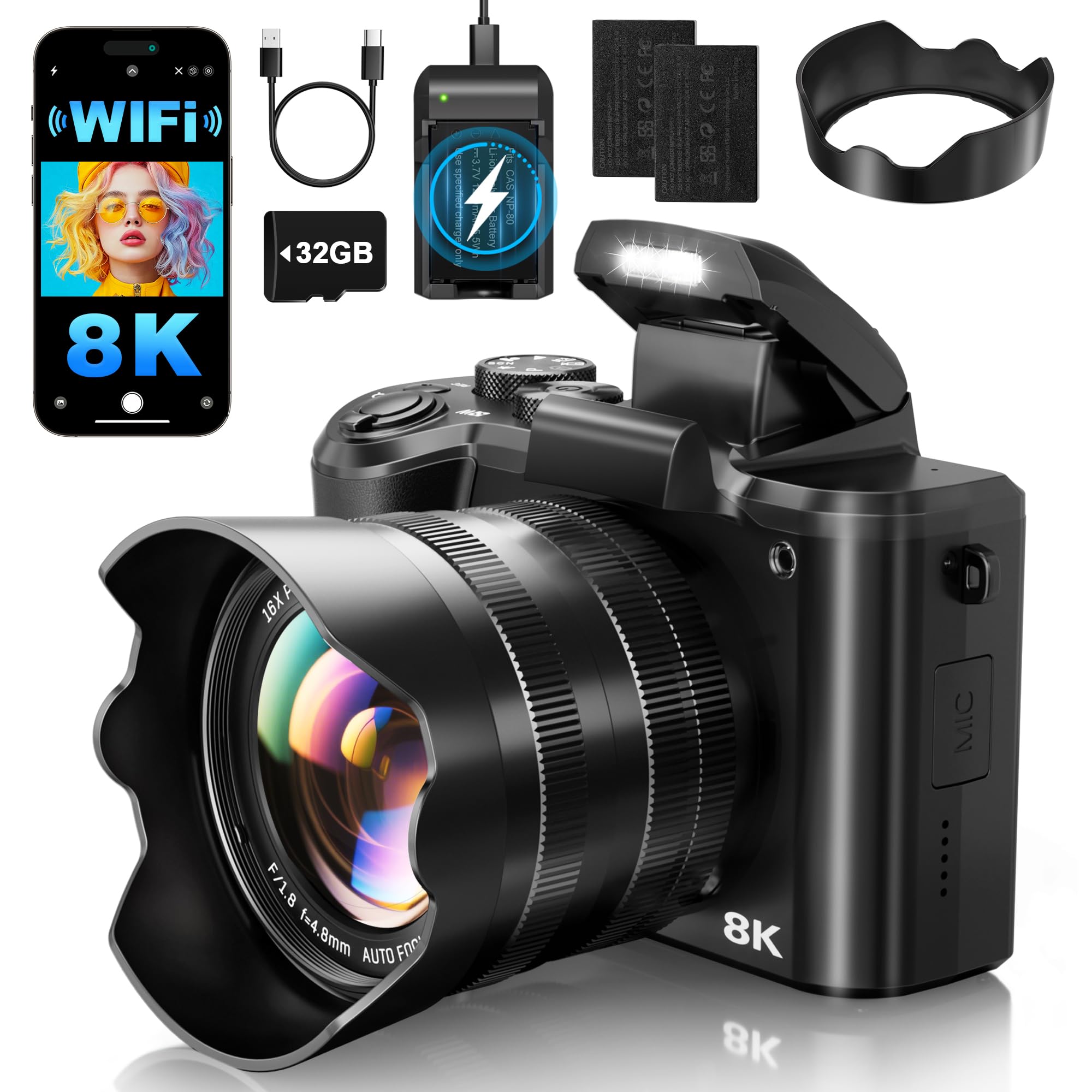
The XNSIAKXA pushes the spec sheet further than almost any competitor at its price, claiming 8K video resolution and an 88MP interpolated sensor. The f/2.8 aperture is faster than most entry-level lenses, meaning better light collection than the f/3.5 or f/4 competitors. The 360° rotary dial for mode switching (time-lapse, filter, portrait, landscape, slow motion) is a genuinely intuitive control that simplifies operation.
The package includes two large-capacity batteries and a charging stand, which is a rare and welcome addition — you can rotate batteries without tying up a USB port. WiFi transfer via the “iSmart DV2” app works for quick social sharing, and the 6-axis stabilization helps smooth out handheld video noticeably. The dual-lens design with front camera is useful for vloggers.
Real-world image quality is mixed. The autofocus system with 79 points works quickly in good light but some units show inconsistent focus in dim conditions, and the 8K is likely interpolated rather than native. Early reviews report battery drain under an hour for some batches. It delivers impressive features for the price, but expect compromises in low-light consistency and overall polish.
Why it’s great
- Fast f/2.8 lens for better low-light capture
- Includes two large batteries and a dedicated charging stand
- 360° rotary dial for quick mode switching
- WiFi and 6-axis stabilization for smoother video
Good to know
- 8K and 88MP are interpolated, not native
- Autofocus quality varies between units in low light
- Battery life reported as under 1 hour in some tests
- No manual focus control — fully dependent on contrast AF
6. 5K 96MP Digital Camera (Jukanur)
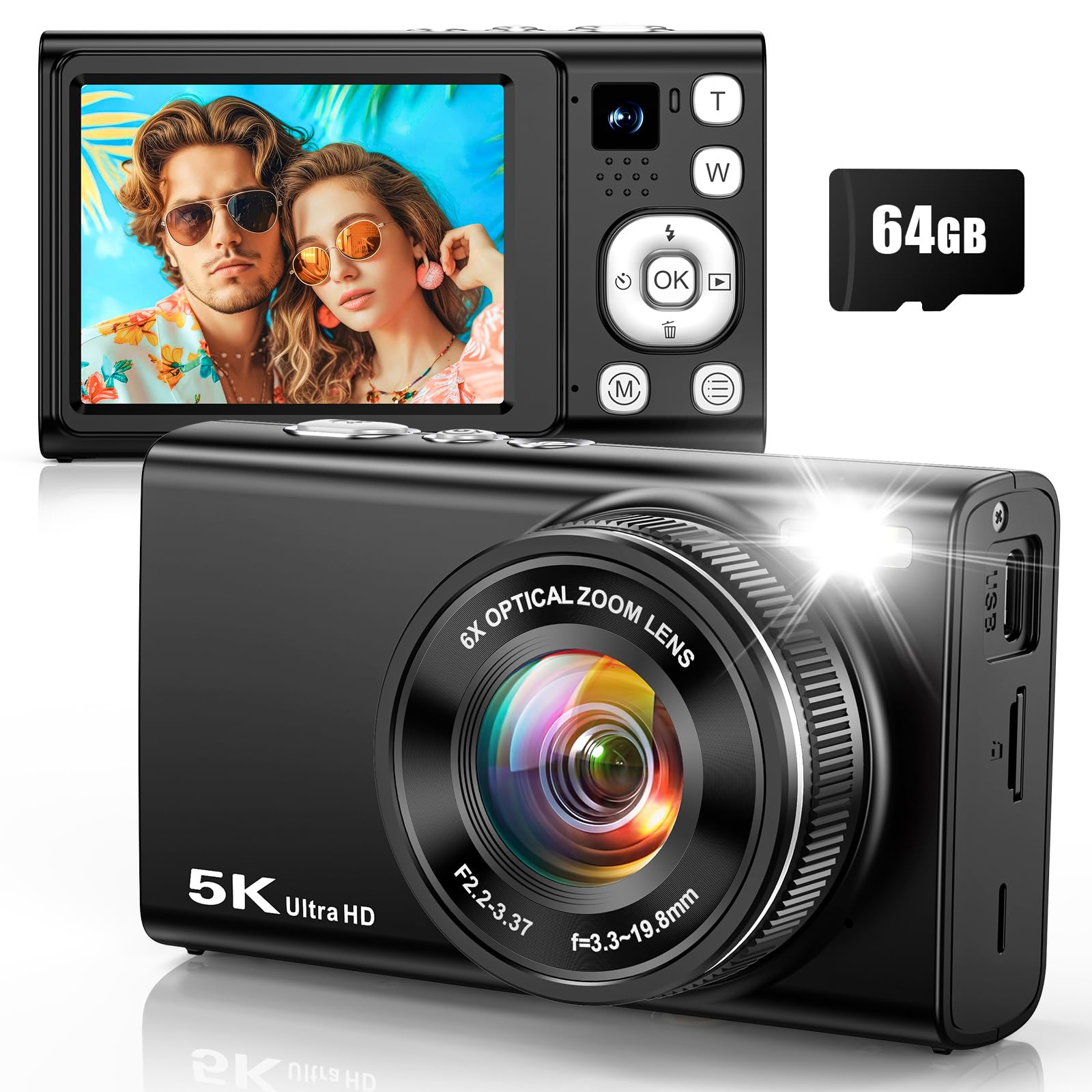
The Jukanur 5K camera delivers the most complete out-of-box experience at the entry level, including a 64GB microSD card, a storage bag, and a lanyard — you can start shooting immediately. The IMX415 CMOS sensor captures true 5K video (5120×2880) and interpolated 96MP stills, with 6x optical zoom that provides real reach without the quality loss of digital cropping.
The dual-lens design supports front-facing selfies and vlogging, and the built-in flash helps in low-light scenarios. Anti-shake stabilization reduces blur at the telephoto end, and features like time-lapse, slow-motion, and face detection give beginners room to experiment. The autofocus uses contrast detection and is fast enough for casual shooting.
Battery life is the weakest link — the built-in 800mAh cell lasts roughly two hours of mixed use, and the battery is not user-replaceable, meaning you must charge via USB and cannot swap in a spare. Some users report soft image quality in poor light and autofocus hunting. It is a capable starter camera for well-lit daytime use, but plan for recharging breaks during longer outings.
Why it’s great
- Includes 64GB microSD card and carrying case
- 6x optical zoom with anti-shake stabilization
- 5K video resolution for high-detail footage
- Dual front/rear lenses for selfies and vlogging
Good to know
- Built-in battery lasts only 2 hours; not user-replaceable
- Image quality softens in low light without flash
- Autofocus can hunt in dim conditions
- 96MP stills are interpolated, not native
7. 5K Digital Camera with WiFi (Nsoela)
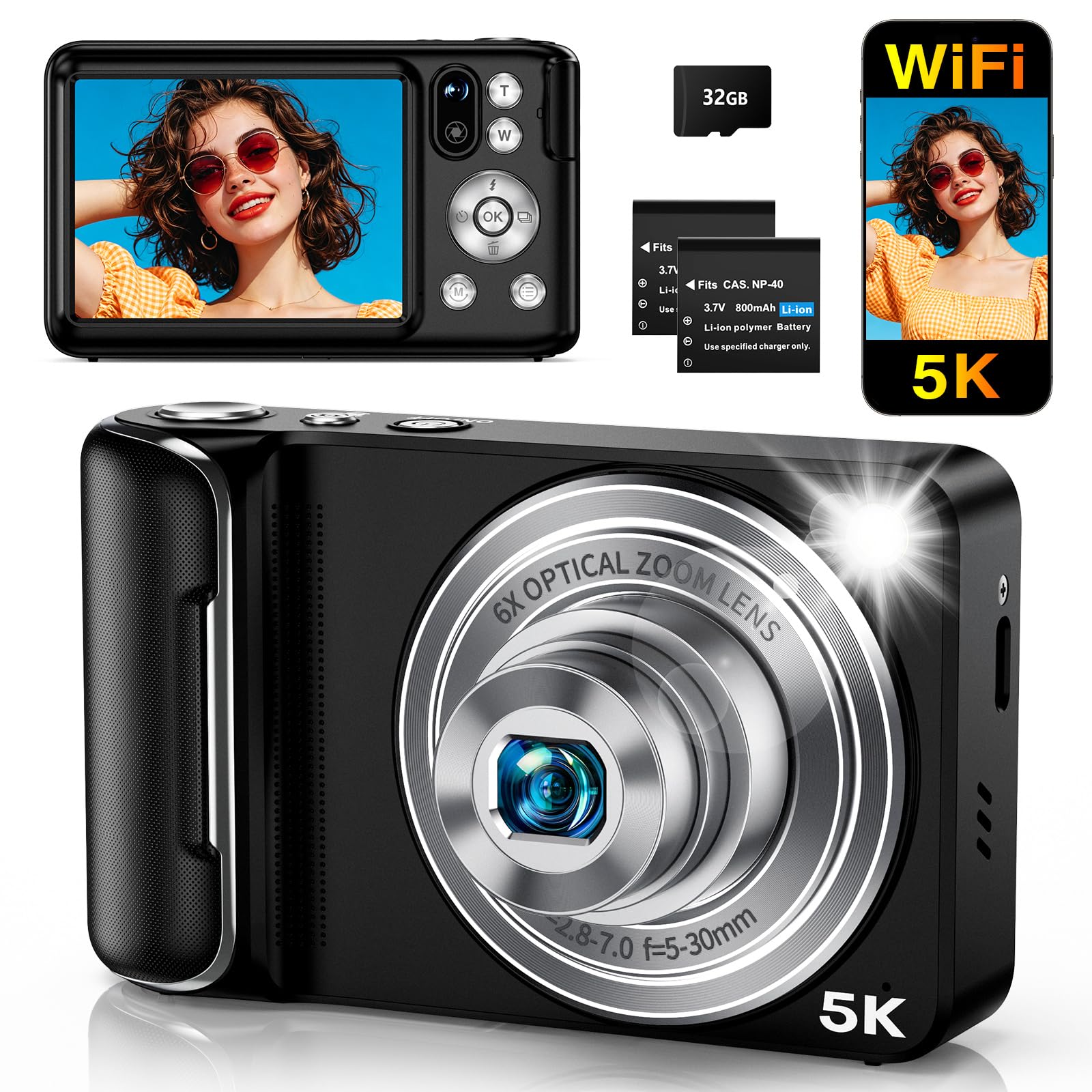
The Nsoela 5K camera is the best option in the entry tier for users who prioritize wireless convenience. The built-in WiFi connects to the Viipulse app for remote viewfinding, remote shutter control, and one-click original-quality downloads — a feature that saves the cable hassle on trips. The 2.8-inch IPS touchscreen supports pinch-to-zoom and swipe gestures for intuitive photo review.
It includes two rechargeable batteries and a 32GB memory card. The 6x optical zoom and fast contrast-detect autofocus perform well in daylight, and the auto-opening dust-resistant lens cover is a thoughtful design detail that eliminates the need for a separate cap. The webcam mode (front and rear switchable) works for live streaming and online classes.
Image quality in bright scenes is solid, with vivid colors and acceptable sharpness. Low-light performance is limited by the small sensor, and some units arrive with zoom jamming or autofocus defects — quality control is inconsistent. The menus take time to learn, and the app setup requires a stable connection. For a budget travel companion with WiFi, this is a good pick if you get a well-assembled unit.
Why it’s great
- Built-in WiFi for remote control and instant transfers
- 2.8-inch IPS touchscreen with pinch-to-zoom
- Includes two rechargeable batteries and 32GB card
- Auto-opening dust-resistant lens cover
Good to know
- Variable quality control — some units have zoom defects
- Low light images show noise and reduced sharpness
- Menus can be unintuitive initially
- WiFi app setup requires a stable network connection
8. LOUM 8K Digital Camera
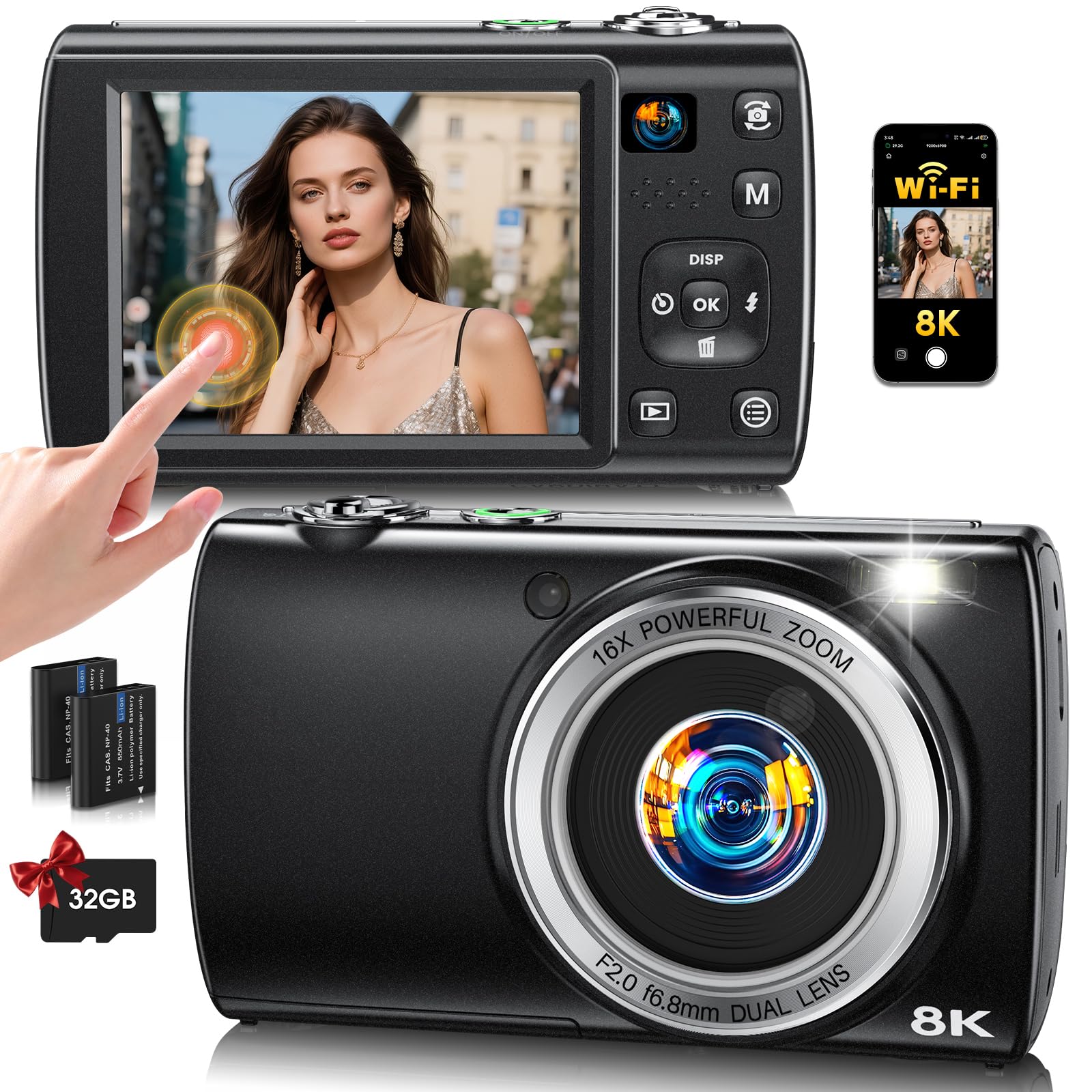
The LOUM 8K camera delivers the highest video resolution claim in this price bracket — 8K at 15fps (7680×4320) — along with interpolated 88MP stills and a 2.8-inch IPS HD touchscreen. The dual-lens system with front and rear cameras is designed for vloggers who want to switch between selfie and subject framing without rotating the camera.
The 16x digital zoom (digital only, no optical element) and 5-axis anti-shake stabilization help produce steady handheld clips. Creative modes including time-lapse, slow motion, loop recording, and burst give beginners plenty of room to experiment. The kit includes two batteries, a 32GB card, and a carrying bag.
Expect interpolation. The 8K resolution runs at a choppy 15fps, making it practical only for still-frame extraction or very slow motion. Real-world image quality with the 88MP setting appears softer than a native 20MP sensor. Users consistently praise the build quality and ease of use for well-lit scenarios, but low-light results are noisy. It is a competent starter camera for social media content in good lighting.
Why it’s great
- 8K video resolution at the lowest price point available
- Includes two batteries, 32GB card, and bag
- Dual front/rear cameras optimized for selfie vlogging
- 5-axis anti-shake for handheld video stability
Good to know
- 8K runs at only 15fps — use for still extraction only
- 88MP stills are interpolated and soft in detail
- Digital zoom is cropping, not optical magnification
- Low-light performance shows significant noise
9. Minolta MND20 44MP Digital Camera
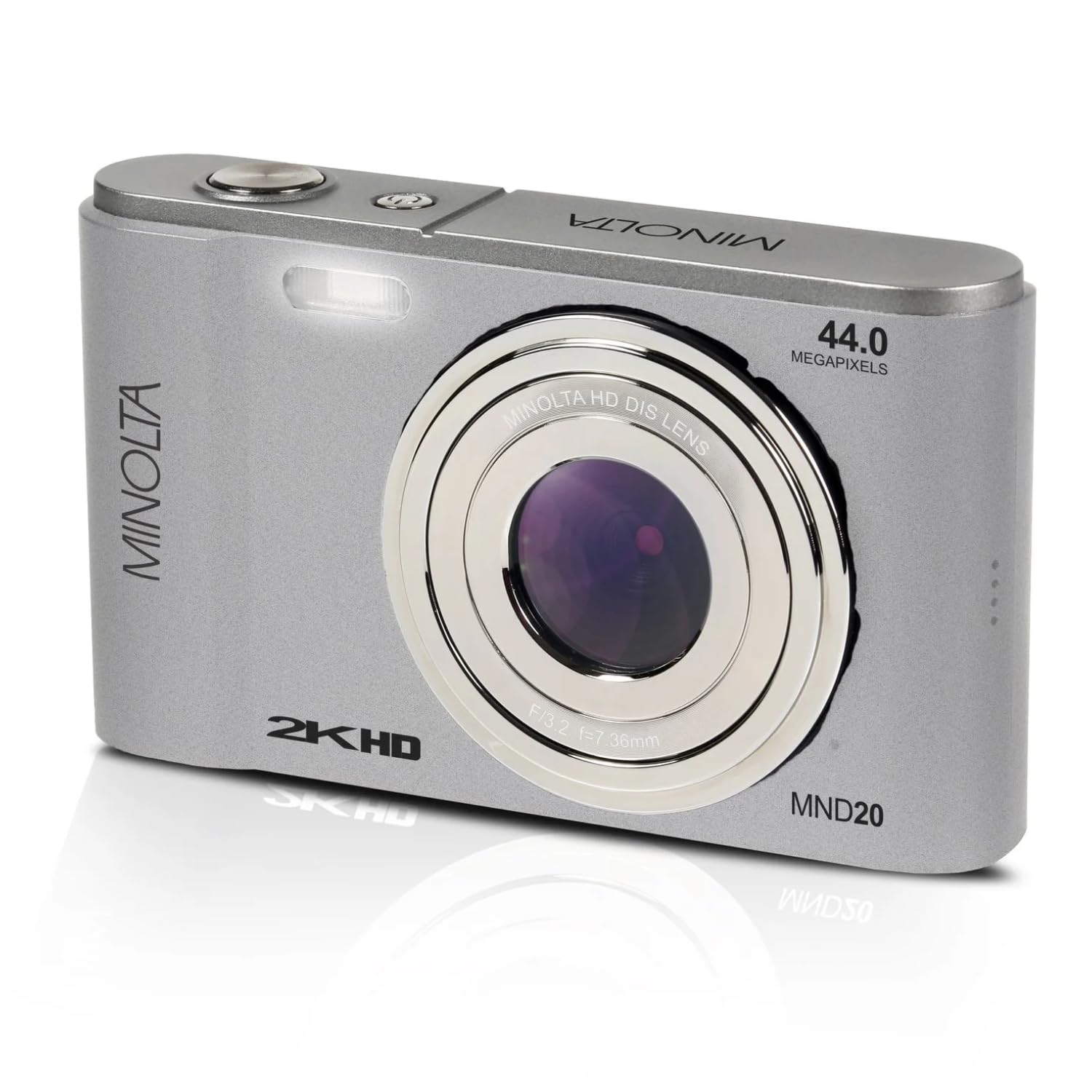
The Minolta MND20 is the lightest and most affordable option in this roundup, weighing only 8 ounces with a compact footprint that slips into a small bag or large pocket. The 44MP interpolated stills and 2.7K Quad HD video (above standard 1080p but below 4K) provide a meaningful jump over phone video quality for casual creators.
The built-in anti-shake, time-lapse mode, face detection, and smile capture offer hands-off shooting for beginners. The 2.9-inch LCD screen is articulating, which helps for overhead or low-angle compositions. The silver retro styling gives it a pleasing aesthetic for those who want a camera that looks as good as it shoots.
Critical limitations: the sensor actually captures only 12MP natively (the 44MP is interpolated), there is no autofocus — the lens uses a fixed focus, meaning you must stand at the correct distance for sharp results, and the proprietary battery drains quickly. The 16x digital zoom is cropping only. It is a charming gadget for a child or a teen learning composition basics, but it will frustrate anyone expecting consistent sharpness.
Why it’s great
- Extremely lightweight at 8 ounces for easy carry
- 2.7K Quad HD video above standard 1080p
- Articulating LCD screen for flexible shooting angles
- Face detection and smile capture for hands-off use
Good to know
- No autofocus — fixed focus lens only
- Actual sensor resolution is 12MP, not 44MP
- Proprietary battery drains quickly for active shooting
- Digital zoom does not add reach — just crops the frame
FAQ
Is a 4K or 8K compact camera worth it at this price?
Can an affordable digital camera replace my smartphone?
Do affordable compact cameras support external memory cards?
What does image stabilization actually do for handheld shots?
Final Thoughts: The Verdict
For most users, the affordable small digital cameras winner is the Panasonic LUMIX ZS99 because it packs a 30x optical Leica zoom into a pocket-sized body with reliable image stabilization and wireless sharing — it is the only camera here that genuinely extends your optical reach beyond what a phone can do, without requiring a separate bag. If you want replaceable lenses and professional-level stabilization, the OM SYSTEM Olympus E-M10 Mark IV offers the best image quality in this price bracket with room to grow. And for a budget-conscious traveler who needs AA battery flexibility and 25x zoom, the Kodak PIXPRO AZ255 is the pragmatic choice.