
A wobbly arrow does not forgive. It turns a perfect release into a frustrated search through tall grass for a miss. The right arrow—matched precisely to your bow’s draw weight and your draw length—does the opposite: it shrinks your groups, extends your effective range, and builds the kind of confidence that separates a casual shooter from a consistent marksman. A poorly matched arrow doesn’t just miss the ten-ring; it can damage your bow or injure you. The stakes are real.
I’m Min — the co-founder and writer behind Gadgets Feed. I’ve spent hundreds of hours analyzing spine charts, grain-per-inch data, and straightness tolerances, cross-referencing thousands of verified buyer experiences to identify which arrows deliver on their promises across the widest range of modern compound bows.
This guide breaks down everything from spine deflection and fletching material to the specific build quality that determines whether an arrow survives its first impact or shatters on contact. It’s the definitive reference for finding the best arrows for compound bow owners of every skill level.
How To Choose Arrows For A Compound Bow
The wrong arrow turns an expensive compound bow into a frustrating toy. Before you buy, eliminate the noise by focusing on the two numbers that matter most: the arrow’s spine deflection and its total weight in grains. Everything else—brand, color, marketing claims—is secondary. A stiff enough spine keeps the shaft from bending sideways on release, and correct weight ensures you’re not over- or under-driving the bow’s cams. Get these two wrong and no amount of fletching pattern will save your shot.
Spine: The Arrow’s Backbone
Spine is the stiffness rating of an arrow shaft. Most carbon arrows list a number like 400, 340, or 300—lower number means stiffer shaft. Compound bows typically require a stiffer spine than recurve bows because the mechanical release generates more lateral force at the moment of launch. A spine that’s too weak will cause the arrow to porpoise (oscillate vertically) or fishtail (wobble left-right), both of which destroy accuracy. Use the manufacturer’s spine chart: match your bow’s draw weight at your actual draw length. If you pull 60 pounds at 28 inches, a 400 spine is a common starting point. At 70 pounds and 30 inches, you’ll want 300 or even 250.
Weight and Kinetic Energy Transfer
Arrow weight is measured in grains per inch (GPI). The total arrow weight determines how much kinetic energy your bow transfers to the target. A lighter arrow flies faster and drops less over distance, but it also penetrates less and is louder on release. A heavier arrow absorbs more energy from the bow, which means quieter shots, deeper penetration on game, and less wear on the bow’s cams and string. Most compound bow hunters prefer a total arrow weight between 400 and 500 grains for a good balance of speed and punch. Target shooters often lean lighter for flatter trajectories in competition.
Straightness Tolerance
Every arrow shaft has a straightness tolerance, usually stated as a plus-minus figure like ±0.006 inches or ±0.0025 inches. The smaller the number, the straighter the arrow. A ±0.006 arrow is acceptable for casual target shooting. A ±0.003 arrow is good for consistent hunting accuracy. A ±0.0025 arrow—or better—is what serious competitors and precision hunters demand. At 30 yards, the difference between a 0.006 and a 0.0025 arrow can mean the margin between a tight group and a flyer that costs you the kill.
Fletching: Vanes vs. Feathers
Compound bows almost always use vanes—plastic or rubber fins—instead of feathers. Vanes are waterproof, durable, and survive repeated contact with arrow rests and containment cages. Feathers are quieter in flight and offer better stability from traditional bows, but they compress in a compound bow’s whisker biscuit and lose their shape. For a compound bow, choose 2-inch to 4-inch vanes. Shorter vanes are faster, longer vanes provide more stabilization for heavy broadheads.
Quick Comparison
On smaller screens, swipe sideways to see the full table.
| Model | Category | Best For | Key Spec | Amazon |
|---|---|---|---|---|
| Carbon Express Maxima RED 250 | Premium | Precision Hunting | Straightness ±0.0025″ | Amazon |
| Carbon Express Maxima RED Contour SD | Premium | Concealment & Accuracy | .203″ Diameter | Amazon |
| Linkboy Fluorescent Carbon | Premium | High-Visibility Practice | Spine 250 to 800 | Amazon |
| Pinals Camo Carbon 12-Pack | Mid-Range | Hunting & Target Mix | Straightness ±0.003″ | Amazon |
| MS JUMPPER Feather Fletch 400 | Mid-Range | Traditional Bow Feel | 4″ Real Feathers | Amazon |
| Pointdo 100% Carbon 340 | Value | Versatile Practice | Straightness 0.006″ | Amazon |
| SUNYA 12-Pack 30″ | Value | Budget Training | Spine 500 or 400 | Amazon |
In‑Depth Reviews
1. Carbon Express Maxima RED Fletched 250 (.400 Spine)
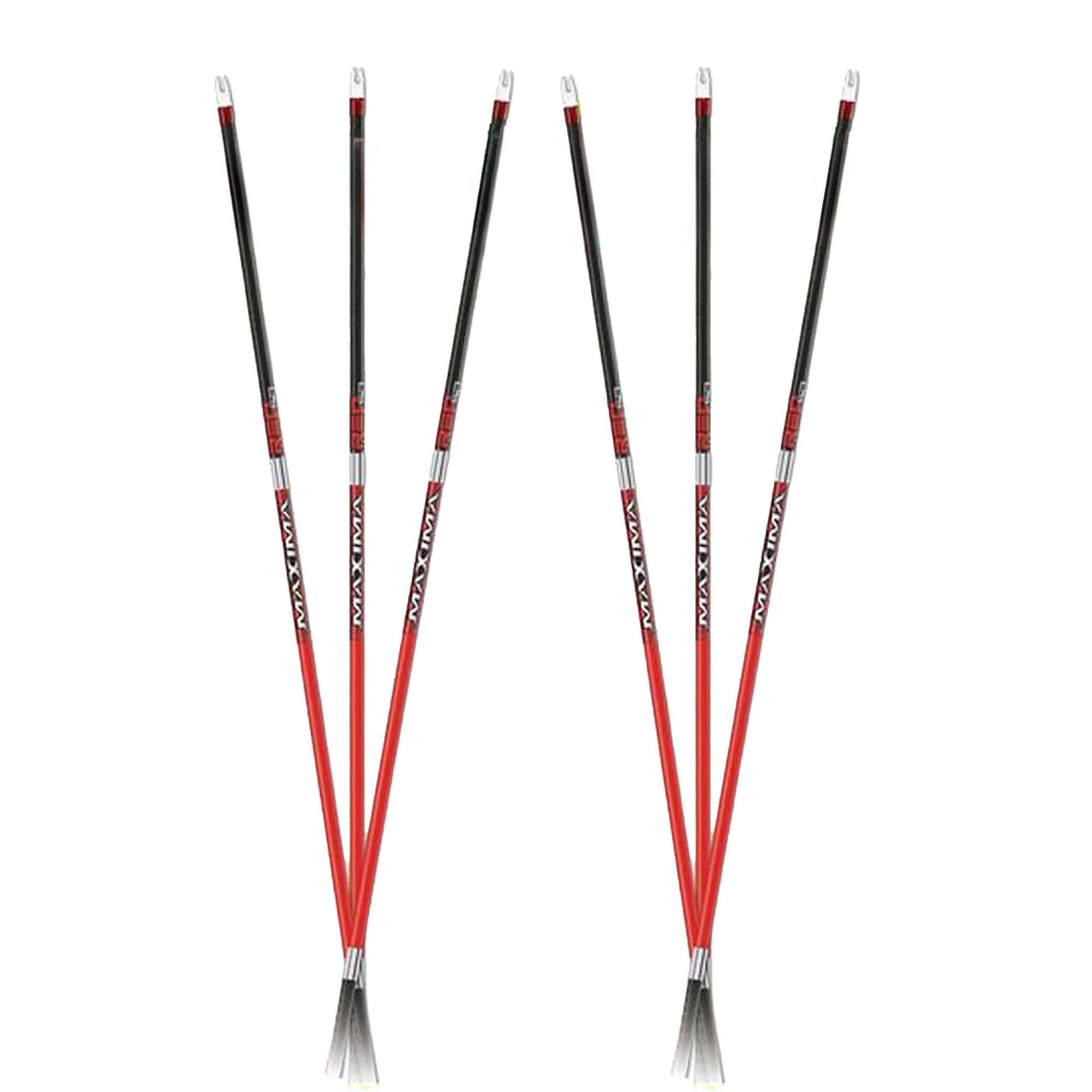
The Carbon Express Maxima RED represents a genuine engineering step forward in how carbon arrows manage dynamic spine. Instead of a single uniform wall, this shaft uses different carbon materials along its length, confining the flex to a controlled “RED Zone” near the center. The result is broadhead flight that rivals field points—a critical advantage for hunters who need their mechanical or fixed-blade heads to track perfectly without planing off to the side. At 8.11 GPI for the 250 spine, this arrow is light enough for a flat trajectory but dense enough to retain kinetic energy on impact.
Straightness is laser-checked to ±0.0025 inches—not a statistical average, but a maximum measurement. Each six-pack is sorted and matched by weight to within ±1.0 grain, meaning every arrow in the batch behaves identically downrange. The Launchpad Precision Nock improves alignment with the string, reducing the torque that can send a perfect release wide. On a 60-70 pound bow at 30 yards, these arrows consistently produce groups you can cover with a single hand.
The inserts come loose from the factory and require a careful bonding step: rough the inner shaft with a brass brush, clean with alcohol, and use a quality super glue. This is a one-time setup that experienced shooters expect from premium arrows. The Blazer vanes are short and stiff, minimizing wind drift while maintaining enough surface area to stabilize heavy broadheads. For the shooter who refuses to compromise on consistency, this is the set to beat.
Why it’s great
- Dynamic spine control makes broadheads fly like field points
- ±0.0025 straightness and matched grain weight produce unmatched consistency
- Launchpad Precision Nocks reduce string torque
Good to know
- Inserts arrive unglued; requires proper bonding before use
- Premium price positions this as an investment, not a budget pick
2. Carbon Express Maxima RED Contour SD 350

The Maxima RED Contour SD takes the same dynamic spine platform and shrinks the shaft diameter to .203 inches. A smaller diameter means less surface area for wind to push against, which translates directly to less drift in crosswinds at extended ranges. The Mossy Oak Contour camo finish is not just cosmetic—it breaks up the shaft’s silhouette against a treeline, giving a whitetail one less thing to process before the shot. This is a purpose-built hunting arrow for the archer who stalks tight quarters and needs every advantage.
Tri-Spine Technology controls the center section of the arrow with three distinct carbon layers, creating what Carbon Express claims is four times the accuracy of a traditional single-spine design. While that’s a marketing number, real-world shooting confirms that these arrows group exceptionally well with both field points and mechanical broadheads. The Bull Dog Nock Collar reinforces the back end, preventing the shaft from splitting on a hard impact. At 9.7 grains per inch in the 350 spine, the SD Contour is heavier than the standard Maxima RED, which helps penetration on heavy game.
These arrows use a half-in/half-out outsert system that requires a 52-grain insert weight. That’s a different spec than standard inserts, so if you swap points or lighted nocks, confirm compatibility before buying. The buildup in the back of the shaft means head pressure changes, and some shooters report a different “click” noise on release compared to all-carbon competitors. On the plus side, the smaller diameter lets these arrows punch through targets and game with less resistance. If concealment and wind-fighting are your priorities, this is the quiver to fill.
Why it’s great
- .203 small diameter reduces wind drift and improves penetration
- Tri-Spine core delivers exceptional broadhead accuracy
- Mossy Oak camo aids concealment in the field
Good to know
- Requires specialized .204 outserts; not compatible with standard inserts
- 6-pack only; heavier shooters will need multiple sets
3. Linkboy Fluorescent Carbon Hunting Arrows
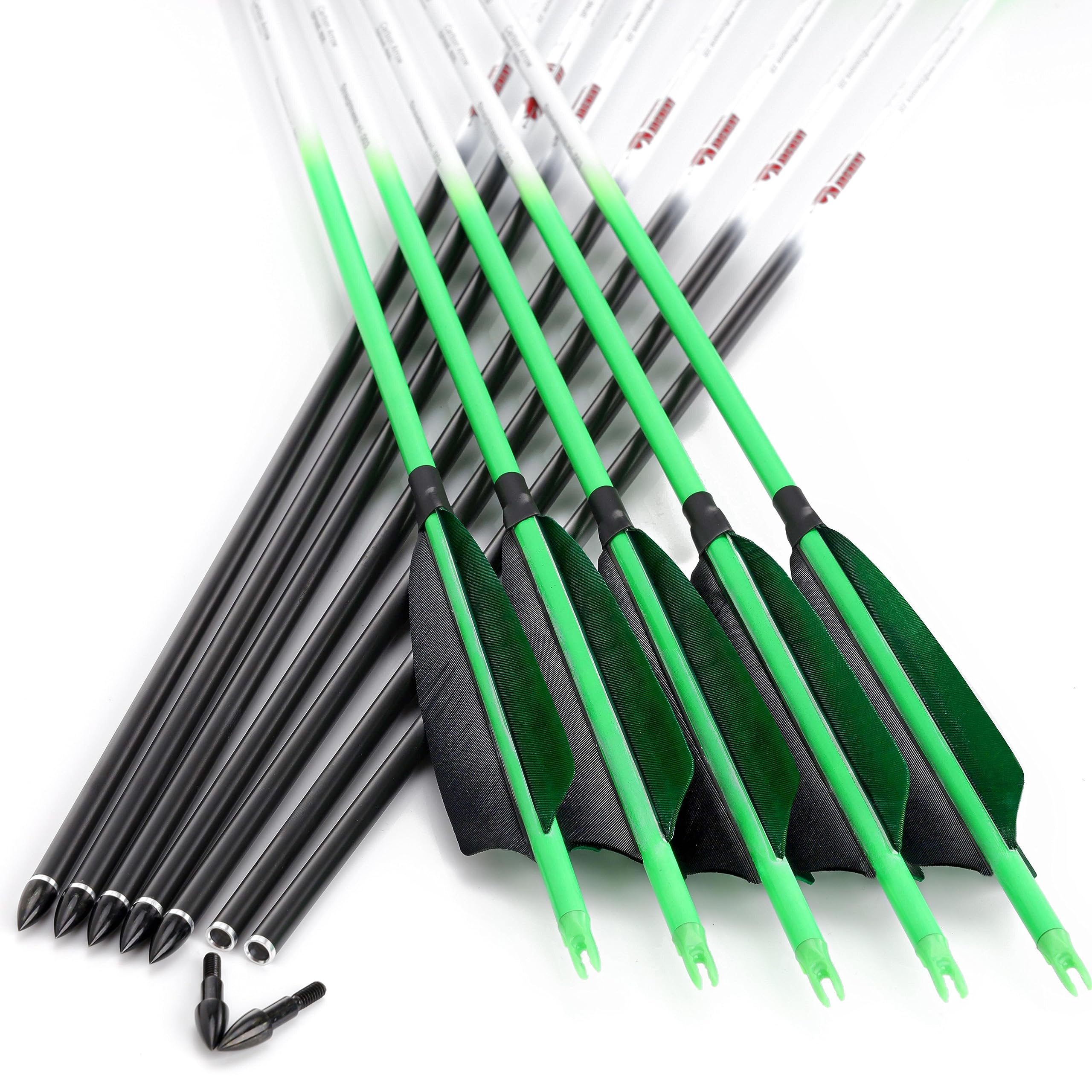
Linkboy’s fluorescent arrows solve a specific problem: losing an arrow in tall grass or low light. The bright green (also available in orange and pink variants) shafts stand out against any natural background, making retrieval faster and reducing the chance of stepping on a buried arrow. That visibility does not come at the cost of performance. The pure carbon construction maintains consistent flex across the length of the shaft, and the straightness is competitive for practice and hunting arrows in this tier. Available in spine ratings from 250 (stiffest) down to 800, these cover everything from a 75-pound compound to a 30-pound recurve.
The stainless steel field points are removable, allowing you to swap in broadheads or heavier target tips. A common complaint with budget arrows—field points loosening after a few shots—is mitigated here by a rubber O-ring between the point and the shaft, which adds friction and keeps the tip tight. The nocks are glue-free and adjustable, so you can orient them correctly for a compound bow’s release aid or a recurve’s string nock point. The shafts also feature a slick coating that pulls cleanly from foam targets without tearing the fletching.
Some users note that the fletching lacks a clear indexing vane (a single vane in a different color to help orient the arrow), so you have to learn the logo’s position on the shaft. The 6-pack count forces you to buy two sets if you want a full dozen. That said, the price per arrow is significantly lower than the premium Carbon Express options, making this an excellent choice for high-volume practice where arrow turnover is expected. For shooters who value visibility without sacrificing basic accuracy, the Linkboys hit a sweet spot.
Why it’s great
- Fluorescent coating makes arrows easy to find after misses
- O-ring prevents field points from loosening during use
- Wide spine selection (250-800) fits virtually any draw weight
Good to know
- Sold in 6-packs; need two boxes for a dozen
- No colored indexing vane for quick orientation
4. Pinals Camo Carbon Hunting Arrows 12-Pack

Pinals leans hard into the value proposition without cutting corners on the specs that matter. The straightness tolerance is ±0.003 inches—tight enough for consistent 30-yard groups and well within what most hunters need for ethical shots on deer and hogs. Each shaft is machine-sorted for weight to within ±1 grain, and the spine options (300, 340, 400) cover the 40-75 pound draw weight range that dominates the compound bow market. The pack of 12 includes two extra aluminum inserts, a thoughtful touch that saves a trip to the archery shop if you bend one.
The shafts are pure precision carbon with a reinforced front section that handles repeated impacts without splintering. The rubber O-ring on the 100-grain field points prevents the tip from backing out after a few shots—a common failure point on cheaper arrows. The nocks are adjustable and not glued, so you can rotate them to match a recurve string or a compound’s D-loop without heat. The green-camo finish is practical, not just cosmetic: it blends into grass and brush, reducing the chance of a spooked deer spotting the shaft in flight.
Some batches have shown variability in straightness—two arrows out of a box of 12 spun poorly on a straightness checker. This is the risk of buying in the value tier, though the vast majority of reports confirm these fly true. The fletching is robust enough for whisker biscuits and drop-away rests without tearing. If you burn through arrows practicing or you want a backup set that shoots well enough to hunt with, the Pinals pack is hard to beat at this price per dozen.
Why it’s great
- ±0.003 straightness at a fraction of premium-brand cost
- Two extra inserts included for quick field repairs
- Machine-sorted weight ensures consistent group performance
Good to know
- Occasional quality control variance; spin-test before hunting
- Camo has a slight pink hue that differs from product photos
5. MS JUMPPER Feather Fletch 400 Spine

Feather fletching on a compound bow arrow is a deliberate choice—and the MS JUMPPER 400 spine is built for shooters who want the quietest possible flight and the fastest stabilization from broadheads. The four-inch turkey feathers create more drag than vanes, but they also collapse against the arrow rest and produce almost no audible friction noise. For a hunter trying to keep a buck from ducking the string at the sound of the shot, that silence can make the difference between a clean pass-through and a miss over the back.
The shaft is a multi-layer carbon construction with a 0.005-inch straightness tolerance, which is adequate for bowhunting ranges inside 40 yards. The 100-grain field points are matched to the shaft weight, and the nocks are adjustable without glue. The 400 spine is optimized for draw weights between 45 and 65 pounds, which covers a wide swath of recreational and hunting compound bows. Users report these arrows fly “like darts” from fast compounds, with tight groups even when paired with 100-grain broadheads.
Feathers are inherently less durable than plastic vanes. They absorb moisture, crush under pressure, and can separate from the shaft after repeated hard impacts. The MS JUMPPER arrows address this with a hard rubber ring at the base of each feather to prevent splitting, but you will still need to store them in a dry quiver and replace fletching more often than with vaned arrows. The points also tend to loosen over time—a drop of thread-locker solves this. If you prioritize quiet, stable flight and don’t mind extra maintenance, these are a versatile option.
Why it’s great
- 4-inch real turkey feathers provide silent, stable flight
- Flies consistently with both field points and broadheads
- Multi-layer carbon construction adds impact durability
Good to know
- Feathers require protection from moisture and frequent replacement
- Field points loosen over time; thread-locker recommended
6. Pointdo 100% Carbon 340 Spine 30-Inch
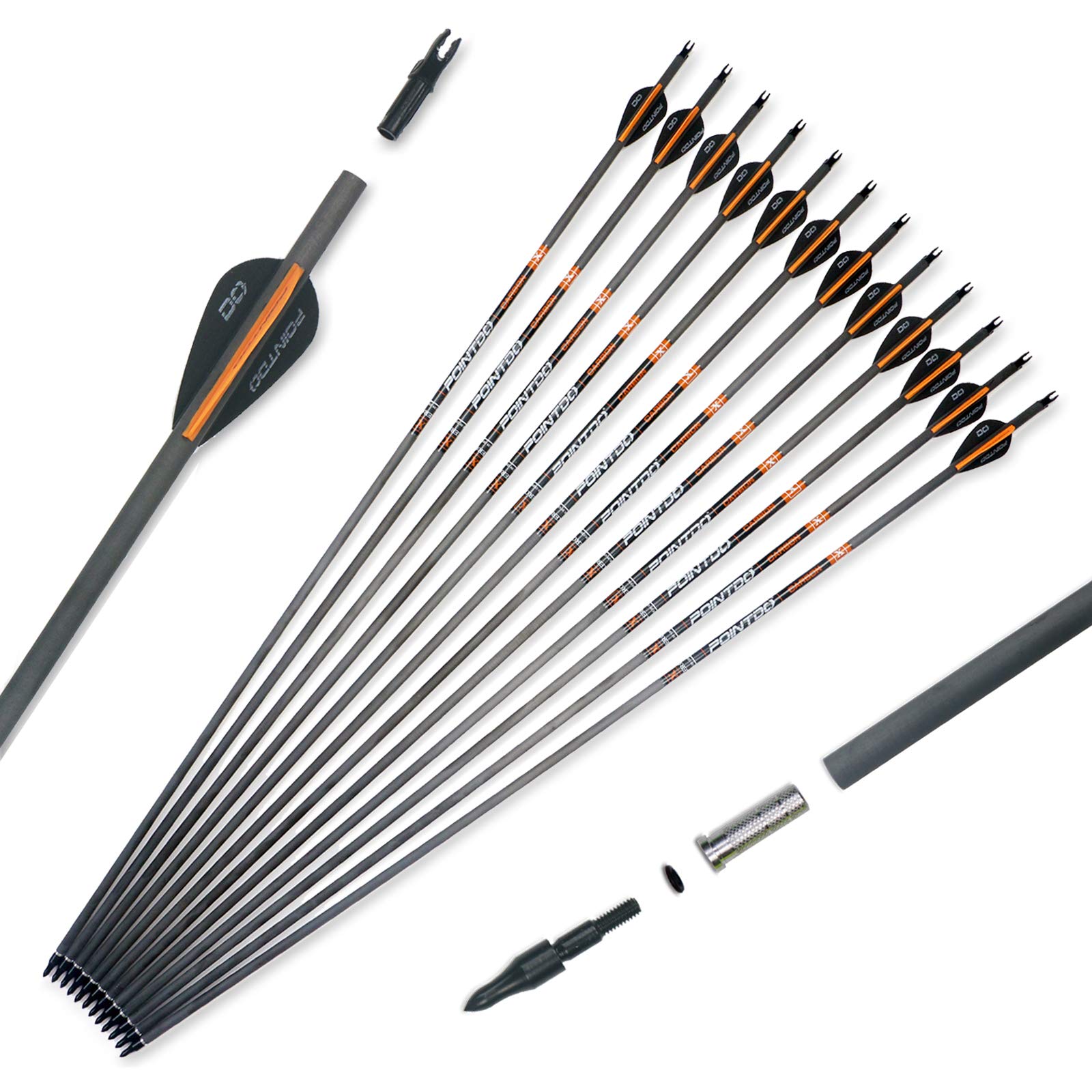
The Pointdo 340 spine arrows are a straightforward no-frills choice for the archer who shoots often and expects to lose or break arrows along the way. The 100% carbon cloth construction uses a multi-angle layup that improves shaft durability without adding weight. At 7.2 GPI, these are on the lighter side, which means faster initial velocity from a compound bow and a flatter trajectory at typical practice distances. The straightness tolerance of ±0.006 inches is the loosest in this lineup—fine for field point practice at 20-30 yards, but not ideal for hunting where a flyer could mean a wounded animal.
Each arrow comes with a fixed insert and a 100-grain field point pre-installed. The nocks are replaceable and not glued, so you can adjust their orientation for a compound bow release or swap them if one cracks. The color scheme—two black and one orange, or two orange and one white—makes it easy to identify your arrows at a glance across a crowded target range. The 12-pack gives you a full quiver and spares, which is a solid value.
The vanes are soft and can deform in storage or after a few impacts. A heat gun or boiling water treatment can restore their shape, but this is an extra step that higher-end vanes don’t require. Some users report the nocks are too tight and need light sanding to seat properly on the string. For the price, these trade-offs are expected. Use these for volume practice and save your premium carbon arrows for hunt day. They fly straight enough to build good form without breaking the bank.
Why it’s great
- Low GPI (7.2) delivers fast, flat trajectories
- Multi-angle carbon layup improves shaft toughness
- 12-pack offers excellent per-unit cost for heavy practice
Good to know
- ±0.006 straightness limits accuracy at longer ranges
- Soft vanes can warp; heat gun needed for correction
7. SUNYA 12-Pack 30-Inch Carbon Arrows
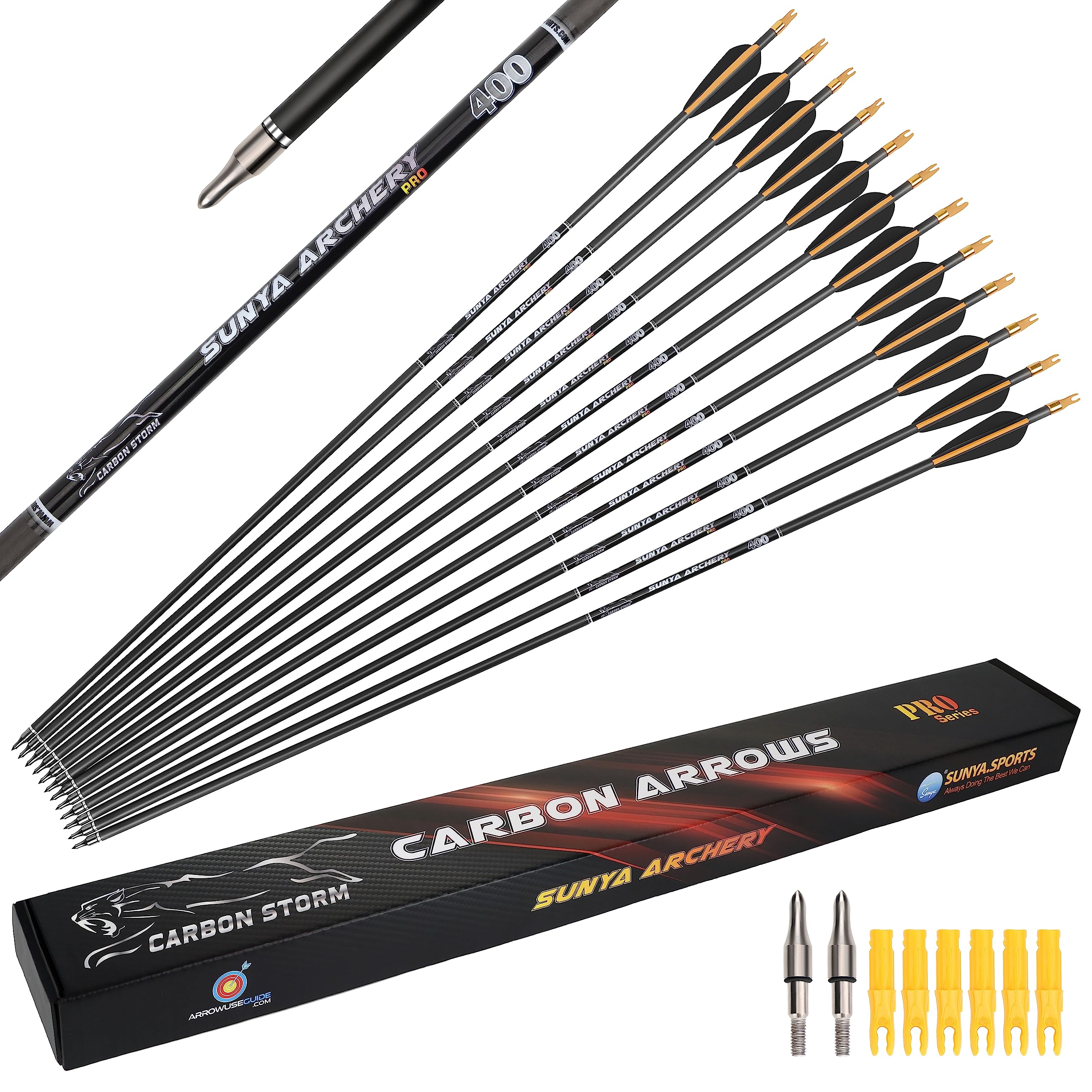
The SUNYA 12-pack is the entry-level ticket for new compound bow owners who need a full dozen arrows at the lowest possible investment. The shaft is 30 inches with a total length of 31.5 inches when nocked, and the available spines of 500 and 400 cover the lower end of the draw weight spectrum—roughly 40 to 60 pounds. The carbon fiber construction is standard for this tier, and the 3-inch TPU vanes provide enough stabilization for field point practice at moderate distances. For a beginner shooting 20-yard groups, these arrows will not be the limiting factor.
A thoughtful feature at this price is the O-ring under the stainless steel point, which prevents the tip from loosening during extraction from a foam target. The aluminum ring at the nock end reinforces the shaft against splitting—a common failure point when a beginner smashes an arrow into a hard surface or another arrow. The nocks come in compound-bow orientation but can be rotated for recurve use. The black and gold color scheme is simple but effective for visibility.
The straightness tolerance is not published, and based on customer feedback, it varies noticeably between batches. Some shafts in the same pack show visible wobble when spun. Also, some tips have broken off on hard impacts (hitting wood targets), and the nocks can be overly tight on certain D-loops. These are not arrows you hunt with or rely on for precision competition. But as a starter set for blasting through target practice while you learn form and release mechanics, the SUNYA pack is cheap enough that breaking one doesn’t hurt.
Why it’s great
- Cost-effective 12-pack for new archers learning the basics
- O-ring prevents field points from loosening
- Aluminum nock ring reduces risk of shaft splitting
Good to know
- Inconsistent straightness between shafts in the same pack
- Points can break on hard impacts; not for heavy use
FAQ
Can I use the same arrows for a compound bow and a recurve bow?
What does 0.003 straightness mean in real-world shooting?
How do I know if an arrow is too weak or too stiff for my compound bow?
Can I mix aluminum and carbon arrows in a compound bow?
Final Thoughts: The Verdict
For most shooters, the best arrows for compound bow shooters is the Carbon Express Maxima RED 250 because it delivers broadhead-grade precision, ±0.0025 straightness, and matched weight sorting that removes all variables from your shot. If you want a smaller diameter for wind-fighting and deep penetration, grab the Carbon Express Maxima RED Contour SD. And for high-volume practice where cost per arrow matters most, nothing beats the Pointdo 340 Spine 12-pack.