
Stepping up from a smartphone to a dedicated camera with interchangeable lenses feels like unlocking a door to a much larger creative space. The challenge isn’t a lack of options; it’s filtering through sensor sizes, autofocus systems, and lens ecosystems to find the one tool that won’t frustrate a beginner while still offering room to grow. The best choices balance intuitive handling, strong video specs, and a clear path to better glass without demanding a second mortgage.
I’m Min — the co-founder and writer behind Gadgets Feed. I’ve spent countless hours combing through the technical data sheets, real-world sample footage, and user reports for this specific price-conscious tier to identify which cameras genuinely deliver on their promises for a newcomer. I’ve cross-referenced everything from rolling shutter performance to menu logic to ensure this list prioritizes practical usability.
Whether you’re capturing family moments or starting a vlog, the right tool makes learning effortless. This guide breaks down the top contenders to help you find the absolute best beginner camera for photography and video that fits your specific creative ambitions.
How To Choose The Best Beginner Camera For Photography And Video
Selecting your first interchangeable-lens camera requires matching technical specifications to your real-world shooting habits. Ignoring sensor size, autofocus performance, and lens availability leads to buyer’s remorse. Focus on these three pillars before making a decision.
Sensor Format: APS-C vs. Full-Frame vs. Micro Four Thirds
The sensor is the heart of every camera. An APS-C sensor (found in the Canon EOS R100 and Sony A6100) offers a strong balance of image quality, low-light performance, and system cost. Full-frame sensors, like the one in the Sony A7 III, provide shallower depth of field and better high-ISO performance but drive up the price for both the body and lenses. Micro Four Thirds, used in the Panasonic G85 and OM-D E-M10 Mark IV, delivers a compact kit with excellent stabilization but a smaller sensor that struggles more in dim light. For a beginner prioritizing value, APS-C is the sweet spot.
Autofocus System and Tracking
Missed focus is the fastest way to ruin a shot or clip. Look for phase-detection autofocus points covering a large percentage of the frame. Real-time Eye AF for humans and animals, found in Sony and Canon models, locks onto eyes and maintains focus even as the subject moves. A camera with 425 phase-detection points (like the A6100) will outperform a 9-point DSLR system (like the Canon T7) for active kids or pets. For video, smooth and silent continuous autofocus is non-negotiable.
Video Capabilities and Recording Limits
A beginner camera for photography and video must handle 4K resolution without severe crop or overheating issues. Check for a microphone jack for external audio, a fully articulating screen for vlogging, and the availability of flat picture profiles for color grading. Some cameras, like the Canon EOS RP, impose recording time limits in 4K mode. Frame rate options (24, 30, or 60 fps) determine the smoothness of your final footage. Prioritize uncropped 4K from the APS-C or full-frame sensor for the widest angle of view.
Quick Comparison
On smaller screens, swipe sideways to see the full table.
| Model | Category | Best For | Key Spec | Amazon |
|---|---|---|---|---|
| Sony Alpha a7 III | Full-Frame Mirrorless | Hybrid photo/video with pro-level AF | 24.2MP BSI Full-Frame Sensor | Amazon |
| Sony Alpha 7 IV | Full-Frame Mirrorless | High-resolution hybrid shooting | 33MP Full-Frame Exmor R Sensor | Amazon |
| Canon EOS RP | Full-Frame Mirrorless | Affordable entry to full-frame | 26.2MP Full-Frame CMOS Sensor | Amazon |
| Nikon D7500 | DSLR | Action and wildlife photography | 51-Point AF System | Amazon |
| Nikon Z fc | APS-C Mirrorless | Style-forward everyday carry | 20.9MP DX CMOS Sensor | Amazon |
| Sony Alpha A6100 | APS-C Mirrorless | Fastest autofocus in class | 425 Phase-Detection AF Points | Amazon |
| Canon EOS R50 V | APS-C Mirrorless | Vlogging and content creation | 4K 30p Uncropped Video | Amazon |
| Olympus E-M10 Mark IV | Micro Four Thirds Mirrorless | Portable everyday photography | 5-Axis In-Body Stabilization | Amazon |
| Canon EOS R100 | APS-C Mirrorless | First step from smartphone | 24.1MP APS-C CMOS Sensor | Amazon |
| Canon T7 EOS Rebel | DSLR | Learning photography fundamentals | 9-Point AF System | Amazon |
| Panasonic LUMIX G85 | Micro Four Thirds Mirrorless | Stabilized video on a budget | 5-Axis In-Body Dual I.S. | Amazon |
In‑Depth Reviews
1. Sony Alpha a7 III

The Sony a7 III remains a benchmark for hybrid shooters entering the full-frame ecosystem. Its 24.2MP back-illuminated sensor captures excellent dynamic range, and the 693 phase-detection AF points provide reliable subject tracking for both stills and video. The 4K recording, though slightly oversampled from the sensor, delivers clean footage with minimal rolling shutter, and the 15-stop dynamic range gives plenty of latitude for color grading in post.
The body is weather-sealed against dust and moisture, with a large battery rated for over 700 shots per charge. The Z-series battery is a significant upgrade over smaller Sony NP-FW50 packs found in the A6100. The dual SD card slots support relay recording when one card fills up, a useful feature for event coverage.
Where the a7 III shows its age is the menu system, which remains layered and can be confusing for absolute beginners. The touchscreen is also limited to focus point selection rather than full menu navigation. For a beginner willing to invest time learning the system, the a7 III offers a professional-grade foundation that will remain relevant for years.
Why it’s great
- Outstanding autofocus with real-time Eye AF for humans and animals
- Excellent low-light performance thanks to the full-frame BSI sensor
- Robust build quality with weather sealing and impressive battery life
Good to know
- The menu system is complex and requires significant navigation learning
- 4K video at 30p lacks the higher frame rates of newer competitors
- Touchscreen functionality is limited compared to modern Canon or Sony interfaces
2. Sony Alpha 7 IV

The Sony Alpha 7 IV pushes the hybrid concept further with a 33MP full-frame Exmor R sensor and the BIONZ XR processor. This combination delivers 4K 60p recording in 10-bit 4:2:2 color depth, which is a significant step up for video work. The 7K oversampling at 4K 30p produces extremely sharp footage with excellent color rendition courtesy of the S-Cinetone color profile.
Autofocus performance is class-leading, with 693 phase-detection points covering 93% of the sensor and real-time Eye AF for both humans and animals in photo and video. The improved menu system from the previous generation makes navigation more intuitive, while the fully articulating touchscreen is ideal for vlogging and low-angle shots.
The biggest consideration for a beginner is the price point, which sits firmly in the enthusiast category. The body alone demands a significant investment, and quality full-frame lenses add to the cost. For someone who plans to grow quickly into semi-professional work, the 7 IV is a future-proof tool. For casual use, the lens ecosystem cost may be overkill.
Why it’s great
- 33MP sensor delivers incredible detail for large prints and cropping
- 4K 60p 10-bit 4:2:2 with S-Cinetone profile for cinema-grade color
- Dual card slots (SD/CFexpress Type A) for backup and overflow
Good to know
- Entry-level price is high, and full-frame lenses are costly
- Heavier and bulkier than APS-C alternatives like the A6100
- 4K 60p requires CFexpress Type A card for maximum bit rates
3. Canon EOS RP

The Canon EOS RP is the most affordable way to enter the full-frame mirrorless world. Its 26.2MP sensor produces clean images with pleasing color science straight out of camera, and the Dual Pixel CMOS AF provides reliable face and eye detection in both photo and video modes. The camera body is surprisingly compact and lightweight, making it a strong travel companion.
The RF lens mount gives access to Canon’s impressive Z-series lenses, though the included RF 24-105mm f/4-7.1 IS STM kit lens is a budget compromise with a slow variable aperture. The 4K video mode has a significant 1.7x crop factor and a 30-minute recording limit, which limits its usefulness for wider shots and longer recordings. The electronic viewfinder is also lower resolution than premium models.
Battery life is a known weak point, with only around 250 shots per CIPA rating using the LP-E17 battery. Carrying spare batteries is essential for a full day of shooting. For a beginner who mainly shoots photos in good light and wants the depth-of-field effect of full-frame, the RP delivers a compelling value proposition.
Why it’s great
- Most budget-friendly entry point into full-frame mirrorless systems
- Compact and lightweight body ideal for travel and everyday carry
- Excellent Dual Pixel AF with smooth face tracking
Good to know
- 4K video has a heavy 1.7x crop and 30-minute recording limit
- Battery life is below average; spare batteries are necessary
- Kit lens has slow variable aperture and soft corners
4. Nikon D7500

The Nikon D7500 is a DSLR that borrows the 20.9MP sensor and metering system from the pro-grade D500. The 51-point AF system with 15 cross-type sensors and Group Area AF delivers fast and accurate tracking for birds, sports, and fast-moving pets. The burst rate of 8 fps is excellent for a camera at this tier.
The optical viewfinder provides a clear, lag-free view of the scene with 100% frame coverage, which some beginners prefer over electronic viewfinders. The 3.2-inch tilting touchscreen is responsive and useful for live view shooting. The 4K UHD video is uncropped and includes stereo sound, power aperture control, and auto ISO during recording.
The main drawback is the weight and size of the DSLR system, along with the lack of in-body image stabilization, requiring stabilized lenses for smooth handheld video. The 18-140mm kit lens covers a versatile range from wide to telephoto, making it a good all-in-one starter. For a beginner who values ruggedness and fast action tracking, the D7500 remains a strong DSLR option.
Why it’s great
- Top-tier 51-point AF system inherited from the pro D500
- 8 fps burst shooting excellent for action and wildlife
- Excellent battery life for extended shooting sessions
Good to know
- Heavier than mirrorless alternatives; less portable for travel
- No in-body image stabilization for video
- Single SD card slot; no support for UHS-II standard
5. Nikon Z fc

The Nikon Z fc combines a 20.9MP DX-format sensor with a retro-inspired body that features dedicated metal dials for ISO, shutter speed, and exposure compensation. This tactile control layout helps beginners learn the exposure triangle intuitively, while the EXPEED 6 processor delivers sharp images with excellent color rendition.
The camera is built for content creation with a fully articulating vari-angle LCD that flips forward for vlogging. The 4K UHD video uses the full sensor width, and the hybrid autofocus system with Eye Detection works reliably for both photos and video. The Nikon SnapBridge app provides seamless Bluetooth transfers to a smartphone.
Where the Z fc compromises is the kit lens performance. The included 16-50mm retractable lens is compact but optically average, with soft corners at the wide end. Investing in higher-quality Z-mount primes like the 28mm f/2.8 unlocks the sensor’s potential. The lack of in-body stabilization is also a concern for handheld video, though it is less critical for stills.
Why it’s great
- Beautiful retro design with analog dials that teach exposure control
- Compact and lightweight build; great for everyday carry
- Good 4K video quality with reliable eye-detection AF
Good to know
- Kit lens is mediocre; upgrading to better Z glass improves results
- No in-body image stabilization
- Wireless transfer via SnapBridge can be unreliable
6. Sony Alpha A6100

The Sony A6100 packs the fastest autofocus in the entry-level APS-C category, with 425 phase-detection and 425 contrast-detection points covering 84% of the sensor. Real-time Eye AF for humans and animals locks onto subjects instantly and maintains tracking during burst shooting at 11 fps. This makes it the go-to choice for capturing children, pets, and fast-moving events.
The 24.2MP Exmor CMOS sensor with the front-end LSI keeps noise under control up to ISO 6400, producing clean stills that compete well with larger sensors. The 180-degree tilting touchscreen is useful for selfies and vlogging, and the 4K video recording uses the full sensor width without a crop for a wider field of view.
The main compromises are the electronic viewfinder, which has a low resolution of 1.44 million dots, and the convoluted menu system that requires time to customize. The included 16-50mm power zoom lens is compact but optically soft, especially at the long end. For a beginner who wants instant, reliable autofocus above all else, the A6100 delivers unmatched performance at its price point.
Why it’s great
- Lightning-fast 0.02s autofocus with 425 phase-detection points
- 11 fps burst shooting with continuous AF tracking
- Uncropped 4K video with real-time Eye AF in movie mode
Good to know
- Electronic viewfinder has low resolution and is not comfortable for long use
- Menu system is complex; requires setup for quick access to key settings
- Kit lens is mediocre; upgrading to a Sigma prime unlocks true potential
7. Canon EOS R50 V
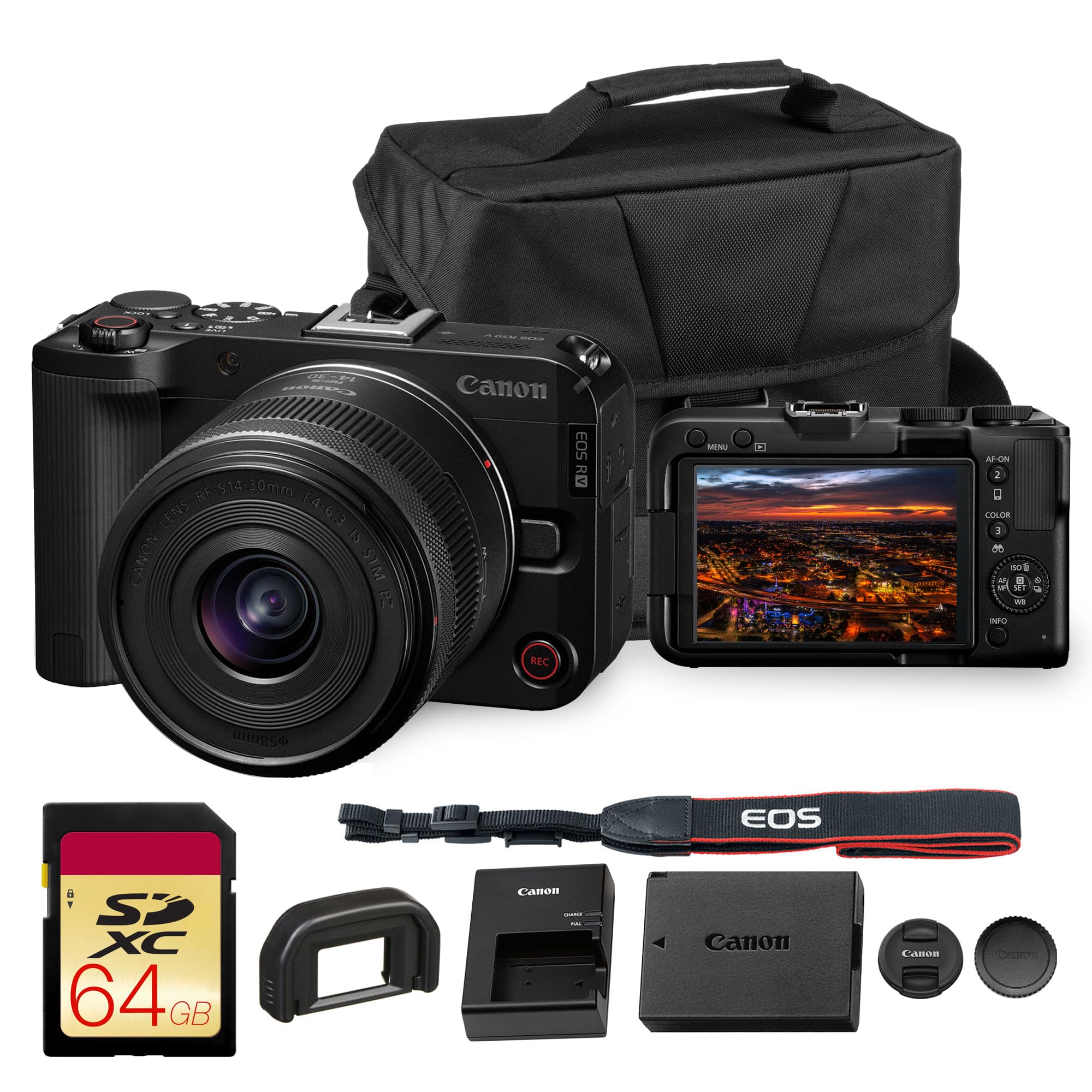
The Canon EOS R50 V is purpose-built for content creators who prioritize video. Its 24.2MP APS-C sensor paired with the DIGIC X processor delivers uncropped 4K 30p footage with excellent detail. The Dual Pixel CMOS AF II provides smooth, silent subject tracking with eye detection for both people and animals.
This camera features a fully articulating flip screen that faces forward for self-recording, a vertical video mode for social media, and USB-C livestream-ready connectivity. The included RF-S 14-30mm f/4-6.3 IS STM PZ lens is a wide-angle power zoom optimized for handheld vlogging with built-in image stabilization.
The R50 V lacks a built-in flash and an electronic viewfinder, which are important considerations for stills shooters. The maximum video frame rate is 30p at 4K, which is lower than the competition’s 60p options. For a beginner focused exclusively on YouTube, vlogging, or livestreaming, the R50 V provides a streamlined, dedicated tool that removes unnecessary complexity.
Why it’s great
- Uncropped 4K 30p with Dual Pixel AF designed for smooth video
- Fully articulating touchscreen ideal for front-facing vlogging
- Wide-angle power zoom kit lens perfect for handheld use
Good to know
- No built-in flash or electronic viewfinder for still photography
- 4K video limited to 30p; no 60p option
- Small grip can feel cramped for larger hands
8. Olympus E-M10 Mark IV

The OM System E-M10 Mark IV is a compact Micro Four Thirds camera that punches above its size. The 5-axis in-body image stabilization provides up to 4.5 stops of correction, allowing sharp handheld shots at shutter speeds that would blur with unstabilized cameras. The 20MP Live MOS sensor produces excellent color and detail for everyday photography.
The flip-down monitor and dedicated selfie mode make it one of the easiest cameras for vlogging and group selfies. The 121-point contrast-detection autofocus is reliable for still subjects, and the 16 Art Filters including Instant Film add creative fun without requiring editing software. The 14-42mm EZ pancake lens collapses for true pocketability.
The Micro Four Thirds sensor has a 2x crop factor, which means a 42mm lens gives an 84mm equivalent field of view. This can be limiting for low-light performance compared to APS-C sensors. The wireless transfer via the OI Share app is slow and requires WiFi pairing. For a beginner who values portability and stabilization above all else, the E-M10 Mark IV is a fantastic choice.
Why it’s great
- Excellent in-body stabilization for sharp handheld shots and video
- Extremely compact; the pancake lens fits in a jacket pocket
- Selfie mode and creative art filters for immediate fun
Good to know
- Smaller sensor limits low-light performance and background blur
- Contrast-detection AF is slower than phase-detection systems
- Wireless app and transfer can be slow and frustrating
9. Canon EOS R100
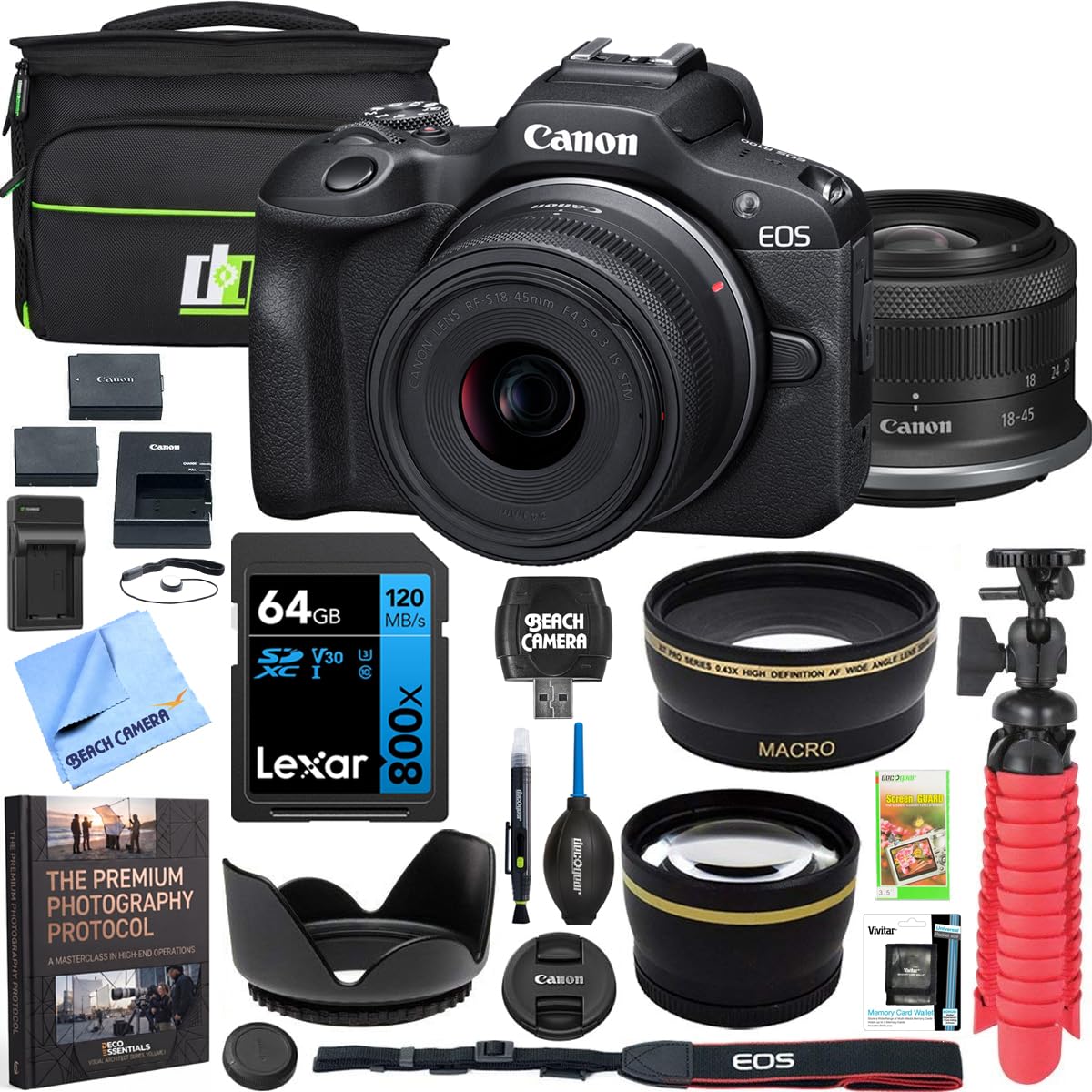
The Canon EOS R100 is the entry-level mirrorless option for users moving directly from a smartphone. Its 24.1MP APS-C CMOS sensor with the DIGIC 8 processor delivers sharp photos with natural colors and shallow depth of field that smartphones cannot replicate. The RF-S 18-45mm kit lens is lightweight and covers a useful everyday range.
The Dual Pixel CMOS AF provides reliable face detection, and the camera includes 4K video at 24 fps. The 3-inch LCD screen is fixed without articulation, which limits flexibility for self-recording or high-angle shots. The electronic viewfinder offers a true 0.39-inch display with 2.36 million dots, which is a significant upgrade over relying solely on the rear screen.
The main limitation for video is the 4K 24p frame rate, which can cause judder on fast-moving subjects. The lack of a microphone jack also restricts audio quality upgrades. For a beginner who prioritizes stills and wants to learn composition with interchangeable lenses, the R100 is an affordable and capable starting point.
Why it’s great
- Affordable entry point with a large APS-C sensor for superior images
- Compact and lightweight; easy to bring on daily adventures
- Clear electronic viewfinder helps compose in bright sunlight
Good to know
- Fixed LCD screen limits composition angles and self-shooting
- 4K video only at 24 fps; no microphone input for external audio
- Battery life is modest; planning for extra packs is wise
10. Canon T7 EOS Rebel
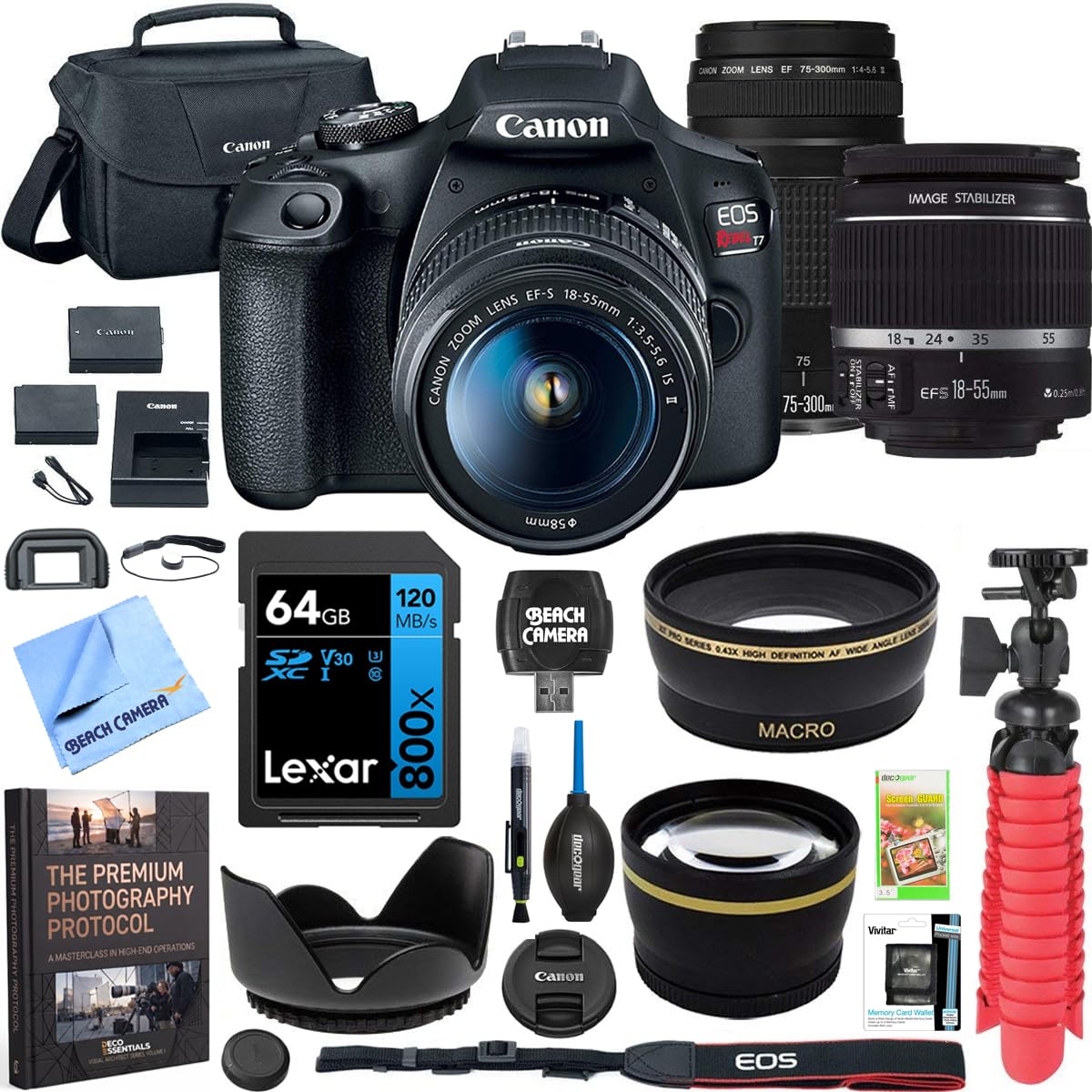
The Canon T7 is a traditional DSLR with an optical viewfinder and a 24.1MP APS-C sensor. Its 9-point AF system is basic by modern standards but works reliably for stationary subjects. The DIGIC 4+ processor is well behind current mirrorless chipsets, limiting the burst rate to 3 fps and restricting the 1080p video to 30 fps.
The bundle includes both an 18-55mm standard zoom and a 75-300mm telephoto lens, covering a wide range of shooting scenarios from landscapes to distant wildlife. The optical viewfinder offers a clear, real-time view with no lag or battery drain, which some users prefer for composition. The built-in Wi-Fi and NFC allow for basic image sharing.
The biggest limitations are the slow burst rate for action shots and the lack of 4K video entirely. The DIGIC 4+ processor also shows its age in noise handling above ISO 1600. For a beginner on a strict budget who wants to learn the fundamentals of photography and can handle basic video, the T7 provides a workable foundation.
Why it’s great
- Includes two zoom lenses covering a wide focal range
- Optical viewfinder offers a lag-free shooting experience
- Very affordable entry into the Canon EF lens ecosystem
Good to know
- Only 3 fps burst and no 4K video recording
- 9-point AF system struggles with moving subjects
- Processor is outdated; noise performance above ISO 1600 is poor
11. Panasonic LUMIX G85

The Panasonic LUMIX G85 delivers exceptional value with its in-body 5-axis dual image stabilization working in tandem with lens OIS. This system provides smooth handheld video that rivals cameras costing much more. The 16MP Micro Four Thirds sensor with no low-pass filter resolves more fine detail than earlier 16MP sensors, producing sharp stills.
The camera is fully weather-sealed with a magnesium alloy body, a 3-inch tilt and touch LCD, and a 2.36-million-dot OLED live viewfinder. It records 4K QFHD video at 30 fps and supports Panasonic’s 4K Photo mode, which captures 30 fps bursts for extracting the perfect still frame from motion.
The 16MP sensor is lower resolution than modern competition, and the autofocus can hunt in low light, especially during 4K video recording. Battery life is below average, with around 320 shots per CIPA rating. The G85 lacks a headphone jack for audio monitoring. For a beginner who prioritizes stabilized video and build quality over pixel count, the G85 is a compelling budget choice.
Why it’s great
- Excellent 5-axis dual stabilization for smooth handheld video
- Weather-sealed body with magnesium alloy construction
- 4K Photo mode and other beginner-friendly features
Good to know
- 16MP sensor is lower resolution than APS-C competitors
- Autofocus struggles in low light, especially in 4K
- No headphone jack for monitoring audio levels
FAQ
Is a DSLR or mirrorless camera better for a beginner?
Do I need a full-frame sensor as a beginner?
What is the minimum autofocus requirement for a beginner camera?
Should I buy a camera bundle or the body only?
Final Thoughts: The Verdict
For most buyers, the best beginner camera for photography and video is the Sony Alpha A6100 because it offers the fastest autofocus in the entry-level class, uncropped 4K video, and access to a mature lens ecosystem that supports both budget and premium glass. If you prefer a full-frame foundation and are willing to invest more, grab the Sony Alpha a7 III for its superior low-light performance and professional build quality. And for pure portability and excellent stabilization without breaking your budget, nothing beats the Olympus E-M10 Mark IV.